New Semester
Started
Get
50% OFF
Study Help!
--h --m --s
Claim Now
Question Answers
Textbooks
Find textbooks, questions and answers
Oops, something went wrong!
Change your search query and then try again
S
Books
FREE
Study Help
Expert Questions
Accounting
General Management
Mathematics
Finance
Organizational Behaviour
Law
Physics
Operating System
Management Leadership
Sociology
Programming
Marketing
Database
Computer Network
Economics
Textbooks Solutions
Accounting
Managerial Accounting
Management Leadership
Cost Accounting
Statistics
Business Law
Corporate Finance
Finance
Economics
Auditing
Tutors
Online Tutors
Find a Tutor
Hire a Tutor
Become a Tutor
AI Tutor
AI Study Planner
NEW
Sell Books
Search
Search
Sign In
Register
study help
mathematics
calculus early transcendentals
Calculus Early Transcendentals 2nd edition William L. Briggs, Lyle Cochran, Bernard Gillett - Solutions
Evaluate and simplify the following derivatives.d/dx (2x (sin x) (√3x - 1)
Evaluate the derivatives of the following functions.f(x) = sec-1 (ln x)
Find the derivatives of the following functions.y = 5 · 4x
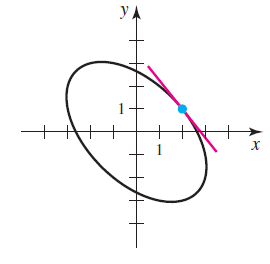
Carry out the following steps.a. Verify that the given point lies on the curve.b. Determine an equation of the line tangent to the curve at the given point.x2 + xy + y2 = 7; (2, 1) УА х
A 12-foot ladder is leaning against a vertical wall when Jack begins pulling the foot of the ladder away from the wall at a rate of 0.2 ft/s. What is the configuration of the ladder at the instant that the vertical speed of the top of the ladder equals the horizontal speed of the foot of the ladder?
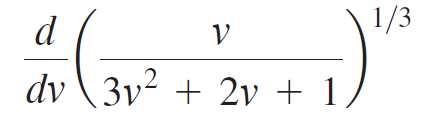
Evaluate and simplify the following derivatives. 1/3 ν dν , 3ν + 2v + 1
Evaluate the derivatives of the following functions.f(w) = sin (sec-1 2w)
Find the derivatives of the following functions.y = 53t
Use implicit differentiation to find dy/dx.√x + y2 = sin y
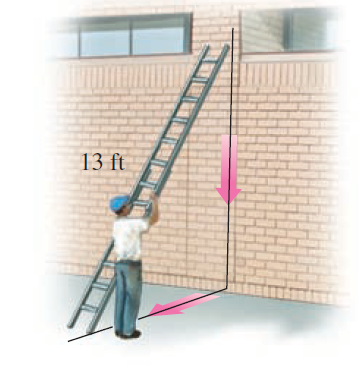
A 13-foot ladder is leaning against a vertical wall (see figure) when Jack begins pulling the foot of the ladder away from the wall at a rate of 0.5 ft/s. How fast is the top of the ladder sliding down the wall when the foot of the ladder is 5 ft from the wall? 13 ft
Evaluate and simplify the following derivatives.d/dθ (tan (sin θ))
Evaluate the derivatives of the following functions.f(y) = cot-1 (1/(y2 + 1))
Suppose f is a one-to-one function with f(2) = 8 and f'(2) = 4. What is the value of (f -1)'(8)?
How are the derivatives of sin-1 x and cos-1 x related?
What is the slope of the line tangent to the graph of y = tan-1 x at x = -2?
What is the slope of the line tangent to the graph of y = sin-1 x at x = 0?
State the derivative formulas for sin-1 x, tan-1 x, and sec-1 x.
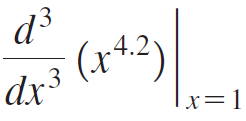
Find the following higher-order derivatives. q3 4.2 (x42) dx3
A rope is attached to the bottom of a hot-air balloon that is floating above a flat field. If the angle of the rope to the ground remains 65° and the rope is pulled in at 5 ft/s, how quickly is the elevation of the balloon changing?
Find the derivative of the inverse sine function using Theorem 3.23.
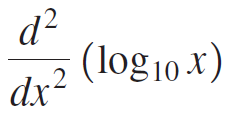
Find the following higher-order derivatives. d? (log 10 x) .2
Water flows into a conical tank at a rate of 2 ft3/min. If the radius of the top of the tank is 4 ft and the height is 6 ft, determine how quickly the water level is rising when the water is 2 ft deep in the tank.
Find the derivative of the inverse cosine function in the following two ways.a. Using Theorem 3.23b. Using the identity sin-1 x + cos-1 x = π/2
Find the following higher-order derivatives.dn/dxn (2x)
Find d2y/dx2 for the following functions.y = sin x2
Find d2y/dx2 for the following functions.y = √x2 + 2
A jet flies horizontally 500 ft directly above a spectator at an air show at 450 mi/hr. How quickly is the angle of elevation (between the ground and the line from the spectator to the jet) changing 2 seconds later?
Use a trigonometric identity to show that the derivatives of the inverse cotangent and inverse cosecant differ from the derivatives of the inverse tangent and inverse secant, respectively, by a multiplicative factor of -1.
Find the following higher-order derivatives.d3/dx3 (x2 ln x)
Find d2y/dx2 for the following functions.y = e-2x2
A man whose eye level is 6 ft above the ground walks toward a billboard at a rate of 2 ft/s. The bottom of the billboard is 10 ft above the ground, and it is 15 ft high. The man’s viewing angle is the angle formed by the lines between the man’s eyes and the top and bottom of the billboard. At
Suppose y = L(x) = ax + b (with a ≠ 0) is the equation of the line tangent to the graph of a one-to-one function f at (x0, y0). Also, suppose that y = M(x) = cx + d is the equation of the line tangent to the graph of f-1 at (y0, x0).a. Express a and b in terms of x0 and y0.b. Express c in terms
Calculate the derivative of the following functions(i) Using the fact that bx = ex ln b.(ii) By using logarithmic differentiation. Verify that both answers are the same.y = (x2 + 1)x
a. Calculate d/dx(x2 + x)2 using the Chain Rule. Simplify your answer.b. Expand (x2 + x)2 first and then calculate the derivative. Verify that your answer agrees with part (a).
Prove the following identities and give the values of x for which they are true.cos (sin-1 x) = √1 - x2
The output of an economic system Q, subject to two inputs, such as labor L and capital K, is often modeled by the Cobb-Douglas production function Q = cLaKb. When a + b = 1, the case is called constant returns to scale. Suppose Q = 1280, a = 1/3, b =2/3, and c = 40.a. Find the rate of change of
Find the derivative of the following functions.y = √f(x), where f is differentiable and non negative at x.
Prove the following identities and give the values of x for which they are true.cos (2 sin-1 x) = 1 - 2x2
The lateral surface area of a cone of radius r and height h (the surface area excluding the base) is A = πr√r2 + h2.a. Find dr/dh for a cone with a lateral surface area of A = 1500π.b. Evaluate this derivative when r = 30 and h = 40.
Find the derivative of the following functions.y = √f(x)g(x), where f and g are differentiable and non negative at x.
Give an example in which one dimension of a geometric figure changes and produces a corresponding change in the area or volume of the figure.
Find dy/dx, where(x2 + y2)(x2 + y2 + x) = 8xy2.
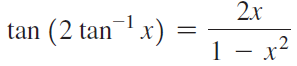
Prove the following identities and give the values of x for which they are true. 2x tan (2 tanx) 2
Imagine slicing through a sphere with a plane (sheet of paper). The smaller piece produced is called a spherical cap. Its volume is V = πh2 (3r - h)/3, where r is the radius of the sphere and h is the thickness of the cap. a. Find dr/dh for a sphere with a volume of 5π/3.b. Evaluate
Use the properties of logarithms to simplify the following functions before computing f'(x).f(x) = ln (3x + 1)4
Determine an equation of the line tangent to the graph of y = (x2 - 1)2 / x3 - 6x - 1 at the point (3, 8). Graph the function and the tangent line.
Prove the following identities and give the values of x for which they are true.sin (2 sin-1 x) = 2x√1 - x2
The volume of a torus (doughnut or bagel) with an inner radius of a and an outer radius of b is V = π2 (b + a)(b - a)2/4.a. Find db>da for a torus with a volume of 64π2.b. Evaluate this derivative when a = 6 and b = 10.
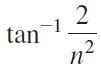
a. Use derivatives to show thatanddiffer by a constant.b. Prove that 2 -1 tan n° tan (n – 1) (n + 1) – tan
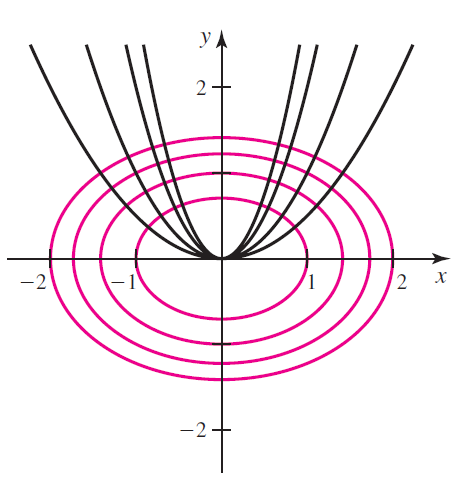
Two curves are orthogonal to each other if their tangent lines are perpendicular at each point of intersection (recall that two lines are perpendicular to each other if their slopes are negative reciprocals). A family of curves forms orthogonal trajectories with another family of curves if each
Use the properties of logarithms to simplify the following functions before computing f'(x).f(x) = ln √10x
Assume f and g are differentiable on their domains with h(x) = f(g(x)). Suppose the equation of the line tangent to the graph of g at the point (4, 7) is y = 3x - 5 and the equation of the line tangent to the graph of f at (7, 9) is y = -2x + 23.a. Calculate h(4) and h'(4).b. Determine an equation
Two curves are orthogonal to each other if their tangent lines are perpendicular at each point of intersection (recall that two lines are perpendicular to each other if their slopes are negative reciprocals). A family of curves forms orthogonal trajectories with another family of curves if each
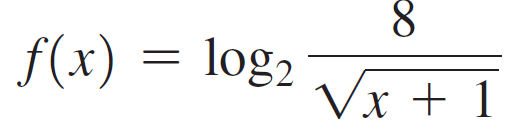
Use the properties of logarithms to simplify the following functions before computing f'(x). 8. f(x) = log2 Vx + 1
Assume f is a differentiable function whose graph passes through the point (1, 4). Suppose g(x) = f(x2) and the line tangent to the graph of f at (1, 4) is y = 3x + 1. Determine each of the following.a. g(1)b. g'(x)c. g'(1)d. An equation of the line tangent to the graph of g when x = 1
Two curves are orthogonal to each other if their tangent lines are perpendicular at each point of intersection (recall that two lines are perpendicular to each other if their slopes are negative reciprocals). A family of curves forms orthogonal trajectories with another family of curves if each
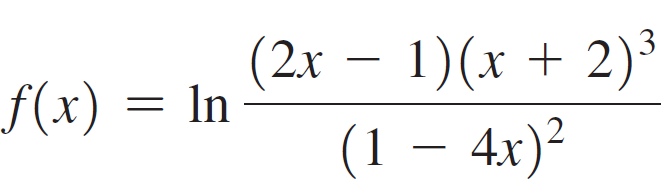
Use the properties of logarithms to simplify the following functions before computing f'(x). (2x – 1)(x + 2)³ In f(x) (1 – 4x)²
Find the equation of the line tangent to y = e2x at x = 1/2 ln 3. Graph the function and the tangent line.
Find the slope of the curve 5√x - 10√y = sin x at the point (4π, π ).
Use the properties of logarithms to simplify the following functions before computing f'(x).f(x) = ln (sec4 x tan2 x)
Suppose f is differentiable on [-2, 2] with f'(0) = 3 and f'(1) = 5. Let g(x) = f (sin x). Evaluate the following expressions.a. g'(0)b. g'(π/2)c. g'(π)
Find the equation of the line tangent to y = 2sin x at x = π/2. Graph the function and the tangent line.
The graph of y = cos x • ln cos2 x has seven horizontal tangent lines on the interval [0, 2π]. Find the approximate x-coordinates of all points at which these tangent lines occur.
Suppose an object of mass m is attached to the end of a spring hanging from the ceiling. The mass is at its equilibrium position y = 0 when the mass hangs at rest. Suppose you push the mass to a position y0 units above its equilibrium position and release it. As the mass oscillates up and down
Find d2y/dx2, where√y + xy = 1.
Compute the following derivatives. Use logarithmic differentiation where appropriate.d/dx (x10x)
Suppose an object of mass m is attached to the end of a spring hanging from the ceiling. The mass is at its equilibrium position y = 0 when the mass hangs at rest. Suppose you push the mass to a position y0 units above its equilibrium position and release it. As the mass oscillates up and down
Compute the following derivatives. Use logarithmic differentiation where appropriate.d/dx (2x)2x
Suppose an object of mass m is attached to the end of a spring hanging from the ceiling. The mass is at its equilibrium position y = 0 when the mass hangs at rest. Suppose you push the mass to a position y0 units above its equilibrium position and release it. As the mass oscillates up and down
Proceed with caution when using implicit differentiation to find points at which a curve has a specified slope. For the following curves, find the points on the curve (if they exist) at which the tangent line is horizontal or vertical. Once you have found possible points, make sure they actually
Compute the following derivatives. Use logarithmic differentiation where appropriate.d/dx (xcos x)
The displacement of a mass on a spring suspended from the ceiling is given by y = 10e-t/2 cos πt/8.a. Graph the displacement function.b. Compute and graph the velocity of the mass, v(t) = y'(t).c. Verify that the velocity is zero when the mass reaches the high and low points of its oscillation.
Proceed with caution when using implicit differentiation to find points at which a curve has a specified slope. For the following curves, find the points on the curve (if they exist) at which the tangent line is horizontal or vertical. Once you have found possible points, make sure they actually
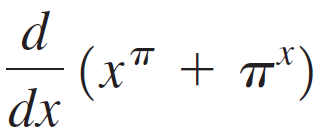
Compute the following derivatives. Use logarithmic differentiation where appropriate. (x" + T") dx
A mechanical oscillator (such as a mass on a spring or a pendulum) subject to frictional forces satisfies the equation (called a differential equation)y"(t) + 2y'(t) + 5y(t) = 0,where y is the displacement of the oscillator from its equilibrium position. Verify by substitution that the function
Proceed with caution when using implicit differentiation to find points at which a curve has a specified slope. For the following curves, find the points on the curve (if they exist) at which the tangent line is horizontal or vertical. Once you have found possible points, make sure they actually
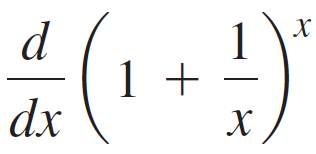
Compute the following derivatives. Use logarithmic differentiation where appropriate. d dx х
The number of hours of daylight at any point on Earth fluctuates throughout the year. In the northern hemisphere, the shortest day is on the winter solstice and the longest day is on the summer solstice. At 40° north latitude, the length of a day is approximated by
Compute the following derivatives. Use logarithmic differentiation where appropriate.d/dx (1 + x2)sin x
A 500-liter (L) tank is filled with pure water. At time t = 0, a salt solution begins flowing into the tank at a rate of 5 L/min. At the same time, the (fully mixed) solution flows out of the tank at a rate of 5.5 L/min. The mass of salt in grams in the tank at any time t ≥ 0 is given byM(t) =
Compute the following derivatives. Use logarithmic differentiation where appropriate.d/dx (x(x10))
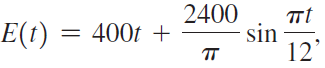
The total energy in megawatt-hr (MWh) used by a town is given bywhere t ≥ 0 is measured in hours, with t = 0 corresponding to noon.a. Find the power, or rate of energy consumption, P(t) = E'(t) in units of megawatts (MW).b. At what time of day is the rate of energy consumption a maximum? What is
Compute the following derivatives. Use logarithmic differentiation where appropriate.d/dx (ln x)x2
a. Differentiate both sides of the identity cos 2t = cos2 t - sin2 t to prove that sin 2t = 2 sin t cos t.b. Verify that you obtain the same identity for sin 2t as in part (a) if you differentiate the identity cos 2t = 2 cos2 t - 1.c. Differentiate both sides of the identity sin 2t = 2 sin t
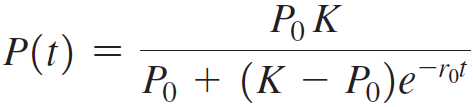
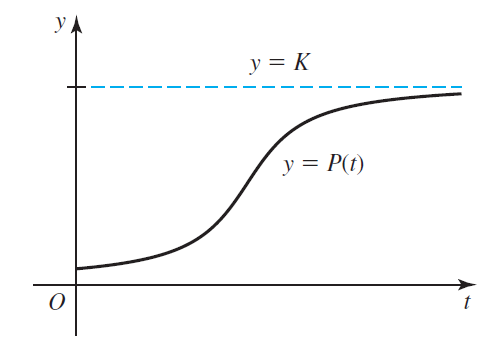
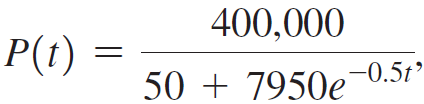
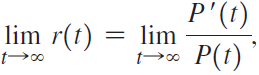
Scientists often use the logistic growth functionto model population growth, where P0 is the initial population at time t = 0, K is the carrying capacity, and r0 is the base growth rate. The carrying capacity is a theoretical upper bound on the total population that the surrounding environment can
Let f(x) = cos2 x + sin2 x.a. Use the Chain Rule to show that f'(x) = 0.b. Assume that if f' = 0, then f is a constant function. Calculate f(0) and use it with part (a) to explain why cos2 x + sin2 x = 1.
Scientists often use the logistic growth functionto model population growth, where P0 is the initial population at time t = 0, K is the carrying capacity, and r0 is the base growth rate. The carrying capacity is a theoretical upper bound on the total population that the surrounding environment can
a. Identify the inner function g and the outer function f for the composition f(g(x)) = ekx, where k is a real number.b. Use the Chain Rule to show that d/dx (ekx) = kekx.
Scientists often use the logistic growth functionto model population growth, where P0 is the initial population at time t = 0, K is the carrying capacity, and r0 is the base growth rate. The carrying capacity is a theoretical upper bound on the total population that the surrounding environment can
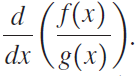
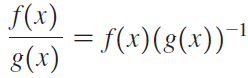
Suppose you forgot the Quotient Rule for calculatingUse the Chain Rule and Product Rule with the identityto derive the Quotient Rule. d (f(x) dx \g(x) 8(x), |f(x) = f(x)(8(x))| g(x)
Scientists often use the logistic growth functionto model population growth, where P0 is the initial population at time t = 0, K is the carrying capacity, and r0 is the base growth rate. The carrying capacity is a theoretical upper bound on the total population that the surrounding environment can
a. Derive a formula for the second derivative, d2/dx2 (f(g(x))).b. Use the formula in part (a) to calculate d2/dx2 (sin (3x4 + 5x2 + 2)).
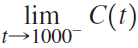
Beginning at age 30, a self-employed plumber saves $250 per month in a retirement account until he reaches age 65. The account offers 6% interest, compounded monthly. The balance in the account after t years is given by A(t) = 50,000 (1.00512t - 1).a. Compute the balance in the account after 5, 15,
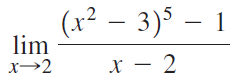
The following limits are the derivatives of composite function g at a point a.a. Find a possible function g and number a.b. Use the Chain Rule to find each limit. Verify your answer using a (x² – 3)5 – 1 lim
It is easily verified that the graphs of y = x2 and y = ex have no points of intersection (for x > 0), and the graphs of y = x3 and y = ex have two points of intersection. It follows that for some real number 2 < p < 3, the graphs of y = xp and y = ex have exactly one point of intersection
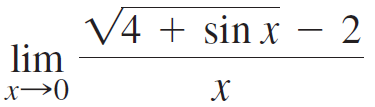
The following limits are the derivatives of composite function g at a point a.a. Find a possible function g and number a.b. Use the Chain Rule to find each limit. Verify your answer using a V4 + sin x – 2 lim х>0 х
It is easily verified that the graphs of y = 1.1x and y = x have two points of intersection, and the graphs of y = 2x and y = x have no points of intersection. It follows that for some real number 1 < p < 2, the graphs of y = px and y = x have exactly one point of intersection. Using
The following limits are the derivatives of composite function g at a point a.a. Find a possible function g and number a.b. Use the Chain Rule to find each limit. Verify your answer using a sin (7/2 + h)? – sin (7/4) lim TT
Graph the functions f(x) = x3, g(x) = 3x, and h(x) = xx and find their common intersection point (exactly).
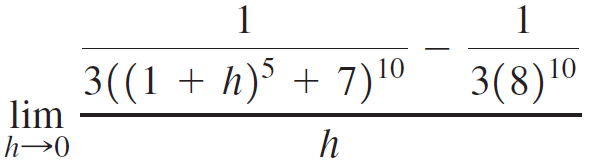
The following limits are the derivatives of composite function g at a point a.a. Find a possible function g and number a.b. Use the Chain Rule to find each limit. Verify your answer using a 1 3((1 + h) + 7)10 3(8)10 lim
Showing 5200 - 5300
of 6775
First
46
47
48
49
50
51
52
53
54
55
56
57
58
59
60
Last
Step by Step Answers

 Get 50% OFF
Claim Now
Get 50% OFF
Claim Now