New Semester
Started
Get
50% OFF
Study Help!
--h --m --s
Claim Now
Question Answers
Textbooks
Find textbooks, questions and answers
Oops, something went wrong!
Change your search query and then try again
S
Books
FREE
Study Help
Expert Questions
Accounting
General Management
Mathematics
Finance
Organizational Behaviour
Law
Physics
Operating System
Management Leadership
Sociology
Programming
Marketing
Database
Computer Network
Economics
Textbooks Solutions
Accounting
Managerial Accounting
Management Leadership
Cost Accounting
Statistics
Business Law
Corporate Finance
Finance
Economics
Auditing
Tutors
Online Tutors
Find a Tutor
Hire a Tutor
Become a Tutor
AI Tutor
AI Study Planner
NEW
Sell Books
Search
Search
Sign In
Register
study help
mathematics
calculus early transcendentals
Calculus Early Transcendentals 2nd edition William L. Briggs, Lyle Cochran, Bernard Gillett - Solutions
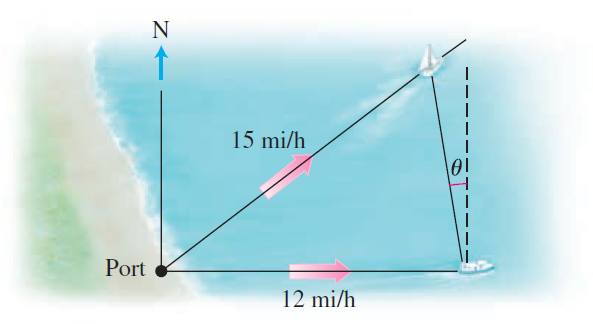
A boat leaves a port traveling due east at 12 mi/hr. At the same time, another boat leaves the same port traveling northeast at 15 mi/hr. The angle θ of the line between the boats is measured relative to due north (see figure). What is the rate of change of this angle 30 min after the boats leave
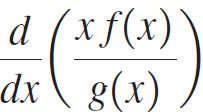
Evaluate the following derivatives. Express your answers in terms of f, g, f', and g'. d (xf(x) dx\ g(x)
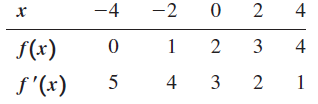
Use the following tables to determine the indicated derivatives or state that the derivative cannot be determined.a. f'(f(0))b. (f-1)' (0)c. (f-1)' (1)d. (f-1)' (f(4)) -4 -2 х 3 f(x) 4 1 f '(x) 5 4 3 2 2I 3. 2.
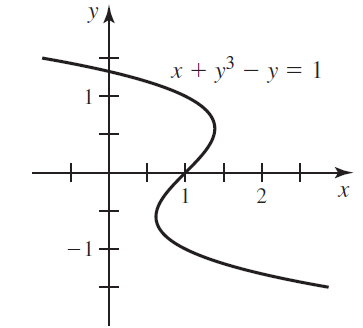
Complete the following steps.a. Find equations of all lines tangent to the curve at the given value of x.b. Graph the tangent lines on the given graph.x + y3 - y = 1; x = 1 y х + уз — у%3D1 х
Determine whether the graph of y = x√x has any horizontal tangent lines.
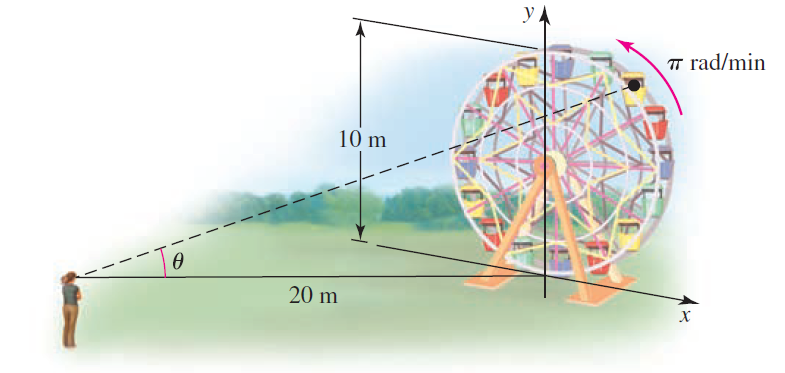
An observer stands 20 m from the bottom of a 10-m-tall Ferris wheel on a line that is perpendicular to the face of the Ferris wheel. The wheel revolves at a rate of π rad/min, and the observer’s line of sight with a specific seat on the wheel makes an angle θ with the ground (see figure). Forty
Evaluate the following derivatives. Express your answers in terms of f, g, f', and g'.d/dx f(√g(x)), g(x) ≥ 0
Determine whether the following statements are true and give an explanation or counterexample.a. d/dx (sin-1 x + cos-1 x) = 0.b. d/dx (tan-1 x) = sec2 x.c. The lines tangent to the graph of y = sin-1 x on the interval [-1, 1] have a minimum slope of 1.d. The lines tangent to the graph of y = sin x
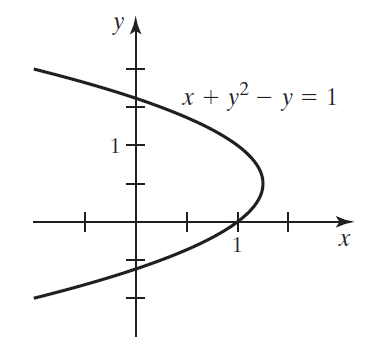
Complete the following steps.a. Find equations of all lines tangent to the curve at the given value of x.b. Graph the tangent lines on the given graph.x + y2 - y = 1; x = 1 УА y у? — У3D1 х + х
The graph of y = (x2)x has two horizontal tangent lines. Find equations for both of them.
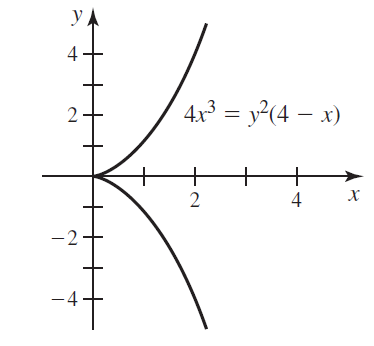
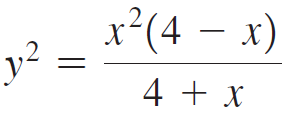
Complete the following steps.a. Find equations of all lines tangent to the curve at the given value of x.b. Graph the tangent lines on the given graph.4x3 = y2 (4 - x); x = 2 (cissoid of Diocles) УА 4x3 = y?(4 – x) 2 х -2
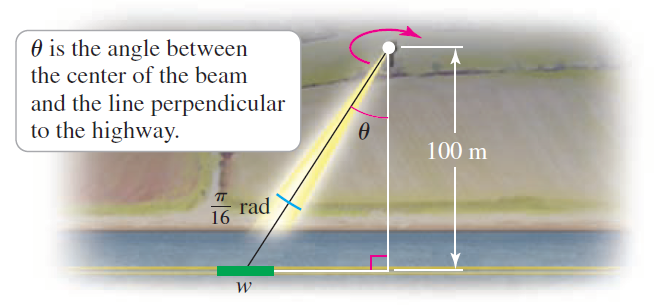
A revolving searchlight, which is 100 m from the nearest point on a straight highway, casts a horizontal beam along a highway (see figure). The beam leaves the spotlight at an angle of π/16 rad and revolves at a rate of π/6 rad/s. Let w be the width of the beam as it sweeps along the highway and
The graph of y = xln x has one horizontal tangent line. Find an equation for it.
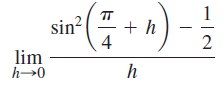
The following limits represent the derivative of a function f at a point a. Find a possible f and a, and then evaluate the limit. т sin? 4 lim
a. Graph f with a graphing utility.b. Compute and graph f'.c. Verify that the zeros of f' correspond to points at which f has a horizontal tangent line.f(x) = (x2 - 1) sin-1 x on [-1, 1]
Calculate the derivative of the following functions.y = 4 log3 (x2 - 1)
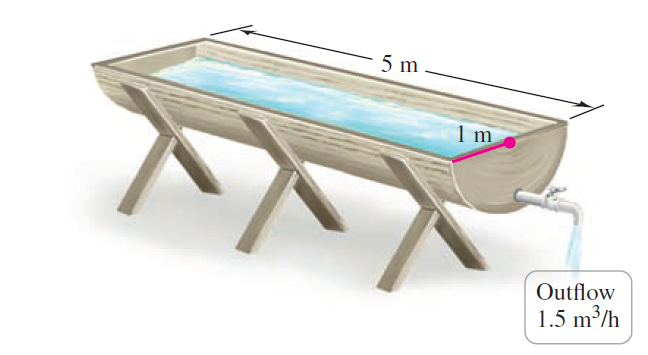
A trough in the shape of a half cylinder has length 5 m and radius 1 m. The trough is full of water when a valve is opened, and water flows out of the bottom of the trough at a rate of 1.5 m3/hr (see figure). The area of a sector of a circle of a radius r subtended by an angle θ is r2 θ/2.)a. How
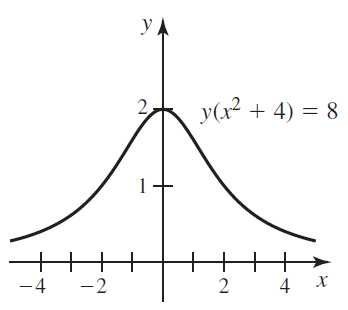
Let y (x2 + 4) = 8a. Use implicit differentiation to find dy/dx.b. Find equations of all lines tangent to the curve y(x2 + 4) = 8 when y = 1.c. Solve the equation y(x2 + 4) = 8 for y to find an explicit expression for y and then calculate dy/dx.d. Verify that the results of parts (a) and (c) are
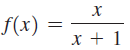
Consider the following functions. In each case, without finding the inverse, evaluate the derivative of the inverse at the given point.f(x) = 1/(x + 1) at f(0)
a. Determine the points at which the curve x + y3 - y = 1 has a vertical tangent line (see Exercise 52).b. Does the curve have any horizontal tangent lines? ExplainData from Exercise 52Complete the following steps.x + y3 - y = 1; x = 1 y х + уз — у%3D1 х
a. Graph f with a graphing utility.b. Compute and graph f'.c. Verify that the zeros of f' correspond to points at which f has a horizontal tangent line.f(x) = (sec-1 x)/x on [1, ∞)
Calculate the derivative of the following functions.y = log10 x
Two boats leave a port at the same time, one traveling west at 20 mi/hr and the other traveling southwest at 15 mi/hr. At what rate is the distance between them changing 30 min after they leave the port?
Consider the following functions. In each case, without finding the inverse, evaluate the derivative of the inverse at the given point.y = √x3 + x - 1 at y = 3
a. Determine the points where the curve x + y2 - y = 1 has a vertical tangent line (see Exercise 53).b. Does the curve have any horizontal tangent lines? Explain.Data from Exercise 53Complete the following steps.x + y2 - y = 1; x = 1 УА y у? — У3D1 х + х
a. Graph f with a graphing utility.b. Compute and graph f'.c. Verify that the zeros of f' correspond to points at which f has a horizontal tangent line.f(x) = e-x tan-1 x on [0, ∞]
Calculate the derivative of the following functions.y = cos x ln (cos2 x)
Find the derivative of the inverse of the following functions. Express the result with x as the independent variable.f(x) = 12x - 16
Find the equations of the vertical and horizontal tangent lines of the following ellipses.x2 + 4y2 + 2xy = 12
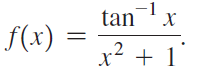
a. Graph the function b. Compute and graph f' and determine (perhaps approximately) the points at which f'(x) = 0.c. Verify that the zeros of f' correspond to points at which f has a horizontal tangent line. tanx f(x) : x² + 1 .2
Find the derivative of the inverse of the following functions. Express the result with x as the independent variable.f(x) = x-1/3
Find the equations of the vertical and horizontal tangent lines of the following ellipses.9x2 + y2 - 36x + 6y + 36 = 0
Consider the following functions (on the given interval, if specified). Find the inverse function, express it as a function of x, and find the derivative of the inverse function.f(x) = 3x - 4
Calculate the derivative of the following functions.y = 1/log4 x
The functionis one-to-one for x > -1 and has an inverse on that interval.a. Graph f, for x > -1.b. Find the inverse function f-1 corresponding to the function graphed in part (a). Graph f-1 on the same set of axes as in part (a).c. Evaluate the derivative of f-1 at the point (1/2, 1).d.
The following equations implicitly define one or more functions.a. Find dy/dx using implicit differentiation.b. Solve the given equation for y to identify the implicitly defined functions y = f1(x), y = f2(x), . . . .c. Use the functions found in part (b) to graph the given equation.y3 = ax2
Consider the following functions (on the given interval, if specified). Find the inverse function, express it as a function of x, and find the derivative of the inverse function.f(x) = |x + 2|, for x ≤ -2
Calculate the derivative of the following functions.y = log2 (log2 x)
Let f(x) = sin x, f-1 (x) = sin-1 x, and (x0, y0) = (π/4, 1/√2).a. Evaluate (f-1)'(1/√2) using Theorem 3.23.b. Evaluate (f-1)'(1/√2z) directly by differentiating f-1. Check for agreement with part (a).
The following equations implicitly define one or more functions.a. Find dy/dx using implicit differentiation.b. Solve the given equation for y to identify the implicitly defined functions y = f1(x), y = f2(x), . . . .c. Use the functions found in part (b) to graph the given equation.x + y3 - xy = 1
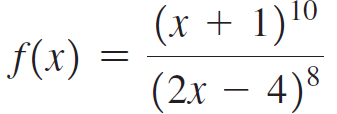
Use logarithmic differentiation to evaluate f'(x). (x + 1)10 (2x – 4)³ f(x)
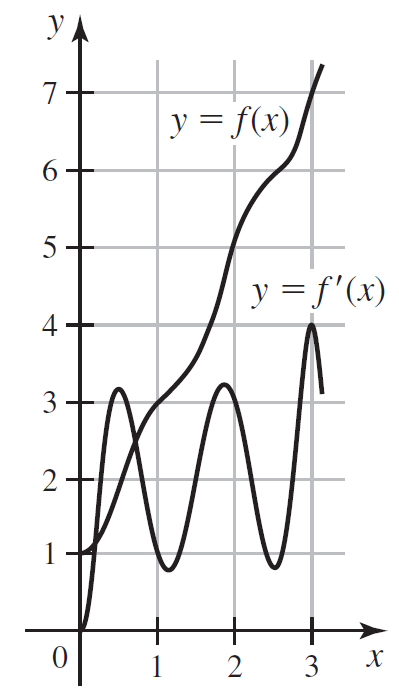
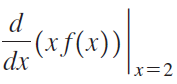
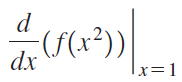
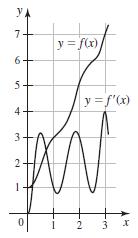
If possible, evaluate the following derivatives using the graphs of f and f'.a. b. c. УА y = f(x) 6. y = f'(x) 4 2 1 х 2 1 3. 3. :(xf(x)) dx |x=2
The following equations implicitly define one or more functions.a. Find dy/dx using implicit differentiation.b. Solve the given equation for y to identify the implicitly defined functions y = f1(x), y = f2(x), . . . .c. Use the functions found in part (b) to graph the given equation.(right
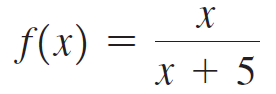
Consider the following functions (on the given interval, if specified). Find the inverse function, express it as a function of x, and find the derivative of the inverse function. х f(x) х+5
Use logarithmic differentiation to evaluate f'(x).f(x) = x2 cos x
The following equations implicitly define one or more functions.a. Find dy/dx using implicit differentiation.b. Solve the given equation for y to identify the implicitly defined functions y = f1(x), y = f2(x), . . . .c. Use the functions found in part (b) to graph the given equation.x4 = 2(x2 - y2)
If possible, evaluate the following derivatives using the graphs of f and f'.a. (f-1)'(7)b. (f-1)'(3)c. (f-1)'(f(2)) yA 7 y = fcr) 5 y =f'(x) 4 3- 2- 2 3 x す
Use logarithmic differentiation to evaluate f'(x).f(x) = xln x
The following equations implicitly define one or more functions.a. Find dy/dx using implicit differentiation.b. Solve the given equation for y to identify the implicitly defined functions y = f1(x), y = f2(x), . . . .c. Use the functions found in part (b) to graph the given equation.y2(x + 2) =
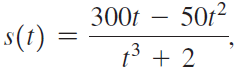
A small probe is launched vertically from the ground. After it reaches its high point, a parachute deploys and the probe descends to Earth. The height of the probe above the ground isfor 0 ≤ t ≤ 6.a. Graph the height function and describe the motion of the probe.b. Find the velocity of the
Consider the following functions (on the given interval, if specified). Find the inverse function, express it as a function of x, and find the derivative of the inverse function.f(x) = x2/3, for x > 0
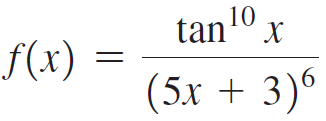
Use logarithmic differentiation to evaluate f'(x). tanº x f(х) (5х + 3)6
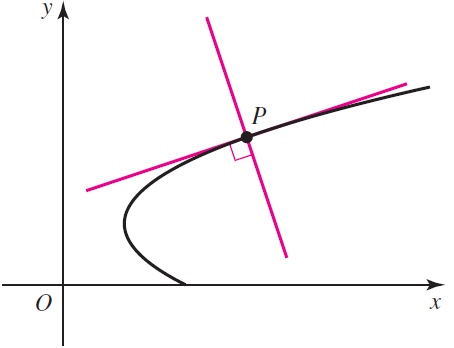
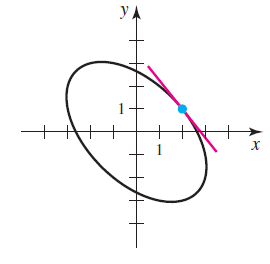
Normal lines A normal line at a point P on a curve passes through P and is perpendicular to the line tangent to the curve at P (see figure). Use the following equations and graphs to determine an equation of the normal line at the given point. Illustrate your work by graphing the curve with the
Suppose the cost of producing x lawn mowers is C(x) = -0.02x2 + 400x + 5000.a. Determine the average and marginal costs for x = 3000 lawn mowers.b. Interpret the meaning of your results in part (a).
Iodine-123 is a radioactive isotope used in medicine to test the function of the thyroid gland. If a 350 - microcurie (µCi) dose of iodine-123 is administered to a patient, the quantity Q left in the body after t hours is approximately Q = 350(1/2)t/13.1.a. How long does it take for the level of
Find the derivatives of the following functions.y = 8x
Second derivatives Find d2y / dx2.e2y + x = y
Use implicit differentiation to find dy/dx.√x4 + y2 = 5x + 2y3
Two boats leave a port at the same time; one travels west at 20 mi/hr and the other travels south at 15 mi/hr. At what rate is the distance between them changing 30 minutes after they leave the port?
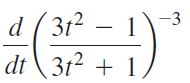
Evaluate and simplify the following derivatives. d (312 - 1 dt \ 3t² + 1 -3
Evaluate the derivatives of the following functions.f(t) = ln (tan-1 t)
Find the following derivatives.d/dx (ln (ex + e-x))
Use implicit differentiation to find dy/dx.sin x cos y = sin x + cos y
A surface ship is moving (horizontally) in a straight line at 10 km/hr. At the same time, an enemy submarine maintains a position directly below the ship while diving at an angle that is 20° below the horizontal. How fast is the submarine’s altitude decreasing?
Evaluate the derivatives of the following functions.f(u) = csc-1 (2u + 1)
Use implicit differentiation to find dy/dx.6x3 + 7y3 = 13xy
A jet ascends at a 10° angle from the horizontal with an airspeed of 550 mi/hr (its speed along its line of flight is 550 mi/hr). How fast is the altitude of the jet increasing? If the sun is directly overhead, how fast is the shadow of the jet moving on the ground?
Evaluate the derivatives of the following functions.f(t) = (cos-1 t)2
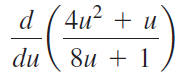
Evaluate and simplify the following derivatives. 4u? + и 8и + 1 du
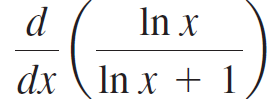
Find the following derivatives. d In x dx In x + 1
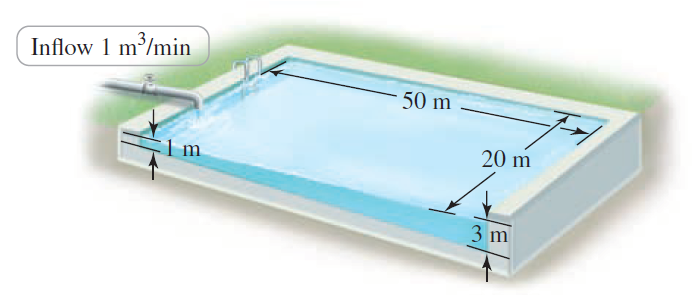
A swimming pool is 50 m long and 20 m wide. Its depth decreases linearly along the length from 3 m to 1 m (see figure). It is initially empty and is filled at a rate of 1 m3/min. How fast is the water level rising 250 min after the filling begins? How long will it take to fill the pool? Inflow 1
Use implicit differentiation to find dy/dx.(xy + 1)3 = x - y2 + 8
Evaluate and simplify the following derivatives.d/dx (csc5 3x)
Find the following derivatives.d/dx (ln (cos2 x))
Evaluate the derivatives of the following functions.f(x) = cos-1 (1/x)
Find the following derivatives.d/dx (ln (ln x))
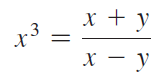
Use implicit differentiation to find dy/dx. x + y +3 х
A rectangle initially has dimensions 2 cm by 4 cm. All sides begin increasing in length at a rate of 1 cm/s. At what rate is the area of the rectangle increasing after 20 s?
Evaluate the derivatives of the following functions.f(x) = sec-1 √x
Evaluate and simplify the following derivatives.d/dx (5x + sin3 x + sin x3)
Find the following derivatives.d/dx (ln |x2 - 1|)
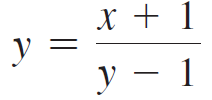
Use implicit differentiation to find dy/dx. х+1 У y – 1
A bug is moving along the parabola y = x2. At what point on the parabola are the x- and y-coordinates changing at the same rate?
Evaluate the derivatives of the following functions.f(z) = cot-1 √z
Evaluate and simplify the following derivatives.d/dt (5t2 sin t)
Find the following derivatives.d/dx ((x2 + 1) ln x)
Use implicit differentiation to find dy/dx.cos y2 + x = ey
A bug is moving along the right side of the parabola y = x2 at a rate such that its distance from the origin is increasing at 1 cm/ min. At what rates are the x- and y-coordinates of the bug increasing when the bug is at the point (2, 4)?
Evaluate the derivatives of the following functions.g(z) = tan-1 (1/z)
Evaluate and simplify the following derivatives.d/dx (2x√x2 - 2x + 2)
Find the following derivatives.d/dx (ex ln x)
Use implicit differentiation to find dy/dx.x + 2y = √y
A spherical snowball melts at a rate proportional to its surface area. Show that the rate of change of the radius is constant. Surface area = 4πr2.
Evaluate the derivatives of the following functions.f(y) = tan-1 (2y2 - 4)
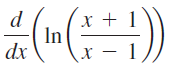
Find the following derivatives. In |dx
Use implicit differentiation to find dy/dx.x + y = cos y
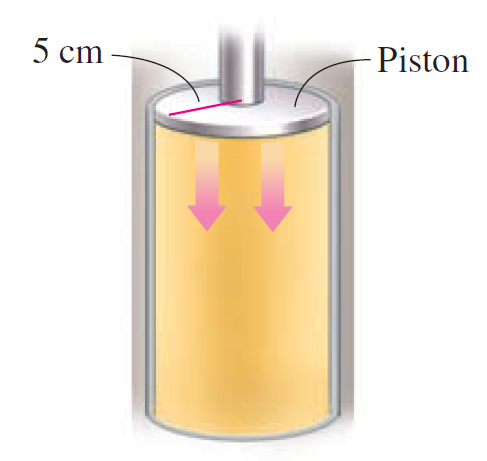
A piston is seated at the top of a cylindrical chamber with radius 5 cm when it starts moving into the chamber at a constant speed of 3 cm/s (see figure). What is the rate of change of the volume of the cylinder when the piston is 2 cm from the base of the chamber? 5 cm Piston
Evaluate the derivatives of the following functions.f(x) = x cot-1 (x/3)
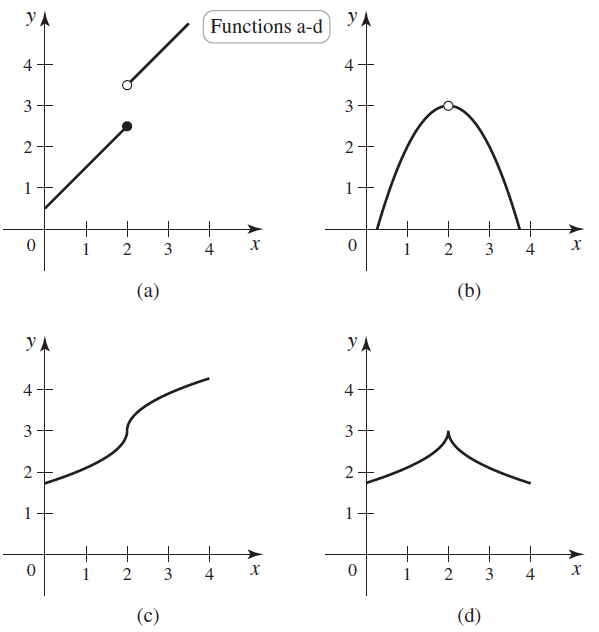
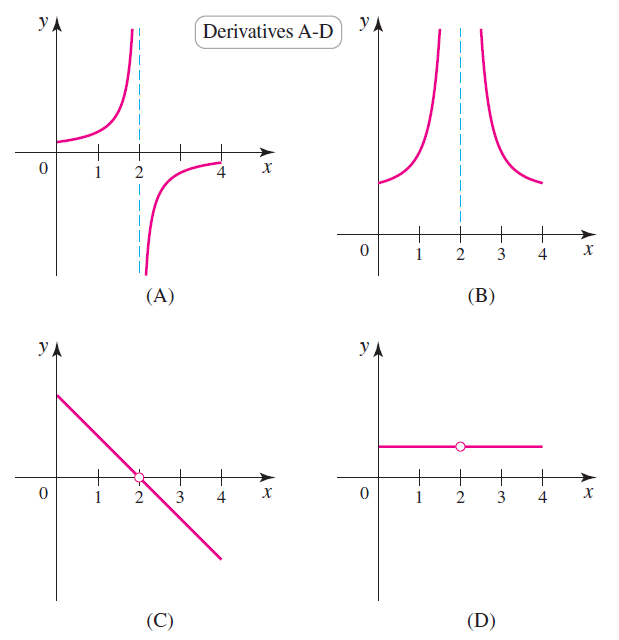
Match the functions in a–d with the derivatives in A–D. Ул Functions a-d 4 4- 3 3 - х х 4 3 4 (a) (b) УА 4 3 3 2 1 + + + х х 1 4 2 3 4 (d) (c) 2. 2. 3. 3. 2. 4. y Derivatives A-D Ул 1 х 3 4 (A) (B) УА УА 1 3 4 х х (C) (D) 4. 3. 2. 2.
Find the following derivatives.d/dx (ln x2/x)
Showing 5000 - 5100
of 6775
First
44
45
46
47
48
49
50
51
52
53
54
55
56
57
58
Last
Step by Step Answers

 Get 50% OFF
Claim Now
Get 50% OFF
Claim Now