New Semester
Started
Get
50% OFF
Study Help!
--h --m --s
Claim Now
Question Answers
Textbooks
Find textbooks, questions and answers
Oops, something went wrong!
Change your search query and then try again
S
Books
FREE
Study Help
Expert Questions
Accounting
General Management
Mathematics
Finance
Organizational Behaviour
Law
Physics
Operating System
Management Leadership
Sociology
Programming
Marketing
Database
Computer Network
Economics
Textbooks Solutions
Accounting
Managerial Accounting
Management Leadership
Cost Accounting
Statistics
Business Law
Corporate Finance
Finance
Economics
Auditing
Tutors
Online Tutors
Find a Tutor
Hire a Tutor
Become a Tutor
AI Tutor
AI Study Planner
NEW
Sell Books
Search
Search
Sign In
Register
study help
mathematics
calculus early transcendentals
Calculus Early Transcendentals 2nd edition William L. Briggs, Lyle Cochran, Bernard Gillett - Solutions
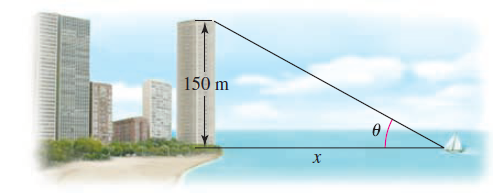
A boat sails directly toward a 150-meter skyscraper that stands on the edge of a harbor. The angular size θ of the building is the angle formed by lines from the top and bottom of the building to the observer (see figure below). a. What is the rate of change of the angular size dθ/dx when
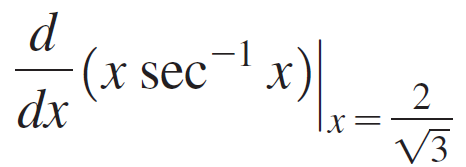
Evaluate and simplify the following derivatives. d (x sec dx х х — V3
Use the General Power Rule where appropriate to find the derivative of the following functions.f(x) = 2x√2
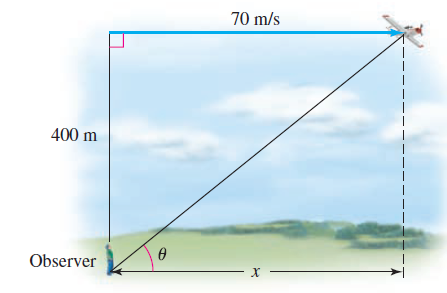
A small plane, moving at 70 m/s, flies horizontally on a line 400 meters directly above an observer. Let θ be the angle of elevation of the plane (see figure below).a. What is the rate of change of the angle of elevation dθ/dx when the plane is x = 500 m past the observer?b. Graph dθ/dx as a
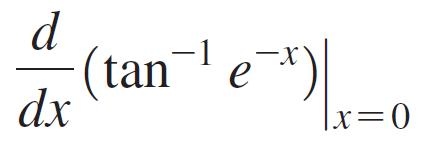
Evaluate and simplify the following derivatives. d (tan-l e *) dx |x=0
An angler hooks a trout and begins turning her circular reel at 1.5 rev/s. If the radius of the reel (and the fishing line on it) is 2 in, how fast is she reeling in her fishing line?
Find dy / dxy = (5x + 1)2/3
Find (f -1)'(3) if f(x) = x3 + x + 1.
Find y', y", and y"' for the following functions.y = (x - 3) √x + 2
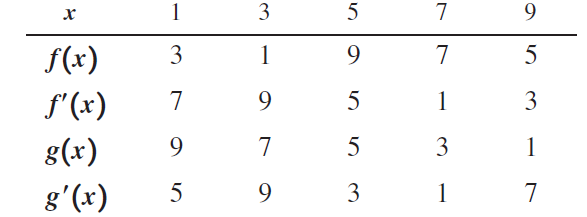
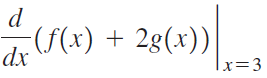
Find the values of the following derivatives using the table.a. b. c. d. e. (g-1)'(7) 3 5 9. 1 3 9. 5 f(x) 1 9. 5 3 f'(x) 1 9. 3 g(x) 5 3 g'(x) (f(x) + 2g(x) dx x=3
a. Graph f with a graphing utility.b. Compute and graph f'.c. Verify that the zeros of f' correspond to points at which f has a horizontal tangent line.f(x) = (x - 1) sin-1 x on [-1, 1]
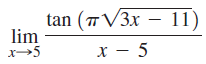
The following limits represent the derivative of a function f at a point a. Find a possible f and a, and then evaluate the limit. — 11) х — 5 tan (пVЗx lim x→5
Calculate the derivative of the following functions.y = log8 |tan x|
Consider the following functions (on the given interval, if specified). Find the inverse function, express it as a function of x, and find the derivative of the inverse function.f(x) = x2 - 4, for x > 0
Consider the following functions (on the given interval, if specified). Find the inverse function, express it as a function of x, and find the derivative of the inverse function.f(x) = √x + 2, for x ≥ -2
Consider the following functions (on the given interval, if specified). Find the inverse function, express it as a function of x, and find the derivative of the inverse function.f(x) = x-1/2, for x > 0
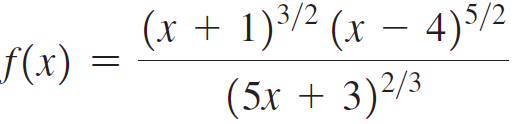
Use logarithmic differentiation to evaluate f'(x). (x + 1)/2 (x – 4)5/2 (5x + 3)2/3 f(x)
Suppose a company produces fly rods. Assume C(x) = -0.0001x3 + 0.05x2 + 60x + 800 represents the cost of making x fly rods.a. Determine the average and marginal costs for x = 400 fly rods.b. Interpret the meaning of your results in part (a).
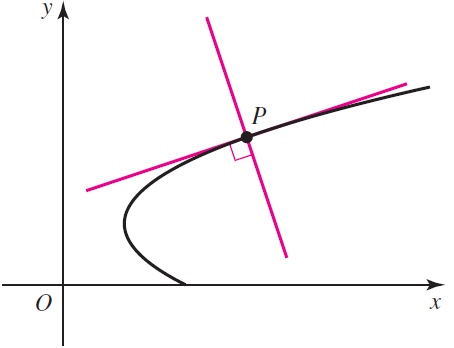
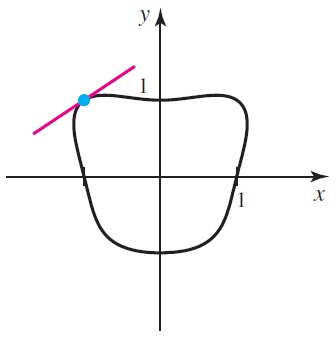
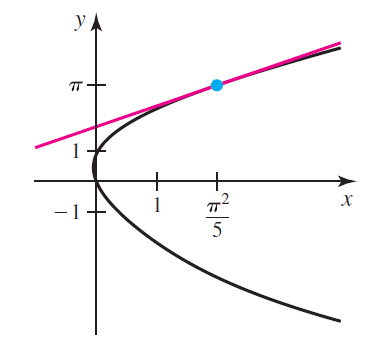
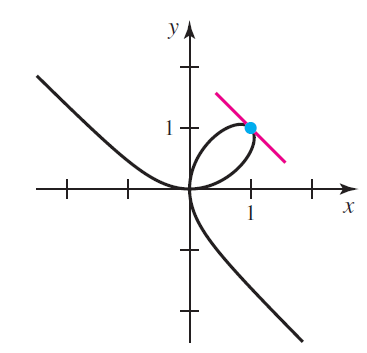
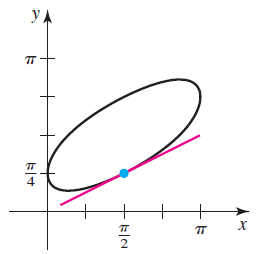
Normal lines A normal line at a point P on a curve passes through P and is perpendicular to the line tangent to the curve at P (see figure). Use the following equations and graphs to determine an equation of the normal line at the given point. Illustrate your work by graphing the curve with the
Consider the following functions (on the given interval, if specified). Find the inverse function, express it as a function of x, and find the derivative of the inverse function.f(x) = x3 + 3
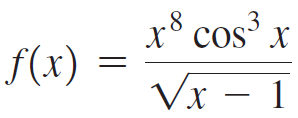
Use logarithmic differentiation to evaluate f'(x). x8 cos' x f(x) Vx – 1
Suppose p(t) = -1.7t3 + 72t2 + 7200t + 80,000 is the population of a city t years after 1950.a. Determine the average rate of growth of the city from 1950 to 2000.b. What was the rate of growth of the city in 1990?
Normal lines A normal line at a point P on a curve passes through P and is perpendicular to the line tangent to the curve at P (see figure). Use the following equations and graphs to determine an equation of the normal line at the given point. Illustrate your work by graphing the curve with the
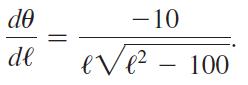
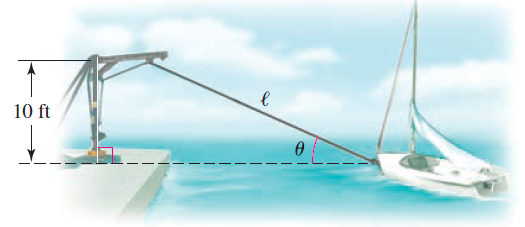
A boat is towed toward a dock by a cable attached to a winch that stands 10 feet above the water level (see figure). Let u be the angle of elevation of the winch and let ℓ be the length of the cable as the boat is towed toward the dock.a. Show that the rate of change of θ with respect to ℓ
Use logarithmic differentiation to evaluate f'(x).f(x) = (sin x) tan x
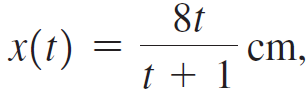
The distance between the head of a piston and the end of a cylindrical chamber is given by for t ≥ 0 (measured in seconds). The radius of the cylinder is 4 cm.a. Find the volume of the chamber, for t ≥ 0.b. Find the rate of change of the volume V'(t), for t ≥ 0.c. Graph the derivative of the
Normal lines A normal line at a point P on a curve passes through P and is perpendicular to the line tangent to the curve at P (see figure). Use the following equations and graphs to determine an equation of the normal line at the given point. Illustrate your work by graphing the curve with the
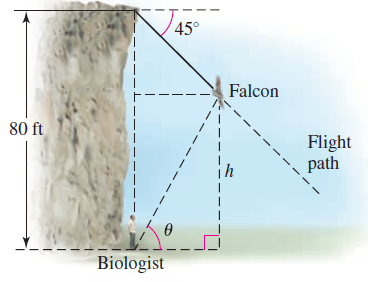
A biologist standing at the bottom of an 80-foot vertical cliff watches a peregrine falcon dive from the top of the cliff at a 45° angle from the horizontal (see figure). a. Express the angle of elevation θ from the biologist to the falcon as a function of the height h of the bird above the
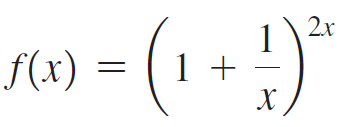
Use logarithmic differentiation to evaluate f'(x). 1«) = (1 + )*| 2x f(x)
Two boats leave a dock at the same time. One boat travels south at 30 mi/hr and the other travels east at 40 mi/hr. After half an hour, how fast is the distance between the boats increasing?
Normal lines A normal line at a point P on a curve passes through P and is perpendicular to the line tangent to the curve at P (see figure). Use the following equations and graphs to determine an equation of the normal line at the given point. Illustrate your work by graphing the curve with the
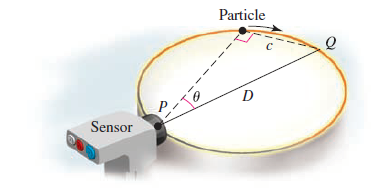
A particle travels clockwise on a circular path of diameter D, monitored by a sensor on the circle at point P; the other endpoint of the diameter on which the sensor lies is Q (see figure). Let θ be the angle between the diameter PQ and the line from the sensor to the particle. Let c be the length
A spherical balloon is inflated at a rate of 10 cm3/min. At what rate is the diameter of the balloon increasing when the balloon has a diameter of 5 cm?
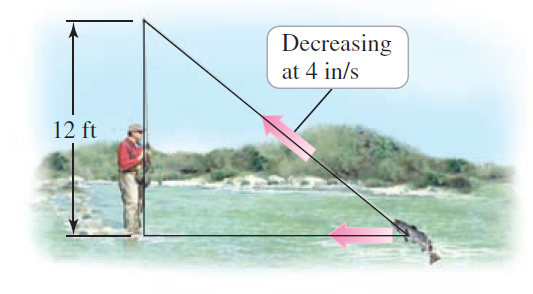
An angler hooks a trout and reels in his line at 4 in/s. Assume the tip of the fishing rod is 12 ft above the water and directly above the angler, and the fish is pulled horizontally directly toward the angler (see figure). Find the horizontal speed of the fish when it is 20 ft from the angler.
Find dy / dxy = 3√x2 - x + 1
Use the General Power Rule where appropriate to find the derivative of the following functions.s(t) = cos 2t
Find the derivative of the inverse of the following functions at the specified point on the graph of the inverse function. You do not need to find f-1.f(x) = 1/2 x + 8; (10, 4)
Once Kate’s kite reaches a height of 50 ft (above her hands), it rises no higher but drifts due east in a wind blowing 5 ft/s. How fast is the string running through Kate’s hands at the moment that she has released 120 ft of string?
Calculate y'(x) for the following relations.sin x cos (y - 1) = 1/2
Find the derivative of the inverse of the following functions at the specified point on the graph of the inverse function. You do not need to find f-1.f(x) = -5x + 4; (-1, 1)
A rope passing through a capstan on a dock is attached to a boat offshore. The rope is pulled in at a constant rate of 3 ft/s, and the capstan is 5 ft vertically above the water. How fast is the boat traveling when it is 10 ft from the dock?
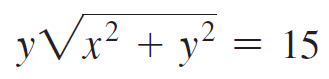
Calculate y'(x) for the following relations. yVr + y² = 15 .2 .2 ||
Find dy / dxy = ex √x3
Use the General Power Rule where appropriate to find the derivative of the following functions.y = ln (x3 + 1)π
Find the derivative of the inverse of the following functions at the specified point on the graph of the inverse function. You do not need to find f-1.f(x) = x2 + 1, for x ≥ 0; (5, 2)
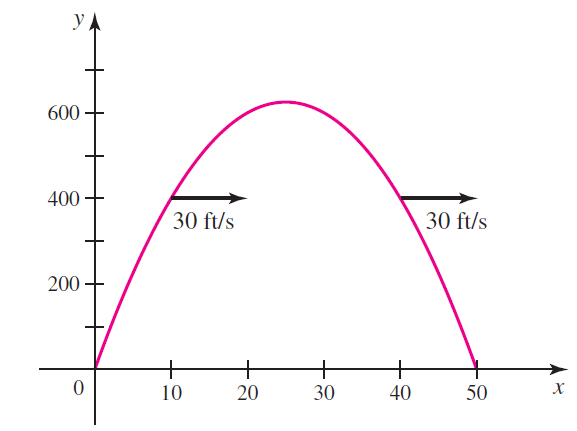
An arrow is shot into the air and moves along the parabolic path y = x(50 - x) (see figure). The horizontal component of velocity is always 30 ft/s. What is the vertical component of velocity when (i) x = 10?(ii) x = 40? УА 600 400 30 ft/s 30 ft/s 200 + + х 10 40 30
a. Show that if (a, f(a)) is any point on the graph of f(x) = x2, then the slope of the tangent line at that point is m = 2a.b. Show that if (a, f(a)) is any point on the graph of f(x) = bx2 + cx + d, then the slope of the tangent line at that point is m = 2ab + c.
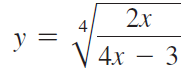
Find dy / dx 2x 4 y = 4х — 3
Use the General Power Rule where appropriate to find the derivative of the following functions.f(x) = (2x - 3)x3/2
Find the derivative of the inverse of the following functions at the specified point on the graph of the inverse function. You do not need to find f-1.f(x) = tan x; (1, π/4)
An airliner passes over an airport at noon traveling 500 mi/hr due west. At 1:00 p.m., another airliner passes over the same airport at the same elevation traveling due north at 550 mi/hr. Assuming both airliners maintain their (equal) elevations, how fast is the distance between them changing at
Find an equation of the line tangent to the following curves at the given point.y = 3x3 + sin x; (0, 0)
Find dy / dxy = x(x + 1)1/3
Use the General Power Rule where appropriate to find the derivative of the following functions.y = tan (x0.74)
Find the derivative of the inverse of the following functions at the specified point on the graph of the inverse function. You do not need to find f-1.f(x) = x2 - 2x - 3, for x ≤ 1; (12, -3)
a. Use either definition of the derivative to determine the slope of the curve y = f(x) at the given point P.b. Find an equation of the line tangent to the curve y = f(x) at P; then graph the curve and the tangent line.f(x) = 4x2 - 7x + 5; P(2, 7)
An equilateral triangle initially has sides of length 20 ft when each vertex moves toward the midpoint of the opposite side at a rate of 1.5 ft/min. Assuming the triangle remains equilateral, what is the rate of change of the area of the triangle at the instant the triangle disappears?
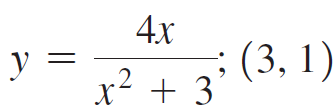
Find an equation of the line tangent to the following curves at the given point. 4х (3, 1) + 3 y = .2
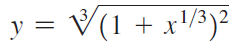
Find dy / dx y = V(1 + x'/³)²
Use the General Power Rule where appropriate to find the derivative of the following functions.f(x) = 2x/2x + 1
Given the function f, find the slope of the line tangent to the graph of f-1 at the specified point on the graph of f-1.f(x) = √x; (2, 4)
The hands of the clock in the tower of the Houses of Parliament in London are approximately 3 m and 2.5 m in length. How fast is the distance between the tips of the hands changing at 9:00? Use the Law of Cosines.
Find an equation of the line tangent to the following curves at the given point.y + √xy = 6; (1, 4)
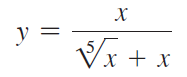
Find dy / dx х y = VI + x
Use the General Power Rule where appropriate to find the derivative of the following functions.f(x) = (2x + 1)π
Given the function f, find the slope of the line tangent to the graph of f-1 at the specified point on the graph of f-1.f(x) = x3; (8, 2)
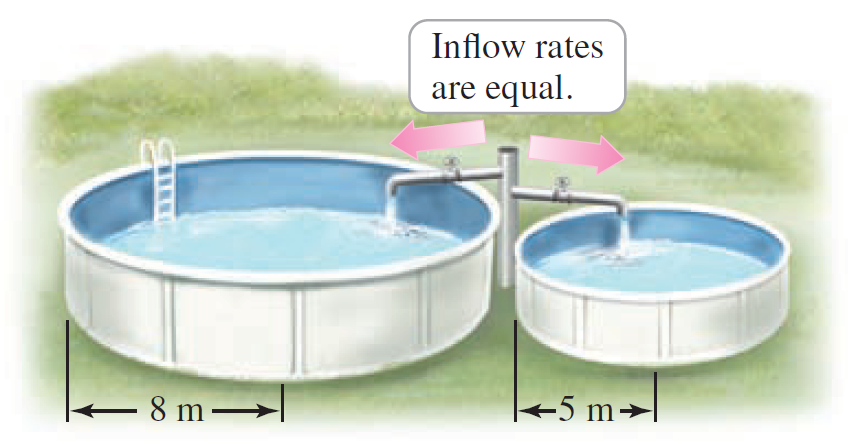
Two cylindrical swimming pools are being filled simultaneously at the same rate (in m3/min; see figure). The smaller pool has a radius of 5 m, and the water level rises at a rate of 0.5 m/min. The larger pool has a radius of 8 m. How fast is the water level rising in the larger pool? Inflow rates
Find an equation of the line tangent to the following curves at the given point.x2y + y3 = 75; (4, 3)
Determine the slope of the following curves at the given point.3√x + 3√y4 = 2; (1, 1)
Find the derivative of each function and evaluate the derivative at the given value of a.f(x) = xcos x; a = π/2
Given the function f, find the slope of the line tangent to the graph of f-1 at the specified point on the graph of f-1.f(x) = (x + 2)2; (36, 4)
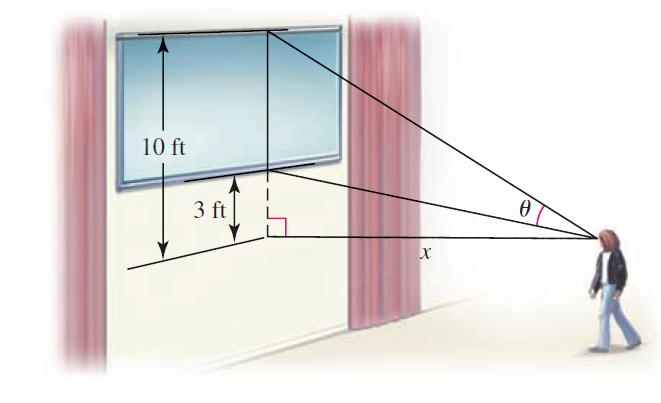
The bottom of a large theater screen is 3 ft above your eye level and the top of the screen is 10 ft above your eye level. Assume you walk away from the screen (perpendicular to the screen) at a rate of 3 ft/s while looking at the screen. What is the rate of change of the viewing angle θ when you
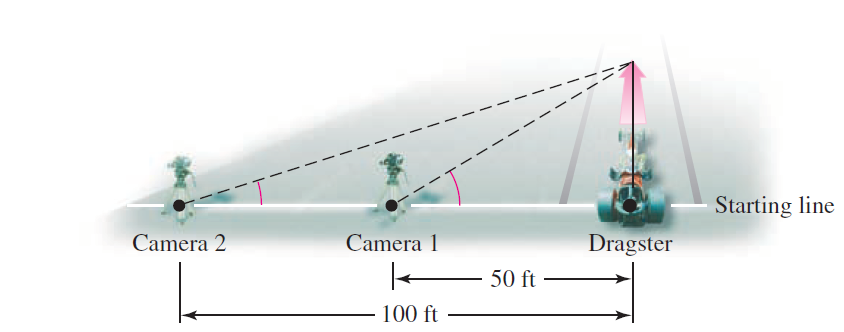
A camera is set up at the starting line of a drag race 50 ft from a dragster at the starting line (camera 1 in the figure). Two seconds after the start of the race, the dragster has traveled 100 ft and the camera is turning at 0.75 rad/s while filming the dragster.a. What is the speed of the
For what value(s) of x is the line tangent to the curve y = x√6 - x horizontal? Vertical?
Determine the slope of the following curves at the given point.x2/3 + y2/3 = 2; (1, 1)
Find the derivative of each function and evaluate the derivative at the given value of a.g(x) = xln x; a = e
Given the function f, find the slope of the line tangent to the graph of f-1 at the specified point on the graph of f-1.f(x) = -x2 + 8; (7, 1)
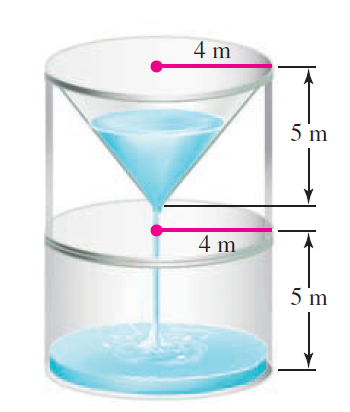
A conical tank with an upper radius of 4 m and a height of 5 m drains into a cylindrical tank with a radius of 4 m and a height of 5 m (see figure). If the water level in the conical tank drops at a rate of 0.5 m/min, at what rate does the water level in the cylindrical tank rise when the water
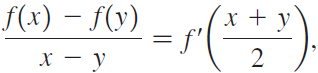
Let f(x) = x2.a. Show that for all x ≠ y.b. Is this property true for f(x) = ax2, where a is a nonzero real number?c. Give a geometrical interpretation of this property.d. Is this property true for f(x) = ax3? Г) — Г) х+у f' 2 х — у
Determine the slope of the following curves at the given point.x 3√y + y = 10; (1, 8)
Find the derivative of each function and evaluate the derivative at the given value of a.h(x) = x√x; a = 4
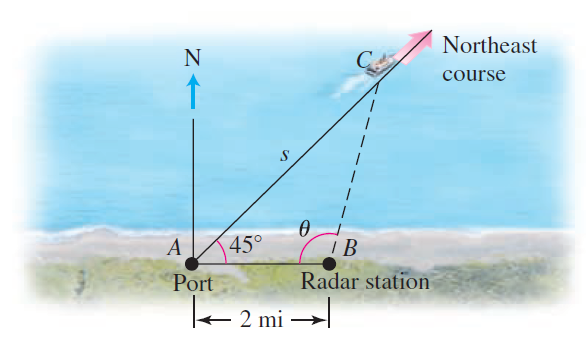
A port and a radar station are 2 mi apart on a straight shore running east and west see figure). A ship leaves the port at noon traveling northeast at a rate of 15 mi/hr. If the ship maintains its speed and course, what is the rate of change of the tracking angle θ between the shore and the
Find y', y", and y"' for the following functions.y = sin √x
Determine the slope of the following curves at the given point.(x + y)2/3 = y; (4, 4)
Find the derivative of each function and evaluate the derivative at the given value of a.f(x) = (x2 + 1)x; a = 1
Find the slope of the curve y = f-1(x) at (4, 7) if the slope of the curve y = f(x) at (7, 4) is 2/3.
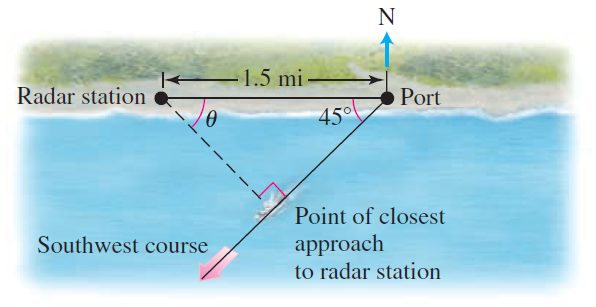
A ship leaves port traveling southwest at a rate of 12 mi/hr. At noon, the ship reaches its closest approach to a radar station, which is on the shore 1.5 mi from the port. If the ship maintains its speed and course, what is the rate of change of the tracking angle θ between the radar station and
Determine the slope of the following curves at the given point.xy + x3/2 y-1/2 = 2; (1, 1)
Find the derivative of each function and evaluate the derivative at the given value of a.f(x) = (sin x)ln x; a = π/2
Suppose the slope of the curve y = f-1(x) at (4, 7) is 45 . Find f'(7).
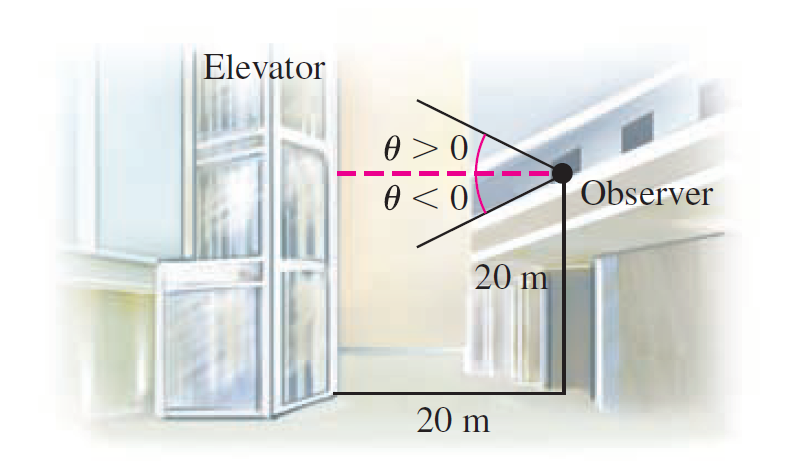
An observer is 20 m above the ground floor of a large hotel atrium looking at a glass-enclosed elevator shaft that is 20 m horizontally from the observer (see figure). The angle of elevation of the elevator is the angle that the observer’s line of sight makes with the horizontal (it may be
Evaluate the following derivatives. Express your answers in terms of f, g, f', and g'.d/dx (x2f(x))
Determine the slope of the following curves at the given point.xy5/2 + x3/2 y = 12; (4, 1)
Find the derivative of each function and evaluate the derivative at the given value of a.f(x) = (tan x)x - 1; a = π/4
Suppose the slope of the curve y = f(x) at (4, 7) is 1/5. Find (f-1)'(7).
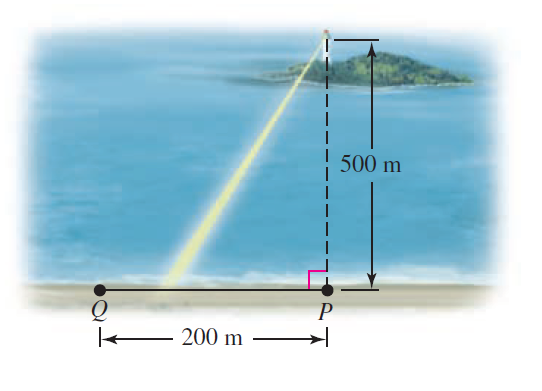
A lighthouse stands 500 m off a straight shore and the focused beam of its light revolves four times each minute. As shown in the figure, P is the point on shore closest to the lighthouse and Q is a point on the shore 200 m from P. What is the speed of the beam along the shore when it strikes the
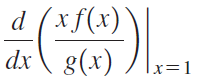
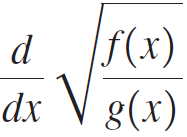
Evaluate the following derivatives. Express your answers in terms of f, g, f', and g'. |F(x) dx V 8(x) d
Determine whether the following statements are true and give an explanation or counterexample.a. For any equation containing the variables x and y, the derivative dy/dx can be found by first using algebra to rewrite the equation in the form y = f(x).b. For the equation of a circle of radius r, x2 +
Find an equation of the line tangent to y = xsin x at the point x = 1.
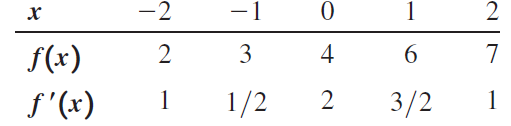
Use the following tables to determine the indicated derivatives or state that the derivative cannot be determined.a. (f-1)' (4)b. (f-1)' (6)c. (f-1)' (1)d. (f)' (1) -1 -2 х f(x) 1 3 4 6. 1/2 3/2 2 f'(x)
Showing 4900 - 5000
of 6775
First
43
44
45
46
47
48
49
50
51
52
53
54
55
56
57
Last
Step by Step Answers

 Get 50% OFF
Claim Now
Get 50% OFF
Claim Now