New Semester
Started
Get
50% OFF
Study Help!
--h --m --s
Claim Now
Question Answers
Textbooks
Find textbooks, questions and answers
Oops, something went wrong!
Change your search query and then try again
S
Books
FREE
Study Help
Expert Questions
Accounting
General Management
Mathematics
Finance
Organizational Behaviour
Law
Physics
Operating System
Management Leadership
Sociology
Programming
Marketing
Database
Computer Network
Economics
Textbooks Solutions
Accounting
Managerial Accounting
Management Leadership
Cost Accounting
Statistics
Business Law
Corporate Finance
Finance
Economics
Auditing
Tutors
Online Tutors
Find a Tutor
Hire a Tutor
Become a Tutor
AI Tutor
AI Study Planner
NEW
Sell Books
Search
Search
Sign In
Register
study help
mathematics
calculus early transcendentals
Calculus Early Transcendentals 2nd edition William L. Briggs, Lyle Cochran, Bernard Gillett - Solutions
Given the following velocity functions of an object moving along a line, find the position function with the given initial position. Then graph both the velocity and position functions.v(t) = 6t2 + 4t - 10; s(0) = 0
Given the following velocity functions of an object moving along a line, find the position function with the given initial position. Then graph both the velocity and position functions.v(t) = 2 cos t; s(0) = 0
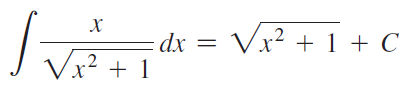
Verify the following indefinite integrals by differentiation. dx = Vx² + 1 + C Vx² + 1
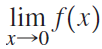
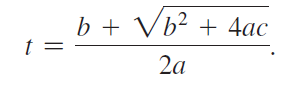
Consider the function f(x) = (abx + (1 - a)cx)1/x, where a, b, and c are positive real numbers with 0 < a < 1.a. Graph f for several sets of (a, b, c). Verify that in all cases f is an increasing function with a single inflection point, for all x.b. Use analytical methods to determinein terms
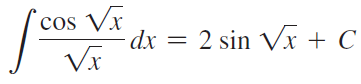
Verify the following indefinite integrals by differentiation. cos Vr dx = 2 sin Vx + C VI
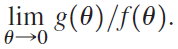
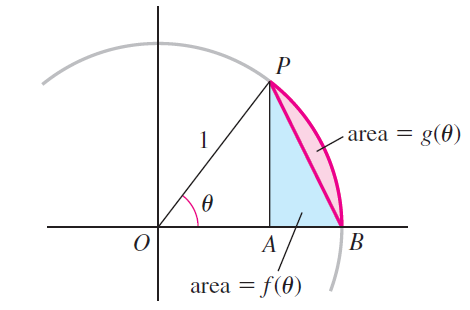
Let f (θ) be the area of the triangle ABP (see figure) and let g(θ) be the area of the region between the chord PB and the arc PB. Evaluate lim g(0)/f(0). area = g(0) B area = f(0)
Use the identities sin2 x = (1 - cos 2x)/2 and cos2 x = (1 + cos 2x)/2 to find ∫sin2 x dx and ∫cos2 x dx.
The factorial function is defined for positive integers as n! = n(n - 1)(n - 2) · · · 3 • 2 • 1. For example, 5! = 5 • 4 • 3 • 2 • 1 = 120. A valuable result that gives good approximations to n! for large values of n is Stirling’s formula, n! ≈ √2πn nne-n. Use this formula and
Suppose that object A is located at s = 0 at time t = 0 and starts moving along the s-axis with a velocity given by v(t) = 2at, where a > 0. Object B is located at s = c > 0 at t = 0 and starts moving along the s-axis with a constant velocity given by V(t) = b > 0. Show that A always
Show that f(x) = loga x and g(x) = logb x, where a > 1 and b > 1, grow at a comparable rate as x→∞.
A large tank is filled with water when an outflow valve is opened at t = 0. Water flows out at a rate, in gal/min, given by Q'(t) = 0.1(100 - t2), for 0 ≤ t ≤ 10. a. Find the amount of water Q(t) that has flowed out of the tank after t minutes, given the initial condition Q(0) = 0.b. Graph
Show that f(x) = ax grows faster than g(x) = bx as x→∞ if 1 < b < a.
A mass oscillates up and down on the end of a spring. Find its position s relative to the equilibrium position if its acceleration is a(t) = sin πt and its initial velocity and position are v(0) = 3 and s(0) = 0, respectively.
Show that any exponential function bx, for b > 1, grows faster than xp, for p > 0.
Determine the following indefinite integrals. Check your work by differentiation.∫(5s + 3)2 ds
Find the intervals on which f is increasing and decreasing.f(x) = 3 cos 3x on [-π, π]
a. Find the critical points of the following functions on the domain or on the given interval.b. Use a graphing utility to determine whether each critical point corresponds to a local maximum, local minimum, or neither.f(x) = 3x3 + 3x2/2 - 2x on [-1, 1]
Make a complete graph of the following functions. If an interval is not specified, graph the function on its domain. Use a graphing utility to check your work.f(x) = sin x - x on [0, 2π]
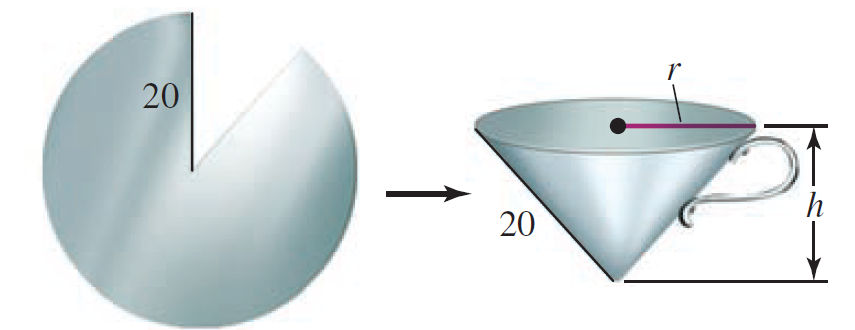
A cone is constructed by cutting a sector from a circular sheet of metal with radius 20. The cut sheet is then folded up and welded (see figure). Find the radius and height of the cone with maximum volume that can be formed in this way. 20 20
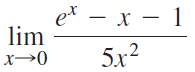
Evaluate the following limits. — х — 1 e* lim |х—0 5x2
A metal cistern in the shape of a right circular cylinder with volume V = 50 m3 needs to be painted each year to reduce corrosion. The paint is applied only to surfaces exposed to the elements (the outside cylinder wall and the circular top). Find the dimensions r and h of the cylinder that
Consider the function f(x) = x5 + 4x4 + x3 - 10x2 - 4x + 8, which has zeros at x = 1 and x = -2. Apply Newton’s method to this function with initial approximations of x0 = -1, x0 = -0.2, x0 = 0.2, and x0 = 2. Discuss and compare the results of the calculations.
Use linear approximations to estimate the following quantities. Choose a value of a that produces a small error.√5/29
Determine the following indefinite integrals. Check your work by differentiation.∫(5/t2 + 4t2) dt
Find the intervals on which f is increasing and decreasing. Superimpose the graphs of f and f' to verify your work.f(x) = ex/e2x + 1
a. Find the critical points of the following functions on the domain or on the given interval.b. Use a graphing utility to determine whether each critical point corresponds to a local maximum, local minimum, or neither.f(x) = x4/4 - x3/3 - 3x2 + 10 on [-4, 4]
Find the function F that satisfies the following differential equations and initial conditions.F"'(x) = 672x5 + 24x, F"(0) = 0, F'(0) = 2, F (0) = 1
Make a complete graph of the following functions. If an interval is not specified, graph the function on its domain. Use a graphing utility to check your work.f(x) = 2 - x2/3 + x4/3
A piece of wire of length 60 is cut, and the resulting two pieces are formed to make a circle and a square. Where should the wire be cut to (a) Minimize. (b) Maximize the combined area of the circle and the square?
Find the function F that satisfies the following differential equations and initial conditions.F"'(x) = 4x, F"(0) = 0, F'(0) = 1, F(0) = 3
Let a and b be positive real numbers. Evaluatein terms of a and b. lim (ax – Va?x² – bx)
Without evaluating derivatives, which of the functions f(x) = ln x, g(x) = ln 2x, h(x) = ln x2, and p(x) = ln 10x2 have the same derivative?
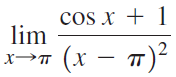
Evaluate the following limits. cos x + lim 1 (x – )² х-
A line segment of length 10 joins the points (0, p) and (q, 0) to form a triangle in the first quadrant. Find the values of p and q that maximize the area of the triangle.
The functions f(x) = (x - 1)2 and g(x) = x2 - 1 both have a root at x = 1. Apply Newton’s method to both functions with an initial approximation x0 = 2. Compare the rate at which the method converges in each case and give an explanation.
Use linear approximations to estimate the following quantities. Choose a value of a that produces a small error.ln (1.05)
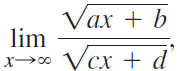
Consider the limitwhere a, b, c, and d are positive real numbers. Show that l’Hôpital’s Rule fails for this limit. Find the limit using another method. Vax + b lim Усх + d х- х—0о
Find the function F that satisfies the following differential equations and initial conditions.F"(x) = cos x, F'(0) = 3, F(π) = 4
Sketch the graph of a (simple) non constant function f that has a local maximum at x = 1, with f'(1) = 0, where f' does not change sign from positive to negative as x increases through 1. Why can’t the First Derivative Test be used to classify the critical point at x = 1 as a local maximum? How
The complexity of a computer algorithm is the number of operations or steps the algorithm needs to complete its task assuming there are n pieces of input (for example, the number of steps needed to put n numbers in ascending order). Four algorithms for doing the same task have complexities of A:
Find the function F that satisfies the following differential equations and initial conditions.F"(x) = 1, F'(0) = 3, F(0) = 4
Show that the general quartic (fourth-degree) polynomial f(x) = x4 + ax3 + bx2 + cx + d has either zero or two inflection points, and that the latter case occurs provided that b < 3a2/8.
Suppose you make a deposit of $P into a savings account that earns interest at a rate of 100 r% per year. a. Show that if interest is compounded once per year, then the balance after t years is B(t) = P(1 + r)t.b. If interest is compounded m times per year, then the balance after t years is
Determine the following indefinite integrals. Check your work by differentiation.∫ √x (2x6 - 4 3√x) dx
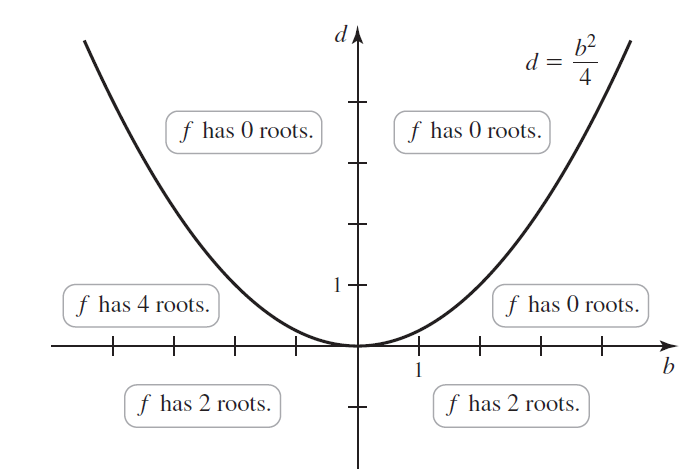
Consider the quartic (fourth-degree) polynomial f(x) = x4 + bx2 + d consisting only of even-powered terms.a. Show that the graph of f is symmetric about the y-axis.b. Show that if b ≥ 0, then f has one critical point and no inflection points.c. Show that if b < 0, then f has three critical
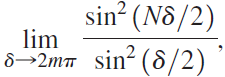
The theory of interference of coherent oscillators requires thewhere N is a positive integer and m is any integer. Show that the value of this limit is N2. sin² (N8/2) lim 6→2m sin? (8/2)
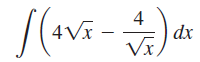
Determine the following indefinite integrals. Check your work by differentiation. (wi-) /(av- 4Vx - dx Vx,
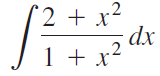
Determine the following indefinite integrals. Check your work by differentiation. .2 2 + .2 1 + x
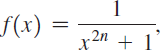
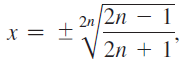
Consider the functions where n is a positive integer.a. Show that these functions are even.b. Show that the graphs of these functions intersect at the points (±1, 1/2), for all positive values of n.c. Show that the inflection points of these functions occur at for all positive values of n.d. Use a
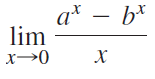
Evaluate the following limits in terms of the parameters a and b, which are positive real numbers. In each case, graph the function for specific values of the parameters to check your results. a* – b* lim х х>0 x-
Consider the general cubic polynomial f(x) = x3 + ax2 + bx + c, where a, b, and c are real numbers.a. Prove that f has exactly one local maximum and one local minimum provided that a2 > 3b.b. Prove that f has no extreme values if a2 < 3b.
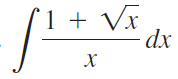
Determine the following indefinite integrals. Check your work by differentiation. (1 + Vx dx.
Determine the following indefinite integrals. Check your work by differentiation.∫(csc2 θ + 1) dθ
Consider the general cubic polynomial f(x) = x3 + ax2 + bx + c, where a, b, and c are real numbers.a. Show that f has exactly one inflection point and it occurs at x* = -a/3.b. Show that f is an odd function with respect to the inflection point (x*, f(x*)). This means that f(x*) - f(x* + x) = f(x*
Evaluate the following limits in terms of the parameters a and b, which are positive real numbers. In each case, graph the function for specific values of the parameters to check your results. lim (a* – b*)*, a > b > 0 х>0+
Determine the following indefinite integrals. Check your work by differentiation.∫(csc2 θ + 2θ2 - 3θ) dθ
Give an argument to support the claim that if a function is concave up at a point, then the tangent line at that point lies below the curve near that point.
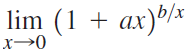
Evaluate the following limits in terms of the parameters a and b, which are positive real numbers. In each case, graph the function for specific values of the parameters to check your results. |lim (1 + ax)b/x ax)6/x х—0
Determine the following indefinite integrals. Check your work by differentiation.∫(4 cos 4w - 3 sin 3w) dw
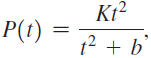
he population of a species is given by the function where t ≥ 0 is measured in years and K and b are positive real numbers.a. With K = 300 and b = 30, what isthe carrying capacity of the population?b. With K = 300 and b = 30, when does the maximum growth rate occur?c. For arbitrary positive
The ranking of growth rates given in the text applies for x→∞. However, these rates may not be evident for small values of x. For example, an exponential grows faster than any power of x. However, for 1 < x < 19,800, x2 is greater than ex/1000. For the following pairs of functions,
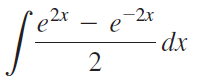
Determine the following indefinite integrals. Check your work by differentiation. -2x dx
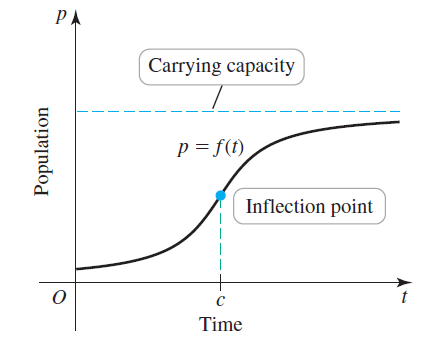
A typical population curve is shown in the figure. The population is small at t = 0 and increases toward a steady-state level called the carrying capacity. Explain why the maximum growth rate occurs at an inflection point of the population curve. PA Carrying capacity p = f(t) Inflection point Time
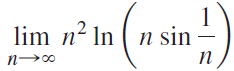
Use analytical methods to evaluate the following limits. lim n² In ( n sin п, п—0о
Determine the following indefinite integrals. Check your work by differentiation.∫ 3√x2 + √x3) dx
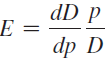
Economists use demand functions to describe how much of a commodity can be sold at varying prices. For example, the demand function D(p) = 500 - 10p says that at a price of p = 10, a quantity of D(10) = 400 units of the commodity can be sold. The elasticity of the demand gives the approximate
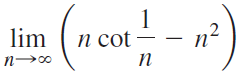
Use analytical methods to evaluate the following limits. п cot- п п? ,2 lim по
Determine whether the following statements are true and give an explanation or counterexample.a. F(x) = x3 - 4x + 100 and G(x) = x3 - 4x - 100 are antiderivatives of the same function.b. If F'(x) = f(x), then f is an antiderivative of F.c. If F'(x) = f(x), then ∫f(x) dx = F(x) + C.d. f(x) = x3 +
Consider the general parabola described by the function f(x) = ax2 + bx + c. For what values of a, b, and c is f concave up? For what values of a, b, and c is f concave down?
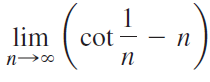
Use analytical methods to evaluate the following limits. lim cot п п- п
Consider the following descriptions of the vertical motion of an object subject only to the acceleration due to gravity. Begin with the acceleration equation a(t) = v'(t) = g, where g = -9.8 m/s2.a. Find the velocity of the object for all relevant times.b. Find the position of the object for all
Locate the critical points of the following functions and use the Second Derivative Test to determine (if possible) whether they correspond to local maxima or local minima.f(x) = x3 + 2x2 + 4x - 1
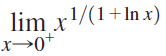
Use analytical methods to evaluate the following limits. lim x'/(1+In x) r→0+
Consider the following descriptions of the vertical motion of an object subject only to the acceleration due to gravity. Begin with the acceleration equation a(t) = v'(t) = g, where g = -9.8 m/s2.a. Find the velocity of the object for all relevant times.b. Find the position of the object for all
Locate the critical points of the following functions and use the Second Derivative Test to determine (if possible) whether they correspond to local maxima or local minima.h(x) = (x + a)4; a constant.
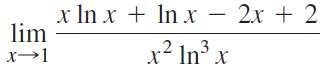
Use analytical methods to evaluate the following limits. x In x + In x - lim 2x + 2 x² In³ x
Consider the following descriptions of the vertical motion of an object subject only to the acceleration due to gravity. Begin with the acceleration equation a(t) = v'(t) = g, where g = -9.8 m/s2.a. Find the velocity of the object for all relevant times.b. Find the position of the object for all
Locate the critical points of the following functions and use the Second Derivative Test to determine (if possible) whether they correspond to local maxima or local minima. 5x3 4x? + 48x 3 f(x)
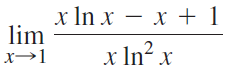
Use analytical methods to evaluate the following limits. х In x — х + 1 lim x x In? х—1 х х
Consider the following descriptions of the vertical motion of an object subject only to the acceleration due to gravity. Begin with the acceleration equation a(t) = v'(t) = g, where g = -9.8 m/s2.a. Find the velocity of the object for all relevant times.b. Find the position of the object for all
Locate the critical points of the following functions and use the Second Derivative Test to determine (if possible) whether they correspond to local maxima or local minima.p(t) = 2t3 + 3t2 - 36t
Let f(x) = (a + x)x, where a > 0.a. What is the domain of f (in terms of a)?b. Describe the end behavior of f (near the left boundary of its domain and as x→∞).c. Compute f'. Then graph f and f', for a = 0.5, 1, 2, and 3.d. Show that f has a single local minimum at the point z that satisfies
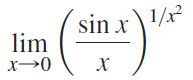
Use analytical methods to evaluate the following limits. 1/2 sin x lim х—0 х
The velocity function and initial position of Runners A and B are given. Analyze the race that results by graphing the position functions of the runners and finding the time and positions (if any) at which they first pass each other.A: v(t) = 2e-t, s(0) = 0; B: V(t) = 4e-4t, S(0) = 10
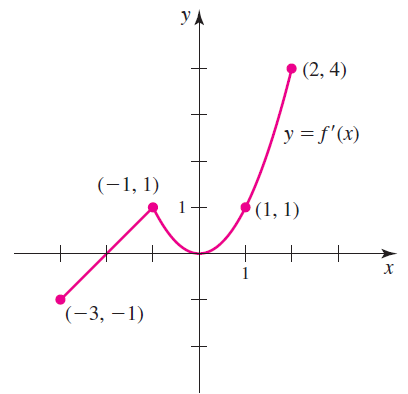
The graph of f' on the interval 3-3, 24 is shown in the figure.a. On what interval(s) is f increasing? Decreasing?b. Find the critical points of f. Which critical points correspond to local maxima? Local minima? Neither?c. At what point(s) does f have an inflection point?d. On what interval(s) is f
Consider the function g(x) = (1 + 1/x)x + a. Show that if 0 ≤ a < 12 , then g(x) → e from below as x → ∞; if 1/2 ≤ a < 1, then g(x) → e from above as x →∞.
Find the intervals on which f is increasing and decreasing. Superimpose the graphs of f and f' to verify your work.f(x) = x2 ln x2 + 1
a. Find the critical points of the following functions on the domain or on the given interval.b. Use a graphing utility to determine whether each critical point corresponds to a local maximum, local minimum, or neither.f(x) = x3/3 - 9x on [-7, 7]
Make a complete graph of the following functions. If an interval is not specified, graph the function on its domain. Use a graphing utility to check your work.f(x) = x - 3x1/3
A rectangle is constructed with its base on the diameter of a semicircle with radius 5 and its two other vertices on the semicircle. What are the dimensions of the rectangle with maximum area?
Why do two different antiderivatives of a function differ by a constant?
Determine whether the following statements are true and give an explanation or counterexample.a. The continuous function f(x) = 1 - |x| satisfies the conditions of the Mean Value Theorem on the interval [-1, 1].b. Two differentiable functions that differ by a constant always have the same
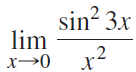
Evaluate the following limits. sin? 3x lim х—0 .2 х
Use Newton’s method to find approximate answers to the following questions.Where is the local extremum of f(x) = ex/x (Use Newton’s method.)
What point on the graph of f(x) = 5/2 - x2 is closest to the origin? You can minimize the square of the distance.
Use linear approximations to estimate the following quantities. Choose a value of a that produces a small error.3√65
Determine the following indefinite integrals. Check your work by differentiation.∫3u-2 - 4u2 + 1) du
Find the intervals on which f is increasing and decreasing. Superimpose the graphs of f and f' to verify your work.f(x) = 2x5 - 15x4/4 + 5x3/3
a. Find the critical points of the following functions on the domain or on the given interval.b. Use a graphing utility to determine whether each critical point corresponds to a local maximum, local minimum, or neither.f(x) = 1/8 x3 - 1/2 x on [-1, 3]
Make a complete graph of the following functions. If an interval is not specified, graph the function on its domain. Use a graphing utility to check your work.f(x) = x - 3x2/3
Showing 4300 - 4400
of 6775
First
37
38
39
40
41
42
43
44
45
46
47
48
49
50
51
Last
Step by Step Answers

 Get 50% OFF
Claim Now
Get 50% OFF
Claim Now