New Semester
Started
Get
50% OFF
Study Help!
--h --m --s
Claim Now
Question Answers
Textbooks
Find textbooks, questions and answers
Oops, something went wrong!
Change your search query and then try again
S
Books
FREE
Study Help
Expert Questions
Accounting
General Management
Mathematics
Finance
Organizational Behaviour
Law
Physics
Operating System
Management Leadership
Sociology
Programming
Marketing
Database
Computer Network
Economics
Textbooks Solutions
Accounting
Managerial Accounting
Management Leadership
Cost Accounting
Statistics
Business Law
Corporate Finance
Finance
Economics
Auditing
Tutors
Online Tutors
Find a Tutor
Hire a Tutor
Become a Tutor
AI Tutor
AI Study Planner
NEW
Sell Books
Search
Search
Sign In
Register
study help
mathematics
college algebra graphs and models
College Algebra 7th Edition Robert F Blitzer - Solutions
For each f(x), complete the following. (a) Find the x- and y-intercepts. (b) Determine the multiplicity of each zero of f. (c) Sketch a graph of y = f(x) by hand. f(x) = -x(x - 1)(x + 2)
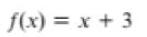
Determine if f is odd, even, or neither. f(x) = x + 3
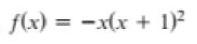
For each f(x), complete the following. (a) Find the x- and y-intercepts. (b) Determine the multiplicity of each zero of f. (c) Sketch a graph of y = f(x) by hand. f(x) = -x(x + 1)²
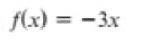
Determine if f is odd, even, or neither. f(x) = -3x
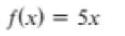
Determine if f is odd, even, or neither. f(x) = 5x
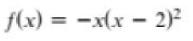
For each f(x), complete the following. (a) Find the x- and y-intercepts. (b) Determine the multiplicity of each zero of f. (c) Sketch a graph of y = f(x) by hand. f(x) = -xx - 2)7
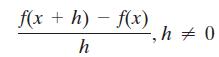
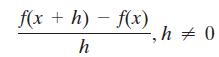
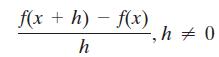
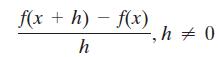
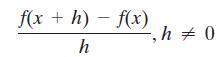
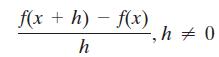
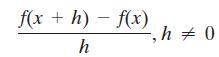
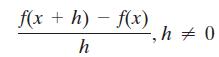
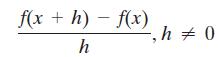
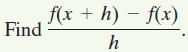
In Exercises 71–92, find and simplify the difference quotient f(x +h)-f(x) h -, h = 0
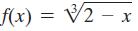
In Exercises 76–83, use a graphing utility to graph the function. Use the graph to determine whether the function has an inverse that is a function (that is, whether the function is one-to-one). f(x) = √√/2 - x
In Exercises 67–80, begin by graphing the square root function, f(x) = √x. Then use transformations of this graph to graph the given function. h(x)=√x + 2-2
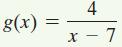
In Exercises 76–81, find the domain of each function. g(x) = 4 x - 7
In Exercises 76–83, use a graphing utility to graph the function. Use the graph to determine whether the function has an inverse that is a function (that is, whether the function is one-to-one). f(x) X 2
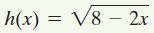
In Exercises 76–81, find the domain of each function. h(x) = V8 - 2x
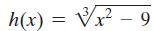
In Exercises 75–82, express the given function h as a composition of two functions f and g so that h(x) = (f ° g)(x). h(x) = √x²-9
In Exercises 67–80, begin by graphing the square root function, f(x) = √x. Then use transformations of this graph to graph the given function. h(x) = √x + 1 − 1 Vx+1-1
In Exercises 71–92, find and simplify the difference quotient f(x +h)-f(x) h -, h = 0
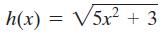
In Exercises 75–82, express the given function h as a composition of two functions f and g so that h(x) = (f ° g)(x). h(x) = 2 √5x² + 3
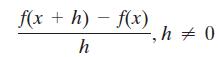
In Exercises 71–92, find and simplify the difference quotient f(x +h)-f(x) h -, h = 0
In Exercises 71–92, find and simplify the difference quotient f(x +h)-f(x) h -, h = 0
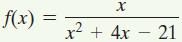
In Exercises 76–81, find the domain of each function. f(x) X x² + 4x + 4x - 21
In Exercises 77–78, give the slope and y-intercept of each line whose equation is given. Assume that B ≠ 0.Ax = By - C
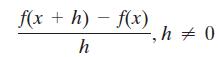
In Exercises 71–92, find and simplify the difference quotient f(x +h)-f(x) h -, h = 0
In Exercises 67–80, begin by graphing the square root function, f(x) = √x. Then use transformations of this graph to graph the given function. g(x) = 2√x + 2 - 2
What is a circle? Without using variables, describe how the definition of a circle can be used to obtain a form of its equation.
In Exercises 85–86, finda. (f ° g)(x);b. (g ° f)(x);c. (f ° g)(3). f(x)=√x, g(x) = x + 1
In Exercises 71–92, find and simplify the difference quotient f(x +h)-f(x) h -, h = 0
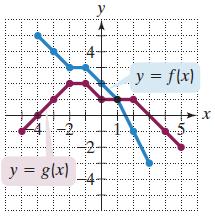
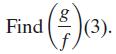
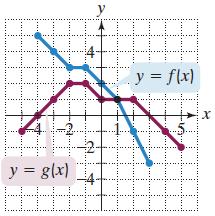
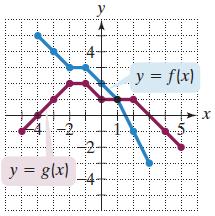
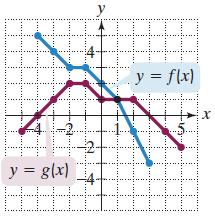
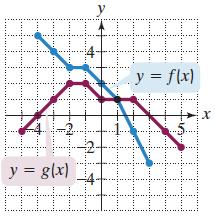
Use the graphs of f and g to solve Exercises 83–90. y = g(x) HH y .y = f(x) # X
In Exercises 79–80, find the value of y if the line through the two given points is to have the indicated slope.(3, y) and (1, 4), m = -3
Give an example of a circle’s equation in standard form. Describe how to find the center and radius for this circle.
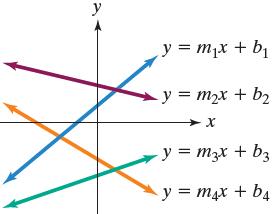
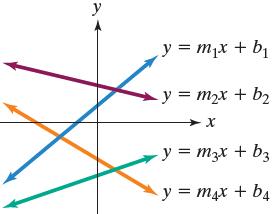
Use the figure to make the lists in Exercises 85–86.List the slopes m1 , m2 , m3 , and m4 in order of decreasing size. y y = m₁x + b₁ y = m₂x + b₂ X - y = m3x + b3 y = m4x + b4
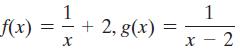
In Exercises 84–86, use a graphing utility to graph f and g in the same [-8, 8, 1] by [-5, 5, 1] viewing rectangle. In addition, graph the line y = x and visually determine if f and g are inverses. f(x) 1 - X + 2, g(x) = 1 x - 2
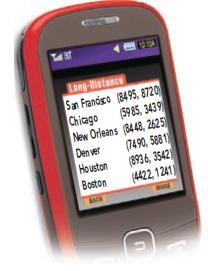
Write and solve a problem about the flying time between a pair of cities shown on the cellphone screen for Exercises 71–72. Do not use the pairs in Exercise 71 or Exercise 72. Begin by determining a reasonable average speed, in miles per hour, for a jet flying between the cities.Data from
In Exercises 71–92, find and simplify the difference quotient f(x +h)-f(x) h -, h = 0
In Exercises 81–94, begin by graphing the absolute value function, f(x) = |x|. Then use transformations of this graph to graph the given function. h(x) = x + 4 - 2
In Exercises 76–83, use a graphing utility to graph the function. Use the graph to determine whether the function has an inverse that is a function (that is, whether the function is one-to-one).f(x) = int(x - 2)
Use the graphs of f and g to solve Exercises 83–90. Find (fg)(2). y = g(x) HH y .y = f(x) # X
In Exercises 81–82, graph each linear function.3x - 4f(x) - 6 = 0
In Exercises 76–83, use a graphing utility to graph the function. Use the graph to determine whether the function has an inverse that is a function (that is, whether the function is one-to-one).f(x) =|x - 2|
In Exercises 83–85, use a graphing utility to graph each circle whose equation is given. Use a square setting for the viewing window. x² + 10x + y² - 4y - 20 = 0
In Exercises 81–94, begin by graphing the absolute value function, f(x) = |x| . Then use transformations of this graph to graph the given function. h(x) = x +31-2
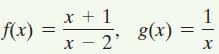
In Exercises 87–88, finda. (f ° g)(x);b. the domain of (f ° g). f(x) x + 1 x - 2' g(x) = 1 X
In Exercises 76–83, use a graphing utility to graph the function. Use the graph to determine whether the function has an inverse that is a function (that is, whether the function is one-to-one).f(x) = (x - 1)3
How is the standard form of a circle’s equation obtained from its general form?
In Exercises 71–92, find and simplify the difference quotient f(x +h)-f(x) h -, h = 0
In Exercises 84–86, use a graphing utility to graph f and g in the same [-8, 8, 1] by [-5, 5, 1] viewing rectangle. In addition, graph the line y = x and visually determine if f and g are inverses. f(x) = √x - 2, g(x) = (x + 2)³
In Exercises 85–86, finda. (f ° g)(x);b. (g ° f)(x);c. (f ° g)(3).f(x) = x2 + 3, g(x) = 4x - 1
Use the figure to make the lists in Exercises 85–86.List the y-intercepts b1 , b2 , b3 , and b4 in order of decreasing size. y y = m₁x + b₁ y = m₂x + b₂ X - y = m3x + b3 y = m4x + b4
Use the graphs of f and g to solve Exercises 83–90. Find the domain of f + g. y = g(x) HH y .y = f(x) # X
In Exercises 81–94, begin by graphing the absolute value function, f(x) = |x| . Then use transformations of this graph to graph the given function. h(x) = -x + 4|
In Exercises 86–89, determine whether each statement makes sense or does not make sense, and explain your reasoning.To avoid sign errors when finding h and k, I place parentheses around the numbers that follow the subtraction signs in a circle’s equation.
In Exercises 87–90, determine whether each statement makes sense or does not make sense, and explain your reasoning.I found the inverse of f(x) = 5x - 4 in my head: The reverse of multiplying by 5 and subtracting 4 is adding 4 and dividing by 5, so f -1(x) =x + 4/5.
In Exercises 86–89, determine whether each statement makes sense or does not make sense, and explain your reasoning.I used the equation (x + 1)2 + (y - 5)2 = -4 to identify the circle’s center and radius.
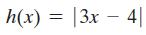
In Exercises 75–82, express the given function h as a composition of two functions f and g so that h(x) = (f ° g)(x). h(x) = |3x - 4|
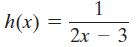
In Exercises 75–82, express the given function h as a composition of two functions f and g so that h(x) = (f ° g)(x). h(x) = 1 2x - 3
In Exercises 71–92, find and simplify the difference quotient f(x +h)-f(x) h -, h = 0
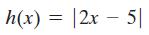
In Exercises 75–82, express the given function h as a composition of two functions f and g so that h(x) = (f ° g)(x). h(x) = |2x - 5]
In Exercises 79–80, find the value of y if the line through the two given points is to have the indicated slope. (-2, y) and (4,-4), m = 33
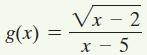
In Exercises 76–81, find the domain of each function. g(x): || Vx - 2 x - 5
In Exercises 67–80, begin by graphing the square root function, f(x) = √x. Then use transformations of this graph to graph the given function. g(x) = 2√x + 1 - 1 21
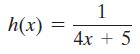
In Exercises 75–82, express the given function h as a composition of two functions f and g so that h(x) = (f ° g)(x). h(x) 1 4x + 5
In Exercises 71–92, find and simplify the difference quotient f(x +h)-f(x) h -, h = 0
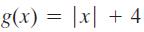
In Exercises 81–94, begin by graphing the absolute value function, f(x) = |x| . Then use transformations of this graph to graph the given function. + + |x| = (x)8
In Exercises 76–81, find the domain of each function. f(x) = √x −1+ √x + 5
Does (x - 3)2 + (y - 5)2 = -25 represent the equation of a circle? What sort of set is the graph of this equation?
In Exercises 81–82, graph each linear function.6x - 5f(x) - 20 = 0
In Exercises 82–84, find f + g, f - g, fg, and f/g. Determine the domain for each function.f(x) = 3x - 1, g(x) = x - 5
In Exercises 76–83, use a graphing utility to graph the function. Use the graph to determine whether the function has an inverse that is a function (that is, whether the function is one-to-one). f(x) -V16 16x²
Use the graphs of f and g to solve Exercises 83–90. Find (f + g)(-3). y = g(x) HH y .y = f(x) # X
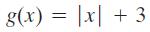
In Exercises 81–94, begin by graphing the absolute value function, f(x) = |x|. Then use transformations of this graph to graph the given function. g(x) = x + 3
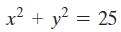
In Exercises 83–85, use a graphing utility to graph each circle whose equation is given. Use a square setting for the viewing window. x² + y² = 25
In Exercises 71–92, find and simplify the difference quotient f(x +h)-f(x) h -, h = 0
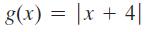
In Exercises 81–94, begin by graphing the absolute value function, f(x) = |x| . Then use transformations of this graph to graph the given function. g(x) = |x + 4|
In Exercises 82–84, find f + g, f - g, fg, and f/g. Determine the domain for each function.f(x) = x2 + x + 1, g(x) = x2 - 1
If one point on a line is (3, -1) and the line’s slope is -2, find the y-intercept.
Use the graphs of f and g to solve Exercises 83–90. Find (g - f)(-2). y = g(x) HH y .y = f(x) # X
If one point on a line is (2, -6) and the line’s slope is - 3/2, find the y-intercept.
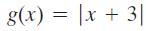
In Exercises 81–94, begin by graphing the absolute value function, f(x) = |x| . Then use transformations of this graph to graph the given function. g(x) = |x + 3|
In Exercises 82–84, find f + g, f - g, fg, and f/g. Determine the domain for each function. f(x) = √x + 7, g(x) = √x - 2
In Exercises 84–86, use a graphing utility to graph f and g in the same [-8, 8, 1] by [-5, 5, 1] viewing rectangle. In addition, graph the line y = x and visually determine if f and g are inverses.f(x) = 4x + 4, g(x) = 0.25x - 1
List by letter all relations that are not functions.a. {(7, 5), (8, 5), (9, 5)}b. {(5, 7), (5, 8), (5, 9)}c.d. x2 + y2 = 100e. у - Х
In Exercises 16–23, let f(x) = x2 - x - 4 and g(x) = 2x - 6. Find f(x +h)-f(x) h
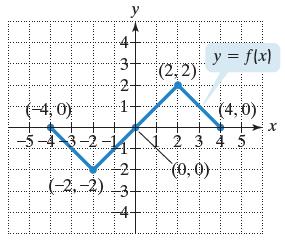
In Exercises 17–32, use the graph of y = f(x) to graph each function g.g(x) = f(x - 1) + 2 T 321 4,0) 5-4-3-2-1 3- y IIII] y = f(x) 8:00:07 11 (2,2) 2 (0, 0) (4,0) 2 3 4 5 (-2,-2) 3- [IIIII|IIIII X
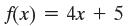
In Exercises 27–38, evaluate each function at the given values of the independent variable and simplify.a.b.c. f(x) = 4x + 5
In Exercises 27–38, evaluate each function at the given values of the independent variable and simplify.a.b.c.d. h(x) = x4 x² + 1
In Exercises 27–38, evaluate each function at the given values of the independent variable and simplify.a.b.c. g(x) = x² 10x - 3
In Exercises 27–38, evaluate each function at the given values of the independent variable and simplify.a.b.c. g(x) = x² + 2x + 3
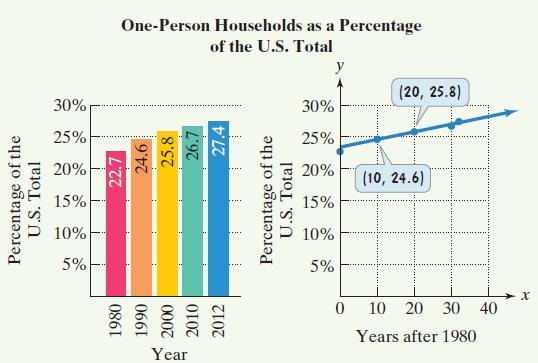
we worked with data involving the increasing number of U.S. adults ages 18 and older living alone. The bar graph reinforces the fact that one-person households are growing more common. It shows one-person households as a percentage of the U.S. total for five selected years from 1980 through 2012.a.
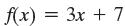
In Exercises 27–38, evaluate each function at the given values of the independent variable and simplify.a.b.c. f(x) = 3x + 7
In Exercises 27–38, evaluate each function at the given values of the independent variable and simplify.a.b.c.d. h(x) = x³ = x + 1 -
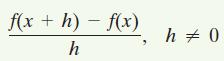
In Exercises 33–34, find and simplify the difference quotientfor the given function.f(x) = 8x - 11 f(x + h) − f(x)¸ h ‡ 0 h
In Exercises 11–38, use the given conditions to write an equation for each line in point-slope form and slope-intercept form.Passing through (-3, 6) and (3, -2)
In Exercises 31–50, find f + g, f - g, fg, and f/g. Determine the domain for each function.f(x) = 3x - 4, g(x) = x + 2
If you know a point on a line and you know the equation of a line perpendicular to this line, explain how to write the line’s equation.
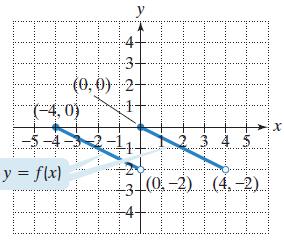
In Exercises 33–44, use the graph of y = f(x) to graph each function g.g(x) = f(x) + 2 -4,0) -5-4-3 4-33 y = f(x) y (0,0) 2- 3.4 45 -2) (4-2) X
In Exercises 31–50, find f + g, f - g, fg, and f/g. Determine the domain for each function.f(x) = x - 5, g(x) = 3x2
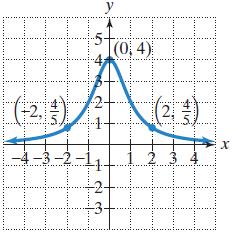
In Exercises 33–36, use possible symmetry to determine whether each graph is the graph of an even function, an odd function, or a function that is neither even nor odd. ------ -2, y CI (0,4) 2 14 -4-3-2-1₁. 1 2 3 4 # ILIPOIII] X
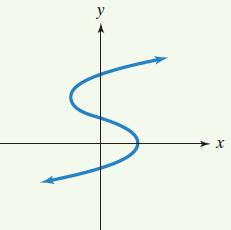
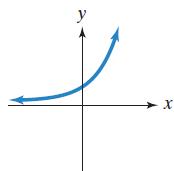
Which graphs in Exercises 29–34 represent functions that have inverse functions? y X
In Exercises 31–40, write the standard form of the equation of the circle with the given center and radius.Center (3, 2), r = 5
In Exercises 27–38, graph each equation in a rectangular coordinate system.f(x) = x2 - 4
In Exercises 11–38, use the given conditions to write an equation for each line in point-slope form and slope-intercept form.Passing through (-3, -1) and (4, -1)
In Exercises 27–38, evaluate each function at the given values of the independent variable and simplify.a.b.c. f(x) || 4x² 2 1
Showing 9800 - 9900
of 13634
First
92
93
94
95
96
97
98
99
100
101
102
103
104
105
106
Last
Step by Step Answers

 Get 50% OFF
Claim Now
Get 50% OFF
Claim Now