New Semester
Started
Get
50% OFF
Study Help!
--h --m --s
Claim Now
Question Answers
Textbooks
Find textbooks, questions and answers
Oops, something went wrong!
Change your search query and then try again
S
Books
FREE
Study Help
Expert Questions
Accounting
General Management
Mathematics
Finance
Organizational Behaviour
Law
Physics
Operating System
Management Leadership
Sociology
Programming
Marketing
Database
Computer Network
Economics
Textbooks Solutions
Accounting
Managerial Accounting
Management Leadership
Cost Accounting
Statistics
Business Law
Corporate Finance
Finance
Economics
Auditing
Tutors
Online Tutors
Find a Tutor
Hire a Tutor
Become a Tutor
AI Tutor
AI Study Planner
NEW
Sell Books
Search
Search
Sign In
Register
study help
mathematics
precalculus
Thomas Calculus Early Transcendentals 13th Edition Joel R Hass, Christopher E Heil, Maurice D Weir - Solutions
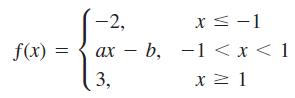
For what values of a and b iscontinuous at every x? f(x) = -2, ax − b, −1
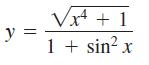
At what points are the function. y √x + 1 1 + sin² x
Gives a function ƒ(x) and numbers L, c, and ϵ > 0. In each case, find an open interval about c on which the inequality |ƒ(x) - L | < ϵ holds. Then give a value for δ > 0 such that for all x satisfying 0 < |x - c| < δ the inequality |ƒ(x) - L | < ϵ holds. f(x) = mx, m > 0,
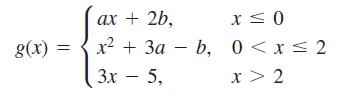
For what values of a and b iscontinuous at every x? g(x) = ax + 2b, x² + 3ab, 3x - 5, x≤0 0 < x≤ 2 x > 2
Gives a function ƒ(x) and numbers L, c, and ϵ > 0. In each case, find an open interval about c on which the inequality |ƒ(x) - L | < ϵ holds. Then give a value for δ > 0 such that for all x satisfying 0 < |x - c| < δ the inequality |ƒ(x) - L | < ϵ holds. f(x) = 120/x, L =
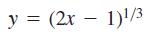
At what points are the function. y = (2x - 1)¹/3
Prove the limit statement. lim f(x) = 2 if f(x) x→1 4- 2x, 6x - 4, x < 1 x ≥ 1
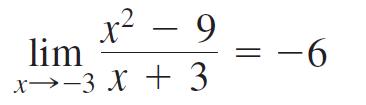
Prove the limit statement. x² - 9 lim x -3x + 3 -6
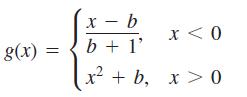
For what value of b iscontinuous at every x? g(x): = x - b b + 1' x² + b, x > 0 x < 0
Gives a function ƒ(x), a point c, and a positive number ϵ. Find L = limx→c ƒ(x). Then find a number δ > 0 such that for all x 0 < x − c < 8 - U |f(x) - L < €.
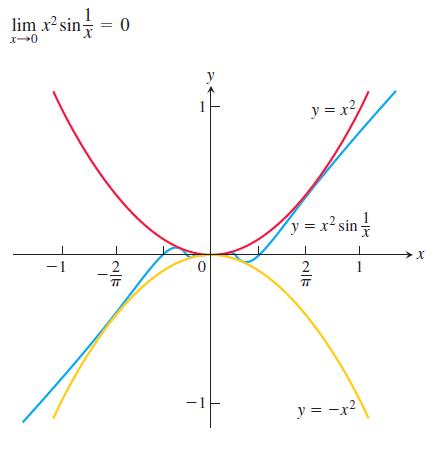
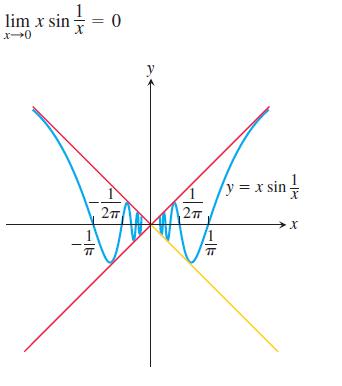
Prove the limit statement. lim x² sin = 0 x->0 alk y 1 y = x² y = x² sin / alk y = -x²\ X<
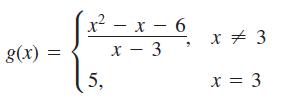
At what points are the function. g(x) = x² - x - 6 x - 3 5, x = 3 x = 3
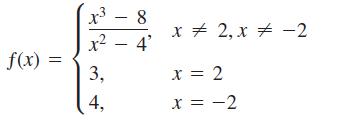
At what points are the function. f(x) = - 8 x² - 4' 3, 4, x = 2, x = -2 x = 2 x = -2
Gives a function ƒ(x) and numbers L, c, and ϵ > 0. In each case, find an open interval about c on which the inequality |ƒ(x) - L | < ϵ holds. Then give a value for δ > 0 such that for all x satisfying 0 < |x - c| < δ the inequality |ƒ(x) - L | < ϵ holds. f(x) c = 1/2, = mx
Prove the limit statement. lim_x sin = 0 == x-0 FALA 2π 2πT y = x sin X
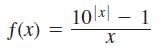
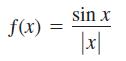
Graph the function ƒ to see whether it appears to have a continuous extension to the origin. If it does, use Trace and Zoom to find a good candidate for the extended function’s value at x = 0. If the function does not appear to have a continuous extension, can it be extended to be continuous at
Graph the function ƒ to see whether it appears to have a continuous extension to the origin. If it does, use Trace and Zoom to find a good candidate for the extended function’s value at x = 0. If the function does not appear to have a continuous extension, can it be extended to be continuous at
Prove the limit statement. lim f(x) = 0 if f(x) x-0 [2.x, Lx/2₂ x < 0 x ≥ 0
Graph the function ƒ to see whether it appears to have a continuous extension to the origin. If it does, use Trace and Zoom to find a good candidate for the extended function’s value at x = 0. If the function does not appear to have a continuous extension, can it be extended to be continuous at
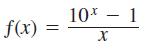
Make a table of values for the function F(x) = (x + 2)/(x - 2) at the points x = 1.2, x = 11/10, x = 101/100, x = 1001/1000, x = 10001/10000, and x = 1.a. Find the average rate of change of F(x) over the intervals 31, x4 for each x ≠ 1 in your table.b. Extending the table if necessary, try to
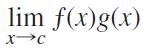
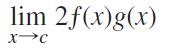
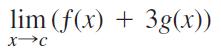
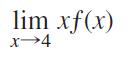
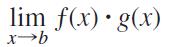
Suppose limx→c ƒ(x) = 5 and limx→c g(x) = -2. Finda.b.c.d. lim f(x)g(x) X-C
Gives a function ƒ(x), a point c, and a positive number ϵ. Find L = limx→c ƒ(x). Then find a number δ > 0 such that for all x 0 < x − c < 8 - U |f(x) - L < €.
Prove the limit statement. lim_ f(x) = 4 if f(x) x→-2 [x², (1, x = -2 x = -2
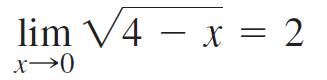
Prove the limit statement. lim V4 - x = 2 x-0
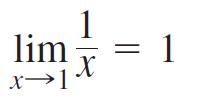
Prove the limit statement. lim x→1 1 X = 1
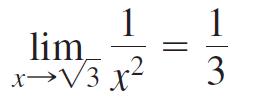
Prove the limit statement. 1 lim x→√3 x² || 1 3
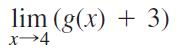
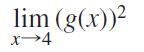
Suppose limx→4 ƒ(x) = 0 and limx→4 g(x) = -3. Finda.b.c.d. lim (g(x) + 3) x-4
Let g(x) = √x for x ≥ 0.a. Find the average rate of change of g(x) with respect to x over the intervals [1, 2], [1, 1.5] and [1, 1 + h].b. Make a table of values of the average rate of change of g with respect to x over the interval [1, 1 + h] for some values of h approaching zero, say h = 0.1,
Let ƒ(t) = 1/t for t ≠ 0.a. Find the average rate of change of ƒ with respect to t over the intervals (i) from t = 2 to t = 3, and (ii) from t = 2 to t = T.b. Make a table of values of the average rate of change of ƒ with respect to t over the interval [2, T] , for some values of T approaching
At what points are the function.y = tan πx/2
At what points are the function.y = csc 2x
Graph the function ƒ to see whether it appears to have a continuous extension to the origin. If it does, use Trace and Zoom to find a good candidate for the extended function’s value at x = 0. If the function does not appear to have a continuous extension, can it be extended to be continuous at
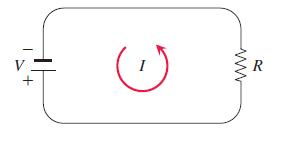
Ohm’s law for electrical circuits like the one shown in the accompanying figure states that V = RI. In this equation, V is a constant voltage, I is the current in amperes, and R is the resistance in ohms. Your firm has been asked to supply the resistors for a circuit in which V will be 120 volts
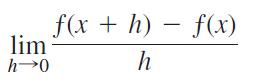
Because of their connection with secant lines, tangents, and instantaneous rates, limits of the formoccur frequently in calculus. Evaluate this limit for the given value of x and function ƒ.ƒ(x) = x2, x = 1 lim h→0 f(x + h) = f(x) h
Define g(3) in a way that extends g(x) = (x2 - 9)/(x - 3) to be continuous at x = 3.
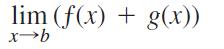
Suppose limx→b ƒ(x) = 7 and limx→b g(x) = -3. Finda.b.c.d. lim (f(x) + g(x)) x-b
Define g(4) in a way that extends g(x) = (x2 - 16)/ (x2 - 3x - 4) to be continuous at x = 4.
Once you know limx→a+ ƒ(x) and limx→a- ƒ(x) at an interior point of the domain of ƒ, do you then know limx→a ƒ(x)? Give reasons for your answer.
Define ƒ(1) in a way that extends ƒ(s) = (s3 - 1)/(s2 - 1) to be continuous at s = 1.
If you know that limx→c ƒ(x) exists, can you find its value by calculating limx→c+ ƒ(x)? Give reasons for your answer.
Define h(2) in a way that extends h(t) = (t2 + 3t - 10)/(t - 2) to be continuous at t = 2.
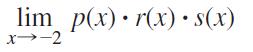
Suppose that limx→-2 p(x) = 4, limx→-2 r(x) = 0, and limx→-2 s(x) = -3. Finda.b.c. lim (p(x) +r(x) + s(x)) x→-2
Suppose that ƒ is an even function of x. Does knowing that limx→2- ƒ(x) = 7 tell you anything about either limx→-2- ƒ(x) or limx→-2+ ƒ(x)? Give reasons for your answer.
Suppose that ƒ is an odd function of x. Does knowing that limx→0+ ƒ(x) = 3 tell you anything about limx→0- ƒ(x)? Give reasons for your answer.
Prove that limx→c ƒ(x) = L if and only if limh→0 ƒ(h + c) = L.
Define what it means to say that limx→0g(x) = k.
A continuous function y = ƒ(x) is known to be negative at x = 0 and positive at x = 1. Why does the equation ƒ(x) = 0 have at least one solution between x = 0 and x = 1? Illustrate with a sketch.
Because of their connection with secant lines, tangents, and instantaneous rates, limits of the formoccur frequently in calculus. Evaluate this limit for the given value of x and function ƒ.ƒ(x) = x2, x = -2 lim h→0 f(x + h) = f(x) h
Explain why the equation cos x = x has at least one solution.
Before contracting to grind engine cylinders to a cross-sectional area of 9 in2, you need to know how much deviation from the ideal cylinder diameter of c = 3.385 in. you can allow and still have the area come within 0.01 in2 of the required 9 in2. To find out, you let A = π(x/2)2 and look for the
Show that the equation x3 - 15x + 1 = 0 has three solutions in the interval [-4, 4].
Show that the function F(x) = (x - a)2 · (x - b)2 + x takes on the value (a + b)/2 for some value of x.
If ƒ(x) = x3 - 8x + 10, show that there are values c for which ƒ(c) equals (a) π; (b) -√3; (c) 5,000,000.
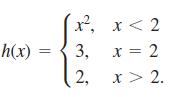
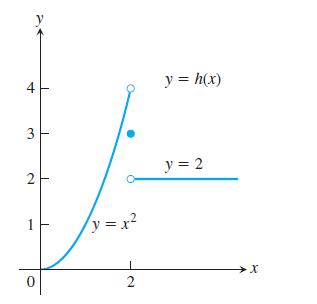
LetShow thata. limx→2 h(x) ≠ 4b. limx→2h(x) ≠ 3c. limx→2h(x) ≠ 2 h(x) = x², x < 2 x = 2 3, 2, x > 2.
Because of their connection with secant lines, tangents, and instantaneous rates, limits of the formoccur frequently in calculus. Evaluate this limit for the given value of x and function ƒ.ƒ(x) = 3x - 4, x = 2 lim h→0 f(x + h) = f(x) h
Explain why the following five statements ask for the same information.a. Find the roots of ƒ(x) = x3 - 3x - 1.b. Find the x-coordinates of the points where the curve y = x3 crosses the line y = 3x + 1.c. Find all the values of x for which x3 - 3x = 1.d. Find the x-coordinates of the points where
Give an example of a function ƒ(x) that is continuous for all values of x except x = 2, where it has a removable discontinuity. Explain how you know that ƒ is discontinuous at x = 2, and how you know the discontinuity is removable.
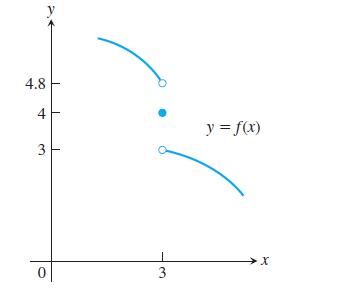
For the function graphed here, explain whya. limx→3 f(x) ≠ 4b. limx→3f(x) ≠ 4.8c. limx→3f(x) ≠ 3 4.8 4 ننا 3 0 3 y = f(x) X
Because of their connection with secant lines, tangents, and instantaneous rates, limits of the formoccur frequently in calculus. Evaluate this limit for the given value of x and function ƒ.ƒ(x) = 1/x, x = -2 lim h→0 f(x + h) = f(x) h
Give an example of a function g(x) that is continuous for all values of x except x = -1, where it has a nonremovable discontinuity. Explain how you know that g is discontinuous there and why the discontinuity is not removable.
Because of their connection with secant lines, tangents, and instantaneous rates, limits of the formoccur frequently in calculus. Evaluate this limit for the given value of x and function ƒ.ƒ(x) = √x, x = 7 lim h→0 f(x + h) = f(x) h
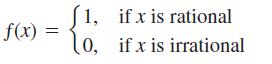
a. Use the fact that every nonempty interval of real numbers contains both rational and irrational numbers to show that the functionis discontinuous at every point.b. Is ƒ right-continuous or left-continuous at any point? f(x)= = [1, 0, if x is rational if x is irrational
Because of their connection with secant lines, tangents, and instantaneous rates, limits of the formoccur frequently in calculus. Evaluate this limit for the given value of x and function ƒ.ƒ(x) = √3x + 1, x = 0 lim h→0 f(x + h) = f(x) h
If functions ƒ(x) and g(x) are continuous for 0 ≤ x ≤ 1, could ƒ(x)/g(x) possibly be discontinuous at a point of [0, 1]? Give reasons for your answer.
If the product function h(x) = ƒ(x) · g(x) is continuous at x = 0, must ƒ(x) and g(x) be continuous at x = 0? Give reasons for your answer.
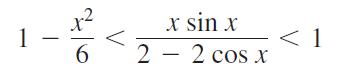
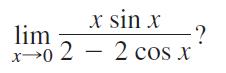
a. It can be shown that the inequalitieshold for all values of x close to zero. What, if anything, does this tell you aboutGive reasons for your answer.b. Graph y = 1 - (x2/6), y = (x sin x)/(2 - 2 cos x), and y = 1 together for -2 ≤ x ≤ 2. Comment on the behavior of the graphs as x→0. 1 6 x
If √5 - 2x2 ≤ ƒ(x) ≤ √5 - x2 for -1 ≤ x ≤ 1, find limx→0 ƒ(x).
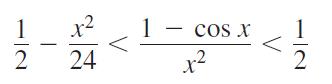
a. Suppose that the inequalitieshold for values of x close to zero. What, if anything, does this tell you aboutGive reasons for your answer.b. Graph the equations y = (1/2) - (x2/24), y = (1 - cos x)/x2, and y = 1/2 together for -2 ≤ x ≤ 2. Comment on the behavior of the graphs as x→0.
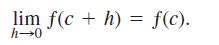
Prove that ƒ is continuous at c if and only if lim f(c + h) = f(c). h→0
Is it true that a continuous function that is never zero on an interval never changes sign on that interval? Give reasons for your answer.
If 2 - x2 ≤ g(x) ≤ 2 cos x for all x, find limx→0 g(x).
Give an example of functions ƒ and g, both continuous at x = 0, for which the composite f ° g is discontinuous at x = 0. Does this contradict Theorem 9? Give reasons for your answer.
Is it true that if you stretch a rubber band by moving one end to the right and the other to the left, some point of the band will end up in its original position? Give reasons for your answer.
Let g(x) = (x2 - 2)/(x - √2).a. Make a table of the values of g at the points x = 1.4, 1.41, 1.414, and so on through successive decimal approximations of 22. Estimate limx→√2 g(x).b. Support your conclusion in part (a) by graphing g near c = 22 and using Zoom and Trace to estimate y-values
Suppose that a function ƒ is continuous on the closed interval [0, 1] and that 0 ≤ ƒ(x) ≤ 1 for every x in [0, 1]. Show that there must exist a number c in [0, 1] such that ƒ(c) = c (c is called a fixed point of ƒ).
Let ƒ be defined on an interval (a, b) and suppose that ƒ(c) ≠ 0 at some c where ƒ is continuous. Show that there is an interval (c - δ, c + δ) about c where ƒ has the same sign as ƒ(c).
Let G(x) = (x + 6)/(x2 + 4x - 12).a. Make a table of the values of G at x = -5.9, -5.99, -5.999, and so on. Then estimate limx→ -6 G(x). What estimate do you arrive at if you evaluate G at x = -6.1, -6.01, -6.001, c instead?b. Find limx→ -6 G(x) algebraically.
Together with the identities sin (h + c) = sin h cos c + cos h sin c, cos (h + c) = cos h cos c - sin h sin c to prove that both ƒ(x) = sin x and g(x) = cos x are continuous at every point x = c.
Let h(x) = (x2 - 2x - 3) / (x2 - 4x + 3).a. Make a table of the values of h at x = 2.9, 2.99, 2.999, and so on. Then estimate limx→3 h(x). What estimate do you arrive at if you evaluate h at x = 3.1, 3.01, 3.001,c instead?b. Support your conclusions in part (a) by graphing h near c = 3 and using
Use the Intermediate Value Theorem to prove that each equation has a solution. Then use a graphing calculator or computer grapher to solve the equations.x3 - 3x - 1 = 0
Let ƒ(x) = (x2 - 1) / (|x| - 1).a. Make tables of the values of ƒ at values of x that approach c = -1 from above and below. Then estimate limx→ -1 ƒ(x).b. Support your conclusion in part (a) by graphing ƒ near c = -1 and using Zoom and Trace to estimate y-values on the graph as x→ -1.c.
Let F(x) = (x2 + 3x + 2) / (2 - |x|).a. Make tables of values of F at values of x that approach c = -2 from above and below. Then estimate limx→ -2 F(x).b. Support your conclusion in part (a) by graphing F near c = -2 and using Zoom and Trace to estimate y-values on the graph as x→-2.c. Find
Use the Intermediate Value Theorem to prove that each equation has a solution. Then use a graphing calculator or computer grapher to solve the equations.2x3 - 2x2 - 2x + 1 = 0
Use the Intermediate Value Theorem to prove that each equation has a solution. Then use a graphing calculator or computer grapher to solve the equations.x(x - 1)2 = 1 (one root)
Let g(θ) = (sin θ)/θ.a. Make a table of the values of g at values of θ that approach θ0 = 0 from above and below. Then estimate limθ→0 g(θ).b. Support your conclusion in part (a) by graphing g near θ0 = 0.
Use the Intermediate Value Theorem to prove that each equation has a solution. Then use a graphing calculator or computer grapher to solve the equations.xx = 2
Use the Intermediate Value Theorem to prove that each equation has a solution. Then use a graphing calculator or computer grapher to solve the equations. √x + √1 + x = 4
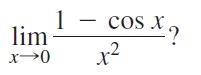
Let G(t) = (1 - cos t)/t2.a. Make tables of values of G at values of t that approach t0 = 0 from above and below. Then estimate limt→0 G(t).b. Support your conclusion in part (a) by graphing G near t0 = 0.
Let ƒ(x) = (3x - 1)/x.a. Make tables of values of ƒ at values of x that approach c = 0 from above and below. Does ƒ appear to have a limit as x→ 0? If so, what is it? If not, why not?b. Support your conclusions in part (a) by graphing ƒ near c = 0.
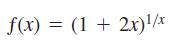
Let ƒ(x) = x1/(1-x).a. Make tables of values of ƒ at values of x that approach c = 1 from above and below. Does ƒ appear to have a limit as x→ 1? If so, what is it? If not, why not?b. Support your conclusions in part (a) by graphing ƒ near c = 1.
Use the Intermediate Value Theorem to prove that each equation has a solution. Then use a graphing calculator or computer grapher to solve the equations.cos x = x (one root). Make sure you are using radian mode.
Suppose that g(x) ≤ ƒ(x) ≤ h(x) for all x ≠ 2 and suppose thatCan we conclude anything about the values of ƒ, g, and h at x = 2? Could ƒ(2) = 0? Could limx→2 ƒ(x) = 0? Give reasons for your answers. lim g(x) x-2 = lim h(x) = -5. x-2
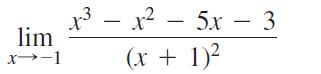
Use a CAS to perform the following steps:a. Plot the function near the point c being approached.b. From your plot guess the value of the limit. lim x→-1 x3 r3 – 2 – 5x – 3 (x + 1)²
a. Ifb. If f(x) lim x-2 X-2 5 = 3, find lim f(x). x-2
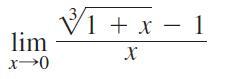
Use a CAS to perform the following steps:a. Plot the function near the point c being approached.b. From your plot guess the value of the limit. lim x-0 √1 + x - 1 X
If x4 ≤ ƒ(x) ≤ x2 for x in [-1, 1] and x2 ≤ ƒ(x) ≤ x4 for x < -1 and x > 1, at what points c do you automatically know limx→c ƒ(x)? What can you say about the value of the limit at these points?
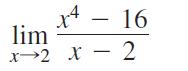
Use a CAS to perform the following steps:a. Plot the function near the point c being approached.b. From your plot guess the value of the limit. +4 lim x-2 X-2 16
Use the Intermediate Value Theorem to prove that each equation has a solution. Then use a graphing calculator or computer grapher to solve the equations.2 sin x = x (three roots). Make sure you are using radian mode.
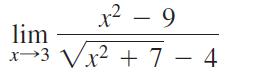
Use a CAS to perform the following steps:a. Plot the function near the point c being approached.b. From your plot guess the value of the limit. x² - 9 lim x 3 √√√x² + 7 - 4
a. Graph g(x) = x sin (1/x) to estimate limx→0 g(x), zooming in on the origin as necessary.b. Confirm your estimate in part (a) with a proof.
Showing 13900 - 14000
of 29454
First
133
134
135
136
137
138
139
140
141
142
143
144
145
146
147
Last
Step by Step Answers

 Get 50% OFF
Claim Now
Get 50% OFF
Claim Now