New Semester
Started
Get
50% OFF
Study Help!
--h --m --s
Claim Now
Question Answers
Textbooks
Find textbooks, questions and answers
Oops, something went wrong!
Change your search query and then try again
S
Books
FREE
Study Help
Expert Questions
Accounting
General Management
Mathematics
Finance
Organizational Behaviour
Law
Physics
Operating System
Management Leadership
Sociology
Programming
Marketing
Database
Computer Network
Economics
Textbooks Solutions
Accounting
Managerial Accounting
Management Leadership
Cost Accounting
Statistics
Business Law
Corporate Finance
Finance
Economics
Auditing
Tutors
Online Tutors
Find a Tutor
Hire a Tutor
Become a Tutor
AI Tutor
AI Study Planner
NEW
Sell Books
Search
Search
Sign In
Register
study help
mathematics
precalculus
Calculus Of A Single Variable 11th Edition Ron Larson, Bruce H. Edwards - Solutions
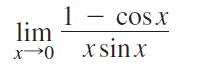
Use a CAS to perform the following steps:a. Plot the function near the point c being approached.b. From your plot guess the value of the limit. 1 - cos.x lim x0 xsinx
a. Graph h(x) = x2 cos (1/x3) to estimate limx→0 h(x), zooming in on the origin as necessary.b. Confirm your estimate in part (a) with a proof.
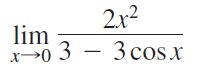
Use a CAS to perform the following steps:a. Plot the function near the point c being approached.b. From your plot guess the value of the limit. 2x² lim x–0 3 – 3cosx
What does it mean to say that f(c) is the minimum of f on an interval I?
In your own words, describe Rolle’s Theorem.
In your own words, describe the Extreme Value Theorem.
In your own words, describe the Mean Value Theorem.
What is the difference between a relative maximum and an absolute maximum on an interval I?
What is a critical number?
Explain how to find the critical numbers of a function.
Explain how to find the extrema of a continuous function on a closed interval [a, b].
Find the two x-intercepts of the function f and show that f′(x) = 0 at some point between the two x-intercepts.f(x) = x2 − x − 2
Determine whether Rolle’s Theorem can be applied to f on the closed interval [a, b]. If Rolle’s Theorem can be applied, find all values of c in the open interval (a, b) such that f′(c) = 0. If Rolle’s Theorem cannot be applied, explain why not.f(x) = 3 − ∣x − 3∣, [0, 6]
Find the critical numbers of the function.f(x) = 4x2 − 6x
Find the critical numbers of the function.g(x) = x − √x
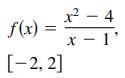
Determine whether Rolle’s Theorem can be applied to f on the closed interval [a, b]. If Rolle’s Theorem can be applied, find all values of c in the open interval (a, b) such that f′(c) = 0. If Rolle’s Theorem cannot be applied, explain why not. x² - 4 x-1' f(x) [-2,2]
Find the critical numbers of the function. f(0) 2 sec 0 + tan 0, 0 < 0 < 2π
Determine whether Rolle’s Theorem can be applied to f on the closed interval [a, b]. If Rolle’s Theorem can be applied, find all values of c in the open interval (a, b) such that f′(c) = 0. If Rolle’s Theorem cannot be applied, explain why not.f(x) = cos x, [π, 3π]
Find the critical numbers of the function.h(x) = sin2 x + cos x, 0 < x < 2π
Determine whether Rolle’s Theorem can be applied to f on the closed interval [a, b]. If Rolle’s Theorem can be applied, find all values of c in the open interval (a, b) such that f′(c) = 0. If Rolle’s Theorem cannot be applied, explain why not.f(x) = cos πx, [0, 2]
Determine whether Rolle’s Theorem can be applied to f on the closed interval [a, b]. If Rolle’s Theorem can be applied, find all values of c in the open interval (a, b) such that f′(c) = 0. If Rolle’s Theorem cannot be applied, explain why not.f(x) = sin 3x, [π/ 2 , 7π/ 6]
Find the absolute extrema of the function on the closed interval.f (x) = 3 − x, [−1, 2]
Find the absolute extrema of the function on the closed interval.h(x) = 5 − 2x2 , [−3, 1]
Find the absolute extrema of the function on the closed interval.f(x) = 7x2 + 1, [−1, 2]
Find the absolute extrema of the function on the closed interval.f(x) = 2x3 − 6x, [0, 3]
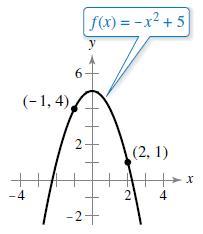
Consider the graph of the function f(x) = −x2 + 5 (see figure).(a) Find the equation of the secant line joining the points (−1, 4) and (2, 1).(b) Use the Mean Value Theorem to determine a point c in the interval (−1, 2) such that the tangent line at c is parallel to the secant line.(c) Find
Find the absolute extrema of the function on the closed interval.g(x) = 6x2/x − 2, [−2, 1]
Find the absolute extrema of the function on the closed interval.h(t) = t/t + 3, [−1, 6]
Find the absolute extrema of the function on the closed interval.y = 3 − ∣t − 3∣, [−1, 5]
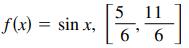
Find the absolute extrema of the function on the closed interval. f(x) = sin x, 5 11 6' 6
Find the absolute extrema of the function on the closed interval.g(x) = ∣x + 4∣, [−7, 1]
Find the absolute extrema of the function on the closed interval.f(x) = [[x]], [−2, 2]
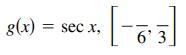
Find the absolute extrema of the function on the closed interval. g(x) = sec x, [-63]
Explain why the Mean Value Theorem does not apply to the function f on the interval [0, 6].f(x) = 1 / x − 3
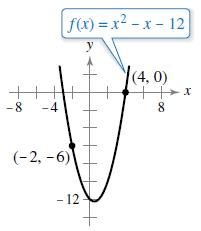
Consider the graph of the function f(x) = x2 − x − 12 (see figure).(a) Find the equation of the secant line joining the points (−2, −6) and (4, 0).(b) Use the Mean Value Theorem to determine a point c in the interval (−2, 4) such that the tangent line at c is parallel to the secant
Find the absolute extrema of the function on the closed interval.h(x) = [[2 − x]], [−2, 2]
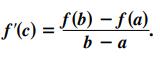
Determine whether the Mean Value Theorem can be applied to f on the closed interval [a, b]. If the Mean Value Theorem can be applied, find all values of c in the open interval (a, b) such thatIf the Mean Value Theorem cannot be applied, explain why not.f(x) = 6x3 , [1, 2] f'(c) = f(b)-f(a) b-a
Explain why the Mean Value Theorem does not apply to the function f on the interval [0, 6].f(x) = ∣x − 3∣
Determine whether the Mean Value Theorem can be applied to f on the closed interval [a, b]. If the Mean Value Theorem can be applied, find all values of c in the open interval (a, b) such thatIf the Mean Value Theorem cannot be applied, explain why not.f(x) = x6, [−1, 1] f'(c) = f(b)-f(a) b-a
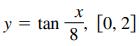
Find the absolute extrema of the function on the closed interval. y = tan [0, 2]
Determine whether the Mean Value Theorem can be applied to f on the closed interval [a, b]. If the Mean Value Theorem can be applied, find all values of c in the open interval (a, b) such thatIf the Mean Value Theorem cannot be applied, explain why not.f(x) = x3 + 2x + 4, [−1, 0] f'(c)
Determine whether the Mean Value Theorem can be applied to f on the closed interval [a, b]. If the Mean Value Theorem can be applied, find all values of c in the open interval (a, b) such thatIf the Mean Value Theorem cannot be applied, explain why not.f(x) = x3 − 3x2 + 9x + 5, [0, 1] f'(c)
Determine whether the Mean Value Theorem can be applied to f on the closed interval [a, b]. If the Mean Value Theorem can be applied, find all values of c in the open interval (a, b) such thatIf the Mean Value Theorem cannot be applied, explain why not.f(x) = x/x − 5, [1, 4] f'(c) = f(b)-f(a) b-a
Determine whether the Mean Value Theorem can be applied to f on the closed interval [a, b]. If the Mean Value Theorem can be applied, find all values of c in the open interval (a, b) such thatIf the Mean Value Theorem cannot be applied, explain why not.f(x) = x + 2/x − 1, [−3, 3] f'(c)
Determine whether the Mean Value Theorem can be applied to f on the closed interval [a, b]. If the Mean Value Theorem can be applied, find all values of c in the open interval (a, b) such thatIf the Mean Value Theorem cannot be applied, explain why not.f(x) = √2 − x, [−7, 2] f'(c)
Determine whether the Mean Value Theorem can be applied to f on the closed interval [a, b]. If the Mean Value Theorem can be applied, find all values of c in the open interval (a, b) such thatIf the Mean Value Theorem cannot be applied, explain why not.f(x) = sin x, [0, π] f'(c) = f(b)-f(a) b-a
Determine whether the Mean Value Theorem can be applied to f on the closed interval [a, b]. If the Mean Value Theorem can be applied, find all values of c in the open interval (a, b) such thatIf the Mean Value Theorem cannot be applied, explain why not.f(x) = cos x + tan x, [0, π] f'(c)
Use a graphing utility to graph the function and find the absolute extrema of the function on the given interval.f(x) = √x + sin x /3, [0, π]
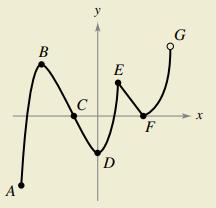
Determine whether each labeled point is an absolute maximum or minimum, a relative maximum or minimum, or none of these. A B с E D F G x
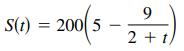
A company introduces a new product for which the number of units sold S iswhere t is the time in months.(a) Find the average rate of change of S during the first year.(b) During what month of the first year does S′(t) equal the average rate of change? 200(5- S(t) = 200 9 2 + 1/
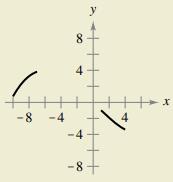
The figure shows two parts of the graph of a continuous differentiable function f on [−10, 4]. The derivative f′ is also continuous. To print an enlarged copy of the graph, go to MathGraphs.com.(a) Explain why f must have at least one zero in [−10, 4].(b) Explain why f′ must also have at
The height of an object t seconds after it is dropped from a height of 300 meters is s(t) = −4.9t2 + 300.(a) Find the average velocity of the object during the first 3 seconds.(b) Use the Mean Value Theorem to verify that at some time during the first 3 seconds of fall, the instantaneous velocity
Consider the function f(x) = x − 4 / x + 2.Is x = −2 a critical number of f ? Why or why not?
Determine whether the statement is true or false. If it is false, explain why or give an example that shows it is false.The maximum of y = x2 on the open interval (−3, 3) is 9.
Determine whether the statement is true or false. If it is false, explain why or give an example that shows it is false.If a function is continuous on a closed interval, then it must have a minimum on the interval.
Determine whether the statement is true or false. If it is false, explain why or give an example that shows it is false.If x = c is a critical number of the function f, then it is also a critical number of the function g(x) = f(x) + k, where k is a constant.
Determine whether the statement is true or false. If it is false, explain why or give an example that shows it is false.If x = c is a critical number of the function f, then it is also a critical number of the function g(x) = f(x − k), where k is a constant.
Determine whether the statement is true or false. If it is false, explain why or give an example that shows it is false. The Mean Value Theorem can be applied to f(x) = tan x on the interval [0, π/4].
(a) Let f(x) = x2 and g(x) = −x3 + x2 + 3x + 2. Then f(−1) = g(−1) and f(2) = g(2). Show that there is at least one value c in the interval (−1, 2) where the tangent line to f at (c, f(c)) is parallel to the tangent line to g at (c, g(c)). Identify c.(b) Let f and g be differentiable
Prove that ∣cos a − cos b∣ ≤ ∣a − b∣ for all a and b.
Prove that ∣sin a − sin b∣ ≤ ∣a − b∣ for all a and b.
How is the Chain Rule applied when finding dy/dx implicitly?
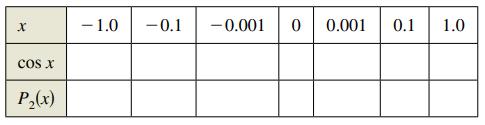
(a) Find the polynomial P1(x) = a0 + a1x whose value and slope agree with the value and slope of f(x) = cos x at the point x = 0.(b) Find the polynomial P2(x) = a0 + a1x + a2 x2 whose value and first two derivatives agree with the value and first two derivatives of f(x) = cos x at the point x = 0.
What is a related-rate equation?
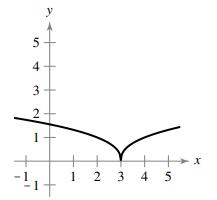
Describe the x-values at which f is differentiable.f(x) = (x − 3)2/5 5 4 3 لیا 2 1 1 2 3 4 5
Find the derivative of the function by the limit process.f(x) = 12
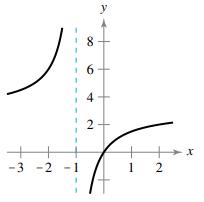
Describe the x-values at which f is differentiable.f(x) = 3x/x + 1 -3-2 00 8 6 2 y 12 X
Find the derivative of the function by the limit process.f(x) = x3 − 2x + 1
Find the derivative of the function by the limit process.f(x) = 6/x
The length s of each side of an equilateral triangle is increasing at a rate of 13 feet per hour. Find the rate of change of the area when s = 41 feet.The formula for the area of an equilateral triangle is A = $²√√√3 S 4
Use the rules of differentiation to find the derivative of the function.y = 25
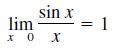
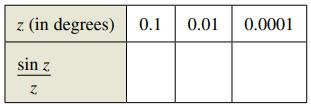
The fundamental limit assumes that x is measured in radians. Suppose you assume that x is measured in degrees instead of radians. (a) Set your calculator to degree mode and complete the table.(b) Use the table to estimatefor z in degrees. What is the exact value of this limit?(c) Use the
Use the rules of differentiation to find the derivative of the function.f(t) = π/6
Use the rules of differentiation to find the derivative of the function.f(x) = x3 − 11x2
The radius r of a circle is increasing at a rate of 4 centimeters per minute. Find the rates of change of the area when r = 37 centimeters.
Use the rules of differentiation to find the derivative of the function.g(s) = 3s5 − 2s4
Use the rules of differentiation to find the derivative of the function.h(x) = 6√x + 33√x
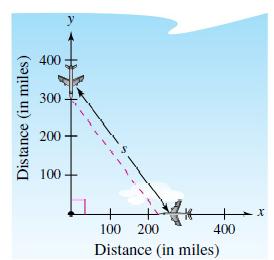
An air traffic controller spots two planes at the same altitude converging on a point as they fly at right angles to each other (see figure). One plane is 225 miles from the point, moving at 450 miles per hour. The other plane is 300 miles from the point, moving at 600 miles per hour.(a) At what
Use the rules of differentiation to find the derivative of the function.f(x) = x1/2 − x−5/6
A spherical balloon is inflated with gas at the rate of 800 cubic centimeters per minute.(a) Find the rates of change of the radius when r = 30 centimeters and r = 85 centimeters.(b) Explain why the rate of change of the radius of the sphere is not constant even though dV/dt is constant.
Use the rules of differentiation to find the derivative of the function.g(t) = 2/3t2
Use the rules of differentiation to find the derivative of the function.h(x) = 8/5x4
Use the rules of differentiation to find the derivative of the function.f(θ) = 4θ − 5 sin θ
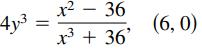
Find dy/dx by implicit differentiation. Then find the slope of the graph at the given point. 4y3 x² - x³ + 36 36' (6, 0)
Use the rules of differentiation to find the derivative of the function.g(α) = 4 cos α + 6
The volume of oil in a cylindrical container is increasing at a rate of 150 cubic inches per second. The height of the cylinder is approximately ten times the radius. At what rate is the height of the oil changing when the oil is 35 inches high?
Complete the table to find the derivative of the function. Original Function Rewrite Differentiate Simplify 8 5x-5 y
Find the slope of the graph of the function at the given point.f(x) = 4x5 + 3x − sin x, (0, 0)
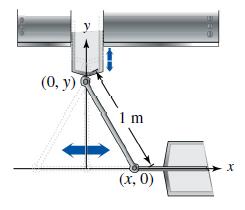
The endpoints of a movable rod of length 1 meter have coordinates (x, 0) and (0, y) (see figure). The position of the end on the x-axis is x(t) = 1/2 sin πt/6 where t is the time in seconds.In Figure (a) Find the time of one complete cycle of the rod.(b) What is the lowest point reached by
The surface area of a cube with sides of length x is given by S = 6x2. Find the rate of change of the surface area with respect to x when x = 4 inches.
Use the position function s(t) = −16t2 + v0t + s0 for free-falling objects.A block is dropped from the top of a 450-foot platform. What is its velocity after 2 seconds? After 5 seconds?
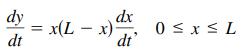
Describe the relationship between the rate of change of y and the rate of change of x in each expression. Assume all variables and derivatives are positive.(a)(b) dy dt = dx 3 dt
Use the Product Rule or the Quotient Rule to find the derivative of the function.f(x) = (9x − 1)sin x
Use the Product Rule or the Quotient Rule to find the derivative of the function.f(t) = 2t5 cos t
Find the derivative of the function.g(x) = (2 + (x2 + 1)4)3
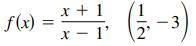
Find an equation of the tangent line to the graph of f at the given point. x f(x) - X + 1² (1-₁-3) x-1' 2²
Let V be the volume of a cube of side length s that is changing with respect to time. If ds/dt is constant, is dV/dt constant? Explain.
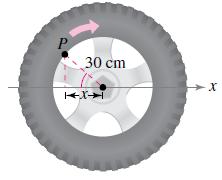
A wheel of radius 30 centimeters revolves at a rate of 10 revolutions per second. A dot is painted at a point P on the rim of the wheel (see figure).In Figure (a) Find dx/dt as a function of θ.(b) Use a graphing utility to graph the function in part (a).(c) When is the absolute value of the
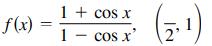
Find an equation of the tangent line to the graph of f at the given point. f(x) 1 + cos x 1 - cos x' 5.¹) 2
Use the Product Rule or the Quotient Rule to find the derivative of the function.y = −x2 tan x
Showing 14000 - 14100
of 29454
First
134
135
136
137
138
139
140
141
142
143
144
145
146
147
148
Last
Step by Step Answers

 Get 50% OFF
Claim Now
Get 50% OFF
Claim Now