New Semester
Started
Get
50% OFF
Study Help!
--h --m --s
Claim Now
Question Answers
Textbooks
Find textbooks, questions and answers
Oops, something went wrong!
Change your search query and then try again
S
Books
FREE
Study Help
Expert Questions
Accounting
General Management
Mathematics
Finance
Organizational Behaviour
Law
Physics
Operating System
Management Leadership
Sociology
Programming
Marketing
Database
Computer Network
Economics
Textbooks Solutions
Accounting
Managerial Accounting
Management Leadership
Cost Accounting
Statistics
Business Law
Corporate Finance
Finance
Economics
Auditing
Tutors
Online Tutors
Find a Tutor
Hire a Tutor
Become a Tutor
AI Tutor
AI Study Planner
NEW
Sell Books
Search
Search
Sign In
Register
study help
mathematics
precalculus
Calculus Of A Single Variable 11th Edition Ron Larson, Bruce H. Edwards - Solutions
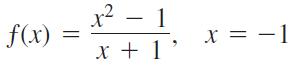
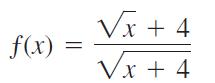
Use the formal definition of limit to prove that the function has a continuous extension to the given value of x. f(x) x² - 1 x + 1' I- X x = -1
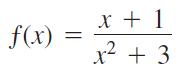
Find the limit of each rational function (a) As x→ ∞ and (b) As x→ -∞. f(x) = x + 1 2 x² + 3
How can looking at the graph of a function help you tell where the function is continuous?
Use the method in Example 3 to find (a) The slope of the curve at the given point P, and (b) An equation of the tangent line at P.y = x3 - 12x, P(1, -11)Example 3Find the slope of the parabola y = x2 at the point P(2, 4). Write an equation for the tangent to the parabola at this point.
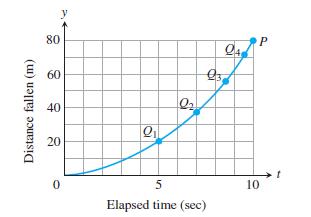
The accompanying figure shows the plot of distance fallen versus time for an object that fell from the lunar landing module a distance 80 m to the surface of the moon.a. Estimate the slopes of the secants PQ1, PQ2, PQ3, and PQ4, arranging them in a table like the one in Figure 2.6.b. About how fast
If limx→0+ ƒ(x) = A and limx→0- ƒ(x) = B, finda. limx→0+ ƒ(x3 - x) b. limx→0- ƒ(x3 - x)c. limx→0+ ƒ(x2 - x4) d. limx→0- ƒ(x2 - x4)
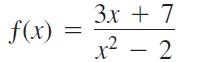
Find the limit of each rational function (a) As x→ ∞ and (b) As x→ -∞. f(x) = 3x 2 X + 7 - 2
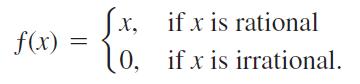
Leta. Show that ƒ is continuous at x = 0.b. Use the fact that every nonempty open interval of real numbers contains both rational and irrational numbers to show that ƒ is not continuous at any nonzero value of x. f(x) = fx, if x is rational 10, 0, if x is irrational.
What does it mean for a function to be right-continuous at a point? Left-continuous? How are continuity and one-sided continuity related?
Use the method in Example 3 to find (a) The slope of the curve at the given point P, and (b) An equation of the tangent line at P.y = x3 - 3x2 + 4, P(2, 0)Example 3Find the slope of the parabola y = x2 at the point P(2, 4). Write an equation for the tangent to the parabola at this point.
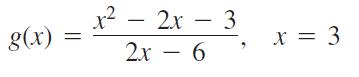
Use the formal definition of limit to prove that the function has a continuous extension to the given value of x. g(x) x² - 2x - 2x - 6 3 x = 3
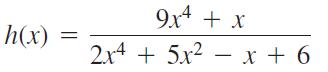
Find the limit of each rational function (a) As x→ ∞ and (b) As x→ -∞. h(x) = 9x² + x 2x4+ 5x² x + 6 -
What does it mean for a function to be continuous on an interval? Give examples to illustrate the fact that a function that is not continuous on its entire domain may still be continuous on selected intervals within the domain.
Which of the following statements are true, and which are false? If true, say why; if false, give a counterexample (that is, an example confirming the falsehood).a. If limx→c ƒ(x) exists but limx→c g(x) does not exist, then limx→c(ƒ(x) + g(x)) does not exist.b. If neither limx→c ƒ(x) nor
What are the basic types of discontinuity? Give an example of each. What is a removable discontinuity? Give an example.
If x is a rational number, then x can be written in a unique way as a quotient of integers m/n where n > 0 and m and n have no common factors greater than 1. (We say that such a fraction is in lowest terms. For example, 6/4 written in lowest terms is 3/2.) Let ƒ(x) be defined for all x in the
What does it mean for a function to have the Intermediate Value Property? What conditions guarantee that a function has this property over an interval? What are the consequences for graphing and solving the equation ƒ(x) = 0?
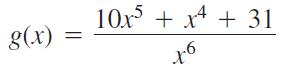
Find the limit of each rational function (a) as x→ ∞ and (b) as x→ -∞. g(x) = 10x° + x+ + 31 0
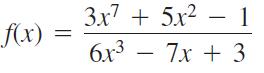
Find the limit of each rational function (a) as x→ ∞ and (b) as x→ -∞. f(x) = 3x7 + 5x² - 1 6x³ - 7x + 3
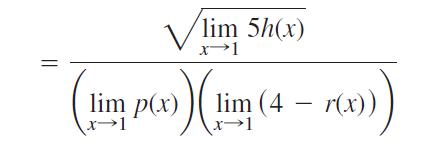
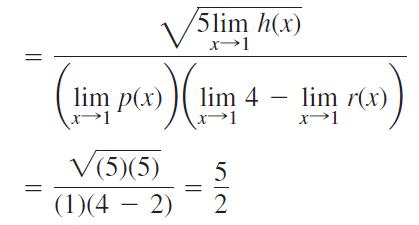
Let limx→1 h(x) = 5, limx→1 p(x) = 1, and limx→1 r(x) = 2. Name the rules in Theorem 1 that are used to accomplish steps (a), (b), and (c) of the following calculation.(a)(b)(c) V5h(x) lim x→i p(x)(4 - r(x)) lim √5h(x) x-1 lim (p(x)(4 r(x))) x-1 -
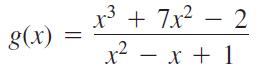
Find the limit of each rational function (a) As x→ ∞ and (b) As x→ -∞. g(x) = zXL + EX 2 x² = x + 1
Under what circumstances can you extend a function ƒ(x) to be continuous at a point x = c? Give an example.
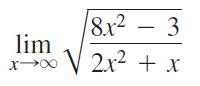
The process by which we determine limits of rational functions applies equally well to ratios containing noninteger or negative powers of x: Divide numerator and denominator by the highest power of x in the denominator and proceed from there. Find the limit. lim 8.x² 3 √ 2x² + x
What exactly do limx→∞ ƒ(x) = L and limx→-∞ ƒ(x) = L mean? Give examples.
a. Show that the expressionequals a if a ≥ b and equals b if b ≥ a. In other words, max {a, b} gives the larger of the two numbers a and b.b. Find a similar expression for min {a, b}, the smaller of a and b. max {a, b} = a + b 2 + |a - bl 2
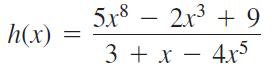
Find the limit of each rational function (a) As x→ ∞ and (b) As x→ -∞. h(x) 5x8 - 2x³ + 9 3 + x - 4x5
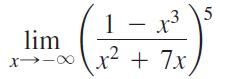
The process by which we determine limits of rational functions applies equally well to ratios containing noninteger or negative powers of x: Divide numerator and denominator by the highest power of x in the denominator and proceed from there. Find the limit. lim 8118 1 - x³ x² + 7x 5
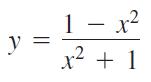
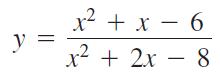
Use limits to determine the equations for all horizontal asymptotes.a.b.c.d. y = 1 - x² 2 x² + 1
What are limx→±∞ k (k a constant) and limx→±∞ (1/x)? How do you extend these results to other functions? Give examples.
Is there any reason to believe that there is always a pair of antipodal (diametrically opposite) points on Earth’s equator where the temperatures are the same? Explain.
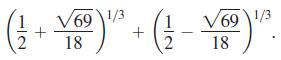
Let ƒ(x) = x3 - x - 1.a. Use the Intermediate Value Theorem to show that ƒ has a zero between -1 and 2.b. Solve the equation ƒ(x) = 0 graphically with an error of magnitude at most 10-8.c. It can be shown that the exact value of the solution in part (b) isEvaluate this exact answer and compare
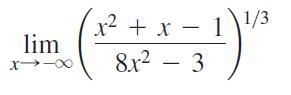
The process by which we determine limits of rational functions applies equally well to ratios containing noninteger or negative powers of x: Divide numerator and denominator by the highest power of x in the denominator and proceed from there. Find the limit. lim + x = - "812² - - 3 1) 1/²
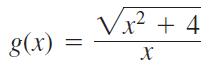
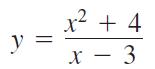
Use limits to determine the equations for all vertical asymptotes.a.b.c. y = x² + 4 X x - 3
How do you find the limit of a rational function as x→±∞? Give examples.
Let ƒ(x) = (x2 - 9)/(x + 3).a. Make a table of the values of ƒ at the points x = -3.1, -3.01, -3.001, and so on as far as your calculator can go. Then estimate limx→-3 ƒ(x). What estimate do you arrive at if you evaluate ƒ at x = -2.9, -2.99, -2.999,cinstead?b. Find limx→-3 ƒ(x)
If limx→c (ƒ(x) + g(x)) = 3 and limx→c (ƒ(x) - g(x)) = -1, find limxSc ƒ(x)g(x).
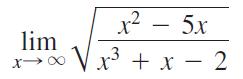
The process by which we determine limits of rational functions applies equally well to ratios containing noninteger or negative powers of x: Divide numerator and denominator by the highest power of x in the denominator and proceed from there. Find the limit. lim r2 – 5x Vx 3 x³ + x - 2
What are horizontal and vertical asymptotes? Give examples.
Show that the equation x + 2 cos x = 0 has at least one solution.
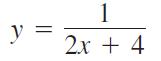
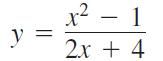
Graph the rational function. Include the graphs and equations of the asymptotes and dominant terms. y 1 2x + 4
A real-valued function ƒ is bounded from above on a set D if there exists a number N such that ƒ(x) ≤ N for all x in D. We call N, when it exists, an upper bound for ƒ on D and say that ƒ is bounded from above by N. In a similar manner, we say that ƒ is bounded from below on D if there
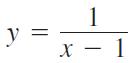
Graph the rational function. Include the graphs and equations of the asymptotes and dominant terms. y 1 x - 1 X
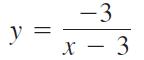
Graph the rational function. Include the graphs and equations of the asymptotes and dominant terms. y = -3 3
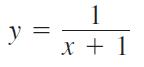
Graph the rational function. Include the graphs and equations of the asymptotes and dominant terms. y = 1 x + 1
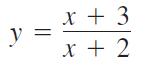
Graph the rational function. Include the graphs and equations of the asymptotes and dominant terms. y = x + 3 x + 2
Sketch the graph of a function y = ƒ(x) that satisfies the given conditions. No formulas are required—just label the coordinate axes and sketch an appropriate graph. f(0) = 0, lim f(x) = 0, lim f(x) = x +∞ x-1 lim f(x) = -∞, and lim f(x) = − ∞ x→1+ x--1- lim f(x) = ∞, x→-1+
Can ƒ(x) = x(x2 - 1)/ | x2 - 1| be extended to be continuous at x = 1 or -1? Give reasons for your answers. (Graph the function— you will find the graph interesting.)
Sketch the graph of a function y = ƒ(x) that satisfies the given conditions. No formulas are required—just label the coordinate axes and sketch an appropriate graph. f(0) = 0, f(1) = 2, f(−1) = −2, lim f(x) = -1, and X--X lim f(x) = 1
Explain why the function ƒ(x) = sin (1/x) has no continuous extension to x = 0.
Find a function that satisfies the given conditions and sketch its graph. h(x) = -1, lim h(x) = 1, lim h(x) = -1, and X78 x-0 X--X lim h(x) = 1 x-0+
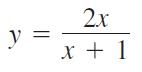
Graph the rational function. Include the graphs and equations of the asymptotes and dominant terms. y || 2x x + 1
Find a function that satisfies the given conditions and sketch its graph. lim f(x) = 0, lim f(x) = ∞, and lim f(x) = 8 x→ +∞ x-2 x-2+
Show by example that the following statement is wrong.The number L is the limit of ƒ(x) as x approaches c if ƒ(x) gets closer to L as x approaches c.Explain why the function in your example does not have the given value of L as a limit as x→ c.
Sketch the graph of a function y = ƒ(x) that satisfies the given conditions. No formulas are required—just label the coordinate axes and sketch an appropriate graph. f(0) = 0, lim f(x) = 0, lim f(x) = 2, and x→+∞ lim f(x) = -2 x-0
Find a function that satisfies the given conditions and sketch its graph. lim k(x) x→ +∞ = 1, lim k(x) x-1 = ∞, and lim k(x) = -∞ x-1+
Sketch the graph of a function y = ƒ(x) that satisfies the given conditions. No formulas are required—just label the coordinate axes and sketch an appropriate graph. ƒ(2) = 1, ƒ(−1) = 0, lim f(x) = 0, lim_ f(x) = ∞, X-X x->0+ = 1 lim f(x) = -∞, and lim f(x) x-0 x-x
Find a function that satisfies the given conditions and sketch its graph. lim g(x) x-+∞ = 0, lim g(x) x-3¯ = -∞, and lim g(x) x-3+ = ∞
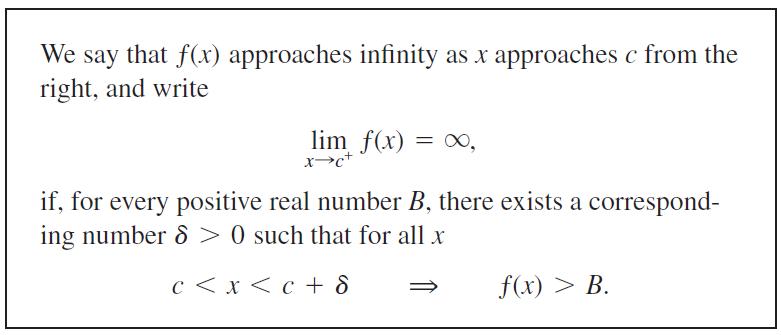
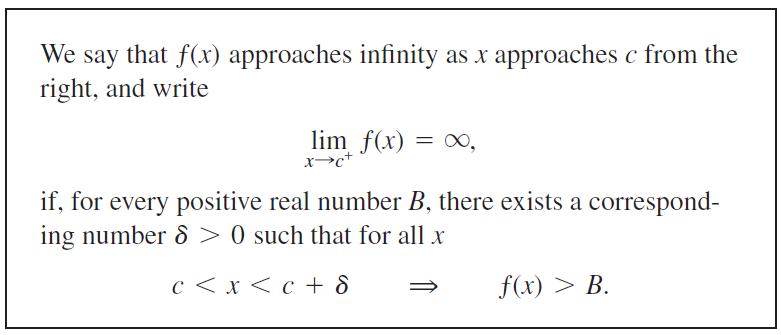
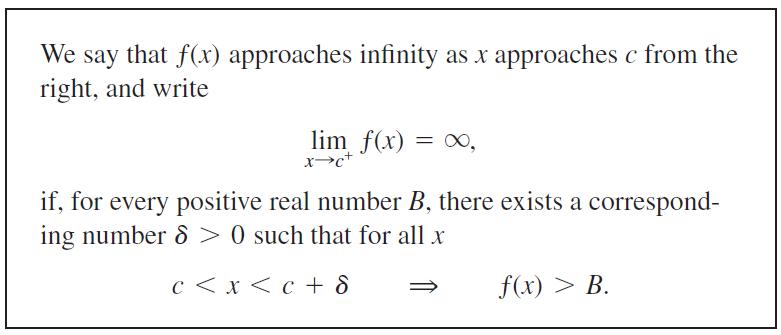
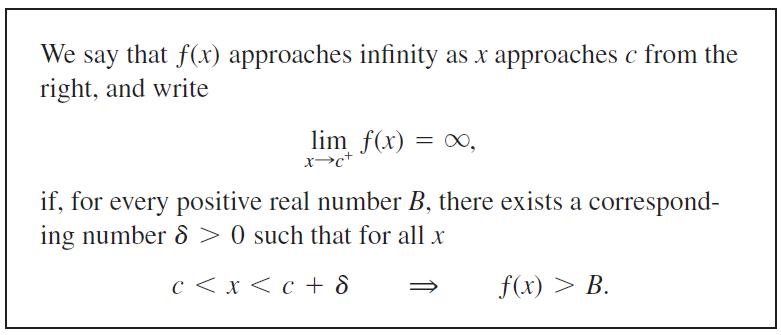
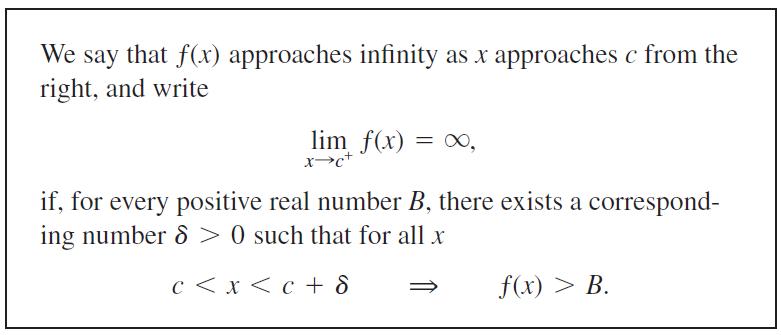
Here is the definition of infinite right-hand limit.Modify the definition to cover the following cases.a. limx→cƒ(x) = ∞b. limx→c+ ƒ(x) = -∞c. limx→c-ƒ(x) = -∞ We say that f(x) approaches infinity as x approaches c from the right, and write lim f(x) = ∞, x-c+ if, for every positive
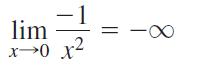
Use formal definitions to prove the limit statement. x = zł 0
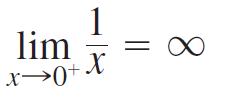
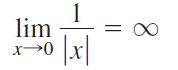
Use the formal definitions from Exercise 93 to prove the limit statement.Here is the definition of infinite right-hand limit.Modify the definition to cover the following cases.a. limx→cƒ(x) = ∞b. limx→c+ ƒ(x) = -∞c. limx→c-ƒ(x) = -∞ 1 lim = ∞ X+0
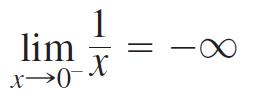
Use the formal definitions from Exercise 93 to prove the limit statement.Here is the definition of infinite right-hand limit.Modify the definition to cover the following cases.a. limx→cƒ(x) = ∞b. limx→c+ ƒ(x) = -∞c. limx→c-ƒ(x) = -∞ 1 lim // X x-0 -8
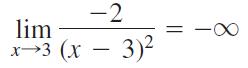
Use formal definitions to prove the limit statement. -2 lim x-3 (x - 3)² = -
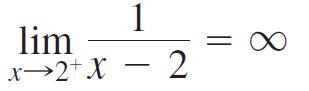
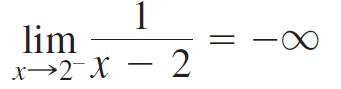
Use the formal definitions from Exercise 93 to prove the limit statement.Here is the definition of infinite right-hand limit.Modify the definition to cover the following cases.a. limx→cƒ(x) = ∞b. limx→c+ ƒ(x) = -∞c. limx→c-ƒ(x) = -∞ 1 lim x->2+ X - 2 ∞
Use formal definitions to prove the limit statement. 8 || X 0
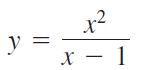
Graph the rational function. Include the graphs and equations of the asymptotes. y = z.X x - 1
Use the formal definitions from Exercise 93 to prove the limit statement.Here is the definition of infinite right-hand limit.Modify the definition to cover the following cases.a. limx→cƒ(x) = ∞b. limx→c+ ƒ(x) = -∞c. limx→c-ƒ(x) = -∞ lim x 2 X 1 2 -8
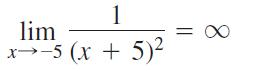
Use formal definitions to prove the limit statement. 1 lim x-5 (x + 5)² = ∞
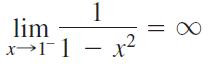
Use the formal definitions from Exercise 93 to prove the limit statement.Here is the definition of infinite right-hand limit.Modify the definition to cover the following cases.a. limx→cƒ(x) = ∞b. limx→c+ ƒ(x) = -∞c. limx→c-ƒ(x) = -∞ 1 lim x-11-x² || 8
Suppose that ƒ(x) and g(x) are polynomials in x and that limx→ ∞ (ƒ(x)/g(x)) = 2. Can you conclude anything about limx→ -∞ (ƒ(x)/g(x))? Give reasons for your answer.
Suppose that ƒ(x) and g(x) are polynomials in x. Can the graph of ƒ(x)/g(x) have an asymptote if g(x) is never zero? Give reasons for your answer.
Graph the rational function. Include the graphs and equations of the asymptotes. y = X 1
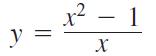
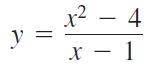
Graph the rational function. Include the graphs and equations of the asymptotes. y x² - 4 x - 1
How many horizontal asymptotes can the graph of a given rational function have? Give reasons for your answer.
Use the formal definitions of limits as x→ ±∞ to establish the limit.If ƒ has the constant value ƒ(x) = k, then limx→∞ ƒ(x) = k.
Use the formal definitions of limits as x→ ±∞ to establish the limit.If ƒ has the constant value ƒ(x) = k, then limx→-∞ ƒ(x) = k.
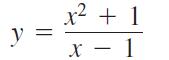
Graph the rational function. Include the graphs and equations of the asymptotes. y x² + 1 x - 1
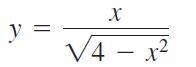
Graph the curves Explain the relationship between the curve’s formula and what you see. y X -2 で
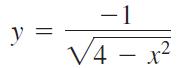
Graph the curves Explain the relationship between the curve’s formula and what you see. y - 1 √4 - x² 2
Graph the rational function. Include the graphs and equations of the asymptotes. y = 1 2x + 4
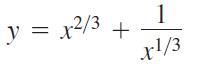
Graph the curves Explain the relationship between the curve’s formula and what you see. y = x²/3 + 1 x1/3
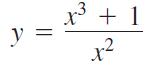
Graph the rational function. Include the graphs and equations of the asymptotes. y x3 x³ + 1 -2 X
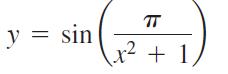
Graph the curves Explain the relationship between the curve’s formula and what you see. y = sin TT 1.1.² + 1/
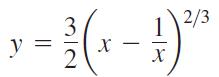
Graph the function. Then answer the following questions.a. How does the graph behave as x→0+?b. How does the graph behave as x→±∞?c. How does the graph behave near x = 1 and x = -1?Give reasons for your answers. y || X - 2/3
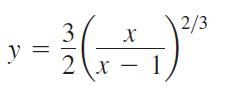
Graph the function. Then answer the following questions.a. How does the graph behave as x→0+?b. How does the graph behave as x→±∞?c. How does the graph behave near x = 1 and x = -1?Give reasons for your answers. y || X X - 2/3
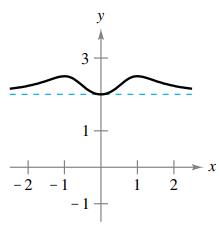
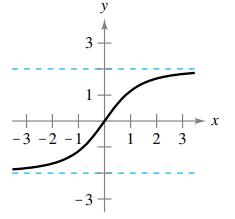
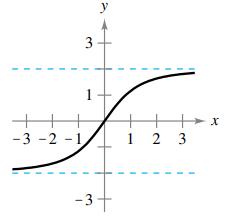
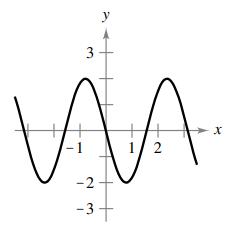
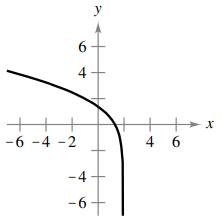
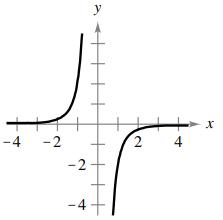
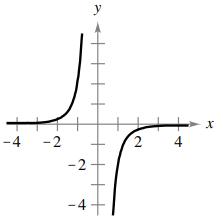
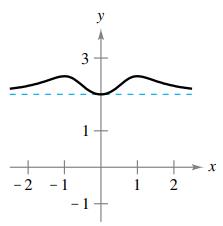
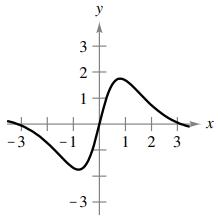
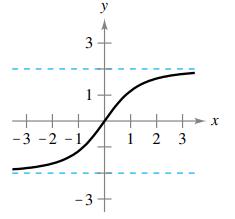
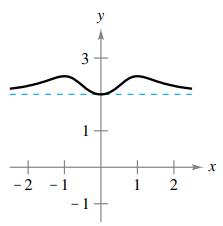
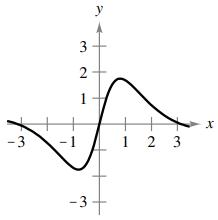
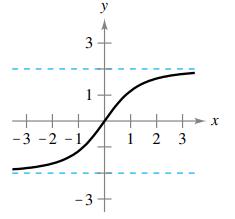
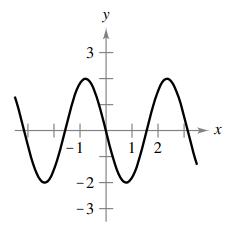
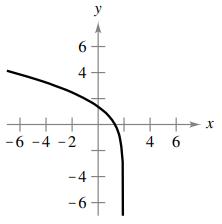
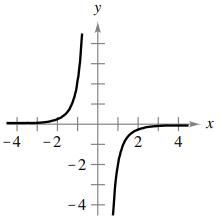
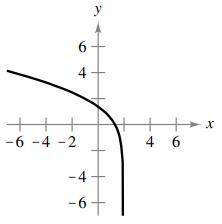
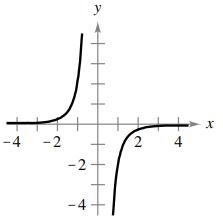
Match the function with its graph using horizontal asymptotes as an aid. [The graphs are labeled (a), (b), (c), (d), (e), and (f).](a)(b)(c)(d)(e)(f) -2 -1 3 1 y 1 2 X
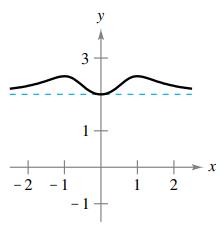
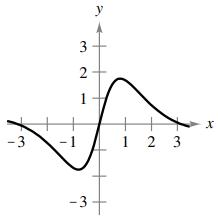
Match the function with its graph using horizontal asymptotes as an aid. [The graphs are labeled (a), (b), (c), (d), (e), and (f).](a)(b)(c)(d)(e)(f) -2 -1 3 1 y 1 2 X
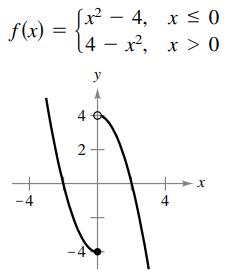
Describe the x-values at which f is differentiable. f(x) -4 = I [x²2 - 4, 14- x², 2 4 y x ≤ 0 x > 0 4 X
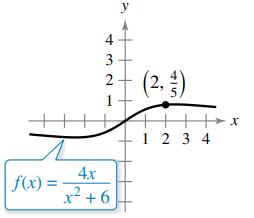
Find an equation of the tangent line to the graph at the given point. f(x) = 432- X 1 4x 2+6 (2,3) 1234 X
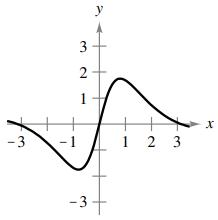
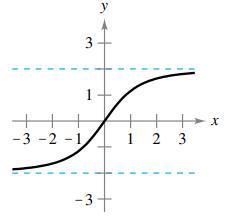
Match the function with its graph using horizontal asymptotes as an aid. [The graphs are labeled (a), (b), (c), (d), (e), and (f).](a)(b)(c)(d)(e)(f) -2 -1 3 1 y 1 2 X
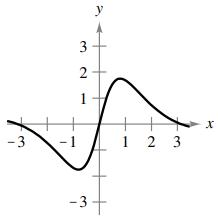
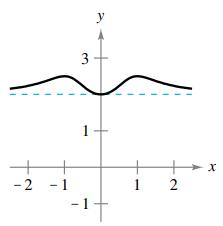
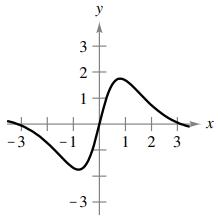
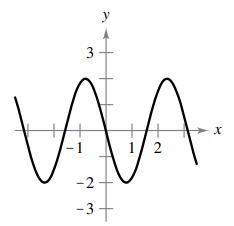
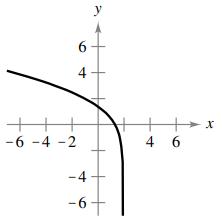
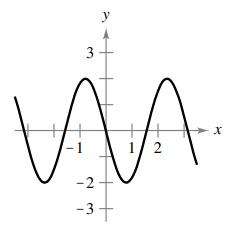
Match the graph of the function with the graph of its derivative. [The graphs of the derivatives are labeled (a), (b), (c), and (d).](a)(b)(c)(d) y 3 VAA 2 -2 -3+ X
Match the graph of the function with the graph of its derivative. [The graphs of the derivatives are labeled (a), (b), (c), and (d).](a)(b)(c)(d) y 3 VAA 2 -2 -3+ X
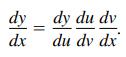
Determine whether the statement is true or false. If it is false, explain why or give an example that shows it is false.If y is a differentiable function of u, u is a differentiable function of v, and v is a differentiable function of x, then dy dx dy du dv du dv dx
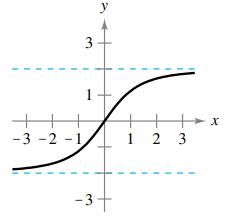
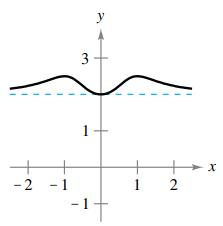
Match the function with its graph using horizontal asymptotes as an aid. [The graphs are labeled (a), (b), (c), (d), (e), and (f).](a)(b)(c)(d)(e)(f) -2 -1 3 1 y 1 2 X
Match the function with its graph using horizontal asymptotes as an aid. [The graphs are labeled (a), (b), (c), (d), (e), and (f).](a)(b)(c)(d)(e)(f) -2 -1 3 1 y 1 2 X
Match the function with its graph using horizontal asymptotes as an aid. [The graphs are labeled (a), (b), (c), (d), (e), and (f).](a)(b)(c)(d)(e)(f) -2 -1 3 1 y 1 2 X
Match the graph of the function with the graph of its derivative. [The graphs of the derivatives are labeled (a), (b), (c), and (d).](a)(b)(c)(d) y 3 VAA 2 -2 -3+ X
Match the graph of the function with the graph of its derivative. [The graphs of the derivatives are labeled (a), (b), (c), and (d).](a)(b)(c)(d) y 3 VAA 2 -2 -3+ X
Use the rules of differentiation to find the derivative of the function.y = x7
Use the rules of differentiation to find the derivative of the function.y = 2x3 + 6x2 − 1
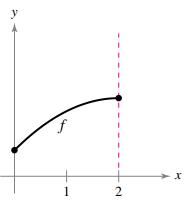
The graph of f is shown. State the signs of f′ and f″ on the interval (0, 2). y f 1 2 X
Showing 13600 - 13700
of 29454
First
130
131
132
133
134
135
136
137
138
139
140
141
142
143
144
Last
Step by Step Answers

 Get 50% OFF
Claim Now
Get 50% OFF
Claim Now