New Semester
Started
Get
50% OFF
Study Help!
--h --m --s
Claim Now
Question Answers
Textbooks
Find textbooks, questions and answers
Oops, something went wrong!
Change your search query and then try again
S
Books
FREE
Study Help
Expert Questions
Accounting
General Management
Mathematics
Finance
Organizational Behaviour
Law
Physics
Operating System
Management Leadership
Sociology
Programming
Marketing
Database
Computer Network
Economics
Textbooks Solutions
Accounting
Managerial Accounting
Management Leadership
Cost Accounting
Statistics
Business Law
Corporate Finance
Finance
Economics
Auditing
Tutors
Online Tutors
Find a Tutor
Hire a Tutor
Become a Tutor
AI Tutor
AI Study Planner
NEW
Sell Books
Search
Search
Sign In
Register
study help
mathematics
precalculus
Precalculus Concepts Through Functions A Unit Circle Approach To Trigonometry 5th Edition Michael Sullivan - Solutions
In Problems 64–69, find the exact value of each expression. cos[tan-¹(-1) + cos-¹-)]
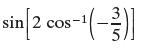
In Problems 64–69, find the exact value of each expression. sin[2 cos-¹(-3)]
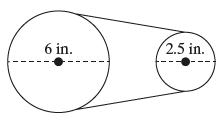
Problems 61–70. The purpose of these problems is to keep the material fresh in your mind so that you are better prepared for later sections, a final exam, or subsequent courses such as calculus.The figure shows two flywheels connected by a belt. If the 6-inch diameter flywheel spins at 2000
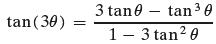
In Problems 51–72, establish each identity. tan (30) 3 tan tan ³0 1- 3 tan²0
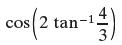
In Problems 64–69, find the exact value of each expression. cos(2 tan- 3/
In Problems 51–72, establish each identity. In | sin | 201 (In|1 cos(20)|- In 2) -
Problems 61–70. The purpose of these problems is to keep the material fresh in your mind so that you are better prepared for later sections, a final exam, or subsequent courses such as calculus.Complete the square to write the quadratic function f (x) = 1/3 x2 − 2x − 2 in vertex form.
In Problems 51–72, establish each identity. tantan (0+120°) + tan(0 + 240°) = 3 tan (30)
In Problems 51–72, establish each identity. In | cose = (In]1 cos(20)] In 2) + -
In Problems 70–81, solve each equation on the interval 0 ≤ θ < 2π. COS 2
Problems 61–70. The purpose of these problems is to keep the material fresh in your mind so that you are better prepared for later sections, a final exam, or subsequent courses such as calculus.Solve the formula A = 1/2 bh for h.
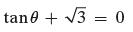
In Problems 70–81, solve each equation on the interval 0 ≤ θ < 2π. tan0 + √3 = 0
Problems 61–70. The purpose of these problems is to keep the material fresh in your mind so that you are better prepared for later sections, a final exam, or subsequent courses such as calculus.Given f (x) = 2x2 − 3x and g(x) = 4x − 3, determine where f (x) ≤ g(x).
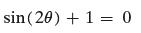
In Problems 70–81, solve each equation on the interval 0 ≤ θ < 2π. sin (20)+10
Problems 61–70 are based on previously learned material. The purpose of these problems is to keep the material fresh in your mind so that you are better prepared for later sections, a final exam, or subsequent courses such as calculus.Find the difference quotient of f (x) = 2/3 x + 9. 2/3
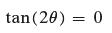
In Problems 70–81, solve each equation on the interval 0 ≤ θ < 2π. tan (20) = 0
In Problems 73–82, solve each equation on the interval 0 ≤ θ < 2π. cos(20) + 6 sin ²0 = 4
In Problems 70–81, solve each equation on the interval 0 ≤ θ < 2π. sec² 0 = 4
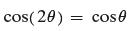
In Problems 73–82, solve each equation on the interval 0 ≤ θ< 2π. cos(20) cos
In Problems 73–82, solve each equation on the interval 0 ≤ θ < 2π. cos(20) = 2 2 sin ²0
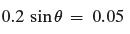
In Problems 70–81, solve each equation on the interval 0 ≤ θ < 2π. 0.2 sin0 = 0.05
In Problems 73–82, solve each equation on the interval 0 ≤ θ< 2π. sin (20) + sin(40) = 0
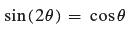
In Problems 73–82, solve each equation on the interval 0 ≤ θ< 2π. sin (20) = cos
In Problems 73–82, solve each equation on the interval 0 ≤ θ < 2π. cos(20) cos(40) = 0
In Problems 70–81, solve each equation on the interval 0 ≤ θ < 2π. sin+sin(20) = 0
In Problems 70–81, solve each equation on the interval 0 ≤ θ < 2π. 2 sin 203 sin0 + 1 = 0
In Problems 73–82, solve each equation on the interval 0 ≤ θ < 2π. cos (20) + 5 cose + 3 = 0
In Problems 73–82, solve each equation on the interval 0 ≤ θ < 2π. 3 sin cos (20)
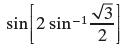
In Problems 83–94, find the exact value of each expression. V3 2 sin 2 sin-1.
In Problems 70–81, solve each equation on the interval 0 ≤ θ < 2π. sin (20) cos0 - 2 sin0 + 1 = 0
In Problems 70–81, solve each equation on the interval 0 ≤ θ < 2π. 4 sin ²0 = 1 + 4 cos 0
In Problems 73–82, solve each equation on the interval 0 ≤ θ< 2π. tan (20) + 2 sin0 = 0
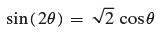
In Problems 70–81, solve each equation on the interval 0 ≤ θ < 2π. sin (20) = √2 cos!
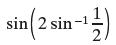
In Problems 83–94, find the exact value of each expression. in-1 1/2 sin 2 sin
In Problems 73–82, solve each equation on the interval 0 ≤ θ< 2π. tan (20) + 2 cos 0 = 0
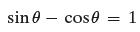
In Problems 70–81, solve each equation on the interval 0 ≤ θ < 2π. sin cos01 -
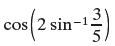
In Problems 83–94, find the exact value of each expression. cos (2 sin-12)
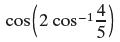
In Problems 83–94, find the exact value of each expression. cos(2 co 5.
In Problems 82–86, use a calculator to find an approximate value for each expression, rounded to two decimal places.sin−1 0.7
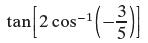
In Problems 83–94, find the exact value of each expression. tan[2 cos-¹(-3)] 5.
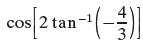
In Problems 83–94, find the exact value of each expression. cos[2 tan-¹(-)]
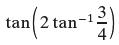
In Problems 83–94, find the exact value of each expression. tan (2 tan-12)
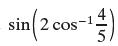
In Problems 83–94, find the exact value of each expression. sin (2 cos -1. 5.
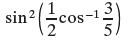
In Problems 83–94, find the exact value of each expression. sin ² n²(cos-¹3) 35
In Problems 90 and 91, find the exact solution of each equation.−3 sin−1 x = π
In Problems 90 and 91, find the exact solution of each equation.2 cos−1 x + π= 4 cos−1 x
Solve the given equation loga Mr =
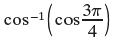
In Problems 15–29, find the exact value, if any, of each composite function. If there is no value, say it is “not defined.” Do not use a calculator. cos-1 (cos 37)
In Problems 15–20 establish each identity. csc 0 + cot 0 sec 0 + tan 0 sec 0 tan csc - cot
In Problems 15–20 establish each identity. sine tane + cose = sece
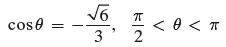
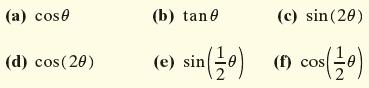
In Problems 9 – 20 , use the information given about the angle θ, 0 ≤ θ (a) sin(20) (b) cos(20) (c) sin (d) cos 2 (e) tan(20) (f) tan-
In Problems 9 – 20 , use the information given about the angle θ, 0 ≤ θ (a) sin(20) (b) cos(20) (c) sin (d) cos 2 (e) tan(20) (f) tan-
In Problems 7–16, express each product as a sum containing only sines or only cosines. in 3 co 2 sin DIN 30 0 COS 2
In Problems 15–29, find the exact value, if any, of each composite function. If there is no value, say it is “not defined.” Do not use a calculator. IS -1 IIS
In Problems 7–14, find the exact value of each expression. Do not use a calculator. cot-¹(-1)
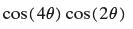
In Problems 7–16, express each product as a sum containing only sines or only cosines. cos (30) cos(40)
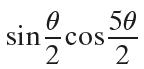
In Problems 7–16, express each product as a sum containing only sines or only cosines. 0 sin-cos 50 2
In Problems 7–14, find the exact value of each expression. Do not use a calculator. sec-1√√√2
In Problems 9 – 20 , use the information given about the angle θ, 0 ≤ θ (a) sin(20) (b) cos(20) (c) sin (d) cos 2 (e) tan(20) (f) tan-
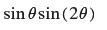
In Problems 7–16, express each product as a sum containing only sines or only cosines. sin sin (20)
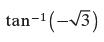
In Problems 7–14, find the exact value of each expression. Do not use a calculator. tan-¹(-√3)
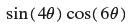
In Problems 7–16, express each product as a sum containing only sines or only cosines. sin (40) cos(60)
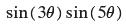
In Problems 7–16, express each product as a sum containing only sines or only cosines. sin (30) sin (50)
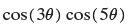
In Problems 7–16, express each product as a sum containing only sines or only cosines. cos (30) cos(50)
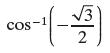
In Problems 7–14, find the exact value of each expression. Do not use a calculator. 5-¹(-1/³) 2 COS-1
In Problems 7–14, find the exact value of each expression. Do not use a calculator. (7-) ₁-UIS
In Problems 7–16, express each product as a sum containing only sines or only cosines. sin (40) cos (20)
If sinα= 1/3, π/2 < α < π, and cosβ= −1/3, π < β < 3π/2, find the exact value of: (a) cosa (d) cos(a + 3) (b) sin 3 3 2 (e) sin- (c) cos(2a)
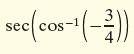
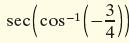
In Problems 1–10, find the exact value of each expression. Express angles in radians. sec(cos-¹(-2))
In Problems 1–10, find the exact value of each expression. Express angles in radians. sec(cos-1(-2))
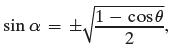
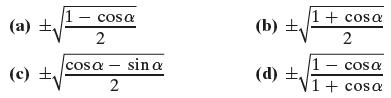
Ifthen which statement describes how θ is related to α? sin a = ±₁ Cos 2
In Problems 7–16, express each product as a sum containing only sines or only cosines. cos (40) cos(20)
If sinθ= −1/3 and π < θ < 3π/2, find the exact value of: (a) cose (d) cos(20) (b) tan (c) sin(20) sin (10) (1) cos(10) (e) sin
In Problems 7–14, find the exact value of each expression. Do not use a calculator.tan−1 1
Find the exact value of cos(tan−1 2).
In Problems 7–14, find the exact value of each expression. Do not use a calculator.cos−1 0
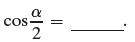
Choose the expression that completes the Half-angle Formula for cosine functions: COS 2 ||
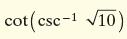
In Problems 1–10, find the exact value of each expression. Express angles in radians. cot (csc-1 √10)
In Problems 1–6, find the exact value of each expression. sin 195° cos 75°
In Problems 1–6, find the exact value of each expression. sin 255° sin 15°
In Problems 95–106, f (θ) = sinθ and g(θ) = cosθ. Find the exact value of each function below if θ= 60°. Do not use a calculator. g(20)
In Problems 7–14, find the exact value of each expression. Do not use a calculator.sin−1 1
True or False tan(2θ) + tan(2θ) = tan(4θ)
A centrifugal force ride, similar to the Gravitron, spins at a rate of 22 revolutions per minute. If the diameter of the ride is 13 meters, what is the linear speed of the passengers in kilometers per hour?
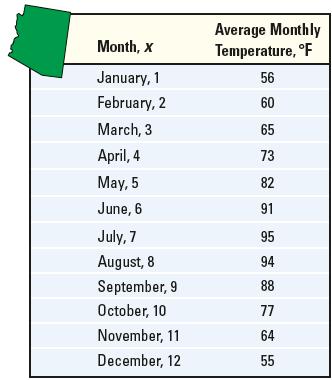
The given data represent the average monthly temperatures for Phoenix, Arizona.(a) Draw a scatter plot of the data for one period.(b) Find a sinusoidal function of the form y = A sin(ωx − ϕ) + B that models the data.(c) Draw the sinusoidal function found in part (b) on the scatter plot.(d) Use
Problems 42–51. The purpose of these problems is to keep the material fresh in your mind so that you are better prepared for later sections, a final exam, or subsequent courses such as calculus.A rectangular garden is enclosed by 54 feet of fencing. If the length of the garden is 3 feet more than
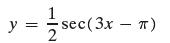
In Problems 3 – 22, find the amplitude (if one exists), period, and phase shift of each function. Graph each function. Be sure to label key points. Show at least two periods. || = -sec (3x - π) 2
Solve the given equationloga(M/N) = _______−________ .
Solve the given equationloga (MN) = _______+______ .
Solve the given equationloga ar =_______
Solve each inequality: 0(a) 3 x − 7 ≤ 8 − 2x.(b) x2 − x − 6 > 0
Solve the given equationloga 1 =_____ .
Solve the given equationa loga M =
True or False s in(2θ) has two equivalent forms: 2 sinθ cosθ and sin2θ− cos2θ
Show thatcos(20) = cos 0 - = 1- - 1 cos(20) = cos² 0 - = 1- - 1
In Problems 1–6, find the exact value of each expression. cos285° cos 195°
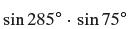
In Problems 1–6, find the exact value of each expression. sin 285° sin 75°
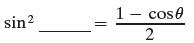
Show that sin 2 1 - cose 2
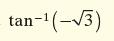
In Problems 1–10, find the exact value of each expression. Express angles in radians. tan-¹(-√3)
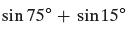
In Problems 1–6, find the exact value of each expression. sin 75° + sin 15°
Showing 2800 - 2900
of 29454
First
22
23
24
25
26
27
28
29
30
31
32
33
34
35
36
Last
Step by Step Answers

 Get 50% OFF
Claim Now
Get 50% OFF
Claim Now