New Semester
Started
Get
50% OFF
Study Help!
--h --m --s
Claim Now
Question Answers
Textbooks
Find textbooks, questions and answers
Oops, something went wrong!
Change your search query and then try again
S
Books
FREE
Study Help
Expert Questions
Accounting
General Management
Mathematics
Finance
Organizational Behaviour
Law
Physics
Operating System
Management Leadership
Sociology
Programming
Marketing
Database
Computer Network
Economics
Textbooks Solutions
Accounting
Managerial Accounting
Management Leadership
Cost Accounting
Statistics
Business Law
Corporate Finance
Finance
Economics
Auditing
Tutors
Online Tutors
Find a Tutor
Hire a Tutor
Become a Tutor
AI Tutor
AI Study Planner
NEW
Sell Books
Search
Search
Sign In
Register
study help
business
behavior in organizations
Behavior In Organizations 10th Global Edition Jerald Greenberg - Solutions
Describe Machiavellianism and the difference between morning and evening persons, and their role in work-related behavior.
Differentiate among cognitive intelligence, practical intelligence, and emotional intelligence and explain the influence of social skills on behavior in organizations.
Have you ever worked for an organization that selected future employees by means of psychological tests? If so, do you think the test made sense—for instance, did it really measure what it was supposed to measure?
Have you ever encountered someone who was very high in cognitive intelligence (the kind IQ tests measure), but low in practical intelligence? How could you tell?
Are you a morning or an evening person? When did you first decide that you were one or the other? Has the fact that you are a morning, or an evening person affected your career decisions in any way?
Various tests have been developed to measure the degree of emotional intelligence a person has, characterized as an emotional quotient (EQ score). The instrument presented here is similar to ones that some scientists have used to assess people’s emotional intelligence. Although this contains just
People who are high in Machiavellianism (high Machs) often come out ahead in dealing with others because they are true pragmatists. That is, they tend to be willing to do or say whatever it takes to win or to get their way. Several questionnaires exist for measuring Machiavellianism as a
Contrary to popular belief, Howard Schultz was not the founder of Starbucks. Instead, Starbucks Coffee, Tea and Spice, as it was known, began in 1971 as a small coffeehouse in Seattle, the vision of three other men, Jerry Baldwin, Zev Siegel, and Gordon Bowker. A decade later, Schultz, who was
A life insurance company has developed a test believed to measure success at personal face-to-face sales. It has used this test to choose new life insurance agents, believing that persons selected in this way will generate high levels of sales. Yet this has not happened. People who score very high
Distinguish between emotions and moods.
Explain how emotions and mood influence behavior in organizations.
Describe ways in which people manage their emotions in organizations.
Identify the major causes of organizational stress.
Describe the adverse effects of organizational stress.
Identify various ways of reducing stress in the workplace.
Think of a time when it was necessary for you to express compassion on the job in response to a traumatic situation. What were the circumstances? What did you do that was effective? What steps might you take to become even more effective the next time it is necessary to express compassion on the
What was the most stressful situation you ever encountered on the job? What were the stressors, and how did you react, both physically and psychologically? What role did social support play in helping you manage this stress?
What experiences have you had using stress management techniques—either formally or informally? For example, do you meditate? Do you find that physical exercise helps you relieve stress? Does talking to others help at all? Of the various techniques described in this chapter, which one do you
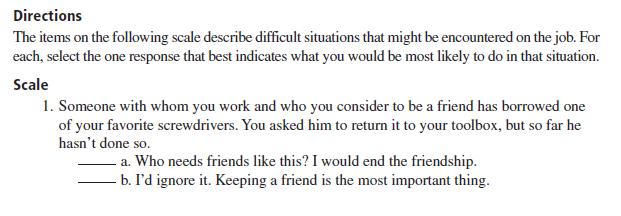
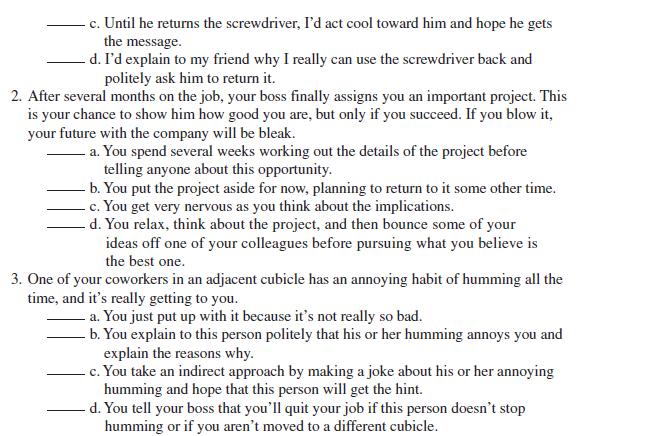
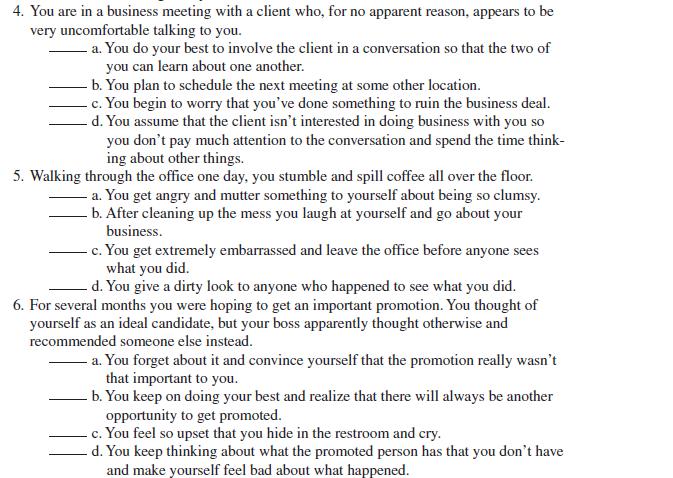
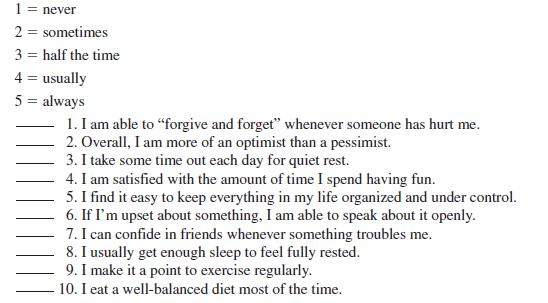
This questionnaire is designed to help you discover how resilient you are. People who are more resilient are less inclined to suffer problems associated with stress because they simply “bounce back” from them without experiencing harm.Directions Using the following scale, respond to each of the
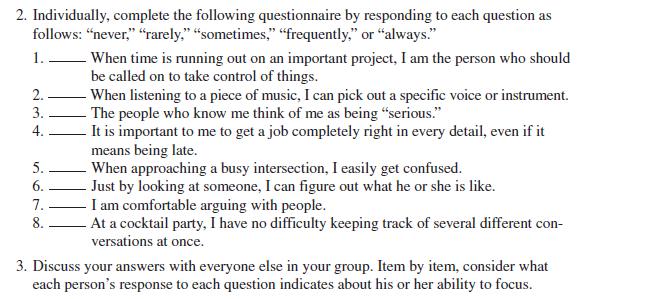
A test known as the Test of Attentional and Interpersonal Style (TAIS) (see Note 42) has been used in recent years to identify the extent to which a person can stay focused and keep his or her emotions under control—the core elements of performing well under high-pressure conditions. Completing
As the managing director of a large e-tail sales company, you are becoming alarmed about the growing levels of turnover your company has been experiencing lately.It already has passed the industry average, and you are growing concerned about the company’s capacity to staff the call center and the
I’ve brought shame on myself, my family and the profession”were the words of Tim Donaghy, as a federal district judge sentenced him to 15 months behind bars in July 2008. Formally, the charges against him were conspiracy to engage in wire fraud and transmitting betting information through
Employee training is a major responsibility for most human resource departments. These programs provide employees with the tools they need to accomplish their job duties successfully. Developing a good plan begins with clearly identifying what needs to be achieved and then determining which kind of
Define attitudes and work-related attitudes, and describe the basic components of attitudes.
Distinguish between prejudice and discrimination and identify various victims of prejudice in organizations.
Describe some of the things being done by today’s organizations to manage diversity in their workforces and the effectiveness of these practices.
Explain the concept of job satisfaction and summarize three major theories of job satisfaction.
Describe the consequences of job dissatisfaction and ways to promote job satisfaction.
Describe the concept of organizational commitment, its major forms, the consequences of low levels of organizational commitment, and how to overcome them.
What steps are today’s organizations taking to promote diversity, and are these efforts effective?
Think of a particular job you have enjoyed most. What did you like about it so much? Now, think of a particular job that you enjoyed least. What made you dislike it so much? Did the factors you liked fall into the“motivator” category of two-factor theory? Did the factors you disliked fall into
Think about the particular organization at which you have worked the longest. What were the main reasons you stayed there? How do these compare to the three forms of organizational commitment described in this chapter?
If you have ever participated in a diversity management training program, what effects did it have on you? In what ways, if any, did your attitudes or behavior change? If you have never participated in a diversity management training program, how do you think you would react to being in one? Do you
One of the strategies that has been recommended for enhancing job satisfaction is to make jobs more fun. We all like having fun, of course, but do you really think these matters when it comes to job satisfaction? In other words, is job satisfaction promoted by just having a pleasant, joking
In today’s economy, where replacing employees can be an expensive proposition, it pays to be able to maintain a highly committed workforce. Of the various things that can be done to promote commitment to an organization, which tactics do you believe may be most effective? Explain the basis for
Racial prejudice has been a serious problem in American society for a long time. How do you reconcile this with the fact that diversity management training generally seems to be successful? In other words, do you think diversity training actually changes people’s prejudicial attitudes? Or, do you
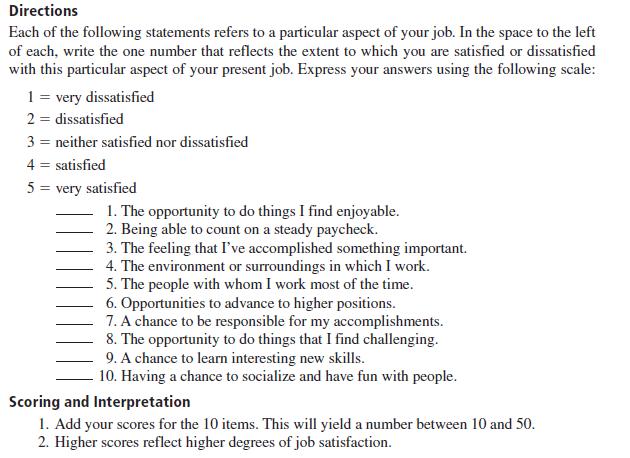
Questionnaires similar to this one are used to assess job satisfaction. Completing this questionnaire will help you appreciate the level of satisfaction you feel toward your own job. It also illustrates one of the most popular tools for measuring this important work-related attitude. Questions for
You’ve probably been a victim of stereotyping by others, undoubtedly more often than you’d like.At the same time, you may have engaged in stereotyping others, even if you’re not especially proud of it. This exercise is designed to make you sensitive to these processes so that hopefully
The president of a small manufacturing firm comes to you with a problem: The company is spending a lot of money training new employees, but 75 percent of them quit after working less than a year. Worse, they take jobs at the company’s biggest competitor. Answer the following questions relevant to
Nine million miles—that’s how far you’d travel if you went to the moon 37 times. Coincidentally, that’s also how far Domino’s Pizza delivery drivers travel each week in more than 60 countries. The 170,000 employees who work in the 8,800 stores in these nations get 1.3 million pizzas out
Define motivation and explain its importance in the field of organizational behavior.
Describe the motivational-fit approach and what it suggests about how to improve motivation in organizations.
Identify and explain the conditions through which goal setting can be used to improve job performance.
Describe equity theory and explain how it may be applied to motivating people in organizations.
Describe expectancy theory and how it may be applied in organizations.
Distinguish among job enlargement, job enrichment and the job characteristics model as techniques for motivating employees.
What experiences have you had in setting personal goals (e.g., for saving money, for losing weight, for getting a certain job)? Which rules of goal setting did you follow? Which rules might you have followed to be even more successful?
Think of a time in which you felt inequitably underpaid by your employer or manager. How did it make you feel, and how did you respond as a result?
Think of the job you currently do, or one that you have done recently. Describe two specific things that could be done to redesign that job so that employees will be more motivated to perform it.
Imagine that you are devising an incentive plan for your company. What particular guidelines will you follow to ensure that it is effective? What problems do you anticipate as the plan takes effect?
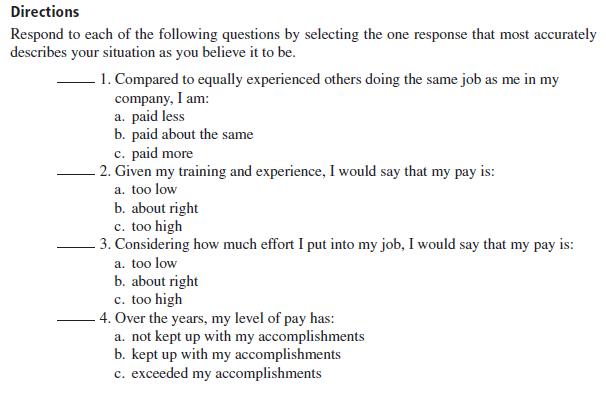
The desire to be paid equitably is very strong among people in the workplace. Too often, however, employees believe that they are inequitably paid—either overpaid or underpaid. The following questionnaire will help you assess how you stand in this regard.Questions for Discussion1. What do your
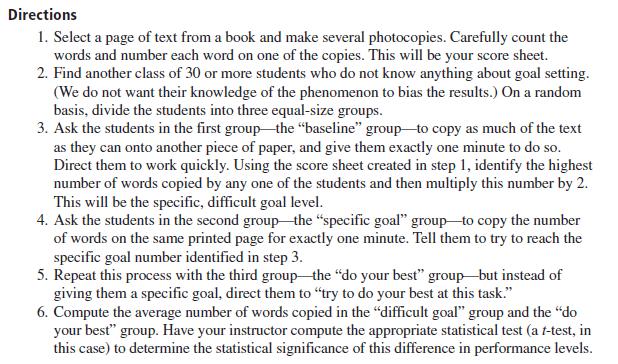
Specific, difficult goals tend to enhance task performance. The following exercise is designed to help you demonstrate this effect for yourself. All you need is a class of students willing to participate and a few simple supplies.Questions for Discussion1. Was there a statistically significant
You have been hired by the director of a large suburban hospital to help resolve problems of poor morale that have been plaguing the nursing staff. Unfortunately, the nurses don’t find their jobs particularly interesting. As a result, turnover and absenteeism have been high, and patient care is
Google, the immensely popular Web search engine, has been touted as “the closest thing the Web has to an ultimate answer machine.” Although this is debatable, of course, it is far more difficult to deny that the company is, in fact, the closest thing we have to an ultimate example of business
According to Kathy Hannan, diversity is essential to the culture at KPMG. Hannan heads both the company’s Women’s Advisory Board and the Diversity Advisory Board. In fact, KPMG has established a number of other advisory boards, including one for African Americans, one for Latinos, and one for
KPMG believes that it is important for employees to feel valued and motivated to work. Just a few years ago, however, this was not the case. Workers at the company were not engaged in their jobs, turnover was high, and overall performance was suffering as a result. KPMG recognized that a
Define what is meant by a group and identify different types of groups operating within organizations.
Describe the importance of roles, norms, status, and cohesiveness within organizations.
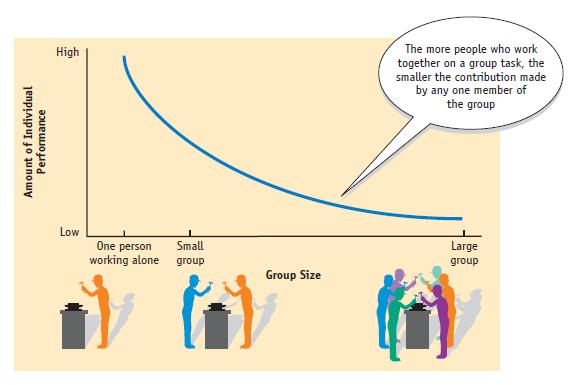
Explain how individual performance in groups is affected by the presence of others (social facilitation), and the number of others with whom one is working (social loafing).
Define what teams are and describe the various types of teams that exist in organizations.
Describe the effectiveness of teams in organizations.
Explain the factors responsible for the failure of some teams to operate as effectively as possible and steps that can be taken to build successful teams.
Think of a group in which you have been working.How do the five-stage model and the punctuatedequilibrium model apply to this experience?
Describe an incident of social loafing in which you may have been involved (e.g., a class project). What might be done to overcome this effect?
How have your own experiences in work teams compared to those described in this chapter? Based on what you read, what could be done to make your own team experiences more successful?
Based on the evidence regarding the effectiveness of teams, would you say that the popularity of teams today is well-founded?
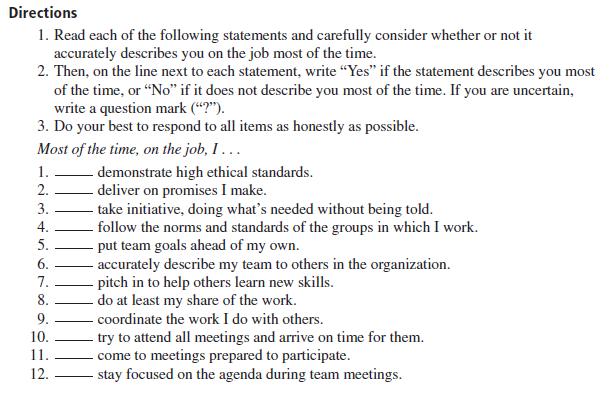
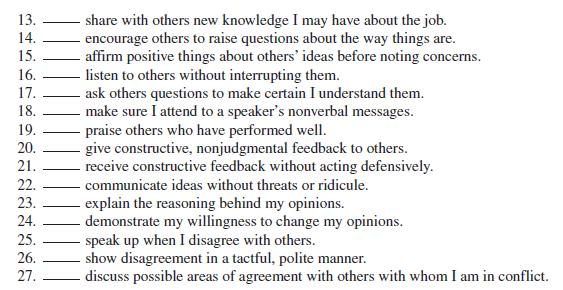
Let’s face it, some people find it easier to work in teams than others. Are you already a “team player,” or have you not yet developed the skills needed to work effectively with others in teams?Knowing where you stand along this dimension may come in handy when it comes to considering a new
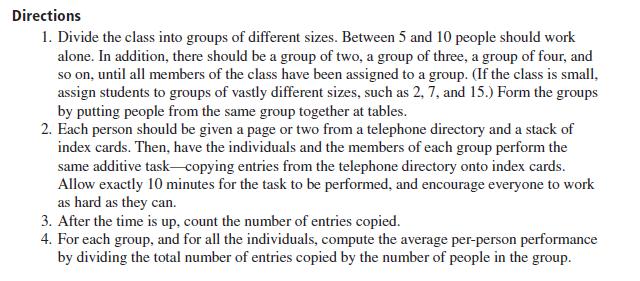
The social loafing effect is quite strong and is likely to occur in many different situations in which people make individual contributions to an additive group task. This exercise is designed to demonstrate the effect firsthand in your own class.Figure 8.11Questions for Discussion1. Was the social
Officials of a large manufacturing company are concerned about the stagnant productivity they’ve seen in the past year. Although sales have been good, employees in the company’s manufacturing plant are having a hard time keeping up with demand. Right now, they are working on an assembly line,
ach July, bicyclists race across the French countryside in the Tour de France. The race, first run in 1903, now consists of about 180 of the world’s best cyclists, who meander through tiny villages, up and down steep mountain grades, and after a grueling 3,407 kilometers (slightly over 2,117
Describe the process of communication and its purposes in organizations.
Identify various forms of verbal media used in organizations and explain which ones are most appropriate for communicating messages of different types.
Describe how technology has influenced organizational communication.
Describe how people’s communication patterns differ based on their sex and culture.
Distinguish between the various forms of formal and informal communication that occur in organizations and how they operate.
Explain how you can improve your effectiveness as a communicator in organizations.
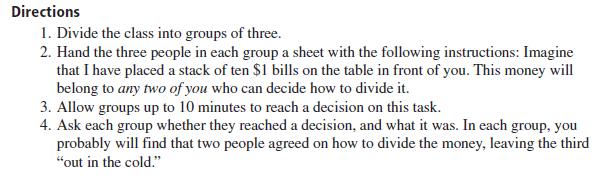
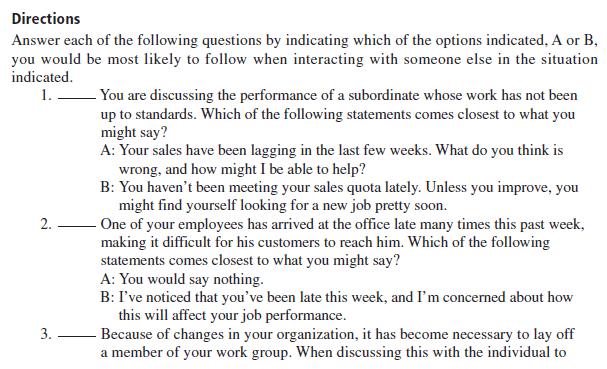
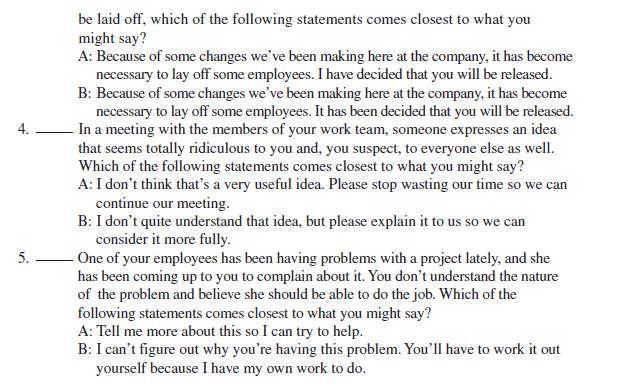
As noted on pages 355–356, one key to being effective as a communicator is to be supportive of people. Supportive communication involves being accurate and honest with people in a manner that builds, rather than jeopardizes, relationships with them. This exercise will give you a good feel for how
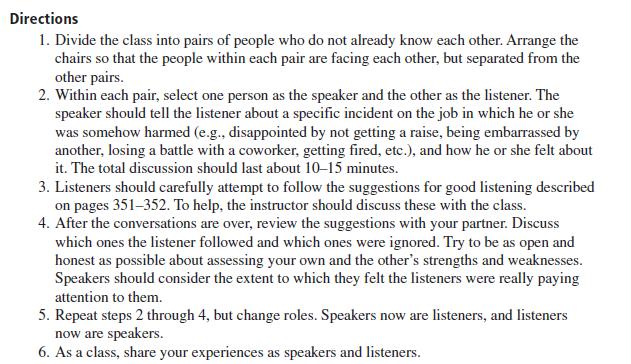
Are you a good listener, a really good listener—one who understands exactly what someone else is saying to you? Most of us tend to think that we are much better than we really are when it comes to this important skill. After all, we’ve been listening to others our whole lives. And, with that
The employees in a company’s phone center are not paying any attention to new procedures for taking orders from clients. They are following the old procedures, which they prefer, and avoiding the changes that they dislike. What’s more, they are spending so much time bickering with one another
Think of an instance in which you had to transmit bad news to another person (e.g., firing, unwanted transfer). Were you reluctant to share this information (as per the MUM effect)? How did you respond in this situation?
Think of an instance in which you used a particular communication medium (e.g., e-mail) in a manner that proved to be ineffective. What occurred? In retrospect, what could you have done to avoid the problems you encountered?
Do you regard yourself to be a good listener? What might you do to improve your skills as a listener?
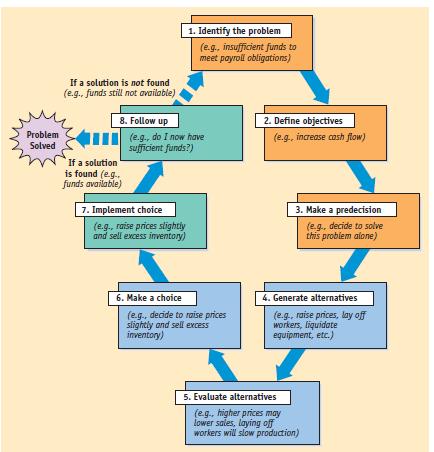
Identify the steps in the analytical model of decision making and distinguish between the various types of decisions that people make.
Describe different individual decision styles and the various organizational factors that influence the decision-making process.
Distinguish among three approaches to how decisions are made: the rational-economic model, the administrative model, and image theory.
Identify the various factors that lead people to make imperfect decisions.
Compare the conditions under which groups make superior decisions than individuals and when individuals make superior decisions than groups.
Describe various techniques that can be used to enhance the quality of individual decisions and group decisions.
Identify ways in which various decisions you have made were biased by framing, heuristics, the use of implicit favorites, and the escalation of commitment.
Think of various decision-making groups in which you may have participated over the years. Do you think that groupthink was involved in these situations?What signs were evident?
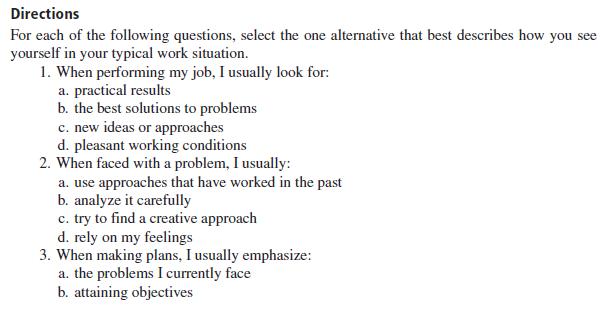
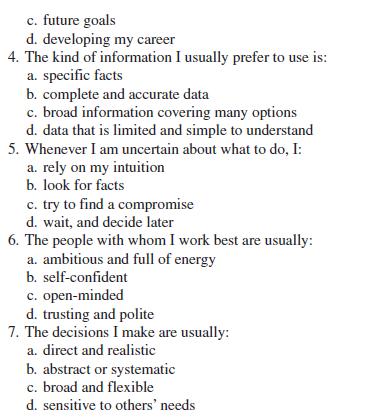
As you read about the various personal decision styles, did you put yourself into any one of the categories? To get a feel for what the decision style inventory reveals about your personal decision style, complete this exercise. It is based on questions similar to those appearing in the actual
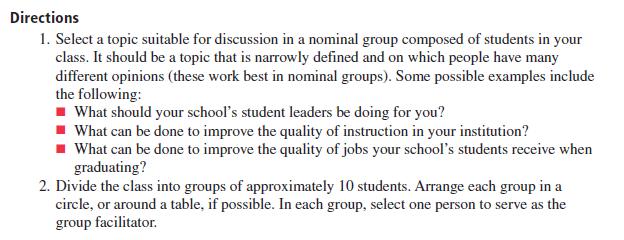
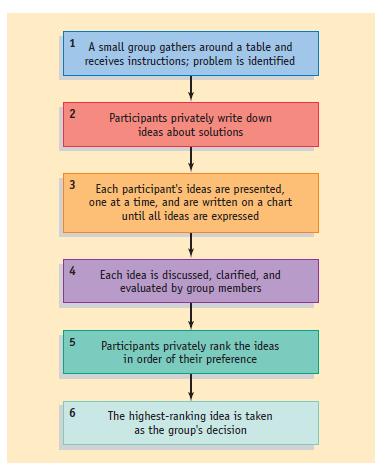
A great deal can be learned about nominal groups by running one—or, at least, participating in one—yourself. Doing so will not only help illustrate the procedure, but demonstrate how effectively it works as well.Figure 10.17Questions for Discussion1. Collectively, how did the group answer the
A large product-distribution company is having a problem during its group meetings: One department manager is constantly disrupting the meetings while trying to get his ideas across. He has so consistently intimidated his coworkers that they are reluctant to speak up. As a result of his
What do Yao Ming, LeBron James, and Earl R. Dean have in common? The first two are professional basketball stars, of course, but who’s Earl R. Dean? He happens to be the person who designed Coca-Cola’s familiar“contour bottle,” the shapely container with a middle diameter that’s larger
Describe three types of psychological contracts and the two basic kinds of trust that play a role in work relationships.
Describe organizational citizenship behavior and ways in which it may be encouraged.
Identify ways in which cooperation can be promoted in the workplace.
Describe the causes and effects of conflict in organizations along with techniques thatcan be used to manage conflict in organizations.
Explain why deviant organizational behavior can produce positive as well as negative effects.
Describe the major forms of workplace deviance.
Showing 800 - 900
of 984
1
2
3
4
5
6
7
8
9
10
Step by Step Answers

 Get 50% OFF
Claim Now
Get 50% OFF
Claim Now