New Semester
Started
Get
50% OFF
Study Help!
--h --m --s
Claim Now
Question Answers
Textbooks
Find textbooks, questions and answers
Oops, something went wrong!
Change your search query and then try again
S
Books
FREE
Study Help
Expert Questions
Accounting
General Management
Mathematics
Finance
Organizational Behaviour
Law
Physics
Operating System
Management Leadership
Sociology
Programming
Marketing
Database
Computer Network
Economics
Textbooks Solutions
Accounting
Managerial Accounting
Management Leadership
Cost Accounting
Statistics
Business Law
Corporate Finance
Finance
Economics
Auditing
Tutors
Online Tutors
Find a Tutor
Hire a Tutor
Become a Tutor
AI Tutor
AI Study Planner
NEW
Sell Books
Search
Search
Sign In
Register
study help
physics
college physics 2nd
College Physics 2nd Edition OpenStax - Solutions
Does Huygens’s principle apply to all types of waves?
Young’s double slit experiment breaks a single light beam into two sources. Would the same pattern be obtained for two independent sources of light, such as the headlights of a distant car? Explain.
What is the separation between two slits for which 610-nm orange light has its first maximum at an angle of 30.0°?
What angle is needed between the direction of polarized light and the axis of a polarizing filter to reduce its intensity by 90.0%?StrategyWhen the intensity is reduced by 90.0%, it is 10.0% or 0.100 times its original value. That is, I = 0.100I0. Using this information, the equation I = I0 cos2 θ
Suppose you use the same double slit to perform Young’s double slit experiment in air and then repeat the experiment in water. Do the angles to the same parts of the interference pattern get larger or smaller? Does the color of the light change? Explain.
Find the distance between two slits that produces the first minimum for 410-nm violet light at an angle of 45.0°.
(a) At what angle will light traveling in air be completely polarized horizontally when reflected from water? (b) From glass?StrategyAll we need to solve these problems are the indices of refraction. Air has n1 = 1.00, water has n2 = 1.333, and crown glass has n′2 = 1.520. The equation tan θb=
Is it possible to create a situation in which there is only destructive interference? Explain.
Calculate the wavelength of light that has its third minimum at an angle of 30.0° when falling on double slits separated by 3.00 μm. Explicitly, show how you follow the steps in Problem-Solving Strategies for Wave Optics.
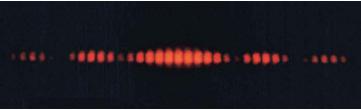
Figure 27.55 shows the central part of the interference pattern for a pure wavelength of red light projected onto a double slit. The pattern is actually a combination of single slit and double slit interference. Note that the bright spots are evenly spaced. Is this a double slit or single slit
What is the wavelength of light falling on double slits separated by 2.00 μm if the third-order maximum is at an angle of 60.0°?
What is the advantage of a diffraction grating over a double slit in dispersing light into a spectrum?
At what angle is the fourth-order maximum for the situation in Exercise 27.6?Data from Exercise 27.6At what angle is the first-order maximum for 450-nm wavelength blue light falling on double slits separated by 0.0500 mm?
What are the advantages of a diffraction grating over a prism in dispersing light for spectral analysis?
Can the lines in a diffraction grating be too close together to be useful as a spectroscopic tool for visible light? If so, what type of EM radiation would the grating be suitable for? Explain.
Find the largest wavelength of light falling on double slits separated by 1.20 μm for which there is a first-order maximum. Is this in the visible part of the spectrum?
If a beam of white light passes through a diffraction grating with vertical lines, the light is dispersed into rainbow colors on the right and left. If a glass prism disperses white light to the right into a rainbow, how does the sequence of colors compare with that produced on the right by a
What is the smallest separation between two slits that will produce a second-order maximum for 720-nm red light?
Suppose pure-wavelength light falls on a diffraction grating. What happens to the interference pattern if the same light falls on a grating that has more lines per centimeter? What happens to the interference pattern if a longer-wavelength light falls on the same grating? Explain how these two
(a) What is the smallest separation between two slits that will produce a second-order maximum for any visible light?(b) For all visible light?
Suppose a feather appears green but has no green pigment. Explain in terms of diffraction.
(a) If the first-order maximum for pure- wavelength light falling on a double slit is at an angle of 10.0°, at what angle is the second-order maximum? (b) What is the angle of the first minimum? (c) What is the highest-order maximum possible here?
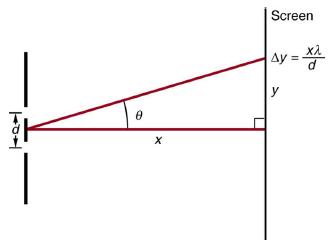
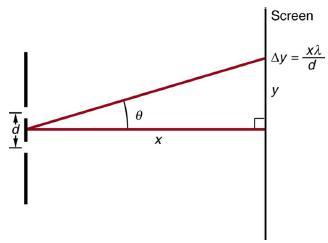
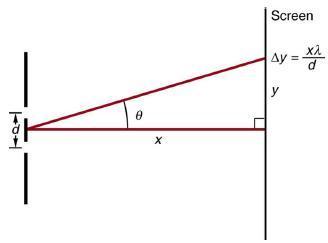
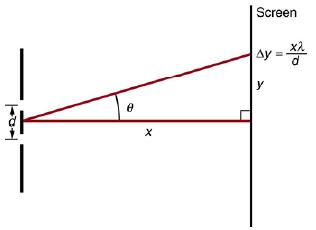
Figure 27.56 shows a double slit located a distance x from a screen, with the distance from the center of the screen given by y. When the distance d between the slits is relatively large, there will be numerous bright spots, called fringes. Show that, for small angles (where sinθ ≈ θ, with θ
It is possible that there is no minimum in the interference pattern of a single slit. Explain why. Is the same true of double slits and diffraction gratings?
Using the result of the problem above, calculate the distance between fringes for 633-nm light falling on double slits separated by 0.0800 mm, located 3.00 m from a screen as in Figure 27.56. TOL 0 x Screen Ay = x₁ y
As the width of the slit producing a single-slit diffraction pattern is reduced, how will the diffraction pattern produced change?
Using the result of the problem two problems prior, find the wavelength of light that produces fringes 7.50 mm apart on a screen 2.00 m from double slits separated by 0.120 mm (see Figure 27.56). TOL 0 Screen Ay = x₁ y
A beam of light always spreads out. Why can a beam not be created with parallel rays to prevent spreading? Why can lenses, mirrors, or apertures not be used to correct the spreading?
What effect does increasing the wedge angle have on the spacing of interference fringes? If the wedge angle is too large, fringes are not observed. Why?
A diffraction grating has 2000 lines per centimeter. At what angle will the first-order maximum be for 520-nm-wavelength green light?
How is the difference in paths taken by two originally in-phase light waves related to whether they interfere constructively or destructively? How can this be affected by reflection? By refraction?
Find the angle for the third-order maximum for 580-nm-wavelength yellow light falling on a diffraction grating having 1500 lines per centimeter.
Is there a phase change in the light reflected from either surface of a contact lens floating on a person’s tear layer? The index of refraction of the lens is about 1.5, and its top surface is dry.
How many lines per centimeter are there on a diffraction grating that gives a first-order maximum for 470-nm blue light at an angle of 25.0°?
In placing a sample on a microscope slide, a glass cover is placed over a water drop on the glass slide. Light incident from above can reflect from the top and bottom of the glass cover and from the glass slide below the water drop. At which surfaces will there be a phase change in the reflected
What is the distance between lines on a diffraction grating that produces a second-order maximum for 760-nm red light at an angle of 60.0°?
Answer the above question if the fluid between the two pieces of crown glass is carbon disulfide.Question Above:In placing a sample on a microscope slide, a glass cover is placed over a water drop on the glass slide. Light incident from above can reflect from the top and bottom of the glass cover
Calculate the wavelength of light that has its second-order maximum at 45.0° when falling on a diffraction grating that has 5000 lines per centimeter.
While contemplating the food value of a slice of ham, you notice a rainbow of color reflected from its moist surface. Explain its origin.
An electric current through hydrogen gas produces several distinct wavelengths of visible light. What are the wavelengths of the hydrogen spectrum, if they form first-order maxima at angles of 24.2°, 25.7°, 29.1°, and 41.0° when projected on a diffraction grating having 10,000 lines per
An inventor notices that a soap bubble is dark at its thinnest and realizes that destructive interference is taking place for all wavelengths. How could she use this knowledge to make a nonreflective coating for lenses that is effective at all wavelengths? That is, what limits would there be on the
(a) What do the four angles in the above problem become if a 5000-line-per-centimeter diffraction grating is used?(b) Using this grating, what would the angles be for the second-order maxima?(c) Discuss the relationship between integral reductions in lines per centimeter and the new angles of
What is the maximum number of lines per centimeter a diffraction grating can have and produce a complete first-order spectrum for visible light?
Why is it much more difficult to see interference fringes for light reflected from a thick piece of glass than from a thin film? Would it be easier if monochromatic light were used?
The yellow light from a sodium vapor lamp seems to be of pure wavelength, but it produces two first- order maxima at 36.093° and 36.129° when projected on a 10,000 line per centimeter diffraction grating. What are the two wavelengths to an accuracy of 0.1 nm?
Under what circumstances is the phase of light changed by reflection? Is the phase related to polarization?
What is the spacing between structures in a feather that acts as a reflection grating, given that they produce a first-order maximum for 525-nm light at a 30.0° angle?
Can a sound wave in air be polarized? Explain.
Structures on a bird feather act like a reflection grating having 8000 lines per centimeter. What is the angle of the first-order maximum for 600-nm light?
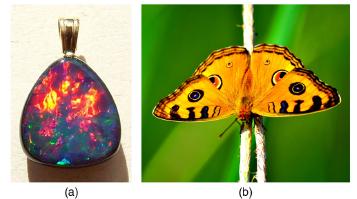
An opal such as that shown in Figure 27.17 acts like a reflection grating with rows separated by about 8 μm. If the opal is illuminated normally,(a) At what angle will red light be seen and (b) At what angle will blue light be seen?Data from figure 27.17 (a) (b)
No light passes through two perfect polarizing filters with perpendicular axes. However, if a third polarizing filter is placed between the original two, some light can pass. Why is this? Under what circumstances does most of the light pass?
Explain what happens to the energy carried by light that it is dimmed by passing it through two crossed polarizing filters.
At what angle does a diffraction grating produces a second-order maximum for light having a first- order maximum at 20.0°?
When particles scattering light are much smaller than its wavelength, the amount of scattering is proportional to 1/λ4. Does this mean there is more scattering for small λ than large λ ? How does this relate to the fact that the sky is blue?
Using the information given in the preceding question, explain why sunsets are red.Data from previous questionWhen particles scattering light are much smaller than its wavelength, the amount of scattering is proportional to 1/λ4. Does this mean there is more scattering for small λ than large λ ?
If a diffraction grating produces a first-order maximum for the shortest wavelength of visible light at 30.0°, at what angle will the first-order maximum be for the longest wavelength of visible light?
When light is reflected at Brewster's angle from a smooth surface, it is 100% polarized parallel to the surface. Part of the light will be refracted into the surface. Describe how you would do an experiment to determine the polarization of the refracted light. What direction would you expect the
The analysis shown in the figure below also applies to diffraction gratings with lines separated by a distance d. What is the distance between fringes produced by a diffraction grating having 125 lines per centimeter for 600-nm light, if the screen is 1.50 m away? 화 8 X Screen Ay=쯤 y
(a) Find the maximum number of lines per centimeter a diffraction grating can have and produce a maximum for the smallest wavelength of visible light.(b) Would such a grating be useful for ultraviolet spectra? (c) For infrared spectra?
A He–Ne laser beam is reflected from the surface of a CD onto a wall. The brightest spot is the reflected beam at an angle equal to the angle of incidence. However, fringes are also observed. If the wall is 1.50 m from the CD, and the first fringe is 0.600 m from the central maximum, what is the
Red light of wavelength of 700 nm falls on a double slit separated by 400 nm. (a) At what angle is the first-order maximum in the diffraction pattern? (b) What is unreasonable about this result? (c) Which assumptions are unreasonable or inconsistent?
Lasers are used to burn and read CDs. Explain why a laser that emits blue light would be capable of burning and reading more information than one that emits infrared.
Crystal lattices can be examined with x rays but not UV. Why?
Find the radius of a hydrogen atom in the n = 2 state according to Bohr's theory.
CT scanners do not detect details smaller than about 0.5 mm. Is this limitation due to the wavelength of x rays? Explain.
(a) As a soap bubble thins it becomes dark, because the path length difference becomes small compared with the wavelength of light and there is a phase shift at the top surface. If it becomes dark when the path length difference is less than onefourth the wavelength, what is the thickest the bubble
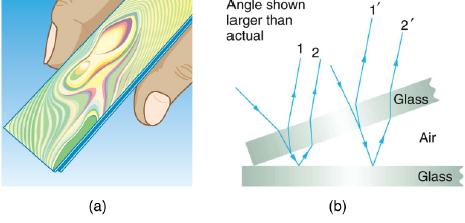
Figure 27.34 shows two 7.50-cm-long glass slides illuminated by pure 589-nm wavelength light incident perpendicularly. The top slide touches the bottom slide at one end and rests on some debris at the other end, forming a wedge of air. How thick is the debris, if the dark bands are 1.00 mm
A film of oil on water will appear dark when it is very thin, because the path length difference becomes small compared with the wavelength of light and there is a phase shift at the top surface. If it becomes dark when the path length difference is less than one-fourth the wavelength, what is the
Repeat Exercise 27.70, but take the light to be incident at a 45° angle.Data from Exercise 27.70A soap bubble is 100 nm thick and illuminated by white light incident perpendicular to its surface. What wavelength and color of visible light is most constructively reflected, assuming the same index
Repeat Exercise 27.71, but take the light to be incident at a 45° angle.Data from Exercise 27.71An oil slick on water is 120 nm thick and illuminated by white light incident perpendicular to its surface. What color does the oil appear (what is the most constructively reflected wavelength), given
To save money on making military aircraft invisible to radar, an inventor decides to coat them with a non-reflective material having an index of refraction of 1.20, which is between that of air and the surface of the plane. This, he reasons, should be much cheaper than designing Stealth bombers.(a)
What angle is needed between the direction of polarized light and the axis of a polarizing filter to cut its intensity in half?
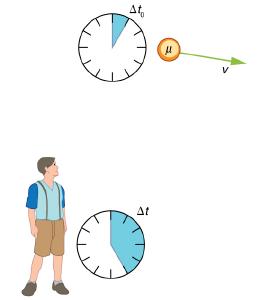
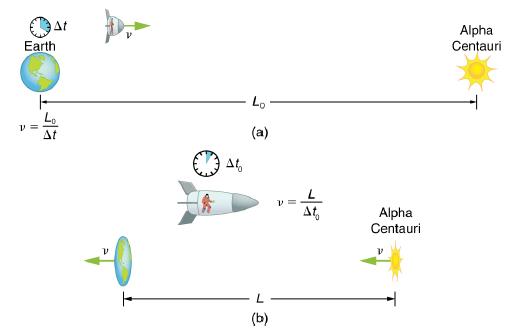
Suppose a cosmic ray colliding with a nucleus in the Earth's upper atmosphere produces a muon that has a velocity v = 0.950c. The muon then travels at constant velocity and lives 1.52 μs as measured in the muon's frame of reference. (You can imagine this as the muon's internal clock.) How long
(a) How long does it take the astronaut in Example 28.2 to travel 4.30 ly at 0.99944c (as measured by the Earth-bound observer)?(b) How long does it take according to the astronaut? (c) Verify that these two times are related through time dilation with γ=30.00 as given.Data from Example
A supernova explosion of a 2.00 x 1031 kg star produces 1.00 x 1044 J of energy.(a) How many kilograms of mass are converted to energy in the explosion? (b) What is the ratio Δm/m of mass destroyed to the original mass of the star?
There is approximately 1034 J of energy available from fusion of hydrogen in the world's oceans.(a) If 1033 J of this energy were utilized, what would be the decrease in mass of the oceans? Assume that 0.08% of the mass of a water molecule is converted to energy during the fusion of hydrogen.(b)
A muon has a rest mass energy of 105.7 MeV, and it decays into an electron and a massless particle.(a) If all the lost mass is converted into the electron’s kinetic energy, find for the electron.(b) What is the electron’s velocity?
Alpha decay is nuclear decay in which a helium nucleus is emitted. If the helium nucleus has a mass of 6.80 x 10⁻²⁷ kg and is given 5.00 MeV of kinetic energy, what is its velocity?
(a) Beta decay is nuclear decay in which an electron is emitted. If the electron is given 0.750 MeV of kinetic energy, what is its velocity?(b) Comment on how the high velocity is consistent with the kinetic energy as it compares to the rest mass energy of the electron.
A positron is an antimatter version of the electron, having exactly the same mass. When a positron and an electron meet, they annihilate, converting all of their mass into energy.(a) Find the energy released, assuming negligible kinetic energy before the annihilation.(b) If this energy is given to
What is the kinetic energy in MeV of a π-meson that lives 1.40 × 10⁻¹⁶ s as measured in the laboratory, and 0.840 x 10⁻¹⁶ s when at rest relative to an observer, given that its rest energy is 135 MeV?
(a) Show that (pc)2/(mc2)2 = γ2-1. This means that at large velocities pc>> mc2. (b) Is E ≈ pc when γ = 30.0, as for the astronaut discussed in the twin paradox?
A laser with a power output of 2.00 mW at a wavelength of 400 nm is projected onto calcium metal.(a) How many electrons per second are ejected? (b) What power is carried away by the electrons, given that the binding energy is 2.71 eV?
Name three different types of evidence for the existence of atoms.
(a) Calculate the mass of a proton using the charge-to-mass ratio given for it in this chapter and its known charge. (b) How does your result compare with the proton mass given in this chapter?
Find the kinetic energy in MeV of a neutron with a measured life span of 2065 s, given its rest energy is 939.6 MeV, and rest life span is 900s.
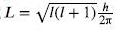
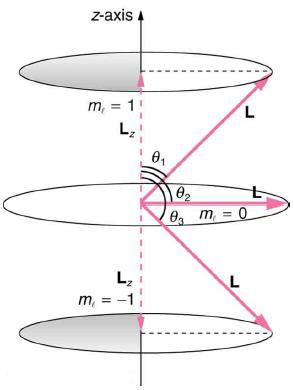
Calculate the angles that the angular momentum vector L can make with the z-axis for l= 1, as illustrated in Figure 30.52.StrategyFigure 30.52 represents the vectors Land Lz as usual, with arrows proportional to their magnitudes and pointing in the correct directions. L and Lz form a right
Explain why patterns observed in the periodic table of the elements are evidence for the existence of atoms, and why Brownian motion is a more direct type of evidence for their existence.
If someone wanted to build a scale model of the atom with a nucleus 1.00 m in diameter, how far away would the nearest electron need to be?
If atoms exist, why can’t we see them with visible light?
List all the possible sets of quantum numbers for the n = 2 shell, and determine the number of electrons that can be in the shell and each of its subshells.StrategyGiven n = 2 for the shell, the rules for quantum numbers limit l to be 0 or 1. The shell therefore has two subshells, labeled 2s and
What two pieces of evidence allowed the first calculation of me, the mass of the electron?(a) The ratios qe/me and qp/mp.(b) The values of qe and EB.(c) The ratio qe/me and qe. Justify your response.
Rutherford found the size of the nucleus to be about 10-15 m. This implied a huge density. What would this density be for gold?
How many subshells are in the n = 3 shell? Identify each subshell, calculate the maximum number of electrons that will fit into each, and verify that the total is 2n2.StrategySubshells are determined by the value of l; thus, we first determine which values of I are allowed, and then we apply the
In Millikan's oil-drop experiment, one looks at a small oil drop held motionless between two plates. Take the voltage between the plates to be 2033 V, and the plate separation to be 2.00 cm. The oil drop (of density 0.81 g/cm3) has a diameter of 4.0 x 10⁻⁶ m. Find the charge on the drop, in terms
How do the allowed orbits for electrons in atoms differ from the allowed orbits for planets around the sun? Explain how the correspondence principle applies here.
(a) An aspiring physicist wants to build a scale model of a hydrogen atom for her science fair project. If the atom is 1.00 m in diameter, how big should she try to make the nucleus?(b) How easy will this be to do?
How do the allowed orbits for electrons in atoms differ from the allowed orbits for planets around the sun? Explain how the correspondence principle applies here.
By calculating its wavelength, show that the first line in the Lyman series is UV radiation.
Explain how Bohr’s rule for the quantization of electron orbital angular momentum differs from the actual rule.
Showing 800 - 900
of 3651
First
2
3
4
5
6
7
8
9
10
11
12
13
14
15
16
Last
Step by Step Answers

 Get 50% OFF
Claim Now
Get 50% OFF
Claim Now