New Semester
Started
Get
50% OFF
Study Help!
--h --m --s
Claim Now
Question Answers
Textbooks
Find textbooks, questions and answers
Oops, something went wrong!
Change your search query and then try again
S
Books
FREE
Study Help
Expert Questions
Accounting
General Management
Mathematics
Finance
Organizational Behaviour
Law
Physics
Operating System
Management Leadership
Sociology
Programming
Marketing
Database
Computer Network
Economics
Textbooks Solutions
Accounting
Managerial Accounting
Management Leadership
Cost Accounting
Statistics
Business Law
Corporate Finance
Finance
Economics
Auditing
Tutors
Online Tutors
Find a Tutor
Hire a Tutor
Become a Tutor
AI Tutor
AI Study Planner
NEW
Sell Books
Search
Search
Sign In
Register
study help
physics
college physics 2nd
College Physics 2nd Edition OpenStax - Solutions
Suppose an astronaut is moving relative to the Earth at a significant fraction of the speed of light.(a) Does he observe the rate of his clocks to have slowed? (b) What change in the rate of Earth-bound clocks does he see?(c) Does his ship seem to him to shorten? (d) What about the distance
(a) At what relative velocity is γ = 1.50? (b) At what relative velocity is γ = 100?
Explain the meaning of the terms “red shift” and “blue shift” as they relate to the relativistic Doppler effect.
(a) At what relative velocity is γ= 2.00? (b) At what relative velocity is γ = 10.0?
What happens to the relativistic Doppler effect when relative velocity is zero? Is this the expected result?
(a) Find the value of γ for the following situation. An Earth-bound observer measures 23.9 h to have passed while signals from a high-velocity space probe indicate that 24.0 h have passed on board.(b) What is unreasonable about this result?(c) Which assumptions are unreasonable or inconsistent?
Is the relativistic Doppler effect consistent with the classical Doppler effect in the respect that λobs is larger for motion away?
A spaceship, 200 m long as seen on board, moves by the Earth at 0.970c. What is its length as measured by an Earth-bound observer?
All galaxies farther away than about 50 × 106 ly exhibit a red shift in their emitted light that is proportional to distance, with those farther and farther away having progressively greater red shifts. What does this imply, assuming that the only source of red shift is relative motion?
How fast would a 6.0 m-long sports car have to be going past you in order for it to appear only 5.5 m long?
How does modern relativity modify the law of conservation of momentum?
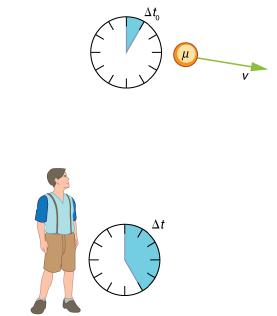
(a) How long would the muon in Example 28.1 have lived as observed on the Earth if its velocity was 0.0500c?(b) How far would it have traveled as observed on the Earth? (c) What distance is this in the muon's frame?Data from Example 28.1Suppose a cosmic ray colliding with a nucleus in the Earth's
Is it possible for an external force to be acting on a system and relativistic momentum to be conserved? Explain.
How are the classical laws of conservation of energy and conservation of mass modified by modern relativity?
What happens to the mass of water in a pot when it cools, assuming no molecules escape or are added? Is this observable in practice? Explain.
(a) How fast would an athlete need to be running for a 100-m race to look 100 yd long? (b) Is the answer consistent with the fact that relativistic effects are difficult to observe in ordinary circumstances? Explain.
Consider a thought experiment. You place an expanded balloon of air on weighing scales outside in the early morning. The balloon stays on the scales and you are able to measure changes in its mass. Does the mass of the balloon change as the day progresses? Discuss the difficulties in carrying out
(a) Find the value of γ for the following situation. An astronaut measures the length of her spaceship to be 25.0 m, while an Earth-bound observer measures it to be 100 m. (b) What is unreasonable about this result? (c) Which assumptions are unreasonable or inconsistent?
The mass of the fuel in a nuclear reactor decreases by an observable amount as it puts out energy. Is the same true for the coal and oxygen combined in a conventional power plant? If so, is this observable in practice for the coal and oxygen? Explain.
A spaceship is heading directly toward the Earth at a velocity of 0.800c. The astronaut on board claims that he can send a canister toward the Earth at 1.20c relative to the Earth.(a) Calculate the velocity the canister must have relative to the spaceship. (b) What is unreasonable about this
We know that the velocity of an object with mass has an upper limit of c. Is there an upper limit on its momentum? Its energy? Explain.
Suppose a spaceship heading straight towards the Earth at 0.750c can shoot a canister at 0.500c relative to the ship.(a) What is the velocity of the canister relative to the Earth, if it is shot directly at the Earth? (b) If it is shot directly away from the Earth?
Given the fact that light travels at c, can it have mass? Explain.
Repeat the previous problem with the ship heading directly away from the Earth.Data from Previous ProblemSuppose a spaceship heading straight towards the Earth at 0.750c can shoot a canister at 0.500c relative to the ship.(a) What is the velocity of the canister relative to the Earth, if it is shot
If you use an Earth-based telescope to project a laser beam onto the Moon, you can move the spot across the Moon’s surface at a velocity greater than the speed of light. Does this violate modern relativity? (Note that light is being sent from the Earth to the Moon, not across the surface of the
(a) Suppose the speed of light were only 3000 m/s. A jet fighter moving toward a target on the ground at 800 m/s shoots bullets, each having a muzzle velocity of 1000 m/s. What are the bullets' velocity relative to the target?(b) If the speed of light was this small, would you observe relativistic
If a galaxy moving away from the Earth has a speed of 1000 km/s and emits 656 nm light characteristic of hydrogen (the most common element in the universe).(a) What wavelength would we observe on the Earth? (b) What type of electromagnetic radiation is this? (c) Why is the speed of the Earth in
If two spaceships are heading directly towards each other at 0.800c, at what speed must a canister be shot from the first ship to approach the other at 0.999c as seen by the second ship?
A space probe speeding towards the nearest star moves at 0.250c and sends radio information at a broadcast frequency of 1.00 GHz. What frequency is received on the Earth?
A highway patrol officer uses a device that measures the speed of vehicles by bouncing radar off them and measuring the Doppler shift. The outgoing radar has a frequency of 100 GHz and the returning echo has a frequency 15.0 kHz higher. What is the velocity of the vehicle? Note that there are two
Two planets are on a collision course, heading directly towards each other at 0.250c. A spaceship sent from one planet approaches the second at 0.750c as seen by the second planet. What is the velocity of the ship relative to the first planet?
What is the relative velocity of two spaceships if one fires a missile at the other at 0.750c and the other observes it to approach at 0.950c?
Near the center of our galaxy, hydrogen gas is moving directly away from us in its orbit about a black hole. We receive 1900 nm electromagnetic radiation and know that it was 1875 nm when emitted by the hydrogen gas. What is the speed of the gas?
Prove that for any relative velocity v between two observers, a beam of light sent from one to the other will approach at speed c (provided that v is less than c, of course).
Show that for any relative velocity v between two observers, a beam of light projected by one directly away from the other will move away at the speed of light (provided that v is less than c, of course).
Find the momentum of a helium nucleus having a mass of 6.68 x 10⁻²⁷ kg that is moving at 0.200c.
What is the momentum of an electron traveling at 0.980c?
(a) Find the momentum of a 1.00 × 10⁹ kg asteroid heading towards the Earth at 30.0 km/s.(b) Find the ratio of this momentum to the classical momentum. (Use the approximation that γ = 1+(1/2)v2/c2 at low velocities.)
(a) What is the momentum of a 2000 kg satellite orbiting at 4.00 km/s? (b) Find the ratio of this momentum to the classical momentum. ( Use the approximation that γ = 1+(1/2)v2/c2 at low velocities.)
Find the velocity of a proton that has a momentum of 4.48 x-10-19 kg-m/s.
(a) Calculate the speed of a 1.00-μg particle of dust that has the same momentum as a proton moving at 0.999c.(b) What does the small speed tell us about the mass of a proton compared to even a tiny amount of macroscopic matter?
(a) Calculate γ for a proton that has a momentum of 1.00 kg-m/s.(b) What is its speed? Such protons form a rare component of cosmic radiation with uncertain origins.
What is the rest energy of an electron, given its mass is 9.11 x 10⁻³¹ kg? Give your answer in joules and MeV.
The Big Bang that began the universe is estimated to have released 1068 J of energy. How many stars could half this energy create, assuming the average star's mass is 4.00 × 1030 kg?
If the rest energies of a proton and a neutron (the two constituents of nuclei) are 938.3 and 939.6 MeV respectively, what is the difference in their masses in kilograms?
Find the rest energy in joules and MeV of a proton, given its mass is 1.67 x 10⁻²⁷ kg.
One cosmic ray neutron has a velocity of 0.250c relative to the Earth.(a) What is the neutron's total energy in MeV?(b) Find its momentum.(c) Is E ≈ pc in this situation? Discuss in terms of the equation given in part (a) of the previous problem.
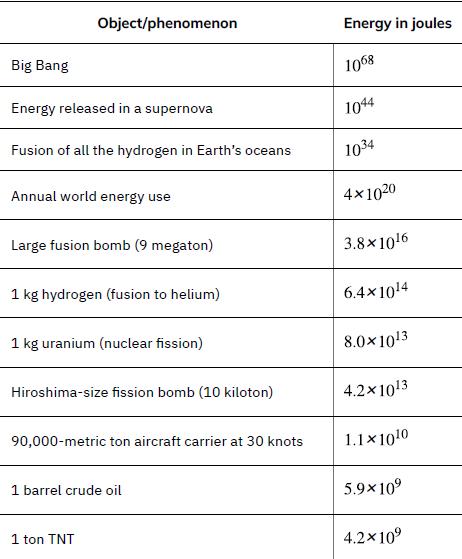
(a) Using data from Table 7.1, find the mass destroyed when the energy in a barrel of crude oil is released. (b) Given these barrels contain 200 liters and assuming the density of crude oil is 750 kg/m3, what is the ratio of mass destroyed to original mass, Δm/m?Data from Table 7.1 Big
What is γ for a proton having a mass energy of 938.3 MeV accelerated through an effective potential of 1.0 TV (teravolt) at Fermilab outside Chicago?
(a) What is the effective accelerating potential for electrons at the Stanford Linear Accelerator, if γ = 1.00 x 10⁵ for them?(b) What is their total energy (nearly the same as kinetic in this case) in GeV?
A Van de Graaff accelerator utilizes a 50.0 MV potential difference to accelerate charged particles such as protons. (a) What is the velocity of a proton accelerated by such a potential? (b) An electron?
Suppose you use an average of 500 kW.h of electric energy per month in your home.(a) How long would 1.00 g of mass converted to electric energy with an efficiency of 38.0% last you? (b) How many homes could be supplied at the 500 kWh per month rate for one year by the energy from the described
(a) A nuclear power plant converts energy from nuclear fission into electricity with an efficiency of 35.0%. How much mass is destroyed in one year to produce a continuous 1000 MW of electric power? (b) Do you think it would be possible to observe this mass loss if the total mass of the fuel is
Nuclear-powered rockets were researched for some years before safety concerns became paramount.(a) What fraction of a rocket's mass would have to be destroyed to get it into a low Earth orbit, neglecting the decrease in gravity? (Assume an orbital altitude of 250 km, and calculate both the kinetic
The Sun produces energy at a rate of 4.00 × 1026 W by the fusion of hydrogen.(a) How many kilograms of hydrogen undergo fusion each second?(b) If the Sun is 90.0% hydrogen and half of this can undergo fusion before the Sun changes character, how long could it produce energy at its current rate?(c)
A proton has a mass of 1.67 x 10⁻²⁷ kg. A physicist measures the proton's total energy to be 50.0 MeV.(a) What is the proton's kinetic energy?(b) What is unreasonable about this result? (c) Which assumptions are unreasonable or inconsistent?
Consider a highly relativistic particle. Discuss what is meant by the term “highly relativistic.” (Note that, in part, it means that the particle cannot be massless.) Construct a problem in which you calculate the wavelength of such a particle and show that it is very nearly the same as the
Consider an astronaut traveling to another star at a relativistic velocity. Construct a problem in which you calculate the time for the trip as observed on the Earth and as observed by the astronaut. Also calculate the amount of mass that must be converted to energy to get the astronaut and ship to
Critical Thinking A space rock with a length of 1,000.0 m is moving through space at exactly 0.6 c. (a) If the space rock is moving toward an observer, what is the contracted length observed?(b) If the space rock is moving away from the observer, what is the contracted length observed?(c) Can the
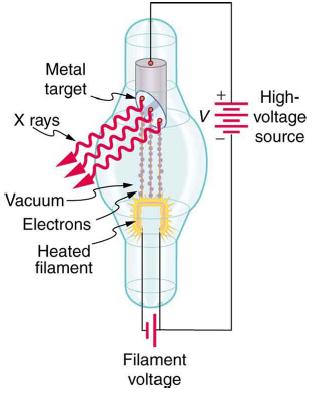
Find the maximum energy in eV of an x-ray photon produced by electrons accelerated through a potential difference of 50.0 kV in a CRT like the one in Figure 29.11.Data from figure 29.11StrategyElectrons can give all of their kinetic energy to a single photon when they strike the anode of a CRT.
Give an example of a physical entity that is quantized. State specifically what the entity is and what the limits are on its values.
Give an example of a physical entity that is not quantized, in that it is continuous and may have a continuous range of values.
Short-wavelength UV is sometimes called vacuum UV, because it is strongly absorbed by air and must be studied in a vacuum. Calculate the photon energy in eV for 100-nm vacuum UV, and estimate the number of molecules it could ionize or break apart.Strategy Using the equation E = hf and appropriate
The difference in energy between allowed oscillator states in HBr molecules is 0.330 eV. What is the oscillation frequency of this molecule?
What aspect of the blackbody spectrum forced Planck to propose quantization of energy levels in its atoms and molecules?
A physicist is watching a 15-kg orangutan at a zoo swing lazily in a tire at the end of a rope. He (the physicist) notices that each oscillation takes 3.00 s and hypothesizes that the energy is quantized. (a) What is the difference in energy in joules between allowed oscillator states?(b) What is
If Planck's constant were large, say 1034 times greater than it is, we would observe macroscopic entities to be quantized. Describe the motions of a child's swing under such circumstances.
Assuming that 10.0% of a 100-W light bulb’s energy output is in the visible range (typical for incandescent bulbs) with an average wavelength of 580 nm, calculate the number of visible photons emitted per second.Strategy Power is energy per unit time, and so if we can find the energy per photon,
What is the longest-wavelength EM radiation that can eject a photoelectron from silver, given that the binding energy is 4.73 eV? Is this in the visible range?
Why don’t we notice quantization in everyday events?
Find the longest-wavelength photon that can eject an electron from potassium, given that the binding energy is 2.24 eV. Is this visible EM radiation?
Is visible light the only type of EM radiation that can cause the photoelectric effect?
What is the binding energy in eV of electrons in magnesium, if the longest-wavelength photon that can eject electrons is 337 nm?
Which aspects of the photoelectric effect cannot be explained without photons? Which can be explained without photons? Are the latter inconsistent with the existence of photons?
(a) If the position of an electron in an atom is measured to an accuracy of 0.0100 nm, what is the electron’s uncertainty in velocity? (b) If the electron has this velocity, what is its kinetic energy in eV?StrategyThe uncertainty in position is the accuracy of the measurement, or Δx = 0.0100
Is the photoelectric effect a direct consequence of the wave character of EM radiation or of the particle character of EM radiation? Explain briefly.
What is the maximum kinetic energy in eV of electrons ejected from sodium metal by 450-nm EM radiation, given that the binding energy is 2.28 eV?
An atom in an excited state temporarily stores energy. If the lifetime of this excited state is measured to be 1.0 x 10⁻¹⁰ s, what is the minimum uncertainty in the energy of the state in eV?StrategyThe minimum uncertainty in energy ΔE is found by using the equals sign in ΔEΔt ≥ h/4π and
Insulators (nonmetals) have a higher BE than metals, and it is more difficult for photons to eject electrons from insulators. Discuss how this relates to the free charges in metals that make them good conductors.
The following topics are involved in this integrated concepts worked example:A 550-nm photon (visible light) is absorbed by a 1.00-μg particle of dust in outer space.(a) Find the momentum of such a photon.(b) What is the recoil velocity of the particle of dust, assuming it is initially at
UV radiation having a wavelength of 120 nm falls on gold metal, to which electrons are bound by 4.82 eV. What is the maximum kinetic energy of the ejected photoelectrons?
If you pick up and shake a piece of metal that has electrons in it free to move as a current, no electrons fall out. Yet if you heat the metal, electrons can be boiled off. Explain both of these facts as they relate to the amount and distribution of energy involved with shaking the object as
Violet light of wavelength 400 nm ejects electrons with a maximum kinetic energy of 0.860 eV from sodium metal. What is the binding energy of electrons to sodium metal?
Why are UV, x rays, and γ rays called ionizing radiation?
UV radiation having a 300-nm wavelength falls on uranium metal, ejecting 0.500-eV electrons. What is the binding energy of electrons to uranium metal?
How can treating food with ionizing radiation help keep it from spoiling? UV is not very penetrating. What else could be used?
Some television tubes are CRTs. They use an approximately 30-kV accelerating potential to send electrons to the screen, where the electrons stimulate phosphors to emit the light that forms the pictures we watch. Would you expect x rays also to be created?
Tanning salons use “safe” UV with a longer wavelength than some of the UV in sunlight. This “safe” UV has enough photon energy to trigger the tanning mechanism. Is it likely to be able to cause cell damage and induce cancer with prolonged exposure?
What is the maximum velocity of electrons ejected from a material by 80-nm photons, if they are bound to the material by 4.73 eV?
Your pupils dilate when visible light intensity is reduced. Does wearing sunglasses that lack UV blockers increase or decrease the UV hazard to your eyes? Explain.
Photoelectrons from a material with a binding energy of 2.71 eV are ejected by 420-nm photons. Once ejected, how long does it take these electrons to travel 2.50 cm to a detection device?
One could feel heat transfer in the form of infrared radiation from a large nuclear bomb detonated in the atmosphere 75 km from you. However, none of the profusely emitted x rays or γ rays reaches you. Explain.
Can a single microwave photon cause cell damage? Explain.
(a) Calculate the number of photoelectrons per second ejected from a 1.00-mm2 area of sodium metal by 500-nm EM radiation having an intensity of 1.30 kW/m2 (the intensity of sunlight above the Earth's atmosphere).(b) Given that the binding energy is 2.28 eV, what power is carried away by the
Red light having a wavelength of 700 nm is projected onto magnesium metal to which electrons are bound by 3.68 eV.(a) Use KEe=hf-BE to calculate the kinetic energy of the ejected electrons. (b) What is unreasonable about this result? (c) Which assumptions are unreasonable or inconsistent?
In an x-ray tube, the maximum photon energy is given by hf = qV. Would it be technically more correct to say hf = qV+ BE, where BE is the binding energy of electrons in the target anode? Why isn't the energy stated the latter way?
Which formula may be used for the momentum of all particles, with or without mass?
Is there any measurable difference between the momentum of a photon and the momentum of matter?
What is the energy in joules and eV of a photon in a radio wave from an AM station that has a 1530-kHz broadcast frequency?
Why don’t we feel the momentum of sunlight when we are on the beach?
Showing 1100 - 1200
of 3651
First
5
6
7
8
9
10
11
12
13
14
15
16
17
18
19
Last
Step by Step Answers

 Get 50% OFF
Claim Now
Get 50% OFF
Claim Now