New Semester
Started
Get
50% OFF
Study Help!
--h --m --s
Claim Now
Question Answers
Textbooks
Find textbooks, questions and answers
Oops, something went wrong!
Change your search query and then try again
S
Books
FREE
Study Help
Expert Questions
Accounting
General Management
Mathematics
Finance
Organizational Behaviour
Law
Physics
Operating System
Management Leadership
Sociology
Programming
Marketing
Database
Computer Network
Economics
Textbooks Solutions
Accounting
Managerial Accounting
Management Leadership
Cost Accounting
Statistics
Business Law
Corporate Finance
Finance
Economics
Auditing
Tutors
Online Tutors
Find a Tutor
Hire a Tutor
Become a Tutor
AI Tutor
AI Study Planner
NEW
Sell Books
Search
Search
Sign In
Register
study help
physics
college physics 2nd
College Physics 2nd Edition OpenStax - Solutions
Compare the electrostatic force between an electron and proton separated by 0.530 × 10⁻¹⁰ m with the gravitational force between them. This distance is their average separation in a hydrogen atom.StrategyTo compare the two forces, we first compute the electrostatic force using Coulomb's law, We
If your radio is producing an average sound intensity level of 85 dB, what is the next lowest sound intensity level that is clearly less intense?
Calculate the strength and direction of the electric field E due to a point charge of 2.00 nC (nano-Coulombs) at a distance of 5.00 mm from the charge.StrategyWe can find the electric field created by a point charge by using the equation E =kQ/r2.
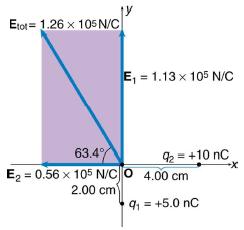
Find the magnitude and direction of the total electric field due to the two point charges, q1 and q2, at the origin of the coordinate system as shown in Figure 18.21.StrategySince the electric field is a vector (having magnitude and direction), we add electric fields with the same vector techniques
What force does the electric field found in the previous example exert on a point charge of -0.250 μC?StrategySince we know the electric field strength and the charge in the field, the force on that charge can be calculated using the definition of electric field E= F/q rearranged to F =qE.
If steps are not taken to ground a gasoline pump, static electricity can be placed on gasoline when filling your car's tank. Suppose a tiny drop of gasoline has a mass of 4.00 × 10⁻¹⁵ kg and is given a positive charge of 3.20 x 10⁻¹⁹ C.(a) Find the weight of the drop.(b) Calculate the electric
An electron has an initial velocity of 5.00 x 10⁶ m/s in a uniform 2.00 x 10⁵ N/C strength electric field. The field accelerates the electron in the direction opposite to its initial velocity. (a) What is the direction of the electric field? (b) How far does the electron travel before coming to
Suppose you have a 12.0 V motorcycle battery that can move 5000 C of charge, and a 12.0 V car battery that can move 60,000 C of charge. How much energy does each deliver? (Assume that the numerical value of each charge is accurate to three significant figures.)StrategyTo say we have a 12.0 V
When a 12.0 V car battery runs a single 30.0 W headlight, how many electrons pass through it each second?StrategyTo find the number of electrons, we must first find the charge that moved in 1.00 s. The charge moved is related to voltage and energy through the equation ΔPE =qΔV. A 30.0 W lamp uses
Calculate the final speed of a free electron accelerated from rest through a potential difference of 100 V. (Assume that this numerical value is accurate to three significant figures.)StrategyWe have a system with only conservative forces. Assuming the electron is accelerated in a vacuum, and
Dry air will support a maximum electric field strength of about 3.0 x 10⁶ V/m. Above that value, the field creates enough ionization in the air to make the air a conductor. This allows a discharge or spark that reduces the field. What, then, is the maximum voltage between two parallel conducting
(a) An electron gun has parallel plates separated by 4.00 cm and gives electrons 25.0 keV of energy. What is the electric field strength between the plates? (b) What force would this field exert on a piece of plastic with a 0.500 μC charge that gets between the plates?StrategySince the voltage
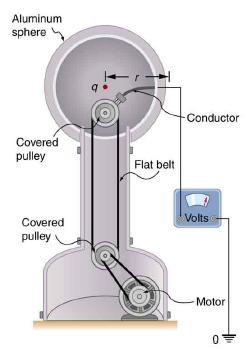
A demonstration Van de Graaff generator has a 25.0 cm diameter metal sphere that produces a voltage of 100 kV near its surface. (See Figure 19.7.) What excess charge resides on the sphere? (Assume that each numerical value here is shown with three significant figures.)StrategyThe potential on the
Charges in static electricity are typically in the nanocoulomb (nC) to microcoulomb (μC) range. What is the voltage 5.00 cm away from the center of a 1-cm diameter metal sphere that has a-3.00 nC static charge?StrategyAs we have discussed in Electric Charge and Electric Field, charge on a metal
(a) What is the capacitance of a parallel plate capacitor with metal plates, each of area 1.00 m2, separated by 1.00 mm?(b) What charge is stored in this capacitor if a voltage of 3.00 × 10³ V is applied to it?StrategyFinding the capacitance C is a straightforward application of the equation C =
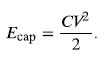
A heart defibrillator delivers 4.00 x 10² J of energy by discharging a capacitor initially at 1.00 x 10⁴ V. What is its capacitance?StrategyWe are given Ecap and V, and we are asked to find the capacitance C. Of the three expressions in the equation for Ecap, the most convenient relationship is
Find the total capacitance for three capacitors connected in series, given their individual capacitances are 1.000, 5.000, and 8.000 μF.StrategyWith the given information, the total capacitance can be found using the equation for capacitance in series.
What charge is stored in the capacitor in Example 19.8?Data given in Example 19.8(a) What is the capacitance of a parallel plate capacitor with metal plates, each of area 1.00 m2, separated by 1.00 mm?(b) What charge is stored in this capacitor if a voltage of 3.00 × 10³ V is applied to
(a) If the cost of electricity in your area is 12 cents per kWh, what is the total cost (capital plus operation) of using a 60-W incandescent bulb for 1000 hours (the lifetime of that bulb) if the bulb cost 25 cents? (b) If we replace this bulb with a compact fluorescent light that provides the
Repeat the above example on Example 20.3, but for a wire made of silver and given there is one free electron per silver atom.Data given in Example 20.3Calculate the drift velocity of electrons in a 12-gauge copper wire (which has a diameter of 2.053 mm) carrying a 20.0-A current, given that there
Using the results of the above example on Example 20.3, find the drift velocity in a copper wire of twice the diameter and carrying 20.0 A.Data given in Example 20.3Calculate the drift velocity of electrons in a 12-gauge copper wire (which has a diameter of 2.053 mm) carrying a 20.0-A current,
A 14-gauge copper wire has a diameter of 1.628 mm. What magnitude current flows when the drift velocity is 1.00 mm/s? (See above example on Example 20.3 for useful information.)Data given in Example 20.3Calculate the drift velocity of electrons in a 12-gauge copper wire (which has a diameter of
00-gauge copper wire has a diameter of 9.266 mm. Calculate the power loss in a kilometer of such wire when it carries 1.00 × 10² A.
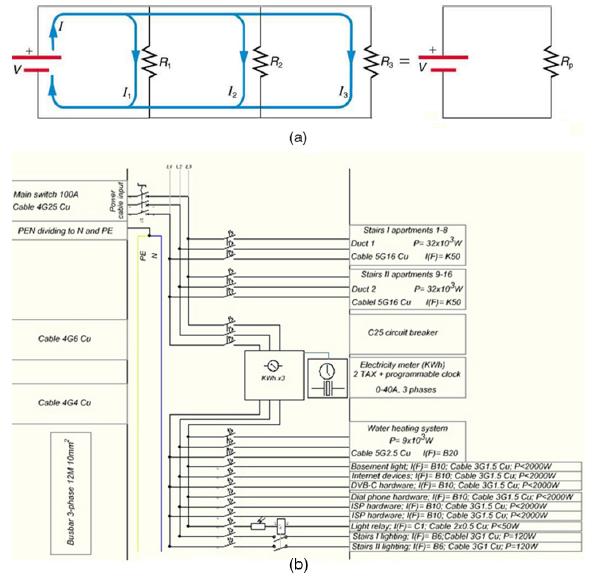
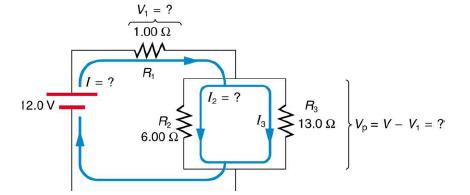
Let the voltage output of the battery and resistances in the parallel connection in Figure 21.4 be the same as the previously considered series connection: V = 12.0 V, R1 = 1.00 Ω, R2 = 6.00 Ω, and R3 = 13.0 Ω.(a) What is the total resistance? (b) Find the total current. (c) Calculate the
(a) What is the resistance of a 1.00 x 10² -Ω, a 2.50-kΩ, and a 4.00-kΩ resistor connected in series?(b) In parallel?
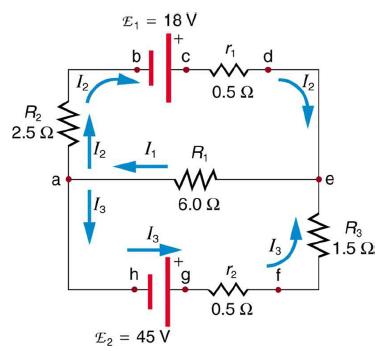
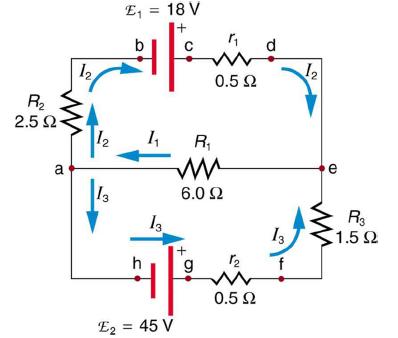
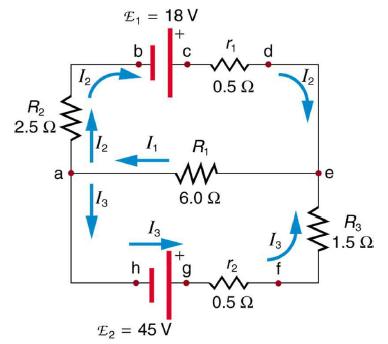
Find the currents flowing in the circuit in Figure 21.25.StrategyThis circuit is sufficiently complex that the currents cannot be found using Ohm's law and the series-parallel techniques-it is necessary to use Kirchhoff's rules. Currents have been labeled I1, I2, and I3 in the figure and
An 1800-W toaster, a 1400-W electric frying pan, and a 75-W lamp are plugged into the same outlet in a 15-A, 120-V circuit. (The three devices are in parallel when plugged into the same socket.). (a) What current is drawn by each device? (b) Will this combination blow the 15-A fuse?
High-speed flash photography was pioneered by Doc Edgerton in the 1930s, while he was a professor of electrical engineering at MIT. You might have seen examples of his work in the amazing shots of hummingbirds in motion, a drop of milk splattering on a table, or a bullet penetrating an apple (see
Your car’s 30.0-W headlight and 2.40-kW starter are ordinarily connected in parallel in a 12.0-V system. What power would one headlight and the starter consume if connected in series to a 12.0-V battery? (Neglect any other resistance in the circuit and any change in resistance in the two devices.)
Referring to Figure 21.6:(a) Calculate P3 and note how it compares with P3 found in the first two example problems in this module. (b) Find the total power supplied by the source and compare it with the sum of the powers dissipated by the resistors. 12.0 V [ = ? V = ? 1.00 Ω Ω R₁ R₂ 6.00
(a) Given a 48.0-V battery and 24.0-Ω and 96.0-Ω resistors, find the current and power for each when connected in series.(b) Repeat when the resistances are in parallel.
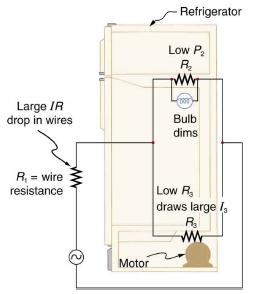
Refer to Figure 21.7 and the discussion of lights dimming when a heavy appliance comes on.(a) Given the voltage source is 120 V, the wire resistance is 0.400 Ω, and the bulb is nominally 75.0 W, what power will the bulb dissipate if a total of 15.0 A passes through the wires when the motor comes
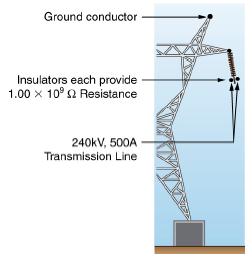
A 240-kV power transmission line carrying 5.00 x 10² A is hung from grounded metal towers by ceramic insulators, each having a 1.00 x 10⁹ -Ω resistance. Figure 21.49.(a) What is the resistance to ground of 100 of these insulators?(b) Calculate the power dissipated by 100 of them.(c) What fraction
Show that if two resistors R1 and R2 are combined and one is much greater than the other (R1 >> R2): (a) Their series resistance is very nearly equal to the greater resistance R1.(b) Their parallel resistance is very nearly equal to smaller resistance R2.
Two resistors, one having a resistance of 145 Ω, are connected in parallel to produce a total resistance of 150 Ω.(a) What is the value of the second resistance?(b) What is unreasonable about this result? (c) Which assumptions are unreasonable or inconsistent?
Two resistors, one having a resistance of 900 kΩ, are connected in series to produce a total resistance of 0.500 MΩ. (a) What is the value of the second resistance? (b) What is unreasonable about this result? (c) Which assumptions are unreasonable or inconsistent?
Standard automobile batteries have six lead-acid cells in series, creating a total emf of 12.0 V. What is the emf of an individual lead-acid cell?
What is the output voltage of a 3.0000-V lithium cell in a digital wristwatch that draws 0.300 mA, if the cell's internal resistance is 2.00 Ω?
What is the internal resistance of an automobile battery that has an emf of 12.0 V and a terminal voltage of 15.0 V while a current of 8.00 A is charging it?
(a) Find the terminal voltage of a 12.0-V motorcycle battery having a 0.600-Ω internal resistance, if it is being charged by a current of 10.0 A. (b) What is the output voltage of the battery charger?
A car battery with a 12-V emf and an internal resistance of 0.050Ω is being charged with a current of 60 A. Note that in this process the battery is being charged.(a) What is the potential difference across its terminals? (b) At what rate is thermal energy being dissipated in the battery?(c) At
The label on a portable radio recommends the use of rechargeable nickel-cadmium cells (nicads), although they have a 1.25-V emf while alkaline cells have a 1.58-V emf. The radio has a 3.20-Ω resistance.(a) Draw a circuit diagram of the radio and its batteries. Now, calculate the power delivered to
An automobile starter motor has an equivalent resistance of 0.0500 Ω and is supplied by a 12.0-V battery with a 0.0100-Ω internal resistance.(a) What is the current to the motor?(b) What voltage is applied to it? (c) What power is supplied to the motor? (d) Repeat these calculations for when
A child's electronic toy is supplied by three 1.58-V alkaline cells having internal resistances of 0.0200 Ω in series with a 1.53-V carbon-zinc dry cell having a 0.100-Ω internal resistance. The load resistance is 10.0Ω.(a) Draw a circuit diagram of the toy and its batteries. (b) What current
(a) What is the internal resistance of a voltage source if its terminal voltage drops by 2.00 V when the current supplied increases by 5.00 A? (b) Can the emf of the voltage source be found with the information supplied?
A person with body resistance between his hands of 10.0 kΩ accidentally grasps the terminals of a 20.0-kV power supply. (Do NOT do this!) (a) Draw a circuit diagram to represent the situation. (b) If the internal resistance of the power supply is 2000 Ω, what is the current through his
Electric fish generate current with biological cells called electroplaques, which are physiological emf devices. The electroplaques in the South American eel are arranged in 140 rows, each row stretching horizontally along the body and each containing 5000 electroplaques. Each electroplaque has an
A 12.0-V emf automobile battery has a terminal voltage of 16.0 V when being charged by a current of 10.0 A.(a) What is the battery's internal resistance? (b) What power is dissipated inside the battery? (c) At what rate (in °C/min) will its temperature increase if its mass is 20.0 kg and it has
A 1.58-V alkaline cell with a 0.200-Ω internal resistance is supplying 8.50 A to a load. (a) What is its terminal voltage?(b) What is the value of the load resistance? (c) What is unreasonable about these results? (d) Which assumptions are unreasonable or inconsistent?
Apply the loop rule to loop abcdefgha in Figure 21.25. R₂ 2.5 Ω· a 12 12 E₁ = 18 V b C 4F h 1₁ 13 R₁ ww 6.0 92 E2 = 45 V 0.5 Ω + 12 0.5 Ω d 13 f 12 e R3 €1.592
(a) What is the internal resistance of a 1.54-V dry cell that supplies 1.00 W of power to a 15.0-Ω bulb? (b) What is unreasonable about this result? (c) Which assumptions are unreasonable or inconsistent?
Verify the second equation in Example 21.5 by substituting the values found for the currents I1 and I2.Data given in Example 21.5Find the currents flowing in the circuit in Figure 21.25.StrategyThis circuit is sufficiently complex that the currents cannot be found using Ohm's law and the
Verify the third equation in Example 21.5 by substituting the values found for the currents I1 and I3.Data given in Example 21.5Find the currents flowing in the circuit in Figure 21.25.StrategyThis circuit is sufficiently complex that the currents cannot be found using Ohm's law and the
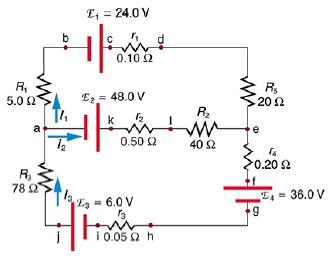
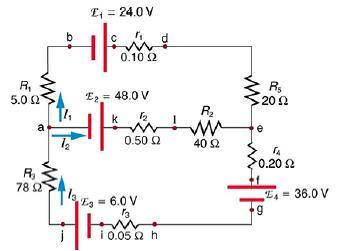
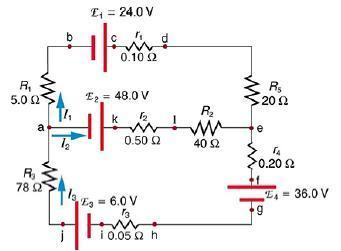
Apply the junction rule at point a in Figure 21.50. R 5.0 Ω R₂ 78 Ω b 12 T; = 24.0 V 010 Ω Έ, = 48.00 k Γα 0.50 Ω 2=6ον 13 Η 10.05 Ω Η R₂ ww 40 Ω - 20 Ω e R₂ Ω Για 70.20 Ω 2, = 36.0 V V 9
Apply the loop rule to loop akledcba in Figure 21.50. R₁ 5.0 Ω a R₂ 78 Ω b 14 T+ = 24.0 V 0.10 Ω Έγ = 48.00 k 12 0.50 Ω Έg = 60V Pa M 1.0.05 Ω h Η R₂ 40 Ω R₂ 20 Ω Θ FA 70.20 Ω 2 = 36.0 V g
Find the currents flowing in the circuit in Figure 21.50. Explicitly show how you follow the steps in the Problem-Solving Strategies for Series and Parallel Resistors. R₁ 5.0 Ω a R₂ 78 Ω b 14 T; = 24.0 V να 0.10 Ω Έγ = 48.00 κ για 0.50 Ω Eg = 6.0 V Pa m 1.0.05 Ω h Η R₂ 40
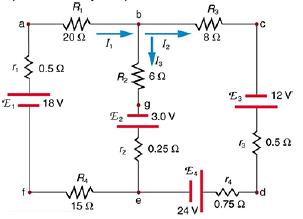
Find the currents flowing in the circuit in Figure 21.45. ۴. E₁ a 20 92 0.502 R₁ 18 V R₁ 15 22 1, P₂2₂ E₂ 00 602 9 3.0 V 0.25 Ω E i 24 V R₂ 892 E3 T 5 12 V 0.52 w d 0.75 22
Consider the circuit in Figure 21.51, and suppose that the emfs are unknown and the currents are given to be I1 = 5.00 A, I2 = 3.0 A, and I3 = -2.00 A.(a) Could you find the emfs?(b) What is wrong with the assumptions? R₂ 2.5 Ω· CO a 12, 12 E₁ = 18 V + b h I₁ 13 R₁ ww 6.0 Ω E₂ = 45
What is the sensitivity of the galvanometer (that is, what current gives a full-scale deflection) inside a voltmeter that has a 1.00-MΩ resistance on its 30.0-V scale?
What is the sensitivity of the galvanometer (that is, what current gives a full-scale deflection) inside a voltmeter that has a 25.0-kΩ resistance on its 100-V scale?
Find the resistance that must be placed in series with a 25.0-Ω galvanometer having a 50.0-μA sensitivity (the same as the one discussed in the text) to allow it to be used as a voltmeter with a 3000-V full-scale reading. Include a circuit diagram with your solution.
Find the resistance that must be placed in parallel with a 25.0-Ω galvanometer having a 50.0-μA sensitivity (the same as the one discussed in the text) to allow it to be used as an ammeter with a 10.0-A full-scale reading. Include a circuit diagram with your solution.
Find the resistance that must be placed in parallel with a 25.0-Ω galvanometer having a 50.0-μA sensitivity (the same as the one discussed in the text) to allow it to be used as an ammeter with a 300-mA full-scale reading.
Find the resistance that must be placed in series with a 10.0-Ω galvanometer having a 100-μA sensitivity to allow it to be used as a voltmeter with:(a) A 300-V full-scale reading, and(b) A 0.300-V full-scale reading.
Find the resistance that must be placed in parallel with a 10.0-Ω galvanometer having a 100-μA sensitivity to allow it to be used as an ammeter with:(a) A 20.0-A full-scale reading, and(b) A 100-mA full-scale reading.
Suppose you measure the terminal voltage of a 3.200-V lithium cell having an internal resistance of 5.00 Ω by placing a 1.00-kΩ voltmeter across its terminals.(a) What current flows? (b) Find the terminal voltage. (c) To see how close the measured terminal voltage is to the emf, calculate their
A certain ammeter has a resistance of 5.00 x 10⁻⁵ Ω on its 3.00-A scale and contains a 10.0-Ω galvanometer. What is the sensitivity of the galvanometer?
A 1.00-MΩ voltmeter is placed in parallel with a 75.0-kΩ resistor in a circuit.(a) Draw a circuit diagram of the connection. (b) What is the resistance of the combination? (c) If the voltage across the combination is kept the same as it was across the 75.0-kΩ resistor alone, what is the
A 0.0200-Ω ammeter is placed in series with a 10.00-Ω resistor in a circuit.(a) Draw a circuit diagram of the connection. (b) Calculate the resistance of the combination.(c) If the voltage is kept the same across the combination as it was through the 10.00-Ω resistor alone, what is the percent
Suppose you have a 40.0-Ω galvanometer with a 25.0-μA sensitivity.(a) What resistance would you put in series with it to allow it to be used as a voltmeter that has a full-scale deflection for 0.500 mV? (b) What is unreasonable about this result? (c) Which assumptions are responsible?
(a) What resistance would you put in parallel with a 40.0-Ω galvanometer having a 25.0-μA sensitivity to allow it to be used as an ammeter that has a full-scale deflection for 10.0-μA?(b) What is unreasonable about this result?(c) Which assumptions are responsible?
What is the emfx of a cell being measured in a potentiometer, if the standard cell's emf is 12.0 V and the potentiometer balances for Rx = 5.000 Ω and Rs = 2.500 Ω?
Calculate the emfx of a dry cell for which a potentiometer is balanced when Rx = 1.200 Ω, while an alkaline standard cell with an emf of 1.600 V requires Rs = 1.247 Ω to balance the potentiometer.
When an unknown resistance Rx is placed in a Wheatstone bridge, it is possible to balance the bridge by adjusting R3 to be 2500 Ω. What is Rx if R2/R1 = 0.625?
To what value must you adjust R3 to balance a Wheatstone bridge, if the unknown resistance Rx is 100Ω, R is 50.0Ω, and R2 is 175 Ω?
(a) What is the unknown emfx in a potentiometer that balances when Rx is 10.0Ω, and balances when Rs, is 15.00Ω for a standard 3.000-V emf? (b) The same emfx is placed in the same potentiometer, which now balances when Rs, is 15.0Ω for a standard emf of 3.100 V. At what resistance Rx will the
Suppose you want to measure resistances in the range from 10.0 Ω to 10.0 kΩ using a Wheatstone bridge that has R2/R1 = 2.000. Over what range should R3 be adjustable?
A heart pacemaker fires 72 times a minute, each time a 25.0-nF capacitor is charged (by a battery in series with a resistor) to 0.632 of its full voltage. What is the value of the resistance?
The duration of a photographic flash is related to an RC time constant, which is 0.100 μs for a certain camera. (a) If the resistance of the flash lamp is 0.0400Ω during discharge, what is the size of the capacitor supplying its energy? (b) What is the time constant for charging the capacitor,
A 2.00- and a 7.50-μF capacitor can be connected in series or parallel, as can a 25.0- and a 100-Ωk resistor. Calculate the four RC time constants possible from connecting the resulting capacitance and resistance in series.
After two time constants, what percentage of the final voltage, emf, is on an initially uncharged capacitor C, charged through a resistance R?
A 500-Ω resistor, an uncharged 1.50-μF capacitor, and a 6.16-V emf are connected in series. (a) What is the initial current? (b) What is the RC time constant?(c) What is the current after one time constant? (d) What is the voltage on the capacitor after one time constant?
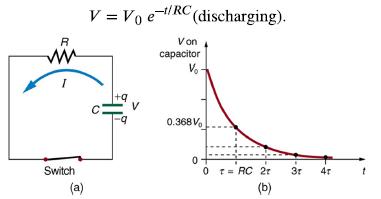
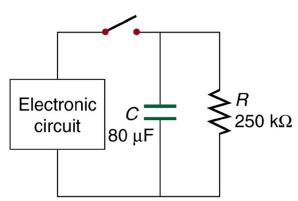
Figure 21.53 shows how a bleeder resistor is used to discharge a capacitor after an electronic device is shut off, allowing a person to work on the electronics with less risk of shock.(a) What is the time constant?(b) How long will it take to reduce the voltage on the capacitor to 0.250% (5% of 5%)
An ECG monitor must have an RC time constant less than 1.00 x 10² us to be able to measure variations in voltage over small time intervals.(a) If the resistance of the circuit (due mostly to that of the patient's chest) is 1.00 kΩ, what is the maximum capacitance of the circuit? (b) Would it be
Using the exact exponential treatment, find how much time is required to discharge a 250-μF capacitor through a 500-Ω resistor down to 1.00% of its original voltage.
Using the exact exponential treatment, find how much time is required to charge an initially uncharged 100-pF capacitor through a 75.0-MΩ resistor to 90.0% of its final voltage.
A 160-μF capacitor charged to 450 V is discharged through a 31.2-kΩ resistor.(a) Find the time constant. (b) Calculate the temperature increase of the resistor, given that its mass is 2.50 g and its specific heat is 1.67 noting that kg most of the thermal energy is retained in the short time of
A flashing lamp in a Christmas earring is based on an RC discharge of a capacitor through its resistance. The effective duration of the flash is 0.250 s, during which it produces an average 0.500 W from an average 3.00 V.(a) What energy does it dissipate? (b) How much charge moves through the
(a) Calculate the capacitance needed to get an RC time constant of 1.00 x 10³ s with a 0.100-Ω resistor.(b) What is unreasonable about this result? (c) Which assumptions are responsible?
Consider a camera's flash unit. Construct a problem in which you calculate the size of the capacitor that stores energy for the flash lamp. Among the things to be considered are the voltage applied to the capacitor, the energy needed in the flash and the associated charge needed on the capacitor,
Consider a rechargeable lithium cell that is to be used to power a camcorder. Construct a problem in which you calculate the internal resistance of the cell during normal operation. Also, calculate the minimum voltage output of a battery charger to be used to recharge your lithium cell. Among the
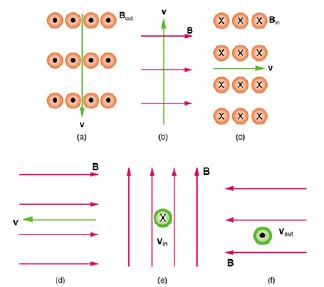
Repeat the previous exercise for a negative charge.Data given in Previous ExerciseWhat is the direction of the magnetic force on a positive charge that moves as shown in each of the six cases shown in Figure 22.47? Oooo oooo (a) B €1 (d) (0) X Vn (e) B XXX B XXX χ.χ.χ. X X X B (C) 6 (1) Vou!
A circuit has a voltage source producing 1.00 x 10² V and a 2.50 x 10³ resistor. (a) If the circuit contains nothing else, how much power is dissipated by the resistor?(b) A second 2.50 x 10³ resistor is added in parallel to the first resistor. Now how much power is dissipated by the
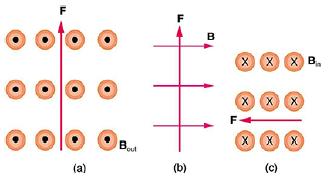
What is the direction of the velocity of a negative charge that experiences the magnetic force shown in each of the three cases in Figure 22.48, assuming it moves perpendicular to B? F (a) Bout (b) B X X F4 X X X B X X XX (c)
Repeat the previous exercise for a positive charge.Data given in Previous ExerciseWhat is the direction of the velocity of a negative charge that experiences the magnetic force shown in each of the three cases in Figure 22.48, assuming it moves perpendicular to B? F (a) Bout (b) B X X F4 X X X B X
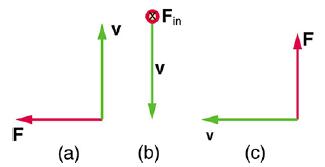
What is the direction of the magnetic field that produces the magnetic force on a positive charge as shown in each of the three cases in the figure below, assuming B is perpendicular to v? F (a) Fin V (b) V (c) AF
Repeat the previous exercise for a negative charge.Data given in Previous ExerciseWhat is the direction of the magnetic field that produces the magnetic force on a positive charge as shown in each of the three cases in the figure below, assuming B is perpendicular to v? F (a) Fin V (b) V (c) AF
What is the maximum magnitude of the force on an aluminum rod with a 0.100-μC charge that you pass between the poles of a 1.50-T permanent magnet at a speed of 5.00 m/s? In what direction is the force?
(a) Aircraft sometimes acquire small static charges. Suppose a supersonic jet has a 0.500-μC charge and flies due west at a speed of 660 m/s over the Earth's magnetic south pole (near Earth's geographic north pole), where the 8.00 × 10⁻⁵-T magnetic field points straight down. What are the
(a) A cosmic ray proton moving toward the Earth at 5.00 x 10⁷ m/s experiences a magnetic force of 1.70 x 10⁻¹⁶ N. What is the strength of the magnetic field if there is a 45° angle between it and the proton's velocity?(b) Is the value obtained in part (a) consistent with the known strength of the
Showing 1500 - 1600
of 3651
First
9
10
11
12
13
14
15
16
17
18
19
20
21
22
23
Last
Step by Step Answers

 Get 50% OFF
Claim Now
Get 50% OFF
Claim Now