New Semester
Started
Get
50% OFF
Study Help!
--h --m --s
Claim Now
Question Answers
Textbooks
Find textbooks, questions and answers
Oops, something went wrong!
Change your search query and then try again
S
Books
FREE
Study Help
Expert Questions
Accounting
General Management
Mathematics
Finance
Organizational Behaviour
Law
Physics
Operating System
Management Leadership
Sociology
Programming
Marketing
Database
Computer Network
Economics
Textbooks Solutions
Accounting
Managerial Accounting
Management Leadership
Cost Accounting
Statistics
Business Law
Corporate Finance
Finance
Economics
Auditing
Tutors
Online Tutors
Find a Tutor
Hire a Tutor
Become a Tutor
AI Tutor
AI Study Planner
NEW
Sell Books
Search
Search
Sign In
Register
study help
physics
college physics 2nd
College Physics 2nd Edition OpenStax - Solutions
Fusion bombs use neutrons from their fission trigger to create tritium fuel in the reaction What is the energy released by this reaction in MeV? น H+H 19+u
What mass is converted into energy by a 1.00-MT bomb?
It is estimated that the total explosive yield of all the nuclear bombs in existence currently is about 4,000 MT.(a) Convert this amount of energy to kilowatt- hours, noting that 1 kW · h = 3.60 x 10⁶ J. (b) What would the monetary value of this energy be if it could be converted to electricity
A radiation-enhanced nuclear weapon (or neutron bomb) can have a smaller total yield and still produce more prompt radiation than a conventional nuclear bomb. This allows the use of neutron bombs to kill nearby advancing enemy forces with radiation without blowing up your own forces with the blast.
(a) How many 239Pu nuclei must fission to produce a 20.0-kT yield, assuming 200 MeV per fission?(b) What is the mass of this much 239Pu?
This problem gives some idea of the magnitude of the energy yield of a small tactical bomb. Assume that half the energy of a 1.00-kT nuclear depth charge set off under an aircraft carrier goes into lifting it out of the water—that is, into gravitational potential energy. How high is the carrier
It is estimated that weapons tests in the atmosphere have deposited approximately 9 MCi of 90Sr on the surface of the earth. Find the mass of this amount of 90 g 90Sr.
Consider an ultrahigh-energy cosmic ray entering the Earth’s atmosphere (some have energies approaching a joule). Construct a problem in which you calculate the energy of the particle based on the number of particles in an observed cosmic ray shower. Among the things to consider are the average
Taking the range of the strong nuclear force to be about 1 fermi (10-15 m), calculate the approximate mass of the pion carrying the force, assuming it moves at nearly the speed of light.StrategyThe calculation is approximate because of the assumptions made about the range of the force and the speed
The total energy in the beam of an accelerator is far greater than the energy of the individual beam particles. Why isn’t this total energy available to create a single extremely massive particle?
A virtual particle having an approximate mass of 1014 GeV/c2 may be associated with the unification of the strong and electroweak forces. For what length of time could this virtual particle exist (in temporary violation of the conservation of mass-energy as allowed by the Heisenberg uncertainty
Consider a detector needed to observe the proposed, but extremely rare, decay of an electron. Construct a problem in which you calculate the amount of matter needed in the detector to be able to observe the decay, assuming that it has a signature that is clearly identifiable. Among the things to
Synchrotron radiation takes energy from an accelerator beam and is related to acceleration. Why would you expect the problem to be more severe for electron accelerators than proton accelerators?
Calculate the mass in GeV/c2 of a virtual carrier particle that has a range limited to 10-30 m by the Heisenberg uncertainty principle. Such a particle might be involved in the unification of the strong and electroweak forces.
(a) How much mass is converted to energy when a proton and antiproton annihilate each other? (b) How much energy is produced in the conversion above? (c) If energy were to produce a proton-antiproton pair, how much energy would this take? (d) What characteristic other than one being antimatter
What two major limitations prevent us from building high-energy accelerators that are physically small?
Another component of the strong nuclear force is transmitted by the exchange of virtual K-mesons. Taking K-mesons to have an average mass of 495 MeV/c2, what is the approximate range of this component of the strong force?
What are the advantages of colliding-beam accelerators? What are the disadvantages?
Large quantities of antimatter isolated from normal matter should behave exactly like normal matter. An antiatom, for example, composed of positrons, antiprotons, and antineutrons should have the same atomic spectrum as its matter counterpart. Would you be able to tell it is antimatter by its
The ratio of the strong to the weak force and the ratio of the strong force to the electromagnetic force become 1 under circumstances where they are unified. What are the ratios of the strong force to those two forces under normal circumstances?
Massless particles are not only neutral, they are chargeless (unlike the neutron). Why is this so?
At full energy, protons in the 2.00-km-diameter Fermilab synchrotron travel at nearly the speed of light, since their energy is about 1000 times their rest mass energy.(a) How long does it take for a proton to complete one trip around?(b) How many times per second will it pass through the target
Massless particles must travel at the speed of light, while others cannot reach this speed. Why are all massless particles stable? If evidence is found that neutrinos spontaneously decay into other particles, would this imply they have mass?
Suppose a W- created in a bubble chamber lives for 5.00 x 10⁻²⁵ s. What distance does it move in this time if it is traveling at 0.900 c? Since this distance is too short to make a track, the presence of the W- must be inferred from its decay products. given W- Note that the time is longer than the
When a star erupts in a supernova explosion, huge numbers of electron neutrinos are formed in nuclear reactions. Such neutrinos from the 1987A supernova in the relatively nearby Magellanic Cloud were observed within hours of the initial brightening, indicating they traveled to earth at
What length track does a π+ traveling at 0.100 c leave in a bubble chamber if it is created there and lives for 2.60 × 10⁻⁸ s? (Those moving faster or living longer may escape the detector before decaying.)
Theorists have had spectacular success in predicting previously unknown particles. Considering past theoretical triumphs, why should we bother to perform experiments?
The 3.20-km-long SLAC produces a beam of 50.0-GeV electrons. If there are 15,000 accelerating tubes, what average voltage must be across the gaps between them to achieve this energy?
What lifetime do you expect for an antineutron isolated from normal matter?
Because of energy loss due to synchrotron radiation in the LHC at CERN, only 5.00 MeV is added to the energy of each proton during each revolution around the main ring. How many revolutions are needed to produce 7.00-TeV (7000 GeV) protons, if they are injected with an initial energy of 8.00 GeV?
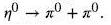
Why does the η0 meson have such a short lifetime compared to most other mesons?
A proton and an antiproton collide head-on, with each having a kinetic energy of 7.00 TeV (such as in the LHC at CERN). How much collision energy is available, taking into account the annihilation of the two masses?
(a) Is a hadron always a baryon?(b) Is a baryon always a hadron?(c) Can an unstable baryon decay into a meson, leaving no other baryon?
When an electron and positron collide at the SLAC facility, they each have 50.0 GeV kinetic energies. What is the total collision energy available, taking into account the annihilation energy? Note that the annihilation energy is insignificant, because the electrons are highly relativistic.
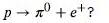
The π0 is its own antiparticle and decays in the following manner: What is the energy of each γ ray if the π0 is at rest when it decays? º →y+y.
Explain how conservation of baryon number is responsible for conservation of total atomic mass (total number of nucleons) in nuclear decay and reactions.
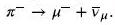
The primary decay mode for the negative pion is What is the energy release in MeV in this decay? XT गूँ → H + VH.
The quark flavor change d → u takes place in β- decay. Does this mean that the reverse quark flavor change u → d takes place in β+ decay? Justify your response by writing the decay in terms of the quark constituents, noting that it looks as if a proton is converted into a neutron in β+
Explain how the weak force can change strangeness by changing quark flavor.
The mass of a theoretical particle that may be associated with the unification of the electroweak and strong forces is 1014 GeV/c.(a) How many proton masses is this? (b) How many electron masses is this? (This indicates how extremely relativistic the accelerator would have to be in order to make
The decay mode of the negative muon is(a) Find the energy released in MeV. (b) Verify that charge and lepton family numbers are conserved. t ↑ +Ve+vu.
The decay mode of the positive tau is(a) What energy is released?(b) Verify that charge and lepton family numbers are conserved.(c) The τ+ is the antiparticle of the τ-. Verify that all the decay products of the τ+ are the antiparticles of those in the decay of the τ- given in the text. +
Beta decay is caused by the weak force, as are all reactions in which strangeness changes. Does this imply that the weak force can change quark flavor? Explain.
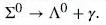
The principal decay mode of the sigma zero is (a) What energy is released?(b) Considering the quark structure of the two baryons, does it appear that the Σ0 is an excited state of the ∧0? (c) Verify that strangeness, charge, and baryon number are conserved in the decay. (d) Considering the
Why is it easier to see the properties of the c, b, and t quarks in mesons having composition W- or tt̅ rather than in baryons having a mixture of quarks, such as udb?
(a) What is the uncertainty in the energy released in the decay of a π0 due to its short lifetime? (b) What fraction of the decay energy is this, noting that the decay mode is (so that all the mass is destroyed)? l+h ←"
How can quarks, which are fermions, combine to form bosons? Why must an even number combine to form a boson? Give one example by stating the quark substructure of a boson.
What evidence is cited to support the contention that the gluon force between quarks is greater than the strong nuclear force between hadrons? How is this related to color? Is it also related to quark confinement?
(a) What is the uncertainty in the energy released in the decay of a τ- due to its short lifetime?(b) Is the uncertainty in this energy greater than or less than the uncertainty in the mass of the tau neutrino? Discuss the source of the uncertainty.
Discuss how we know that π-mesons (π+, π, π0 ) are not fundamental particles and are not the basic carriers of the strong force.
Accelerators such as the Triangle Universities Meson Facility (TRIUMF) in British Columbia produce secondary beams of pions by having an intense primary proton beam strike a target. Such “meson factories” have been used for many years to study the interaction of pions with nuclei and, hence,
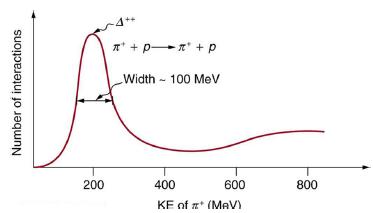
(a) Verify from its quark composition that the Δ+ particle could be an excited state of the proton. (b) There is a spread of about 100 MeV in the decay energy of the Δ+, interpreted as uncertainty due to its short lifetime. What is its approximate lifetime? (c) Does its decay proceed via the
An antibaryon has three antiquarks with colors R̅G̅B̅. What is its color?
The reaction (described in the preceding problem) takes place via the strong force.(a) What is the baryon number of the Δ++ particle?(b) Draw a Feynman diagram of the reaction showing the individual quarks involved. ++P→ A++ p T
Suppose leptons are created in a reaction. Does this imply the weak force is acting? (for example, consider β decay.)
One of the decay modes of the omega minus is (a) What is the change in strangeness?(b) Verify that baryon number and charge are conserved, while lepton numbers are unaffected.(c) Write the equation in terms of the constituent quarks, indicating that the weak force is responsible. Ω → Ξ0 + π.
How can the lifetime of a particle indicate that its decay is caused by the strong nuclear force? How can a change in strangeness imply which force is responsible for a reaction? What does a change in quark flavor imply about the force that is responsible?
The sigma-zero particle decays mostly via the reaction Explain how this decay and the respective quark compositions imply that the is an excited state of the ·1+0V 03
(a) Do all particles having strangeness also have at least one strange quark in them?(b) Do all hadrons with a strange quark also have nonzero strangeness?
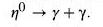
One decay mode for the eta-zero meson is (a) Find the energy released. (b) What is the uncertainty in the energy due to the short lifetime? (c) Write the decay in terms of the constituent quarks.(d) Verify that baryon number, lepton numbers, and charge are conserved. n° →Y+Y.
One decay mode for the eta-zero meson is (a) Write the decay in terms of the quark constituents.(b) How much energy is released?(c) What is the ultimate release of energy, given the decay mode for the pi zero is π0 → γ + γ? n² - 0 +0. ->
What do the quark compositions and other quantum numbers imply about the relationships between the Δ+ and the proton? The Δ0 and the neutron?
Is the decay possible considering the appropriate conservation laws? State why or why not. ne+ + e-
Discuss the similarities and differences between the photon and the Z0 in terms of particle properties, including forces felt.
Is the decay possible considering the appropriate conservation laws? State why or why not. μ e+Ve+ Vμ
Identify evidence for electroweak unification.
(a) Is the decay possible considering the appropriate conservation laws? State why or why not.(b) Write the decay in terms of the quark of the particles. constituents 10 n tao
The quarks in a particle are confined, meaning individual quarks cannot be directly observed. Are gluons confined as well? Explain
(a) Is the decay possible considering the appropriate conservation laws? State why or why not. (b) Write the decay in terms of the quark constituents of the particles. M Σ -n+π म
If a GUT is proven, and the four forces are unified, it will still be correct to say that the orbit of the moon is determined by the gravitational force. Explain why.
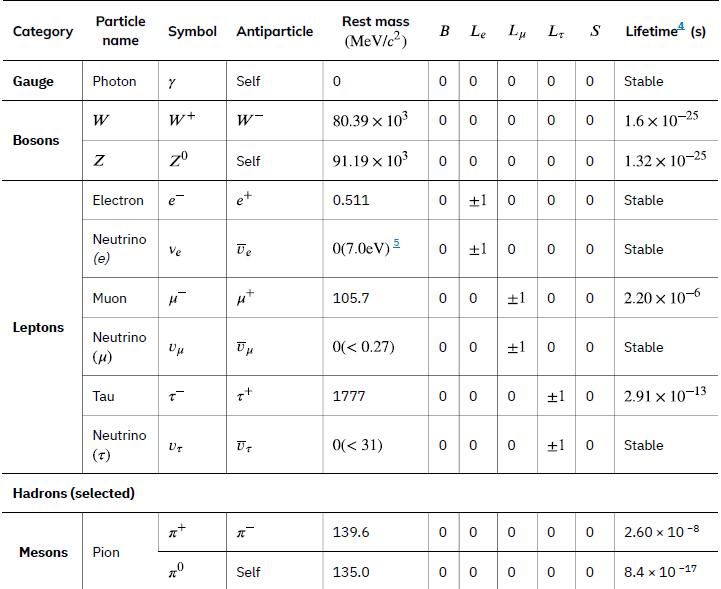
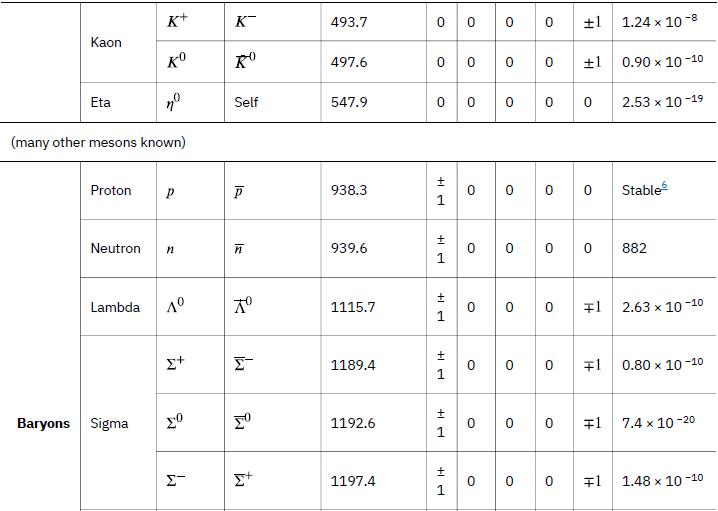
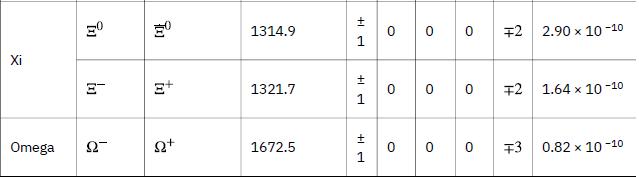
Verify the quantum numbers given for the Ω+ in Table 33.2 by adding the quantum numbers for its quark constituents as inferred from Table 33.4.Data from Table 33.2Data from Table 33.4 Category Bosons Particle name Gauge Photon Y Leptons W Z Neutrino Muon Electron
If the Higgs boson is discovered and found to have mass, will it be considered the ultimate carrier of the weak force? Explain your response.
Verify the quantum numbers given for the proton and neutron in Table 33.2 by adding the quantum numbers for their quark constituents as given in Table 33.4.Data from Table 33.2Data from Table 33.4 Category Bosons Particle name Gauge Photon Y Leptons W Z Neutrino Muon Electron
The only combination of quark colors that produces a white baryon is RGB. Identify all the color combinations that can produce a white meson.
Gluons and the photon are massless. Does this imply that the W+, W-, and Z0 are the ultimate carriers of the weak force?
(a) Show that the conjectured decay of the proton, violates conservation of baryon number and conservation of lepton number. (b) What is the analogous decay process for the antiproton? P º+e+,
(a) Three quarks form a baryon. How many combinations of the six known quarks are there if all combinations are possible?(b) This number is less than the number of known baryons. Explain why.
(a) How much energy would be released if the proton did decay via the conjectured reaction (b) Given that the π0 decays to two γ s and that the et will find an electron to annihilate, what total energy is ultimately produced in proton decay? (c) Why is this energy greater than the proton's
(a) Find the charge, baryon number, strangeness, charm, and bottomness of the J/ψ particle from its quark composition. (b) Do the same for the γ particle.
There are particles called D-mesons. One of them is the D+ meson, which has a single positive charge and a baryon number of zero, also the value of its strangeness, topness, and bottomness. It has a charm of +1. What is its quark configuration?
There are particles called bottom mesons or B-mesons. One of them is the B- meson, which has a single negative charge; its baryon number is zero, as are its strangeness, charm, and top ness. It has a bottomness of -1. What is its quark configuration?
(a) What particle has the quark composition u̅u̅d̅? (b) What should its decay mode be?
Assuming conservation of momentum, what is the energy of each ray produced in the decay of a neutral at rest pion, in the reaction ¿^+^+ 0²
(a) Show that all combinations of three quarks produce integral charges. Thus baryons must have integral charge.(b) Show that all combinations of a quark and an antiquark produce only integral charges. Thus mesons must have integral charge.
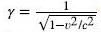
(a) Calculate the relativistic quantity for 1.00-TeV protons produced at Fermilab.(b) If such a proton created a π+ having the same speed, how long would its life be in the laboratory? (c) How far could it travel in this time? Y = √1-1²/c²
What is the wavelength of a 50-GeV electron, which is produced at SLAC? This provides an idea of the limit to the detail it can probe.
The primary decay mode for the negative pion is (a) What is the energy release in MeV in this decay?(b) Using conservation of momentum, how much energy does each of the decay products receive, given the π- is at rest when it decays? You may assume the muon antineutrino is massless and has
Plans for an accelerator that produces a secondary beam of K-mesons to scatter from nuclei, for the purpose of studying the strong force, call for them to have a kinetic energy of 500 MeV.(a) What would the relativistic quantity be for these particles?(b) How long would their average lifetime be in
In supernovas, neutrinos are produced in huge amounts. They were detected from the 1987A supernova in the Magellanic Cloud, which is about 120,000 light years away from the Earth (relatively close to our Milky Way galaxy). If neutrinos have a mass, they cannot travel at the speed of light, but if
A physics student caught breaking conservation laws is imprisoned. She leans against the cell wall hoping to tunnel out quantum mechanically. Explain why her chances are negligible.
What is the index of refraction of a material for which the wavelength of light is 0.671 times its value in a vacuum? Identify the likely substance.
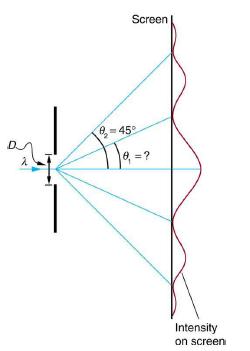
Visible light of wavelength 550 nm falls on a single slit and produces its second diffraction minimum at an angle of 45.0° relative to the incident direction of the light.(a) What is the width of the slit? (b) At what angle is the first minimum produced?StrategyFrom the given information, and
Under what conditions can light be modeled like a ray? Like a wave?
Analysis of an interference effect in a clear solid shows that the wavelength of light in the solid is 329 nm. Knowing this light comes from a He-Ne laser and has a wavelength of 633 nm in air, is the substance zircon or diamond?
Go outside in the sunlight and observe your shadow. It has fuzzy edges even if you do not. Is this a diffraction effect? Explain.
What is the ratio of thicknesses of crown glass and water that would contain the same number of wavelengths of light?
Why does the wavelength of light decrease when it passes from vacuum into a medium? State which attributes change and which stay the same and, thus, require the wavelength to decrease.
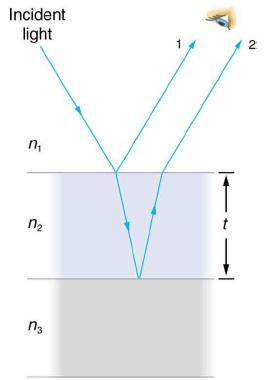
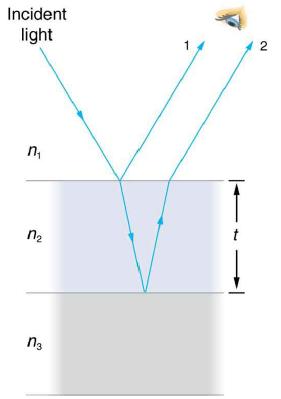
Sophisticated cameras use a series of several lenses. Light can reflect from the surfaces of these various lenses and degrade image clarity. To limit these reflections, lenses are coated with a thin layer of magnesium fluoride that causes destructive thin film interference. What is the thinnest
At what angle is the first-order maximum for 450-nm wavelength blue light falling on double slits separated by 0.0500 mm?
(a) What are the three smallest thicknesses of a soap bubble that produce constructive interference for red light with a wavelength of 650 nm? The index of refraction of soap is taken to be the same as that of water. (b) What three smallest thicknesses will give destructive interference?Strategy
Showing 700 - 800
of 3651
1
2
3
4
5
6
7
8
9
10
11
12
13
14
15
Last
Step by Step Answers

 Get 50% OFF
Claim Now
Get 50% OFF
Claim Now