New Semester
Started
Get
50% OFF
Study Help!
--h --m --s
Claim Now
Question Answers
Textbooks
Find textbooks, questions and answers
Oops, something went wrong!
Change your search query and then try again
S
Books
FREE
Study Help
Expert Questions
Accounting
General Management
Mathematics
Finance
Organizational Behaviour
Law
Physics
Operating System
Management Leadership
Sociology
Programming
Marketing
Database
Computer Network
Economics
Textbooks Solutions
Accounting
Managerial Accounting
Management Leadership
Cost Accounting
Statistics
Business Law
Corporate Finance
Finance
Economics
Auditing
Tutors
Online Tutors
Find a Tutor
Hire a Tutor
Become a Tutor
AI Tutor
AI Study Planner
NEW
Sell Books
Search
Search
Sign In
Register
study help
physics
college physics 2nd
College Physics 2nd Edition OpenStax - Solutions
How does the interference of water waves differ from the interference of electrons? How are they analogous?
Calculate the frequency in hertz of a 1.00-MeV γ-ray photon.
Describe one type of evidence for the wave nature of matter.
(a) What is the wavelength of a 1.00-eV photon?(b) Find its frequency in hertz. (c) Identify the type of EM radiation.
Describe one type of evidence for the particle nature of EM radiation.
What is the Heisenberg uncertainty principle? Does it place limits on what can be known?
Confirm the statement in the text that the range of photon energies for visible light is 1.63 to 3.26 eV, given that the range of visible wavelengths is 380 to 760 nm.
(a) Calculate the energy in eV of an IR photon of frequency 2.00 x 10¹³ Hz.(b) How many of these photons would need to be absorbed simultaneously by a tightly bound molecule to break it apart? (c) What is the energy in eV of a y ray of frequency 3.00 x 10²⁰ Hz?(d) How many tightly bound molecules
In what ways are matter and energy related that were not known before the development of relativity and quantum mechanics?
Prove that, to three-digit accuracy, h = 4.14 x 10⁻¹⁵ eV .s, as stated in the text.
(a) What is the maximum energy in eV of photons produced in a CRT using a 25.0-kV accelerating potential, such as a color TV?(b) What is their frequency?
What is the accelerating voltage of an x-ray tube that produces x rays with a shortest wavelength of 0.0103 nm?
(a) What is the ratio of power outputs by two microwave ovens having frequencies of 950 and 2560 MHz, if they emit the same number of photons per second? (b) What is the ratio of photons per second if they have the same power output?
How many photons per second are emitted by the antenna of a microwave oven, if its power output is 1.00 kW at a frequency of 2560 MHz?
Some satellites use nuclear power.(a) If such a satellite emits a 1.00-W flux of γ rays having an average energy of 0.500 MeV, how many are emitted per second?(b) These γ rays affect other satellites. How far away must another satellite be to only receive one γ ray per second per square meter?
How many x-ray photons per second are created by an x-ray tube that produces a flux of x rays having a power of 1.00 W? Assume the average energy per photon is 75.0 keV.
(a) How far away must you be from a 650-kHz radio station with power 50.0 kW for there to be only one photon per second per square meter? Assume no reflections or absorption, as if you were in deep outer space. (b) Discuss the implications for detecting intelligent life in other solar systems by
Assuming that 10.0% of a 100-W light bulb’s energy output is in the visible range (typical for incandescent bulbs) with an average wavelength of 580 nm, and that the photons spread out uniformly and are not absorbed by the atmosphere, how far away would you be if 500 photons per second enter the
Consider a laser pen. Construct a problem in which you calculate the number of photons per second emitted by the pen. Among the things to be considered are the laser pen’s wavelength and power output. Your instructor may also wish for you to determine the minimum diffraction spreading in the beam
(a) Find the momentum of a 4.00-cm-wavelength microwave photon. (b) Discuss why you expect the answer to (a) to be very small.
(a) What is the momentum of a 0.0100-nmwavelength photon that could detect details of an atom? (b) What is its energy in MeV?
(a) A y-ray photon has a momentum of 8.00 × 10⁻²¹ kg · m/s. What is its wavelength?(b) Calculate its energy in MeV.
(a) Calculate the momentum of a photon having a wavelength of 2.50 μm.(b) Find the velocity of an electron having the same momentum. (c) What is the kinetic energy of the electron, and how does it compare with that of the photon?
Repeat the previous problem for a 10.0-nmwavelength photon.Data from previous problem(a) Calculate the momentum of a photon having a wavelength of 2.50 μm.(b) Find the velocity of an electron having the same momentum. (c) What is the kinetic energy of the electron, and how does it compare with
(a) Calculate the wavelength of a photon that has the same momentum as a proton moving at 1.00% of the speed of light. (b) What is the energy of the photon in MeV? (c) What is the kinetic energy of the proton in MeV?
(a) Find the momentum of a 100-keV x-ray photon.(b) Find the equivalent velocity of a neutron with the same momentum. (c) What is the neutron’s kinetic energy in keV?
Consider a space sail such as mentioned in Example 29.5. Construct a problem in which you calculate the light pressure on the sail in N/m2 produced by reflecting sunlight. Also calculate the force that could be produced and how much effect that would have on a spacecraft. Among the things to be
A car feels a small force due to the light it sends out from its headlights, equal to the momentum of the light divided by the time in which it is emitted.(a) Calculate the power of each headlight, if they exert a total force of 2.00 x 10⁻² N backward on the car. (b) What is unreasonable about
At what velocity will an electron have a wavelength of 1.00 m?
What is the wavelength of an electron moving at 3.00% of the speed of light?
At what velocity does a proton have a 6.00-fm wavelength (about the size of a nucleus)? Assume the proton is nonrelativistic. (1 femtometer = 10-15 m.)
What is the velocity of a 0.400-kg billiard ball if its wavelength is 7.50 cm (large enough for it to interfere with other billiard balls)?
Find the wavelength of a proton moving at 1.00% of the speed of light.
(a) Find the velocity of a neutron that has a 6.00-fm wavelength (about the size of a nucleus). Assume the neutron is nonrelativistic. (b) What is the neutron’s kinetic energy in MeV?
What is the wavelength of an electron accelerated through a 30.0-kV potential, as in a TV tube?
What is the kinetic energy of an electron in a TEM having a 0.0100-nm wavelength?
(a) Calculate the velocity of an electron that has a wavelength of 1.00 μm. (b) Through what voltage must the electron be accelerated to have this velocity?
The velocity of a proton emerging from a Van de Graaff accelerator is 25.0% of the speed of light.(a) What is the proton’s wavelength?(b) What is its kinetic energy, assuming it is nonrelativistic? (c) What was the equivalent voltage through which it was accelerated?
The kinetic energy of an electron accelerated in an x-ray tube is 100 keV. Assuming it is nonrelativistic, what is its wavelength?
(a) Assuming it is nonrelativistic, calculate the velocity of an electron with a 0.100-fm wavelength (small enough to detect details of a nucleus). (b) What is unreasonable about this result? (c) Which assumptions are unreasonable or inconsistent?
(a) If the position of an electron in a membrane is measured to an accuracy of 1.00 μm, what is the electron's minimum uncertainty in velocity? (b) If the electron has this velocity, what is its kinetic energy in eV? (c) What are the implications of this energy, comparing it to typical molecular
(a) If the position of a chlorine ion in a membrane is measured to an accuracy of 1.00 μm, what is its minimum uncertainty in velocity, given its mass is 5.86 x 10⁻²⁶ kg? (b) If the ion has this velocity, what is its kinetic energy in eV, and how does this compare with typical molecular binding
Suppose the velocity of an electron in an atom is known to an accuracy of 2.0 x 10³ m/s (reasonably accurate compared with orbital velocities). What is the electron's minimum uncertainty in position, and how does this compare with the approximate 0.1-nm size of the atom?
The velocity of a proton in an accelerator is known to an accuracy of 0.250% of the speed of light. (This could be small compared with its velocity.) What is the smallest possible uncertainty in its position?
(a) The lifetime of a highly unstable nucleus is 10-20 s. What is the smallest uncertainty in its decay energy?(b) Compare this with the rest energy of an electron.
The decay energy of a short-lived particle has an uncertainty of 1.0 MeV due to its short lifetime.What is the smallest lifetime it can have?
The decay energy of a short-lived nuclear excited state has an uncertainty of 2.0 eV due to its short lifetime. What is the smallest lifetime it can have?
What is the approximate uncertainty in the mass of a muon, as determined from its decay lifetime?
Derive the approximate form of Heisenberg's uncertainty principle for energy and time, ΔEΔt ≈ h, using the following arguments: Since the position of a particle is uncertain by Δx = λ, where is the wavelength of the photon used to examine it, there is an uncertainty in the time the photon
An electron microscope produces electrons with a 2.00-pm wavelength. If these are passed through a 1.00-nm single slit, at what angle will the first diffraction minimum be found?
A certain heat lamp emits 200 W of mostly IR radiation averaging 1500 nm in wavelength.(a) What is the average photon energy in joules? (b) How many of these photons are required to increase the temperature of a person's shoulder by 2.0°C, assuming the affected mass is 4.0 kg with a specific heat
On its high power setting, a microwave oven produces 900 W of 2560 MHz microwaves.(a) How many photons per second is this? (b) How many photons are required to increase the temperature of a 0.500-kg mass of pasta by 45.0°C, assuming a specific heat of 0.900 kcal/kg · °C? Neglect all other heat
(a) Calculate the amount of microwave energy in joules needed to raise the temperature of 1.00 kg of soup from 20.0°C to 100°C.(b) What is the total momentum of all the microwave photons it takes to do this?(c) Calculate the velocity of a 1.00-kg mass with the same momentum.(d) What is the
(a) What is γ for an electron emerging from the Stanford Linear Accelerator with a total energy of 50.0 GeV? (b) Find its momentum. (c) What is the electron's wavelength?
(a) What is y for a proton having an energy of 1.00 TeV, produced by the Fermilab accelerator? (b) Find its momentum. (c) What is the proton's wavelength?
(a) What is the separation between double slits that produces a second-order minimum at 45.0° for 650-nm light?(b) What slit separation is needed to produce the same pattern for 1.00-keV protons.
(a) Calculate the velocity of electrons that form the same pattern as 450-nm light when passed through a double slit. (b) Calculate the kinetic energy of each and compare them. (c) Would either be easier to generate than the other Explain.
An electron microscope passes 1.00-pm- wavelength electrons through a circular aperture 2.00 μm in diameter. What is the angle between two just-resolvable point sources for this microscope?
A laser with a power output of 2.00 mW at a wavelength of 400 nm is projected onto calcium metal.(a) How many electrons per second are ejected? (b) What power is carried away by the electrons, given that the binding energy is 2.71 eV? (c) Calculate the current of ejected electrons.(d) If the
A 1.00-fm photon has a wavelength short enough to detect some information about nuclei.(a) What is the photon momentum? (b) What is its energy in joules and MeV? (c) What is the (relativistic) velocity of an electron with the same momentum?(d) Calculate the electron’s kinetic energy.
The momentum of light is exactly reversed when reflected straight back from a mirror, assuming negligible recoil of the mirror. Thus the change in momentum is twice the photon momentum. Suppose light of intensity 1.00 kW/m2 reflects from a mirror of area 2.00 m2.(a) Calculate the energy reflected
Sunlight above the Earth's atmosphere has an intensity of 1.30 kW/m2. If this is reflected straight back from a mirror that has only a small recoil, the light's momentum is exactly reversed, giving the mirror twice the incident momentum.(a) Calculate the force per square meter of mirror.(b) Very
A photon of light with a wavelength of 550.0 nm is involved in a collision with an electron. Use 6.63 x 10⁻³⁴ m2 kg/s for Planck's constant.(a) How much momentum does the photon have before the collision?(b) If the wavelength of the photon leaving the collision is 650.0 nm, how much momentum does
Your friends show you an image through a microscope. They tell you that the microscope has an objective with a 0.500 cm focal length and an eyepiece with a 5.00 cm focal length. The resulting overall magnification is 250,000. Are these viable values for a microscope?
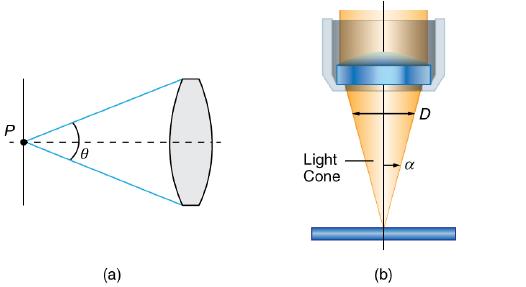
You are using a standard microscope with a 0.10NA 4x objective and switch to a 0.65 NA 40X objective. What are the acceptance angles for each? Compare and comment on the values. Which would you use first to locate the target area on of your specimen? (See Figure 26.17.)Data from Figure 26.17
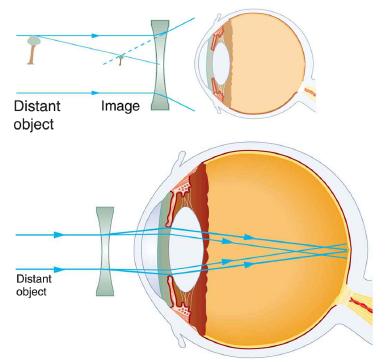
A myopic person sees that their contact lens prescription is -4.00 D. What is their far point?
The far point of a myopic administrator is 50.0 cm.(a) What is the relaxed power of their eyes? (b) If they have the normal 8.00% ability to accommodate, what is the closest object they can see clearly?
If the cornea is to be reshaped (this can be done surgically or with contact lenses) to correct myopia, should its curvature be made greater or smaller? Explain. Also explain how hyperopia can be corrected.
A person with presbyopia has lost some or all of the ability to accommodate the power of the eye. If such a person’s distant vision is corrected with LASIK, will she still need reading glasses? Explain.
Your camera’s zoom lens has an adjustable focal length ranging from 80.0 to 200 mm. What is its range of powers?
Consider sunlight entering the Earth's atmosphere at sunrise and sunset-that is, at a 90° incident angle. Taking the boundary between nearly empty space and the atmosphere to be sudden, calculate the angle of refraction for sunlight. This lengthens the time the Sun appears to be above the horizon,
If the lens of a person’s eye is removed because of cataracts (as has been done since ancient times), why would you expect a spectacle lens of about 16 D to be prescribed?
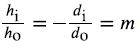
What is the size of the image on the retina of a 1.20 x 10⁻² cm diameter human hair, held at arm's length (60.0 cm) away? Take the lens-to-retina distance to be 2.00 cm.StrategyWe want to find the height of the image hi, given the height of the object is ho = 1.20 x 10⁻² cm. We also know that the
What is the power of the eye when viewing an object 50.0 cm away?
A cataract is cloudiness in the lens of the eye. Is light dispersed or diffused by it?
Calculate the power of the eye when viewing objects at the greatest and smallest distances possible with normal vision, assuming a lens-to-retina distance of 2.00 cm (a typical value).StrategyFor clear vision, the image must be on the retina, and so di = 2.00 cm here. For distant vision, do ≈
When laser light is shone into a relaxed normal-vision eye to repair a tear by spot-welding the retina to the back of the eye, the rays entering the eye must be parallel. Why?
What power of spectacle lens is needed to correct the vision of a nearsighted person whose far point is 30.0 cm? Assume the spectacle (corrective) lens is held 1.50 cm away from the eye by eyeglass frames.StrategyYou want this nearsighted person to be able to see very distant objects clearly. That
(a) The print in many books averages 3.50 mm in height. How high is the image of the print on the retina when the book is held 30.0 cm from the eye?(b) Compare the size of the print to the sizes of rods and cones in the fovea and discuss the possible details observable in the letters. (The
Suppose a certain person's visual acuity is such that he can see objects clearly that form an image 4.00 μm high on his retina. What is the maximum distance at which he can read the 75.0 cm high letters on the side of an airplane?
How does the power of a dry contact lens compare with its power when resting on the tear layer of the eye? Explain.
What power of spectacle lens is needed to allow a farsighted person, whose near point is 1.00 m, to see an object clearly that is 25.0 cm away? Assume the spectacle (corrective) lens is held 1.50 cm away from the eye by eyeglass frames.StrategyWhen an object is held 25.0 cm from the person's eyes,
Why is your vision so blurry when you open your eyes while swimming under water? How does a face mask enable clear vision?
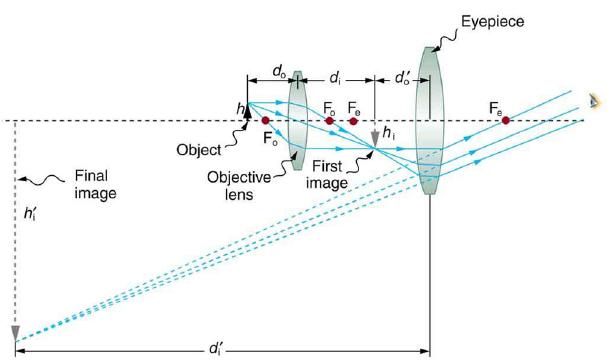
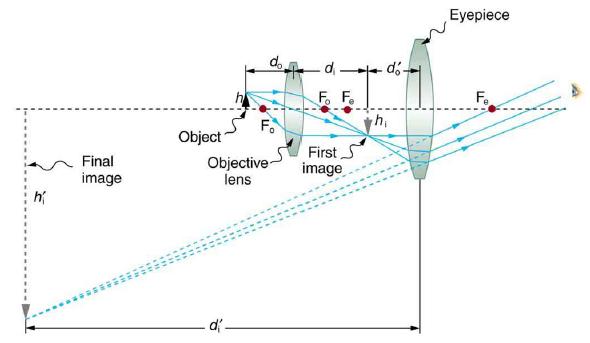
Calculate the magnification of an object placed 6.20 mm from a compound microscope that has a 6.00 mm focal length objective and a 50.0 mm focal length eyepiece. The objective and eyepiece are separated by 23.0 cm.Strategy and ConceptThis situation is similar to that shown in Figure 26.16. To find
People who do very detailed work close up, such as jewellers, often can see objects clearly at much closer distance than the normal 25 cm.(a) What is the power of the eyes of a woman who can see an object clearly at a distance of only 8.00 cm?(b) What is the size of an image of a 1.00 mm object,
What is the far point of a person whose eyes have a relaxed power of 50.5 D?
It has become common to replace the cataract-clouded lens of the eye with an internal lens. This intraocular lens can be chosen so that the person has perfect distant vision. Will the person be able to read without glasses? If the person was nearsighted, is the power of the intraocular lens greater
What is the near point of a person whose eyes have an accommodated power of 53.5 D?
(a) A laser vision correction reshaping the cornea of a myopic patient reduces the power of his eye by 9.00 D, with a ± 5.0% uncertainty in the final correction. What is the range of diopters for spectacle lenses that this person might need after LASIK procedure? (b) Was the person nearsighted or
If there is a fixed percent uncertainty in LASIK reshaping of the cornea, why would you expect those people with the greatest correction to have a poorer chance of normal distant vision after the procedure?
In a LASIK vision correction, the power of a patient’s eye is increased by 3.00 D. Assuming this produces normal close vision, what was the patient’s near point before the procedure?
A pure red object on a black background seems to disappear when illuminated with pure green light. Explain why.
A severely myopic patient has a far point of 5.00 cm. By how many diopters should the power of his eye be reduced in laser vision correction to obtain normal distant vision for him?
What is color constancy, and what are its limitations?
A student’s eyes, while reading the blackboard, have a power of 51.0 D. How far is the board from his eyes?
There are different types of color blindness related to the malfunction of different types of cones. Why would it be particularly useful to study those rare individuals who are color blind only in one eye or who have a different type of color blindness in each eye?
The power of a physician’s eyes is 53.0 D while examining a patient. How far from her eyes is the feature being examined?
Propose a way to study the function of the rods alone, given they can sense light about 1000 times dimmer than the cones.
Geometric optics describes the interaction of light with macroscopic objects. Why, then, is it correct to use geometric optics to analyse a microscope’s image?
The image produced by the microscope in Figure 26.16 cannot be projected. Could extra lenses or mirrors project it? Explain.Data from Figure 26.16 h₁ Final image Object do d'. Fo Objective- lens d. →T do F. F First image h Eyepiece F₂
Showing 1200 - 1300
of 3651
First
6
7
8
9
10
11
12
13
14
15
16
17
18
19
20
Last
Step by Step Answers

 Get 50% OFF
Claim Now
Get 50% OFF
Claim Now