New Semester
Started
Get
50% OFF
Study Help!
--h --m --s
Claim Now
Question Answers
Textbooks
Find textbooks, questions and answers
Oops, something went wrong!
Change your search query and then try again
S
Books
FREE
Study Help
Expert Questions
Accounting
General Management
Mathematics
Finance
Organizational Behaviour
Law
Physics
Operating System
Management Leadership
Sociology
Programming
Marketing
Database
Computer Network
Economics
Textbooks Solutions
Accounting
Managerial Accounting
Management Leadership
Cost Accounting
Statistics
Business Law
Corporate Finance
Finance
Economics
Auditing
Tutors
Online Tutors
Find a Tutor
Hire a Tutor
Become a Tutor
AI Tutor
AI Study Planner
NEW
Sell Books
Search
Search
Sign In
Register
study help
physics
college physics a strategic approach 2nd
College Physics Essentials Electricity And Magnetism Optics Modern Physics Volume Two 8th Edition Jerry D. Wilson, Anthony J. Buffa, Bo Lou - Solutions
Shear moduli are not zero for (a) solids, (b) liquids, (c) gases, (d) all of these,
A relative measure of deformation is (a) a modulus, (b) work, (c) stress, (d) strain.
The volume stress for the bulk modulus is (a) \(\Delta p\), (b) \(\Delta V\), (c) \(V_{0}\), (d) \(\Delta V / V_{\mathrm{o}}\).
For a liquid in an open container, the absolute pressure at any depth depends on (a) atmospheric pressure,(b) liquid density, (c) acceleration due to gravity, (d) all of the preceding.
For the pressure-depth relationship for a fluid \((p=ho g h)\) it is assumed that (a) the pressure decreases with depth, (b) a pressure difference depends on the reference point, (c) the fluid density is constant, (d) the relationship applies only to liquids.
When measuring automobile tire pressure, what type of pressure is this: (a) gauge, (b) absolute, (c) atmospheric, or (d) all of the preceding?
A wood block floats in a swimming pool. The buoyant force exerted on the block by water depends on (a) the volume of water in the pool, (b) the volume of the wood block, (c) the volume of the wood block under water, (d) all of the preceding.
If a submerged object displaces an amount of liquid of greater weight than its own and is then released, the object will (a) rise to the surface and float, (b) sink, (c) remain in equilibrium at its submerged position, (d) none of the preceding.
A rock is thrown into a lake. While sinking, the buoyant force (a) is zero, (b) decreases, (c) increases, (d) remains constant.
A glass containing an ice cube is filled to the brim and the cube floats on the surface. When the ice cube melts, (a) water will spill over the sides of the glass, (b) the water level decreases, (c) the water level is at the top of the glass without any spill.
Comparing an object's average density \(\left(ho_{\mathrm{o}}\right)\) to that of a fluid \(\left(ho_{\mathrm{f}}\right)\). What is the condition for the object to sink:(a) \(ho_{\mathrm{o}}
An ideal fluid is not (a) steady, (b) compressible, (c) irrotational, (d) nonviscous.
Bernoulli's equation is based primarily on (a) Newton's laws, (b) conservation of momentum, (c) conservation of mass, (d) conservation of energy.
Water droplets and soap bubbles tend to assume the shape of a sphere. This effect is due to (a) viscosity, (b) surface tension, (c) laminar flow, (d) none of the preceding.
Some insects can walk on water because (a) the density of water is greater than that of the insect, (b) water is viscous, (c) water has surface tension, (d) none of the preceding.
The viscosity of a fluid is due to (a) forces causing friction between the molecules, (b) surface tension, (c) density, (d) none of the preceding.
Why are scissors sometimes called shears? Is this a descriptive name in the physical sense?
Ancient stonemasons sometimes split huge blocks of rock by inserting wooden pegs into holes drilled in the rock and then pouring water on the pegs. Can you explain the physics that underlies this technique?
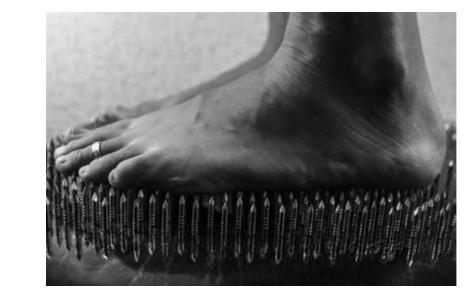
Figure \(\mathbf{9 . 2 5}\) shows a famous "bed of nails" trick. The woman stands on a bed of nails and the nails do not pierce her feet.
Automobile tires are inflated to about \(30 \mathrm{lb} / \mathrm{in}^{2}\), whereas thin bicycle tires are inflated to 90 to \(115 \mathrm{lb} / \mathrm{in}^{2}\) - at least three times as much pressure! Why?
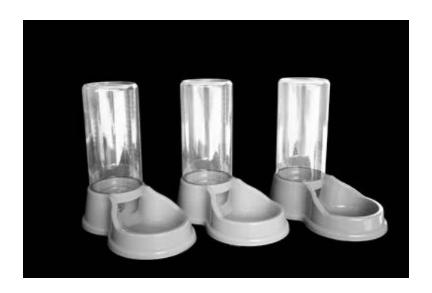
A type of water dispenser for pets contains an inverted plastic bottle, as shown in Figure 9.27. When a certain amount of water is drunk from the bowl, more water flows automatically from the bottle into the bowl. The bowl never overflows. Explain the operation of the dispenser.
A heavy object is dropped into a lake. As it descends below the surface, does the pressure on it increase? Does the buoyant force on the object increase?
Two blocks of equal volume, one iron, and one aluminum, are dropped into a body of water. Which block will experience the greater buoyant force? Why?
The speed of blood flow is greater in arteries than in capillaries. However, the flow rate equation \((A v=\) constant) seems to predict that the speed should be greater in the smaller capillaries. Can you resolve this apparent inconsistency?
A car traveling at 5.0 m/s speeds up to 10 m/s, with an increase in kinetic energy that requires work W1. Then the car’s speed increases from 10 to 15 m/s, requiring additional work W2. Which of the following relationships accurately compares the two amounts of work:(a) \(W_{1}>W_{2}\),(b)
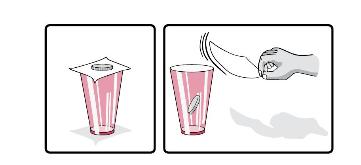
The following is an old trick (Figure 4.28). When the cardboard is pulled quickly, the coil falls into the glass. Why?
An \(80-\mathrm{kg}\) person stands on one foot with the heel elevated ( Figure 4.17a). This gives rise to a tibia force \(F_{1}\) and an Achilles tendon "pull" force \(F_{2}\) as illustrated in Figure 4.17b. Typical angles are \(\theta_{1}=15^{\circ}\) and \(\theta_{2}=21^{\circ}\), respectively.
(a) In Figure 4.21, if the coefficient of static friction between the \(40.0-\mathrm{kg}\) crate and the floor is 0.650 , what is the magnitude of the minimum horizontal force the worker must pull to get the crate moving? (b) If the worker maintains that force once the crate starts to move and the
Two vectors are given by \(\overrightarrow{\mathbf{A}}=4.0 \hat{\mathbf{x}}-2.0 \hat{\mathbf{y}}\) and \(\overrightarrow{\mathbf{B}}=1.0 \hat{\mathbf{x}}+5.0 \hat{\mathbf{y}}\). What is (a) \(\overrightarrow{\mathbf{A}}+\overrightarrow{\mathbf{B}}\), (b)
Given two displacement vectors, \(\overrightarrow{\mathbf{A}}\), with a magnitude of \(8.0 \mathrm{~m}\) in a direction \(45^{\circ}\) below the \(+x\)-axis, and \(\overrightarrow{\mathbf{B}}\), which has an \(x\)-component of \(+2.0 \mathrm{~m}\) and a \(y\)-component of \(+4.0 \mathrm{~m}\). Find
A wheel rolls uniformly on level ground without slipping. A piece of mud on the wheel flies off when it is at the 9 o'clock position (rear of the wheel). Describe the subsequent motion of the mud.
A torque of \(18 \mathrm{~m} \cdot \mathrm{N}\) is required to loosen a bolt. If a force of \(50 \mathrm{~N}\) is applied, what should be the minimum length of the wrench?
How many different positions of stable equilibrium and unstable equilibrium are there for a cube? Consider each surface, edge, and corner to be a different position.
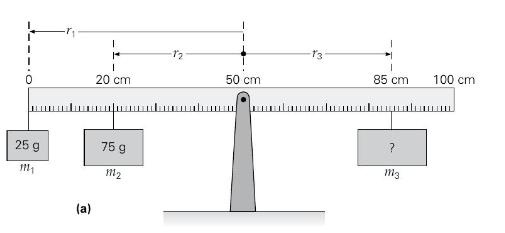
A uniform meterstick pivoted at its center, as in Example 8.5, has a \(100-\mathrm{g}\) mass suspended at the \(25.0-\mathrm{cm}\) position. (a) At what position should a \(75.0-\mathrm{g}\) mass be suspended to put the system in equilibrium? (b) What mass would have to be suspended at the
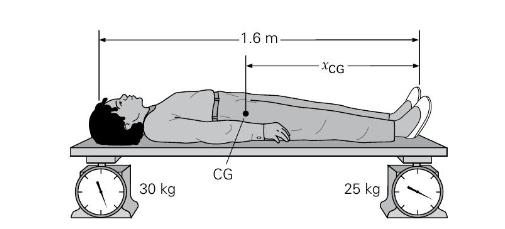
The location of a person's center of gravity relative to his or her height can be found by using the arrangement shown in \(abla\) Figure \(\mathbf{8 . 3 4}\). The scales are initially adjusted to zero with the board alone. (a) Would you expect the location of the center of gravity to be (1) midway
If four metersticks were stacked on a table with \(10 \mathrm{~cm}, 15 \mathrm{~cm}, 30 \mathrm{~cm}\), and \(50 \mathrm{~cm}\), respectively, hanging over the edge, as shown in \(\boldsymbol Figure 8.35, would the top meterstick remain on the table? 21 A10.0-kg solid uniform cube with
In pure rotational motion of a rigid body, (a) all the particles of the body have the same angular velocity, (b) all the particles of the body have the same tangential velocity, (c) acceleration is always zero, (d) there are always two simultaneous axes of rotation.
For an object with only rotational motion, all particles of the object have the same (a) instantaneous velocity, (b) average velocity, (c) distance from the axis of rotation, (d) instantaneous angular velocity.
The condition for rolling without slipping is (a) \(a_{\mathrm{c}}=r \omega^{2}\), (b) \(v_{\mathrm{CM}}=r \omega\), (c) \(F=m a\), (d) \(a_{\mathrm{c}}=v^{2} / r\).
A rolling object (a) has an axis of rotation through the axis of symmetry, (b) has a zero velocity at the point or line of contact, (c) will slip if \(s=r \theta\), (d) all of the preceding.
For the tires on your rolling, but skidding car, (a) \(v_{\mathrm{CM}}=r \omega\), (b) \(v_{\mathrm{CM}}>r \omega\), (c) \(v_{\mathrm{CM}}
It is possible to have a net torque when (a) all forces act through the axis of rotation, (b) \(\sum \overrightarrow{\mathbf{F}}_{i}=0\), (c) an object is in rotational equilibrium, (d) an object remains in unstable equilibrium.
If an object in stable equilibrium is displaced slightly, (a) there will be a restoring force or torque, (b) the object returns to its original equilibrium position, (c) its center of gravity still lies above and inside the object's original base of support, (d) all of the preceding.
Torque has the same units as (a) work, (b) force, (c) angular velocity, (d) angular acceleration.
The moment of inertia of a rigid body (a) depends on the axis of rotation, (b) cannot be zero, (c) depends on mass distribution, (d) all of the preceding.
Which of the following best describes the physical quantity called torque: (a) rotational analogue of force, (b) energy due to rotation, (c) rate of change of linear momentum, or (d) force that is tangent to a circle?
In general, the moment of inertia is greater when (a) more mass is farther from the axis of rotation, (b) more mass is closer to the axis of rotation, (c) it makes no difference.
A solid sphere (radius \(R\) ) and a solid cylinder (radius \(R\) ) with equal masses are released simultaneously from the top of a frictionless inclined plane. Then, (a) the sphere reaches the bottom first, (b) the cylinder reaches the bottom first, (c) they reach the bottom together.
The moment of inertia about an axis parallel to the axis through the center of mass depends on (a) the mass of the rigid body, (b) the distance between the axes, (c) the moment of inertia about the axis through the center of mass, (d) all of the preceding.
From \(W=\tau \theta\), the unit of rotational work is the (a) watt, (b) \(\mathrm{N} \cdot \mathrm{m}\), (c) \(\mathrm{kg} \cdot \mathrm{rad} / \mathrm{s}^{2}\), (d) \(\mathrm{N} \cdot \mathrm{rad}\).
A bowling ball rolls without slipping on a flat surface. The ball has (a) rotational kinetic energy, (b) translational kinetic energy, (c) both translational and rotational kinetic energy, (d) neither translational nor rotational kinetic energy.
The angular momentum may be increased by (a) increasing the moment of inertia, (b) increasing the angular velocity, (c) increasing both the moment of inertia and the angular velocity.
The units of angular momentum are (a) \(\mathrm{N} \cdot \mathrm{m}\), (b) \(\mathrm{kg} \cdot \mathrm{m} / \mathrm{s}^{2}\), (c) \(\mathrm{kg} \cdot \mathrm{m}^{2} / \mathrm{s},
Suppose someone in your physics class says that it is possible for a rigid body to have translational motion and rotational motion at the same time. Would you agree?
For a rolling cylinder, what would happen if the tangential speed \(v\) were less than \(r \omega\)? Is it possible for \(v\) to be greater than \(r \omega\)?
A force can produce torque. Will a large force always produce a larger torque?
If an object is in mechanical equilibrium, what conditions must be satisfied?
(a) Does the moment of inertia of a rigid body depend in any way on the center of mass of the body?(b) Can a moment of inertia have a negative value? If so, explain what this would mean.
Why does the moment of inertia of a rigid body have different values for different axes of rotation? What does this mean physically?
Tightrope walkers are continually in danger of falling (unstable equilibrium). Commonly, a performer carries a long pole while walking the tight rope, as shown in the chapter-opening photo. What is the purpose of the pole? (In walking along a narrow board or rail, you probably extend your arms for
Can you increase the rotational kinetic energy of a wheel without changing its translational kinetic energy?
In order to produce fuel-efficient vehicles, automobile manufacturers want to minimize rotational kinetic energy and maximize translational kinetic energy when a car is traveling. If you were the designer of wheels of a certain diameter, how would you design them?
A child stands on the edge of a rotating playground merry-go-round (the hand-driven type). He then starts to walk toward the center of the merry-go-round. This can result in a dangerous situation. Why?
The release of vast amounts of carbon dioxide may result in an increase in the Earth's average temperature through the so-called greenhouse effect and cause melting of the polar ice caps. If this occurred and the ocean level rose substantially, what effect would it have on the Earth's rotation?
In the classroom demonstration illustrated in Figure 8.30, a person on a rotating stool holds a rotating bicycle wheel by handles attached to the wheel. When the wheel is held horizontally, she rotates one way (clockwise as viewed from above). When the wheel is turned over, she rotates in the
A cylinder rolls on a horizontal surface without slipping with a constant speed of \(v\). (a) At any point in time, the tangential speed of the top of the cylinder is (1) \(v\), (2) \(r \omega\), (3) \(v+r \omega\), or (4) zero. (b) The cylinder has a radius of \(12 \mathrm{~cm}\) and a
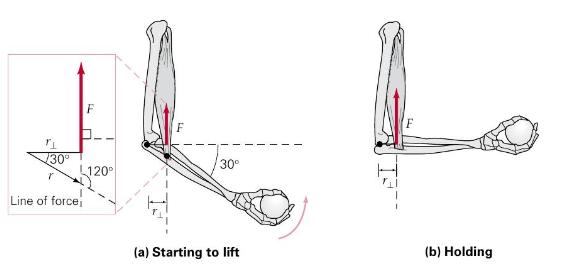
In the human body torques produced by the contraction of muscles cause some bones to rotate at joints. For example, when you lift something with your forearm, a torque is applied to the lower arm by the biceps muscle ( Figure 8.4). With the axis of rotation through the elbow joint and the muscle
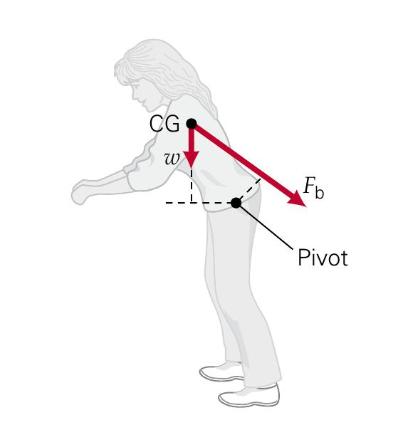
A person bends over as shown in Figure 8.5. For most of us, the center of gravity of the human body is in or near the chest region. When bending over, the force of gravity on the person's upper torso, acting through its center of gravity, gives rise to a torque that tends to produce rotation about
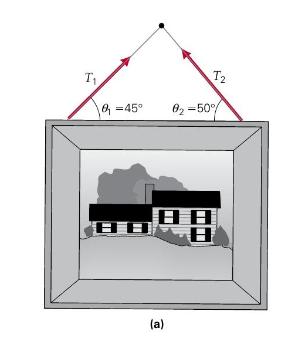
A picture hangs motionless on a wall as shown in Figure 8.7a. If the picture has a mass of \(3.0 \mathrm{~kg}\), what are the magnitudes of the tension forces in the wires?THINKING IT THROUGH. Since the picture remains motionless, it must be in static equilibrium, so applying the conditions for
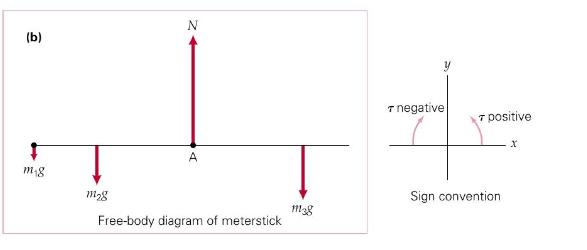
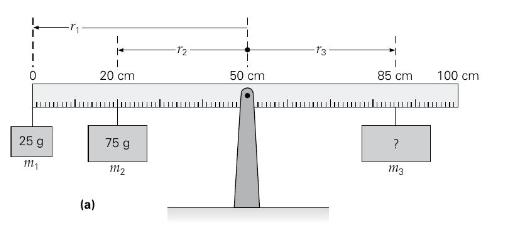
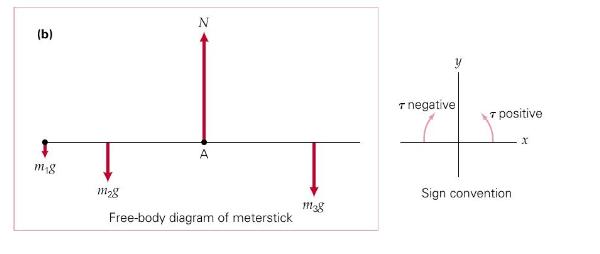
Three masses are suspended from a meterstick as shown in Figure 8.8a. How much mass must be suspended on the right side for the system to be in static equilibrium? (Neglect the mass of the meterstick.) THINKING IT THROUGH. As the free-body diagram (Figure 8.8b) shows, the translational equilibrium
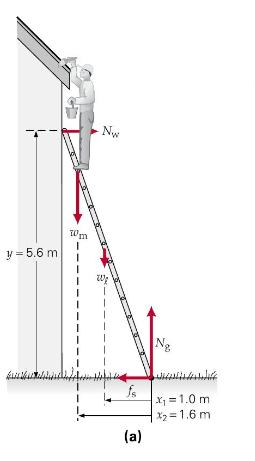
A ladder with a mass of \(15 \mathrm{~kg}\) rests against a smooth wall ( \(\triangle\) Figure 8.9a). A painter who has a mass of \(78 \mathrm{~kg}\) stands on the ladder as shown in the figure. What is the magnitude of frictional force that must act on the bottom of the ladder to keep it from
Uniform, identical bricks \(20 \mathrm{~cm}\) long are stacked so that \(4.0 \mathrm{~cm}\) of each brick extends beyond the brick beneath, as shown in Figure 8.14a. How many bricks can be stacked in this way before the stack falls over?THINKING IT THROUGH. As each brick is added, the center of
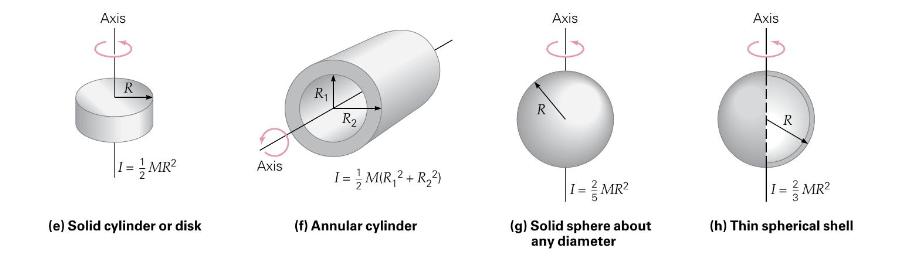
Find the moment of inertia about the axis indicated for each of the one-dimensional dumbbell configurations in Figure 8.16. (Neglect the mass of the connecting bar and give your answers to three significant figures for comparison.)THINKING IT THROUGH. This is a direct application of Equation 8.6
A student opens a uniform 12 -kg door by applying a constant force of \(40 \mathrm{~N}\) at a perpendicular distance of \(0.90 \mathrm{~m}\) from the hinges ( Figure 8.19). If the door is \(2.0 \mathrm{~m}\) in height and \(1.0 \mathrm{~m}\) wide, what is the magnitude of its angular acceleration?
A block of mass \(m\) hangs from a string wrapped around a frictionless, disk-shaped pulley of mass \(M\) and radius \(R\), as shown in - Figure 8.20. If the block descends from rest under the influence of gravity, what is the magnitude of its linear acceleration? (Neglect the mass of the
The string of a yo-yo sitting on a level surface is pulled as shown in Figure 8.21. Will the yo-yo roll (a) toward the person or (b) away from the person? F Instantaneous axis of rotation
A uniform, solid \(1.0-\mathrm{kg}\) cylinder rolls without slipping at a speed of \(1.8 \mathrm{~m} / \mathrm{s}\) on a flat surface. (a) What is the total kinetic energy of the cylinder? (b) What percentage of this total is rotational kinetic energy?THINKING IT THROUGH. The cylinder has both
A uniform cylindrical hoop is released from rest at a height of \(0.25 \mathrm{~m}\) near the top of an inclined plane ( Figure 8.23). If the hoop rolls down the plane without slipping and no energy is lost due to friction, what is the linear speed of the cylinder's center of mass at the bottom of
A small ball at the end of a string that passes through a tube is swung in a circle, as illustrated in Figure 8.24. When the string is pulled downward through the tube, the angular speed of the ball increases. (a) Is the increase in angular speed caused by a torque due to the pulling force? (b) If
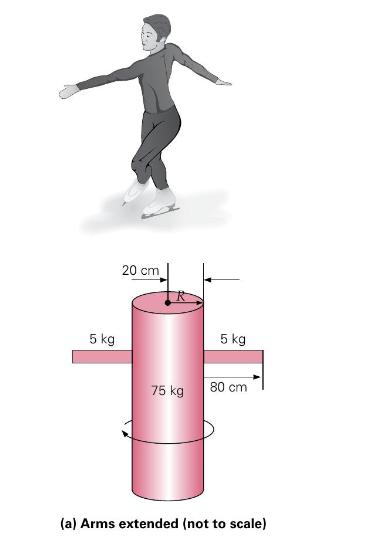
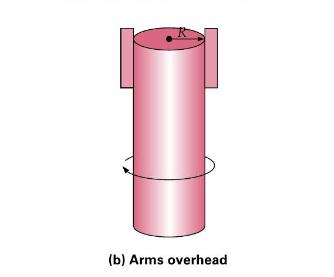
Real-life situations are generally complicated, but some can be approximately analyzed by using simple models. Such a model for a skater's spin is shown in \(\square\) Figure 8.26, with a cylinder and rods representing the skater. In (a), the skater goes into the spin with the "arms" out, and in
The radian unit is a ratio of (a) degree/time, (b) length, (c) length/length, and (d) length/time.
For the polar coordinates of a particle traveling in a circle, the variables are (a) both r and θ, (b) only r, (c) only θ, and (d) none of the preceding.
Which of the following is the greatest angle: (a) 3π/2 rad, (b) 5π/8 rad, or (c) 220°?
Viewed from above, a turntable rotates counterclockwise. The angular velocity vector is then (a) tangential to the turntable’s rim, (b) out of the plane of the turntable, (c) counterclockwise, (d) none of the preceding.
The frequency unit of hertz is equivalent to (a) that of the period, (b) that of the cycle, (c) radian/s, (d) s−1.
The unit of angular speed is (a) rad, (b) s−1 (c) s, (d) rad/rpm.
The particles in a uniformly rotating object all have the same (a) angular acceleration, (b) angular speed, (c) tangential velocity, (d) both (a) and (b).
Uniform circular motion requires (a) centripetal acceleration, (b) angular speed, (c) tangential velocity, (d) all of the preceding.
In uniform circular motion, there is a (a) constant velocity, (b) constant angular velocity, (c) zero acceleration, (d) nonzero tangential acceleration.
If the centripetal force on a particle in uniform circular motion is increased, (a) the tangential speed will remain constant, (b) the tangential speed will decrease, (c) the radius of the circular path will increase, (d) the tangential speed will increase and/or the radius will decrease.
The unit of angular acceleration is (a) s−2, (b) rpm, (c) rad2/s, (d) s2.
The angular acceleration in a circular motion (a) is equal in magnitude to the tangential acceleration divided by the radius, (b) increases the angular velocity if both angular velocity and angular acceleration are in the same direction, (c) has units of s−2, (d) all of the preceding.
In circular motion, the tangential acceleration (a) does not depend on the angular acceleration, (b) is constant, (c) has units of s−2, (d) none of these.
For uniform circular motion, (a) α = 0, (b) ω = 0, (c) v = 0, (d) none of the preceding.
The gravitational force is (a) a linear function of distance, (b) an inverse function of distance, (c) an inverse function of distance squared, (d) sometimes repulsive.
The acceleration due to gravity of an object on the Earth’s surface (a) is a universal constant, like G, (b) does not depend on the Earth’s mass, (c) is directly proportional to the Earth’s radius, (d) does not depend on the object’s mass.
Compared with its value on the Earth’s surface, the value of the acceleration due to gravity at an altitude of one Earth radius is (a) the same, (b) two times as great, (c) one-half as great, (d) one-fourth as great.
A new planet is discovered and its period determined. The new planet’s distance from the Sun could then be found by using Kepler’s (a) first law, (b) second law, (c) third law.
As a planet moves in its elliptical orbit, (a) its speed is constant, (b) its distance from the Sun is constant, (c) it moves faster when it is closer to the Sun, (d) it moves slower when it is closer to the Sun.
Why does 1 rad equal 57.3°? Wouldn’t it be more convenient to have an even number of degrees?
Showing 1900 - 2000
of 3511
First
13
14
15
16
17
18
19
20
21
22
23
24
25
26
27
Last
Step by Step Answers

 Get 50% OFF
Claim Now
Get 50% OFF
Claim Now