New Semester
Started
Get
50% OFF
Study Help!
--h --m --s
Claim Now
Question Answers
Textbooks
Find textbooks, questions and answers
Oops, something went wrong!
Change your search query and then try again
S
Books
FREE
Study Help
Expert Questions
Accounting
General Management
Mathematics
Finance
Organizational Behaviour
Law
Physics
Operating System
Management Leadership
Sociology
Programming
Marketing
Database
Computer Network
Economics
Textbooks Solutions
Accounting
Managerial Accounting
Management Leadership
Cost Accounting
Statistics
Business Law
Corporate Finance
Finance
Economics
Auditing
Tutors
Online Tutors
Find a Tutor
Hire a Tutor
Become a Tutor
AI Tutor
AI Study Planner
NEW
Sell Books
Search
Search
Sign In
Register
study help
physics
college physics a strategic approach 2nd
College Physics A Strategic Approach 2nd Edition Randall D. Knight, Brian Jones, Stuart Field - Solutions
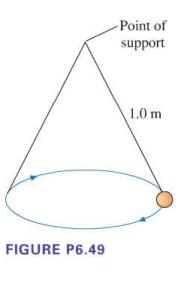
A conical pendulum is formed by attaching a 500 g ball to a 1.0-m-long string, then allowing the mass to move in a horizontal circle of radius 20 cm. Figure P6.49 shows that the string traces out the surface of a cone, hence the name. a. What is the tension in the string?b. What is the ball's
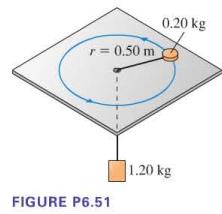
The 0.20 kg puck on the frictionless, horizontal table in Figure P6.51 is connected by a string through a hole in the table to a hanging 1.20 kg block. With what speed must the puck rotate in a circle of radius 0.50 m if the block is to remain hanging at rest? r = 0.50 m FIGURE P6.51 0.20 kg 1.20 kg
The Space Shuttle orbits 300 km above the surface of the earth. a. What is the force of gravity on a 1.0 kg sphere inside the Space Shuttle? b. The sphere floats around inside the Space Shuttle, apparently "weightless." How is this possible?
a. What is the free-fall acceleration on Mars? b. Estimate the maximum speed at which an astronaut can walk on the surface of Mars.
The material that comprises the side of the moon facing the earth is actually slightly more dense than the material on the far side. When the spacecraft is above a more dense area of the surface, the moon's gravitational force on the craft is a bit stronger. In order to stay in a circular orbit of
To throw a discus, the thrower holds it with a fully outstretched arm. Starting from rest, he begins to turn with a constant angular acceleration, releasing the discus after making one complete revolution. The diameter of the circle in which the discus moves is about 1.8 m. If the thrower takes 1.0
A computer hard disk starts from rest, then speeds up with an angular acceleration of 190 rad/s2 until it reaches its final angular speed of 7200 rpm. How many revolutions has the disk made 10.0 s after it starts up?
The crankshaft in a race car goes from rest to 3000 rpm in 2.0 s.a. What is the crankshaft's angular acceleration? b. How many revolutions does it make while reaching 3000 rpm?
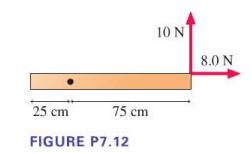
What is the net torque of the bar shown in Figure P7.12, about the axis indicated by the dot? 25 cm FIGURE P7.12 75 cm 10 N 8.0 N
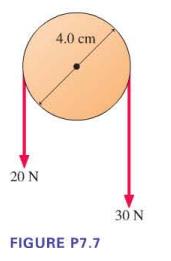
What is the net torque about the axle on the pulley in Figure P7.7? 20 N 4.0 cm FIGURE P7.7 30 N
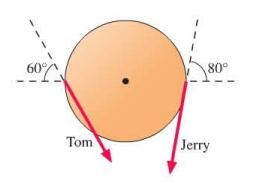
Tom and Jerry both push on the 3.00-m-diameter merry-go round shown in Figure P7.11. Figure P7.11a. If Tom pushes with a force of 40.0 N and Jerry pushes with a force of 35.2 N, what is the net torque on the merry-go-round?b. What is the net torque if Jerry reverses the direction he pushes by
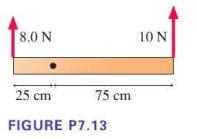
What is the net torque of the bar shown in Figure P7.13, about the axis indicated by the dot? 8.0 N 25 cm FIGURE P7.13 75 cm 10 N
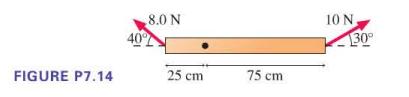
What is the net torque of the bar shown in Figure P7.14, about the axis indicated by the dot? FIGURE P7.14 8.0 N 40% 25 cm 75 cm 10 N, 30°
A 1.7-m-long barbell has a 20 kg weight on its left end and a 35 kg weight on its right end. a. If you ignore the weight of the bar itself, how far from the left end of the barbell is the center of gravity? b. Where is the center of gravity if the 8.0 kg mass of the bar-bell itself is taken into
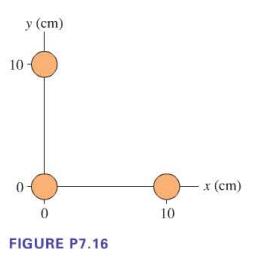
Three identical coins lie on three corners of a square 10.0 cm on a side, as shown in Figure P7.16. Determine the x and y coordinates of the center of gravity of the three coins. 10 y (cm) FIGURE P7.16 10 x (cm)
Hold your arm out- stretched so that it is horizontal. Estimate the mass of your arm and the position of its center of gravity. What is the gravitational torque on your arm in this position, computed around the shoulder joint?
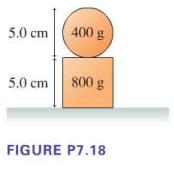
A solid cylinder sits on top of a solid cube as shown in Figure P7.18. How far above the table's surface is the center of gravity of the combined object? 5.0 cm 400 g 5.0 cm 800 g FIGURE P7.18
Two thin beams are joined end-to-end as shown in Figure P7.23 to make a single object. The left beam is 10.0 kg and 1.00 m long and the right one is 40.0 kg and 2.00 m long. a. How far from the left end of the left beam is the center of gravity of the object? b. What is the gravitational torque
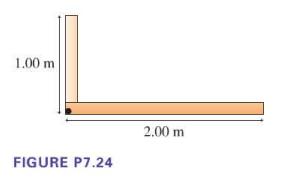
Figure P7.24 shows two thin beams joined at right angles. The vertical beam is 15.0 kg and 1.00 m long and the horizontal beam is 25.0 kg and 2.00 m long.a. Find the center of gravity of the two joined beams. Express your answer in the form (x, y), taking the origin at the corner where the beams
A regulation table tennis ball has a mass of 2.7 g and is 40 mm in diameter. What is its moment of inertia about an axis that passes through its center?
A solid cylinder with a radius of 4.0 cm has the same mass as a solid sphere of radius R. If the cylinder and sphere have the same moment of inertia about their centers, what is the sphere's radius?
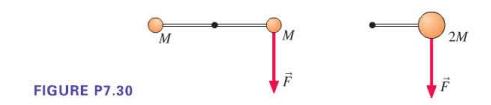
The left part of Figure P7.30 shows a bird's-eye view of two identical balls connected by a light rod that rotates about a vertical axis through its center. The right part shows a ball of twice the mass connected to a light rod of half the length, that rotates about its left end. If equal forces
A bicycle rim has a diameter of 0.65 m and a moment of inertia, measured about its center, of 0.19 kg. m2. What is the mass of the rim?
A small grinding wheel has a moment of inertia of 4.0 x 10⁻⁵ kg • m2. What net torque must be applied to the wheel for its angular acceleration to be 150 rad/s2?
While sitting in a swivel chair, you push against the floor with your heel to make the chair spin. The 7.0 N frictional force is applied at a point 40 cm from the chair's rotation axis, in the direction that causes the greatest angular acceleration. If that angular acceleration is 1.8 rad/s2, what
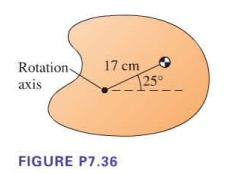
The 2.5 kg object shown in Figure P7.36 has a moment of inertia about the rotation axis of 0.085 kg • m3. The rotation axis is horizontal. When released, what will be the object's initial angular acceleration? Rotation axis 17 cm FIGURE P7.36 25°
A 200 g, 20-cm-diameter plastic disk is spun on an axle through its center by an electric motor. What torque must the motor supply to take the disk from 0 to 1800 rpm in 4.0 s?
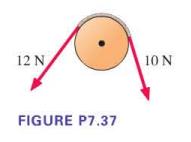
A frictionless pulley, which can be modeled as a 0.80 kg solid cylinder with a 0.30 m radius, has a rope going over it, as shown in Figure P7.37. The tension in the rope is 10 N on one side and 12 N on the other. What is the angular acceleration of the pulley? 12 N FIGURE P7.37 10 N
If you lift the front wheel of a poorly maintained bicycle off the ground and then start it spinning at 0.72 rev/s, friction in the bearings causes the wheel to stop in just 12 s. If the moment of inertia of the wheel about its axle is 0.30 kg • m2, what is the magnitude of the frictional torque?
A toy top with a spool of diameter 5.0 cm has a moment of inertia of 3.0×10⁻⁵ kg • m2 about its rotation axis. To get the top spinning, its string is pulled with a tension of 0.30 N. How long does it take for the top to complete the first five revolutions? The string is long enough that it is
A 34-cm-diameter potter's wheel with a mass of 20 kg is spinning at 180 rpm. Using her hands, a potter forms a pot, centered on the wheel, with a 14 cm diameter. Her hands apply a net friction force of 1.3 N to the edge of the pot. If the power goes out, so that the wheel's motor no longer provides
A 1.5 kg block and a 2.5 kg block are attached to opposite ends of a light rope. The rope hangs over a solid, frictionless pulley that is 30 cm in diameter and has a mass of 0.75 kg. When the blocks are released, what is the acceleration of the lighter block?
A bicycle with 0.80-m-diameter tires is coasting on a level road at 5.6 m/s. A small blue dot has been painted on the tread of the rear tire.a. What is the angular speed of the tires? b. What is the speed of the blue dot when it is 0.80 m above the road? c. What is the speed of the blue dot when
A 1.2 g pebble is stuck in a tread of a 0.76-m-diameter auto- mobile tire, held in place by static friction that can be at most 3.6 N. The car starts from rest and gradually accelerates on a straight road. How fast is the car moving when the pebble flies out of the tire tread?
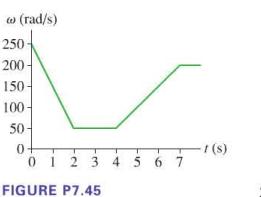
The graph in Figure P7.45 shows the angular velocity of the crankshaft in a car. Draw a graph of the angular acceleration versus time. Include appropriate numerical scales on both axes. w (rad/s) 250- 200- 150 100- 50- 0+ 0 FIGURE P7.45 1 2 3 4 5 6 7 1 (S)
Three 0.10 kg balls are connected by light rods to form an equilateral triangle with a side length of 0.30 m. What is the moment of inertia of this triangle about an axis perpendicular to its plane and passing through one of the balls?
A reasonable estimate of the moment of inertia of an ice skater spinning with her arms at her sides can be made by modeling most of her body as a uniform cylinder. Suppose the skater has a mass of 64 kg. One-eighth of that mass is in her arms, which are 60 cm long and 20 cm from the vertical axis
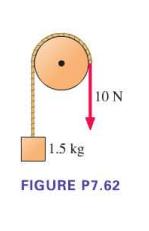
A 1.5 kg block is connected by a rope ac ross a 50-cmdi ameter, 2.0 kg, frictionless puUey, as shown in Figure P7.62. A constant 10 N tension is applied to the other end of the rope. Starting from rest, how long does it take the block to move 30cm? 1.5 kg 10 N FIGURE P7.62
A tradesman sharpens a knife by pushing it against the rim of a grindstone. The 30-cm-diameter stone is spinning at 200 rpm and has a mass of 28 kg. The coefficient of kinetic friction between the knife and the stone is 0.20. If the stone loses 10% of its speed in 10s of grinding, what is the force
To perform this maneuver, the dancer relies on the fact that the position of her center of gravity.A. Is near the center of the torso. B. Is determined by the positions of her arms and legs. C. Moves in a horizontal path. D. Is outside of her body.
Suppose you wish to make a vertical leap with the goal of getting your head as high as possible above the ground. At the top of your leap, your arms should be A. Held at your sides. B. Raised above your head. C. Outstretched, away from your body.
When the dancer is in the air, is there a gravitational torque on her? Take the dancer's rotation axis to be through her center of gravity.A. Yes, there is a gravitational torque. B. No, there is not a gravitational torque. C. It depends on the positions of her arms and legs.
In addition to changing her center of gravity, a dancer may change her moment of inertia. Consider her moment of inertia about a vertical axis through the center of her body. When she raises her arms and legs,A. Increases her moment of inertia. B. Decreases her moment of inertia. C. Does not
An object is acted upon by two (and only two) forces that are of equal magnitude and oppositely directed. Is the object necessarily in static equilibrium?
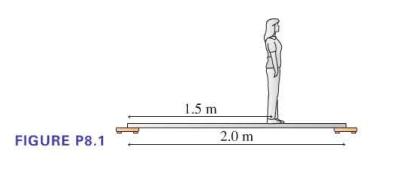
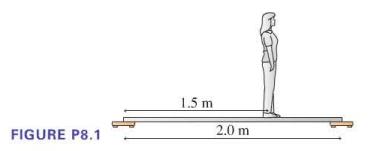
A 64 kg woman stands on a very light, rigid board that rests on a bathroom scale at each end, as shown in Figure P8.1. What is the reading on each of the scales? FIGURE P8.1 1.5 m 2.0 m
Suppose the woman in Figure P8.1 is 54 kg, and the board she is standing on has a 10 kg mass. What is the reading on each of the scales? FIGURE P8.1 1.5 m 2.0 m
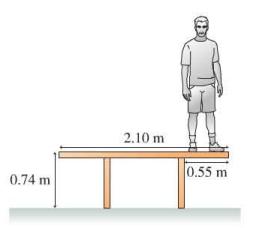
How close to the right edge of the 56 kg picnic table shown in Figure P8.3 can a 70 kg man stand without the table tipping over?Figure P8.3 0.74 m 2.10 m 0.55 m
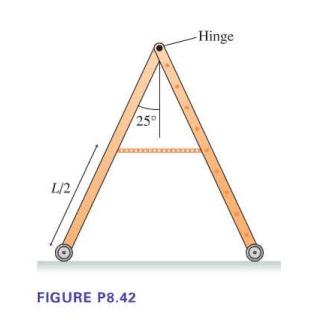
A library ladder of length L rolls on wheels as shown in Figure P8.42. The two legs of the ladder freely pivot at the hinge at the top. The legs are kept from splaying apart by a light- weight chain that is attached halfway up the ladder. If the ladder weighs 200 N, and the angle between each leg
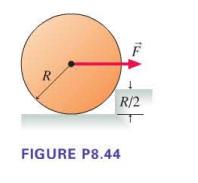
The wheel of mass m in Figure P8.44 is pulled on by a horizontal force applied at its center. The wheel is touching a curb whose height is half the wheel's radius. What is the minimum force required to just raise the wheel off the ground? R R/2 FIGURE P8.44
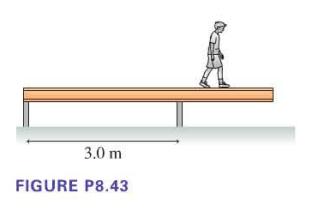
A 40 kg, 5.0-m-long beam is supported by, but not attached to, the two posts in Figure P8.43. A 20 kg boy starts walking along the beam. How close can he get to the right end of the beam without it tipping?
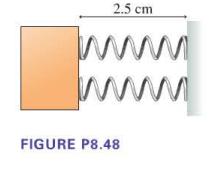
Two springs have the same spring constant k = 130 N/m but different equilibrium lengths, 3.0 cm and 5.0 cm. They are arranged as shown in Figure P8.48, then a block is pushed against them, compressing both to a length of 2.5 cm. With what net force do they push back on the block? 2.5
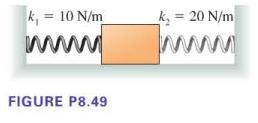
Figure P8.49 shows two springs attached to a block that can slide on a friction less surface. In the block's equilibrium position, the left spring is compressed by 2.0 cm.a. By how much is the right spring compressed? b. What is the net force on the block if it is moved 15 cm to the right of its
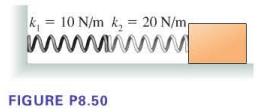
Figure P8.50 shows two springs attached to each other, and also attached to a box that can slide on a frictionless surface. In the block's equilibrium position, neither spring is stretched. What is the net force on the block if it is moved 15 cm to the right of its equilibrium position? k, 10 N/m
A 25 kg child bounces on a pogo stick. The pogo stick has a spring with spring constant 2.0 X 10⁴ N/m. When the child makes a nice big bounce, she finds that at the bottom of the bounce she is accelerating upward at 9.8 m/s2. How much is the spring compressed?
Orb spiders make silk with a typical diameter of 0.15 mm.a. A typical large orb spider has a mass of 0.50 g. If this spider suspends itself from a single 12-cm-long strand of silk, by how much will the silk stretch? b. What is the maximum weight that a single thread of this silk could support?
A 57 g tennis ball is served at 45 m/s. If the ball started from rest, what impulse was applied to the ball by the racket?
Starting from rest, object 1 is subject to a 12 N force for 2.0 s. Object 2, with twice the mass, is subject to a 15 N force for 3.0 s. Which object has the greater final speed? Explain.
A student throws a 120 g snowball at 7.5 m/s at the side of the schoolhouse, where it hits and sticks. What is the magnitude of the average force on the wall if the duration of the collision is 0.15 s?
Two pucks, of mass m and 4m, lie on a frictionless table. Equal forces are used to push both pucks forward a distance of 1 m. a. Which puck takes longer to travel the distance? Explain. b. Which puck has the greater momentum upon completing the distance? Explain.
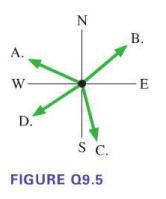
A stationary firecracker explodes into three pieces. One piece travels off to the east; a second travels to the north. Which of the vectors of Figure Q9.5 could be the velocity of the third piece? Explain. A. W- D. N S.C. FIGURE Q9.5 B. -E
A sled and rider, gliding over horizontal, frictionless ice at 4.0 m/s, have a combined mass of 80 kg. The sled then slides over a rough spot in the ice, slowing down to 3.0 m/s. What impulse was delivered to the sled by the friction force from the rough spot?
Two students stand at rest, facing each other on frictionless skates. They then start tossing a heavy ball back and forth between them. Describe their subsequent motion.
Automobiles are designed with "crumple zones" intended to collapse in a collision. Why would a manufacturer design part of a car so that it collapses in a collision?
A child is sliding on a sled at 1.5 m/s to the right. You stop the sled by pushing on it for 0.50 s in a direction opposite to its motion. If the mass of the child and sled is 35 kg, what average force do you need to apply to stop the sled? Use the concepts of impulse and momentum.
You probably know that it feels better to catch a baseball if you are wearing a padded glove. Explain why this is so, using the ideas of momentum and impulse.
An ice hockey puck slides along the ice at 12 m/s. A hockey stick delivers an impulse of 4.0 kg • m/s, causing the puck to move off in the opposite direction with the same speed. What is the mass of the puck?
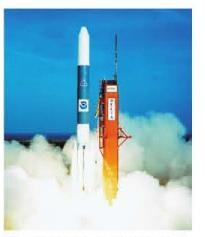
In the early days of rocketry, some people claimed that rockets couldn't fly in outer space as there was no air for the rockets to push against. Suppose you were an early investigator in the field of rocketry and met someone who made this argument. How would you convince the person that rockets
As part of a safety investigation, two 1400 kg cars traveling at 20 m/s are crashed into different barriers. Find the average forces exerted on (a). The car that hits a line of water barrels and takes 1.5 s to stop,(b). The car that hits a concrete barrier and takes 0.1 s to stop.
Two ice skaters, Megan and Jason, push off from each other on frictionless ice. Jason's mass is twice that of Megan. a. Which skater, if either, experiences the greater impulse during the push? Explain. b. Which skater, if either, has the greater speed after the push- off? Explain.
In a Little League baseball game, the 145 g ball enters the strike zone with a speed of 15.0 m/s. The batter hits the ball, and it leaves his bat with a speed of 20.0 m/s in exactly the opposite direction. a. What is the magnitude of the impulse delivered by the bat to the ball? b. If the bat is
Suppose a rubber ball and a steel ball collide. Which, if either, receives the larger impulse? Explain.
A small, 100 g cart is moving at 1.20 m/s on an air track when it collides with a larger, 1.00 kg cart at rest. After the collision, the small cart recoils at 0.850 m/s. What is the speed of the large cart after the collision?
While standing still on a basketball court, you throw the ball to a teammate. Why do you not move backward as a result? Is the law of conservation of momentum violated?
A man standing on very slick ice fires a rifle horizontally. The mass of the man together with the rifle is 70 kg, and the mass of the bullet is 10 g. If the bullet leaves the muzzle at a speed of 500 m/s, what is the final speed of the man?
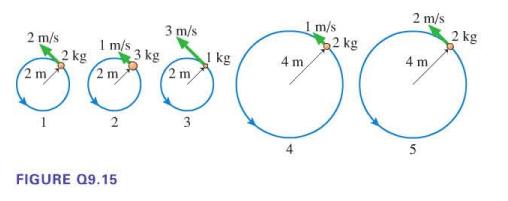
Rank in order, from largest to smallest, the angular momenta L1 through L5, of the balls shown in Figure Q9.15. Explain. 3 m/s 2 m/s [ m/s 2 kg 3 kg බිමට 2m 2 m 2 m 2 1 FIGURE 09.15 3 1 kg 2 m/s 1 m/s 2kg 4 m 4m පාල st -- 2kg
To win a prize at the county fair, you're trying to knock down a heavy bowling pin by hitting it with a thrown object. Should you choose to throw a rubber ball or a beanbag of equal size and weight? Explain.
A 2.7 kg block of wood sits on a table. A 3.0 g bullet, fired horizontally at a speed of 500 m/s, goes completely through the block, emerging at a speed of 220 m/s. What is the speed of the block immediately after the bullet exits?
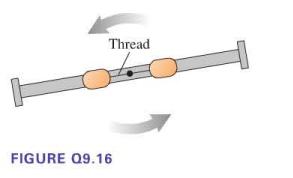
Figure Q9.16 shows two masses held together by a thread on a rod that is rotating about its center with angular velocity w. If the thread breaks, the masses will slide out to the ends of the rod. If that happens, will the rod's angular velocity increase, decrease, or remain unchanged? Explain.
A strong man is compressing a lightweight spring between two weights. One weight has a mass of 2.3 kg, the other a mass of 5.3 kg. He is holding the weights stationary, but then he loses his grip and the weights fly off in opposite directions. The lighter of the two is shot out at a speed of 6.0
If the earth warms significantly, the polar ice caps will melt. Water will move from the poles, near the earth's rotation axis. and will spread out around the globe. In principle, this will change the length of the day. Why? Will the length of the day increase or decrease?
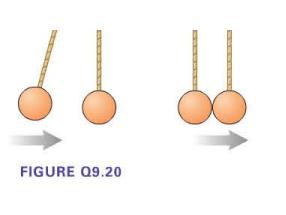
Two balls are hung from cords. The first ball, of mass 1.0 kg, is pulled to the side and released, reaching a speed of 2.0 m/s at the bottom of its arc. Then, as shown in Figure Q9.20, it hits and sticks to another ball. The speed of the pair just after the collision is 1.2 m/s. What is the mass of
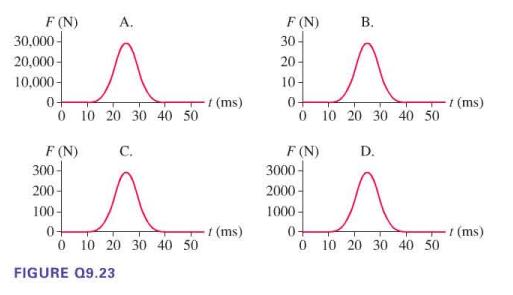
Curling is a sport played with 20 kg stones that slide across an ice surface. Suppose a curling stone sliding at 1 m/s strikes another stone and comes to rest in 2 ms. Approximately how much force is there on the stone during the impact? A. 200 N B. 1000 N C. 2000 N D. 10,000 N
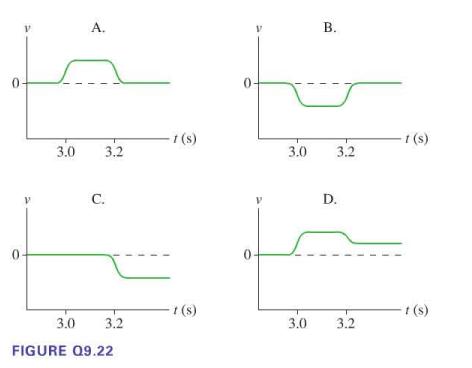
Two friends are sitting in a stationary canoe. At t = 3.0 s the person at the front tosses a sack to the person in the rear, who catches the sack 0.2 s later. Which plot in Figure Q9.22 shows the velocity of the boat as a function of time? Positive velocity is forward, negative velocity is
A 9.5 kg dog takes a nap in a canoe and wakes up to find the canoe has drifted out onto the lake but now is stationary. He walks along the length of the canoe at 0.50 m/s, relative to the water, and the canoe simultaneously moves in the opposite direc- tion at 0.15 m/s. What is the mass of the
A 71 kg baseball player jumps straight up to catch a line drive. If the 140 g ball is moving horizontally at 28 m/s, and the catch is made when the ballplayer is at the highest point of his leap, what is his speed immediately after stopping the ball?
Two blocks, with masses m1 = 2.5 kg and m2 = 14 kg, approach each other along a horizontal, frictionless track. The initial velocities of the blocks are v1 = 12.0 m/s to the right and v2 = 3.4 m/s to the left. The two blocks then collide and stick together. Which of the graphs could represent the
A kid at the junior high cafeteria wants to propel an empty milk carton along a lunch table by hitting it with a 3.0 g spit ball. If he wants the speed of the 20 g carton just after the spit ball hits it to be 0.30 m/s, at what speed should his spit ball hit the carton?
A red ball, initially at rest, is simultaneously hit by a blue ball traveling from west to east at 3 m/s and a green ball traveling east to west at 3 m/s. All three balls have equal mass. Afterward, the red ball is traveling south and the green ball is moving to the east. In which direction is the
A 2.0 kg block slides along a frictionless surface at 1.0 m/s. A second block, sliding at a faster 4.0 m/s, collides with the first from behind and sticks to it. The final velocity of the combined blocks is 2.0 m/s. What was the mass of the second block?
A 24 g, 3-cm-diameter thin, hollow sphere rotates at 30 rpm about a vertical, frictionless axis through its center. A 4 g bug stands at the top of the sphere. He then walks along the surface of the sphere until he reaches its "equator." When he reaches the equator, the sphere is rotating at A. 15
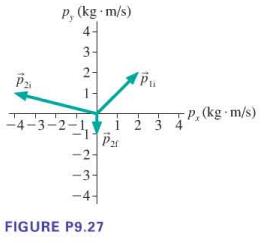
Il Two particles collide and bounce apart. Figure P9.27 shows the initial momenta of both and the final momentum of particle 2. What is the final momentum of particle 1? Show your answer by copying the figure and drawing the final momentum vector on the figure. P,
What is the angular momentum of the moon around the earth? The moon's mass is 7.4 x 10²² kg and it orbits 3.8 x 10⁸ m from the earth.
A little girl is going on the merry-go-round for the first time, and wants her 47 kg mother to stand next to her on the ride, 2.6 m from the merry-go-round's center. If her mother's speed is 4.2 m/s when the ride is in motion, what is her angular momentum around the center of the merry-go-round?
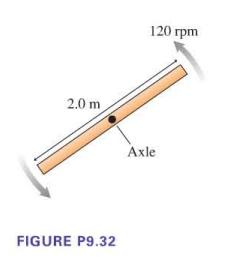
What is the angular momentum about the axle of the 500 g rotating bar in Figure P9.32? 2.0 m FIGURE P9.32 120 rpm Axle
Divers change their body position in midair while rotating about their center of mass. In one dive, the diver leaves the board with her body nearly straight, then tucks into a somersault position. If the moment of inertia of the diver in a straight position is 14 kg • m and in a tucked position
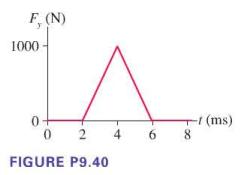
A 200 g ball is dropped from a height of 2.0 m and bounces on a hard floor. The force on the ball from the floor is shown in Figure P9.40. How high does the ball rebound? F (N) 1000 앙 FIGURE P9.40 0 2 4 6 00 8 (ms)
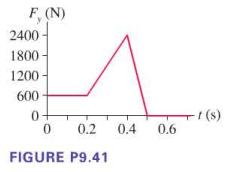
Figure P9.41 is a graph of the force exerted by the floor on a woman making a vertical jump. At what speed does she leave the ground? F, (N) 2400- 1800 1200 600 0- 0 0.2 FIGURE P9.41 0.4 0.6 t(s)
A 140 g baseball is moving horizontally to the right at 35 m/s when it is hit by the bat. The ball flies off to the left at 55 m/s, at an angle of 25° above the horizontal. What are the magnitude and direction of the impulse that the bat delivers to the ball?
Squids rely on jet propulsion, a versatile technique to move around in water. A 1.5 kg squid at rest suddenly expels 0.10 kg of water backward to quickly get itself moving forward at 3.0 m/s. If other forces (such as the drag force on the squid) are ignored, what is the speed with which the squid
James and Sarah stand on a stationary cart with frictionless wheels. The total mass of the cart and riders is 130 kg. At the same instant, James throws a 1.0 kg ball to Sarah at 4.5 m/s, while Sarah throws a 0.50 kg ball to James at 1.0 m/s. James's throw is to the right and Sarah's is to the
Showing 3200 - 3300
of 3511
First
22
23
24
25
26
27
28
29
30
31
32
33
34
35
36
Step by Step Answers

 Get 50% OFF
Claim Now
Get 50% OFF
Claim Now