New Semester
Started
Get
50% OFF
Study Help!
--h --m --s
Claim Now
Question Answers
Textbooks
Find textbooks, questions and answers
Oops, something went wrong!
Change your search query and then try again
S
Books
FREE
Study Help
Expert Questions
Accounting
General Management
Mathematics
Finance
Organizational Behaviour
Law
Physics
Operating System
Management Leadership
Sociology
Programming
Marketing
Database
Computer Network
Economics
Textbooks Solutions
Accounting
Managerial Accounting
Management Leadership
Cost Accounting
Statistics
Business Law
Corporate Finance
Finance
Economics
Auditing
Tutors
Online Tutors
Find a Tutor
Hire a Tutor
Become a Tutor
AI Tutor
AI Study Planner
NEW
Sell Books
Search
Search
Sign In
Register
study help
physics
college physics a strategic approach 2nd
College Physics A Strategic Approach 2nd Edition Randall D. Knight, Brian Jones, Stuart Field - Solutions
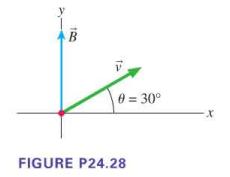
At t = 0 s, a proton is moving with a speed of 5.5 x 10⁵ m/s at an angle of 30 from the x-axis, as shown in Figure P24.28. A uniform magnetic field of magnitude 1.50 T is pointing in the positive y-direction. What will be the y-coordinate of the proton 10 s later? У B 0 = 30° FIGURE P24.28 X Х
The computers that control MRI machines cannot have CRT monitors. Explain why this is so.
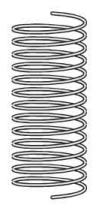
A Slinky is a child's toy that is a long coil spring. Suppose you take a Slinky and let it hang down and stretch out so that the coils do not touch each other, as in Figure Q24.28. Now you connect the Slinky to a power supply and pass a large DC cur- rent through it. Think about the current in the
Early black-and-white television sets used an electron beam to draw a picture on the screen. The electrons in the beam were accelerated by a voltage of 3.0 kV; the beam was then steered to different points on the screen by coils of wire that produced a magnetic field of up to 0.65 T. a. What is
A solenoid carries a current that produces a field inside it. A wire carrying a current lies inside the solenoid, at the center, carrying a current along the solenoid's axis. Is there a force on this wire due to the field of the solenoid? Explain.
You want to make an electromagnet by wrapping wire around a nail. Should you use bare copper wire or wire coaled with inslIlating plastic? Explain.
The moon does not have a molten iron core like the earth, but the moon does have a small magnetic field. What might be the source of this field?
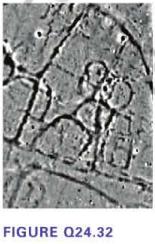
Archaeologists can use instruments that measure small variations in magnetic field to locate buried walls made of fired brick, as shown in Figure Q24.32. When fired, the magnetic moments in the clay become randomly aligned; as the clay cools, the magnetic moments line up with the earth's field and
The unit of current, the ampere, is defined in terms of the force between currents. If two 1.0-meter-long sections of very long wires a distance 1.0 m apart each carry a current of 1.0 A, what is the force between them? (If the force between two actual wires has this value, the current is defined
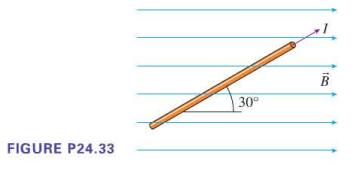
A uniform 2.5 T magnetic field points to the right. A 3.0-m-long wire, carrying 15 A, is placed at an angle of 30 to the field, as shown in Figure 24.33. What is the force (magnitude and direction) on the wire? FIGURE P24.33 30º +1₂ TRO B
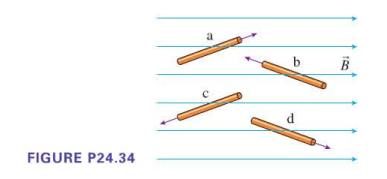
The four wires in Figure P24.34 are tilted at 20° with respect to a uniform 0.35 T field. If each carries 4.5 A and is 0.35 m long, what is the force (direction and magnitude) on each? FIGURE P24.34 રી b d
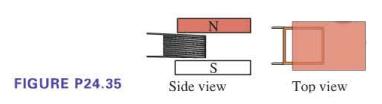
Magnetic information on hard drives is accessed by a read head that must move rapidly back and forth across the disk. The force to move the head is generally created with a voice coil actuator, a flat coil of fine wire that moves between the poles of a strong magnet, as in Figure P24.35. Assume
A current loop in a motor has an area of 0.85 cm2 It carries a 240 mA current in a uniform field of 0.62 T. What is the magnitude of the maximum torque on the current loop?
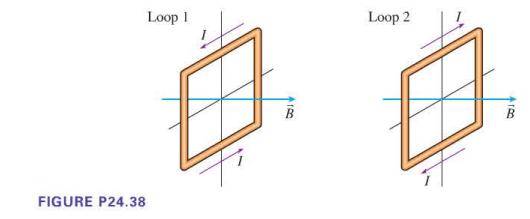
Figure P24.38 shows two square current loops. The loops are far apart and do not interact with each other.a. Use force diagrams to show that both loops are in equilibrium, having a net force of zero and no torque. b. One of the loop positions is stable. That is, the forces will return it to
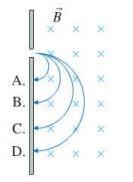
Figure Q24.36 shows four particles moving to the right as they enter a region of uniform magnetic field, directed into the paper as noted. All particles move at the same speed and have the same charge. Which particle has the largest mass? Figure Q24.36 A. B. C. D. B x x x
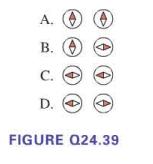
If two compasses are brought near enough to each other, the magnetic fields of the compasses themselves will be larger than the field of the earth, and the needles will line up with each other. Which of the arrangements of two compasses shown in Figure Q24.39 is a possible stable arrangement?
Moving a charge from point A, where the potential is 300 V, to point B, where the potential is 150 V, takes 4.5 x 10⁻⁴ J of work. What is the value of the charge?
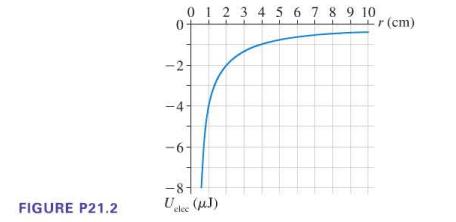
The graph in Figure P21.2 shows the electric potential energy as a function of separation for two point charges. If one charge is +0.44 nC, what is the other charge? FIGURE P21.2 0 1 2 3 4 5 6 7 8 9 10 0- -r (cm) -2- -4- -6- -84 Udlec (MJ)
By moving a 10 nC charge from point A to point B, you determine that the electric potential at B is 150 V. What would be the potential at B if a 20 nC charge were moved from A to B?
Why is the potential energy of two opposite charges a negative number?
It takes 3.0 μJ of work to move a 15 nC charge from point A to B. It takes -5.0 μJ of work to move the charge from C to B. What is the potential difference Vc-VA?
A 20 nC charge is moved from a point where V = 150 V to a point where V = -50 V. How much work is done by the force that moves the charge?
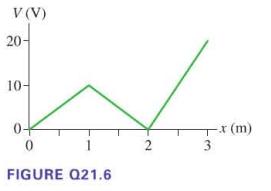
The graph in Figure Q21.6 shows the electric potential along the x-axis. Draw a graph of the potential energy of a 0.10 C charged particle in this region of space, providing a numerical scale on the energy axis. V (V) 20- 10- 0 FIGURE Q21.6 2 3 x (m)
At one point in space, the electric potential energy of a 15 nC charge is 45 μJ.a. What is the electric potential at this point? b. If a 25 nC charge were placed at this point, what would its electric potential energy be?
An electron has been accelerated from rest through a potential difference of 1000 V. a. What is its kinetic energy, in electron volts? b. What is its kinetic energy, in joules? c. What is its speed?
A proton has been accelerated from rest through a potential difference of -1000 V. a. What is its kinetic energy, in electron volts? b. What is its kinetic energy, in joules? c. What is its speed?
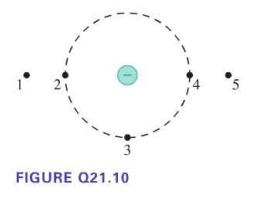
Rank in order, from most positive to most negative, the electric potentials V1 to V5 at points 1 to 5 in Figure Q21.10. Explain. 3 FIGURE Q21.10
What potential difference is needed to accelerate a He+ ion (charge +e, mass 4 u) from rest to a speed of 1.0 × 10⁶ m/s?
The electric potential at a point that is halfway between two identical charged particles is 300 V. What is the potential at a point that is 25% of the way from one particle to the other?
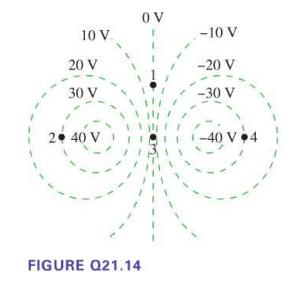
Rank in order, from largest to smallest, the electric field strengths E1, E2, E3, and E4 at the four labeled points in Figure Q21.14. Explain. 10 V 20 V 30 V 2 40 V OV FIGURE Q21.14 -10 V -20 V -30 V -40 V 4
A 2.0 cm × 2.0 cm parallel-plate capacitor has a 2.0 mm spacing. The electric field strength inside the capacitor is 1.0 × 10⁵ V/m.a. What is the potential difference across the capacitor? b. How much charge is on each plate?
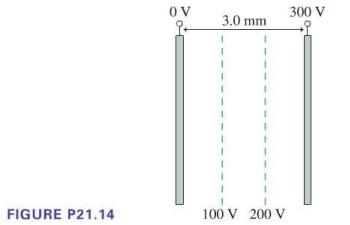
a. In Figure P21.14, which capacitor plate, left or right, is the positive plate?b. What is the electric field strength inside the capacitor? c. What is the potential energy of a proton at the midpoint of the capacitor? FIGURE P21.14 OV 3.0 mm 100 V 200 V 300 V
A +25 nC charge is at the origin. a. What are the radii of the 1000 V, 2000 V, 3000 V, and 4000 V equipotential surfaces? b. Draw an equipotential map in the xy-plane showing the charge and these four surfaces.
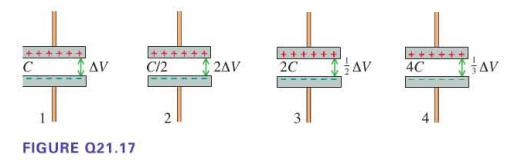
Rank in order, from largest to smallest, the energies (Uc)1, to (Uc)4 stored in each of the capacitors in Figure Q21.17. Explain. ΔΙ FIGURE Q21.17 C/2 24V +++++ 2C AV AC AV
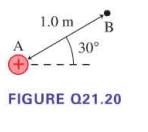
A 1.0 nC positive point charge is located at point A in Figure Q21.20. The electric potential at point B is A. 9.0 V B. 9.0sin 30° V C. 9.0cos 30° V D. 9.0tan 30° V A 1.0 m 30° B FIGURE Q21.20
A 1.0-mm-diameter ball bearing has 2.0 x 10⁹ excess electrons. What is the ball bearing's potential?
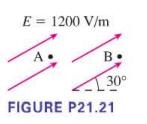
In Figure P21.21, the electric potential at point A is -300 V. What is the potential at point B, which is 5.0 cm to the right of A? E = 1200 V/m A B 30⁰ FIGURE P21.21
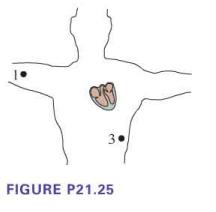
One standard location for a pair of electrodes during an EKG is shown in Figure P21.25. The potential difference ΔV31 = V3 - V1 is recorded. For each of the three instants a, b, and c during the heart's cycle shown in Figure 21.29, will ΔV31 be positive or negative? Explain. 3 FIGURE P21.25
Two 2.0 cm × 2.0 cm square aluminum electrodes, spaced 0.50 mm apart, are connected to a 100 V battery. a. What is the capacitance? b. What is the charge on the positive electrode?
An uncharged capacitor is connected to the terminals of a 3.0 V battery, and 6.0 μC flows to the positive plate. The 3.0 V battery is then disconnected and replaced with a 5.0 V battery, with the positive and negative terminals connected in the same manner as before. How much additional charge
An atom of helium and one of argon are singly ionized-one electron is removed from each. The two ions are then accelerated from rest by the electric field between two plates with a potential difference of 150 V. After accelerating from one plate to the other,A. The helium ion has more kinetic
What is the voltage of a battery that will charge a 2.0 μF capacitor to ± 48 μC?
Two electrodes connected to a 9.0 V battery are charged to ± 45 nC. What is the capacitance of the electrodes?
A science-fair radio uses a homemade capacitor made of two 35 cm x 35 cm sheets of aluminum foil separated by a 0.25-mm-thick sheet of paper. What is its capacitance?
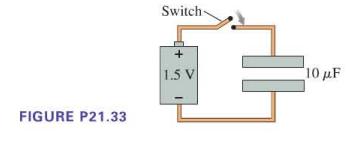
Initially, the switch in Figure P21.33 is open and the capacitor is uncharged. How much charge flows through the switch after the switch is closed? FIGURE P21.33 Switch- + 1.5V 루 10 F
A 1.2 nF parallel-plate capacitor has an air gap between its plates. Its capacitance increases by 3.0 nF when the gap is filled by a dielectric. What is the dielectric constant of that dielectric?
A 25 pF parallel-plate capacitor with an air gap between the plates is connected to a 100 V battery. A Teflon slab is then inserted between the plates and completely fills the gap. What is the change in the charge on the positive plate when the Teflon is inserted?
Two 2.0-cm-diameter electrodes with a 0.10-mm-thick sheet of Teflon between them are attached to a 9.0 V battery. Without disconnecting the battery, the Teflon is removed. What are the charge, potential difference, and electric field (a) before and (b) after the Teflon is removed?
A capacitor with its plates separated by paper stores 4.4 nC of charge when it is connected to a particular battery. An otherwise identical capacitor, but with its plates separated by Pyrex glass, is connected to the same battery. How much charge does that capacitor store?
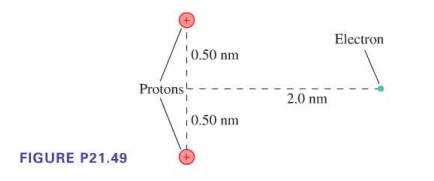
What is the electric potential energy of the electron in Figure P21.49? The protons are fixed and can't move. FIGURE P21.49 Protons 0.50 nm 0.50 nm 2.0 nm Electron
A pair of 10 μF capacitors in a high-power laser are charged to 1.7 kV.a. What charge is stored in each capacitor? b. How much energy is stored in each capacitor?
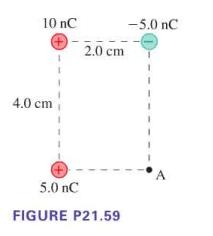
a. What is the electric potential at point A in Figure P21.59?b. What is the potential energy of a proton at point A? 10 nC 4.0 cm 2.0 cm 5.0 nC FIGURE P21.59 -5.0 nC A
Electric outlets have a voltage of approximately 120 V between the two parallel slots. Estimate the electric field strength between these two slots.
Estimate the magnitude of the electric field in a cell membrane with a thickness of 8 nm.
A Na+ ion moves from inside a cell, where the electric potential is -70 mV, to outside the cell, where the potential is 0 V. What is the change in the ion's electric potential energy as it moves from inside to outside the cell? Does its energy increase or decrease?
In the early 1900s, Robert Millikan used small charged droplets of oil, suspended in an electric field, to make the first quantitative measurements of the electron's charge. A 0.70-um- diameter droplet of oil, having a charge of +e, is suspended in midair between two horizontal plates of a
A 2.5-mm-diameter sphere is charged to -4.5 nC. An electron fired directly at the sphere from far away comes to within 0.30 mm of the surface of the target before being reflected.a. What was the electron's initial speed? b. At what distance from the surface of the sphere is the electron's speed
The plates of a 3.0 nF parallel-plate capacitor are each 0.27 m2 in area. a. How far apart are the plates if there's air between them? b. If the plates are separated by a Teflon sheet, how thick is the sheet?
The dielectric in a capacitor serves two purposes. It increases the capacitance, compared to an otherwise identical capacitor with an air gap, and it increases the maximum potential difference the capacitor can support. If the electric field in a material is sufficiently strong, the material will
Two wires connect a lightbulb to a battery, completing a circuit and causing the bulb to glow. Do the simple observations and measurements that you can make on this circuit prove that something is flowing through the wires? If so, state the observations and/or measurements that are relevant and the
Two wires connect a lightbulb to a battery, completing a circuit and causing the bulb to glow. Are the simple observations and measurements you can make on this circuit able to distinguish a current composed of positive charge carriers from a current composed of negative charge carriers? If so,
A wire carries a 1.0 A current for 30 s. How many electrons move past a point in the wire?
What causes electrons to move through a wire as a current?
When a nerve cell depolarizes, charge is transferred across the cell membrane, changing the potential difference. For a typical nerve cell, 9.0 pC of charge flows in a time of 0.50 ms. What is the average current?
A lightbulb is connected to a battery by two copper wires of equal lengths but different thicknesses. A thick wire connects one side of the lightbulb to the positive terminal of the battery and a thin wire connects the other side of the bulb to the negative terminal. a. Which wire carries a
A wire carries a 15 μA current. How many electrons pass a given point on the wire in 1.0 s?
In a typical lightning strike, 2.5 C flows from cloud to ground in 0.20 ms. What is the current during the strike?
A wire carries a 4 A current. What is the current in a second wire that delivers twice as much charge in half the time?
A capacitor is charged to 6.0 X 10⁻⁴ C, then discharged by connecting a wire between the two plates. 40 us after the dis- charge begins, the capacitor still holds 13% of its original charge. What was the average current during the first 40 μs of the discharge?
Metal 1 and metal 2 are each formed into 1-mm-diameter wires. The electric field needed to cause a 1 A current in metal 1 is larger than the electric field needed to cause a 1 A current in metal 2. Which metal has the larger resistivity? Explain.
Cells in the nervous system have a potential difference of 70 mV across the cell membrane separating the interior of the cell from the extracellular fluid. This potential difference is maintained by ion pumps that move charged ions across the mem- brane. Is this an emf?
If you change the temperature of a segment of metal wire, the dimensions change and the resistivity changes. How does each of these changes affect the resistance of the wire?
A battery supplies a steady 1.5 A current to a circuit. If the charges moving in the battery are positive ions with charge e, how many ions per second are transported from the negative terminal to the positive terminal?
What is the emf of a battery that does 0.60 J of work to transfer 0.050 C of charge from the negative to the positive terminal?
An individual hydrogen-oxygen fuel cell has an output of 0.75 V. How many cells must be connected in series to drive a 24.0 V motor?
When lightning strikes the ground, it generates a large electric field along the surface of the ground directed toward the point of the strike. People near a lightning strike are often injured not by the lightning itself but by a large current that flows up one leg and down the other due to this
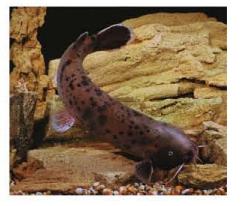
An electric catfish can generate a significant potential difference using stacks of special cells called electrocytes. Each electrocyte develops a potential difference of 110 mV. How many cells must be connected in series to give the 350 V a large catfish can produce?
Over time, atoms "boil off" the hot filament in an incandescent bulb and the filament becomes thinner. How does this affect the brightness of the lightbulb?
Lightbulbs are typically rated by their power dissipation when operated at a given voltage. Which of the following light- bulbs has the largest current through it when operated at the voltage for which it's rated? A. 0.8 W, 1.5 V C. 4 W, 4.5 V B. 6 W, 3 V D. 8 W, 6 V
We can model the rear window defroster in a car as a resistor that is connected to the car's 12 V battery. The defroster is made of a material whose resistance increases rapidly as the temperature increases. When the defroster is cold, its resistance is low; when the defroster is warm, its
Lightbulbs are typically rated by their power dissipation when operated at a given voltage. Which of the following light- bulbs has the largest resistance when operated at the voltage for which it's rated? A. 0.8 W, 1.5 V C. 4 W, 4.5 V B. 6 W, 3 V D. 8 W, 6 V
What is the resistance of a. A 1.0-m-long copper wire that is 0.50 mm in diameter? b. A 10-cm-long piece of iron with a 1.0 mm X 1.0 mm square cross section?
A stereo amplifier creates a 5.0 V potential difference across a speaker. To double the power output of the speaker, the amplifier's potential difference must be increased to A. 7.1 V B. 10 V C. 14 V D. 25 V
A motorcyclist is making an electric vest that, when connected to the motorcycle's 12 V battery, will warm her on cold rides. She is using 0.25-mm-diameter copper wire, and she wants a current of 4.0 A in the wire. What length wire must she use?
If a 1.5 V battery stores 5.0 kJ of energy (a reasonable value for an inexpensive C cell), for how many minutes could it sustain a current of 1.2 A? A. 2.7 B. 6.9 C. 9.0 D. 46
A 3.0 V potential difference is applied between the ends of a 0.80-mm-diameter, 50-cm-long nichrome wire. What is the current in the wire?
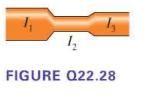
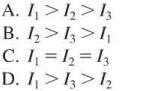
Figure Q22.28 shows a side view of a wire of varying circular cross section. Rank in order the currents flowing in the three sections. ½ FIGURE Q22.28
A 1.0-mm-diameter, 20-cm-long copper wire carries a 3.0 A current. What is the potential difference between the ends of the wire?
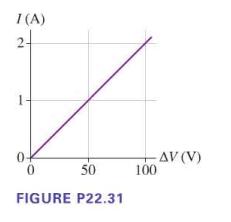
Figure P22.31 is a current-versus-potential-difference graph for a cylinder. What is the cylinder's resistance? 1 (A) 24 0- 0 50 FIGURE P22.31 -AV (V) 100
A person gains weight by adding fat and therefore adding girth to his body and his limbs, with the amount of muscle remaining constant. How will this affect the electrical resistance of his limbs?A. The resistance will increase. B. The resistance will stay the same.C. The resistance will decrease.
A small electric lap blanket contains a 40-foot-long wire wrapped back and forth inside. An 18 V supply creates a current in this wire, warming it and thus the blanket. What is the electric field strength inside this wire?
Two identical lightbulbs are connected in series to a single 9.0 V battery. a. Sketch the circuit. b. Sketch a graph showing the potential as a function of distance through the circuit, starting with V = OV at the negative terminal of the battery.
You've brought your 1000 W (120 V) hair dryer on vacation to Europe, where the standard outlet voltages are 230 V. Assuming the hair dryer can operate safely at the higher voltage, can you actually use it if the outlet can provide at most 15 A, or will it draw more current than this?
A 70 W electric blanket runs at 18 V. a. What is the resistance of the wire in the blanket? b. How much current does the wire carry?
A 60-cm-long heating wire is connected to a 120 V outlet. If the wire dissipates 45 W, what are(a) The current in(b) The resistance of the wire?
A 3.0 V battery powers a flashlight bulb that has a resistance of 6.0 Ω. How much charge moves through the battery in 10 min?
For a science experiment you need to electroplate a 100-nm-thick zinc coating onto both sides of a very thin, 2.0 cm x 2.0 cm copper sheet. You know that the charge carriers in the ionic solution are divalent (charge 2e) zinc ions. The density of zinc is 7140 kg/m3. If the electroplating apparatus
The hot dog cooker described in the chapter heats hot dogs by connecting them to 120 V household electricity. A typical hot dog has a mass of 60 g and a resistance of 150 Ω N. How long will it take for the cooker to raise the temperature of the hot dog from 20°C to 80°C? The specific heat of a
A 40 W (120 V) lightbulb has a tungsten filament of thickness 0.040 mm. The filament's operating temperature is 1500°C.a. How long is the filament? b. What is the resistance of the filament at 20°C?
When the starter motor on a car is engaged, there is a 300 A current in the wires between the battery and the motor. Suppose the wires are made of copper and have a total length of 1.0 m. What minimum diameter can the wires have if the voltage drop along the wires is to be less than 0.50 V?
Showing 2400 - 2500
of 3511
First
18
19
20
21
22
23
24
25
26
27
28
29
30
31
32
Last
Step by Step Answers

 Get 50% OFF
Claim Now
Get 50% OFF
Claim Now