New Semester
Started
Get
50% OFF
Study Help!
--h --m --s
Claim Now
Question Answers
Textbooks
Find textbooks, questions and answers
Oops, something went wrong!
Change your search query and then try again
S
Books
FREE
Study Help
Expert Questions
Accounting
General Management
Mathematics
Finance
Organizational Behaviour
Law
Physics
Operating System
Management Leadership
Sociology
Programming
Marketing
Database
Computer Network
Economics
Textbooks Solutions
Accounting
Managerial Accounting
Management Leadership
Cost Accounting
Statistics
Business Law
Corporate Finance
Finance
Economics
Auditing
Tutors
Online Tutors
Find a Tutor
Hire a Tutor
Become a Tutor
AI Tutor
AI Study Planner
NEW
Sell Books
Search
Search
Sign In
Register
study help
physics
college physics a strategic approach 2nd
College Physics A Strategic Approach 2nd Edition Randall D. Knight, Brian Jones, Stuart Field - Solutions
A child has an ear canal that is 1.3 cm long. At what sound frequencies in the audible range will the child have increased hearing sensitivity?
Two guitar strings made of the same type of wire have the same length. String I has a higher pitch than string 2. Which of the following is true? A. The wave speed of string 1 is greater than that of string 2. B. The tension in string 2 is greater than that in string 1. C. The wavelength of the
The frequency of the lowest standing-wave mode on a 1.0-m-long string is 20 Hz. What is the wave speed on the string? A. 10 m/s B. 20 m/s C. 30 m/s D. 40 m/s
Suppose you pluck a string on a guitar and it produces the note A at a frequency of 440 Hz. Now you press your finger down on the string against one of the frets, making this point the new end of the string. The newly shortened string has 4/5 the length of the full string. When you pluck the
Two identical loudspeakers separated by distance d emit 170 Hz sound waves along the x-axis. As you walk along the axis, away from the speakers, you don't hear anything even though both speakers are on. What are three possible values for d? Assume a sound speed of 340 m/s.
The fundamental frequency of a standing wave on a 1.0-m- long string is 440 Hz. What would be the wave speed of a pulse moving along this string?
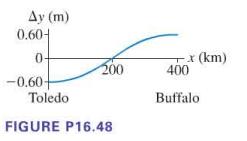
Lake Erie is prone to remarkable seiches standing waves that slosh water back and forth in the lake basin from the west end at Toledo to the east end at Buffalo. Figure P16.48 shows smoothed data for the displacement from normal water levels along the lake at the high point of one particular
A string, stretched between two fixed posts, forms standing wave resonances at 325 Hz and 390 Hz. What is the largest possible value of its fundamental frequency?
Spiders may "tune" strands of their webs to give enhanced response at frequencies corresponding to the frequencies at which desirable prey might struggle. Orb web silk has a typical diameter of 0.0020 mm, and spider silk has a density of 1300 kg/m3. To give a resonance at 100 Hz, to what tension
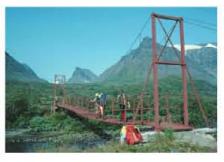
A 2.5-cm-diameter steel cable (with density 7900 kg/m3) that is part of the suspension system for a footbridge stretches 14 m between the tower and the ground. After walking over the bridge, a hiker finds that the cable is vibrating in its fundamental mode with a period of 0.40 s. What is the
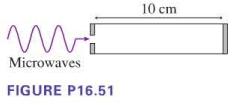
A microwave generator can produce microwaves at any frequency between 10 GHz and 20 GHz. As Figure P16.51 shows, the microwaves are aimed, through a small hole, into a "microwave cavity" that consists of a 10-cm-long cylinder with reflective ends. a. Which frequencies between 10 GHz and 20 GHz
Just as you are about to step into a nice hot bath, a small earthquake rattles your bathroom. Immediately afterward, you notice that the water in the tub is oscillating. The water in the center seems to be motionless while the water at the two ends alternately rises and falls, like a seesaw. You
A carbon-dioxide laser emits infrared light with a wavelength of 10.6 μm. a. What is the length of a tube that will oscillate in the m = 100,000 mode? b. What is the frequency? c. Imagine a pulse of light bouncing back and forth between the ends of the tube. How many round trips will the pulse
A 50-cm-long wire with a mass of 1.0 g and a tension of 440 N passes across the open end of an open-closed tube of air. The wire, which is fixed at both ends, is bowed at the center so as to vibrate at its fundamental frequency and generate a sound wave. Then the tube length is adjusted until the
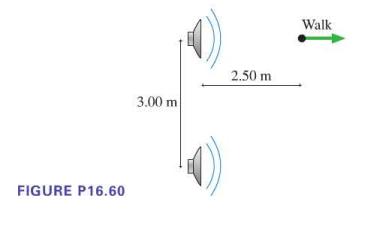
You are standing 2.50 m directly in front of one of the two loudspeakers shown in Figure P16.60. They are 3.00 m apart and both are playing a 686 Hz tone in phase. As you begin to walk directly away from the speaker, at what distances from the speaker do you hear a minimum sound intensity? The room
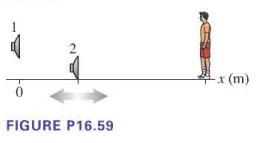
Two loudspeakers located along the x-axis as shown in Figure P16.59 produce sounds of equal frequency. Speaker 1 is at the origin, while the location of speaker 2 can be varied by a remote control wielded by the listener. He notices maxima in the sound intensity when speaker 2 is located at x =
FM station KCOM ("All commercials, all the time") transmits simultaneously, at a frequency of 99.9 MHz, from two broadcast towers placed precisely 31.5 m apart along a north- south line. a. What is the wavelength of KCOM's transmissions?b. Suppose you stand 90.0 m due east of the point halfway
Two loudspeakers, 4.0 m apart and facing each other, play identical sounds of the same frequency. You stand halfway between them, where there is a maximum of sound intensity. Moving from this point toward one of the speakers, you encounter a minimum of sound intensity when you have moved 0.25
Certain birds produce vocalizations consisting of two distinct frequencies that are not harmonically related that is, the two frequencies are not harmonics of a common fundamental frequency. These two frequencies must be produced by two different vibrating structures in the bird's vocal tract. a.
A Doppler blood flow meter emits ultrasound at a frequency of 5.0 MHz. What is the beat frequency between the emitted waves and the waves reflected from blood cells moving away from the emitter at 0.15 m/s?
The frequency of a light wave in air is 5.3 X 10¹⁴ Hz. Is the frequency of this wave higher, lower, or the same after the light enters a piece of glass?
A double-slit interference experiment shows fringes on a screen. The entire experiment is then immersed in water. Do the fringes on the screen get closer together, farther apart, remain the same, or disappear entirely? Explain.
Figure Q17.5 shows the fringes observed in a double-slit interference experiment when the two slits are illuminated by white light. The central maximum is white, but as we move away from the central maximum, the fringes become less distinct and more colorful. What is special about the central
How much time does it take a pulse of light to travel through 150 m of water?
In a double-slit interference experiment, interference fringes are observed on a distant screen. The width of both slits is then doubled without changing the distance between their centers. a. What happens to the spacing of the fringes? Explain. b. What happens to the intensity of the bright
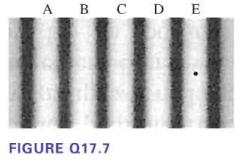
Figure Q17.7 shows the viewing screen in a double-slit experiment with monochromatic light. Fringe C is the central maximum.a. What will happen to the fringe spacing if the wave-length of the light is decreased?b. What will happen to the fringe spacing if the spacing between the slits is
Two narrow slits 50 μm apart are illuminated with light of wavelength 500 nm. What is the angle of the m = 2 bright fringe in radians? In degrees?
Consider a point P on the viewing screen of a double slit interference experiment. This point is 75% of the way from the center of the 3rd bright fringe to the center of the 4th bright fringe. If the wavelength of the light is 600 nm, what is the extra distance that the wave from one slit traveled
A soap bubble usually pops because some part of it becomes too thin due to evaporation or drainage of fluid. The change in thickness also changes the color of light the bubble reflects. Why?
A diffraction grating with 750 slits/mm is illuminated by light that gives a first-order diffraction angle of 34.0. What is the wavelength of the light?
Light passes through a diffraction grating with a slit spacing of 0.001 mm. A viewing screen is 100 cm behind the grating. If the light is blue, with a wavelength of 450 nm, at about what distance from the center of the interference pattern will the first- order maximum appear? A. 5 cm B. 25
Blue light of wavelength 450 nm passes through an interference grating with a slit spacing of 0.001 mm and makes an interference pattern on the wall. How many bright fringes will be seen? A. 1 B. 3 C. 5 D. 7
Yellow light of wavelength 590 nm passes through a diffraction grating and makes an interference pattern on a screen 80 cm away. The first bright fringes are 1.9 cm from the center of the pattern. How many lines per mm does this grating have? A. 20 B. 40 C. 80 D. 200
Light passes through a 10-μm-wide slit and is viewed on a screen 1 m behind the slit. If the width of the slit is narrowed, the band of light on the screen will.A. Become narrower. B. Become wider. C. Stay about the same.
Blue light of wavelength 450 nm passes through a 0.20-mm-wide slit and illuminates a screen 1.2 m away. How wide is the central maximum of the diffraction pattern? A. 1.2 mm B. 2.0 mmC. 2.7 mmD. 5.4 mm
A green laser beam of wavelength 540 nm passes through a pinhole and illuminates a dartboard 3.0 m past the pinhole. The first minimum in the intensity coincides with the ring surrounding the bull's-eye, 12 mm in diameter. What is the diameter of the pinhole?A. 0.14 mm B. 0.33 mm C. 0.59 mm D.
A thin film of MgF2 (n = 1.38) coats a piece of glass. Constructive interference is observed for the reflection of light with wavelengths of 500 nm and 625 nm. What is the thinnest film for which this can occur?
Your friend has been given a laser for her birthday. Unfortunately, she did not receive a manual with it and so she doesn't know the wavelength that it emits. You help her by performing a double-slit experiment, with slits separated by 0.36 mm. You find that the two bright fringes are 5.5 mm apart
A laser beam, with a wavelength of 532 nm, is directed exactly perpendicular to a screen having two narrow slits spaced 0.15 mm apart. Interference fringes, including a central maximum, are observed on a screen 1.0 m away. The direction of the beam is then slowly rotated around an axis parallel to
A soap bubble is essentially a thin film of water surrounded by air. The colors you see in soap bubbles are produced by interference. What visible wavelengths of light are strongly reflected from a 390-nm-thick soap bubble? What color would such a soap bubble appear to be?
The idea of light rays goes back to the ancient Greeks. How- ever, they believed that "visual rays" were emitted by eyes. If you were transported back in time, what arguments would you present to those early scientists to convince them that vision has something to do with rays going into, rather
A 5.0-ft-tall girl stands on level ground. The sun is 25° above the horizon. How long is her shadow?
Is there any property that distinguishes a light ray emitted by a light bulb and one that has been diffusely reflected by the page of a book? Explain.
A 10-cm-diameter disk emits light uniformly from its surface. 20 cm from this disk, along its axis, is an 8.0-cm-diameter opaque black disk; the faces of the two disks are parallel. 20 cm beyond the black disk is a white viewing screen. The lighted disk illuminates the screen, but there's a shadow
Can you see the rays from the sun on a clear day? Why or why not? How about when they stream through a forest on a foggy morning? Why or why not?
If you take a walk on a summer night along a dark, unpaved road in the woods, with a flashlight pointing at the ground several yards ahead to guide your steps, any water-filled potholes are noticeable because they appear much darker than the sur- rounding dry road. Explain why.
In Manet's A Bar at the Folies Bergre (see Figure Q18.8) the reflection of the barmaid is visible in the mirror behind her. Is this the reflection you would expect if the mirror's surface is parallel to the bar? Where is the man seen facing her in the mirror actually standing?Figure Q18.8
Explain why ambulances have the word "AMBULANCE" written backward on the front of them.
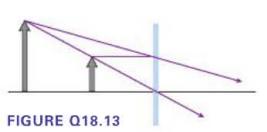
A student ray diagram Figure Q18.13 but forgets to label the object, the image, or the type of lens used. Using the diagram, draws draws the shown in explain whether the lens is converging or diverging, which arrow represents the object, and which represents the image. FIGURE Q18.13
A laser beam in air is incident on a liquid at an angle of 37° with respect to the normal. The laser beam's angle in the liquid is 26°. What is the liquid's index of refraction?
A diamond is underwater. A light ray enters one face of the diamond, then travels at an angle of 30° with respect to the nor-mal. What was the ray's angle of incidence on the diamond?
You are 2.4 m from a plane mirror, and you would like to take a picture of yourself in the mirror. You need to manually adjust the focus of the camera by dialing in the distance to what you are photographing. What distance do you dial in?A. 1.2 m B. 2.4 m C. 3.6 m D. 4.S m
A real image of an object can be formed by A. A converging lens. B. A plane mirror. C. A convex mirror. D. Any of the above.
An object is 40 cm from a converging lens with a focal length of 30 cm. A real image is formed on the other side of the lens, 120 cm from the lens. What is the magnification?A. 2D B. 3.0 C. 4D D. 1.33 E. 0.33
A dentist uses a curved mirror to view the back side of teeth on the upper jaw. Suppose she wants an erect image with a magnification of 2.0 when the mirror is 1.2 cm from a tooth. (Treat this problem as though the object and image lie along a straight line.) Use ray tracing to decide whether a
An object is 50 cm from a diverging lens with a focal length of -20 cm. How far from the lens is the image, and on which side of the lens is it? A. 14 cm, on the same side as the object B. 14 cm, on the opposite side from the object C. 30 cm, on the same side as the object D. 33 cm, on the same
An object is 6 cm in front of a convex mirror with a focal length of 10 cm. Use ray tracing to determine the location of the image. Is the image upright or inverted? Is it real or virtual?
Starting 3.5 m from a department store mirror, Suzanne walks toward the mirror at 1.5 m/s for 2.0 s. How far is Suzanne from her image in the mirror after 2.0 s?
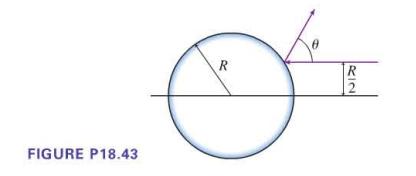
Figure P18.43 shows a light ray incident on a polished metal cylinder. At what angle θ will the ray be reflected? FIGURE P18.43 R J R2
You slowly back away from a plane mirror at a speed of 0.10 m/s. With what speed does your image appear to be moving away from you?
You shine your laser pointer through the flat glass side of a rectangular aquarium at an angle of incidence of 45°. The index of refraction of this type of glass is 1.55. a. At what angle from the normal does the beam from the laser pointer enter the water inside the aquarium? b. Does your
A ray of light traveling through air encounters a 1.2-cm-thick sheet of glass at a 35° angle of incidence. How far does the light ray travel in the glass before emerging on the far side?
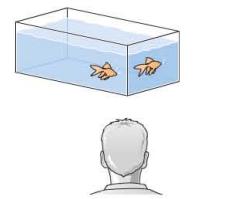
If you look at a fish through the corner of a rectangular aquarium you sometimes see two fish, one on each side of the corner, as shown in Figure P18.49. Sketch some of the light rays that reach your eye from the fish to show how this can happen.Figure P18.49
What is the angle of incidence in air of a light ray whose angle of refraction in glass is half the angle of incidence?
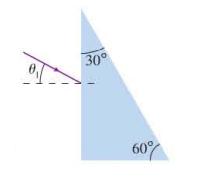
What is the smallest angle θ1, for which a laser beam will undergo total internal reflection on the hypotenuse of the glass prism in Figure P18.54?Figure P18.54 30° 60% 09
A swimmer looks upward from the bottom of a 3.0-m-deep swimming pool. The end of the diving board is directly above him, 2.0 m above the water's surface. How far from the swimmer does the board appear to be?
A microscope is focused on an amoeba. When a 0.15-mm- thick cover glass (n = 1.50) is placed over the amoeba, by how far must the microscope objective be moved to bring the organ- ism back into focus? Must it be raised or lowered?
A ray diagram can be used to find the location of an object if you are given the location of its image and the focal length of the mirror. Draw a ray diagram to find the height and position of an object that makes a 2.0-cm-high upright virtual image that appears 8.0 cm behind a convex mirror of
The image produced by a converging lens is typically a different size from the object itself. However, for a lens with focal length of there is one object distance that will yield an image the same size as the object. What is that object distance?
A 2.0-cm-tall object is located 8.0 cm in front of a converging lens with a focal length of 10 cm. Use ray tracing to deter- mine the location and height of the image. Is the image upright or inverted? Is it real or virtual?
A near-sighted person might correct his vision by wearing diverging lenses with focal length f = -50 cm. When wearing his glasses, he looks not at actual objects but at the virtual images of those objects formed by his glasses. Suppose he looks at a 12-cm-long pencil held vertically 2.0 m from his
A 1.0-cm-tall object is 20 cm in front of a converging lens that has a 10 cm focal length. Use ray tracing to find the position and height of the image. To do this accurately, use a ruler or paper with a grid. Determine the image distance and image height by making measurements on your diagram.
A 2.0-cm-tall object is 20 cm in front of a converging lens that has a 60 cm focal length. Use ray tracing to find the position and height of the image. To do this accurately, use a ruler or paper with a grid. Determine the image distance and image height by making measurements on your diagram.
A 1.0-cm-tall object is 7.5 cm in front of a diverging lens that has a 10 cm focal length. Use ray tracing to find the position and height of the image. To do this accurately, use a ruler or paper with a grid. Determine the image distance and image height by making measurements on your diagram.
A 1.6-m-tall woman stands 2.0 m in front of a convex fun house mirror with a focal length of 2/3 m. Use ray tracing to determine the location and height of her image.
A 2.0-cm-diameter spider is 2.0 m from a wall. Determine the focal length and position (measured from the wall) of a lens that will make a half-size image of the spider on the wall.
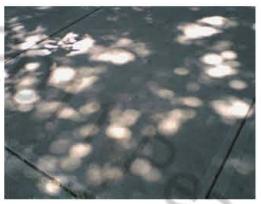
On a sunny summer day, with the sun overhead, you can stand under a tree and look on the ground at the pattern of light that has passed through gaps between the leaves. You may see illuminated circles of varying brightness. Why are there circles. when the gaps between the leaves have irregular
The human eye has a lot in common with a pinhole camera, being essentially a small box with a hole in the front (the pupil) and "film" at the back (the retina). The distance from the pupil to the retina is approximately 24 mm. a. Suppose you look at a 180-cm-tall friend who is standing 7.4 m in
A student has built a 20-cm-long pinhole camera for a science fair project. She wants to photograph the Washington Monument, which is 167 m (550 ft) tall, and to have the image on the film be 5.0 cm high. How far should she stand from the Washington Monument?
A pinhole camera is made from an 80-cm-long box with a small hole in one end. If the hole is 5.0 m from a 1.8-m-tall per- son, how tall will the image of the person on the film be?
Many cameras have a zoom lens. This is a lens whose focal length and distance from the film can be varied. If the camera's exposure is correct when the lens has a focal length of 8.0 mm, will it be overexposed, underexposed, or still correct when the focal length is increased to 16.0 mm (assume the
A photographer uses his camera, whose lens has a 50 mm focal length, to focus on an object 2.0 m away. He then wants to take a picture of an object that is 40 cm away. How far, and in which direction, must the lens move to focus on this second object?
A nature photographer taking a close-up shot of an insect replaces the standard lens on his camera with a lens that has a shorter focal length and is positioned farther from the film. Explain why he does this.
A camera takes a perfectly exposed picture when the lens diaphragm is set to f/4 and the shutter speed is 1/250 s. If the diaphragm is changed to f/11, what should the new shutter speed be so that the exposure is still correct? (Standard camera shutter speeds include 1/250 s, 1/125 s, 1/60 s, 1/30
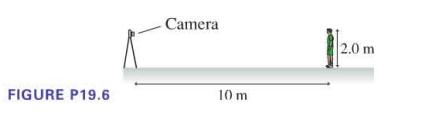
In Figure P19.6 the camera lens has a 50 mm focal length. How high is the man's well-focused image on the film? FIGURE P19.6 Camera 10 m 2.0 m
The CCD detector in a certain camera has a width of 8 mm. The photographer realizes that with the lens she is currently using, she can't fit the entire landscape she is trying to photograph into her picture. Should she switch to a lens with a longer or shorter focal length? Explain.
All humans have what is known as a blind spot, where the optic nerve exits the eye and no light-sensitive cells exist. To locate your blind spot, look at the figure of the cross. Close your left eye and place your index finger on the cross. Slowly move your finger to the left while following it wi
A telephoto lens with focal length of 135 mm has f-numbers ranging from f/2.8 to f/22. What is the diameter of the lens aperture at these two f-numbers?
You have lenses with the following focal lengths: f = 25 mm, 50 mm, 100 mm, and 200 mm. Which lens or pair of lenses would you use, and in what arrangement, to get the highest- power magnifier, microscope, and telescope? Explain.
A farsighted person has a near point of 50 cm rather than the normal 25 cm. What strength lens, in diopters, should be pre- scribed to correct this vision problem?
An 8-year-old child and a 75-year-old man both use the same magnifier to observe a bug. For whom does the magnifier more likely have the higher magnification? Explain.
A nearsighted woman has a far point of 300 cm. What kind of lens, converging or diverging, should be prescribed for her to see distant objects more clearly? What power should the lens have?
The relaxed human eye is about 2 cm from front to back. If the iris of the human eye can be opened to 7 mm at its widest, what is the f-number of the human eye?
The near point for your myopic uncle is 10 cm. Your own vision is normal; that is, your near point is 25 cm. Suppose you and your uncle hold dimes (which are 1.7 cm in diameter) at your respective near points. a. What is the dime's angular size, in radians, according to you? b. What is the dime's
A pair of binoculars has a magnification of 7X. What would be their magnification if you were to look through them the wrong way, that is, through one of their objective lenses instead of the eyepieces?
For a patient, a doctor prescribes glasses with a converging lens having a power of 4.0 D. a. Is the patient nearsighted or farsighted? b. If the patient is nearsighted, what is the location of her eye's far point? If she is farsighted, what is the location of her near point?
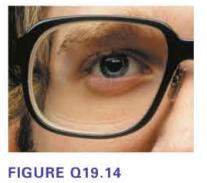
Is the wearer of the glasses in Figure Q19.14 nearsighted or far- sighted? How can you tell? FIGURE Q19.14
Rank the following people from the most nearsighted to the most farsighted, indicating any ties: A. Bernie has a prescription of +2.0 D. B. Carol needs diverging lenses with a focal length of -0.35 m. C. Maria Elena wears converging lenses with a focal length of 0.50 m. D. Janet has a
A magnifier has a magnification of 5x. How far from the lens should an object be placed so that its (virtual) image is at the near-point distance of 25 cm?
A farsighted man has a near point of 40 cm. What power lens should he use as a magnifier to see clearly at a distance of 10 cm without wearing his glasses?
Showing 2700 - 2800
of 3511
First
21
22
23
24
25
26
27
28
29
30
31
32
33
34
35
Last
Step by Step Answers

 Get 50% OFF
Claim Now
Get 50% OFF
Claim Now