New Semester
Started
Get
50% OFF
Study Help!
--h --m --s
Claim Now
Question Answers
Textbooks
Find textbooks, questions and answers
Oops, something went wrong!
Change your search query and then try again
S
Books
FREE
Study Help
Expert Questions
Accounting
General Management
Mathematics
Finance
Organizational Behaviour
Law
Physics
Operating System
Management Leadership
Sociology
Programming
Marketing
Database
Computer Network
Economics
Textbooks Solutions
Accounting
Managerial Accounting
Management Leadership
Cost Accounting
Statistics
Business Law
Corporate Finance
Finance
Economics
Auditing
Tutors
Online Tutors
Find a Tutor
Hire a Tutor
Become a Tutor
AI Tutor
AI Study Planner
NEW
Sell Books
Search
Search
Sign In
Register
study help
physics
inquiry into physics
Inquiry into Physics 8th edition Vern J. Ostdiek, Donald J. Bord - Solutions
How fast would a muon have to be traveling relative to an observer for its lifetime as measured by this observer to be 10 times longer than its lifetime when at rest relative to the observer?
The concept of a black hole, that is, an object whose gravity is so strong that not even light, traveling at a speed of 3 x 10⁸ m/s, can escape from it, dates back to at least the 18th century and the work of Pierre-Simon Laplace, who referred to them as “dark stars.” From Newtonian mechanics,
Suppose you perform a scattering experiment in which you fire BBs into a slab of jello in which a layer of randomly distributed but identical marbles are suspended. Of the BBs entering the jello, 90 percent pass cleanly through without scattering off any marbles. If the total target area presented
One interesting (unbelievable?) implication of time dilation is contained in what is called the twin paradox. Imagine identical twins who decide to perform an experiment to test the accuracy of Einstein’s predictions about time dilation. After synchronizing their (identical) clocks, one of the
In the electroweak theory, symmetry breaking occurs on a length scale of about 10-17 m. Compute the frequency of particles with de Broglie wavelengths (see Section 10.5) equal to this value, and, using this result, determine their energies by the Planck formula E = hf. Show that the mass of
Although doubly charged baryons have been found (baryons with net charge 12), no doubly charged mesons have yet been identified. What effect on the quark model would there be if a meson of charge 12 were discovered? How could such a meson be interpreted within the quark model?
If the average lifetime of the proton were 1016 years, estimate the number of protons per kilogram of human body mass that would decay radioactively each year. Assume that a human being is made entirely of water molecules and that each molecule contributes 10 protons.If each proton decay released 1
When a proton–antiproton pair at rest annihilates, two photons are created. Find the wavelengths of these two light quanta, given that they share equally in the annihilation energy. In what portion of the electromagnetic spectrum do such wavelengths appear?
Compare the strength of the electric force to that of the gravitational force as suggested in Section 12.3. In particular, find the ratio of the Coulomb force of repulsion between two protons separated by 10-15 m to their gravitational force of attraction for the same distance. The mass and charge
Show that in the limit of low speeds the expression for the relativistic kinetic energy (see Important Equations) reduces to the familiar one from classical mechanics, KE = (1/2)mv2.
A 3,000-kg truck runs into the rear of a 1,000-kg car that was stationary. The truck and car are locked together after the collision and move with speed 9 m/s. What was the speed of the truck before the collision?
If we know that a force of 5 N acts on an object while it moves 2 meters, can we calculate how much work was done with no other information? Explain.
The work-energy theorem: Show explicitly that the work, Fd, done by a constant force to accelerate an object of mass m from rest to a final velocity v is equal to the kinetic energy, (1/2)mv2, of the object.
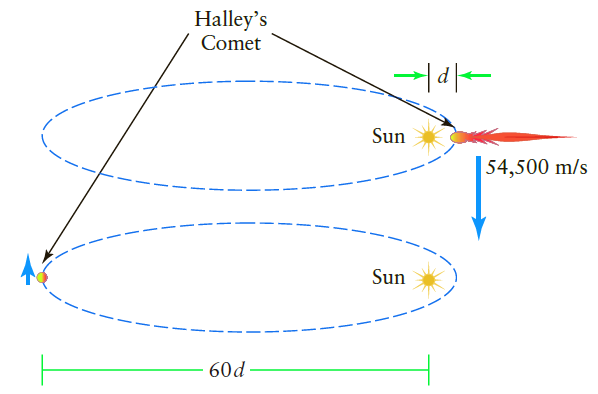
At the point in its orbit when it is closest to the Sun, Halley€™s Comet moves with a speed of 54,500 m/s (Figure 3.48). When it is at its most distant point, the separation between it and the Sun is about 60 times larger than when it is at its closest point. What is the speed of the
Describe several things you have done today that involved doing work. Are you doing work right now?
The “shot” used in the shot-put event is a metal ball with a mass of 7.3 kg. When thrown in Olympic competition, it is accelerated to a speed of about 14 m/s. As an approximation, let’s say that the athlete exerts a constant force on the shot while throwing it and that it moves a distance of
A basketball with a mass of 0.62 kg falls vertically to the floor where it hits with a speed of −6 m/s. (We take the positive direction to be upward here.) The ball rebounds, leaving the floor with a speed of 4.5 m/s.(a) What impulse acts on the ball during its collision with the floor?(b) If the
For what type of interaction between bodies is the law of conservation of linear momentum most useful?
Assume that as a car brakes to a stop it undergoes a constant acceleration (deceleration). Explain why the stopping distance becomes four times as large if the initial speed is doubled.
An astronaut working with many tools some distance away from a spacecraft is stranded when the “maneuvering unit” malfunctions. How can the astronaut return to the spacecraft by sacrificing some of the tools?
A runner with a mass of 80 kg accelerates from 0 to 9 m/s in 3 s. Find the net force on the runner using the alternate form of Newton’s second law.
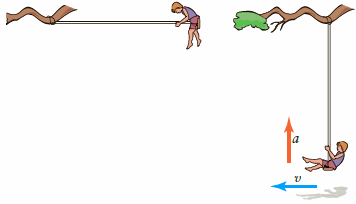
A person on a swing moves so that the support rods are horizontal at the turning points (Figure 3.47). Show that the centripetal acceleration of the person at the low point of the arc is exactly 2 g, regardless of the length of the rods. This means that the force on the rods at the low point is
Could the linear momentum of a turtle be greater than the linear momentum of a horse? Explain why or why not.
In a head-on, inelastic collision, a 4,000-kg truck going 10 m/s east strikes a 1,000-kg car going 20 m/s west. (a) What is the speed and direction of the wreckage? (b) How much kinetic energy was lost in the collision?
Why is the alternate form of Newton’s second law of motion given in this chapter the more general form?
Which has the larger linear momentum: a 2,000-kg houseboat going 5 m/s or a 600-kg speedboat going 20 m/s?
A bullet with a mass of 0.01 kg is fired horizontally into a block of wood hanging on a string. The bullet sticks in the wood and causes it to swing upward to a height of 0.1 m. If the mass of the wood block is 2 kg, what was the initial speed of the bullet?
What is a conservation law? What is the basic approach taken when using a conservation law?
Re-examine Section 3.3 on work. Make a list of at least 10 key concepts and applications relating to work; write each of the concepts or examples on small Post-it® notes. Rank the items on your list from most inclusive to least inclusive, and organize your notes on a large piece of paperor poster
Rank the following three collisions in terms of the extent of damage that the car would experience. Explain your reasons for ranking the collisions as you did.(a) A car going 10 m/s striking an identical car that was stationary on level ground.(b) A car going 10 m/s running into an immovable
A mass of 0.75 kg is attached to a relaxed spring with k 5 2.5 N/m. The mass rests on a horizontal, frictionless surface. If the mass is displaced by 0.33 m, what is the magnitude of the force exerted on the mass by the spring? If the mass is then released to execute simple harmonic motion along
A space probe is launched from Earth headed for deep space. At a distance of 10,000 miles from Earth’s center, the gravitational force on it is 600 lb. What is the size of the force when it is at each of the following distances from Earth’s center?(a) 20,000 miles(b) 30,000 miles(c) 100,000
A centripetal force of 200 N acts on a 1,000-kg satellite moving with a speed of 5,000 m/s in a circular orbit around a planet. What is the radius of its orbit?
A 0.1-kg ball is attached to a string and whirled around in a circle overhead. The string breaks if the force on it exceeds 60 N. What is the maximum speed the ball can have when the radius of the circle is 1 m?
A race car rounds a curve at 60 m/s. The radius of the curve is 400 m, and the car’s mass is 600 kg.(a) What is the car’s (centripetal) acceleration? What is it in g’s?(b) What is the centripetal force acting on the car?
An airplane is built to withstand a maximum acceleration of 6 g. If its mass is 1,200 kg, what size force would cause this acceleration?
On aircraft carriers, catapults are used to accelerate jet aircraft to flight speeds in a short distance. One such catapult takes a 18,000-kg jet from 0 to 70 m/s in 2.5 s.(a) What is the acceleration of the jet (in m/s2 and g’s)?(b) How far does the jet travel while it is accelerating?(c) How
A sprinter with a mass of 80 kg accelerates uniformly from 0 m/s to 9 m/s in 3 s.(a) What is the runner’s acceleration?(b) What is the net force on the runner?(c) How far does the sprinter travel during the 3 s?
A jet aircraft with a mass of 4,500 kg has an engine that exerts a force (thrust) equal to 60,000 N.(a) What is the jet’s acceleration when it takes off?(b) What is the jet’s speed after it accelerates for 8 s?(c) How far does the jet travel during the 8 s?
During our discussion of the motion of a falling body near Earth’s surface, we said that the gravitational force acting on it—its weight—is constant. But the law of universal gravitation tells us that the gravitational force on a body increases as it gets closer to Earth. Is there a
The Kingda Ka roller coaster in New Jersey is the world’s tallest ride of its kind. As the passenger cars are launched from rest at the start, they are accelerated uniformly to a speed of 57 m/s (128 mph) in just 3.5 s.(a) What is the acceleration experienced by passengers on this ride in m/s2?
Complete the calculation of the mass of Earth as outlined in Section 2.7.
A 200-kg communications satellite is placed into a circular orbit around Earth with a radius of 4.23 x 10⁷m (26,300miles).(a) Find the gravitational force on the satellite. (There is some useful information in Section 2.7.)(b) Use the equation for centripetal force to compute the speed of the
In an experiment performed in a space station, a force of 60 N causes an object to have an acceleration equal to 4 m/s2. What is the object’s mass?
The acceleration of a freely falling body is not exactly the same everywhere on Earth. For example, in the Galapagos Islands at the equator, the acceleration of a freely falling body is 9.780 m/s2, whereas at the latitude of Oslo, Norway, it is 9.831 m/s2. Why aren’t these accelerations the same?
Perhaps you’ve noticed that the rockets used to put satellites and spacecraft into orbit are usually launched from pads near the equator. Why is this so? Is the fact that rockets are usually launched to the east also important? Why?
A motorcycle and rider have a total mass equal to 300 kg. The rider applies the brakes, causing the motorcycle to accelerate at a rate of 25 m/s2. What is the net force on the motorcycle?
Perform the calculation of the force acting between two 70-kg people standing 1 m apart to verify the result given in Section 2.7 (3.3 × 1027 N). Show your work.
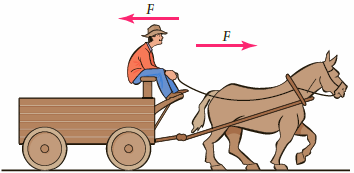
As a horse and wagon are accelerating from rest, the horse exerts a force of 400 N on the wagon(Figure 2.56). Illustrating Newton€™s third law, the wagon exerts an equal and opposite force of 400 N. Because the two forces are in opposite directions, why don€™t they cancel each
The mass of a certain elephant is 1,130 kg.(a) Find the elephant’s weight in newtons.(b) Find its weight in pounds.
Why does banking a curve on a highway allow a vehicle to successfully negotiate the turn at a higher speed?
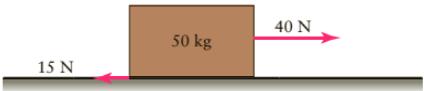
Two forces, one equal to 15 N and another equal to 40 N, act on a 50-kg crate resting on a horizontal surface as shown in Figure 2.55.(a) What is the net horizontal force on the crate?(b) What is its horizontal acceleration?(c) If the crate starts from rest, what is its horizontal speed after
A child weighs 300 N. What is the child’s mass in kilograms? In slugs?
In this chapter, you’ve encountered a large number of concepts related to forces and motion. Organizing a concept map might help clarify the meanings of many of these concepts for you. As a start, you examine Concept Map2.2 pertaining to the concept of “net force” created by a student who had
The force on a baseball as it is being hit with a bat can be more than 8,000 lb. No human can push on a bat with that much force. What is happening in this instance?
Express your weight in newtons. From this determine your mass in kilograms.
Reread Section 2.7 on the law of universal gravitation and make a list of concepts and examples that might serve as a basis for developing a concept map summarizing the material in this section. After creating your list, reorder the items, ranking them from most general to least general (that is,
During takeoff, an airplane goes from 0 to 50 m/s in 8 s.(a) What is its acceleration?(b) How fast is it going after 5 s?(c) How far has it traveled by the time it reaches 50 m/s?
A rock is dropped off the side of a bridge and hits the water below 2 s later.(a) What was the rock’s velocity when it hit the water?(b) What was the rock’s average velocity as it fell?(c) What is the height of the bridge above the water?
The following data describe different situations where a person is walking or running through a train car while the train is in motion. The speed and direction of motion of the person (P) and the train (T) are given in each case, with east being reckoned as positive, west as negative. An observer
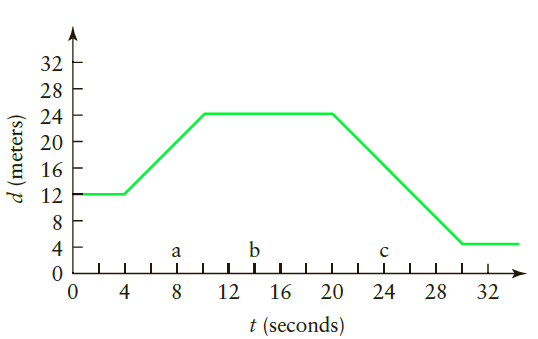
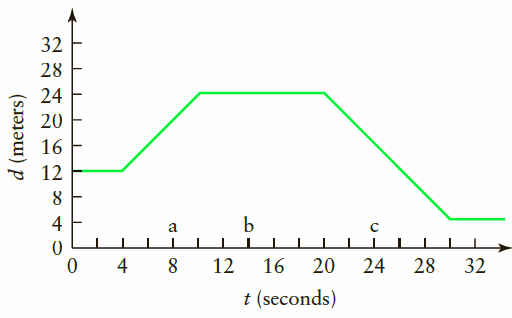
Draw an accurate graph of the velocity versus time for the elevator inProblem 16. 32 28 24 20 16 12 4 32 12 16 20 24 28 t (seconds) d (meters)
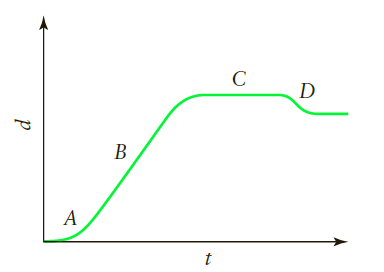
Sketch a graph of velocity versus time for the motion illustrated in Figure 1.24. Indicate what the car€™s acceleration is at different times.Figure 1.24 D B
What does the slope of a distance-versus-time graph represent physically?
Initially stationary, a train has a constant acceleration of 0.5 m/s2.(a) What is its speed after 15 s?(b) What is the total time required for the train to reach a speed of 25 m/s?
If a ball is thrown straight up into the air, what is its acceleration as it moves upward? What is its acceleration when it reaches its highest point and is stopped at an instant?
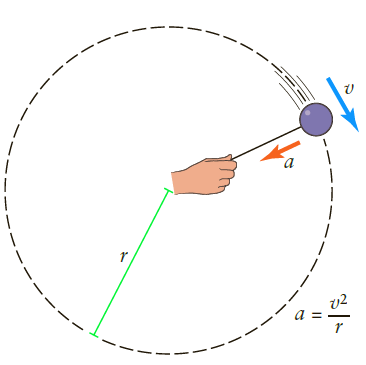
In Figure 1.19, arrows show the directions of the velocity and the acceleration of a ball moving in a circle. Make a similar sketch showing these directions for a car Figure 1.19(a) speeding up from a stop sign.(b) slowing down as it approaches a stop sign.
The following are speeds and headings displayed on a GPS receiver. (Heading gives the direction of motion based on north 5 0°, east 5 90°, south 5 180°, etc.) In each case, indicate whether the receiver was accelerating during the time between the displays and, if it was, describe in what way
A child sits on the edge of a spinning merry-go-round that has a radius of 1.5 m. The child’s speed is 2 m/s. What is the child’s acceleration?
As a car goes around a curve, the driver increases its speed. This means the car has two accelerations. What are the directions of these two accelerations?
During 200-meter and 400-meter races, runners must stay in lanes as they go around a curved part of the track. If runners in two different lanes have exactly the same speed, will they also have exactly the same centripetal acceleration as they go around a curve? Explain.
As a baseball is being thrown, it goes from 0 to 40 m/s in 0.15 s.(a) What is the acceleration of the baseball?(b) What is the acceleration in g’s?
What is centripetal acceleration? What is the direction of the centripetal acceleration of a car going around a curve?
Using concepts and physical quantities discussed in this chapter, explain why it is usually safe for a person standing on the seat of a chair to jump horizontally and land on the floor, but not for a person standing on the roof of a tall building to jump horizontally and land on the ground.
The graph inFigure 1.38 shows the distance versus time for an elevator as it moves up and down in a building.Compute the elevator€™s velocity at the times marked a, b, and c. 32 28 24 20 16 12 Ь a 28 32 4 12 16 20 24 t (seconds) d (meters)
How does the velocity of a freely falling body change with time? How does the distance it has fallen change? How about the acceleration?
As a stop light changes from red to green, a car starts to cross through the intersection. An instant before it begins to move, its velocity is zero. Must its acceleration at that time also be zero. Why or why not? Explain.
A long-distance runner has an average speed of 4 m/s during a race. How far does the runner travel in 20 min?
What is the relationship between velocity and acceleration?
A basketball player shoots a free throw. Make a sketch showing the basketball’s velocity just after the ball leaves the player’s hands. Draw in two components of this velocity, one horizontal and one vertical. Repeat the sketch for the instant just before the ball reaches the basket. What is
On a day when the wind is blowing toward the south at 3 m/s, a runner jogs west at 4 m/s. What is the velocity (speed and direction) of the air relative to the runner?
A swimmer heads for the opposite bank of a river. Make a sketch showing the swimmer’s two velocities and the resultant velocity.
Can the resultant of two velocities have zero magnitude? If so, give an example.
The Moon is about 3.8 × 10⁸ m from Earth. Traveling at the speed of light, 3.0 × 10⁸ m/s, how long does it take a laser beam to go from Earth to the Moon and back again? The same physics was responsible for the noticeable delay in communications signals between lunar astronauts and controllers at
What is “vector addition” and how is it done?
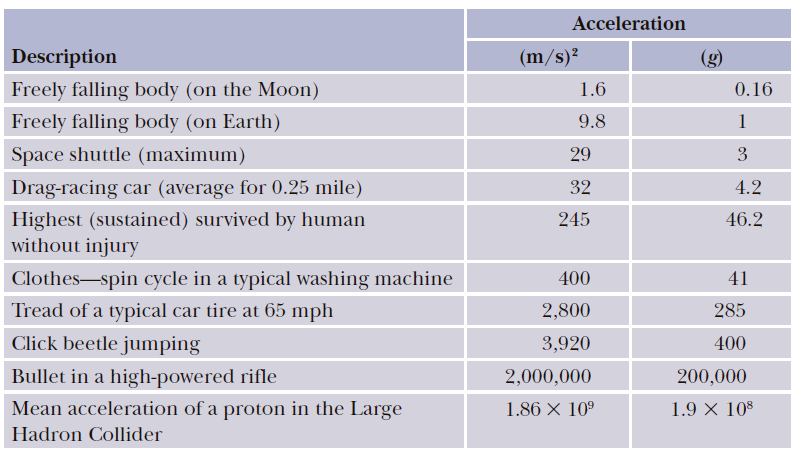
Air Force Col. John P. Stapp was a pioneer in the study of the effects of large, rapid accelerations and decelerations on humans, as well as one of the early designers and advocates for pilot/passenger safety harnesses in planes and automobiles in the late 1940s and early 1950s. In many of the
A ball thrown at a brick wall bounces directly back with the same speed it had when it struck the wall. Has the velocity of the ball changed? Explain.
A race car starts from rest on a circular track with radius 100m and begins to increase its speed by 5 m/s each second. At what point in time is the car’s vector acceleration directed 45° away from straight ahead? What is the magnitude of the resultant acceleration at that moment?
At the 2006 Winter Olympics in Torino, Italy, U.S. speed skater Apolo Ohno took the gold medal for the 500-m sprint by completing the course in 41.935 s. What was his average speed for this event?
What is the distinction between speed and velocity? Describe a situation in which an object’s speed is constant but its velocity is not.
For an object starting at rest with a constant acceleration, derive the equation that relates its speed to the distance it has traveled. In other words, eliminate time in the two equations relating d to t and v to t. Test the equation by showing that an object reaches a final speed of 9.8 m/s if it
List the physical quantities identified in this chapter. From which of the fundamental physical quantities is each derived? Which of them are vectors, and which are scalars?
The quartz crystal used in an electric watch vibrates with a frequency of 32,768 Hz. What is the period of the crystal’s motion?
When an object is thrown straight upward, gravity causes it to decelerate at a rate of 1 g —its speed decreases 9.8 m/s or 22 mph each second. (a) Explain how we can use the equations, tables, and graphs for a freely falling body to analyze this motion.(b) A baseball is thrown vertically
A wind is blowing from the north (the air is moving toward the south). When a person is walking toward the north, is the relative speed of the wind that the person senses greater than, the same as, or less than the speed the person senses when not walking? How about when the person is walking
A spacecraft lands on a newly discovered planet orbiting the star 51 Pegasi. To measure the acceleration from gravity on the planet, an astronaut drops a rock from a height of 2 m. A precision timer indicates that it takes the rock 0.71 s to fall to the surface. What is the acceleration from
What are the “basic” or “fundamental” physical quantities? Why are they called that?
A sports car is advertised to have a maximum cornering acceleration of 0.85 g.(a) What is the maximum speed that the car can go around a curve with a 100-m radius?(b) What is its maximum speed for a 50-m radius curve?(c) If wet pavement reduces its maximum cornering acceleration to 0.6 g, what do
One mile is equal to 1,609 m. Express this distance in kilometers and in centimeters.
A pendulum clock is taken to a repair shop. Its pendulum is replaced by a shorter one that oscillates with a smaller period than the original. What effect, if any, does this have on how the clock runs?
A car is stopped at a red light. When the light turns green, the car begins to accelerate with a constant acceleration of 4.0 m/s2. Just as the car starts moving, it is passed by a small truck traveling uniformly with a speed of 12 m/s.(a) If each vehicle continues to move as described, find the
Showing 800 - 900
of 906
1
2
3
4
5
6
7
8
9
10
Step by Step Answers

 Get 50% OFF
Claim Now
Get 50% OFF
Claim Now