New Semester
Started
Get
50% OFF
Study Help!
--h --m --s
Claim Now
Question Answers
Textbooks
Find textbooks, questions and answers
Oops, something went wrong!
Change your search query and then try again
S
Books
FREE
Study Help
Expert Questions
Accounting
General Management
Mathematics
Finance
Organizational Behaviour
Law
Physics
Operating System
Management Leadership
Sociology
Programming
Marketing
Database
Computer Network
Economics
Textbooks Solutions
Accounting
Managerial Accounting
Management Leadership
Cost Accounting
Statistics
Business Law
Corporate Finance
Finance
Economics
Auditing
Tutors
Online Tutors
Find a Tutor
Hire a Tutor
Become a Tutor
AI Tutor
AI Study Planner
NEW
Sell Books
Search
Search
Sign In
Register
study help
physics
physics scientists and engineers
Physics for Scientists and Engineers A Strategic Approach with Modern Physics 4th edition Randall D. Knight - Solutions
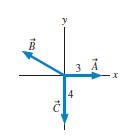
For the three vectors shown in FIGURE EX3.20, A̅ + B̅ + C̅ = 1ĵ.What is vector B̅?a. Write B̅ in component form.b. Write B̅ as a magnitude and a direction.FIGURE EX3.20:
LetA̅ = 4î - 2ĵ, B̅ = -3î + 5ĵ, and F̅ = A̅ - 4B̅.a. Write vector F̅ in component form.b. Draw a coordinate system and on it show vectors A̅, B̅, and F̅.c. What are the magnitude and direction of vector F̅?
Let A̅ = 4î - 2ĵ, B̅ = -3î + 5ĵ, and E̅ = 2 A̅ + 3B̅.a. Write vector E̅ in component form.b. Draw a coordinate system and on it show vectors A̅ , B̅, and Eu.c. What are the magnitude and direction of vector E̅?
Let A̅ = 4î - 2ĵ, B̅ = -3î + 5̂ĵ, and C̅ = A̅ + B̅.a. Write vector C̅ in component form.b. Draw a coordinate system and on it show vectors A̅ , B̅, and C̅.c. What are the magnitude and direction of vector C̅?
Let A̅ = 2î + 3ĵ, B̅ = 2î - 4ĵ, and C̅ = A̅ + B̅.a. Write vector C̅ in component form.b. Draw a coordinate system and on it show vectors A̅, B̅ and C̅.c. What are the magnitude and direction of vector C̅?
Draw each of the following vectors, label an angle that specifies the vector’s direction, and then find the vector’s magnitude and direction.a. A̅ = 3.0î + 7.0ĵb. a̅ = (-2.0î + 4.5ĵ) m/s2c. v̅ = (14î - 11ĵ) m/sd. r̅ = (-2.2î - 3.3ĵ) m
Draw each of the following vectors. Then find its x- and y-components.a. v̅ = (7.5 m/s, 30° clockwise from the positive y-axis)b. a̅ = (1.5 m/s2, 30° above the negative x-axis)c. F̅ = (50.0 N, 36.9° counterclockwise from the positive y-axis)
Draw each of the following vectors. Then find its x- and y-components.a. a̅ = (3.5 m/s2, negative x-direction)b. v̅ = (440 m/s, 30° below the positive x-axis)c. r̅ = (12 m, 40° above the positive x-axis)
a. What are the x- and y-components of vector E̅ shown in FIGURE EX3.3 in terms of the angle θ and the magnitude E̅?b. For the same vector, what are the x- and y-components in terms of the angle Φ and the magnitude E?FIGURE EX3.3:
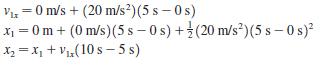
You are given the kinematic equation or equations that are used to solve a problem. For each of these, you are to: a. Write a realistic problem for which this is the
You are given the kinematic equation or equations that are used to solve a problem. For each of these, you are to: a. Write a realistic problem for which this is the correct
You are given the kinematic equation or equations that are used to solve a problem. For each of these, you are to: a. Write a realistic problem for
You are given the kinematic equation or equations that are used to solve a problem. For each of these, you are to: a. Write a realistic problem for which this is
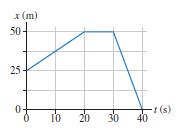
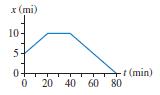
FIGURE EX2.4 is the position-versus-time graph of a jogger. What is the jogger’s velocity at t = 10 s, at t = 25 s, and at t = 35 s?FIGURE EX2.4:
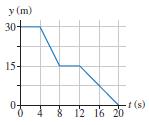
For Questions 1 through 3, interpret the position graph given in each figure by writing a very short “story” of what is happening. Be creative! Have characters and situations! Simply saying that “a car moves 100 meters to the right” doesn’t qualify as a story. Your stories should make
For Questions 1 through 3, interpret the position graph given in each figure by writing a very short “story” of what is happening. Be creative! Have characters and situations! Simply saying that “a car moves 100 meters to the right” doesn’t qualify as a story. Your stories should make
For Questions 1 through 3, interpret the position graph given in each figure by writing a very short “story” of what is happening. Be creative! Have characters and situations! Simply saying that “a car moves 100 meters to the right” doesn’t qualify as a story. Your stories should make
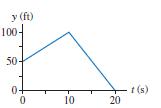
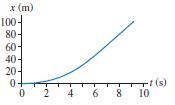
Write a short description of a real object for which Figure P1.60 would be a realistic position-versus-time graph.FIGURE P1.60:
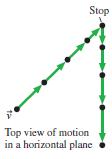
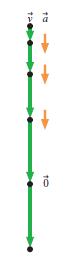
a. Complete the motion diagram by adding acceleration vectors.b. Write a physics problem for which this is the correct motion diagram. Be imaginative! Don’t forget to include enough information to make the problem complete and to state clearly what is to be found.c. Draw a pictorial
a. Complete the motion diagram by adding acceleration vectors.b. Write a physics problem for which this is the correct motion diagram. Be imaginative! Don’t forget to include enough information to make the problem complete and to state clearly what is to be found.c. Draw a pictorial
a. Complete the motion diagram by adding acceleration vectors.b. Write a physics problem for which this is the correct motion diagram. Be imaginative! Don’t forget to include enough information to make the problem complete and to state clearly what is to be found.c. Draw a pictorial
a. Complete the motion diagram by adding acceleration vectors.b. Write a physics problem for which this is the correct motion diagram. Be imaginative! Don’t forget to include enough information to make the problem complete and to state clearly what is to be found.c. Draw a pictorial
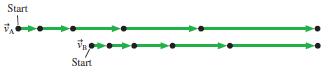
Show a motion diagram. For each of these problems, write a one or two sentence “story” about a real object that has this motion diagram. Your stories should talk about people or objects by name and say what they are doing. FIGURE P1.48:
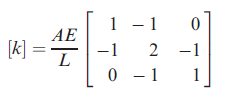
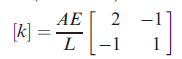
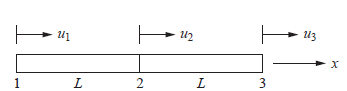
A two-element bar as shown in Figure PA-12 with element lengths L, cross-sectional area A, and Young?s modulus E can be shown to have a stiffness matrix of ? Show that the det (|k|) = 0 and hence that ?k is positive semi definite and the matrix is also singular. Now fix the left end (set u1 = 0)
Determine [C]-1
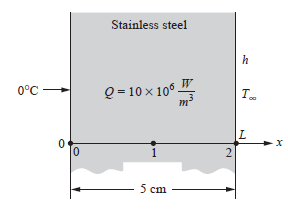
A large plate of stainless steel with thickness of 5 cm and thermal conductivity of k = 15W/ m-oC is subjected to an internal uniform heat generation throughout the plate at constant rate of Q = 10 ? 106?W/m3. One side of the plate is maintained at 0 oC by ice water, and the other side is subjected
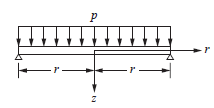
An aircraft cabin window of circular cross section and simple supports all around as shown in the following is made of polycarbonate with E = 0:345 ? 106 psi, n = 0:36, radius = 20 in., and thickness t = 0:75 in. The safety of the material is tested at a uniform pressure of 10 psi. Determine the
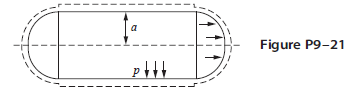
For the cylindrical vessel with hemispherical ends (heads) under uniform internal pressure of intensity p ? 500 psi shown in Figure P9?21, determine the maximum von Mises stress and where it is located. The material is ASTM?A242 quenched and tempered alloy steel. Use a factor of safety of 3 against
Write a computer program to solve plane stress problems using the LST element.
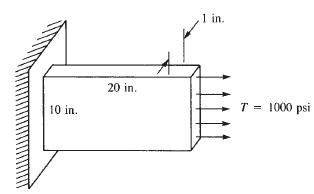
Use the LST element to solve Example 6.2. Compare the results. In example 6.2 For a thin plate subjected to the surface traction shown in Figure 6?16, determine the nodal displacements and the element stresses. The plate thickness t = 1 in., E = 30 x 106 psi, and n = 0:30. 1 in. 20 in. T = 1000
How would you treat a linearly varying thickness for a three-noded triangle?
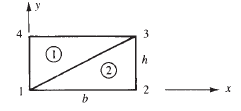
Compute the stiffness matrix of element 1 of the two-triangle element model of the rectangular plate in plane stress shown in the following figure. Then use it to compute the stiffness matrix of element 2. 4 (2)
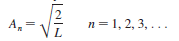
Show that the normalization constant Anfor the wave functions of a particle in a rigid box has the value given in Equation 40.26. n= 1, 2, 3, ... A,= A,= VI
What is the probability that an electron will tunnel through a 0.45 nm gap from a metal to a STM probe if the work function is 4.0 eV?
Tennis balls traveling faster than 100 mph routinely bounce off tennis rackets. At some sufficiently high speed, however, the ball will break through the strings and keep going. The racket is a potential-energy barrier whose height is the energy of the slowest string-breaking ball. Suppose that a
a. What is the probability that an electron will tunnel through a 0.50 nm air gap from a metal to a STM probe if the work function is 4.0 eV?b. The probe passes over an atom that is 0.050 nm “tall.” By what factor does the tunneling current increase?c. If a 10% current change is reliably
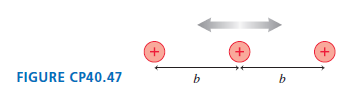
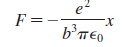
In most metals, the atomic ions form a regular arrangement called a crystal lattice. The conduction electrons in the sea of electrons move through this lattice. FIGURE CP40.47 is a one-dimensional model of a crystal lattice. The ions have mass m, charge e, and an equilibrium separation b. a.
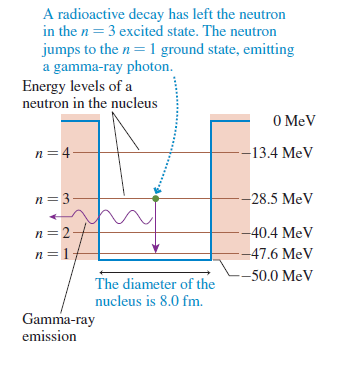
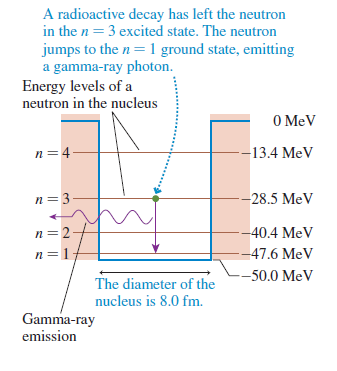
In a nuclear physics experiment, a proton is fired toward a Z = 13 nucleus with the diameter and neutron energy levels shown inFigure 40.17. The nucleus, which was initially in its ground state, subsequently emits a gamma ray with wavelength 1.73 × 10⁻⁴nm. What was the minimum initial
A proton’s energy is 1.0 MeV below the top of a 10-fm-wide energy barrier. What is the probability that the proton will tunnel through the barrier?
Even the smoothest mirror finishes are “rough” when viewed at a scale of 100 nm. When two very smooth metals are placed in contact with each other, the actual distance between the surfaces varies from 0 nm at a few points of real contact to ≈100 nm. The average distance between the surfaces
Figure 40.17showed that a typical nuclear radius is 4.0 fm. As you€™ll learn in Chapter 42, a typical energy of a neutron bound inside the nuclear potential well is En= -20 MeV. To find out how €œfuzzy€ the edge of the nucleus is, what is the neutron€™s
A particle of mass m has the wave function when it is in an allowed energy level with E = 0.a. Draw a graph of ψ(x) versus x.b. At what value or values of x is the particle most likely to be found?c. Find and graph the potential-energy function U(x). V(x) =Axexp(-x²la²)
a. Derive an expression for the classical probability density Pclass(y) for a ball that bounces between the ground and height h. The collisions with the ground are perfectly elastic.b. Graph your expression between y = 0 and y = h.c. Interpret your graph. Why is it shaped as it is?
a. Derive an expression for the classical probability density Pclass(x) for a simple harmonic oscillator with amplitude A.b. Graph your expression between x = -A and x = +A.c. Interpret your graph. Why is it shaped as it is?
a. Determine the normalization constant A1 for the n = 1 ground-state wave function of the quantum harmonic oscillator. Your answer will be in terms of b.b. Write an expression for the probability that a quantum harmonic oscillator in its n = 1 ground state will be found in the classically
Show that the constant b used in the quantum-harmonic oscillator wave functions(a) Has units of length(b) Is the classical turning point of an oscillator in the n = 1 ground state.
A typical electron in a piece of metallic sodium has energy -E0 compared to a free electron, where E0 is the 2.7 eV work function of sodium.a. At what distance beyond the surface of the metal is the electron’s probability density 10% of its value at the surface?b. How does this distance compare
For a particle in a finite potential well of width L and depth U0, what is the ratio of the probability Prob(in δx at x = L + η) to the probability Prob(in δx at x = L)?
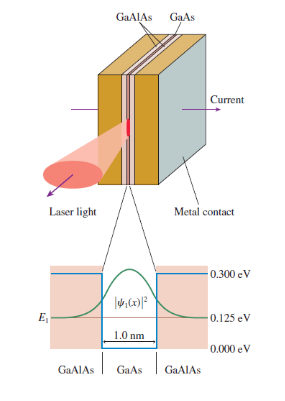
For the quantum-well laser ofFigure 40.16, estimate the probability that an electron will be found within one of the GaAlAs layers rather than in the GaAs layer. Explain your reasoning. GAAIAS GạAs Current Laser light Metal contact -0.300 eV 0.125 eV 1.0 nm 0.000 eV |GAAIAS GAAIAS GaAs
A neutron is confined in a 10-fm-diameter nucleus. If the nucleus is modeled as a one-dimensional rigid box, what is the probability that a neutron in the ground state is less than 2.0 fm from the edge of the nucleus?
Consider a particle in a rigid box of length L. For each of the states n = 1, n = 2, and n = 3:a. Sketch graphs of |ψ(x)|2. Label the points x = 0 and x = L.b. Where, in terms of L, are the positions at which the particle is most likely to be found?c. Where, in terms of L, are the positions at
A particle confined in a rigid one-dimensional box of length 10 fm has an energy level En = 32.9 MeV and an adjacent energy level En+1 = 51.4 MeV.a. Determine the values of n and n + 1.b. Draw an energy-level diagram showing all energy levels from 1 through n + 1. Label each level and write the
a. Derive an expression for λ2→1, the wavelength of light emitted by a particle in a rigid box during a quantum jump from n = 2 to n = 1.b. In what length rigid box will an electron undergoing a 2 → 1 transition emit light with a wavelength of 694 nm? This is the wavelength of a ruby laser.
Model an atom as an electron in a rigid box of length 0.100 nm, roughly twice the Bohr radius.a. What are the four lowest energy levels of the electron?b. Calculate all the wavelengths that would be seen in the emission spectrum of this atom due to quantum jumps between these four energy levels.
A 2.0-μm-diameter water droplet is moving with a speed of 1.0 mm/s in a 20@mm@long box.a. Estimate the particle’s quantum number.b. Use the correspondence principle to determine whether quantum mechanics is needed to understand the particle’s motion or if it is “safe” to use classical
Suppose that ψ1(x) and ψ2(x) are both solutions to the Schrödinger equation for the same potential energy U(x). Prove that the superposition ψ(x) = Aψ1(x) + Bψ2(x) is also a solution to the Schrödinger equation.
An electron approaches a 1.0-nm-wide potential-energy barrier of height 5.0 eV. What energy electron has a tunneling probability of(a) 10%,(b) 1.0%,(c) 0.10%?
Verify that the n = 1 wave function ψ1(x) of the quantum harmonic oscillator really is a solution of the Schrödinger equation. That is, show that the right and left sides of the Schrödinger equation are equal if you use the ψ1(x) wave function.
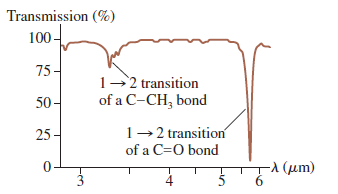
Use the data fromFigure 40.24 to calculate the first three vibrational energy levels of a C = O carbon-oxygen double bond. Transmission (%) 100- 75- 1-2 transition of a C-CH, bond 50- 1-2 transition 25- of a C=0 bond -λ (μm) 6.
An electron is confined in a harmonic potential well that has a spring constant of 12.0 N/m. What is the longest wavelength of light that the electron can absorb?
An electron in a harmonic potential well absorbs a photon with a wavelength of 400 nm as it undergoes a 1 → 2 quantum jump. What wavelength is absorbed in a 1 → 3 quantum jump?
An electron confined in a harmonic potential well emits a 1200 nm photon as it undergoes a 3 → 2 quantum jump. What is the spring constant of the potential well?
Two adjacent energy levels of an electron in a harmonic potential well are known to be 2.0 eV and 2.8 eV. What is the spring constant of the potential well?
An electron is confined in a harmonic potential well that has a spring constant of 2.0 N/m.a. What are the first three energy levels of the electron?b. What wavelength photon is emitted if the electron undergoes a 3 → 1 quantum jump?
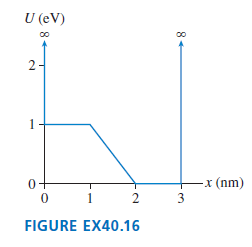
The graph in FIGURE EX40.16 shows the potential-energy function U(x) of a particle. Solution of the Schrödinger equation finds that the n = 3 level has E3= 0.5 eV and that the n = 6 level has E6= 2.0 eV. a. Redraw this figure and add to it the energy lines for the n = 3 and n = 6 states.b. Sketch
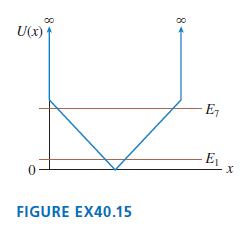
Sketch the n = 1 and n = 7 wave functions for the potential energy shown in FIGURE EX40.15. U(x) ↑ E, E FIGURE EX40.15
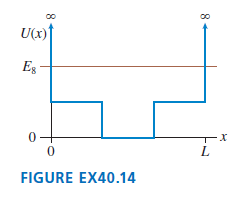
Sketch the n = 8 wave function for the potential energy shown in FIGURE EX40.14. U(x) Eg L FIGURE EX40.14 8
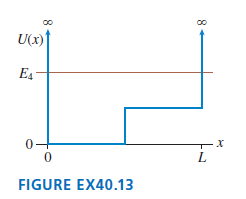
Sketch the n = 4 wave function for the potential energy shown in FIGURE EX40.13. U(x) E4 FIGURE EX40.13 8 8.
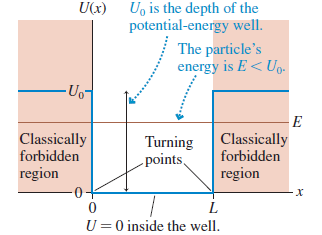
A helium atom is in a finite potential well. The atom’s energy is 1.0 eV below U0. What is the atom’s penetration distance into the classically forbidden region?
An electron in a finite potential well has a 1.0 nm penetration distance into the classically forbidden region. How far below U0 is the electron’s energy?
The energy of an electron in a 2.00-eV-deep potential well is 1.50 eV. At what distance into the classically forbidden region has the amplitude of the wave function decreased to 25% of its value at the edge of the potential well?
An electron has a 0.0100 probability (a 1.00% chance) of tunneling through a potential barrier. If the width of the barrier is doubled, will the tunneling probability be 0.0050, 0.0025, or 0.0001? Explain.
A finite potential well has depth U0 = 2.00 eV. What is the penetration distance for an electron with energy(a) 0.50 eV,(b) 1.00 eV(c) 1.50 eV?
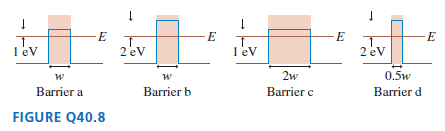
Four quantum particles, each with energy E, approach the potential-energy barriers seen in FIGURE Q40.8 from the left. Rank in order, from largest to smallest, the tunneling probabilities (Ptunnel)ato (Ptunnel)d. E E E 1 ev 2 eV 1 eV 2 ev 2w 0.5w Barrier a Barrier b Barrier c Barrier d FIGURE Q40.8
a. Sketch graphs of the probability density |ψ(x)|2 for the four states in the finite potential well of Figure 40.14a. Stack them vertically, similar to theFigure 40.14agraphs of ψ(x).b. What is the probability that a particle in the n = 2 state of the finite potential
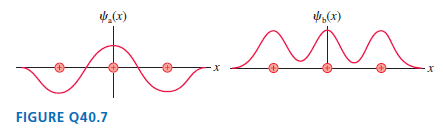
FIGURE Q40.7 shows two possible wave functions for an electron in a linear triatomic molecule. Which of these is a bonding orbital and which is an antibonding orbital? Explain how you can distinguish them. .(x) ,(x) FIGURE Q40.7
Show that the penetration distance h has units of m.
Consider a quantum harmonic oscillator.a. What happens to the spacing between the nodes of the wave function as |x| increases? Why?b. What happens to the heights of the antinodes of the wave function as |x| increases? Why?c. Sketch a reasonably accurate graph of the n = 8 wave function of a quantum
A 16-nm-long box has a thin partition that divides the box into a 4-nm-long section and a 12-nm-long section. An electron confined in the shorter section is in the n = 2 state. The partition is briefly withdrawn, then reinserted, leaving the electron in the longer section of the box. What is the
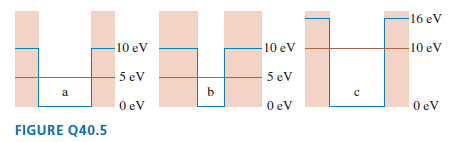
Rank in order, from largest to smallest, the penetration distances ηato ηcof the wave functions corresponding to the three energy levels in FIGURE Q40.5. LELELE 16 eV -10 eV 10 eV 10 eV 5 eV 5 eV a O eV O eV O ev FIGURE Q40.5
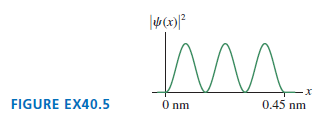
FIGURE EX40.5 is the probability density for an electron in a rigid box. What is the electron??s energy, in eV? O nm 0.45 nm FIGURE EX40.5
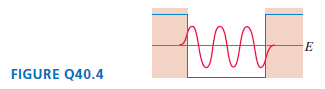
What is the quantum number of the particle in FIGURE Q40.4? How can you tell? E FIGURE Q40.4
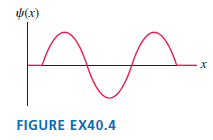
FIGURE EX40.4 shows the wave function of an electron in a rigid box. The electron energy is 12.0 eV. What is the energy, in eV, of the next higher state? (x) FIGURE EX40.4
A particle in a potential well is in the n = 5 quantum state. How many peaks are in the probability density P(x) = |ψ(x)|2?
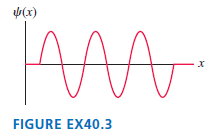
FIGURE EX40.3 shows the wave function of an electron in a rigid box. The electron energy is 25 eV. How long is the box? (x) FIGURE EX40.3
The correspondence principle says that the average behavior of a quantum system should begin to look like the Newtonian solution in the limit that the quantum number becomes very large. What is meant by “the average behavior” of a quantum system?
An electron in a rigid box absorbs light. The longest wavelength in the absorption spectrum is 600 nm. How long is the box?
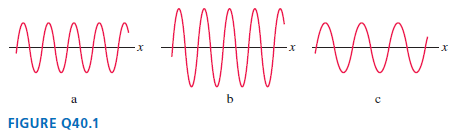
FIGURE Q40.1 shows the de Broglie waves of three equal- mass particles. Which one is moving most slowly? Explain. a b. FIGURE Q40.1
The electrons in a rigid box emit photons of wavelength 1484 nm during the 3 → 2 transition.a. What kind of photons are they—infrared, visible, or ultraviolet?b. How long is the box in which the electrons are confined?
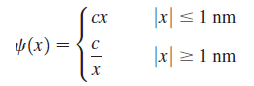
Consider the electron wave function where x is in nm.a. Determine the normalization constant c.b. Draw a graph of ψ(x) over the interval -5 nm ?? x ?? 5 nm. Provide numerical scales on both axes.c. Draw a graph of |ψ(x)|2 over the interval -5 nm ?? x ?? 5 nm. Provide numerical scales.d. If 106
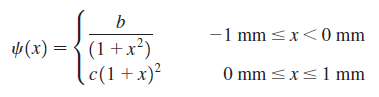
The wave function of a particle is and zero elsewhere.a. You will learn in Chapter 40 that the wave function must be a continuous function. Assuming that to be the case, what can you conclude about the relationship between b and c?b. Draw graphs of the wave function and the probability density
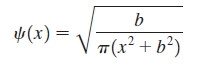
The wave function of a particle is where b is a positive constant. Find the probability that the particle is located in the interval -b ?? x ?? b. b ¥(x)= ㅠ(x2 + b?) IT
The probability density of finding a particle somewhere along the x-axis is 0 for x < 1 mm. At x = 1 mm, the probability density is c. For x ≥ 1 mm, the probability density decreases by a factor of 8 each time the distance from the origin is doubled. What is the probability that the particle
a. Starting with the expression Δf Δt ≈ 1 for a wave packet, find an expression for the product ΔE Δt for a photon.b. Interpret your expression. What does it tell you?c. The Bohr model of atomic quantization says that an atom in an excited state can jump to a lower-energy state by emitting a
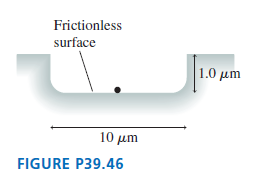
A small speck of dust with mass 1.0 × 10⁻¹³g has fallen into the hole shown in FIGURE P39.46 and appears to be at rest. According to the uncertainty principle, could this particle have enough energy to get out of the hole? If not, what is the deepest hole of this width from which it would have a
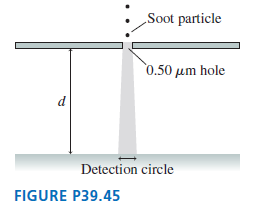
Soot particles, from incomplete combustion in diesel engines, are typically 15 nm in diameter and have a density of 1200 kg/m3. FIGURE P39.45 shows soot particles released from rest, in vacuum, just above a thin plate with a 0.50-μm-diameter hole€” roughly the wavelength of
Physicists use laser beams to create an atom trap in which atoms are confined within a spherical region of space with a diameter of about 1 mm. The scientists have been able to cool the atoms in an atom trap to a temperature of approximately 1 nK, which is extremely close to absolute zero, but it
Heavy nuclei often undergo alpha decay in which they emit an alpha particle (i.e., a helium nucleus). Alpha particles are so tightly bound together that it’s reasonable to think of an alpha particle as a single unit within the nucleus from which it is emitted.a. A 238U nucleus, which decays by
You learned in Chapter 37 that, except for hydrogen, the mass of a nucleus with atomic number Z is larger than the mass of the Z protons. The additional mass was ultimately discovered to be due to neutrons, but prior to the discovery of the neutron it was suggested that a nucleus with mass number A
What is the smallest one-dimensional box in which you can confine an electron if you want to know for certain that the electron’s speed is no more than 10 m/s?
Showing 600 - 700
of 3693
1
2
3
4
5
6
7
8
9
10
11
12
13
14
15
Last
Step by Step Answers

 Get 50% OFF
Claim Now
Get 50% OFF
Claim Now