New Semester
Started
Get
50% OFF
Study Help!
--h --m --s
Claim Now
Question Answers
Textbooks
Find textbooks, questions and answers
Oops, something went wrong!
Change your search query and then try again
S
Books
FREE
Study Help
Expert Questions
Accounting
General Management
Mathematics
Finance
Organizational Behaviour
Law
Physics
Operating System
Management Leadership
Sociology
Programming
Marketing
Database
Computer Network
Economics
Textbooks Solutions
Accounting
Managerial Accounting
Management Leadership
Cost Accounting
Statistics
Business Law
Corporate Finance
Finance
Economics
Auditing
Tutors
Online Tutors
Find a Tutor
Hire a Tutor
Become a Tutor
AI Tutor
AI Study Planner
NEW
Sell Books
Search
Search
Sign In
Register
study help
physics
physics scientists and engineers
Physics for Scientists and Engineers A Strategic Approach with Modern Physics 4th edition Randall D. Knight - Solutions
a. How many days will it take a spaceship to accelerate to the speed of light (3.0 × 10⁸ m/s) with the acceleration g?b. How far will it travel during this interval?c. What fraction of a light year is your answer to part b? A light year is the distance light travels in one year.We know, from
A jet plane is cruising at 300 m/s when suddenly the pilot turns the engines up to full throttle. After traveling 4.0 km, the jet is moving with a speed of 400 m/s. What is the jet’s acceleration, assuming it to be a constant acceleration?
a. What constant acceleration, in SI units, must a car have to go from zero to 60 mph in 10 s?b. How far has the car traveled when it reaches 60 mph? Give your answer both in SI units and in feet.
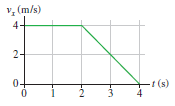
FIGURE EX2.12 shows the velocity-versus-time graph for a particle moving along the x-axis. Its initial position is x0= 2.0 m at t0= 0 s.a. What are the particle€™s position, velocity, and acceleration at t = 1.0 s?b. What are the particle€™s position, velocity, and acceleration
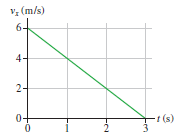
FIGURE EX2.11 shows the velocity graph of a particle moving along the x-axis. Its initial position is x0= 2.0 m at t0= 0 s. At t = 2.0 s, what are the particle€™s(a) Position,(b) Velocity, and(c) Acceleration?Figure Ex 2.11 V, (m/s) 6+ 4 0+ (s)
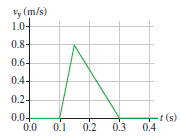
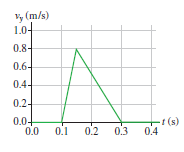
FIGURE EX2.7 showed the velocity graph of blood in the aorta. What is the blood€™s acceleration during each phase of the motion, speeding up and slowing down?Figure Ex 2.7 5 (m/s) 1.04 0.8- 0.6- 0.4- 0.2- 0.0+ 0.0 -1 (s) 0.4 0.1 0.2 0.3
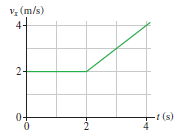
FIGURE EX2.9 shows the velocity graph of a particle. Draw the particle€™s acceleration graph for the interval 0 s ‰¤ t ‰¤ 4 s.Figure Ex 2.9 (m/s) 4+ 2- t (s) 0+ 2
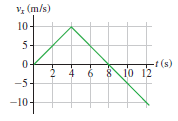
FIGURE EX2.8 shows the velocity graph for a particle having initial position x0= 0 m at t0= 0 s. At what time or times is the particle found at x = 35 m?Figure Ex 2.8 V (m/s) 10- 5. 0- 2 4 6 -t (s) 81o 12 -5- -10-
FIGURE EX2.7 is a somewhat idealized graph of the velocity of blood in the ascending aorta during one beat of the heart. Approximately how far, in cm, does the blood move during one beat?Figure Ex 2.7 , (m/s) 1.0- 0.8- 0.6- 0.4- 0.2- 0.0+ 0.0 0.1 0.2 0.3 0.4 t (s)
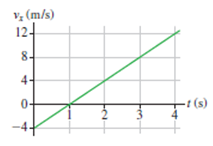
A particle starts from x0= 10 m at t0= 0 s and moves with the velocity graph shown in FIGURE EX2.6.a. Does this particle have a turning point? If so, at what time?b. What is the object€™s position at t = 2 s and 4 s?Figure Ex 2.6 V½ (m/s) 124 8- 4- t(s) 2.
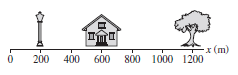
Larry leaves home at 9:05 and runs at constant speed to the lamppost seen in FIGURE EX2.3. He reaches the lamppost at 9:07, immediately turns, and runs to the tree. Larry arrives at the tree at 9:10.a. What is Larry€™s average velocity, in m/min, during each of these two intervals?b. What
Julie drives 100 mi to Grandmother’s house. On the way to Grandmother’s, Julie drives half the distance at 40 mph and half the distance at 60 mph. On her return trip, she drives half the time at 40 mph and half the time at 60 mph.a. What is Julie’s average speed on the way to Grandmother’s
Alan leaves Los Angeles at 8:00 a.m. to drive to San Francisco, 400 mi away. He travels at a steady 50 mph. Beth leaves Los Angeles at 9:00 a.m. and drives a steady 60 mph.a. Who gets to San Francisco first?b. How long does the first to arrive have to wait for the second?
A rock is thrown (not dropped) straight down from a bridge into the river below. At each of the following instants, is the magnitude of the rock’s acceleration greater than g, equal to g, less than g, or 0? Explain.(a) Immediately after being released.(b) Just before hitting the water.
A ball is thrown straight up into the air. At each of the following instants, is the magnitude of the ball’s acceleration greater than g, equal to g, less than g, or 0? Explain.a. Just after leaving your hand.b. At the very top (maximum height).c. Just before hitting the ground?
(a) Give an example of a vertical motion with a positive velocity and a negative acceleration.(b) Give an example of a vertical motion with a negative velocity and a negative acceleration?
A bicycle is traveling east. Can its acceleration vector ever point west? Explain.
You’re driving along the highway at a steady speed of 60 mph when another driver decides to pass you. At the moment when the front of his car is exactly even with the front of your car, and you turn your head to smile at him, do the two cars have equal velocities? Explain.
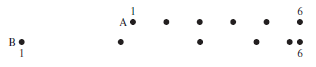
FIGURE Q2.8 shows six frames from the motion diagrams of two moving cars, A and B.(a) Do the two cars ever have the same position at one instant of time? If so, in which frame number (or numbers)?(b) Do the two cars ever have the same velocity at one instant of time? If so, between which two
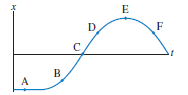
FIGURE Q2.7 shows the position-versus-time graph for a moving object. At which lettered point or points:(a) Is the object moving the fastest?(b) Is the object moving to the left?(c) Is the object speeding up?(d) Is the object turning around?Figure Q2.7 A
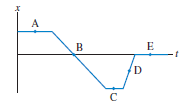
FIGURE Q2.6 shows the position-versus-time graph for a moving object. At which lettered point or points:a. Is the object moving the slowest?b. Is the object moving the fastest?c. Is the object at rest?d. Is the object moving to the left?Figure Q2.6 А B E
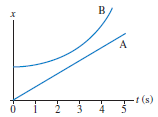
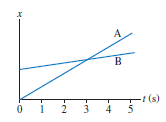
FIGURE Q2.5 shows a position-versus-time graph for the motion of objects A and B as they move along the same axis.a. At the instant t = 1 s, is the speed of A greater than, less than, or equal to the speed of B? Explain.b. Do objects A and B ever have the same speed? If so, at what time or times?
FIGURE Q2.4 shows a position-versus-time graph for the motion of objects A and B as they move along the same axis.a. At the instant t = 1 s, is the speed of A greater than, less than, or equal to the speed of B? Explain.b. Do objects A and B ever have the same speed? If so, at what time or times?
For Questions 1 through 3, interpret the position graph given in each figure by writing a very short €œstory€ of what is happening. Be creative! Have characters and situations! Simply saying that €œa car moves 100 meters to the right€ doesn€™t
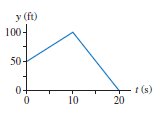
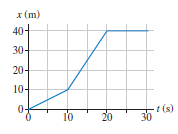
Write a short description of a real object for which Figure P1.59 would be a realistic position-versus-time graph.Figure P1.59 x (m) 40+ 30- 20- 10- 0- -1 (s) 30 20 10
Figure P1.58 shows a motion diagram of a car traveling down a street. The camera took one frame every 10 s. A distance scale is provided.Figure P1-58a. Measure the x-value of the car at each dot. Place your data in a table, similar to Table 1.1, showing each position and the instant of time at
The quantity called mass density is the mass per unit volume of a substance. What are the mass densities in SI units of the following objects?a. A 215 cm3 solid with a mass of 0.0179 kg.b. 95 cm3 of a liquid with a mass of 77 g?
An intravenous saline drip has 9.0 g of sodium chloride per liter of water. By definition, 1 mL = 1 cm3. Express the salt concentration in kg/m3?
A 5.4-cm-diameter cylinder has a length of 12.5 cm. What is the cylinder’s volume in SI units?
As an architect, you are designing a new house. A window has a height between 140 cm and 150 cm and a width between 74 cm and 70 cm. What are the smallest and largest areas that the window could be?
A regulation soccer field for international play is a rectangle with a length between 100 m and 110 m and a width between 64 m and 75 m. What are the smallest and largest areas that the field could be?
Show a partial motion diagram. For each:a. Complete the motion diagram by adding acceleration vectors.b. Write a physics problem for which this is the correct motion diagram. Be imaginative! Don€™t forget to include enough information to make the problem complete and to state clearly what
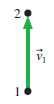
FIGURE EX1.10 shows two dots of a motion diagram and vector1Copy this figure, then add dot 3 and the next velocity vector2if the acceleration vectorat dot 2(a) Points up and(b) Points down.Figure Ex 1.10 V1
a. FIGURE EX1.8 shows the first three points of a motion diagram. Is the object€™s average speed between points 1 and 2 greater than, less than, or equal to its average speed between points 0 and 1? Explain how you can tell.b. Use Tactics Box 1.3 to find the average acceleration vector at
A softball player slides into second base. Use the particle model to draw a motion diagram showing his position and his average velocity vectors from the time he begins to slide until he reaches the base?
A baseball player starts running to the left to catch the ball as soon as the hit is made. Use the particle model to draw a motion diagram showing the position and average velocity vectors of the player during the first few seconds of the run?
You drop a soccer ball from your third-story balcony. Use the particle model to draw a motion diagram showing the ball’s position and average velocity vectors from the time you release the ball until the instant it touches the ground?
a. Write a paragraph describing the particle model. What is it, and why is it important?b. Give two examples of situations, different from those described in the text, for which the particle model is appropriate.c. Give an example of a situation, different from those described in the text, for
You are watching a jet ski race. A racer speeds up from rest to 70 mph in just a few seconds, then continues at a constant speed. Draw a basic motion diagram of the jet ski, using images from the video, from 10 s before reaching top speed until 10 s afterward?
A rocket is launched straight up. Draw a basic motion diagram, using the images from the video, from the moment of liftoff until the rocket is at an altitude of 500 m?
A car skids to a halt to avoid hitting an object in the road. Draw a basic motion diagram, using the images from the video, from the time the skid begins until the car is stopped?
Santa loses his footing and slides down a frictionless, snowy roof that is tilted at an angle of 30°. If Santa slides 10 m before reaching the edge, what is his speed as he leaves the roof?
An electromagnet on the ceiling of an airplane holds a steel ball. When a button is pushed, the magnet releases the ball. The experiment is first done while the plane is parked on the ground, and the point where the ball hits the floor is marked with an X. Then the experiment is repeated while the
A rock is thrown from a bridge at an angle 30° below horizontal. Immediately after the rock is released, is the magnitude of its acceleration greater than, less than, or equal to g? Explain.
I was driving along at 20 m/s, trying to change a CD and not watching where I was going. When I looked up, I found myself 45 m from a railroad crossing. And wouldn’t you know it, a train moving at 30 m/s was only 60 m from the crossing. In a split second, I realized that the train was going to
Water drops fall from the edge of a roof at a steady rate. A fifth drop starts to fall just as the first drop hits the ground. At this instant, the second and third drops are exactly at the bottom and top edges of a 1.00-m-tall window. How high is the edge of the roof?
A cat is sleeping on the floor in the middle of a 3.0-m-wide room when a barking dog enters with a speed of 1.50 m/s. As the dog enters, the cat (as only cats can do) immediately accelerates at 0.85 m/s2 toward an open window on the opposite side of the room. The dog (all bark and no bite) is a bit
David is driving a steady 30 m/s when he passes Tina, who is sitting in her car at rest. Tina begins to accelerate at a steady 2.0 m/s2 at the instant when David passes.a. How far does Tina drive before passing David?b. What is her speed as she passes him?
Nicole throws a ball straight up. Chad watches the ball from a window 5.0 m above the point where Nicole released it. The ball passes Chad on the way up, and it has a speed of 10 m/s as it passes him on the way back down. How fast did Nicole throw the ball?
David is driving a steady 30 m/s when he passes Tina, who is sitting in her car at rest. Tina begins to accelerate at a steady 2.0 m/s2 at the instant when David passes. How far does Tina drive before passing David?Draw a complete pictorial representation.Do not solve these problems or do any
Ice hockey star Bruce Blades is 5.0 m from the blue line and gliding toward it at a speed of 4.0 m/s. You are 20 m from the blue line, directly behind Bruce. You want to pass the puck to Bruce. With what speed should you shoot the puck down the ice so that it reaches Bruce exactly as he crosses the
A car traveling at 30 m/s runs out of gas while traveling up a 10° slope. How far up the hill will the car coast before starting to roll back down?Draw a complete pictorial representation.Do not solve these problems or do any mathematics.
A motorist is traveling at 20 m/s. He is 60 m from a stoplight when he sees it turn yellow. His reaction time, before stepping on the brake, is 0.50 s. What steady deceleration while braking will bring him to a stop right at the light?Draw a complete pictorial representation.Do not solve these
Sam is recklessly driving 60 mph in a 30 mph speed zone when he suddenly sees the police. He steps on the brakes and slows to 30 mph in three seconds, looking nonchalant as he passes the officer. How far does he travel while braking?Draw a complete pictorial representation.Do not solve these
A speed skater moving across friction less ice at 8.0 m/s hits a 5.0-m-wide patch of rough ice. She slows steadily, then continues on at 6.0 m/s. What is her acceleration on the rough ice?Draw a complete pictorial representation.Do not solve these problems or do any mathematics.
You would like to stick a wet spit wad on the ceiling, so you toss it straight up with a speed of 10 m/s. How long does it take to reach the ceiling, 3.0 m above?Draw a complete pictorial representation.Do not solve these problems or do any mathematics.
Sam is recklessly driving 60 mph in a 30 mph speed zone when he suddenly sees the police. He steps on the brakes and slows to 30 mph in three seconds, looking nonchalant as he passes the officer. How far does he travel while braking?Draw a complete pictorial representation.Do not solve these
A jet plane is cruising at 300 m/s when suddenly the pilot turns the engines up to full throttle. After traveling 4.0 km, the jet is moving with a speed of 400 m/s. What is the jet’s acceleration as it speeds up?Draw a complete pictorial representation.Do not solve these problems or do any
A Porsche accelerates from a stoplight at 5.0 m/s2 for five seconds, then coasts for three more seconds. How far has it traveled?Draw a complete pictorial representation.Do not solve these problems or do any mathematics.
Motor neurons in mammals transmit signals from the brain to skeletal muscles at approximately 25 m/s. Estimate how long in ms it takes a signal to get from your brain to your hand?
Estimate the average speed with which the hair on your head grows. Give your answer in both m/s and mm/hour. Briefly describe how you arrived at this estimate?
Estimate the height of a telephone pole. Give your answer in both feet and meters. Briefly describe how you arrived at this estimate?
Estimate (don’t measure!) the length of a typical car. Give your answer in both feet and meters. Briefly describe how you arrived at this estimate?
Perform the following calculations with the correct number of significant figures.a. 159.31 × 204.6b. 5.1125 + 0.67 + 3.2c. 7.662 - 7.425d. 16.5/3.45
Compute the following numbers, applying the significant figure rules adopted in this textbook.a. 33.3 × 25.4b. 33.3 – 25.4c. √33.3d. 333.3 ÷ 25.4
Using the approximate conversion factors in Table 1.5, convert the following to SI units without using your calculator.Table 1.5 1 cm ≈ 1/2 in10 cm ≈ 4 in1 m ≈ 1 yard1 m ≈ 3 feet1 km ≈ 0.6 mile1 m/s ≈ 2 mpha. 20 ftb. 60 mic. 60 mphd. 8 in
Using the approximate conversion factors in Table 1.5, convert the following SI units to English units without using your calculator.Table 1.51 cm ≈ 1/2 in10 cm ≈ 4 in1 m ≈ 1 yard1 m ≈ 3 feet1 km ≈ 0.6 mile1 m/s ≈ 2 mpha. 30 cmb. 25 m/sc. 5 kmd. 0.5 cm
Convert the following to SI units:a. 75 inb. 3.45 × 10⁶ yrc. 62 ft/dayd. 2.2 × 10⁴ mi2
Convert the following to SI units:a. 8.0 inb. 66 ft/sc. 60 mphd. 14 in2
How many significant figures are there in the following values?(a) 0.05 × 10⁻⁴(b) 0.00340(c) 7.2 × 10⁴(d) 103.00
Draw a pictorial representation for the following problem. Do not solve the problem. What acceleration does a rocket need to reach a speed of 200 m/s at a height of 1.0 km?
Draw a pictorial representation for the following problem. Do not solve the problem. The light turns green, and a bicyclist starts forward with an acceleration of 1.5 m/s2. How far must she travel to reach a speed of 7.5 m/s?
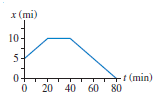
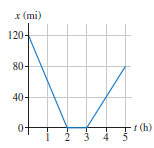
Write a short description of the motion of a real object for which FIGURE EX1.20 would be a realistic position-versus-time graph.Figure EX 1.20 x (mi) 120- 80- 40- (h) 3 4 5 2
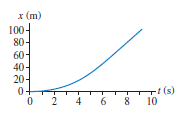
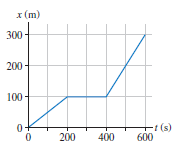
Write a short description of the motion of a real object for which FIGURE EX1.19 would be a realistic position-versus-time graph.Figure EX 1.19 x (m) 300 200 100 - 1 (s) 600 200 400
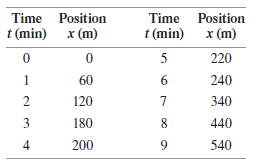
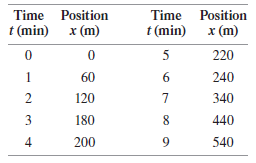
FIGURE EX1.18 shows the motion diagram of a drag racer. The camera took one frame every 2 s.Figure EX 1.18a. Measure the x-value of the racer at each dot. List your data in a table similar to Table 1.1, showing each position and the time at which it occurred.Table 1.1 Measured positions of a
Your roommate drops a tennis ball from a third-story balcony. It hits the sidewalk and bounces as high as the second story. Draw a complete motion diagram of the tennis ball from the time it is released until it reaches the maximum height on its bounce. Be sure to determine and show the
A roof tile falls straight down from a two-story building. It lands in a swimming pool and settles gently to the bottom. Draw a complete motion diagram of the tile?
You use a long rubber band to launch a paper wad straight up. Draw a complete motion diagram of the paper wad from the moment you release the stretched rubber band until the paper wad reaches its highest point?
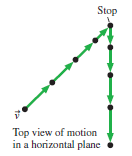
A goose flies toward a pond. It lands on the water and slides for some distance before it comes to a stop. Draw the motion diagram of the goose, starting shortly before it hits the water and assuming the motion is entirely horizontal?
A car travels to the left at a steady speed for a few seconds, then brakes for a stop sign. Draw a complete motion diagram of the car?
A speed skater accelerates from rest and then keeps skating at a constant speed. Draw a complete motion diagram of the skater?
FIGURE EX1.9 shows five points of a motion diagram. Use Tactics Box 1.3 to find the average acceleration vectors at points 1, 2, and 3. Draw the completed motion diagram showing velocity vectors and acceleration vectors?Figure Ex 1.9 4
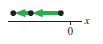
Determine the signs (positive, negative, or zero) of the position, velocity, and acceleration for the particle in FIGURE Q1.8.Figure Q1.8
Determine the signs (positive, negative, or zero) of the position, velocity, and acceleration for the particle in FIGURE Q1.7.Figure Q1.7 0-
Determine the signs (positive, negative, or zero) of the position, velocity, and acceleration for the particle in FIGURE Q1.6.Figure Q1.6
Does the object represented in FIGURE Q1.5 have a positive or negative value of αy? Explain.Figure Q1.5
Does the object represented in FIGURE Q1.4 have a positive or negative value of αx? Explain.Figure Q1.4
Is the particle in FIGURE Q1.3 speeding up? Slowing down? Or can you tell? Explain.Figure Q1.3 ..
How many significant figures does each of the following numbers have?(a) 290(b) 2.90 × 10⁴(c) 0.0029(d) 2.90
How many significant figures does each of the following numbers have?(a) 0.73(b) 7.30(c) 73(d) 0.073
A jet plane is cruising at 300 m/s when suddenly the pilot turns the engines up to full throttle. After traveling 4.0 km, the jet is moving with a speed of 400 m/s. What is the jet’s acceleration, assuming it to be a constant acceleration?
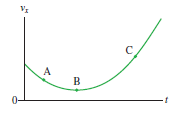
FIGURE Q2.14 shows the velocity-versus-time graph for a moving object. At which lettered point or points:a. Is the object speeding up?b. Is the object slowing down?c. Is the object moving to the left?d. Is the object moving to the right?Figure Q2.14 A 0-
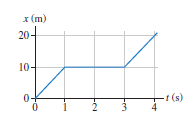
FIGURE EX2.5 shows the position graph of a particle.a. Draw the particle€™s velocity graph for the interval 0 s £ t £ 4 s.b. Does this particle have a turning point or points? If so, at what time or times?Figure Ex 2.5 x (m) 20- 10- (s)
Showing 3600 - 3700
of 3693
First
23
24
25
26
27
28
29
30
31
32
33
34
35
36
37
Step by Step Answers

 Get 50% OFF
Claim Now
Get 50% OFF
Claim Now