New Semester
Started
Get
50% OFF
Study Help!
--h --m --s
Claim Now
Question Answers
Textbooks
Find textbooks, questions and answers
Oops, something went wrong!
Change your search query and then try again
S
Books
FREE
Study Help
Expert Questions
Accounting
General Management
Mathematics
Finance
Organizational Behaviour
Law
Physics
Operating System
Management Leadership
Sociology
Programming
Marketing
Database
Computer Network
Economics
Textbooks Solutions
Accounting
Managerial Accounting
Management Leadership
Cost Accounting
Statistics
Business Law
Corporate Finance
Finance
Economics
Auditing
Tutors
Online Tutors
Find a Tutor
Hire a Tutor
Become a Tutor
AI Tutor
AI Study Planner
NEW
Sell Books
Search
Search
Sign In
Register
study help
physics
physics scientists and engineers
Physics for Scientists and Engineers A Strategic Approach with Modern Physics 4th edition Randall D. Knight - Solutions
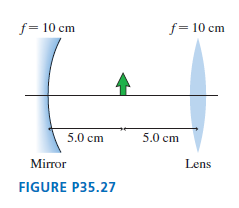
The rays leaving the two-component optical system of FIGURE P35.27 produce two distinct images of the 1.0-cm tall object. What are the position (relative to the lens), orientation, and height of each image? f= 10 cm f= 10 cm 5.0 cm 5.0 cm Mirror Lens FIGURE P35.27
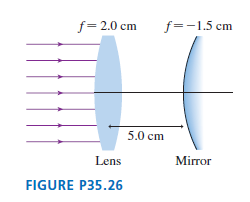
In FIGURE P35.26, parallel rays from the left are focused to a point at two locations on the optical axis. Find the position of each location, giving your answer as a distance left or right of the lens. f= 2.0 cm f=-1.5 cm 5.0 cm Lens Mirror FIGURE P35.26
Two lightbulbs are 1.0 m apart. From what distance can these lightbulbs be marginally resolved by a small telescope with a 4.0-cm-diameter objective lens? Assume that the lens is diffraction limited and λ = 600 nm.
A scientist needs to focus a helium-neon laser beam (λ = 633 nm) to a 10-μm-diameter spot 8.0 cm behind a lens.a. What focal-length lens should she use?b. What minimum diameter must the lens have?
Infrared telescopes, which use special infrared detectors, are able to peer farther into star-forming regions of the galaxy because infrared light is not scattered as strongly as is visible light by the tenuous clouds of hydrogen gas from which new stars are created. For what wavelength of light is
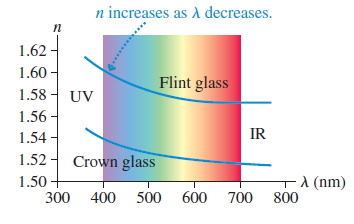
A hydrogen discharge lamp emits light with two prominent wavelengths: 656 nm (red) and 486 nm (blue). The light enters a flint-glass prism perpendicular to one face and then refracts through the hypotenuse back into the air. The angle between these two faces is 35?.a. Use Figure 35.18 to estimate
A narrow beam of white light is incident on a sheet of quartz. The beam disperses in the quartz, with red light (λ ≈ 700 nm) traveling at an angle of 26.3° with respect to the normal and violet light (λ ≈ 400 nm) traveling at 25.7°. The index of refraction of quartz for red light is 1.45.
A sheet of glass has nred = 1.52 and nviolet = 1.55. A narrow beam of white light is incident on the glass at 30°. What is the angular spread of the light inside the glass?
A reflecting telescope is built with a 20-cm-diameter mirror having a 1.00 m focal length. It is used with a 10× eyepiece. What are(a) The magnificatio(b) The f-number of the telescope?
A 20× telescope has a 12-cm-diameter objective lens. What minimum diameter must the eyepiece lens have to collect all the light rays from an on-axis distant source?
A 6.0-mm-diameter microscope objective has a focal length of 9.0 mm. What object distance gives a lateral magnification of -40?
A standardized biological microscope has an 8.0-mm-focal-length objective. What focal-length eyepiece should be used to achieve a total magnification of 100×?
A microscope has a 20 cm tube length. What focal-length objective will give total magnification 500× when used with an eyepiece having a focal length of 5.0 cm?
A magnifier has a magnification of 5×. How far from the lens should an object be held so that its image is seen at the near-point distance of 25 cm? Assume that your eye is immediately behind the lens.
What is the f-number of a relaxed eye with the pupil fully dilated to 8.0 mm? Model the eye as a single lens 2.4 cm in front of the retina.
Ellen wears eyeglasses with the prescription -1.0 D.a. What eye condition does Ellen have?b. What is her far point without the glasses?
Ramon has contact lenses with the prescription +2.0 D.a. What eye condition does Ramon have?b. What is his near point without the lenses?
A camera takes a properly exposed photo with a 3.0-mm-diameter aperture and a shutter speed of 1/125 s. What is the appropriate aperture diameter for a 1/500 s shutter speed?
A camera takes a properly exposed photo at f/5.6 and 1/125 s. What shutter speed should be used if the lens is changed to f/4.0?
An astronomer is trying to observe two distant stars. The stars are marginally resolved when she looks at them through a filter that passes green light with a wavelength near 550 nm. Which of the following actions would improve the resolution? Assume that the resolution is not limited by the
A 2.0-m-tall man is 10 m in front of a camera with a 15 mm-focal-length lens. How tall is his image on the detector?
A 2.0-cm-tall object is 20 cm to the left of a lens with a focal length of 10 cm. A second lens with a focal length of -5 cm is 30 cm to the right of the first lens.a. Use ray tracing to find the position and height of the image. Do this accurately using a ruler or paper with a grid, then make
The center of the galaxy is filled with low-density hydrogen gas that scatters light rays. An astronomer wants to take a picture of the center of the galaxy. Will the view be better using ultraviolet light, visible light, or infrared light? Explain.
A 2.0-cm-tall object is 20 cm to the left of a lens with a focal length of 10 cm. A second lens with a focal length of 5 cm is 30 cm to the right of the first lens.a. Use ray tracing to find the position and height of the image. Do this accurately using a ruler or paper with a grid, then make
A 2.0-cm-tall object is 20 cm to the left of a lens with a focal length of 10 cm. A second lens with a focal length of 15 cm is 30 cm to the right of the first lens.a. Use ray tracing to find the position and height of the image. Do this accurately using a ruler or paper with a grid, then make
Suppose you wanted special glasses designed to let you see underwater without a face mask. Should the glasses use a converging or diverging lens? Explain.
A converging lens with a focal length of 40 cm and a diverging lens with a focal length of -40 cm are 160 cm apart. A 2.0-cm-tall object is 60 cm in front of the converging lens.a. Use ray tracing to find the position and height of the image. Do this accurately using a ruler or paper with a grid,
Two converging lenses with focal lengths of 40 cm and 20 cm are 10 cm apart. A 2.0-cm-tall object is 15 cm in front of the 40-cm-focal-length lens.a. Use ray tracing to find the position and height of the image. Do this accurately using a ruler or paper with a grid, then make measurements on your
The two most prominent wavelengths in the light emitted by a hydrogen discharge lamp are 656 nm (red) and 486 nm (blue).Light from a hydrogen lamp illuminates a diffraction grating with 500 lines/mm, and the light is observed on a screen 1.50 m behind the grating. What is the distance between the
A fish in a flat-sided aquarium sees a can of fish food on the counter. To the fish’s eye, the can looks to be 30 cm outside the aquarium. What is the actual distance between the can and the aquarium? (You can ignore the thin glass wall of the aquarium.)
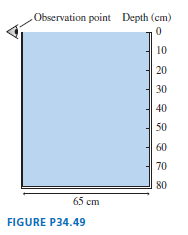
The 80-cm-tall, 65-cm-wide tank shown in FIGURE P34.49 is completely filled with water. The tank has marks every 10 cm along one wall, and the 0 cm mark is barely submerged. As you stand beside the opposite wall, your eye is level with the top of the water. a. Can you see the marks from the top of
A horizontal meter stick is centered at the bottom of a 3.0 m-deep, 3.0-m-wide pool of water. How long does the meter stick appear to be as you look at it from the edge of the pool?
A 4.0-m-wide swimming pool is filled to the top. The bottom of the pool becomes completely shaded in the afternoon when the sun is 20° above the horizon. How deep is the pool?
It’s nighttime, and you’ve dropped your goggles into a 3.0-m deep swimming pool. If you hold a laser pointer 1.0 m above the edge of the pool, you can illuminate the goggles if the laser beam enters the water 2.0 m from the edge. How far are the goggles from the edge of the pool?
An astronaut is exploring an unknown planet when she accidentally drops an oxygen canister into a 1.50-m-deep pool filled with an unknown liquid. Although she dropped the canister 21 cm from the edge, it appears to be 31 cm away when she peers in from the edge. What is the liquid’s index of
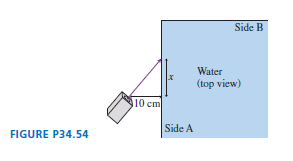
Shown from above in FIGURE P34.54 is one corner of a rectangular box filled with water. A laser beam starts 10 cm from side A of the container and enters the water at position x. You can ignore the thin walls of the container. a. If x = 15 cm, does the laser beam refract back into the air through
A light beam can use reflections to form a closed, N-sided polygon inside a solid, transparent cylinder if N is sufficiently large. What is the minimum possible value of N for light inside a cylinder of(a) Water,(b) Polystyrene plastic,(c) Cubic zirconia?Assume the cylinder is surrounded by air.
Optical engineers need to know the cone of acceptance of an optical fiber. This is the maximum angle that an entering light ray can make with the axis of the fiber if it is to be guided down the fiber. What is the cone of acceptance of an optical fiber for which the index of refraction of the core
One of the contests at the school carnival is to throw a spear at an underwater target lying flat on the bottom of a pool. The water is 1.0 m deep. You’re standing on a small stool that places your eyes 3.0 m above the bottom of the pool. As you look at the target, your gaze is 30° below
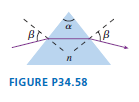
There??s one angle of incidence β onto a prism for which the light inside an isosceles prism travels parallel to the base and emerges at angle β.a. Find an expression for β in terms of the prism??s apex angle α and index of refraction n.b. A laboratory measurement finds that β = 52.2? for a
You’re visiting the shark tank at the aquarium when you see a 2.5-m-long shark that appears to be swimming straight toward you at 2.0 m/s. What is the shark’s actual speed through the water? You can ignore the glass wall of the tank.
Paraxial light rays approach a transparent sphere parallel to an optical axis passing through the center of the sphere. The rays come to a focus on the far surface of the sphere. What is the sphere’s index of refraction?
To determine the focal length of a lens, you place the lens in front of a small lightbulb and then adjust a viewing screen to get a sharply focused image. Varying the lens position produces the following data:Bulb to lens (cm) ..................Lens to screen
The illumination lights in an operating room use a concave mirror to focus an image of a bright lamp onto the surgical site. One such light uses a mirror with a 30 cm radius of curvature. If the mirror is 1.2 m from the patient, how far should the lamp be from the mirror?
A dentist uses a curved mirror to view the back side of teeth in the upper jaw. Suppose she wants an upright image with a magnification of 1.5 when the mirror is 1.2 cm from a tooth. Should she use a convex or a concave mirror? What focal length should it have?
A keratometer is an optical device used to measure the radius of curvature of the eye’s cornea—its entrance surface. This measurement is especially important when fitting contact lenses, which must match the cornea’s curvature. Most light incident on the eye is transmitted into the eye, but
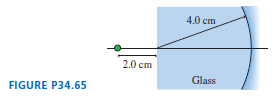
The mirror in FIGURE P34.65 is covered with a piece of glass. A point source of light is outside the glass. How far from the mirror is the image of this source? 4.0 cm 2.0 cm Glass FIGURE P34.65
A 2.0-cm-tall candle flame is 2.0 m from a wall. You happen to have a lens with a focal length of 32 cm. How many places can you put the lens to form a well-focused image of the candle flame on the wall? For each location, what are the height and orientation of the image?
A 25 g rubber ball is dropped from a height of 3.0 m above the center of a horizontal, concave mirror. The ball and its image coincide 0.65 s after the ball is released. What is the mirror’s radius of curvature?
In recent years, physicists have learned to create metamaterials— engineered materials not found in natur —with negative indices of refraction. It’s not yet possible to form a lens from a material with a negative index of refraction, but researchers are optimistic. Suppose you had a
A lightbulb is 3.0 m from a wall. What are the focal length and the position (measured from the bulb) of a lens that will form an image on the wall that is twice the size of the lightbulb?
An old-fashioned slide projector needs to create a 98-cm high image of a 2.0-cm-tall slide. The screen is 300 cm from the slide.a. What focal length does the lens need? Assume that it is a thin lens.b. How far should you place the lens from the slide?
Some electro-optic materials can change their index of refraction in response to an applied voltage. Suppose a planoconvex lens (flat on one side, a 15.0 cm radius of curvature on the other), made from a material whose normal index of refraction is 1.500, is creating an image of an object that is
A point source of light is distance d from the surface of a 6.0 cm-diameter glass sphere. For what value of d is there an image at the same distance d on the opposite side of the sphere?
A lens placed 10 cm in front of an object creates an upright image twice the height of the object. The lens is then moved along the optical axis until it creates an inverted image twice the height of the object. How far did the lens move?
An object is 60 cm from a screen. What are the radii of a symmetric converging plastic lens (i.e., two equally curved surfaces) that will form an image on the screen twice the height of the object?
A wildlife photographer with a 200-mm-focal-length telephoto lens on his camera is taking a picture of a rhinoceros that is 100 m away. Suddenly, the rhino starts charging straight toward the photographer at a speed of 5.0 m/s. What is the speed, in mm/s, of the image of the rhinoceros? Is the
A concave mirror has a 40 cm radius of curvature. How far from the mirror must an object be placed to create an upright image three times the height of the object?
A 2.0-cm-tall object is placed in front of a mirror. A 1.0-cm-tall upright image is formed behind the mirror, 150 cm from the object. What is the focal length of the mirror?
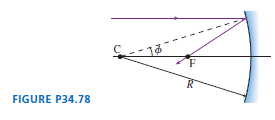
A spherical mirror of radius R has its center at C, as shown in FIGURE P34.78. A ray parallel to the axis reflects through F, the focal point. Prove that f = R/2 if ϕ << 1 rad. C-- 18 FIGURE P34.78
Consider a lens having index of refraction n2 and surfaces with radii R1 and R2. The lens is immersed in a fluid that has index of refraction n1.a. Derive a generalized lens maker’s equation to replace Equation 34.26 when the lens is surrounded by a medium other than air. That is, when n1 ≠
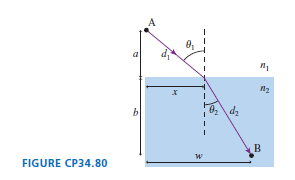
FIGURE CP34.80 shows a light ray that travels from point A to point B. The ray crosses the boundary at position x, making angles θ1and θ2in the two media. Suppose that you did not know Snell??s law. a. Write an expression for the time t it takes the light ray to travel from A to B. Your
A fortune teller’s “crystal ball” (actually just glass) is 10 cm in diameter. Her secret ring is placed 6.0 cm from the edge of the ball.a. An image of the ring appears on the opposite side of the crystal ball. How far is the image from the center of the ball?b. Draw a ray diagram showing the
Consider an object of thickness ds (parallel to the axis) in front of a lens or mirror. The image of the object has thickness ds′. Define the longitudinal magnification as M = ds′/ds. Prove that M = -m2, where m is the lateral magnification.
Suppose a camera’s exposure is correct when the lens has a focal length of 8.0 mm. Will the picture be overexposed, underexposed, or still correct if the focal length is “zoomed” to 16.0 mm without changing the diameter of the lens aperture? Explain.
A camera has a circular aperture immediately behind the lens. Reducing the aperture diameter to half its initial value willA. Make the image blurry.B. Cut off the outer half of the image and leave the inner half unchanged.C. Make the image less bright.D. All the above.Explain your choice.
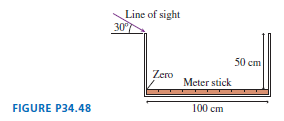
The meter stick in FIGURE P34.48 lies on the bottom of a 100-cm-long tank with its zero mark against the left edge. You look into the tank at a 30? angle, with your line of sight just grazing the upper left edge of the tank. What mark do you see on the meter stick if the tank is (a) Empty, (b) Half
A light ray in air is incident on a transparent material whose index of refraction is n.a. Find an expression for the (non-zero) angle of incidence whose angle of refraction is half the angle of incidence.b. Evaluate your expression for light incident on glass.
A microscope is focused on a black dot. When a 1.00-cm thick piece of plastic is placed over the dot, the microscope objective has to be raised 0.40 cm to bring the dot back into focus. What is the index of refraction of the plastic?
The place you get your hair cut has two nearly parallel mirrors 5.0 m apart. As you sit in the chair, your head is 2.0 m from the nearer mirror. Looking toward this mirror, you first see your face and then, farther away, the back of your head. (The mirrors need to be slightly nonparallel for you to
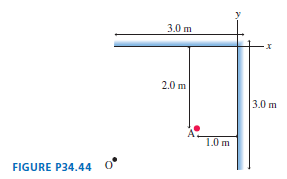
A red ball is placed at point A in FIGURE P34.44. a. How many images are seen by an observer at point O?b. What are the (x, y) coordinates of each image? 3.0 m 2.0 m 3.0 m 1.0 m FIGURE P34.44
An advanced computer sends information to its various parts via infrared light pulses traveling through silicon fibers. To acquire data from memory, the central processing unit sends a light-pulse request to the memory unit. The memory unit processes the request, then sends a data pulse back to the
A 1.0-cm-tall object is 20 cm in front of a convex mirror that has a -60 cm focal length. Calculate the position and height of the image. State whether the image is in front of or behind the mirror, and whether the image is upright or inverted.
A 1.0-cm-tall object is 20 cm in front of a concave mirror that has a 60 cm focal length. Calculate the position and height of the image. State whether the image is in front of or behind the mirror, and whether the image is upright or inverted.
An object is 30 cm in front of a convex mirror with a focal length of -20 cm. Use ray tracing to locate the image. Is the image upright or inverted?
An object is 12 cm in front of a concave mirror with a focal length of 20 cm. Use ray tracing to locate the image. Is the image upright or inverted?
An object is 40 cm in front of a concave mirror with a focal length of 20 cm. Use ray tracing to locate the image. Is the image upright or inverted?
A 2.0-cm-tall object is 15 cm in front of a diverging lens that has a -20 cm focal length.a. Use ray tracing to find the position and height of the image. To do this accurately, use a ruler or paper with a grid. Determine the image distance and image height by making measurements on your diagram.b.
A 1.0-cm-tall object is 60 cm in front of a diverging lens that has a -30 cm focal length.a. Use ray tracing to find the position and height of the image. To do this accurately, use a ruler or paper with a grid. Determine the image distance and image height by making measurements on your diagram.b.
A 2.0-cm-tall object is 15 cm in front of a converging lens that has a 20 cm focal length.a. Use ray tracing to find the position and height of the image. To do this accurately, use a ruler or paper with a grid. Determine the image distance and image height by making measurements on your diagram.b.
A 1.0-cm-tall object is 75 cm in front of a converging lens that has a 30 cm focal length.a. Use ray tracing to find the position and height of the image. To do this accurately, use a ruler or paper with a grid. Determine the image distance and image height by making measurements on your diagram.b.
A 2.0-cm-tall object is 40 cm in front of a converging lens that has a 20 cm focal length.a. Use ray tracing to find the position and height of the image. To do this accurately, use a ruler or paper with a grid. Determine the image distance and image height by making measurements on your diagram.b.
A 1.0-cm-tall object is 10 cm in front of a converging lens that has a 30 cm focal length.a. Use ray tracing to find the position and height of the image. To do this accurately, use a ruler or paper with a grid. Determine the image distance and image height by making measurements on your diagram.b.
A 1.0-cm-tall candle flame is 60 cm from a lens with a focal length of 20 cm. What are the image distance and the height of the flame’s image?
A goldfish lives in a 50-cm-diameter spherical fish bowl. The fish sees a cat watching it. If the cat’s face is 20 cm from the edge of the bowl, how far from the edge does the fish see it as being?
An air bubble inside an 8.0-cm-diameter plastic ball is 2.0 cm from the surface. As you look at the ball with the bubble turned toward you, how far beneath the surface does the bubble appear to be?
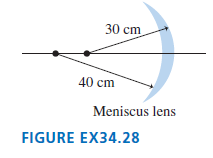
Find the focal length of the meniscus polystyrene plastic lens in FIGURE EX34.28. 30 cm 40 cm Meniscus lens FIGURE EX34.28
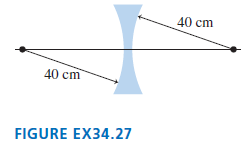
Find the focal length of the glass lens in FIGURE EX34.27. 40 cm 40 cm FIGURE EX34.27
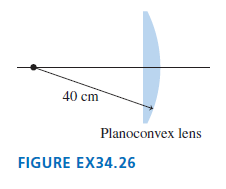
Find the focal length of the planoconvex polystyrene plastic lens in FIGURE EX34.26. 40 cm Planoconvex lens FIGURE EX34.26
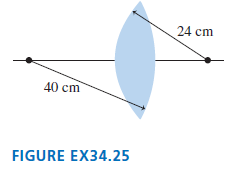
Find the focal length of the glass lens in FIGURE EX34.25. 24 cm 40 cm FIGURE EX34.25
An object is 15 cm in front of a diverging lens with a focal length of -15 cm. Use ray tracing to determine the location of the image. Is the image upright or inverted?
An object is 6 cm in front of a converging lens with a focal length of 10 cm. Use ray tracing to determine the location of the image. Is the image upright or inverted?
An object is 30 cm in front of a converging lens with a focal length of 5 cm. Use ray tracing to determine the location of the image. Is the image upright or inverted?
An object is 20 cm in front of a converging lens with a focal length of 10 cm. Use ray tracing to determine the location of the image. Is the image upright or inverted?
To a fish in an aquarium, the 4.00-mm-thick walls appear to be only 3.50 mm thick. What is the index of refraction of the walls?
A 150-cm-tall diver is standing completely submerged on the bottom of a swimming pool full of water. You are sitting on the end of the diving board, almost directly over her. How tall does the diver appear to be?
A biologist keeps a specimen of his favorite beetle embedded in a cube of polystyrene plastic. The hapless bug appears to be 2.0 cm within the plastic. What is the beetle’s actual distance beneath the surface?
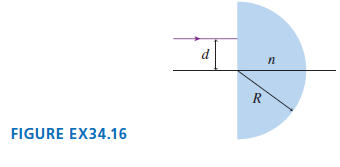
FIGURE EX34.16 shows a transparent hemisphere with radius R and index of refraction n. What is the maximum distance d for which a light ray parallel to the axis refracts out through the curved surface? FIGURE EX34.16
A thin glass rod is submerged in oil. What is the critical angle for light traveling inside the rod?
The glass core of an optical fiber has an index of refraction 1.60. The index of refraction of the cladding is 1.48. What is the maximum angle a light ray can make with the wall of the core if it is to remain inside the fiber?
Showing 1000 - 1100
of 3693
First
4
5
6
7
8
9
10
11
12
13
14
15
16
17
18
Last
Step by Step Answers

 Get 50% OFF
Claim Now
Get 50% OFF
Claim Now