New Semester
Started
Get
50% OFF
Study Help!
--h --m --s
Claim Now
Question Answers
Textbooks
Find textbooks, questions and answers
Oops, something went wrong!
Change your search query and then try again
S
Books
FREE
Study Help
Expert Questions
Accounting
General Management
Mathematics
Finance
Organizational Behaviour
Law
Physics
Operating System
Management Leadership
Sociology
Programming
Marketing
Database
Computer Network
Economics
Textbooks Solutions
Accounting
Managerial Accounting
Management Leadership
Cost Accounting
Statistics
Business Law
Corporate Finance
Finance
Economics
Auditing
Tutors
Online Tutors
Find a Tutor
Hire a Tutor
Become a Tutor
AI Tutor
AI Study Planner
NEW
Sell Books
Search
Search
Sign In
Register
study help
physics
physics scientists and engineers
Physics for Scientists and Engineers A Strategic Approach with Modern Physics 4th edition Randall D. Knight - Solutions
A 4.0-cm-wide diffraction grating has 2000 slits. It is illuminated by light of wavelength 550 nm. What are the angles (in degrees) of the first two diffraction orders?
A Michelson interferometer using 800 nm light is adjusted to have a bright central spot. One mirror is then moved 200 nm forward, the other 200 nm back. Afterward, is the central spot bright, dark, or in between? Explain.
Light of wavelength 620 nm illuminates a diffraction grating. The second-order maximum is at angle 39.5°. How many lines per millimeter does this grating have?
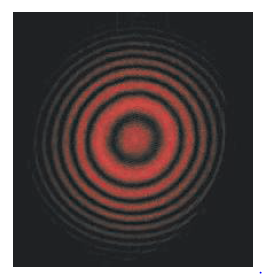
A Michelson interferometer is set up to display constructive interference (a bright central spot in the fringe pattern of Figure 33.25) using light of wavelength λ. If the wavelength is changed to λ/2, does the central spot remain bright, does the central spot become dark,
A diffraction grating produces a first-order maximum at an angle of 20.0°. What is the angle of the second-order maximum?
A diffraction grating is illuminated simultaneously with red light of wavelength 660 nm and light of an unknown wavelength. The fifth-order maximum of the unknown wavelength exactly overlaps the third-order maximum of the red light. What is the unknown wavelength?
A helium-neon laser (λ = 633 nm) illuminates a diffraction grating. The distance between the two m = 1 bright fringes is 32 cm on a screen 2.0 m behind the grating. What is the spacing between slits of the grating?
In a single-slit experiment, the slit width is 200 times the wavelength of the light. What is the width (in mm) of the central maximum on a screen 2.0 m behind the slit?
A helium-neon laser (λ = 633 nm) illuminates a single slit and is observed on a screen 1.5 m behind the slit. The distance between the first and second minima in the diffraction pattern is 4.75 mm. What is the width (in mm) of the slit?
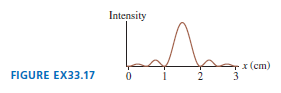
Light of 630 nm wavelength illuminates a single slit of width 0.15 mm. FIGURE EX33.17 shows the intensity pattern seen on a screen behind the slit. What is the distance to the screen? Intensity TAm х (ст) 3 FIGURE EX33.17 2
A 0.50-mm-wide slit is illuminated by light of wavelength 500 nm. What is the width (in mm) of the central maximum on a screen 2.0 m behind the slit?
A laser beam illuminates a single, narrow slit, and the diffraction pattern is observed on a screen behind the slit. The first secondary maximum is 26 mm from the center of the diffraction pattern. How far is the first minimum from the center of the diffraction pattern?
A Michelson interferometer uses red light with a wavelength of 656.45 nm from a hydrogen discharge lamp. How many brightdark-bright fringe shifts are observed if mirror M2 is moved exactly 1 cm?
You need to use your cell phone, which broadcasts an 800 MHz signal, but you’re behind two massive, radio-wave absorbing buildings that have only a 15 m space between them. What is the angular width, in degrees, of the electromagnetic wave after it emerges from between the buildings?
For what slit-width-to-wavelength ratio does the first minimum of a single-slit diffraction pattern appear at(a) 30°,(b) 60°,(c) 90°?
Light from a helium-neon laser (λ = 633 nm) is incident on a single slit. What is the largest slit width for which there are no minima in the diffraction pattern?
Two 50@mm@wide slits spaced 0.25 mm apart are illuminated by blue laser light with a wavelength of 450 nm. The interference pattern is observed on a screen 2.0 m behind the slits. How many bright fringes are seen in the central maximum that spans the distance between the first missing order on one
A laser beam with a wavelength of 480 nm illuminates two 0.12-mm-wide slits separated by 0.30 mm. The interference pattern is observed on a screen 2.3 m behind the slits. What is the light intensity, as a fraction of the maximum intensity I0, at a point halfway between the center and the first
A 0.50-mm-diameter hole is illuminated by light of wavelength 550 nm. What is the width (in mm) of the central maximum on a screen 2.0 m behind the slit?
Infrared light of wavelength 2.5 μm illuminates a 0.20-mm diameter hole. What is the angle of the first dark fringe in radians? In degrees?
You want to photograph a circular diffraction pattern whose central maximum has a diameter of 1.0 cm. You have a heliumneon laser (μ = 633 nm) and a 0.12-mm-diameter pinhole. How far behind the pinhole should you place the screen that’s to be photographed?
Your artist friend is designing an exhibit inspired by circular aperture diffraction. A pinhole in a red zone is going to be illuminated with a red laser beam of wavelength 670 nm, while a pinhole in a violet zone is going to be illuminated with a violet laser beam of wavelength 410 nm. She wants
Light from a helium-neon laser (λ = 633 nm) passes through a circular aperture and is observed on a screen 4.0 m behind the aperture. The width of the central maximum is 2.5 cm. What is the diameter (in mm) of the hole?
Moving mirror M2 of a Michelson interferometer a distance of 100 mm causes 500 bright-dark-bright fringe shifts. What is the wavelength of the light?
A Michelson interferometer uses light from a sodium lamp. Sodium atoms emit light having wavelengths 589.0 nm and 589.6 nm. The interferometer is initially set up with both arms of equal length (L1 = L2), producing a bright spot at the center of the interference pattern. How far must mirror M2 be
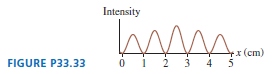
FIGURE P33.33 shows the light intensity on a screen 2.5 m behind an aperture. The aperture is illuminated with light of wavelength 620 nm. a. Is the aperture a single slit or a double slit? Explain.b. If the aperture is a single slit, what is its width? If it is a double slit, what is the spacing
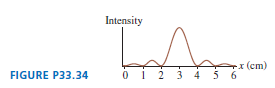
FIGURE P33.34 shows the light intensity on a screen 2.5 m behind an aperture. The aperture is illuminated with light of wavelength 620 nm. a. Is the aperture a single slit or a double slit? Explain.b. If the aperture is a single slit, what is its width? If it is a double slit, what is the spacing
Light from a helium-neon laser (λ = 633 nm) is used to illuminate two narrow slits. The interference pattern is observed on a screen 3.0 m behind the slits. Twelve bright fringes are seen, spanning a distance of 52 mm. What is the spacing (in mm) between the slits?
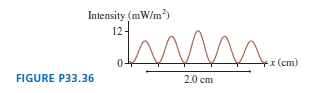
FIGURE P33.36 shows the light intensity on a screen behind a double slit. The slit spacing is 0.20 mm and the wavelength of the light is 620 nm. What is the distance from the slits to the screen? Intensity (mW/m) 124 ¥x(cm) FIGURE P33.36 2.0 cm
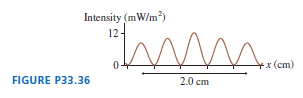
FIGURE P33.36 shows the light intensity on a screen behind a double slit. The slit spacing is 0.20 mm and the screen is 2.0 m behind the slits. What is the wavelength (in nm) of the light? Intensity (mW/m³) 124 ¥x(cm) FIGURE P33.36 2.0 cm
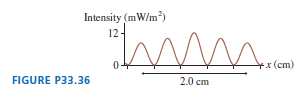
FIGURE P33.36 shows the light intensity on a screen behind a double slit. Suppose one slit is covered. What will be the light intensity at the center of the screen due to the remaining slit? Intensity (mW/m³) 124 ¥x(cm) FIGURE P33.36 2.0 cm
A diffraction grating having 500 lines/mm diffracts visible light at 30°. What is the light’s wavelength?
Helium atoms emit light at several wavelengths. Light from a helium lamp illuminates a diffraction grating and is observed on a screen 50.00 cm behind the grating. The emission at wavelength 501.5 nm creates a first-order bright fringe 21.90 cm from the central maximum. What is the wavelength of
A triple-slit experiment consists of three narrow slits, equally spaced by distance d and illuminated by light of wavelength l. Each slit alone produces intensity I1 on the viewing screen at distance L.a. Consider a point on the distant viewing screen such that the path-length difference between
Because sound is a wave, it’s possible to make a diffraction grating for sound from a large board of sound-absorbing material with several parallel slits cut for sound to go through. When 10 kHz sound waves pass through such a grating, listeners 10 m from the grating report “loud spots” 1.4 m
A diffraction grating with 600 lines/mm is illuminated with light of wavelength 510 nm. A very wide viewing screen is 2.0 m behind the grating.a. What is the distance between the two m = 1 bright fringes?b. How many bright fringes can be seen on the screen?
A 500 line/mm diffraction grating is illuminated by light of wavelength 510 nm. How many bright fringes are seen on a 2.0-m-wide screen located 2.0 m behind the grating?
White light (400–700 nm) incident on a 600 line/mm diffraction grating produces rainbows of diffracted light. What is the width of the first-order rainbow on a screen 2.0 m behind the grating?
A chemist identifies compounds by identifying bright lines in their spectra. She does so by heating the compounds until they glow, sending the light through a diffraction grating, and measuring the positions of first-order spectral lines on a detector 15.0 cm behind the grating. Unfortunately, she
a. Find an expression for the positions y1 of the first-order fringes of a diffraction grating if the line spacing is large enough for the small-angle approximation tan θ ≈ sin θ ≈ θ to be valid. Your expression should be in terms of d, L, and λ. b. Use your expression from part a
For your science fair project you need to design a diffraction grating that will disperse the visible spectrum (400–700 nm) over 30.0° in first order.a. How many lines per millimeter does your grating need?b. What is the first-order diffraction angle of light from a sodium lamp (λ = 589 nm)?
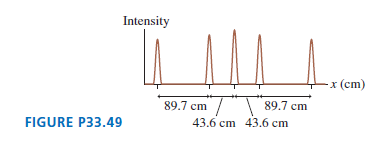
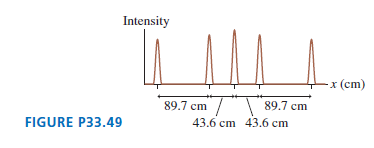
FIGURE P33.49 shows the interference pattern on a screen 1.0 m behind an 800 line/mm diffraction grating. What is the wavelength (in nm) of the light? Intensity x (cm) 89.7 cm 89.7 cm FIGURE P33.49 43.6 cm 43.6 cm
FIGURE P33.49 shows the interference pattern on a screen 1.0 m behind a diffraction grating. The wavelength of the light is 620 nm. How many lines per millimeter does the grating have? Intensity x (cm) 89.7 cm 89.7 cm FIGURE P33.49 43.6 cm 43.6 cm
Light from a sodium lamp (λ = 589 nm) illuminates a narrow slit and is observed on a screen 75 cm behind the slit. The distance between the first and third dark fringes is 7.5 mm. What is the width (in mm) of the slit?
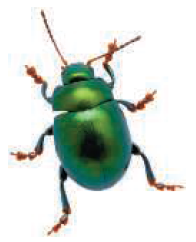
The wings of some beetles have closely spaced parallel lines of melanin, causing the wing to act as a reflection grating. Suppose sunlight shines straight onto a beetle wing. If the melanin lines on the wing are spaced 2.0 μm apart, what is the first-order diffraction angle for green light (λ =
If sunlight shines straight onto a peacock feather, the feather appears bright blue when viewed from 15° on either side of the incident beam of light. The blue color is due to diffraction from parallel rods of melanin in the feather barbules, as was shown in the photograph on page 940. Other
You’ve found an unlabeled diffraction grating. Before you can use it, you need to know how many lines per mm it has. To find out, you illuminate the grating with light of several different wavelengths and then measure the distance between the two first-order bright fringes on a viewing screen 150
A diffraction grating has slit spacing d. Fringes are viewed on a screen at distance L. Find an expression for the wavelength of light that produces a first-order fringe on the viewing screen at distance L from the center of the screen.
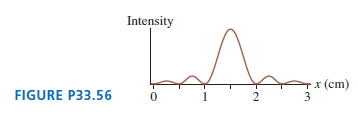
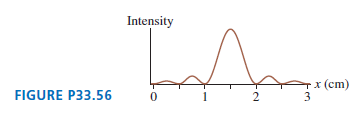
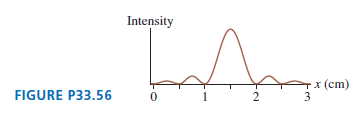
FIGURE P33.56 shows the light intensity on a screen behind a single slit. The slit width is 0.20 mm and the screen is 1.5 m behind the slit. What is the wavelength (in nm) of the light? Intensity Tx (cm) 3 FIGURE P33.56 2.
FIGURE P33.56 shows the light intensity on a screen behind a single slit. The wavelength of the light is 600 nm and the slit width is 0.15 mm. What is the distance from the slit to the screen? Intensity Tx (cm) 3 FIGURE P33.56 2.
FIGURE P33.56 shows the light intensity on a screen behind a circular aperture. The wavelength of the light is 500 nm and the screen is 1.0 m behind the slit. What is the diameter (in mm) of the aperture? Intensity Tx (cm) 3 FIGURE P33.56 2.
A student performing a double-slit experiment is using a green laser with a wavelength of 530 nm. She is confused when the m = 5 maximum does not appear. She had predicted that this bright fringe would be 1.6 cm from the central maximum on a screen 1.5 m behind the slits.a. Explain what prevented
Scientists shine a laser beam on a 35-μm@wide slit and produce a diffraction pattern on a screen 70 cm behind the slit. Careful measurements show that the intensity first falls to 25% of maximum at a distance of 7.2 mm from the center of the diffraction pattern. What is the wavelength of the laser
Light from a helium-neon laser (λ = 633 nm) illuminates a circular aperture. It is noted that the diameter of the central maximum on a screen 50 cm behind the aperture matches the diameter of the geometric image. What is the aperture’s diameter (in mm)?
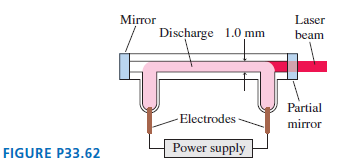
A helium-neon laser (λ = 633 nm) is built with a glass tube of inside diameter 1.0 mm, as shown in FIGURE P33.62. One mirror is partially transmitting to allow the laser beam out. An electrical discharge in the tube causes it to glow like a neon light.From an optical perspective, the laser beam is
Suppose you have two pinhole cameras. The first has a small round hole in the front. The second is identical except it has a square hole of the same area as the round hole in the first camera. Would the pictures taken by these two cameras, under the same conditions, be different in any obvious way?
One day, after pulling down your window shade, you notice that sunlight is passing through a pinhole in the shade and making a small patch of light on the far wall. Having recently studied optics in your physics class, you’re not too surprised to see that the patch of light seems to be a circular
A radar for tracking aircraft broadcasts a 12 GHz microwave beam from a 2.0-m-diameter circular radar antenna. From a wave perspective, the antenna is a circular aperture through which the microwaves diffract.a. What is the diameter of the radar beam at a distance of 30 km?b. If the antenna emits
Scientists use laser range-finding to measure the distance to the moon with great accuracy. A brief laser pulse is fired at the moon, then the time interval is measured until the “echo” is seen by a telescope. A laser beam spreads out as it travels because it diffracts through a circular exit
Light of wavelength 600 nm passes though two slits separated by 0.20 mm and is observed on a screen 1.0 m behind the slits. The location of the central maximum is marked on the screen and labeled y = 0.a. At what distance, on either side of y = 0, are the m = 1 bright fringes?b. A very thin piece
A 600 line/mm diffraction grating is in an empty aquarium tank. The index of refraction of the glass walls is nglass = 1.50. A helium-neon laser (λ = 633 nm) is outside the aquarium. The laser beam passes through the glass wall and illuminates the diffraction grating.a. What is the first-order
A Michelson interferometer operating at a 600 nm wavelength has a 2.00-cm-long glass cell in one arm. To begin, the air is pumped out of the cell and mirror M2 is adjusted to produce a bright spot at the center of the interference pattern. Then a valve is opened and air is slowly admitted into the
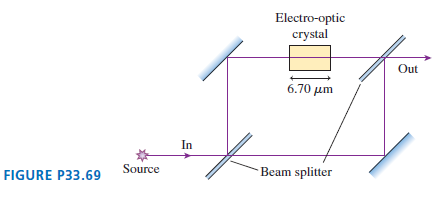
Optical computers require microscopic optical switches to turn signals on and off. One device for doing so, which can be implemented in an integrated circuit, is the Mach Zender interferometer seen in FIGURE P33.69. Light from an on-chip infrared laser (λ = 1.000 μm) is split into two waves that
To illustrate one of the ideas of holography in a simple way, consider a diffraction grating with slit spacing d. The small-angle approximation is usually not valid for diffraction gratings, because d is only slightly larger than λ, but assume that the λ/d ratio of this grating is small enough to
A double-slit experiment is set up using a helium-neon laser (λ = 633 nm). Then a very thin piece of glass (n = 1.50) is placed over one of the slits. Afterward, the central point on the screen is occupied by what had been the m = 10 dark fringe.How thick is the glass?
The intensity at the central maximum of a double-slit interference pattern is 4I1. The intensity at the first minimum is zero. At what fraction of the distance from the central maximum to the first minimum is the intensity I1? Assume an ideal double slit.
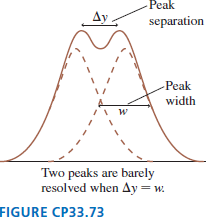
FIGURE CP33.73 shows two nearly overlapped intensity peaks of the sort you might produce with a diffraction grating (see Figure 33.9b). As a practical matter, two peaks can just barely be resolved if their spacing Δy equals the width w of each peak, where w is measured at half of the peak??s
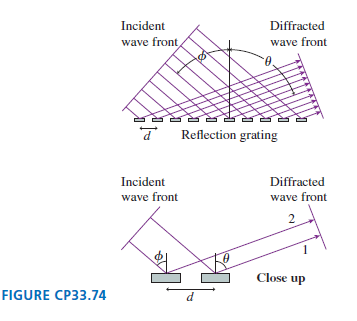
FIGURE CP33.74 shows light of wavelength λ incident at angle ϕ on a reflection grating of spacing d. We want to find the angles θmat which constructive interference occurs. a. The figure shows paths 1 and 2 along which two waves travel and interfere. Find an expression for the path-length
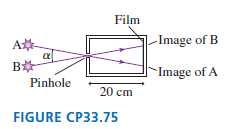
The pinhole camera of FIGURE CP33.75 images distant objects by allowing only a narrow bundle of light rays to pass through the hole and strike the film. If light consisted of particles, you could make the image sharper and sharper (at the expense of getting dimmer and dimmer) by making the aperture
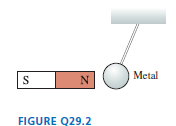
The metal sphere in FIGURE Q29.2 hangs by a thread. When the north pole of a magnet is brought near, the sphere is strongly attracted to the magnet. Then the magnet is reversed and its south pole is brought near the sphere. How does the sphere respond? Explain. Metal N FIGURE Q29.2
Determine the magnetic field direction that causes the charged particles shown in FIGURE Q29.8 to experience the indicated magnetic force. a. b. Finto page
Although the evidence is weak, there has been concern in recent years over possible health effects from the magnetic fields generated by electric transmission lines. A typical high-voltage transmission line is 20 m above the ground and carries a 200 A current at a potential of 110 kV.a. What is the
A 100 A current circulates around a 2.0-mm-diameter superconducting ring.a. What is the ring’s magnetic dipole moment?b. What is the on-axis magnetic field strength 5.0 cm from the ring?
A small, square loop carries a 25 A current. The on-axis magnetic field strength 50 cm from the loop is 7.5 nT. What is the edge length of the square?
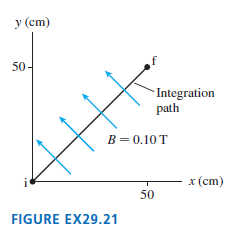
What is the line integral of B between points i and f in FIGURE EX29.21? у (cm) 50- - Integration path B= 0.10 T x (ст) 50 FIGURE EX29.21
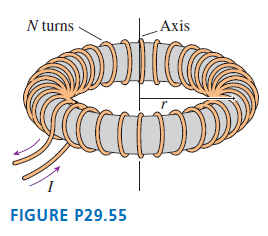
The toroid of FIGURE P29.55 is a coil of wire wrapped around a doughnut-shaped ring (a torus). Toroidal magnetic fields are used to confine fusion plasmas. a. From symmetry, what must be the shape of the magnetic field in this toroid? Explain.b. Consider a toroid with N closely spaced turns
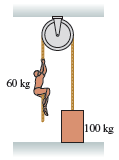
What is the tension in the rope of FIGURE EX7.17? Figure Ex 7.17 60 kg 100 kg
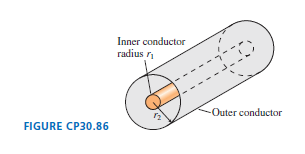
High-frequency signals are often transmitted along a coaxial cable, such as the one shown in FIGURE CP30.86. For example, the cable TV hookup coming into your home is a coaxial cable. The signal is carried on a wire of radius r1while the outer conductor of radius r2is grounded. A soft, flexible
A 2.0-cm-diameter solenoid is wrapped with 1000 turns per meter. 0.50 cm from the axis, the strength of an induced electric field is 5.0 × 10⁻⁴ V/m. What is the rate dI/dt with which the current through the solenoid is changing?
An 8.0 cm × 8.0 cm square loop is halfway into a magnetic field perpendicular to the plane of the loop. The loop’s mass is 10 g and its resistance is 0.010 Ω. A switch is closed at t = 0 s, causing the magnetic field to increase from 0 to 1.0 T in 0.010 s.a. What is the induced current in the
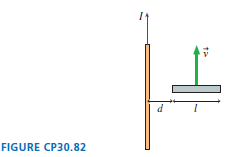
The metal wire in FIGURE CP30.82 moves with speed v parallel to a straight wire that is carrying current I. The distance between the two wires is d. Find an expression for the potential difference between the two ends of the moving wire. d FIGURE CP30.82
In recent years it has been possible to buy a 1.0 F capacitor. This is an enormously large amount of capacitance. Suppose you want to build a 1.0 Hz oscillator with a 1.0 F capacitor. You have a spool of 0.25-mm-diameter wire and a 4.0-cm-diameter plastic cylinder. How long must your inductor be if
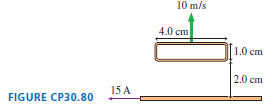
The rectangular loop in FIGURE CP30.80 has 0.020 Ω resistance. What is the induced current in the loop at this instant? 10 m/s 4.0 cm 1.0 cm 2.0 cm 15 A FIGURE CP30.80
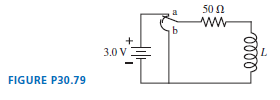
5.0 μs after the switch of FIGURE P30.79 is moved from a to b, the magnetic energy stored in the inductor has decreased by half. What is the value of the inductance L? 50 0 b 3.0 V FIGURE P30.79
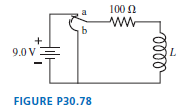
To determine the inductance of an unmarked inductor, you set up the circuit shown in FIGURE P30.78. After moving the switch from a to b at t = 0 s, you monitor the resistor voltage with an oscilloscope. Your data are shown in the table: Time (μs) ........................Voltage
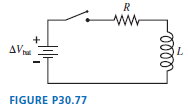
The switch in FIGURE P30.77 has been open for a long time. It is closed at t = 0 s. a. After the switch has been closed for a long time, what is the current in the circuit? Call this current I0.b. Find an expression for the current I as a function of time. Write your expression in terms of I0, R,
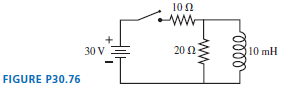
The switch in FIGURE P30.76 has been open for a long time. It is closed at t = 0 s. What is the current through the 20 Ω resistor a. Immediately after the switch is closed?b. After the switch has been closed a long time?c. Immediately after the switch is reopened? 10 0 30 V = 20 10 mH FIGURE
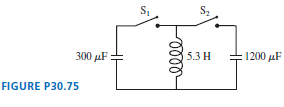
The 300 μF capacitor in FIGURE P30.75 is initially charged to 100 V, the 1200 μF capacitor is uncharged, and the switches are both open. a. What is the maximum voltage to which you can charge the 1200 μF capacitor by the proper closing and opening of the two switches?b. How would you do it?
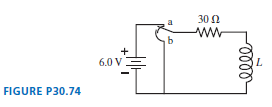
The inductor in FIGURE P30.74 is a 9.0-cm-long, 2.0-cm diameter solenoid wrapped with 300 turns. What is the current in the circuit 10 μs after the switch is moved from a to b? 30 N + 6.0 V FIGURE P30.74 ell
For your final exam in electronics, you’re asked to build an LC circuit that oscillates at 10 kHz. In addition, the maximum current must be 0.10 A and the maximum energy stored in the capacitor must be 1.0 × 10⁻⁵ J. What values of inductance and capacitance must you use?
An electric oscillator is made with a 0.10 μF capacitor and a 1.0 mH inductor. The capacitor is initially charged to 5.0 V. What is the maximum current through the inductor as the circuit oscillates?
An LC circuit is built with a 20 mH inductor and an 8.0 pF capacitor. The capacitor voltage has its maximum value of 25 V at t = 0 s.a. How long is it until the capacitor is first fully discharged?b. What is the inductor current at that time?
The current through inductance L is given by I = I0 e-t/τ.a. Find an expression for the potential difference ΔVL across the inductor.b. Evaluate ΔVL at t = 0, 1.0, and 3.0 ms if L = 20 mH, I0 = 50 mA, and τ = 1.0 ms.
The current through inductance L is given by I = I0 sin ωt.a. Find an expression for the potential difference ΔVL across the inductor.b. The maximum voltage across the inductor is 0.20 V when L = 50 mH and f = 500 kHz. What is I0?
A 3.6 mH inductor with negligible resistance has a 1.0 A current through it. The current starts to increase at t = 0 s, creating a constant 5.0 mV voltage across the inductor. How much charge passes through the inductor between t = 0 s and t = 5.0 s?
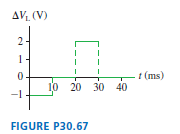
FIGURE P30.67 shows the potential difference across a 50 mH inductor. The current through the inductor at t = 0 s is 0.20 A. Draw a graph showing the current through the inductor from t = 0 s to t = 40 ms. AV (V) 2 1 1 (ms) 10 20 30 40 FIGURE P30.67
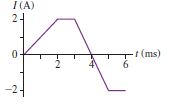
FIGURE P30.66 shows the current through a 10 mH inductor. Draw a graph showing the potential difference ΔVLacross the inductor for these 6 ms. I (A) 2- t (ms) 6 -2
One possible concern with MRI (see Exercise 28) is turning the magnetic field on or off too quickly. Bodily fluids are conductors, and a changing magnetic field could cause electric currents to flow through the patient. Suppose a typical patient has a maximum crosssection area of 0.060 m2. What is
A solenoid inductor has an emf of 0.20 V when the current through it changes at the rate 10.0 A/s. A steady current of 0.10. A produces a flux of 5.0 μWb per turn. How many turns does the inductor have?
Equation 30.26 is an expression for the induced electric field inside a solenoid (r < R). Find an expression for the induced electric field outside a solenoid (r > R) in which the magnetic field is changing at the rate dB/dt.
Showing 1300 - 1400
of 3693
First
7
8
9
10
11
12
13
14
15
16
17
18
19
20
21
Last
Step by Step Answers

 Get 50% OFF
Claim Now
Get 50% OFF
Claim Now