New Semester
Started
Get
50% OFF
Study Help!
--h --m --s
Claim Now
Question Answers
Textbooks
Find textbooks, questions and answers
Oops, something went wrong!
Change your search query and then try again
S
Books
FREE
Study Help
Expert Questions
Accounting
General Management
Mathematics
Finance
Organizational Behaviour
Law
Physics
Operating System
Management Leadership
Sociology
Programming
Marketing
Database
Computer Network
Economics
Textbooks Solutions
Accounting
Managerial Accounting
Management Leadership
Cost Accounting
Statistics
Business Law
Corporate Finance
Finance
Economics
Auditing
Tutors
Online Tutors
Find a Tutor
Hire a Tutor
Become a Tutor
AI Tutor
AI Study Planner
NEW
Sell Books
Search
Search
Sign In
Register
study help
physics
the physics energy
The Physics of Energy 1st edition Robert L. Jaffe, Washington Taylor - Solutions
Assuming that the particles in Problem 18.1 that react are removed from the beam, use the result of that problem to show that the beam current falls exponentially I(z) = I0e−z/λ through the target. Find an expression forλ, which is the mean free path of the particles passing through the target.
Suppose a beam of particles with flux Φ is incident on a uniform target of thickness T and density ρ(mass/volume). Assuming that the atoms in the target do not block one another (the thin-target approximation),show that the reaction rate dN/dt is given by dN/dt = IσρNAT/m, where I is the beam
The uranium isotope 234U accounts for 0.0054% of naturally occurring uranium. Its half-life τ1/2 (234U) =2.455 × 10⁵ y is much too short for any primordial 234U to still exist on Earth. Explain why 234U occurs naturally and explain its fractional abundance. Use the result of Problem
In light of the results of Problem 17.22, what is the rate of energy emission (J/kg) of a sample of 238U that has been around long enough to come into decay equilibrium?
When one of the naturally occurring radioactive heavy elements like 238U decays, a decay chain follows, leading to the creation of various unstable,radioactive descendant nuclides. Consider a sample known to be pure 238U at time zero. Suppose that none of its decay products migrate away from the
97% of naturally occurring calcium is calcium-40,4020Ca. This may seem surprising, since if we use the semi-empirical mass formula to estimate the most stable nuclide with A = 40 we find Z ≈ 18. This suggests that 4020Ca might be unstable to electron capture, which would increase its N/Z ratio.
Ignoring small electron binding energies and the very small mass of the neutrino, show that the mass of a nucleus increases when it decays by electron capture if the Q-value of the decay is less than mec2 ? 0.511 MeV. Verify that this is the case for the electron capture decay of the longest-lived
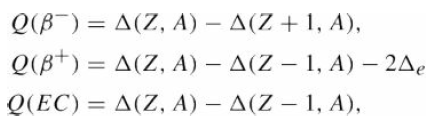
Verify the expressions for the Q-value in ??-decay and electron capture, eq. (17.34)? Q(B¯) = A(Z, A) – A(Z + 1, A), Q(B+) = A(Z, A) – A(Z – 1, A) – 2Ae Q(EC) = A(Z, A) - A(Z – 1, A),
Check that 3He is less tightly bound than 3H. Explain why 3H decays to 3He, and not vice versa.
Examine the derivation of Gamow’s formula for α-decay lifetimes, and then derive the equivalent expression for decay by emission of a (small) nucleus of charge z and mass number a. Assume a/A is small enough to ignore recoil. Make sure that the z and a dependence are explicit. Compare your
Radon gas 22286Rn is a serious environmental hazard(see §20). It is a decay product of 23892U, which is a relatively common constituent of rock. 22286Rn undergoesα-decay to 21884Po. When 22286Rn is created in the foundation of a house, it diffuses out into the basement airspace. If its lifetime
235U can decay by emitting a neon nucleus. How many such decays occur per second per mole of 235U?
Show that the longest-lived isotope of radium, 22688Ra,is energetically allowed to decay by emission of a146C nucleus. This decay has been observed with aprobability of 3.2 × 10⁻⁹.
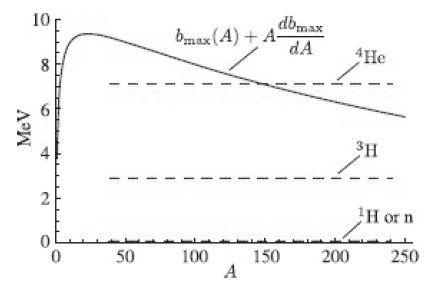
Explain how to read from Figure 17.8? the Q-value for?-decay predicted by the SEMF.? 10 dbmax bmax (A) + A dA 4He 3H 'H or n 50 100 150 200 250 A MeV
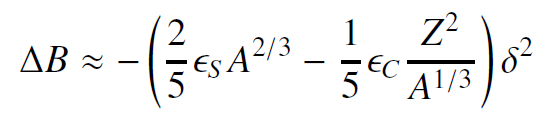
The maximum value of A for which nuclei are stable against instantaneous fission can be estimated as follows. When a charged, spherical nucleus, AZ, with surface tension is deformed into an ellipsoid leaving its volume constant, it is possible to compute the change in its binding energy as a
Check the assertion in the text that the SEMF predicts that nuclei have positive binding energy up to A ∼ 3150.
Derive eq. (17.20) ?by differentiating the SEMF expression for b(Z, A) with respect to Z at fixed A.? A/2 1+7.52 x 10⁻³ A²/3 A/2 Zmin (A) 1+CA2/3 4E sym
Find the SEMF prediction for Zmin(A = 200) from eq. (17.20) Find the actual value of Z that gives the greatest binding energy for A = 200. How well does the SEMF do?? A/2 1+7.52 x 10⁻³ A²/3 A/2 Zmin (A) 1+CA2/3 4E sym
Pressure can be defined as the rate of change of energy with volume, p = ∂E/∂V. Similarly, the surface analogue of pressure, surface tension, is defined as the rate of change of energy with surface area a, σ ≡ ∂E/∂a at constant volume. Ignoring the effects of symmetry,Coulomb, and
Estimate the density of a nucleus by assuming it to be a sphere of radius R0 = 1.3 A1/3 fm. What would be the radius of a nucleus with the mass of Earth?
The radius of a nucleon is about RN = 0.9 fm. Compute the volume of a nucleus with a moderately large value of A in the liquid drop model (i.e. using the SEMF) and show that roughly 2/3 of the nucleus is “empty space.”In contrast, an atom is almost entirely empty space.
3He is so rare that?it must be produced artificially.One way to produce it is through a sequence of reactions that can be carried out in a nuclear reactor, where thermal neutrons are quite common. The reactions are:? Followed by Verify that both of these nuclear reactions are exothermic and
Helium three is an extremely rare but stable isotope of helium made up of two protons and only one neutron.Because 4He is so tightly bound, considerable energy is given off when 3He absorbs a neutron. This makes 3He a very good neutron detector. The nuclear reaction involved is n + 3He → 4He +
There is no stable nucleus with A = 5. This has profound consequences for the way stars burn and form elements. The two candidates for stable nuclei with A = 5 are 52He and 53Li. Look up or figure out what they decay into and show that their decays are allowed by energy conservation.
A typical fission reaction involving 235U is The kinetic energy of a thermal neutron is ?1/40 eV,small enough to ignore in the energy balance. Show that the energy released in the fission is 179.5 MeV. 235 92 U + n(thermal) 144 Ba + 2°Kr + 2n 90 Kr + 2n 56 36
Derive the relation quoted in eq. (17.7) ? between the binding energy of a neutral atom B(Z, A) and its mass excess ?(Z, A). B(Z, A) - ΝΔ n) + ΖΔ(| Η) -Δ(Ζ, A)
Assume that thorium can be converted 100% into 233U and used as a fission fuel. According to world thorium reserves are roughly 6 × 10⁶ tonnes. How long could this amount of thorium supply 100% of the world’s energy needs at the 2015 level?
Check the quoted estimate of 4 × 10⁹ tonnes of uranium from seawater quoted in this chapter. For how many years could this amount of uranium supply 100% of the world’s energy needs at the level of 2015?
In one scenario, enrichment of 200 t of natural uranium yields 26 t enriched to 4% 235U that is used to power a reactor for a year. How much 235U is lost in the depleted uranium discarded during the enrichment process? The spent nuclear fuel removed after a year in the reactor contains about 0.8%
Given the (higher) molar heat of combustion of gasoline (§11.2.2) and knowing its molecular weight, verify that it yields about 1/2 eV per nucleon in complete combustion.
The energy levels of the three-dimensional harmonic oscillator are given by En1,n2,n3 = (n1 +n2 +n3 + 3/2)ћω with n1,2,3 = 0, 1, . . .. Suppose three spin-1/2 fermions are trapped in a three-dimensional oscillator. What is the energy of the ground state? What is its degeneracy? (Remember that the
The energy levels of the one-dimensional harmonic oscillator are given by En = (n + 1/2)ћω with n = 0, 1, 2, . . . . Suppose two spin-1/2 fermions are trapped in a one-dimensional oscillator potential. What are the energies and degeneracies of the first three energy states of this system?
An experimenter seeks to use a sinusoidal potential of the form studied in Example 15.2 to make a one-dimensional trap to confine a number of electrons for further study. She places one electron in the ground state of each potential well. Each electron’s energy should be 0.1 eV and the
Compute the exact amplitude for transmission and reflection of a particle from a rectangular potential barrier of height V0?and width d by matching the wave function and its derivative at the boundary points x = 0, d. Note that, for a barrier that is high and wide, the leading term has the form of
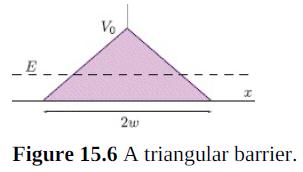
A particle of mass m and energy E encounters a triangular barrier of width 2w and height V0 (see Figure 15.6)Estimate the probability that it will tunnel through the barrier. How does the probability compare with that for a rectangular barrier of the same height and width? то?
Verify the barrier penetration factor obtained for the parabolic barrier in Box 15.2.
Consider the ground state and the first and second excited states of a simple harmonic oscillator as described in §7. Verify the statement made in the text that the probability of finding the particle outside the classically allowed region is 16% when the particle is in the ground state, and
A radioactive source is emitting on average 40 particles per second. In any particular one second interval, what is the probability that it emits 40 particles? 30 particles? None? What is the probability that it emits less than 40 particles?
Potassium-40 (40K) is a naturally occurring form of potassium whose β-decays are responsible for some of Earth’s geothermal energy. 40K can decay in two different ways. The probabilities per unit time for the two decay modes are λ1 = 4.9 × 10⁻¹⁰ y−1 and λ2 = 6.1 × 10⁻¹¹ y−1. What is
Uranium-238 and uranium-235 both decay by α- particle emission. Their measured half-lives are 4.5 × 10⁹ years and 7.0 × 10⁸ years respectively. At the present time the ratio of 235U to 238U in naturally occurring uranium is about 0.72%. It is believed that the uranium on Earth was formed in a
The first radioactive element discovered by Polish physicist Marie Curie was radium-226. It has a halflife of 1700 years. Suppose you obtained a microgram of pure 226Ra. How long would you have to wait before the number of decays per second from this sample fell to 104?
To get a sense of the potential practical relevance for energy purposes of one aspect of as-yet-undiscovered physics, consider proton decay. Making the most general assumptions about the nature of its decay, the lifetime of the proton is currently bounded by τproton > 2.1 × 1029 y. Assume that
Einstein?s energy?momentum relation for a particle of mass m with momentum p is? Estimate the uncertainty in the x, y, and z components of the momentum of a quark confined in a (cubic) box of side length L = 1 fm using the Heisenberg uncertainty principle ?px,y,z & ?/L. Approximate 2> by
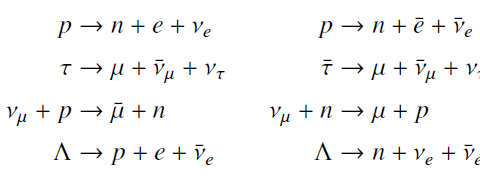
Which of the following interactions are consistent with the conservation laws for baryon number, electric charge, and the three lepton numbers? Don?t worry about energy conservation. (A bar denotes an antiparticle. See Question 14.4 for information about the ? particle.)? p → n + e + Ve p → n
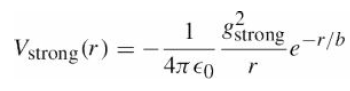
Show that the combination of constants g2strong/ (4??0?c), where gstrong is defined in eq. (14.5) is dimensionless. It is taken as a dimensionless measure of the strength of an interaction. Compute this quantity for electromagnetism (g ? e), where it is known as the fine structure constant and
In principle, and in the absence of electromagnetic or any other non-gravitational interactions, an electron and a proton should form a ?gravitational atom,? bound by the force of gravity. We know that the energy of the ground state of the ordinary hydrogen atom is given by eq. (14.4) Show that
A rocket fuel should have high energy density (per kilogram) because the weight of the propellant is an important consideration. A favorite fuel is liquid hydrogen plus liquid oxygen. What is the energy density (J/kg) of a stoichiometric mixture of H2(l) and O2(l) (assuming they combine to form
Verify the assertion made in §13.5.2 that the net efficiency of a CCGT is ηnet = ηB + ηR(1 − ηB), where ηB/R is the efficiency of the Brayton/Rankine cycle.
Calculate and plot the ratio of the efficiency of the Brayton cycle to the efficiency of the Otto cycle with the same compression ratio (with γ = 1.4).
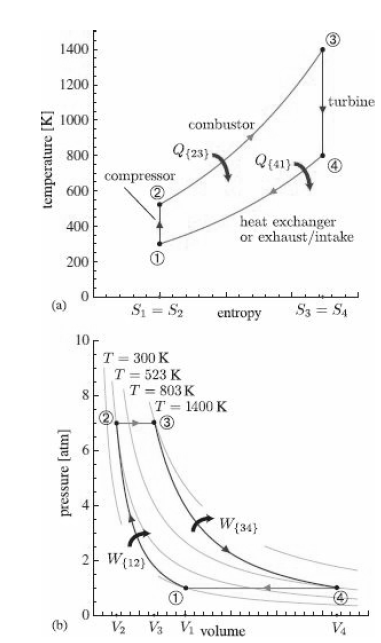
Show that the ratio of the back work (the work necessary to run the compressor) to the total work done by the turbine for the ideal Brayton cycle is W{12}/W{34} = T1/T4. Check your result by comparing to the result stated in the text for the conditions shown in Figure 13.19 1400 1200 turbine 1000
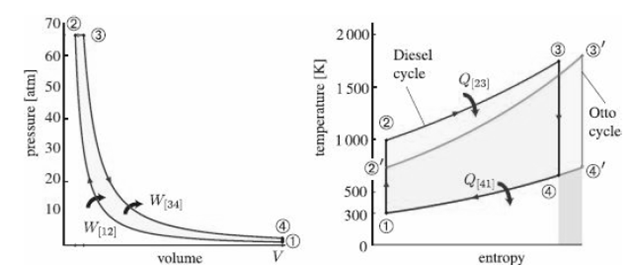
Explain why the Brayton and Otto cycles look so different in the pV-plane even though they are quite similar in the S T-plane.
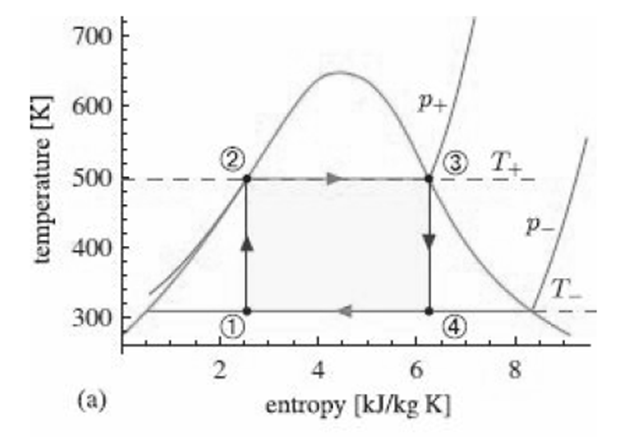
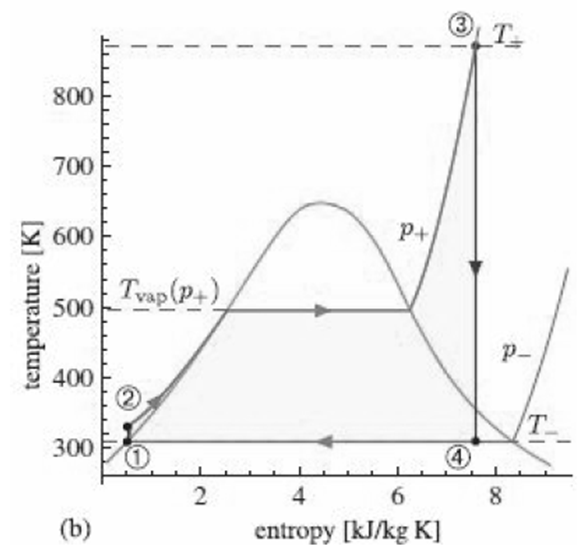
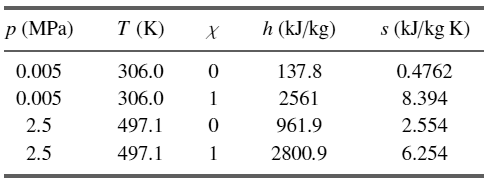
The wear on a steam turbine could be decreased by raising the pressure at the turbine outlet so that the quality of the steam at the outlet is one. In the ideal Rankine cycle of Example 13.2 and Figure 13.12χ = 0.9 at the turbine outlet. Keeping the p+, T+, and T3 unchanged, determine p− and
Modify the coal plant Rankine cycle described in §13.3.5 by including a regeneration cycle similar to the one shown in Figure 13.16(b)A fraction f of the steam is removed from the turbine and returned back to a second pump at a temperature Tr = 130 ◦C. Compute the fraction f needed to heat the
Quantitatively compare the Carnot Rankine cycle of Figure 13.12(a) with the ideal Rankine cycle of Figure 13.12(b) Compare efficiencies and the work done per cycle. All the necessary information about the ideal Rankine cycle can be found in Example 13.2. The required information for the Carnot
Suppose the condenser in the 500 MWe coal power plant we analyzed in is cooled by a once through system, where water taken from the ocean is circulated once through the plant and then returned to the ocean. If regulations permit only a 10 ◦C rise in the ocean water temperature, how much
When we designed the Rankine steam cycle in §13.3.5 we ignored the circulating water’s kinetic and potential energy, having claimed earlier that they are negligible. Using the work per unit mass done by the turbine to set the energy scale, estimate the importance of the potential energy of the
Sketch the ideal Rankine cycle on a pV-diagram including the saturation dome. Label the points ➀–➃. As in Figure 12.7plot the logarithm of the specific volume on the horizontal axis. 700 K 40 650 K 20 600 K 10 550 K X. 500 K 0.005 0.01 specific volume [m/kg] 0.001 0.05 0.1 0.5 (a) critical 40
Neglecting the work done by the pump (which is a good approximation), show that the efficiency of the ideal Rankine cycle is η = (h3 −h4)/(h3 −h2), where hj is the specific enthalpy at the point j in the cycle.
The 5-ton AC unit designed in §13.2.5 reached 33% of the Carnot limit on CoP. Look back at the definition of the “Energy Efficiency Ratio” in Problem 10.12, which employs a different temperature range than the one we specified. Assuming that the unit’s fraction of the Carnot limit remains
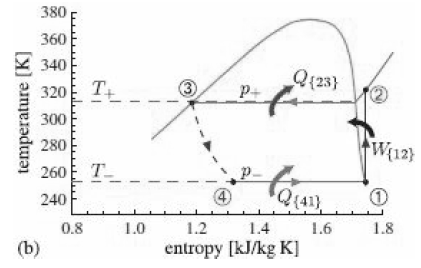
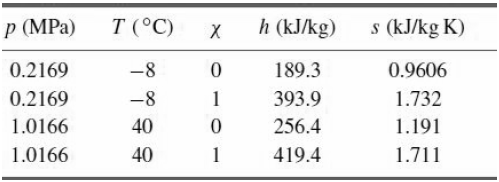
A heat pump based on the ideal VC cycle of Figure 13.5(b) uses the refrigerant R-134a to heat a house. The set points are T? = ?8 ?C, T+ = 40 ?C. What is the CoP; how does it compare with the Carnot limit? What flow rate (m? ) in kg/s is required to provide heat at 50 kW? Relevant thermodynamic
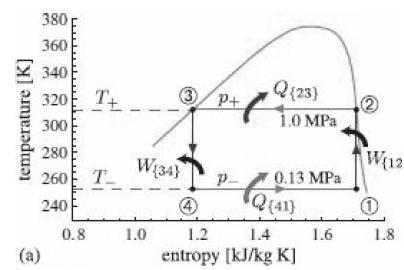
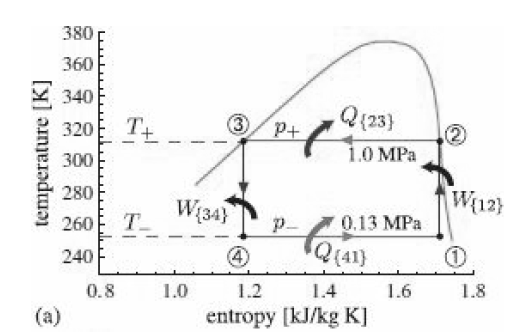
Sketch the Carnot-like VC cycle of Figure 13.5(a) in the pV plane (superimposed on the saturation dome), and contrast the resulting shape with that of the Carnot cooling cycle. 380 360 K 340 Q(23) 320 TŁ (3) 10 МPа 300 280 W{34} W12 0.13 MPa p- Q(41} 260 240 1.4 entropy [kJ/kg K] 0.8 1.0 1.2
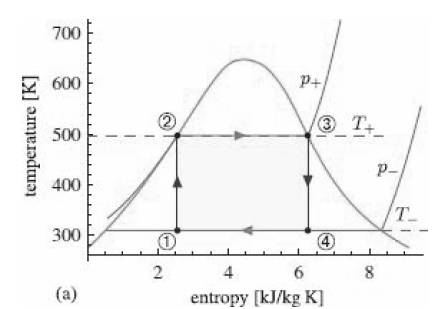
Prove that the Carnot-like vapor-compression cooling cycle {1234} in Figure 13.5(a) has a maximum CoP that equals the Carnot limit regardless of the properties of the working fluid. Likewise, prove that the efficiency of the simplest Rankine power cycle {1234} of Figure 13.12(a) ?equals the
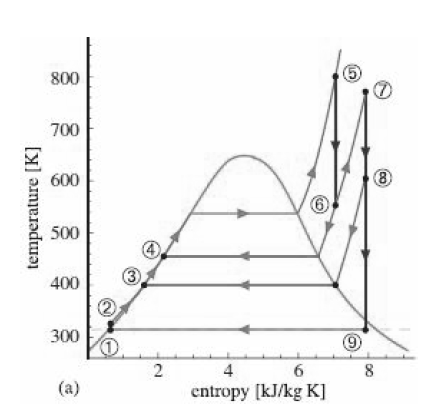
Consider the modified Rankine cycle of Figure 13.17(a) Describe what happens to a quantity of water as it executes the cycle starting at . How many pumps and how many turbines are needed? 800 700 600 8 500 3 400 300 9, 2 4 6. (a) entropy [kJ/kg K] temperature [K]
On a hot summer day in Houston, Texas, the day time temperature is 35 ◦C with relative humidity φ =50%. An air conditioning system cools the indoor air to 25 ◦C. How much water (kg/m3) must be removed from this air in order to maintain a comfortable indoor humidity of 40%? Compare your answer
Repeat the preceding question for a sample at 10 atm with the same specific enthalpy.Preceding questionA sample of H O at a pressure of 1 atm has a specific enthalpy of 700 kJ/kg. What is its temperature? What state is it in, a sub-cooled liquid, superheated vapor, or a mixed phase?
A sample of H2O at a pressure of 1 atm has a specific enthalpy of 700 kJ/kg. What is its temperature? What state is it in, a sub-cooled liquid, super heated vapor, or a mixed phase? If it is in a mixed phase, what fraction is liquid?
A steam turbine can be modeled as an is entropic expansion. The incoming steam is super heated at an initial temperature T+ and pressure p+. After expansion, the exhausted steam is at temperature T−. A high-performance turbine cannot tolerate low-quality steam because the water droplets degrade
Revisit Question 12.2 quantitatively. Specifically, what is the pressure in the cylinder when the system comes to equilibrium after the volume has been doubled at−20 ◦C? What is the pressure after the cylinder has been heated to 110 ◦C? What fraction of the water in the cylinder is in vapor
Using the data given in Table 12.1, find the deviations from the ideal gas law for water vapor just above the boiling point at p = 105 Pa. For example, does V/n = RT/p?Table 12.1 p(Tsat) 1x 10° Pa (99.61°C) 1.2 x 10° Pa (104.78 °C) h Temp [°C] [m*kg] [m*/kg] [kJ/kg] [kJ/kg] [kJ/kg K] [kJ/kg]
An industrial freezer is designed to use ammonia (NH3)as a working fluid. The freezer is designed so that ammonia flowing through tubes inside the freezer at p− vaporizes at T = −40 ◦C, drawing heat out of the interior. Outside the freezer, the ammonia vapor at T = +45 ◦C liquefies at a
Data on the heat flux for laminar flow of liquid water and for pool boiling of water are shown in Figure 12.4.Take the bulk temperature of the fluid in the case of laminar flow to be T0 = 25 ◦C and assume that the pool boiling process takes place at 1 atm.(a) Suppose the two methods are used to
Consider a volume of 100 L of water, initially in liquid form at temperature Ti, to which ΔU = 25 MJ of energy is added from an external reservoir at temperature Tr through a thermal resistance, so that the rate of energy transfer is Q̇ = (1 kW/K)(Tr − T), where T is the instantaneous
Using the data given in Table 12.1, estimate the enthalpy added to one kilogram of water that undergoes the following transformations: (a) From 0 ◦C to 90 ◦C at p = 105 Pa; (b) From 95 ◦C to 105 ◦C at p = 105 Pa; (c) From 95 ◦C to 105 ◦C at p = 1.2 × 10⁵ Pa. Table
Check that the svap and hvap quoted in Table 12.1 are consistent with Δh = Δu + pΔv and Δs = Δh/T.Table 12.1 p(Tsat) 1x 10° Pa (99.61°C) 1.2 x 10° Pa (104.78 °C) h Temp [°C] [m*kg] [m*/kg] [kJ/kg] [kJ/kg] [kJ/kg K] [kJ/kg] [k/kg] [kJ/kg K] Sat. Lig. 1.0432 x 10 3 Evap. Sat. Vap. 3.
Suppose two engines, one SI, the other CI, have the same temperature range, T1 = 300K and T3 = 1800K. Suppose the SI engine, modeled as an ideal Otto cycle, has a compression ratio of 10:1, while the CI engine, modeled as an ideal Diesel cycle, has twice the compression ratio, 20:1. Using cold air
A marine diesel engine has a compression ratio r = 18 and a cutoff ratio rc = 2.5. The intake air is at p1 =100 kPa and T1 = 300K. Assuming an ideal cold air standard Diesel cycle, what is the engine’s efficiency? Use the ideal and adiabatic gas laws to determine the temperature at points ➁,
Consider the Otto and Diesel cycles shown in Figure 11.13? The parameters have been chosen so both cycles have the same heat input and the same low temperature and pressure set point. Explain why the difference between the Diesel cycle efficiency and the Otto cycle efficiency is proportional to the
Consider a throttled Otto cycle for an engine with the same parameters as Problem 11.1. In the throttled cycle assume that the spent fuel–air mixture is ejected at 1 atm and brought in again at 0.5 atm. Compute the work done per cycle. Compute the associated pumping loss. Subtract from the work
(Requires results from Problem 11.3) Consider the same engine as in Problem 11.3 but now run as an Atkinson cycle. The volume after expansion (V4) is still 2 L, but the volume before compression (V1b) is 1.54 L. The compression ratio is still 9.6:1, so the minimum volume is V2 = 0.16 L. What is the
An SI engine, modeled as an ideal Otto cycle, runs at a compression ratio of 9.6:1 with a maximum cylinder volume (V1) of 2 L and a corresponding displacement of 1.8 L. Combustion leads to a maximum temperature of T3 = 1800K. Using the air standard value of γ = 1.3, find the engine
The cold air standard value of γ = 1.4 was based on the heat capacity of a diatomic gas with no vibrational excitation (see §9), CV = 5/2 nR and Cp = CV + nR. In reality, the heat capacity increases with increased temperature, and γ decreases accordingly. If we assume, however, that CV is
Assume that an SI engine has the following parameters : displacement (V1 − V2): 2.4 L; compression ratio 9.5:1; air to fuel mass ratio 15:1; heating value of fuel 44MJ/kg, pressure at start of compression 90 kPa, intake temperature 300K. Compute the pressure, volume, and temperature at each of
Air conditioners are rated by their Energy Efficiency Ratio, or EER, defined as the cooling power Pr (in Btu/h), divided by the total electric power input Pe (in watts), measured with T+ = 95 ◦F and T− = 80 ◦F: EER = Pr[BTU/h]/Pe [W]. US energy efficiency standards require central air
An air conditioner run on electricity and based on a (ideal) Carnot cycle operates between temperatures T− = 25 ◦C and T+ = 40 ◦C. The gas in the air conditioner has γ = 1.75. The AC is designed to remove 10000 BTU/h from a living space. How much electric power does it draw? Suppose the gas
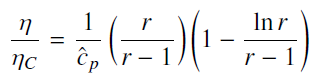
Consider the cycle proposed in Question 10.3 quantitatively. Assume that it is executed reversibly. Show that its efficiency ? relative to the efficiency ?C of a Carnot engine operating between the same temperature limits is given by Where c?p = Cp/NkB is the heat capacity per molecule at constant
Mirrors are used to concentrate sunlight and heat a molten salt mixture to 500K. A heat engine is then used to convert the thermal energy to useful mechanical form. Compare a Carnot engine to a Stirling engine with the same operating parameters. In each case the engine operates between the maximum
Stirling engines generate more work per cycle than Carnot engines operating under the same conditions. Find the ratio WCarnot/W Stirling for engines run with the same compression ratio, r = V1/V3, and temperature ratio T+/T−. Assume the working fluid is an ideal gas.
Consider a Carnot engine cycle operating between a maximum temperature of T3 = T4 = 400 ◦F and a minimum temperature of T1 = T2 = 60 ◦F. Assume that the lowest pressure attained is p1 = 1 atm, the highest pressure is p3 = 9 atm, and the minimum volume of the working gas space is V3 = 1 L. Take
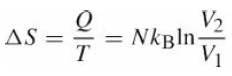
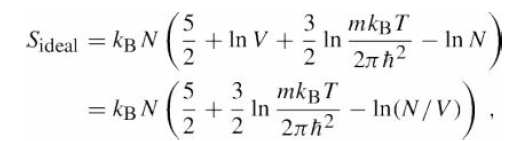
Show that the changes in entropy found for iso thermal and isometric heating of an ideal gas (eqs.Andagree with the prediction from the Sackur? Tetrode equation? AS = 10 V Vi = NkBln-
Describes a thermo electric generator and mentions that the materials used should have large See beck coefficient S , small poor thermal conductivity k, and good electrical conductivity σ. Use dimensional analysis to show that Z = σS2ΔT/k is the unique dimension less figure of merit for the
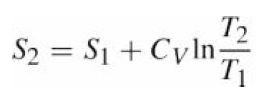
In isobaric heating (and expansion), heat is added reversibly to a gas kept at constant pressure. Find the change in volume and entropy when a sample of an ideal, monatomic gas, initially at temperature T1, volume V1, and pressure p is heated isobarically to T2. Plot the system’s path in the pV-
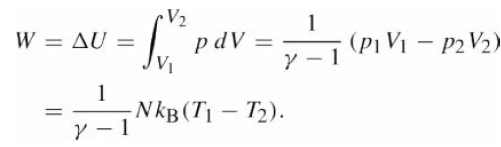
Derive eq. V2 pdV = 1 (Pi V1 – P2V2) W = AU %3D %3D 1 - NkB (T1 – T2). Y - 1
By how much does the temperature drop in the example of adiabatic expansion in Example 10.2?
Show that the method of refining tin explained in Example 9.3 will not work for alumina.
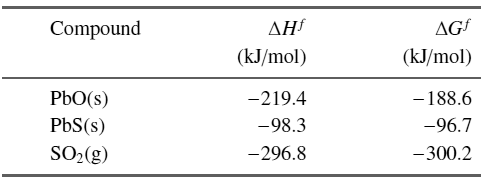
Show that roasting lead (2PbS + 3O2? 2 PbO +2 SO2) is an exothermic reaction and compute the free energy of this reaction under standard conditions. See Table for data. Compound ΔΗ AGƒ (kJ/mol) (kJ/mol) PbO(s) -219.4 -188.6 PbS(s) -98.3 -96.7 SO2(g) -296.8 -300.2
An inexpensive hand warmer uses an exothermic chemical reaction to produce heat: iron reacts with oxygen to form ferric oxide, Fe2O3. Write a balanced chemical reaction for this oxidation process. Compute the energy liberated per kilogram of iron. Assuming that your hands each weigh about 0.4
Thermite is a mixture of powdered metallic aluminum and iron oxide (usually Fe2O3). Although stable at room temperature, the reaction 2Al + Fe2O3 →Al2O3+ 2 Fe proceeds quickly when thermite is heated to its ignition temperature. The reaction itself generates much heat. Thermite is used as an
Acetylene (used in welding torches) C2H2, sucrose(cane sugar) C12H22O11, and caffeine C8H10O2N4, are all popular energy sources. Their heats of combustion are 310.6 kcal/mol, 1348.2 kcal/mol, and 1014.2 kcal/mol, respectively. Which substance has the highest specific energy density (kJ/kg)?
Estimate the lower heating value of a typical cord of wood by first estimating the mass of the wood and then assuming that this mass is completely composed of cellulose (Problem 9.16). Compare your answer with the standard value of 26 GJ. Real “dried” fire wood(density 670 kg/m3) contains a
Wood contains organic polymers such as long chains of cellulose (C6H10O5)n, and is commonly used as abiofuel. Write a balanced equation for the complete combustion of one unit of the cellulose polymer to water and CO2. Note that hydrogen and oxygen are already present in the ratio 2:1. Make a crude
Showing 700 - 800
of 953
1
2
3
4
5
6
7
8
9
10
Step by Step Answers

 Get 50% OFF
Claim Now
Get 50% OFF
Claim Now












![700 P+ 600 о т. 500 p- 400 т. 300 4 6. (a) entropy [kJ/kg K] 3, т. 800 700 P+ 600 Tvap (P) 500 p- 400 т. 300 4 8. (](https://dsd5zvtm8ll6.cloudfront.net/si.question.images/images/question_images/1547/7/3/0/4685c407e24ad0c11547713112571.jpg)
![800 700 p. 600 500 Tregen 6. 400 1-f 300 т. p- 4 (b) entropy [kJ/kg K] temperature [K] 2.](https://dsd5zvtm8ll6.cloudfront.net/si.question.images/images/question_images/1547/7/2/6/1475c406d438691c1547708791667.jpg)
![700 K 40 650 K 20 600 K 10 550 K X. 500 K 0.005 0.01 specific volume [m/kg] 0.001 0.05 0.1 0.5 (a) critical 40 point 20](https://dsd5zvtm8ll6.cloudfront.net/si.question.images/images/question_images/1547/7/2/6/3665c406e1ece5c91547709010890.jpg)
![p(Tsat) 1x 10° Pa (99.61°C) 1.2 x 10° Pa (104.78 °C) h Temp [°C] [m*kg] [m*/kg] [kJ/kg] [kJ/kg] [kJ/kg K] [kJ/kg] [k/kg] [kJ/kg K] Sat. Lig. 1.0432 x 10 3 Evap. Sat. Vap. 3. 439.23 1.0473 x 10 1.4274 439.36 2243.7 2683.1 1.3609 5.9368 417.40 417.40 1.3028 1.6929 6.0560 2088.2](https://dsd5zvtm8ll6.cloudfront.net/si.question.images/images/question_images/1607/6/7/0/9095fd31c7d467341607670907728.jpg)
![p(Tsat) 1x 10° Pa (99.61°C) 1.2 x 10° Pa (104.78 °C) h Temp [°C] [m*kg] [m*/kg] [kJ/kg] [kJ/kg] [kJ/kg K] [kJ/kg] [k/kg] [kJ/kg K] Sat. Lig. 1.0432 x 10 3 Evap. Sat. Vap. 3. 439.23 1.0473 x 10 1.4274 439.36 2243.7 2683.1 1.3609 5.9368 417.40 417.40 1.3028 1.6929 6.0560 2088.2](https://dsd5zvtm8ll6.cloudfront.net/si.question.images/images/question_images/1607/6/7/0/8765fd31c5c00d561607670874621.jpg)
![p(Tsat) 1x 10° Pa (99.61°C) 1.2 x 10° Pa (104.78 °C) h Temp [°C] [m*kg] [m*/kg] [kJ/kg] [kJ/kg] [kJ/kg K] [kJ/kg] [k/kg] [kJ/kg K] Sat. Lig. 1.0432 x 10 3 Evap. Sat. Vap. 3. 439.23 1.0473 x 10 1.4274 439.36 2243.7 2683.1 1.3609 5.9368 417.40 417.40 1.3028 1.6929 6.0560 2088.2](https://dsd5zvtm8ll6.cloudfront.net/si.question.images/images/question_images/1607/6/7/0/7185fd31bbecc95c1607670717130.jpg)