New Semester
Started
Get
50% OFF
Study Help!
--h --m --s
Claim Now
Question Answers
Textbooks
Find textbooks, questions and answers
Oops, something went wrong!
Change your search query and then try again
S
Books
FREE
Study Help
Expert Questions
Accounting
General Management
Mathematics
Finance
Organizational Behaviour
Law
Physics
Operating System
Management Leadership
Sociology
Programming
Marketing
Database
Computer Network
Economics
Textbooks Solutions
Accounting
Managerial Accounting
Management Leadership
Cost Accounting
Statistics
Business Law
Corporate Finance
Finance
Economics
Auditing
Tutors
Online Tutors
Find a Tutor
Hire a Tutor
Become a Tutor
AI Tutor
AI Study Planner
NEW
Sell Books
Search
Search
Sign In
Register
study help
physics
the physics energy
The Physics of Energy 1st edition Robert L. Jaffe, Washington Taylor - Solutions
If all land area in the US that is used for growing corn for ethanol were used for solar thermal electric plants operating at a gross conversion efficiency of 3%, estimate the total electrical energy yearly produced assuming an average insolation of 200 W/m2. Compare to US energy consumption of
The fossil fuel energy input currently needed for ammonia production is roughly 36 GJ/t (§33.3.4). Estimate the energy needed to produce ammonia containing 90 Mt of nitrogen. Compare to the biomass energy of 18 EJ in 40% of all food crops that is estimated to be enabled through fertilizer inputs.
A feedlot cow is fed 12 kg of corn daily for 255 days, and grows from 200 kg to 500 kg in that time. Estimating the energy densities of corn and cow both at roughly 15 MJ/kg (a very rough estimate, actually more of an overestimate for the cow), compute the ratio of corn energy input to cow energy
Estimate the total food energy needed for the planet’s population assuming a diet of 2400 Calories/day/person. Compare to the global food production rate stated in the text.
The enthalpy of combustion of glucose (C6H12O6) is roughly 15.6 MJ/kg. Compute the fraction of incident solar energy from 8 photons with wavelength 680 nm stored through the reaction (26.2)in a single CH2O unit. n(8y + CO2 + H20) → C„H2,On + nɔ2
The thickness of the germanium (density 5.32 gm/c m 3) layer in a triple-junction PV is typically greater than 100 microns. If the overall cell efficiency is 40%, how many watts of PV capacity (nominal insolation of 1000 W/m2) could be manufactured from the world’s annual germanium
Assuming a silicon P V array attains 20% efficiency over a lifetime of 25 years of use, where it is exposed to an average of 250 W/ m2, what is the total energy output of 1 m2 of PV cells (in joules). What quantity of coal would it replace (at 33% net efficiency)?
Use the photo diode equation (25.17)to compute Iphoto/I0 for a silicon solar cell with Voc = 0.7 V. Write the power as a function of voltage and compute the fill factor, the maximum power IV attainable as a fraction of IphotoVoc. Repeat the calculation for cells with Voc = 0.5 and 0.86 V and
The direct band gap in silicon is 3.4 eV. What is the maximum possible collection efficiency (for incident thermal radiation at 6000 K) for excitations over this gap?
Estimate the maximum possible collection efficiency ηmaxcollection for a germanium solar cell (Egap ≅ 0.66 eV).
Determine the maximum concentration C of a solar concentrator satisfying σT4 = CI0, where I0 is the solar constant, directly from the second law of thermodynamics and the surface temperature of the Sun.
For the power tower geometry from the previous problem, assume that the absorber height is equal to its diameter, and that the diameter is that found in part (b) above. If all the light from an overhead sun that hits the circle of radius 100 m containing the reflecting mirrors were to be reflected
Consider a solar thermal “power tower” with a central tower of height 60 m, surrounded by an array of planar mirrors on the ground extending to a radius of 100 m around the tower. At the top of the tower there is a cylindrical absorber with its axis aligned vertically. Each mirror is large
Consider an idealized flat-plate solar collector with no conduction or convection losses, and with insolation 1000W/m2 incident at an angle of 45◦ from the vertical. Assume that the collector is horizontal and is covered with a pane of glass transparent to incoming radiation but opaque to
Consider the examples of single- and double-pane glass-covered collectors described in §24.2.1. Verify the quoted results for the efficiency as a function of Tb, Tg, and I0. In the case of double glazing, compute the temperature of the intermediate glass plate. Plot the efficiency as a function of
Consider a flat-plate collector covered by a single pane of glass exposed to perpendicular insolation at 1000 W/m2. The collector operates at a net efficiency of 35% at a temperature Tb ≅ 65 ◦C. Assuming that the glass covering stays at the ambient temperature of 15 ◦C, compute the net power
Analyze the double pane glass-covered collector described in §24.1.2 and illustrated in Figure 24.14. Tg is assumed to be fixed at ≈ 300 K by conduction and convection and I0 ≈ 1000 W/m2. Write the equations of radiative equilibrium and show that Tb ≈ 180 ◦C.
Consider an idealized flat-plate solar collector. Assume that there are no heat losses to conduction or convection. Assume that the insolation is 1000 W/m2 incident at an angle of 45◦ from the vertical. Compute the temperature of the black body in radiative equilibrium assuming that (a)
Suppose that the surface temperature of the Sun were to increase by 3% from the current value, assuming for simplicity that the radius of the Sun stays fixed. By how much would the solar constant on Earth increase? If, at present, Earth radiates away an amount of energy equal to the current
The population of the city of Cambridge in the state of Massachusetts is around 100 000. Assume that each resident of Cambridge uses energy at the rate of 1 GJ per day. If the average insolation in the area is 150 W/m2, compute the area of land needed to supply all the energy for the
Suppose a gas has an absorption cross section per molecule σ(ω) for light of frequency ω (see §18.2 for an introduction to cross sections). Show that the gas’s absorption coefficient is given by κ(ω) =σ(ω)ρ, where ρ is the number density of gas molecules.
For your location, calculate the maximum instantaneous irradiance (at the top of the atmosphere) on the days of the summer and winter solstices. Now suppose Earth’s obliquity were 0◦. How large would the eccentricity of its orbit have to be to produce the same difference in irradiance between
Consider a location for a solar energy installation in Arizona, at latitude 34◦. Compute the declination δon the following dates: (i) March 20 (spring equinox),(ii) April 20. Compute the length of the day (from sun rise to sunset) at this location in Arizona on April 20.Assuming a clear day,
Show that the insolation averaged over the year and over the entire Earth is ≅ 341 W/m2.
The average radius of Mars’ orbit is 2.28 × 10⁸ km. Compute the solar constant for Mars.
In ?7, we showed that the energy of a particle of mass M in an L ? L ? L box in the state labeled |n, m, l? is E n, m, l = ?2?2(n2 + m2 + l2)/2ML2. The probability of finding a particle in the state |n, m, l? at temperature T is given by the Boltzmann distribution P(n, m, l) ? exp(?E n, m, l/kBT).
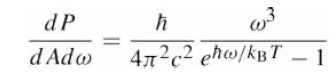
Show that the classical Rayleigh?Jeans law for radiation follows from eq. (22.13) ? in the limit as ? ? 0.. Show that the total power radiated diverges in this limit (the ultraviolet catastrophe that helped lead to the discovery of quantum mechanics). dP d Ado 2,2 eħw/kBT - 1
Use dimensional analysis to show that the wavelength scale of blackbody radiation is given by λth = hc/kBT . The average radiation energy in a cavity depends only on its volume and not on its shape when λth ≪ L, , where L is a typical length scale characterizing the cavity. How low must the
Rewrite the black body power spectrum as a function of ? and compute the value ?max?where the power density dP/d? is maximized. Find the frequency ? corresponding to ?max. Why is ? not equal to ?max, where ?max is given by eq. (22.14) ? Compare ?max?to 2?c/?max for a black body at temperature 5780
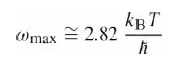
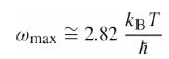
Show that the peak of the black body spectrum as a function of ? is given by eq. (22.14) kg T Wmax = 2.82
Show that the combination of the Boltzmann factor and the tunneling probability give a probability for fusion that is maximized at Emax ≈ (bkBTc/2)2/3, as stated in §22.1.1.
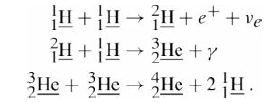
Compute the energy released in each step of the solar PPI fusion chain eq. (22.5) and confirm that the total energy released matches? eq. (22.6) l + |11 → {U + e+ + H + H → He + Y He + He + He +2 |H. + ve
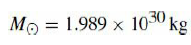
Estimate the gravitational energy in the Sun, using eqs. (22.1) and (22.2) assuming that the mass is distributed uniformly. Can you confirm the statement in the text that gravitational potential energy could only power the Sun at its present luminosity for ?107 y?? At what rate would the radius
Compute the frequency ωmax corresponding to the maximum power of radiation for a blackbody at temperature T = 280 K. This is roughly the average temperature of Earth’s surface. Compute the wavelength corresponding to this frequency.
The incandescent light bulb is a notoriously inefficient way to convert electric power into visible light. The tungsten filament emits blackbody radiation at a temperature that is limited by its melting point. Define the lighting efficiency as the ratio of the power emitted in the visible range
Estimate the rate of thermal radiation from a household hot-water radiator with a surface area of 1 m2 and a temperature of 80℃.
Compute the power radiated in the visible range from the toaster oven coil radiating with a total power of 1500 W, as described in Example 22.1.
Compute or estimate the fraction of radiated thermal energy that is in the visible range (wavelength 400–750 nm) for the following two radiation spectra: (a) solar radiation, assumed to be perfect blackbody radiation at 5780 K; (b) EM radiation from a pot of boiling water, again assume a perfect
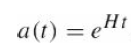
An object moving at the speed of light along thex-axis in the metric (21.35) of an inflating universe satisfies x?(t)eHt = c. Assuming x(0) = 0, compute x(t).Show that x(t) never exceeds the value c/H. Ht а () — еНі
Show that two space-time points (0, 0, 0, 0) and(t, x = vt, 0, 0) that lie on the trajectory of an object traveling at speed v along the x-axis are separated by a distance satisfying Δ2 = 0 if and only if |v| = c. Use the relativistic in variance of Δ2 to show that the speed of light is the same
Consider the circumstances described in Problem 21.8, but now suppose that Δ2 < 0. Use the transformation defined in Problem 21.7 to show that there is a reference frame traveling at a speed v < c in which the two events occur at the same place, but different times. Show that the time order
Consider two events seen by observer (1), who chooses her coordinates so that the first event occurs at the space-time origin x?1 = (0, 0, 0, 0), while the second event occurs at x??1 = ( c? t1, x?1, 0, 0). Suppose ?2 for the two events see eq. (21.24) is positive. Use the transformation defined
The relativistic transformation law that relates the coordinates seen by an observer (2) moving at velocity v relative to an observer (1) is x2 = (cosh ?)x1 ?(sinh ?)ct1, ct2 = (cosh ?)ct1 ? (sinh ?)x1, where sinh ?/ cosh ? = v/c.The similarity to rotation in Euclidean space by an angle?. Confirm
According to special relativity, the speed of light should be the same as seen by two observers moving at different relative velocities. In Newtonian physics, an observer (2) moving at a velocity v in the x-direction relative to an observer (1) labels the x-coordinate of an event by x2 = x1 − vt,
Consider a particle of mass m moving in two dimensions, bound in a central potential V(r), so that its Hamiltonian is H = T(p) + V(r), where T(p) = (p2x+ p2y)/2m. Show that the quantity D = xpx + ypy is not a constant of the motion by computing D? = {D, H}.Compute D? for the special case that V(r)
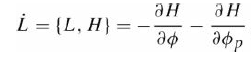
Consider motion in the xy-plane governed by a Hamiltonian H(px , py, x, y). Introduce polar coordinates x = r cos?, y = r sin ?, px = p cos ?p, py = p sin ?p, and use the chain rule for partial derivatives,e.g. ?H/?? = (?H/?x)(?x/??) + (?H/?y)(?y/??), etc.,to derive eq. (21.17). i = {L, H}
Confirm by explicit computations the assertions made in Example 21.1 that the Hamiltonian is invariant under translation and rotation so that total momentum and angular momentum are conserved.
The equation of motion of a classical harmonic oscillator subject to an external time-dependent force F(t) is m̈x = −kx + F(t). Show that the oscillator’s energy is not conserved, but that its time dependence dE/dt can be related to the power delivered to the oscillator by the agent supplying
Consider a situation in which, through accident or ill-intention, all the spent nuclear fuel from a year’s operation of a 1 GWe light water reactor were uniformly distributed across one square kilometer of land 1000 years after the waste is sequestered. Using the information in the chapter,
In §20.6.1 it was stated that approximately 21 t of SNF are removed yearly from a 1 GWe reactor operating at 33% efficiency. Assuming that the spent fuel contains 0.9% unconsumed 235U and that the reactor derives 1/3 of its power from burning 239Pu created during normal operation, determine the
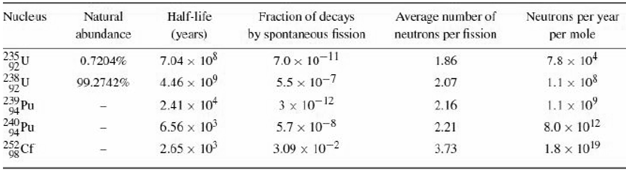
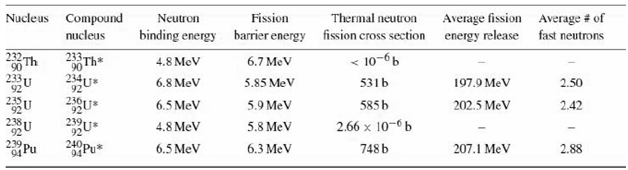
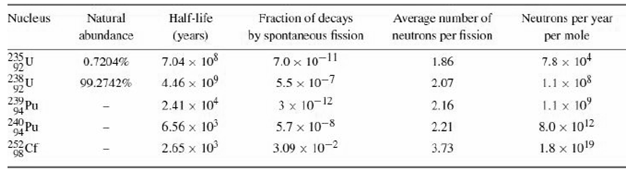
Using the data from Table 18.2, compute the spontaneous fission rate (in Bq/kg) for 240Pu . Compare this with the rate in 239Pu and in uranium enriched to 85% 235U. (See Problem 20.10.) Table 18.2? Average number of neutrons per fission Half-life Fraction of decays by spontaneous fission Nucleus
40K accounts for 0.0117% of naturally occurring potassium and potassium accounts for about 0.2% of the human body mass.Considering only the dominant decay of 40K, which yields a β-decay electron of average energy 0.56 MeV, compute the average annual dose of radiation from potassium inside the body
Particle physics experiments are shielded from cosmic ray muons by placement underground, often in old mines. Cosmic ray muons have been detected at 2000 feet below ground at the Home stake Gold Mine in South Dakota. Estimate a lower limit on the energy of these muons when created high in the
The flux of cosmic ray muons at sea level is about one per square centimeter per minute. Given their mass stopping power of2 MeV cm2 /gm, and their weighting factor , wμ = 1 estimate an average person’s (living at sea level) equivalent dose in mSv/y from cosmic ray muons.
According to the text, roughly 10–15% of lung cancer deaths in the US are due to radon exposure. Use the LNT model and average yearly effective dose from radon to estimate the cancer rate from this source.
Rubidium-87, 87 Rb is a relatively common, very long-lived nuclide. Look up and compare its abundance and lifetime to 40K. How does 87 Rb decay? Why do you think it was omitted from the list of important naturally occurring radio nuclei?
131I is a dangerous fission product because iodine is preferentially absorbed by the thyroid gland in children. It has a half-life of about 8 days and emits a β-particle with average energy 180 keV. (Ignore theγ-radiation that accompanies this decay (see Example 20.2.)) How much mass of 131I
A nuclear accident has exposed a 70 kg worker to 1 Ci of 2 MeV photons for about one minute. Assuming that all the energy of absorbed photons is deposited in the body, with uniform distribution,what absorbed dose of radiation has the worker suffered? What effective dose? What would have been his
Thermal neutrons wandering through biological tissue are most likely to be absorbed by 1H, 12C, or 16O. If absorption is accompanied by emission of a single γ-ray, what are the γ-ray energies produced in these three cases?
In §20.3.1 it is stated that activity a is often used as measure of the mass of radio nuclide in a sample m. Show that for a radio nuclide with half-life t1/2 and atomic mass A, this relationship ism ≅ A t1/2 [sec] a [Ci] 8.87 x 10⁻¹⁷ kg.
The mass attenuation coefficients (μ/ρ) for 1.5 MeV photons inconcrete (ρ = 2.35 g/cm3) and lead (ρ=11.4 g/cm3) are both about 0.5 cm2/g. How thick must concrete or lead shielding be in order to absorb 99% of these 1.5 MeV γ-rays?
To a first approximation for computing stopping power, living tissue can be approximated as water. Using data on the range of protons in water, estimate the energy of a proton required to place its Braggpeak on a tumor at a depth of 10 cm inside a body.
Using the results of Problem 20.3, compare the range of a 2 MeV α-particle in water, air, and bone. (The density of bone is approximately 1100 kg/m3).
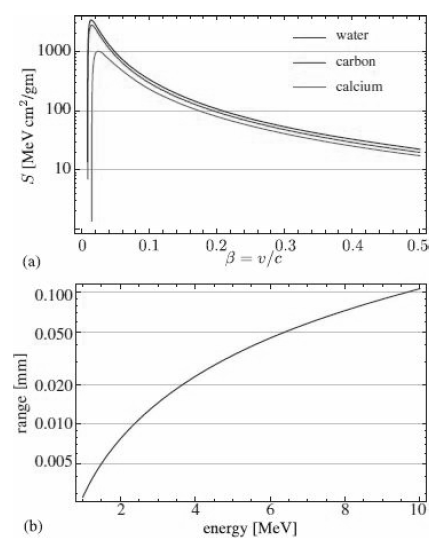
Show that in any material, the range of an ?-particle and a proton with the same speed are the same (in the approximation that m? = 4mp). Using Figure 20.3 find the range of a 2 MeV proton in water. water 1000 carbon calcium 100 10 0.1 0.3 0.23 = v/c 0.4 0.5 (a) %3D 0.100 0.050 0.020 0.010 0.005
Show that a particle’s range (see §20.2.1) expressed as a function of its initial velocity is proportional to its mass and inversely proportional to the square of its charge and to the electron density of the material.
Estimate a lower limit on the number of collisions a 1 MeV proton must make with atomic electrons before its energy is reduced to 10 eV. Why is it reasonable to ignore the atomic binding energy of the electrons in this estimate?
Show that the maximum energy transfer by a heavy particle with mass M and speed v to an electron initially at rest is 2mev2, hence the appearance of this factor in the formula for the stopping power.
Suppose a fusion power plant operates at the pressure (≈ 7 atm) and temperature (≈ 150 × 106 K) planned for ITER, and suppose the plasma volume equals that of ITER (840 m3) as well. Assuming that the plasma contains equal numbers of d and t nuclei, estimate how long such a fusion reactor could
A dt plasma fusion reactor is operating in steady state at a temperature kBT = 15 keV and a pressure of 7 atm, where 〈σfv〉 = 3 × 10⁻²² m3/s. What is the energy confinement time τE required to satisfy the triple product criterion? What is the density of the plasma (particles per cubic
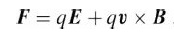
Show that a charged particle moving in the plane perpendicular to a constant magnetic field (eq. (19.29) moves in a circle with Br = mv/q. What is the radius of the circle for an electron with energy 15 keV in a 10 Tesla magnetic field (typical of ITER)? What is the radius for a proton? F = qE +
A thermal breeder reactor is fueled with a mixture of a fertile nucleus A (fraction 1 − x) which breeds a fissile nucleus B (fraction x). To breed more of B it is essential that the reproduction factor η(B) in thermal-neutron induced fission of B is greater than two. Express the maximum possible
A thermal-neutron reactor is charged every year with enriched uranium containing 1.6 t of 235U. When the spent fuel is removed, it contains 400 kg of 235U and 560 kg of 239Pu. Assuming a conversion ratio CR = 0.6, what fraction of the reactor power was generated by fission of 239Pu? (Ignore
A uranium enrichment facility produces nuclear reactor fuel enriched to 4% 235U to fuel the reactor whose power to fuel consumption ratio is described by eq. (19.15)For each tonne of natural uranium, the enrichment facility produces 130 kg of fuel. What is the concentration of 235U in the 870 kg of
When a reactor is turned off, the amount of 135Xe decreases as it decays, but grows as 135I decays to it. Write a pair of differential equations that describe the time rate of change of the numbers NI and NX of 135I and 135Xe nuclei respectively, and solve these equations assuming that NI = N0I and
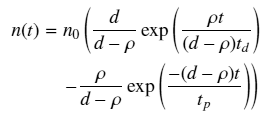
The analysis of prompt and delayed neutrons in ?19.1.6 leads to the following formula for the time dependence of the neutron density, Analyze the time dependence of n(t) when ? d. For example, take tp = 2 ? 10?4 s, td = 12.5 s, and d = 0.0064, and compute n(t)/n(0) for ? = d/2 and ? = 2d. pt d
Suppose a pressurized water reactor is loaded with 200 tons of 3% enriched uranium. The reactor has been designed to run with an average thermal-neutron flux of ??n??= 1.5?1013 cm?2 s?1 for a period of four years before refueling. You can assume that ?n is held constant the whole time, ignore
An approximate description of the Oklo uranium deposit is 90% uraninite (UO2) by mass, saturated with water that acted as the moderator. Assume that the Oklo deposit was homogeneously saturated with water with a ratio of 3.5 uranium nuclei per water molecule and compute the minimum enrichment
It is estimated that the Oklo reactor occurred when the ratio of 235U to 238U was 3.67%. Given the present ratio of 0.72% and the half-lives of both isotopes, estimate the time when the Oklo reactor was active.
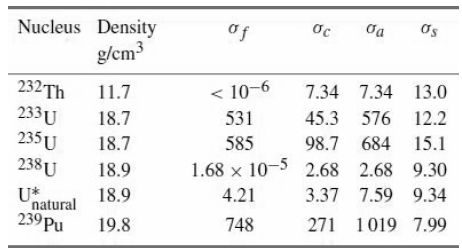
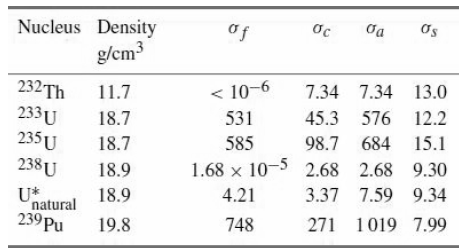
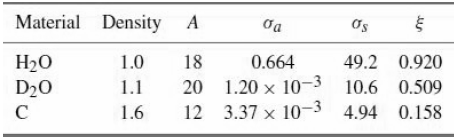
Show that an infinite, homogeneous reactor fueled with natural uranium (0.72% 235U) and moderated by heavy water (D2O) can sustain a fission chain reaction. What is the optimal ratio of moderator to fuel?
Consider an infinite, homogeneous reactor fueled with uranium enriched to 3% and moderated by graphite with a ratio of graphite : uranium of 800 : 1. Find k?. To find p, you can ignore the uranium when computing ??? ?and in the calculation of the scattering cross section. (You can assume ? =
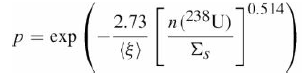
Show from eq. (19.9) that in an infinite, homogeneous graphite-moderated reactor, the resonance escape probability is given by p(y) = exp(?17.28 (1/(9.3 + 4.9y))0.514), where y is the ratio of moderator to fuel. 0.514 2.73 n(238 U) Es p = exp ($)
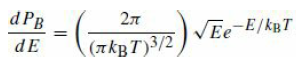
Starting from the Maxwell–Boltzmann distribution, eq. (18.10)for the probability of finding a particle with energy E in a gas with temperature T, show that the most probable speed for a particle is v̅ = √2kBT/m, but that the average speed of a particle is 〈v〉 = √8kBT/πm. Verify that the
Tritium is just barely unstable. How much more tightly would tritium have to be bound in order for it to bestable? Write the nuclear reaction describing tt fusion.How much energy is emitted in tt fusion? Unfortunately the cross section for tt fusion is much smaller than that for dt fusion, so even
The energy released per nucleon for (a) fission of 235U; (b) dt fusion.
Estimate the quantity of tritium (kg/year) required to fuel a 1 GWe fusion power plant assuming 20% overall efficiency.
Show that in d+t → n+4He fusion reaction, the ratio of the kinetic energy on the neutron to that on the 4He is 4:1 if you neglect the initial kinetic energies of the reactants.Why is this a good approximation in terrestrial fusion experiments?
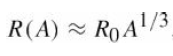
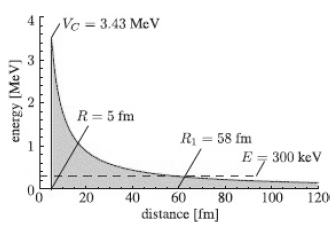
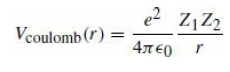
The Coulomb barrier keeping two nuclei apart is given by V(r) = Z1Z2e2/(4??0r), where r is the relative separation of the two nuclei. Assume that V reaches its maximum value VC when r ? R1 + R2, where Rj is the radius of the jth nucleus. Using eq. (17.10) estimate the Coulomb barrier between a
The net reaction that accounts for the Sun’s power takes four neutral hydrogen atoms and fuses them to make a neutral helium atom, 4 11H→ 42He. Compute the energy released per hydrogen atom. The Sun’s total power output is L⊙ ≅ 3.85 × 1026W. How many protons per second are reacting
Show that the probability of finding a particle with energy greater than 0.2 MeV in a gas at temperature 15 × 106 K is ∼10−69.
Estimate the height of the Coulomb barrier between two protons as follows: the strong nuclear interaction potential between two protons at large separation is given by eq. (14.5) Add to this the repulsive Coulomb potential given in eq. (18.8) Show that there sulting potential has a maximum at ?
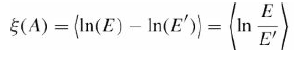
(a)?Derive the large A approximation to the logarithmic energy decrement given in eq. (18.5) (b) Show that the number of collisions with a nucleus with atomic mass A required to decrease the energy of a neutron from E0 = 2 MeV to Ef = 0.025 eV is N ? 18.2/?(A). Ķ(A) = (In(E) – In(E') = E In E'
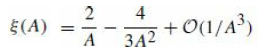
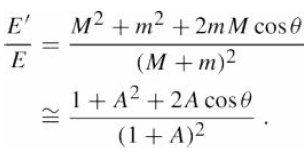
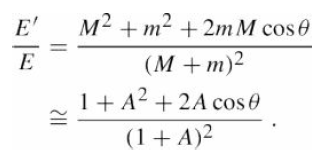
Derive the expression eq. (18.7)? for ?(A) by averaging over angles in the center-of-mass reference? frame.Take E/E? from eq. (18.4) and remember that the measure for averaging over ? is 1/2 sin ?d?. 2 4 + 0(1/A?) $(A) A 3A2
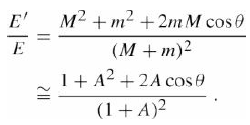
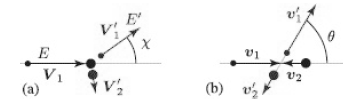
Verify the classical energy loss formula (18.4) For an elastic two-body collision. Use the notation in the Figure 18.8 Use the fact that the relationship between a velocity vector V in the target rest frame and the vector v in the center-of-mass frame is V = v + VCM,where VCM is the velocity of
Two sources of delayed neutrons in 235U fission are the fission fragments 87Br and 137I. Find the fraction of their decays that yield a neutron, and the half-life of each. Verify that the Q-value for the β-decay with neutron emission is positive.
When 235U fissions by absorbing a slow neutron, 93Zr is one of the most common fission fragments. Suppose three neutrons are given off in the fission. What is the other nucleus produced in this fission reaction?What is the total energy released in this particular fission reaction, including
An example of a thermal-neutron fission reaction isnth + 235U → 139Ba + 94Kr + 3n. Perform the analysis of Example 18.1 for this case.
Verify the statements made after eq. (18.2) About the energy released for the case of thermal-neutron induced fission of 235U. First, use measured mass excesses to show that the asymmetric fission reaction nth + 235U ? 92Kr + 144Ba has a smaller Q-value than the symmetric fission into two 118Pd
In §18.3.3 it is stated that a neutron in uranium is bound by ∼ 6 MeV. Check this by using data from [70] to compute the binding energy of a neutron
Given the data in Table 18.2 estimate the number of neutrons emitted by spontaneous fission per second per kilogram of naturally occurring uranium. Nucleus Natural Half-life Fraction of decays by spontaneous fission Average number of neutrons per fission Neutrons per year abundance (years) per
A beam of thermal neutrons with current? is incident on a uniform (thin) target of thickness 1 cm, consisting of 20% 235U and 80% 238U. Table 18.3? ? and Problem 18.1. What is the fission rate? What is the thermal power being deposited in the target? 1 = [ dAÐ = 108 s-1 S
Showing 600 - 700
of 953
1
2
3
4
5
6
7
8
9
10
Step by Step Answers

 Get 50% OFF
Claim Now
Get 50% OFF
Claim Now











![AM[t] = 3.3 x GW Arly] P 1.5Er af x NA AM](https://dsd5zvtm8ll6.cloudfront.net/si.question.images/images/question_images/1547/8/3/3/0935c420f05055041547815740529.jpg)