New Semester
Started
Get
50% OFF
Study Help!
--h --m --s
Claim Now
Question Answers
Textbooks
Find textbooks, questions and answers
Oops, something went wrong!
Change your search query and then try again
S
Books
FREE
Study Help
Expert Questions
Accounting
General Management
Mathematics
Finance
Organizational Behaviour
Law
Physics
Operating System
Management Leadership
Sociology
Programming
Marketing
Database
Computer Network
Economics
Textbooks Solutions
Accounting
Managerial Accounting
Management Leadership
Cost Accounting
Statistics
Business Law
Corporate Finance
Finance
Economics
Auditing
Tutors
Online Tutors
Find a Tutor
Hire a Tutor
Become a Tutor
AI Tutor
AI Study Planner
NEW
Sell Books
Search
Search
Sign In
Register
study help
physics
the physics energy
The Physics of Energy 1st edition Robert L. Jaffe, Washington Taylor - Solutions
Find the enthalpy of reaction for the two pathways of decomposition of TNT.
The convention we have used for LHV differs from the one offered by the US Department of Energy, which defines LHV as “the amount of heat released by combusting a specified quantity (initially at 25 ◦C) and returning the temperature of the combustion products to 150 ◦C, which assumes the
Look up the standard enthalpies of formation and the entropies of solid ice and liquid water and verify that ice may spontaneously melt at NTP (20 ◦C, 1 atm).
Estimate the amount of CO2 produced per kilogram of CaCO3 in the calcination reaction (9.10). In addition to the CO2 released in the reaction, include the CO2 emitted if coal is burned (at 100% efficiency) to supply the enthalpy of reaction and the energy necessary to heat the reactants to
Suppose reaction data, ΔH◦r and ΔG◦r (and therefore ΔS◦r), on a chemical reaction are all known at a temperature T0 and pressure p, but you want to know there action enthalpy and free energy at a different temperature T1. Suppose the heat capacities of all the reactants(at pressure p) are
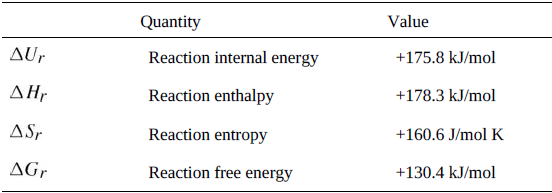
Show that the data in Table 9.6 satisfy the definitions of Gibbs and Helmholtz free energy, (1) ?Gr =?Hr ? T?Sr and (2) ?Hr = ?Ur + p?Vr . Quantity Value AUr Reaction internal energy +175.8 kJ/mol ΔΗ Reaction enthalpy +178.3 kJ/mol ASr Reaction entropy +160.6 J/mol K AGr Reaction free energy
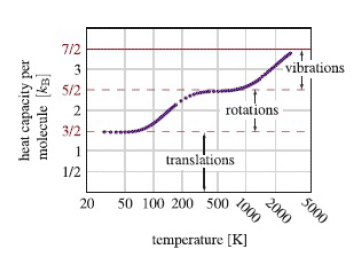
Approximating the inter atomic potential as a harmonic oscillator with angular frequency ωvib, the vibrational - rotational energy levels of a diatomic molecule are given by E(n, J) = ℏωvib(n+1/2)+ℏ2 J(J+1)/(2μr2e ). Here re is the equilibrium inter atomic separation,μ is the reduced
Another commonly used model for the potential energy of a diatomic molecule is the Lennard–Jones(LJ) potential V(r) = ε((rm/r)12 − 2(rm/r)6). Using the results of Problem 9.6, find the choice of the parameters rm and ε that gives the same equilibrium separation between atoms and the same
The Morse potential parameters for oxygen are given by De = 5.211 eV, α = 2.78 Å−1, and re =1.207 Å. Using the result from the previous problem, estimate the energy necessary to excite the oxygen molecule out of its ground state. Compare with your answer to Problem 7.10.
Find the frequency of the lowest vibrational mode of a diatomic molecule in terms of the parameters of the Morse potential, eq. Vstone () = De (1-e -r)* -1 -a(r-re
The power output of air conditioners is measured in“tons,” an ancient nomenclature dating back to the days when air was cooled by blowing it over blocks of ice.A ton of air conditioning is defined to be the energy required to melt one ton (2000 pounds) of ice at 32 ◦F distributed over a
The cubic growth of the heat capacity of a solid as a function of temperature continues only up to roughly one tenth of the Debye temperature associated with the shortest wavelength excitations in the solid. This may seem surprising, since this implies that at this point the heat capacity becomes
When the spin of the electron in a hydrogen atom flips from parallel to anti parallel to the direction of the protons spin, a photon of energy E ≅ 9.41 × 10⁻²⁵ J is emitted. What is the photon’s energy in electron volts? What is its frequency? Its wavelength ? Above roughly what temperature
A blue super giant star may have a surface temperature as high as 50000 K. Estimate the wavelength at which it emits maximum power. Why does the star appear blue?
The universe is filled with electromagnetic radiation left over from the Big Bang. This radiation has a characteristic temperature of ≈ 2.7K. At what wavelength does the power spectrum of this radiation peak? What is the energy of a photon with this wavelength?
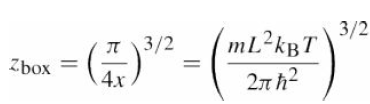
The atoms of an ideal monatomic gas of N particles confined in a box of volume V can be adsorbed onto the surface of the box (surface area A), where they are bound to the surface with binding energy ϵ, but they can move around on the surface like an ideal two-dimensional gas. Use the results of
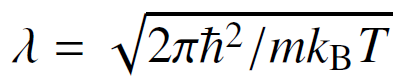
Show that the free energy of an ideal monatomic gas of N3 particles in a volume V can be written as F =−kBN3T (1 − ln(N3λ3/V)), where is a thermal length scale. Show that a two-dimensional ideal gas of N2 particles moving in a bounded area A has free energy 1%3D V2лћ?/mkвТ F2 =
Show that when a system comes into thermal equilibrium while in contact with a heat reservoir at temperature T, its free energy (Helmholtz, if V is held fixed; Gibbs if p is held fixed) is minimized.
Real crystals contain impurities, which lead to nonzero entropy at T = 0. Consider a crystal consisting of N atoms. The crystal is primarily composed of element A but contains M ≪ N atoms of an impurity B. An atom of B can substitute for an atom of A at any location in the crystal. Compute the
Compute the partition function per particle? for helium gas at NTP confined in a cube of side 1 cm. What quantum state has the highest probability of being occupied? What is the probability that a given helium atom is in this state? Given the number of atoms in the box, what is the expected
It was asserted that in order for entropy to be an extensive quantity, the classical partition function of a system of indistinguishable particles must be divided by N!. Consider a box evenly partitioned into two halves, each with volume V, and each containing N atoms of a monatomic ideal gas at a
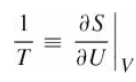
Use the Sackur?Tetrode equation?? to show that (?S/?U)|V = 1/T for an ideal monatomic gas. Likewise show that (?S/?H)|p = 1/T, verifying eq and the assertion of footnote 6. Sideal = NkB + In V + 5 In mkgT In – kg In(N!) 2 2πh
Show that in general the condition that? and the requirement that the entropy be finite at all temperatures (we cannot be infinitely ignorant about a finite system), require that C(T) ? 0 as T ? 0 for all systems. S (T) – S (T») = f Cy(T)dT/T Cv(T)dT/T То
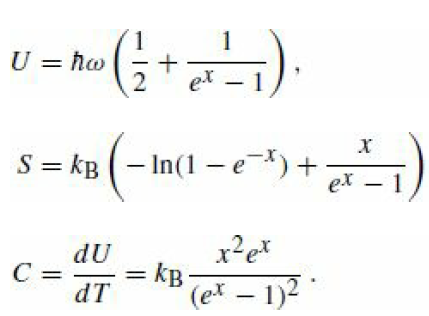
Check the results quoted in eqs.? for a single harmonic oscillator. Show that as T ? 0, the entropy and the heat capacity both vanish. Show that? 1 U = hw 1 ex – 1 S = kB - In(1 – e) + ex – 1 dU x²et = kB dT (ex – 1)2 С —
Consider a simple quantum system consisting of twenty independent simple harmonic oscillators each with frequency ω. The energy of this system is just the sum of the energies of the 20 oscillators. When the energy of this system is U(n) = (n + 10)ћω, show that its entropy is S (n) = kB ln((n +
Repeat the calculations of Example 8.3 for the H2?molecule, with ??/kB ? 6000K. In particular, compute the probabilities that a given molecule is in the ground state or first excited state at temperatures T = 500, 1000, and 2000K, compute the vibrational contribution to the heat capacity at each of
A simple system in which to study entropy and the Boltzmann distribution consists of N independent two-state subsystems coupled thermally to a reservoir at temperature T. The two states in each subsystem have energies 0 (by definition) and ϵ. Find the partition function, the internal energy, and
In a typical step in the CPU of a computer, a 32-bit register is overwritten with the result of an operation. The original values of the 32 bits are lost. Since the laws of physics are reversible, this information is added to the environment as entropy. For a computer running at 300K that carries
A nuclear power plant operates at a maximum temperature of 375 ◦C and produces 1GW of electric power. If the waste heat is dumped into river water at a temperature of 20◦C and environmental standards limit the effluent water to 30 ◦C, what is the minimum amount of water (liters per second)
A heat engine operates between a temperature T+ and the ambient environment at temperature 298K. How large must T+ be for the engine to have a possible efficiency of 90%? Can you find some materials that have melting points above this temperature, out of which you might build such an engine?
Consider air to be a mixture of 78% nitrogen, 21%oxygen, and 1% argon. Estimate the minimum amount of energy that it takes to separate a cubic meter of air into its constituents at STP, by computing the change in entropy after the separation and using the 2nd Law.
Prove analytically that the entropy of a two-statesystem? is maximized when p+ = p? = 1/2. S = -kB (p+ In p+ +p_ In p_) = -kB (P+ In p4 + (1 – P+) In(1 – P+))
Consider an amount of helium gas at atmospheric pressure and room temperature (T = 300K) enclosed in a 1-liter partition within a cubic meter. The volume outside the partition containing the helium is evacuated. The helium gas is released suddenly by opening a door on the partition, and
What is the information entropy of the results of spinning a roulette wheel with 38 possible equally likely outcomes (36 numbers, 0 and 00) 10 times? How many fair coins would you need to flip to get this much information entropy?
What is the information entropy of the results of flipping a biased coin 1000 times, if the coin comes up tails with probability 5/6 and heads with probability 1/6? For this weighted coin, can you find an encoding for sequential pairs of coin flips (e.g. HH, HT, etc.) in terms of sequences of bits
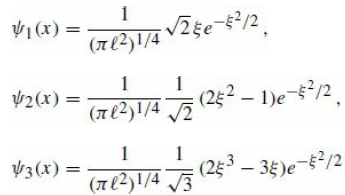
The polynomials appearing in eqs. are known as Hermite polynomials. Compute the second, third, and fourth excited wave functions by assuming quadratic, cubic, and quartic polynomials and determining the coefficients by solving eq. (7.43).Compute the associated energy values. 1 V1 (x) = 1 2(x) =
The energy required to remove an electron from an atom is called the ionization energy. Predict the energy needed to ionize the last electron from an atom with atomic number Z. (The atomic number is the charge on the atom’s nucleus.
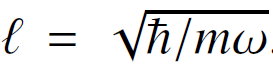
Find the ground state of the quantum harmonic oscillator. Start by showing that the Hamiltonian from eq can be ?factorized? similar to (a2 ? b2) = (a ? b)(a + b) in the form Where? Show that the Schr?dinger equation is satisfied if (? d/dx + x/?)?0(x) = 0. Show that ?0(x) = Ne?ax2 is such a
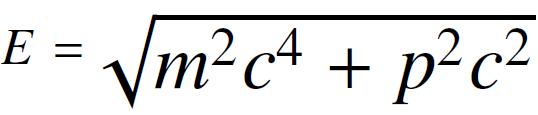
Show that the usual relation E = p2/2m arises as the leading momentum dependence of the energy in an expansion of the relativistic p relation? for small p ? mc. Vm²cª + p?c² E 24 C* + p²c2
Show that the solution to Schr?dinger?s equation for a three-dimensional harmonic oscillator is? where ?n(x) is a solution to the one-dimensional oscillator with energy (n + 1/2)??. Show that the energies of the three-dimensional oscillator are (N + 3/2)?? for N = 0, 1, 2, . . . and find the
Consider a macroscopic oscillator, given by a mass of m = 0.1 kg on a spring with spring constant k = 0.4N/m. What is the natural frequency ω of this oscillator? Considering this as a quantum system, what is the spacing of the energy levels? Do you expect that we could observe the energy of the
Consider a system of two independent harmonic oscillators, each with natural angular frequency ω. We denote states of this system by |nm〉 where the nonnegative integers n,m denote the excitation levels of the two oscillators. The energy of this system is just the sum of the energies of the two
The interatomic potential for diatomic molecules like O2 and N2 can be approximated near its minimum by a simple harmonic oscillator potential 1/2 kx2. Consider the classical motion of a diatomic molecule composed of two atoms of equal mass m. Show that near the minimum of the interatomic potential
A particle with spin S has magnetic moment m = qgS/2Mc (see Example 7.3). Solving for the classical motion of S in a constant magnetic field B, we found that S precesses around B with angular frequency = Ω qg|B|/2Mc.We found that the quantum state of an electron |ψ(0)〉 = |+x precesses with
Show that the set of functions ψk(x) = eikx (for real k) are the solutions to the condition ψ(x+δ) = eiθ(δ)ψ(x) (for real θ). use sequential translations by δ1 and δ2 to show that θ must depend linearly on δ, then expand this condition about δ = 0. Show that if k were complex, then
In the text we introduced electron spin states with spin ±1/2 in the ẑ-direction, |±〉, and states with spin ±1/2 in the x̂-direction, |±x〉 = (|+〉 ± |−〉)/√2. Measuring the z-component of spin in the state |±x〉 gives ±1/2 , each with 50% probability. The analogous states with
A quantum particle is restricted to a one dimensional box 0 ? x ? L. It experiences no forces within the box, but cannot escape. At time t = 0, the particle is in the state ? where ?i(x) are the (correctly normalized) energy basis states from eq.? (a) Compute the probability at t = 0 that the
A particle of mass m in a potential V(x) has an energy basis state with wave function ? What is the potential and what is the energy of this state? What is the value of the constant C? Y(x) = C/ cosh²( ymVox/h) %3D
Suppose an electron, constrained to move only in the vertical direction, sits on an impenetrable table in Earth’s gravitational field. Write down the (one dimensional) Schrödinger equation that determines its wavefunction as a function of height z. Use dimensional analysis to estimate its ground
Nuclear forces are so strong that they keep protons and neutrons in a spherical region a few femtometers in radius (1 fm = 10−15 m). To get a crude idea of the energy scales involved in nuclear physics, model the nucleus as a cube 5 fm on a side. What is the ground state energy of a proton (mass
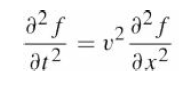
In one dimension, compare the plane wave solutions to the heat equation ?T/?t = a?2T/?x2 with plane wave solutions to the free Schr?dinger equation Show that the heat equation has real solutions that oscillate in space and decay in time, whereas the Schr?dinger equation has complex solutions that
1 Planck’s constant is very small on the scale of human affairs. Compare the angular momentum of a child’s marble spinning at 60 rpm with Planck’s constant. Compare the energy of the same marble attached to a spring with spring constant k = 10 kg/s2 and oscillating with an amplitude of 1 cm
When an object is in radiative equilibrium with its environment at temperature T, the rates at which it emits and absorbs radiant energy must be equal. Each is given by dQ0/dt = εσT4A. If the object’s temperature is raised to T1 > T, show that to first order in ΔT = T1−T, the object loses
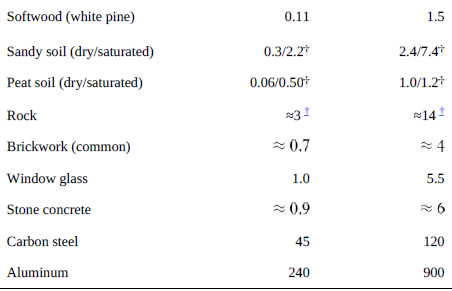
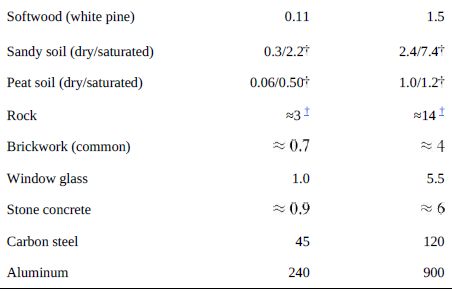
Consider a region with average surface temperature T0 = 10 ◦C, annual fluctuations of ΔT = 30 ◦C, and surface soil with a ≅ 2.4 × 10⁻⁷ m2/s, k ≅ 0.3W/mK. If the local upward heat flux from geothermal sources is 80mW/m2, compute the depth at which the heat flux from surface fluctuations
In areas where the soil routinely freezes it is essential that building foundations, conduits, and the like be buried below the frost level. Central Minnesota is a cold part of the US with yearly average temperature of T0 ∼ 5 ◦C and variation ΔT ∼ 20 ◦C. Typical peaty soils in this region
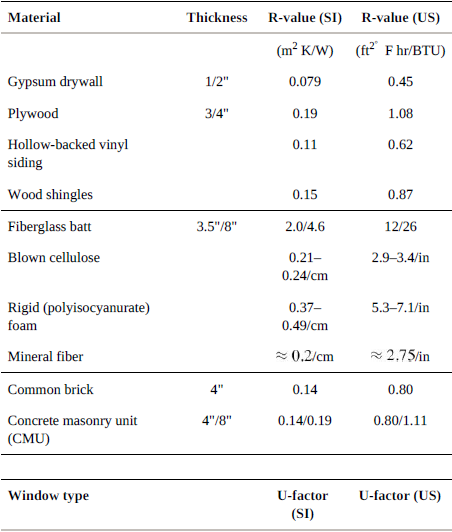
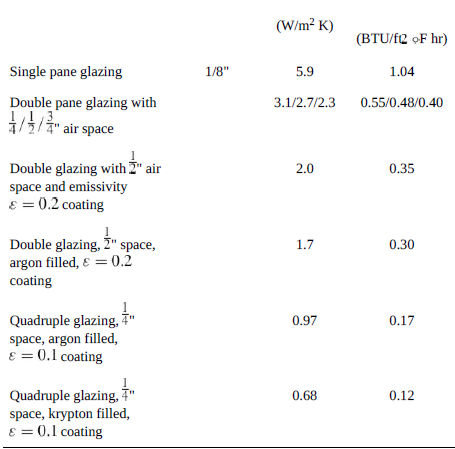
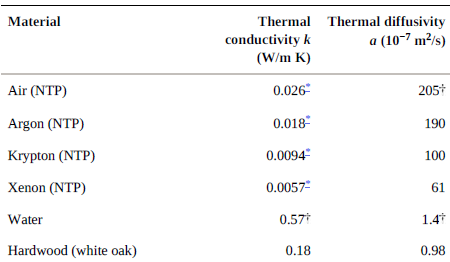
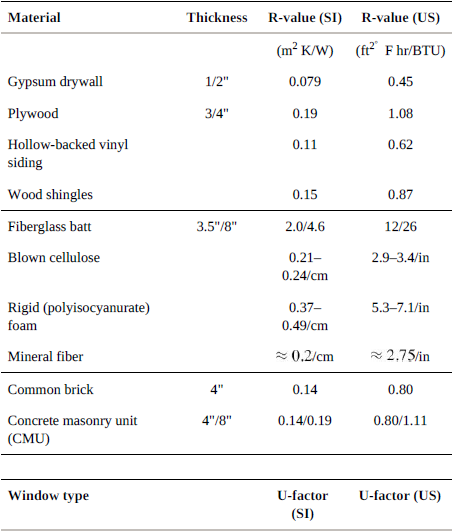
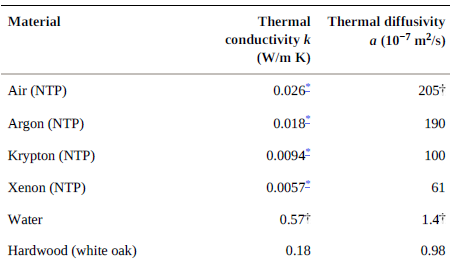
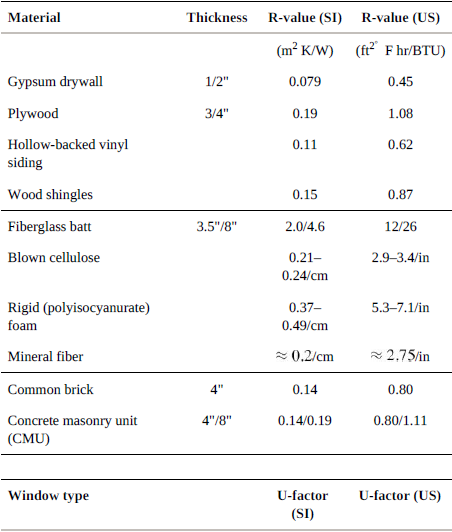
Ignoring convective heat transfer, estimate the change in U-factor by replacing argon by krypton in the quadruple glazed windows described in Table 6.3. You can ignore radiative heat transfer since these are low-emissivity windows. Material Thickness R-value (SI) R-value (US) (m² K/W) (ft? F
An insulated pipe carries a hot fluid. The setup is shown in Figure 6.18. The copper pipe has radius R0 = 1 cm and carries a liquid at T0 = 100 ◦C. The pipe is encased in a cylindrical layer of insulation of outer radius R1; the insulation has been chosen to be closed-cell polyurethane spray foam
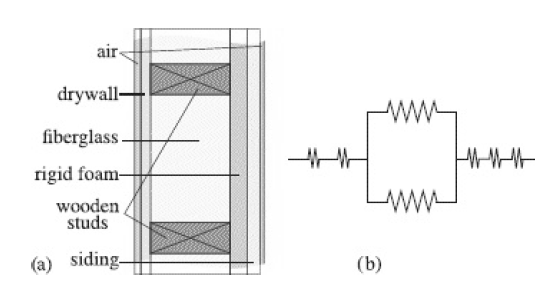
z A building wall is constructed as follows: starting from the inside the materials used are? (a) 1/2" gypsum wallboard;? (b) Wall-cavity, 80% of which is occupied by a 3.5" fiberglass batt and 20% of which is occupied by wood studs, headers, etc.;? (c) Rigid foam insulation/sheathing (R = 0.7m2
According to, a double pane window with an emissivity ε = 0.05 coating and a 1/4" air gap has a measured (center of glass) U-factor of 2.33W/m2 K. Assume that this coating is sufficient to stop all radiative heat transfer, so that the thermal resistance of this window comes from conduction in the
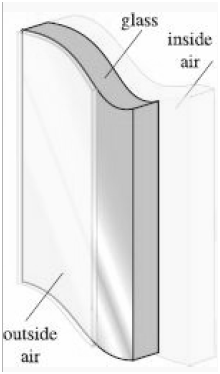
In figure, a film of still air was identified as the source of almost all of the thermal resistance of a single-pane glass window. Determine the thickness of the still air layers on both sides of the window if radiative heat transfer is ignored. It is estimated that about half the thermal
Assume that a 60m2 wall of a house is insulated to an R-value of 5.4 (SI units), but suppose the insulation was omitted from a 1m2 gap where only 6 cm of wood with an R-value of 0.37 remains. Show that the effective R value of the wall drops to R = 4.4 leading to a 23% increase in heat
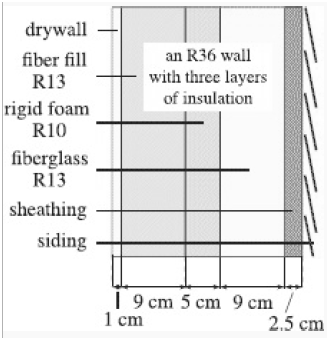
Estimate the R-value of the wall? drywall an R36 wall fiber fill R13 with three layers of insulation rigid foam R10 fiberglass R13 sheathing siding I 9 cm 5 cm 9 cm 1 cm 2.5 cm
Consider a building with 3200 ft2 of walls. Assume the ceiling is well-insulated and compute the energy loss through the walls based on the following materials, assuming an indoor temperature of 70 ?F and an outdoor temperature of 30 ?F:? (a) walls are composed of 4" thick hard wood;? (b) walls
Humans radiate energy at a net rate of roughly 100W; this is essentially waste heat from various chemical processes needed for bodily functioning. Consider four humans in a roughly square hut measuring 5m ? 5m, with a flat roof at 3m height. The exterior walls of the hut are maintained at 0 ?C by
Given the Sun’s power output of 384 YW and radius 695500 km, compute its surface temperature assuming it to be a black body with emissivity one.
The heat transfer coefficient h̅ for air flowing at 30m/s over a 1m long flat plate is measured to be 80W/m2 K. Estimate the relative importance of heat transfer by convection and conduction for this situation.
Two rigid boards of insulating material, each with area A, have thermal conductances U1 and U2. Suppose they are combined in series to make a single insulator of area A. What is the heat flux across this insulator as a function of ΔT? Now suppose they are placed side-by side. What is the heat flux
Suppose a small stoneware kiln with surface area 5m2 sits in a room that is kept at 25 ◦C by ventilation. The 15 cm thick walls of the kiln are made of special ceramic insulation, which has k = 0.03W/mK. The kiln is kept at 1300 ◦C for many hours to fire stoneware. The room ventilating
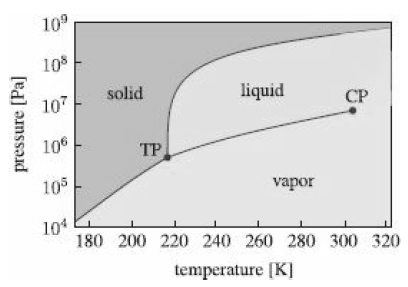
Carbon dioxide sublimes at pressures below roughly 5 atm? At a pressure of 2 atm this phase transition occurs at about ?69 ?C with an enthalpy of sublimation of roughly 26 kJ/mol. Suppose a kilogram of solid CO2 at a temperature of ?69??C is confined in a cylinder by a piston that exerts a
Roughly 70% of the 5 × 10¹⁴ m2 of Earth’s surface is covered by oceans. How much energy would it take to melt enough of the ice in Greenland and Antarctica to raise sea levels 1 meter? Suppose that 1% of energy used by humans became waste heat that melts ice. How long would it take to melt this
A start-up company is marketing steel “ice cubes” to be used in place of ordinary ice cubes. How much would a liter of water, initially at 20 ◦C, be cooled by the addition of 10 cubes of steel, each 2.5 cm on a side, initially at −10 ◦C? Compare your result with the effect of 10 ordinary
A new solar thermal plant being constructed in Australia will collect solar energy and store it as thermal energy, which will then be converted to electrical energy. The plant will store some of the thermal energy in graphite blocks for nighttime power distribution. According to the company
A solar thermal power plant currently under construction will focus solar rays to heat a molten salt working fluid composed of sodium nitrate and potassium nitrate. The molten salt is stored at a temperature of 300 ◦C, and heated in a power tower to 550 ◦C. The salt has a specific heat capacity
A “low-flow” shower head averages 4.8 L/min. Taking other data from Example 5.3, estimate the energy savings (in J/y) if all the people in your country switched from US code to low-flow shower heads.
How much energy does it take to heat 1 liter of soup from room temperature (20 ◦C) to 65 ◦C?
A cylindrical tube oriented vertically on Earth’s surface, closed at the bottom and open at the top (height 100m, cross-sectional area 1m2) initially contains air at a pressure of one atmosphere and temperature 300K. A disc of mass m plugs the cylinder, but is free to slide up and down without
Everyday experience indicates that it is much easier to compress gases than liquids. This property is measured by the isothermal compressibility, β =−1/V ∂V/∂p|T , the fractional change in a substance’s volume with pressure at constant temperature. What is the isothermal compressibility of
When air is inhaled, its volume remains constant and its pressure increases as it is warmed to body temperature Tbody = 37 ◦C. Assuming that air behaves as an ideal gas and that it is initially at a pressure of 1 atm, what is the pressure of air in the lungs after inhalation if the air is
Non-rigid airships known as blimps have occasionally been used for transportation. A blimp is essentially a balloon of volume V filled with helium. The blimp experiences a buoyancy force F = (ρatm − ρHe)Vg, where ρatm is the density of the surrounding air and g ≅ 9.8m/s2. The blimp maintains
A cylinder initially contains V0 = 1 L of argon at temperature T0 = 0 ◦C and pressure p0 = 1 atm. Suppose that the argon is somehow made to expand to a final volume V = 2 L in such a way that the pressure rises proportionally to the volume, finally reaching p = 2 atm. How much work has the argon
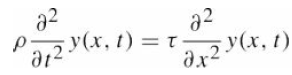
A wave travels to the right on a string with constant tension τ and a mass density that slowly increases from ρ on the far left to ρ′ on the far right. The mass density changes slowly enough that its only effect is to change the speed with which the wave propagates. The waveform on the far
A wave satisfying?eq. passes from one medium in which the phase velocity for all wavelengths is v1 to another medium in which the phase velocity is v2. The incident wave gives rise to a reflected wave that returns to the original medium and a refracted wave that changes direction as it passes
As stated in the text, the dispersion relation relating the wave number and angular frequency of ocean surface waves is ω = √pgk, where g ≅ 9.8 m/s2. Compute the wavelength and speed of propagation (phase velocity) for ocean surface waves with periods 6 s and 12 s.
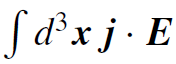
Consider a cylindrical resistor of cross-sectional area A and length L. Assume that the electric field E and current density j are uniform within the resistor. Prove that the integrated power transferred from electromagnetic fields into the resistor is equal to IV. Compute the electric and
What is the pressure exerted by a beam of light on a perfect mirror from which it reflects at normal (perpendicular) incidence? Generalize this to light incident at an angle θ to the normal on an imperfect mirror (which reflects a fraction r(θ) of the light incident at angle θ).
A string of length L is initially stretched into a “zigzag” profile, with linear segments of string connecting the (x, f(x)) points (0, 0), (L/4, a), (3L/4,−a), (L, 0). Compute the Fourier series coefficients cn and the time-evolution of the string y(x,t). Compute the total energy in the
A string of length L begins in the configuration y(x) = A[ 1/3 sin k1 x + 2/3 sin k2 x] with no initial velocity. Write the exact time-dependent solution of the string y(x, t). Compute the contribution to the energy from each mode involved.
Derive eq.??by taking the time derivative of eq.??and using Maxwell?s equations. ди (х, 1) +V. S(x,1) %3 -j(х,1) Е(x, 1) at
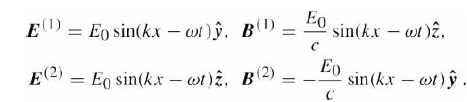
Consider two electromagnetic?plane waves eq.? one with amplitude Ea0 and wave vector ka and the other with amplitude Eb0 and wave vector kb. These waves are said to add coherently if the average energy density u in the resulting wave is proportional to |Ea0 + Eb0|2 or incoherently if the average
It has been proposed that solar collectors could be deployed in space, and that the collected power could be beamed to Earth using microwaves. A potential limiting factor for this technology would be the possible hazard of human exposure to the microwave beam. One proposal involves a circular
Suppose an electromagnetic plane wave is absorbed on a surface oriented perpendicular to the direction of propagation of the wave. Show that the pressure exerted by the radiation on the surface is prad = W/c, where W is the power absorbed per unit area. Solar radiation at the top of Earth’s
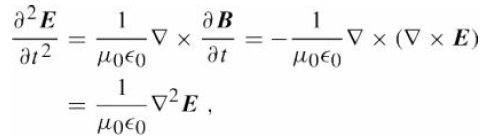
Derive the wave equation for B analogous to eq.? a2 E 1 aB V x at 1 V x (V x E) at2 HOEO 1 -v²E.
The strongest radio stations in the US broadcast at a power of 50 kW. Assuming that the power is broadcast uniformly over the hemisphere above Earth’s surface, compute the strength of the electric field in these radio waves at a distance of 100 km.
Compute the maximum energy flux possible for electromagnetic waves in air given the constraint that the electric field cannot exceed the breakdown field.
Show that the energy density on a string u(x, t), defined in eq.? obeys the conservation law?u/?t +?S/?x = 0, where S (x, t) = ??y?y? is the energy flux, the energy per unit time passing a point x. For the traveling wave y(x, t) = f (x?vt), find u(x, t) and S (x, t) and show that energy flows to
Derive the equation of motion for the string? from a microscopic model. Assume a simple model of a string as a set of masses ?m spaced evenly on the x axis at regular intervals of ?x, connected by springs of spring constant k = ?/?x. Compute the leading term in the force on each mass and take the
A violin A-string of length L = 0.33 m with total mass 0.23 g has a fundamental frequency (for the lowest mode) of 440 Hz. Compute the tension on the string. If the string vibrates at the fundamental frequency with maximum amplitude 2 mm, what is the energy of the vibrational motion?
Sound waves travel in air at roughly 340 m/s. The human ear can hear frequencies ranging from 20 Hz to 20 000 Hz. Determine the wavelengths of the corresponding sine wave modes and compare to human-scale physical systems.
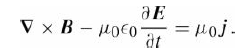
Take the divergence of both sides of eq. Use Coulomb’s law on the left and current conservation on right to show that the equation is consistent. ӘЕ VхВ - ноєо — 3D Дој. at
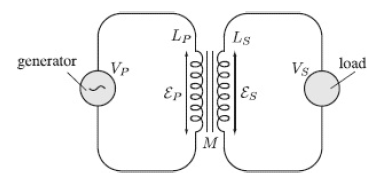
Consider the transformer in Figure 3.25 . Suppose the load is a resistor R and that the transformer is ideal, with M2 = LS LP and all magnetic flux lines passing through both inductors. Show that the voltage drop across the resistor is VS = ?LS /LPVP = NS VP/NP and that the time-averaged power
Showing 800 - 900
of 953
1
2
3
4
5
6
7
8
9
10
Step by Step Answers

 Get 50% OFF
Claim Now
Get 50% OFF
Claim Now