New Semester
Started
Get
50% OFF
Study Help!
--h --m --s
Claim Now
Question Answers
Textbooks
Find textbooks, questions and answers
Oops, something went wrong!
Change your search query and then try again
S
Books
FREE
Study Help
Expert Questions
Accounting
General Management
Mathematics
Finance
Organizational Behaviour
Law
Physics
Operating System
Management Leadership
Sociology
Programming
Marketing
Database
Computer Network
Economics
Textbooks Solutions
Accounting
Managerial Accounting
Management Leadership
Cost Accounting
Statistics
Business Law
Corporate Finance
Finance
Economics
Auditing
Tutors
Online Tutors
Find a Tutor
Hire a Tutor
Become a Tutor
AI Tutor
AI Study Planner
NEW
Sell Books
Search
Search
Sign In
Register
study help
sciences
cambridge international as & a level physics coursebook
Cambridge International AS And A Level Physics Coursebook 3rd Edition David Sang, Graham Jones, Gurinder Chadha, Richard Woodside - Solutions
Use the equation λ = ax/D to explain the following observations:a. With the slits closer together, the fringes are further apart.b. Interference fringes for blue light are closer together than for red light.c. In an experiment to measure the wavelength of light, it is desirable to have the
a. Explain what is meant by the term superposition.b. In a double-slit experiment, yellow light of wavelength 590 nm from a sodium discharge tube is used. A student sets up a screen 1.8 m from the double-slit. The distance between 12 bright fringes is measured to be 16.8 mm.Calculate the separation
Yellow light from a sodium source is used in the double-slit experiment. This yellow light has wavelength 589 nm. The slit separation is 0.20 mm, and the screen is placed 1.20 m from the slits. Calculate the separation between adjacent bright fringes formed on the screen.
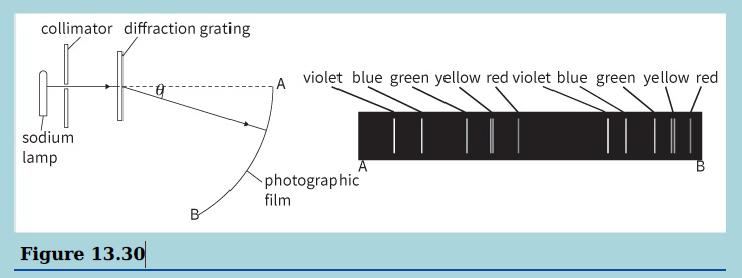
a. A laser light is described as producing light that is both highly coherent and highly monochromatic. Explain what is meant by the terms coherent and monochromatic.b. This diagram shows the experimental setup (left) used to analyse the spectrum of a sodium discharge lamp with a diffraction
In a double-slit experiment, filters were placed in front of a white light source to investigate the effect of changing the wavelength of the light. At first, a red filter was used instead (λ = 600 nm) and the fringe separation was found to be 2.4 mm. A blue filter was then used instead (λ = 450
Explain how the second-order maximum arises in terms of path difference.
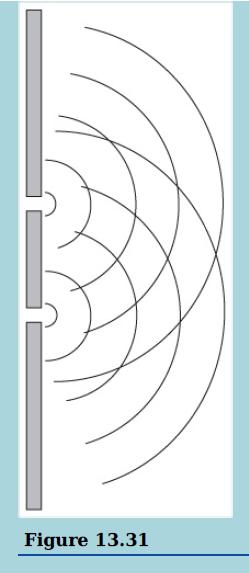
a. Explain what is meant by the diffraction of a wave.b. This diagram shows waves, in a ripple tank, spreading out from two slits.Copy this diagram. On your diagram, sketch:i. A line showing points along the central maximum–label this line 0ii. A line showing the points along first
a. For the case described in Worked example 2, with λ = 580 nm, calculate the angle θ for the second-order maximum.b. Repeat the calculation of θ for n = 3, 4, and so on. Determine how many maxima can be seen. Explain your answer.
Consider the equation d sin θ = nλ. State and explain how the interference pattern would change when:a. The wavelength of the incident light is increased for the same gratingb. The grating is changed for one with more lines per cm for the same incident light.
A student is trying to make an accurate measurement of the wavelength of green light from a mercury lamp. The wavelength λ of this light is 546 nm. Using a double-slit of separation 0.50 mm, the student can see 10 clear bright fringes on a screen at a distance of 0.80 m from the slits. The student
White light is incident normally on a diffraction grating with a slit-separation d of 2.00 × 10⁻⁶ m. The visible spectrum has wavelengths between 400 nm and 700 nm.a. Calculate the angle between the red and violet ends of the first-order spectrum.b. Explain why the second- and third-order
A lamp is operated for 20 s. The current in the lamp is 10 A. In this time, it transfers 400 J of energy to the lamp. Calculate:a. How much charge flows through the lampb. How much energy each coulomb of charge transfers to the lampc. The p.d. across the lamp.
A 12 V car battery can supply a current of 10 A for 5.0 hours. Calculate how many joules of energy the battery transfers in this time.
Calculate the resistance of a 100 W light bulb that draws a current of 0.43 A from a power supply.
An energy-efficient light bulb is labelled ‘230 V, 15 W’. This means that when connected to the 230 V mains supply it is fully lit and changes electrical energy to heat and light at the rate of 15 W.Calculate:a. The current in the bulb when fully litb. Its resistance when fully lit.
A calculator is powered by a 3.0 V battery. The calculator’s resistance is 20 kΩ. Calculate the power transferred to the calculator.
A power station supplies electrical energy to the grid at a voltage of 25 kV. Calculate the output power of the station when the current it supplies is 40 kA.
Calculate the current in a 60 W light bulb when it is connected to a 230 V power supply.
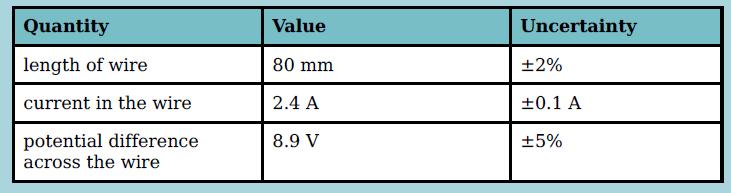
A student is measuring the resistance per unit length of a resistance wire. He takes the following measurements.a. Calculate the percentage uncertainty in the measurement of the current.b. Calculate the value of the resistance per unit length of the wire.c. Calculate the absolute uncertainty of the
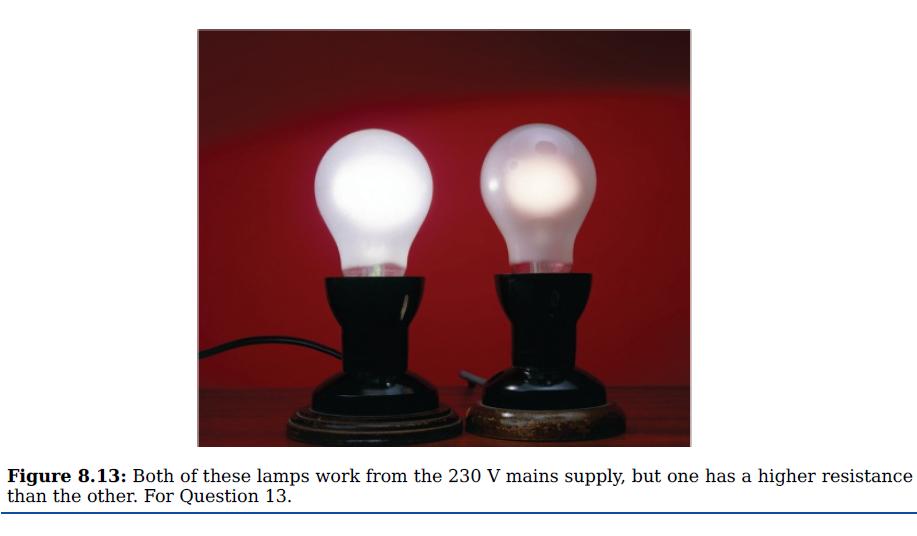
Calculate the resistance of a lamp carrying a current of 0.40 A when connected to a 230 V supply. Figure 8.13: Both of these lamps work from the 230 V mains supply, but one has a higher resistance than the other. For Question 13.
Some electricity-generating companies use a unit called the kilowatt-hour (kWh) to calculate energy bills. 1 kWh is the energy a kilowatt appliance transfers in 1 hour.a. Show that 1 kWh is equal to 3.6 MJ.b. An electric shower heater is rated at 230 V, 9.5 kW.i. Calculate the current it will take
a. Calculate the potential difference across a motor carrying a current of 1.0 A and having a resistance of 50 Ω.b. Calculate the potential difference across the same motor when the current is doubled. Assume its resistance remains constant.
a. Explain the difference between potential difference and e.m.f.b. A battery has negligible internal resistance, an e.m.f. of 12.0 V and a capacity of 100 A h (ampere-hours). Calculate:i. The total charge that it can supplyii. The total energy that it can transfer.c. The battery is connected to a
A length of copper track on a printed circuit board has a cross-sectional area of 5.0 × 10⁻⁸ m2. The current in the track is 3.5 mA. You are provided with some useful information about copper:1 m3 of copper has a mass of 8.9 × 10³ kg54 kg of copper contains 6.0 × 1026 atomsIn copper, there is
A car headlamp bulb has a resistance of 36 Ω. Calculate the current in the lamp when connected to a ‘12 V’ battery.
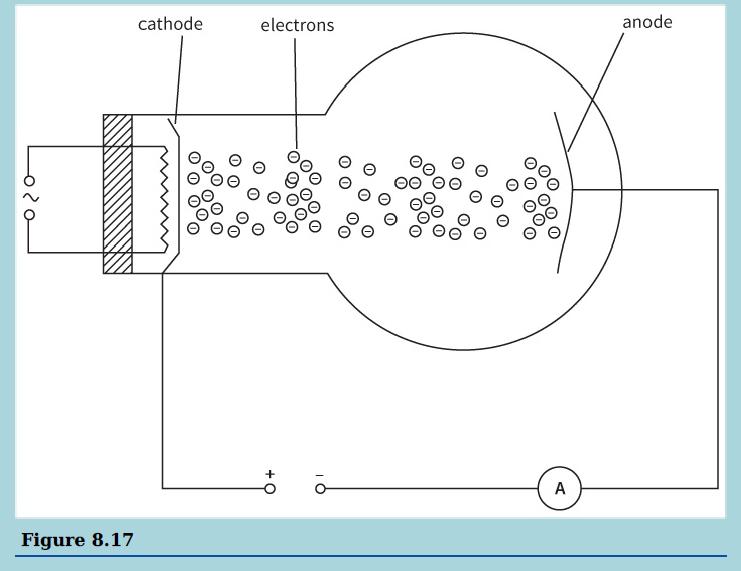
This diagram shows an electron tube. Electrons moving from the cathode to the anode constitute a current. The current in the ammeter is 4.5 mA.a. Calculate the charge passing through the ammeter in 3 minutes.b. Calculate the number of electrons that hit the anode in 3 minutes.c. The potential
A length of copper wire is joined in series to a length of silver wire of the same diameter. Both wires have a current in them when connected to a battery. Explain how the mean drift velocity of the electrons will change as they travel from the copper into the silver. Electron number
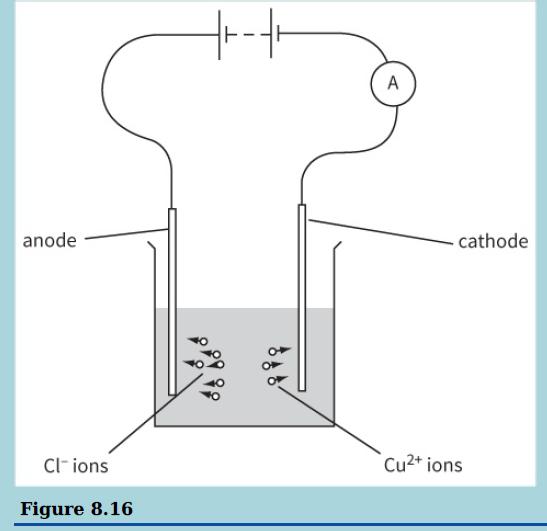
This diagram shows the electrolysis of copper chloride.a i. On a copy of the diagram, mark the direction of the conventional current in the electrolyte. Label it conventional current.ii. Mark the direction of the electron flow in the connecting wires. Label this electron flow.b. In a time period of
Calculate the mean drift velocity of electrons in a copper wire of diameter 1.0 mm with a current of 5.0 A. The electron number density for copper is 8.5 × 1028 m−3.
A woman has available 1 A, 3 A, 5 A, 10 A and 13 A fuses. Explain which fuse she should use for a 120 V, 450 W hairdryer.
Calculate the current in a gold wire of cross-sectional area 2.0 mm2 when the mean drift velocity of the electrons in the wire is 0.10 mm s−1. The electron number density for gold is 5.9 × 1028 m−3.
Calculate the energy gained by an electron when it is accelerated through a potential difference of 50 kV. (Charge on the electron = −1.6 × 10⁻¹⁹ C.)
Which of the following quantities of electric charge is possible? Explain how you know.6.0 × 10−19 C, 8.0 × 10⁻¹⁹ C, 10.0 × 10⁻¹⁹ C
A battery of e.m.f. 6 V produces a steady current of 2.4 A for 10 minutes.Calculate:a. The charge that it suppliedb. The energy that it transferred.
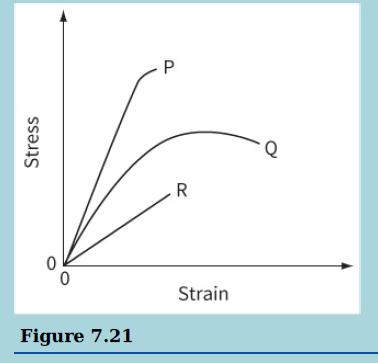
a. These are stress–strain curves for three different materials, P, Q and R.State and explain which material has the greatest Young modulus.b. Describe an experiment to determine the Young modulus for a material in the form of a wire. Include a labelled diagram and explain how you would make the
This is a force–extension graph for a spring.a. State what is represented by:i. The gradient of the graphii. The area under the graph.b. The spring has force constant k = 80 N m−1. The spring is compressed by 0.060 m, within the limit of proportionality, and placed between two trolleys that run
Calculate the number of protons that would have a charge of one coulomb. (Proton charge = +1.6 × 10⁻¹⁹ C.)
a. A lamp of resistance 15 Ω is connected to a battery of e.m.f. 4.5 V.Calculate the current in the lamp.b. Calculate the resistance of the filament of an electric heater that takes a current of 6.5 A when it is connected across a mains supply of 230 V.C. Calculate the voltage that is required to
A car battery is labelled ‘50 A h’. This means that it can supply a current of 50 A for one hour.a. For how long could the battery supply a continuous current of 200 A needed to start the car?b. Calculate the charge that flows past a point in the circuit in this time.
In a lightning strike there is an average current of 30 kA, which lasts for 2,000 μs. Calculate the charge that is transferred in this process.
In a circuit, a charge of 50 C passes a point in 20 s. Calculate the current in the circuit.
A generator produces a current of 40 A. Calculate how long will it take for a total of 2,000 C to flow through the output.
Calculate the current that gives a charge flow of 150 C in a time of 30 s.
Calculate the charge that passes through a lamp when there is a current of 150 mA for 40 minutes.
The current in a circuit is 0.40 A. Calculate the charge that passes a point in the circuit in a period of 15 s.
Which statement defines e.m.f.?A. The e.m.f. of a source is the energy transferred when charge is driven through a resistor.B. The e.m.f. of a source is the energy transferred when charge is driven round a complete circuit.C. The e.m.f. of a source is the energy transferred when unit charge is
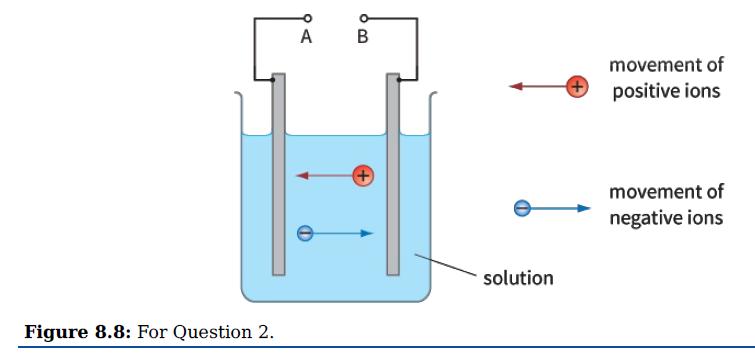
Figure 8.8 shows a circuit with a conducting solution having both positive and negative ions.a. Copy the diagram and draw in a cell between points A and B. Clearly indicate the positive and negative terminals of the cell.b. Add an arrow to show the direction of the conventional current in the
A small immersion heater is connected to a power supply of e.m.f. of 12 V for a time of 150 s. The output power of the heater is 100 W. What charge passes through the heater?A. 1.4 CB. 8.0 CC. 1250 CD. 1800 C
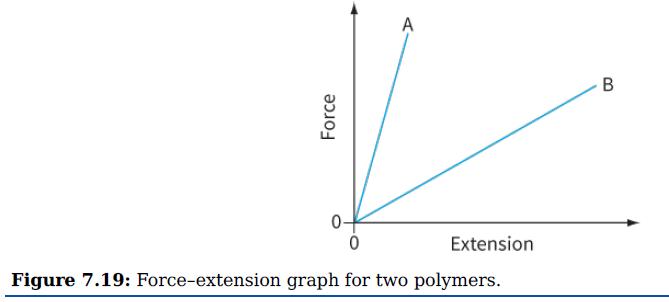
Figure 7.19 shows force–extension graphs for two materials. For each of the following questions, make the statement required. Also explain how you deduce your answer from the graphs.a. State which polymer has the greater stiffness.b. State which polymer requires the greater force to break it.c.
A spring has a force constant of 4800 N m−1. Calculate the elastic potential energy when it is compressed by 2.0 mm.
A force of 12 N extends a length of rubber band by 18 cm. Estimate the energy stored in this rubber band. Explain why your answer can only be an estimate.
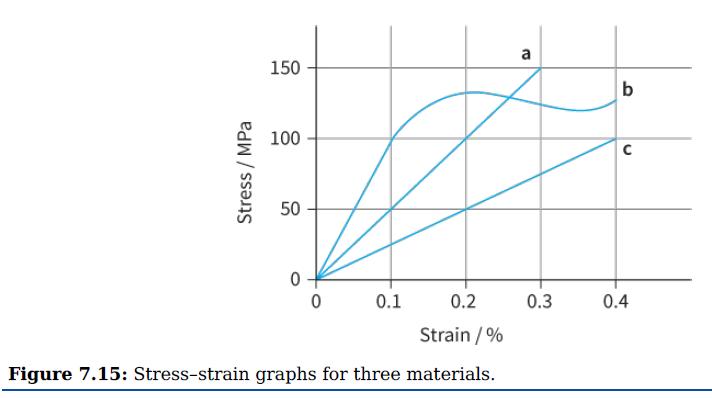
For each of the materials whose stress–strain graphs are shown in Figure 7.15, deduce the values of the Young modulus. a 150 100 50 0.1 0.2 0.3 0.4 Strain / % Figure 7.15: Stress-strain graphs for three materials. Stress / MPa
In an experiment to measure the Young modulus of glass, a student draws out a glass rod to form a fibre 0.800 m in length. Using a travelling microscope, she estimates its diameter to be 0.40 mm. Unfortunately, it proves impossible to obtain a series of readings for load and extension. The fibre
Calculate the extension of a copper wire of length 1.00 m and diameter 1.00 mm when a tensile force of 10 N is applied to the end of the wire. (Young modulus of copper = 130 GPa.)
A light spring that obeys Hooke’s law has an unstretched length of 0.250 m. When an object of mass 2.0 kg is hung from the spring the length of the spring becomes 0.280 m. When the object is fully submerged in a liquid of density 1200 kg m−3, the length of the spring becomes 0.260
A piece of steel wire, 200.0 cm long and having cross-sectional area of 0.50 mm2, is stretched by a force of 50 N. Its new length is found to be 200.1 cm. Calculate the stress and strain, and the Young modulus of steel.
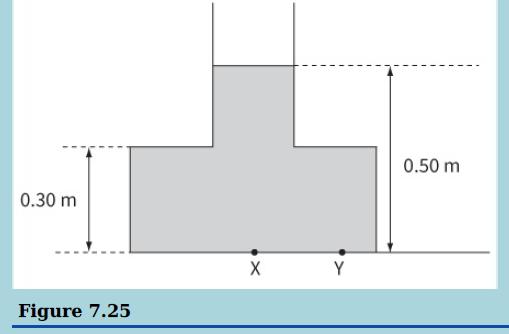
This diagram shows water in a container filled to a depth of 0.50 m. The density of water is 1000 kg m−3.a. Calculate the pressure at X on the base of the container.b. Explain why the pressure at X must be equal to the pressure at Y.c. Explain why the force downwards on the base of the container
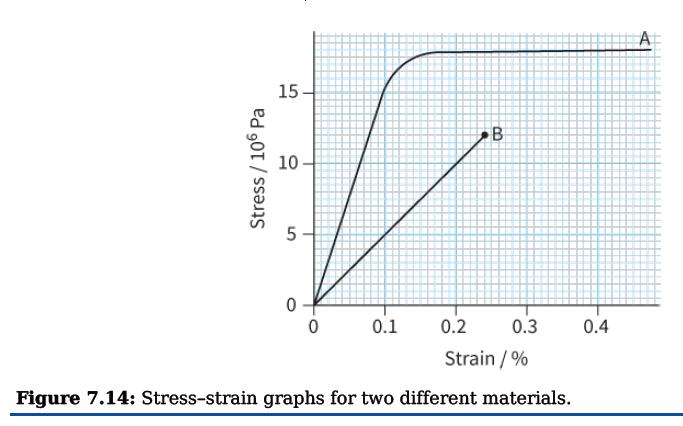
Figure 7.14 shows stress–strain graphs for two materials, A and B. Use the graphs to determine the Young modulus of each material. 15- 10 0.1 0.2 0.3 0.4 Strain / % Figure 7.14: Stress-strain graphs for two different materials. Stress / 106 Pa
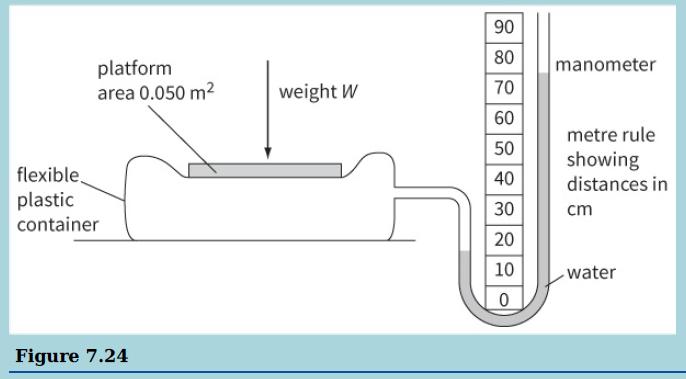
a. Liquid of density ρ fills a cylinder of base area A and height h.i. Using the symbols provided, state the mass of liquid in the container.ii. Using your answer to i, derive a formula for the pressure exerted on the base of the cylinder.b. A boy stands on a platform of area 0.050 m2 and a
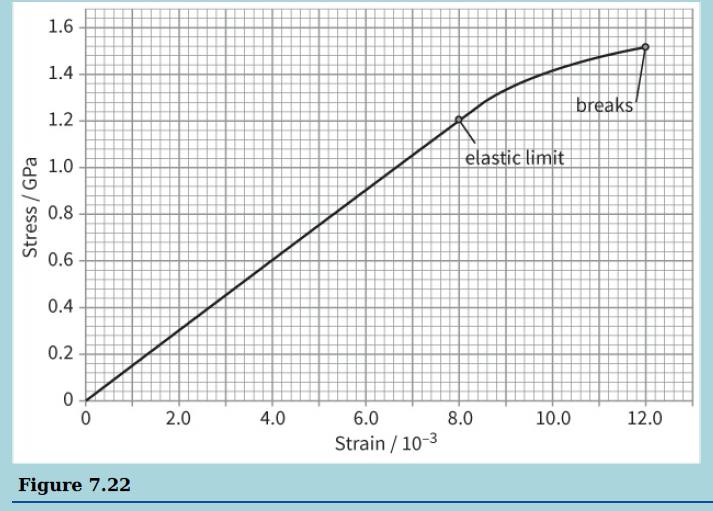
This is a stress–strain graph for a metal wire.The wire has a diameter of 0.84 mm and a natural length of 3.5 m.Use the graph to determine:a. The Young modulus of the wireb. The extension of the wire when the stress is 0.60 GPac. The force that causes the wire to break, assuming that the
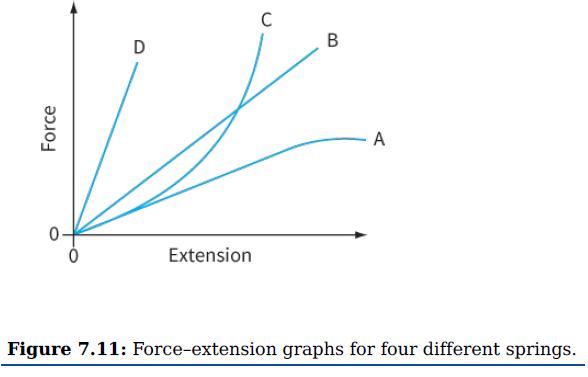
Figure 7.11 shows the force–extension graphs for four springs, A, B, C and D.a. State which spring has the greatest value of force constant.b. State which is the least stiff.c. State which of the four springs does not obey Hooke’s law. C A Extension Figure 7.11: Force-extension graphs for four
To allow for expansion in the summer when temperatures rise, a steel railway line laid in cold weather is pre-stressed by applying a force of 2.6 × 10⁵ N to the rail of cross-sectional area 5.0 × 10⁻³ m2.If the railway line is not pre-stressed, a strain of 1.4 × 10⁻⁵ is caused by each degree
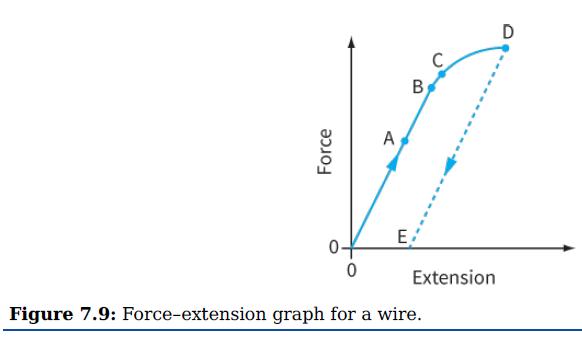
Figure 7.9 shows the force–extension graph for a wire that is stretched and then released.a. Which point shows the limit of proportionality?b. Which point shows the elastic limit? D By A E. Extension Figure 7.9: Force-extension graph for a wire. Force
a. State the meaning of tensile stress and tensile strain.b. A vertical steel wire of length 1.6 m and cross-sectional area 1.3 × 10⁻⁶ m2 carries a weight of 60 N. The Young modulus for steel is 2.1 × 10¹¹ Pa.Calculate:i. The stress in the wireii. The strain in the wireiii. The extension
A balloon of volume 3000 m−3 is filled with hydrogen of density 0.090 kg m−3. The mass of the fabric of the balloon is 100 kg. Calculate the greatest mass that the balloon can lift in air of density 1.2 kg m−3.
Describe how to use a newton-meter, a micrometer screw gauge, a metal cube of side approximately 1.0 cm and a beaker of water to show experimentally that Archimedes’ principle is correct. The density of water is known to be 1000 kg m−3.
A piece of wax is attached to a newton-meter. In air, the reading on the newton-meter is 0.27 N and when submerged in water of density 1,000 kg m−3 thereading is 0.16 N. Calculate:a. The upthrust on the wax when in waterb. The volume of the waxc. The reading on the newton-meter when the wax
A boat has a uniform cross-sectional area at the water line of 750 m2. Fifteen cars of average mass 1200 kg are driven on board. Calculate the extra depth that the boat sinks in water of density 1000 kg m−3.
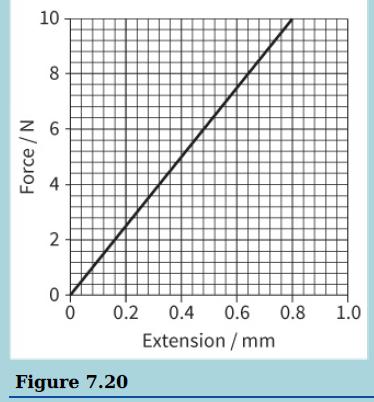
This is the force–extension graph for a metal wire of length 2.0 m and cross-sectional area 1.5 × 10⁻⁷ m2.a. Calculate the Young modulus.b. Determine the energy stored in the wire when the extension is 0.8 mm.c. Calculate the work done in stretching the wire between 0.4 mm and 0.8 mm. 10 8 0.2
a. Why is it difficult to hold an inflated plastic ball underwater?b. A submarine floats at rest under the water. To rise to the surface compressed air is used to push water out of its ‘ballast’ tanks into the sea. Why does this cause the submarine to rise?
A sample of fishing line is 1.0 m long and is of circular cross-section of radius 0.25 mm. When a weight is hung on the line, the extension is 50 mm and the stress is 2.0 × 10⁸ Pa. Calculate:a. The cross-sectional area of the lineb. The weight addedc. The strain in the lined. The Young moduluse.
Estimate the height of the atmosphere if atmospheric density at the Earth’s surface is 1.29 kg m−3. (Atmospheric pressure = 101 kPa.)
Two springs, each with a spring constant 20 N m−1, are connected in series.Draw a diagram of the two springs in series and determine the total extension if a mass, with weight 2.0 N, is hung on the combined springs.
Calculate the pressure due to the water on the bottom of a swimming pool if the depth of water in the pool varies between 0.8 m and 2.4 m. (Density of water = 1000 kg m−3.) If atmospheric pressure is 1.01 × 10⁵ Pa, calculate the maximum total pressure at the bottom of the swimming pool.
Sketch a force–extension graph for a spring that has a spring constant of 20 N m−1 and that obeys Hooke’s law for forces up to 5.0 N. Your graph should cover forces between 0 and 6 N and show values on both axes.
Estimate the pressure you exert on the floor when you stand on both feet. (You could draw a rough rectangle around both your feet placed together to find the area in contact with the floor. You will also need to calculate your weight from your mass.)
a i. Define density.ii. State the SI base units in which density is measured.b i. Define pressure.ii. State the SI base units in which pressure is measured.
A chair stands on four feet, each of area 10 cm2. The chair weighs 80 N. Calculate the pressure it exerts on the floor.
Two wires P and Q both obey Hooke’s law. They are both stretched and have the same strain. The Young modulus of P is four times larger than that of Q.The diameter of P is twice that of Q.What is the ratio of the tension in P to the tension in Q?A. 1/2B. 1C. 2D. 16
The density of steel is 7850 kg m−3. Calculate the mass of a steel sphere of radius 0.15 m. (First, calculate the volume of the sphere using the formula V = 4/3 π r3 and then use the density equation.)
Which force is caused by a difference in pressure?A. DragB. FrictionC. UpthrustD. Weight
A cube of copper has a mass of 240 g. Each side of the cube is 3.0 cm long. Calculate the density of copper in g cm−3 and in kg m−3.
A golf ball has a mass of 0.046 kg. The final velocity of the ball after being struck by a golf club is 50 m s−1. The golf club is in contact with the ball for a time of 1.3 ms. Calculate the average force exerted by the golf club on the ball.
Water pouring from a broken pipe lands on a flat roof. The water is moving at 5.0 m s−1 when it strikes the roof. The water hits the roof at a rate of 10 kg s−1. Calculate the force of the water hitting the roof. (Assume that the water does not bounce as it hits the roof. If it did bounce,
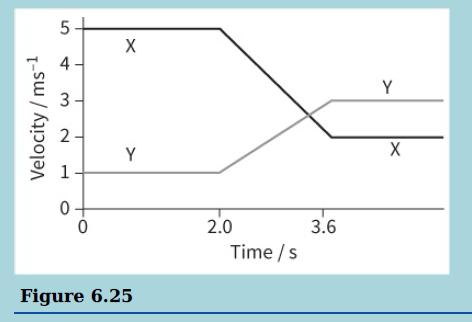
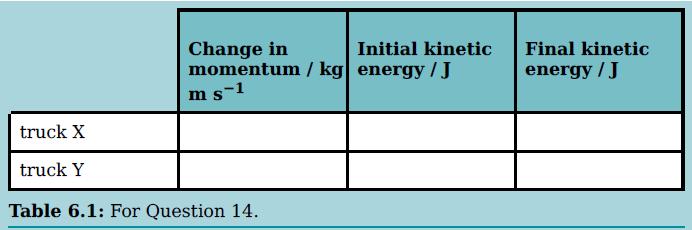
Two railway trucks are travelling in the same direction and collide. The mass of truck X is 2.0 × 10⁴ kg and the mass of truck Y is 3.0 × 10⁴ kg. This graph shows how the velocity of each truck varies with time.a. Copy and complete the table.b. State and explain whether the collision of the two
A ball is kicked by a footballer. The average force on the ball is 240 N and the impact lasts for a time interval of 0.25 s.a. Calculate the change in the ball’s momentum.b. State the direction of the change in momentum.
a. State two quantities that are conserved in an elastic collision.b. A machine gun fires bullets of mass 0.014 kg at a speed of 640 m s−1.i. Calculate the momentum of each bullet as it leaves the gun.ii. Explain why a soldier holding the machine gun experiences a force when the gun is
A car of mass 1,000 kg is travelling at a velocity of +10 m s−1. It accelerates for 15 s, reaching a velocity of +24 m s−1. Calculate:a. The change in the momentum of the car in the 15 s periodb. The average resultant force acting on the car as it accelerates.
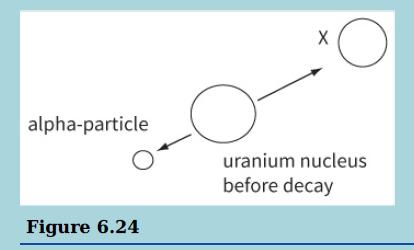
a. State what is meant by:i. A perfectly elastic collisionii. A completely inelastic collision.b. A stationary uranium nucleus disintegrates, emitting an alpha-particle of mass 6.65 × 10⁻²⁷ kg and another nucleus X of mass 3.89 × 10⁻²⁵ kg.i. Explain why the alpha-particle and nucleus X must
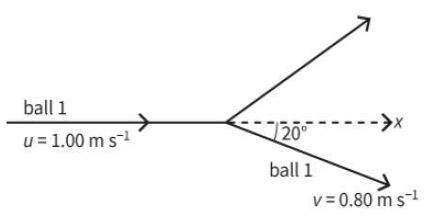
A snooker ball collides with a second identical ball as shown in Figure 6.19.a. Determine the components of the velocity of the first ball in the x- and y-directions.b. Hence, determine the components of the velocity of the second ball in the x- and y-directions.c. Hence, determine the velocity
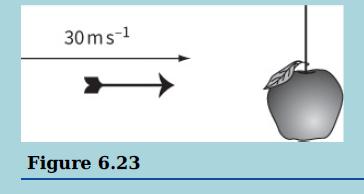
A. State the principle of conservation of momentum and state the condition under which it is valid.B. An arrow of mass 0.25 kg is fired horizontally towards an apple of mass 0.10 kg that is hanging on a string, as shown in Figure 6.23.The horizontal velocity of the arrow as it enters the apple is
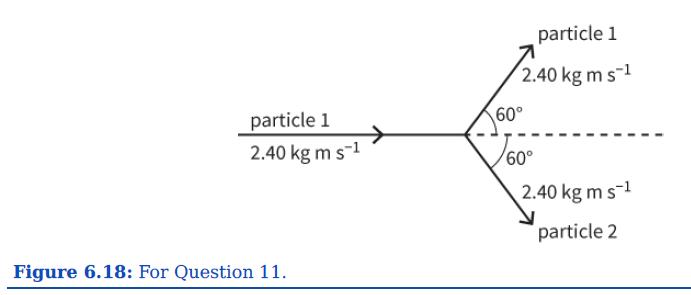
Figure 6.18 shows the momentum vectors for two identical particles, 1 and 2, before and after a collision. Particle 2 was at rest before the collision. Show that momentum is conserved in this collision. particle 1 2.40 kg ms-1 particle 1 60° 2.40 kg m s-1 2.40 kg m s-1 particle 2 Figure 6.18: For
A cricket bat strikes a ball of mass 0.16 kg travelling towards it. The ball initially hits the bat at a speed of 25 m s−1 and returns along the same path with the same speed. The time of impact is 0.0030 s. You may assume no force is exerted on the bat by the cricketer during the actual
Look back to Worked example 4. Draw the vector triangle that shows that momentum is conserved in the collision described in the question. Show the value of each angle in the triangle.
A marble of mass 100 g is moving at a speed of 0.40 m s−1 in the x-direction.a. Calculate the marble’s momentum. The marble strikes a second, identical marble. Each moves off at an angle of 45° to the x-direction.b. Use the principle of conservation of momentum to determine the speed of each
A snooker ball strikes a stationary ball. The second ball moves off sideways at 60° to the initial path of the first ball. Use the idea of conservation of momentum to explain why the first ball cannot travel in its initial direction after the collision. Illustrate your answer with a diagram.
A car of mass 1100 kg is travelling at 24 m s−1. The driver applies the brakes and the car decelerates uniformly and comes to rest in 20 s.a. Calculate the change in momentum of the car.b. Calculate the braking force on the car.c. Determine the braking distance of the car.
A ball of mass 0.40 kg is thrown at a wall. It strikes the wall with a speed of 1.5 m s−1 perpendicular to the wall and bounces off the wall with a speed of 1.2 m s−1. Explain the changes in momentum and energy that happen in the collision between the ball and the wall. Give numerical values
a. Explain what is meant by an:i. Elastic collisionii. Inelastic collision.b. A snooker ball of mass 0.35 kg hits the side of a snooker table at right angles and bounces off also at right angles. Its speed before collision is 2.8 m s−1 and its speed after is 2.5 m s−1. Calculate the change in
Discuss whether momentum is conserved in each of the following situations.a. A star explodes in all directions – a supernova.b. You jump up from a trampoline. As you go up, your speed decreases; as you come down again, your speed increases.
Showing 700 - 800
of 962
1
2
3
4
5
6
7
8
9
10
Step by Step Answers

 Get 50% OFF
Claim Now
Get 50% OFF
Claim Now