New Semester
Started
Get
50% OFF
Study Help!
--h --m --s
Claim Now
Question Answers
Textbooks
Find textbooks, questions and answers
Oops, something went wrong!
Change your search query and then try again
S
Books
FREE
Study Help
Expert Questions
Accounting
General Management
Mathematics
Finance
Organizational Behaviour
Law
Physics
Operating System
Management Leadership
Sociology
Programming
Marketing
Database
Computer Network
Economics
Textbooks Solutions
Accounting
Managerial Accounting
Management Leadership
Cost Accounting
Statistics
Business Law
Corporate Finance
Finance
Economics
Auditing
Tutors
Online Tutors
Find a Tutor
Hire a Tutor
Become a Tutor
AI Tutor
AI Study Planner
NEW
Sell Books
Search
Search
Sign In
Register
study help
sciences
cambridge international as & a level physics coursebook
Cambridge International AS And A Level Physics Coursebook 3rd Edition David Sang, Graham Jones, Gurinder Chadha, Richard Woodside - Solutions
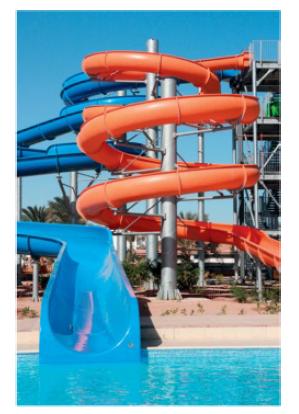
If you have ever been down a water-slide (a flume) (Figure 16.16) you will know that you tend to slide up the side as you go around a bend. Explain how this provides the centripetal force needed to push you around the bend. Explain why you slide higher if you are going faster.
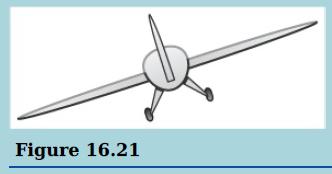
Explain why an aircraft will tend to lose height when banking, unless the pilot increases its speed to provide more lift.
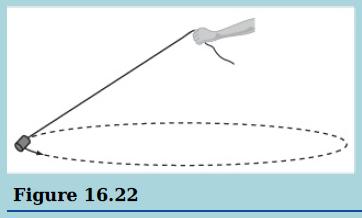
Explain why it is impossible to whirl a bung around on the end of a string in such a way that the string remains perfectly horizontal.
Mars orbits the Sun once every 687 days at a distance of 2.3 × 10¹¹ m. The mass of Mars is 6.4 × 10²³ kg. Calculate:a. The average speed in metres per secondb. Its centripetal accelerationc. The gravitational force exerted on Mars by the Sun.
An toy truck of mass 0.40 kg travels round a horizontal circular track of radius 0.50 m. It makes three complete revolutions every 10 seconds.Calculate:a. Its speedb. Its centripetal accelerationc. The centripetal force.
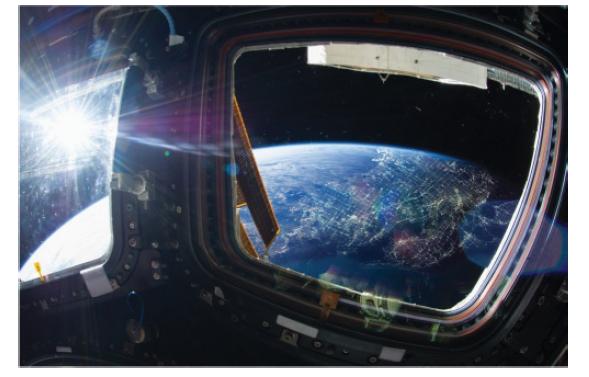
The International Space Station (Figure 16.12) has a mass of 350 tonnes, and orbits the Earth at an average height of 340 km where the gravitational acceleration is 8.8 m s−2. The radius of the Earth is 6400 km. Calculate:a. The centripetal force on the space stationb. The speed at which it
A stone of mass 0.20 kg is whirled round on the end of a string in a vertical circle of radius 30 cm.The string will break when the tension in it exceeds 8.0 N. Calculate the maximum speed at which the stone can be whirled without the string breaking.
Calculate how long it would take a ball to orbit the Earth once, just above the surface, at a speed of 7920 m s−1. (The radius of the Earth is 6400 km.)
Show that an alternative equation for the centripetal acceleration is a = ω2r.
a. Show that in one revolution there are 2π radians.b. This diagram shows a centrifuge used to separate solid particles suspended in a liquid of lower density. The container is spun at a rate of 540 revolutions per minute.i. Calculate the angular velocity of the container.ii. Calculate the
An object follows a circular path at a steady speed. Describe how each of the following quantities changes as it follows this path: speed, velocity, kinetic energy, momentum, centripetal force, centripetal acceleration.
In training, military pilots are given various tests. One test puts them in a seat on the end of a large arm that is then spun round at a high speed, as shown.a. Describe what the pilot will feel and relate this to the centripetal force.b. At top speed the pilot will experience a centripetal force
A car is travelling along a flat road in winter. The car approaches a patch of ice on a bend. Explain why the car cannot go around the perfectly smooth, icy bend. Suggest what might happen if the driver tries turning the steering wheel when the car is on the ice.
In each of the following cases, state what provides the resultant force causing centripetal acceleration:a. The Moon orbiting the Earthb. A car going round a bend on a flat, rough roadc. The weight on the end of a swinging pendulum.
a. Explain what is meant by the term angular speed.b. This diagram shows a rubber bung, of mass 200 g, on the end of a length of string being swung in a horizontal circle of radius 40 cm. The string makes an angle of 56° with the vertical.Calculate:i. The tension in the stringii. The angular speed
A spacecraft orbits the Earth in a circular path of radius 7000 km at a speed of 7800 m s−1. Determine its angular velocity.
This diagram shows an aeroplane banking to make a horizontal turn. The aeroplane is travelling at a speed of 75 m s−1 and the radius of the turning circle is 800 m.a. Copy the diagram. On your copy, draw and label the forces acting on the aeroplane.b. Calculate the angle that the aeroplane makes
A car travels around a 90° bend in 15 s. The radius of the bend is 50 m.a. Determine the angular speed of the car.b. Determine the speed of the car.
A car is travelling round a bend when it hits a patch of oil. The car slides off the road onto the grass verge. Explain, using your understanding of circular motion, why the car came off the road.
The angular speed of the second hand of a clock is 0.105 rad s−1. If the length of the hand is 1.8 cm, calculate the speed of the tip of the hand as it moves round.
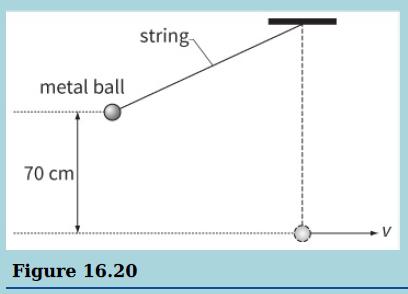
One end of a string is secured to the ceiling and a metal ball of mass 50 g is tied to its other end. The ball is initially at rest in the vertical position. The ball is raised through a vertical height of 70 cm, as shown. The ball is then released. It describes a circular arc as it passes through
In a washing machine, the clothes are held in cylinder called a drum. The drum has holes in it that allow water to enter the drum and also to drain out of the drum.The drum of a particular washing machine spins at a rate of 1200 rpm (revolutions per minute).a. Determine the number of revolutions
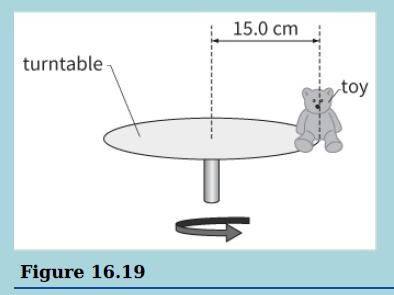
This diagram shows a toy of mass 60 g placed on the edge of a rotating turntable.a. The radius of the turntable is 15.0 cm. The turntable rotates, making 20 revolutions every minute. Calculate the resultant force acting on the toy.b. Explain why the toy falls off when the speed of the turntable is
Show that the angular speed of the second hand of a clock is about 0.105 rad s−1.
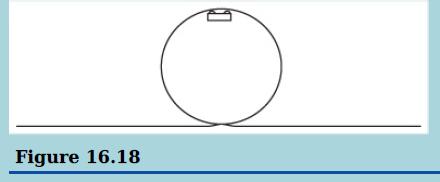
This diagram shows part of the track of a roller-coaster ride in which a truck loops the loop. When the truck is at the position shown, there is no reaction force between the wheels of the truck and the track. The diameter of the loop in the track is 8.0 m.a. Explain what provides the centripetal
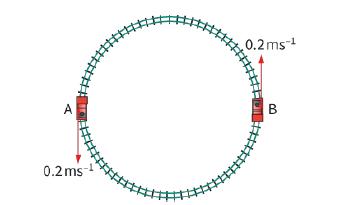
A toy train travels at a steady speed of 0.2 m s−1 around a circular track (Figure 16.6). A and B are two points opposite to one another on the track.a. Determine the change in the speed of the train as it travels from A to B.b. Determine the change in the velocity of the train as it travels from
a. Explain what is meant by a radian.b. A body moves round a circle at a constant speed and completes one revolution in 15 s. Calculate the angular speed of the body.
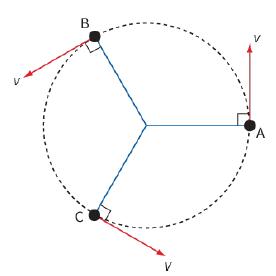
Explain why all the velocity arrows in Figure 16.5 are drawn the same length. A V
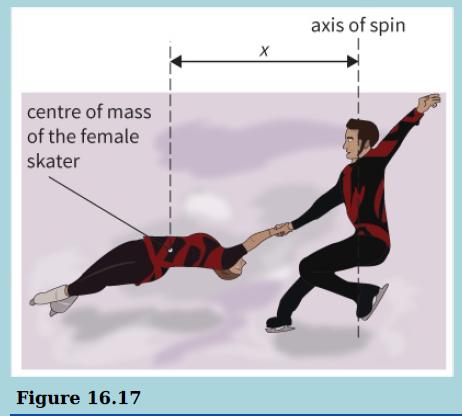
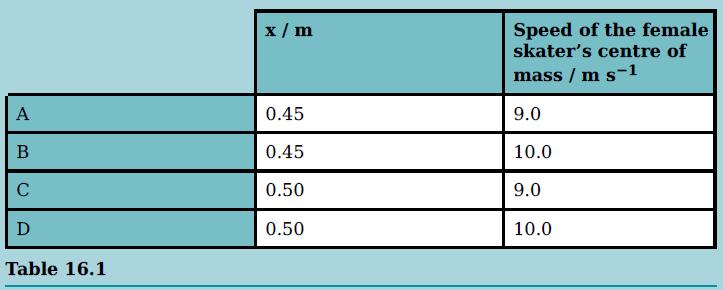
When ice-dancers spin, as shown in the diagram, the first dancer’s hand applies a centripetal force to the second dancer’s hand.In which case is the centripetal force the greatest? axis of spin centre of mass of the female skater Figure 16.17
a. Convert the following angles from degrees into radians: 30°, 90°, 105°.b. Convert these angles from radians to degrees: 0.5 rad, 0.75 rad, π rad, π/r rad.c. Express the following angles as multiples of π radians: 30°, 120°, 270°, 720°.
Which statement is correct?A. There is a resultant force on an object moving along a circular path at constant speed away from the centre of the circle causing it to be thrown outwards.B. There is a resultant force on an object moving along a circular path at constant speed towards the centre of
a. By how many degrees does the angular displacement of the hour hand of a clock change each hour?b. A clock is showing 3.30. Calculate the angular displacements in degrees from the 12.00 position of the clock to:i. The minute handii. The hour hand.
State two differences between hadrons and leptons.
What are the differences between a proton, a positron and a photon? You can describe how their masses differ, how their charges differ or whether they are particles or antiparticles.
The equation 11 p → 10 n + + 0 1 β + v represents β+ decay.Use the equation to explain why the neutrino ν can have no charge and very little mass.
Show that the ϕ-meson is neutral.
Suggest which quarks or antiquarks make up a π− meson.
A ρ-meson is made up of an up quark and an antidown quark. Calculate its charge.
a. Show that the charges on the quarks making up a proton give it a charge of +1e.b. Show that the charges on the quarks making up a neutron give it a charge of 0.
Beta decay occurs as either β+ decay or β− decay. An isotope of calcium Ca decays by β+ emission into the isotope 4621 Sc, and an isotope of magnesium 2312 Mg decays by β emission into the isotope 2311 Na.a. Copy and complete the following decay equations for the calcium and magnesium
Uranium 238 decays through a series of α and β− decays to eventually form the stable isotope lead- 206 in what is known as a decay chain.Determine the number of each type of decay in the decay chain.
Geiger and Marsden carried out an experiment to investigate the structure of the atom. In this experiment, α-particles were scattered by a thin film of gold.a. When Rutherford analysed their results, what conclusions did he draw about the distribution of mass and charge in the atom?b. Describe and
Copper-64 can decay by either β+ or β− emission.Give equations for both processes and identify the resulting elements.
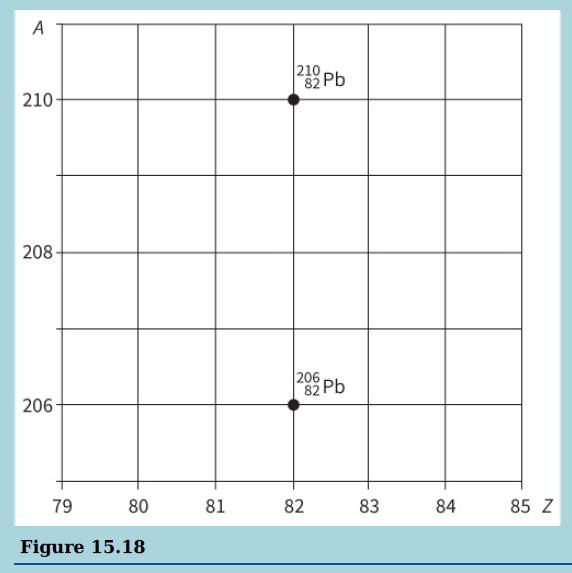
The nuclide of lead 210 82 Pb decays in three separate stages by α and β− emission to another lead nuclide, 206 82 Pb .a. Describe the structure of a nucleus of 206 82 Pb .b. α- and β−-particles are known as ionising radiations. State and explain why such
The isotope thorium-227 decays by α-emission.Write down an equation to describe this decay and identify the element that is produced.
Approximate values for the radius of a gold atom and the radius of a gold nucleus are 10−10 m and 10−15 m, respectively.Estimate the ratio of the volume of a gold atom to the volume of a gold nucleus.The density of gold is 19,000 kg m−3. Estimate the density of a gold nucleus, stating any
a. Explain why you would expect β−-particles to travel further through air than α-particles.b. Explain why you would expect β−-particles to travel further through air than through metal.In these questions, use the Periodic Table in Appendix 3 to determine the identity, or the proton number,
The uranium isotopes U-236 and U-237 both emit radioactive particles. A nucleus of uranium-237 may be written as 237 92 U and emits a β−-particle. A nucleus of uranium-236 emits an α-particle. The number of protons in a nucleus of uranium is 92.a. Describe the differences between an
State which of the following forces act between protons and neutrons in a nucleus.a. Gravitationalb. Electrostaticc. Strong nuclear.
An isotope of carbon 14 6 emits a β−-particle and changes into an isotope of nitrogen (N).a. What are β−-particles?b. Write a nuclear decay equation for the decay.c. Draw a graph with the y-axis representing nucleon numbers between 10 and 16 and the x-axis representing proton numbers
Eight different atoms are labelled A to H. Group the elements A–H into isotopes and name them using the Periodic Table in Appendix 3. A C D E F G H Proton number 20 23 21 22 20 22 22 23 Nucleon number 44 50 46 46 46 48 50 51
The nuclide of iodine with a nucleon number of 131 and a proton number 53 emits a β−-particle. Write a nuclear equation for this decay.
There are seven naturally occurring isotopes of mercury, with nucleon numbers (and relative abundances) of 196 (0.2%), 198 (10%), 199 (16.8%), 200 (23.1%), 201 (13.2%), 202 (29.8%) and 204 (6.9%).a. Determine the proton and neutron numbers for each isotope.b. Determine the average relative atomic
State the changes that take place in a nucleus when it emits an α-particle and then two β−-particles.
Uranium has atomic number 92. Two of its common isotopes have nucleon numbers 235 and 238.Determine the number of neutrons for these isotopes.
A nucleus of strontium has a nucleon number of 90 and a proton number of 38.Describe the structure of this strontium nucleus.
State the charge of each of the following in terms of the elementary charge e:a. Protonb. Neutronc. Nucleusd. Moleculee. α-particle.
Before Rutherford’s model, scientists believed that the atom was made up of negatively charged electrons embedded in a ‘plum pudding’ of positive charge that was spread throughout the atom. Explain how the α-particle scattering experiment proved that this old model of the atom was incorrect.
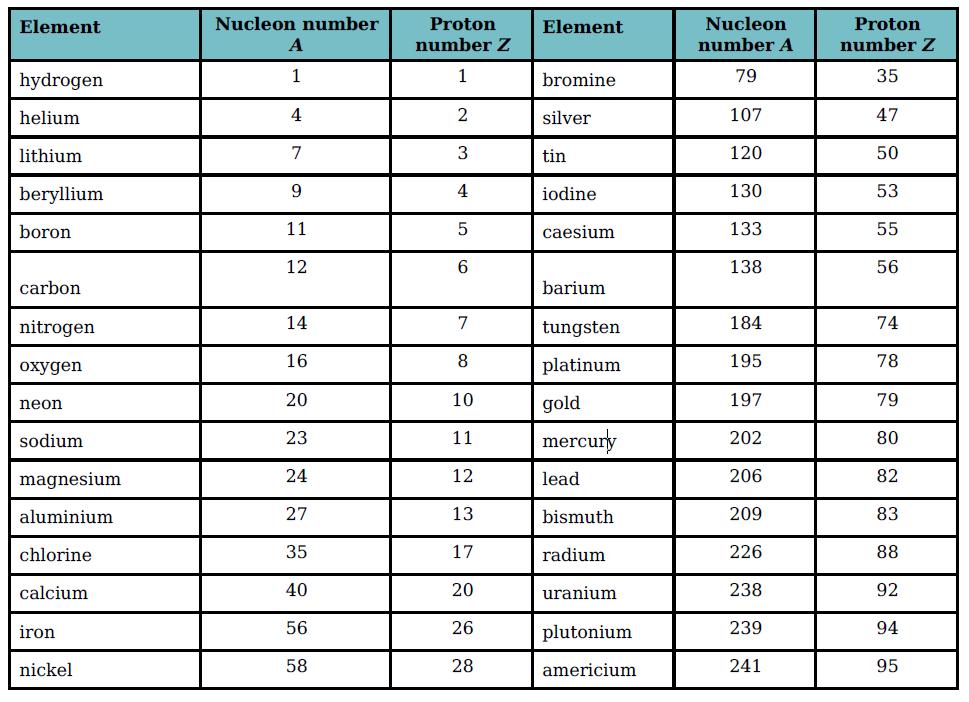
Table 15.2 shows the proton and nucleon numbers of several nuclei. Determine the number of neutrons in the nuclei of the following elements shown in the table:a. Nitrogenb. Brominec. Silverd. Golde. Mercury. Element Nucleon number Proton Element Nucleon Proton number Z number A number Z hydrogen 1
Explain why the most strongly ionising radiation (α-particles) is the least penetrating, while the least ionising (γ-rays) is the most penetrating.
Gold has a density of 19,700 kg m−3. A mass of 193 g of gold contains 6.02 × 10²³ atoms. Use this information to estimate the volume of a gold atom, and hence its radius. State any assumptions you make.
Hadrons are made up from quarks.Which combination of quarks could make up a meson?A. dd¯sB. sscC. s¯bD. sc
In Rutherford’s experiment, α-particles were directed at a thin gold foil. A small fraction of the α-particles were back-scattered through 180°. Describe and explain how the fraction back-scattered changes if each of the following changes are (separately) made.a. A thicker foil is used.b.
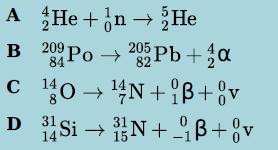
Which of the interactions is not possible? He + in → He Po → Pb +a 205 82 Pb+a 84 C 40 → 14N +iB+°v 14 Si → 1N+ B+;v
Rutherford’s scattering experiments were done in an evacuated container. Explain why this is necessary.
The speed v of a transverse wave on a stretched wire is given by the expression v ∝ √T where T is the tension in the wire.A length of wire is stretched between two fixed point. The tension in the wire is T. The wire is gently plucked from the middle. A stationary wave, of fundamental frequency
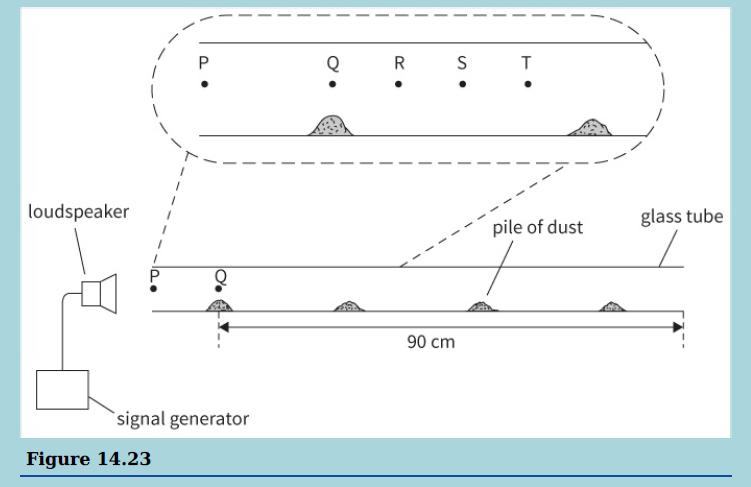
This diagram shows an experiment to measure the speed of sound in air.A small amount of dust is scattered along the tube. The loudspeaker is switched on. When the frequency is set at 512 Hz the dust collects in small piles as shown in the diagram.Determine the wavelength of the sound wave and
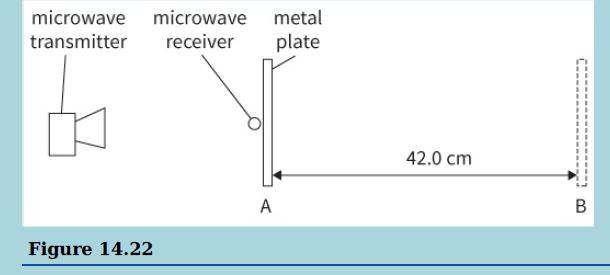
a. Explain what is meant by:i. A coherent source of waves.ii. Phase difference.b. A student, experimenting with microwaves, sets up the arrangement shown in this diagram.With the metal plate at position A there is a very small signal. He slowly moves the plate back, leaving the receiver in the same
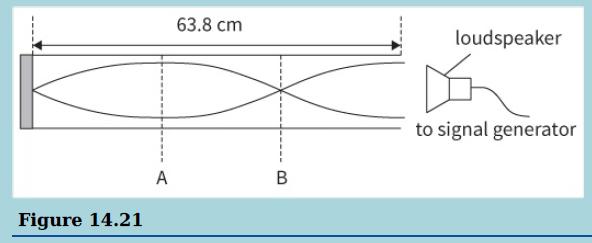
This diagram shows a stationary wave, of frequency 400 Hz, produced by a loudspeaker in a closed tube.a. Describe the movement of the air particles at:i. Aii. Bb. The length the tube is 63.8 cm.Calculate the speed of the sound. 63.8 cm loudspeaker to signal generator A Figure 14.21
For sound waves of frequency 2500 Hz, it is found that two nodes are separated by 20 cm, with three antinodes between them.a. Determine the wavelength of these sound waves.b. Use the wave equation v = fλ to determine the speed of sound in air.
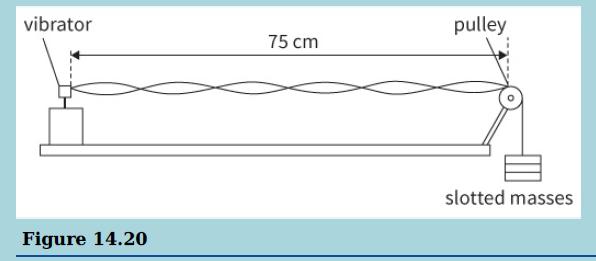
a. State two similarities and two differences between progressive waves and stationary waves.b. This diagram shows an experiment to measure the speed of a sound in a string. The frequency of the vibrator is adjusted until the stationary wave shown is formed.On a copy of the diagram, mark a node
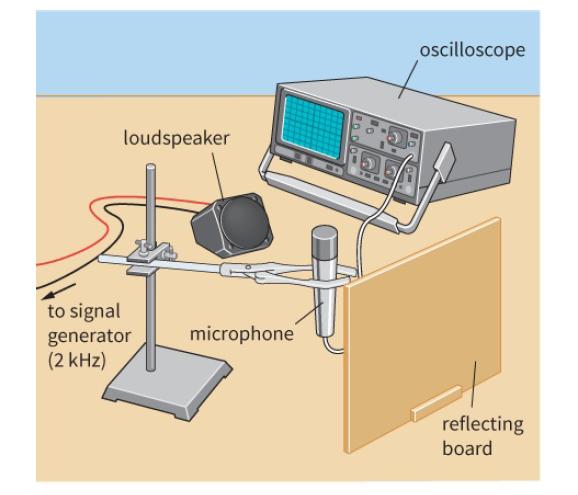
a. For the arrangement shown in Figure 14.17, suggest why it is easier to determine accurately the position of a node rather than an antinode.b. Explain why it is better to measure the distance across several nodes. oscilloscope loudspeaker to signal generator (2 kHz) microphone reflecting board
A tuning fork that produces a note of 256 Hz is placed above a tube that is nearly filled with water. The water level is lowered until resonance is first heard.a. Explain what is meant by the term resonance.b. The length of the column of air above the water when resonance is first heard is 31.2
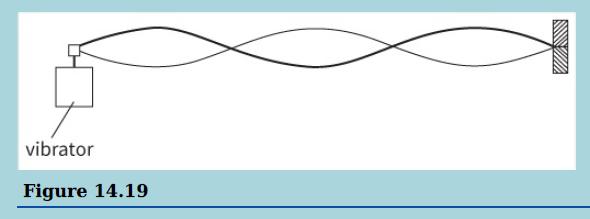
This diagram shows a stationary wave on a string.On a copy of the diagram, label one node (N) and one antinode (A).Mark on your diagram the wavelength of the progressive wave and label it λ.The frequency of the vibrator is doubled. Describe the changes in the stationary wave pattern. vibrator
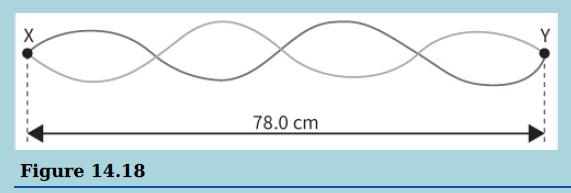
A string is fixed between points X and Y.A stationary wave pattern is formed on the stretched string.The distance between X and Y is 78.0 cm. The string vibrates at a frequency of 120 Hz.What is the speed of the progressive wave on the string?A. 11.7 m s−1B. 23.4 m s−1C. 46.8 m s−1D. 93.6 m
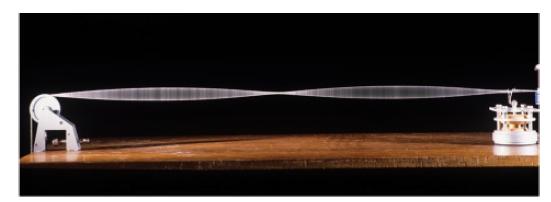
Look at the stationary (standing) wave on the string in Figure 14.7. The length of the vibrating section of the string is 60 cm.a. Determine the wavelength of the progressive wave and the separation of the two neighbouring antinodes. The frequency of vibration is increased until a stationary wave
Which statement is not correct about stationary waves?A. A stationary wave always has transverse oscillations.B. A stationary wave must have at least one node.C. The separation between two adjacent nodes is λ/2 , where λ is the wavelength of the progressive wave.D. The superposition of two
Explain why the two loudspeakers producing sounds of slightly different frequencies will not produce stable effects of interference.
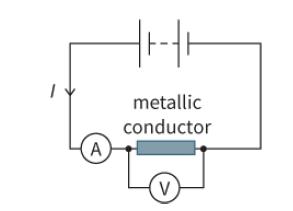
In Figure 8.14 the reading on the ammeter is 2.4 A and the reading on the voltmeter is 6.0 V.Calculate the resistance of the metallic conductor. metallic conductor A
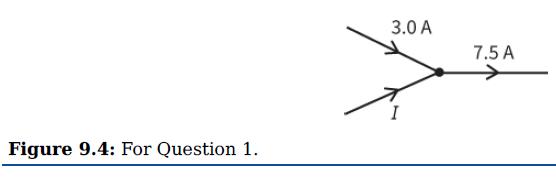
Use Kirchhoff’s first law to deduce the value of the current I in Figure 9.4. 3.0 A 7.5 A Figure 9.4: For Question 1.
Which row in this table is correct?
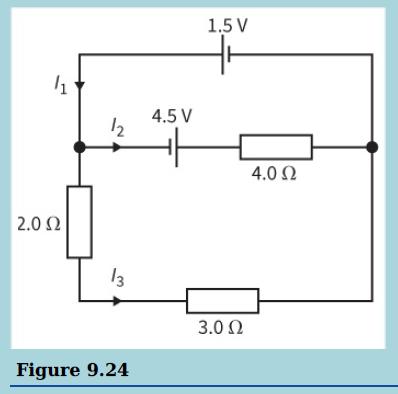
What is the current I1 in this circuit diagram?A. −0.45 AB. +0.45 AC. +1.2 AD. +1.8 A 1.5 V 4.5 V 12 4.0 2 2.0 Ω 13 3.0 Ω Figure 9.24
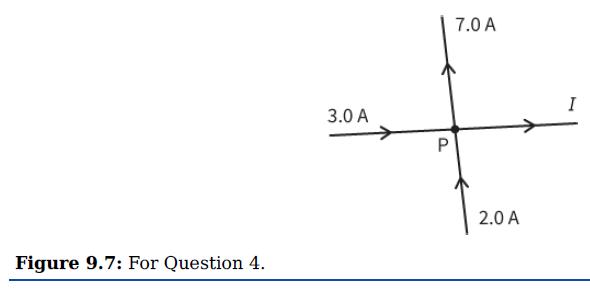
Use Kirchhoff’s first law to deduce the value and direction of the current I in Figure 9.7. 7.0 A I 3.0 A 2.0 A Figure 9.7: For Question 4.
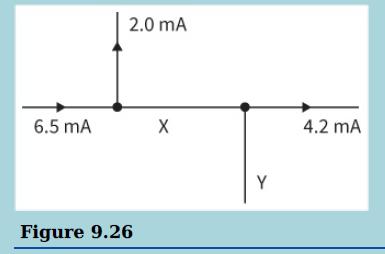
This diagram shows a part of a circuit.Copy the circuit and write in the currents at X and at Y, and show their directions. 2.0 mA 6.5 mA 4.2 mA Y Figure 9.26
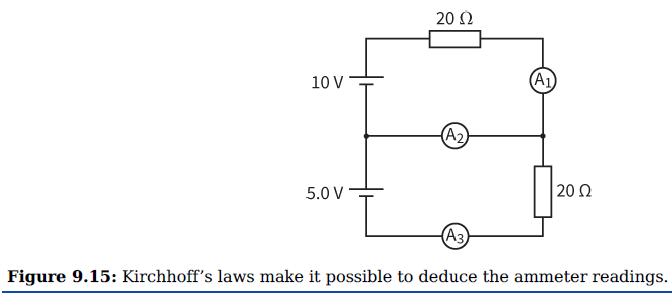
Apply Kirchhoff’s laws to the circuit shown in Figure 9.15 to determine the current that will be shown by the ammeters A1, A2 and A3. 20 Ω (A1 10 V (A2 202 5.0 V (A3) Figure 9.15: Kirchhoff's laws make it possible to deduce the ammeter readings.
Calculate the current drawn from a 12 V battery of negligible internal resistance connected to the ends of the following:a. 500 Ω resistorb. 500 Ω and 1000 Ω resistors in seriesc. 500 Ω and 1000 Ω resistors in parallel.
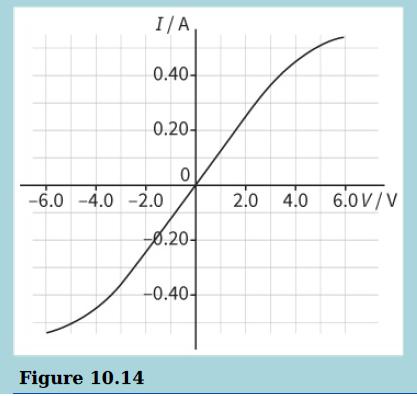
This shows the I–V characteristic of an electrical component.a. Calculate the resistance of the component when the potential difference across it is:i. 2.0 Vii. 5.0 V.b. Suggest what the component is. I/A, 0.40- 0.20- -6.0 -4.0 -2.0 2.0 4.0 6.0 V/V 0.20- -0.40- Figure 10.14
A nichrome wire has a length of 1.5 m and a cross-sectional area of 0.0080 mm2. The resistivity of nichrome is 1.30 × 10⁻⁸ Ω m.a. Calculate the resistance of the wire.b. Calculate the length of this wire that would be needed to make an element of an electric heater of resistance 30 Ω.
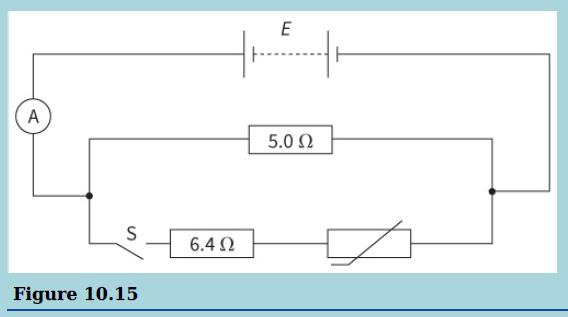
This is a circuit.a. When switch S is open the current in ammeter A is 0.48 A. Calculate the e.m.f. of the battery. You may assume the battery has negligible internal resistance.b. When switch S is closed the current in the ammeter increases to 0.72 A.i. Determine the current in the 6.4 Ω
A single cell of e.m.f. 1.5 V is connected across a 0.30 Ω resistor. The current in the circuit is 2.5 A.a. Calculate the terminal p.d. and explain why it is not equal to the e.m.f. of the cell.b. Show that the internal resistance r of the cell is 0.30 Ω.c. It is suggested that the power
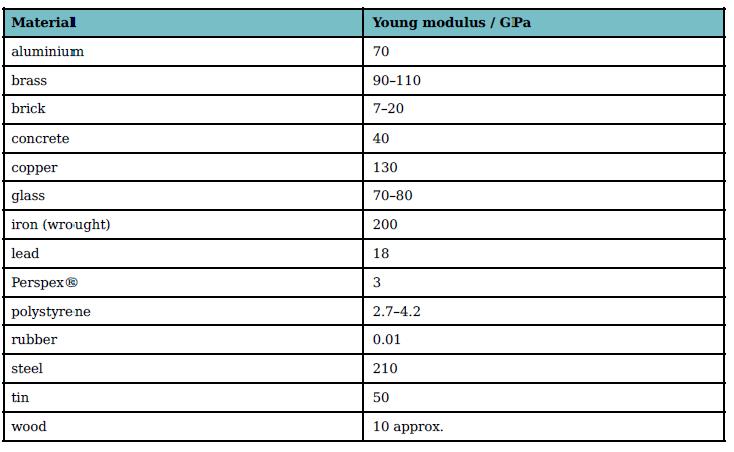
List the metals in Table 7.1 from stiffest to least stiff. Material Young modulus / GPa aluminium 70 brass 90-110 brick 7-20 concrete 40 copper 130 glass 70-80 iron (wrought) 200 lead 18 Perspex® polystyre ne 2.7-4.2 rubber 0.01 steel 210 tin 50 wood 10 approx.
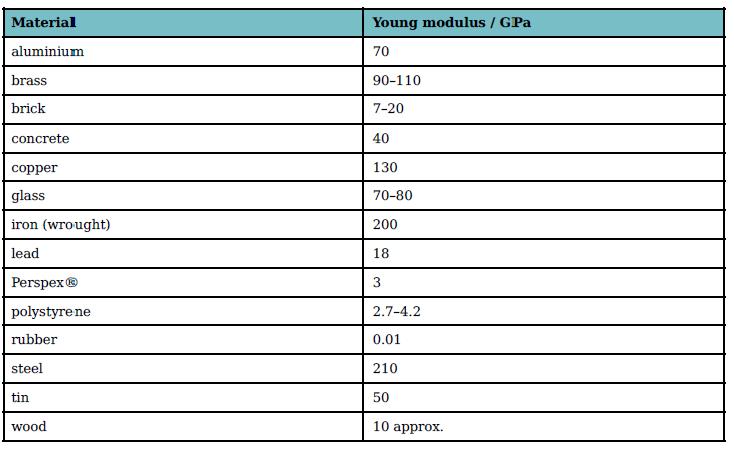
Which of the non-metals in Table 7.1 is the stiffest? Material Young modulus / GPa aluminium 70 brass 90-110 brick 7-20 concrete 40 copper 130 glass 70-80 iron (wrought) 200 lead 18 Perspex® polystyre ne 2.7-4.2 rubber 0.01 steel 210 tin 50 wood 10 approx.
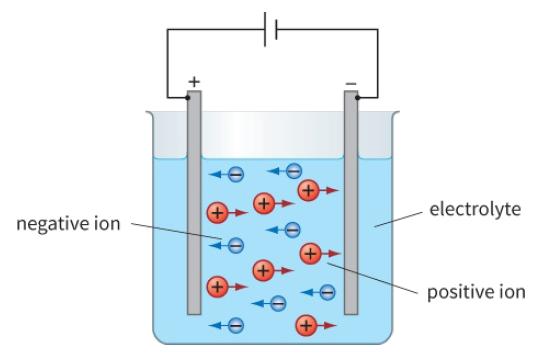
Look at Figure 8.7 and state the direction of the conventional current in the electrolyte (towards the left, towards the right or in both directions at the same time?). + electrolyte negative ion positive ion
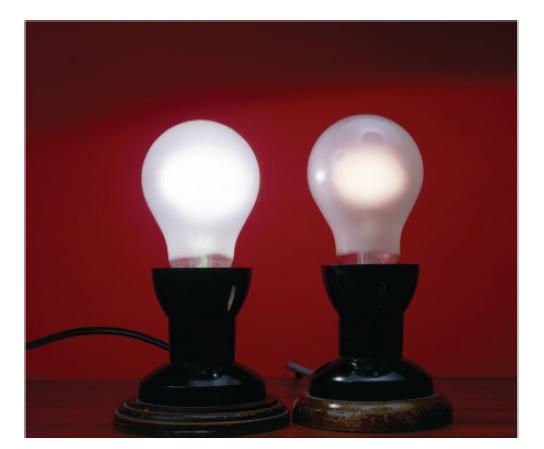
You can buy lamps of different brightness to fit in light fittings at home (Figure 8.13). A ‘100 watt’ lamp glows more brightly than a ‘60 watt’ lamp. Explain which of the lamps has the higher resistance.
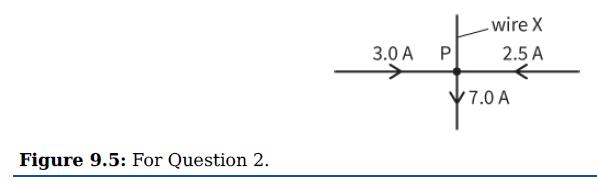
In Figure 9.5, calculate the current in the wire X. State the direction of this current (towards P or away from P). wire X 3.0 A 2.5 A 7.0 A Figure 9.5: For Question 2.
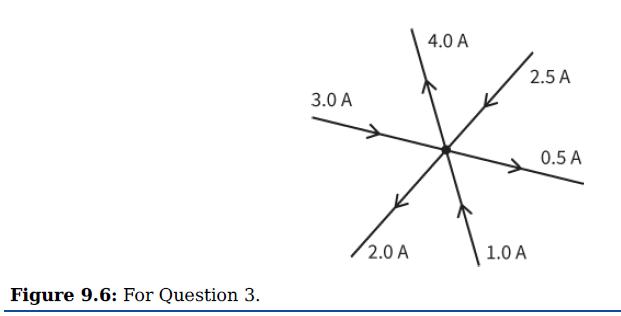
Calculate ΣIin and ΣIout in Figure 9.6. Is Kirchhoff’s first law satisfied? 4.0 A 2.5 A 3.0 A 0.5 A 2.0 A 1.0 A Figure 9.6: For Question 3.
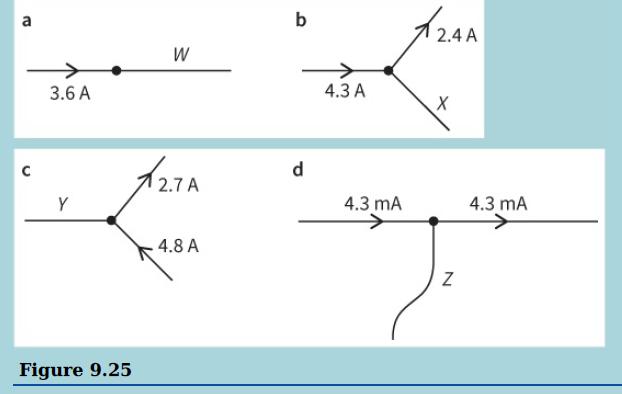
Use Kirchhoff’s first law to calculate the unknown currents in these examples.For each example, state the direction of the current. a b 2.4 A W 3.6 A 4.3 A d 2.7 A Y 4.3 mA 4.3 mA 4.8 A Figure 9.25
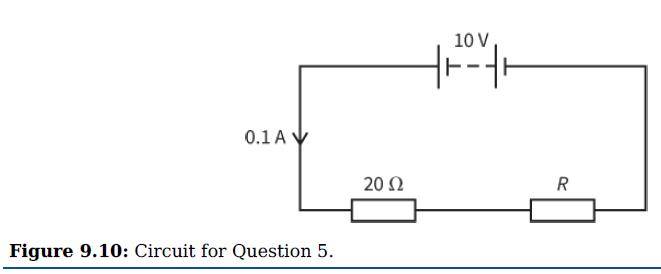
Use Kirchhoff’s second law to deduce the p.d. across the resistor of resistance R in the circuit shown in Figure 9.10, and hence find the value of R. (Assume the battery of e.m.f. 10 V has negligible internal resistance.) 10 V 0.1 A V 20 Ω R Figure 9.10: Circuit for Question 5.
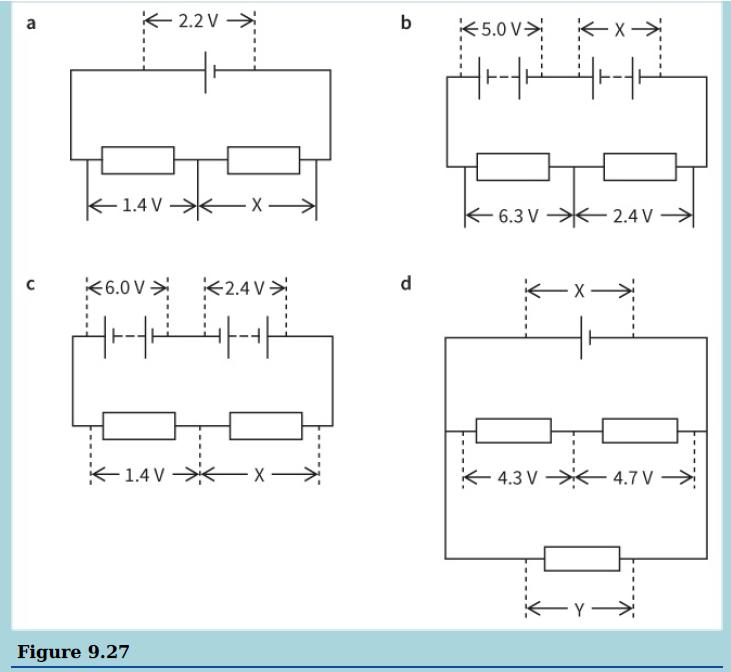
Look at these four circuits.Determine the unknown potential difference (or differences) in each case. K 2.2 V > b x→ K1.4V* - 1.4 K 6.3 V * 2.4 V > 长2.4V d -x- 1.4 V >< X> 4.7 V > 4.3 V -Y - Figure 9.27
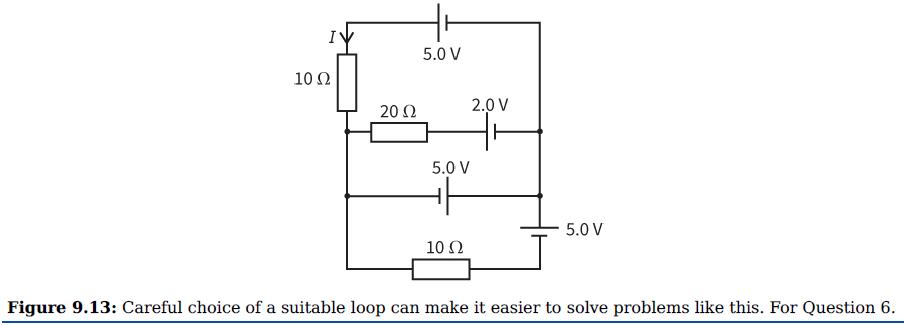
You can use Kirchhoff’s second law to find the current I in the circuit shown in Figure 9.13. Choosing the best loop can simplify the problem.a. Which loop in the circuit should you choose?b. Calculate the current I. 5.0 V 10 2 20 Ω 2.0 V 5.0 V 5.0 V 10 N Figure 9.13: Careful choice of a
Showing 500 - 600
of 962
1
2
3
4
5
6
7
8
9
10
Step by Step Answers

 Get 50% OFF
Claim Now
Get 50% OFF
Claim Now