New Semester
Started
Get
50% OFF
Study Help!
--h --m --s
Claim Now
Question Answers
Textbooks
Find textbooks, questions and answers
Oops, something went wrong!
Change your search query and then try again
S
Books
FREE
Study Help
Expert Questions
Accounting
General Management
Mathematics
Finance
Organizational Behaviour
Law
Physics
Operating System
Management Leadership
Sociology
Programming
Marketing
Database
Computer Network
Economics
Textbooks Solutions
Accounting
Managerial Accounting
Management Leadership
Cost Accounting
Statistics
Business Law
Corporate Finance
Finance
Economics
Auditing
Tutors
Online Tutors
Find a Tutor
Hire a Tutor
Become a Tutor
AI Tutor
AI Study Planner
NEW
Sell Books
Search
Search
Sign In
Register
study help
sciences
cambridge international as & a level physics coursebook
Cambridge International AS And A Level Physics Coursebook 3rd Edition David Sang, Graham Jones, Gurinder Chadha, Richard Woodside - Solutions
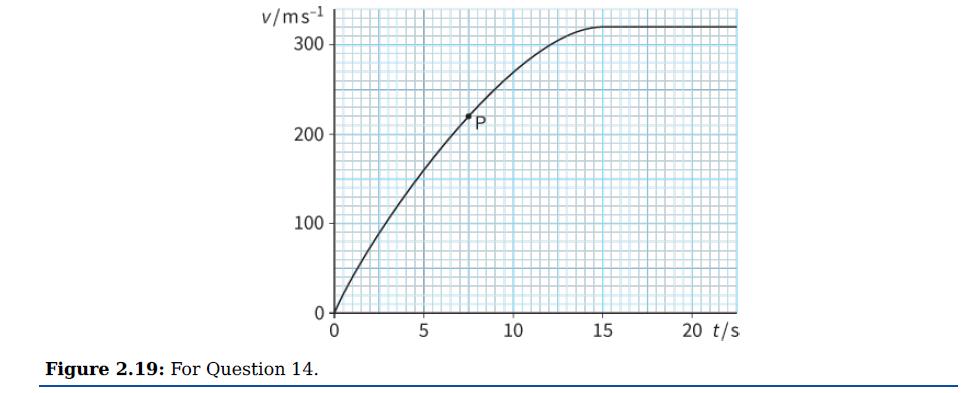
The graph in Figure 2.19 represents the motion of an object moving with varying acceleration. Lay your ruler on the diagram so that it is tangential to the graph at point P.a. What are the values of time and velocity at this point?b. Estimate the object’s acceleration at this point. v/ms-1 300 d,
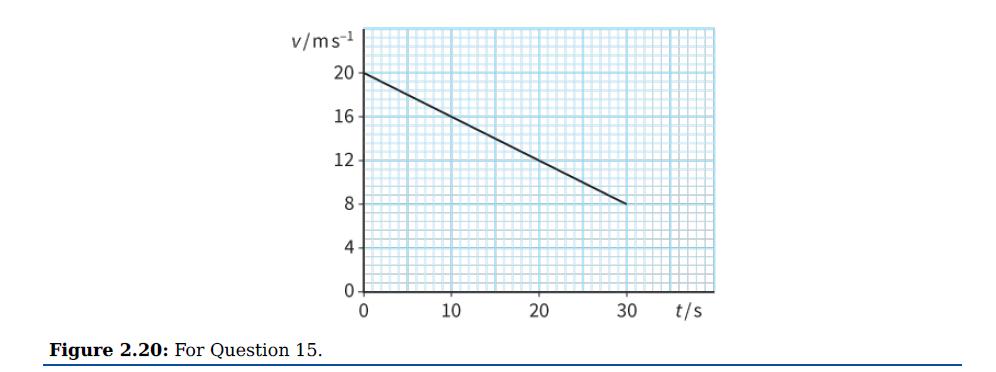
The velocity–time graph (Figure 2.20) represents the motion of a car along a straight road for a period of 30 s.a. Describe the motion of the car.b. From the graph, determine the car’s initial and final velocities over the time of 30 s.c. Determine the acceleration of the car.d. By calculating
If you drop a stone from the edge of a cliff, its initial velocity u = 0, and it falls with acceleration g = 9.81 m s−2. You can calculate the distance s it falls in a given time t using an equation of motion.a. Copy and complete Table 2.3, which shows how s depends on t.b. Draw a graph of s
An egg falls off a table. The floor is 0.8 m from the table-top.a. Calculate the time taken to reach the ground.b. Calculate the velocity of impact with the ground.
A steel ball falls from rest through a height of 2.10 m. An electronic timer records a time of 0.67 s for the fall.a. Calculate the average acceleration of the ball as it falls.b. Suggest reasons why the answer is not exactly 9.81 m s−2.c. Suppose the height is measured accurately but the time is
In an experiment to determine the acceleration due to gravity, a ball was timed electronically as it fell from rest through a height h. The times t shown in Table 2.5 were obtained.a. Plot a graph of h against t2.b. From the graph, determine the acceleration of free fall g.c. Comment on your
In Chapter 1, we looked at how to use a motion sensor to measure the speed and position of a moving object. Suggest how a motion sensor could be used to determine g.
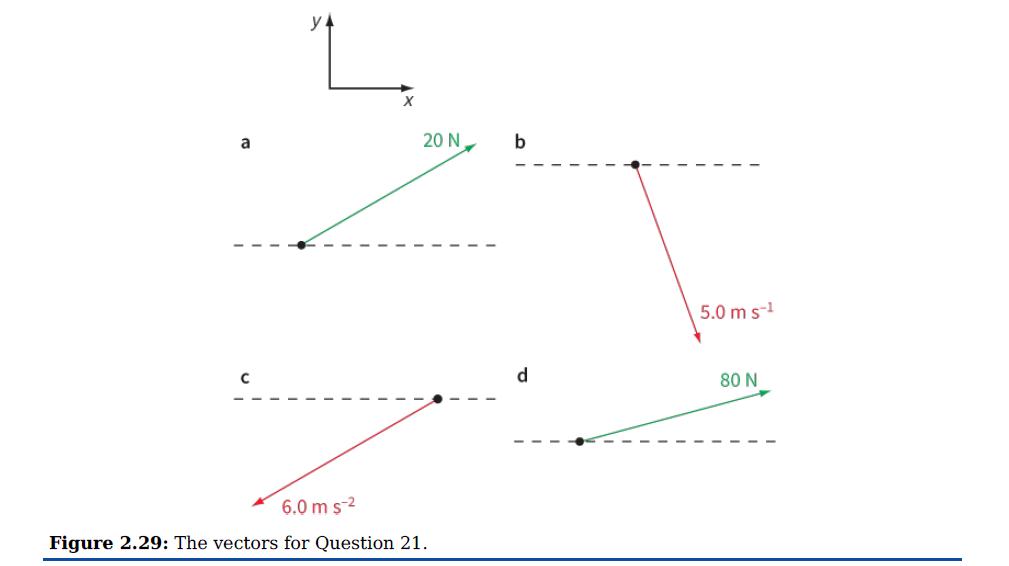
Find the x- and y-components of each of the vectors shown in Figure 2.29. (You will need to use a protractor to measure angles from the diagram.) a 20 N. b 5.0 m s-1 d. 80 N 6.0 m s-2 Figure 2.29: The vectors for Question 21.
In the example in ‘Falling further’, calculate the time it will take for the stone to reach the foot of the cliff.
A ball is fired upwards with an initial velocity of 30 m s−1. Table 2.6 shows how the ball’s velocity changes. (Take g = 9.81 m s−2.)a. Copy and complete the table.b. Draw a graph to represent the data.c. Use your graph to deduce how long the ball took to reach its highest point. -1 30
A stone is thrown horizontally from the top of a vertical cliff and lands 4.0 s later at a distance 12.0 m from the base of the cliff. Ignore air resistance.a. Calculate the horizontal speed of the stone.b. Calculate the height of the cliff.
A stone is thrown with a velocity of 8.0 m s−1 into the air at an angle of 40° to the horizontal.a. Calculate the vertical component of the velocity.b. State the value of the vertical component of the velocity when the stone reaches its highest point. Ignore air resistance.c. Use your answers to
The range of a projectile is the horizontal distance it travels before it reaches the ground. The greatest range is achieved if the projectile is thrown at 45° to the horizontal.A ball is thrown with an initial velocity of 40 m s−1. Calculate its greatest possible range when air resistance is
Calculate the force needed to give a car of mass 800 kg an acceleration of 2.0 m s−2.
Which list contains only SI base units?A. Ampere, kelvin, gramB. Kilogram, metre, newtonC. Newton, second, ampereD. Second, kelvin, kilogram
A rocket has a mass of 5,000 kg. At a particular instant, the resultant force acting on the rocket is 200,000 N. Calculate its acceleration.
The speed v of a wave travelling a wire is given by the equation v = (Tl/m)n where T is the tension in the wire that has mass m and length l. In order for the equation to be homogenous, what is the value of n?A. 1/2B. 1C. 2D. 4
A motorcyclist of mass 60 kg rides a bike of mass 40 kg. As she sets off from the lights, the forward force on the bike is 200 N. Assuming the resultant force on the bike remains constant, calculate the bike’s velocity after 5.0 s.
When a golfer hits a ball his club is in contact with the ball for about 0.000 50 s and the ball leaves the club with a speed of 70 m s−1. The mass of the ball is 46 g.a. Determine the mean accelerating force.b. What mass, resting on the ball, would exert the same force as in part a?
Estimate the mass and weight of each of the following at the surface of the Earth:a. A kilogram of potatoesb. An average studentc. A moused. A 40-tonne truck.(For estimates, use g = 10 m s−2; 1 tonne = 1,000 kg.)
The mass of a spacecraft is 70 kg. As the spacecraft takes off from the Moon, the upwards force on the spacecraft caused by the engines is 500 N. The acceleration of free fall on the Moon is 1.6 N kg−1.Determine:a. The weight of the spacecraft on the Moonb. The resultant force on the spacecraftc.
Use the idea of inertia to explain why some large cars have power-assisted brakes.
A metal ball is dropped into a tall cylinder of oil. The ball initially accelerates but soon reaches a terminal velocity.a. By considering the forces on the metal ball bearing, explain why it first accelerates but then reaches terminal velocity.b. State how you would show that the metal ball
A car crashes head-on into a brick wall. Use the idea of inertia to explain why the driver is more likely to come out through the windscreen if he or she is not wearing a seat belt.
Determine the speed in m s−1 of an object that travels:a. 3.0 μm in 5.0 msb. 6.0 km in 3.0 Msc. 8.0 pm in 4.0 ns.
If you drop a large stone and a small stone from the top of a tall building, which one will reach the ground first? Explain your answer.
A car starts to move along a straight, level road. For the first 10 s, the driver maintains a constant acceleration of 1.5 m s−2. The mass of the car is 1.1 × 10³ kg.a. Calculate the driving force provided by the wheels, when:i. The force opposing motion is negligibleii. The total force opposing
Skydivers jump from a plane at intervals of a few seconds. If two divers wish to join up as they fall, the second must catch up with the first.a. If one diver is more massive than the other, who should jump first? Use the idea of forces and terminal velocity to explain your answer.b. If both divers
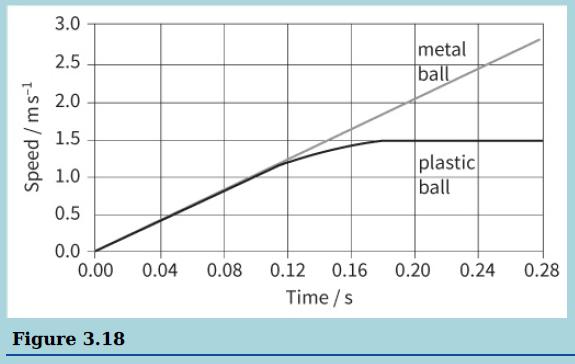
These are the speed–time graphs for two falling balls:a. Determine the terminal velocity of the plastic ball.b. Both balls are of the same size and shape but the metal ball has a greater mass.Explain, in terms of Newton’s laws of motion and the forces involved, why the plastic ball reaches a
A car of mass 1200 kg accelerates from rest to a speed of 8.0 m s−1 in a time of 2.0 s.a. Calculate the forward driving force acting on the car while it is accelerating. Assume that, at low speeds, all frictional forces are negligible.b. At high speeds the resistive frictional force F produced by
Draw a diagram to show the forces that act on a car as it travels along a level road at its top speed.
a. Explain what is meant by the mass of a body and the weight of a body.b. State and explain one situation in which the weight of a body changes while its mass remains constant.c. State the difference between the base units of mass and weight in the SI system.
Imagine throwing a shuttlecock straight up in the air. Air resistance is more important for shuttlecocks than for a tennis ball. Air resistance always acts in the opposite direction to the velocity of an object.Draw diagrams to show the two forces, weight and air resistance, acting on the
a. State Newton’s second law of motion in terms of acceleration.b. When you jump from a wall on to the ground, it is advisable to bend your knees on landing.i. State how bending your knees affects the time it takes to stop when hitting the ground.ii. Using Newton’s second law of motion, explain
Describe one ‘Newton’s third law pair’ of forces involved in the following situations. In each case, state the object that each force acts on, the type of force and the direction of the force.a. You step on someone’s toe.b. A car hits a brick wall and comes to rest.c. A car slows down by
The pull of the Earth’s gravity on an apple (its weight) is about 1 newton. We could devise a new international system of units by defining our unit of force as the weight of an apple. State as many reasons as you can why this would not be a very useful definition.
Determine the base units of:a. Pressure (= force/area)b. Energy (= force × distance)c. Density (= mass/volume)
Use base units to prove that the following equations are homogeneous.a. Pressure = density × acceleration due to gravity × depthb. Distance travelled = initial speed x time + 1/2 acceleration x time2 (s = ut + 1/2 at2)
a. Find the area of one page of this book in cm2 and then convert your value to m2.b. If the uncertainty in measuring one side of the page is 0.1 cm find the uncertainty in the area.This can be done by either taking the largest value of each side when you multiply them together and then finding the
Write down, in powers of ten, the values of these quantities:a. 60 pAb. 500 MWc. 20,000 mm.
A parachutist weighs 1,000 N. When she opens her parachute, it pulls upwards on her with a force of 2,000 N.a. Draw a diagram to show the forces acting on the parachutist.b. Calculate the resultant force acting on her.c. What effect will this force have on her?
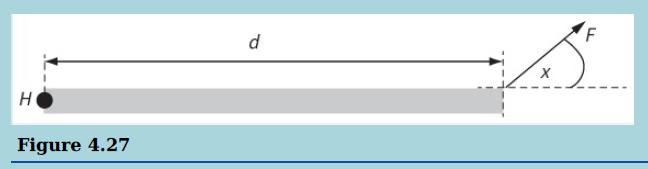
A force F is applied at a distance d from the hinge H and an angle x to the door.What is the moment of the force F about the point H?A. Fd cos xB. Fd/cos xC. Fd sin xD. Fd/sin x d H Figure 4.27
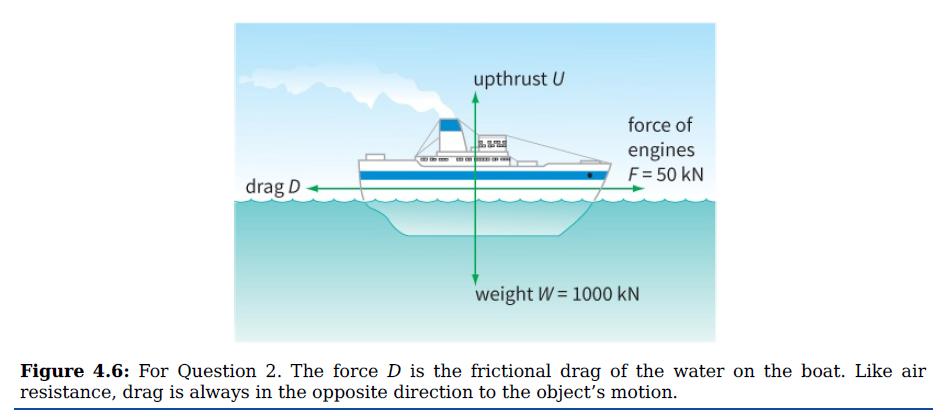
The ship shown in Figure 4.6 is travelling at a constant velocity.a. Is the ship in equilibrium (in other words, is the resultant force on the ship equal to zero)? How do you know?b. What is the upthrust U of the water?c. What is the drag D of the water? upthrust U force of engines F = 50 kN drag D
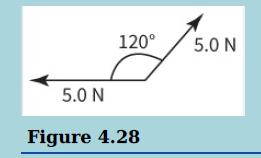
The angle between two forces, each of magnitude 5.0 N, is 120°.What is the magnitude of the resultant of these two forces?A. 1.7 NB. 5.0 NC. 8.5 ND. 10 N 120° 5.0 N 5.0 N Figure 4.28
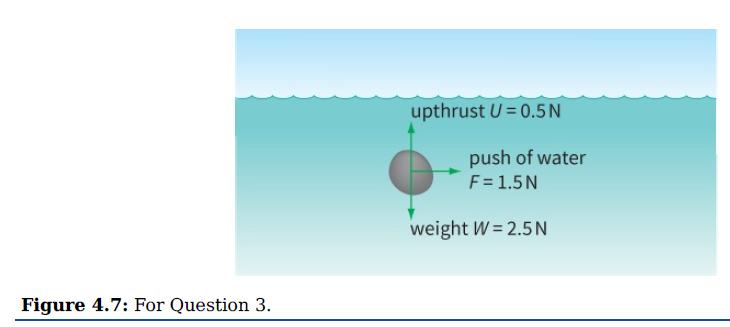
A stone is dropped into a fast-flowing stream. It does not fall vertically because of the sideways push of the water (Figure 4.7).a. Calculate the resultant force on the stone.b. Is the stone in equilibrium? upthrust U = 0.5N push of water F = 1.5N weight W= 2.5 N Figure 4.7: For Question 3.
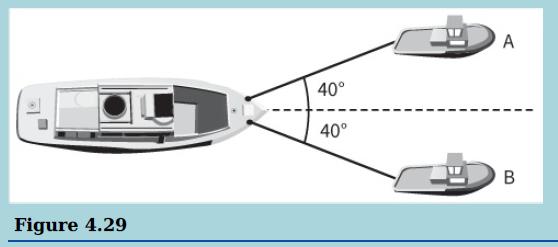
A ship is pulled at a constant speed by two small boats, A and B, as shown. The engine of the ship does not produce any force.The tension in each cable between A and B and the ship is 4000 N.a. Draw a free-body diagram showing the three horizontal forces acting on the ship.b. Draw a vector diagram
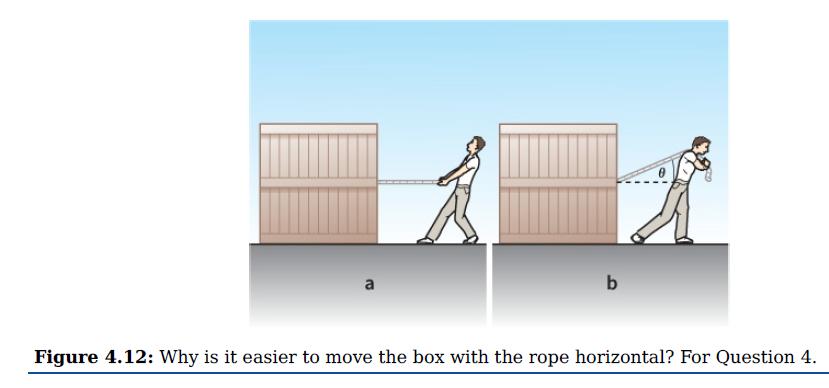
The person in Figure 4.12 is pulling a large box using a rope. Use the idea of components of a force to explain why they are more likely to get the box to move if the rope is horizontal (as in a) than if it is sloping upwards (as in b). a b Figure 4.12: Why is it easier to move the box with the
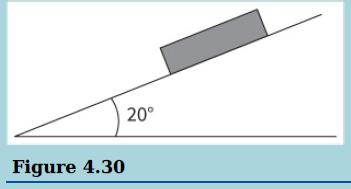
A block of mass 1.5 kg is at rest on a rough surface which is inclined at 20° to the horizontal as shown.a. Draw a free-body diagram showing the three forces acting on the block.b. Calculate the component of the weight that acts down the slope.c. Use your answer to part b to determine the force of
A crate is sliding down a slope. The weight of the crate is 500 N. The slope makes an angle of 30° with the horizontal.a. Draw a diagram to show the situation. Include arrows to represent the weight of the crate and the contact force of the slope acting on the crate.b. Calculate the component of
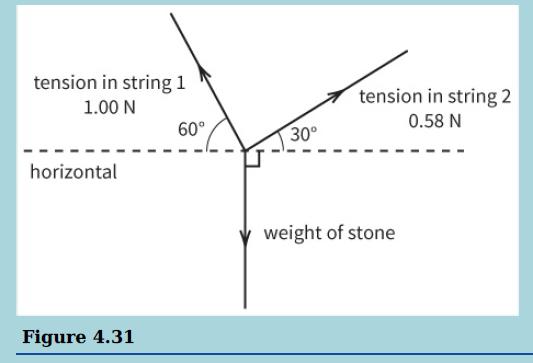
This free-body diagram shows three forces that act on a stone hanging at rest from two strings.a. Calculate the horizontal component of the tension in each string. State why these two components are equal in magnitude?b. Calculate the vertical component of the tension in each string.c. Use your
A child of mass 40 kg is on a water slide. The slide slopes down at 25° to the horizontal. The acceleration of free fall is 9.81 m s−2. Calculate the child’s acceleration down the slope:a. When there is no friction and the only force acting on the child is his weightb. If a frictional force of
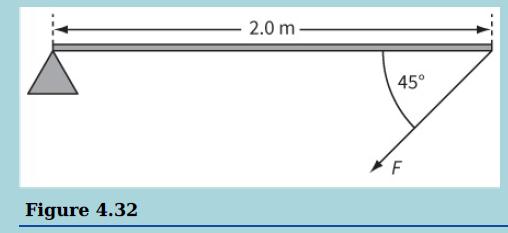
The force F shown here has a moment of 40 N m about the pivot. Calculate the magnitude of the force F. 2.0 m 45° Figure 4.32
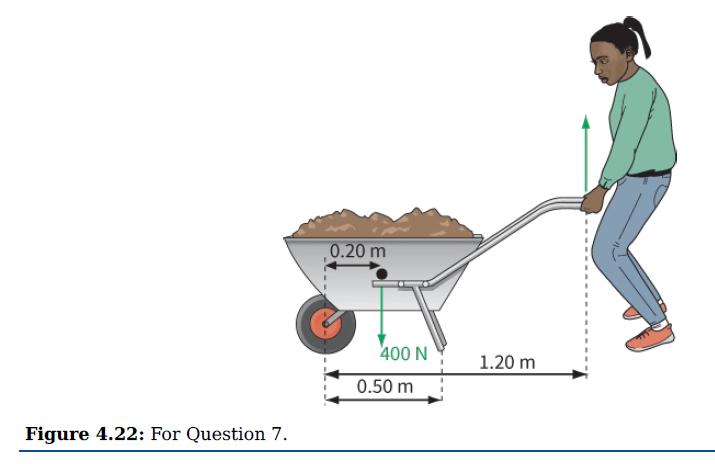
A wheelbarrow is loaded as shown in Figure 4.22.a. Calculate the force that the person needs to exert to hold the wheelbarrow’s legs off the ground.b. Calculate the force exerted by the ground on the legs of the wheelbarrow (taken both together) when the gardener is not holding the handles. 0.20
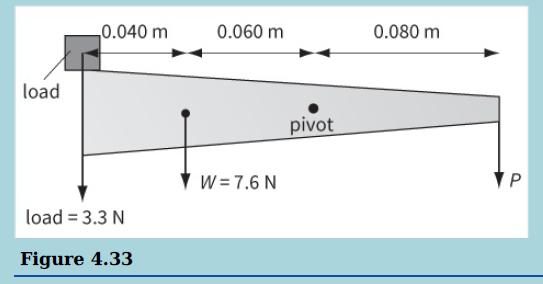
The asymmetric bar shown has a weight of 7.6 N and a centre of gravity that is 0.040 m from the wider end, on which there is a load of 3.3 N. It is pivoted a distance of 0.060 m from its centre of gravity. Calculate the force P that is needed at the far end of the bar in order to maintain
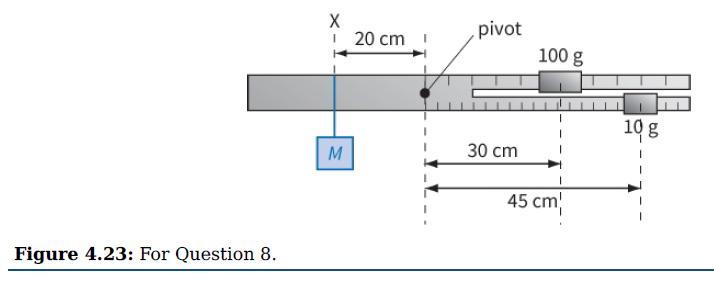
A traditional pair of scales uses sliding masses of 10 g and 100 g to achieve a balance. A diagram of the arrangement is shown in Figure 4.23. The bar itself is supported with its centre of gravity at the pivot.a. Calculate the value of the mass M, attached at X.b. State one advantage of this
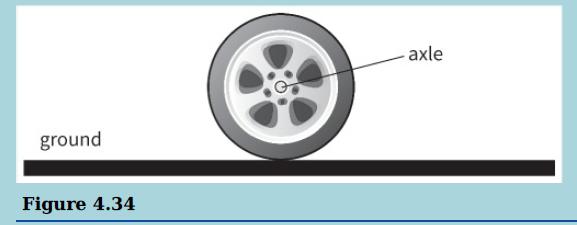
a. State what is meant by:i. A coupleii. Torque.b. The engine of a car produces a torque of 200 N m on the axle of the wheel in contact with the road. The car travels at a constant velocity towards the right:i. Copy the diagram of the wheel and show the direction of rotation of the wheel, and the
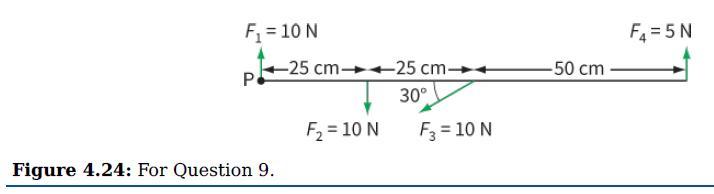
Figure 4.24 shows a beam with four forces acting on it.a. For each force, calculate the moment of the force about point P.b. State whether each moment is clockwise or anticlockwise.c. State whether or not the moments of the forces are balanced. F = 10 N F4 = 5N -25 cm-+25 cm- -50 cm 30° F2 = 10 N
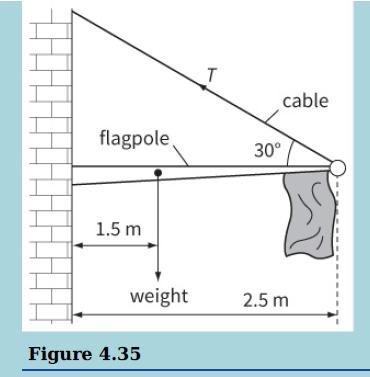
a. Explain what is meant by the centre of gravity of an object.b. A flagpole of mass 25 kg is held in a horizontal position by a cable as shown. The centre of gravity of the flagpole is at a distance of 1.5 m from the fixed end.i. Write an equation to represent taking moments about the left-hand
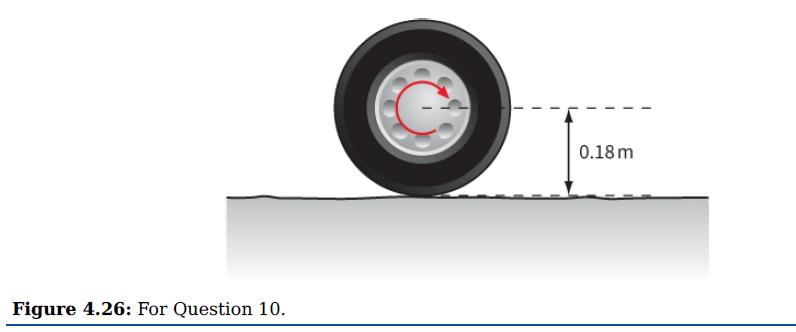
The driving wheel of a car travelling at a constant velocity has a torque of 137 N m applied to it by the axle that drives the car (Figure 4.26). The radius of the tyre is 0.18m. Calculate the driving force provided by this wheel. 0.18 m Figure 4.26: For Question 10.
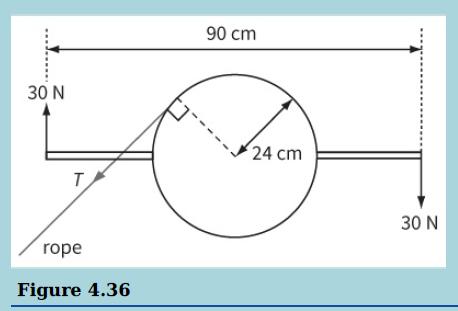
a. State the two conditions necessary for an object to be in equilibrium.b. A metal rod of length 90 cm has a disc of radius 24 cm fixed rigidly at its centre, as shown. The assembly is pivoted at its centre.Two forces, each of magnitude 30 N, are applied normal to the rod at each end so as to
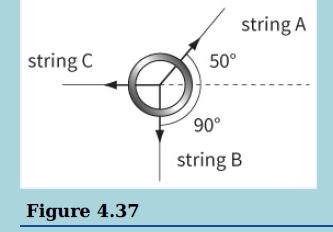
a. State what is meant by the torque of a couple.b. Three strings, A, B and C, are attached to a circular ring, as shown in Figure 4.35.The strings and the ring all lie on a smooth horizontal surface and are at rest. The tension in string A is 8.0 N. Calculate the tension in strings B and C. string
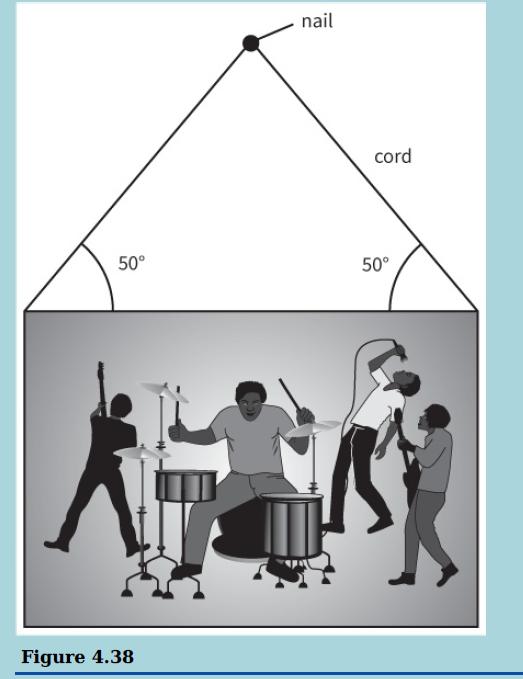
This diagram shows a picture hanging symmetrically by two cords from a nail fixed to a wall. The picture is in equilibrium.a. Explain what is meant by equilibrium.b. Draw a vector diagram to represent the three forces acting on the picture in the vertical plane. Label each force clearly with its
Showing 900 - 1000
of 962
1
2
3
4
5
6
7
8
9
10
Step by Step Answers

 Get 50% OFF
Claim Now
Get 50% OFF
Claim Now