New Semester
Started
Get
50% OFF
Study Help!
--h --m --s
Claim Now
Question Answers
Textbooks
Find textbooks, questions and answers
Oops, something went wrong!
Change your search query and then try again
S
Books
FREE
Study Help
Expert Questions
Accounting
General Management
Mathematics
Finance
Organizational Behaviour
Law
Physics
Operating System
Management Leadership
Sociology
Programming
Marketing
Database
Computer Network
Economics
Textbooks Solutions
Accounting
Managerial Accounting
Management Leadership
Cost Accounting
Statistics
Business Law
Corporate Finance
Finance
Economics
Auditing
Tutors
Online Tutors
Find a Tutor
Hire a Tutor
Become a Tutor
AI Tutor
AI Study Planner
NEW
Sell Books
Search
Search
Sign In
Register
study help
sciences
cambridge international as & a level physics coursebook
Cambridge International AS And A Level Physics Coursebook 3rd Edition David Sang, Graham Jones, Gurinder Chadha, Richard Woodside - Solutions
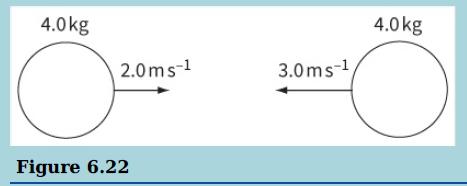
a. Define linear momentum.b. Determine the base units of linear momentum in the SI system.c. A car of mass 900 kg starting from rest has a constant acceleration of 3.5 m s−2. Calculate its momentum after it has travelled a distance of 40 m.d. This diagram shows two identical objects about to make
A trolley of mass 1.0 kg is moving at 2.0 m s−1. It collides with a stationary trolley of mass 2.0 kg. This second trolley moves off at 1.2 m s−1.a. Draw ‘before’ and ‘after’ diagrams to show the situation.b. Use the principle of conservation of momentum to calculate the speed of the
A ball of mass 2.0 kg, moving at 3.0 m s−1, strikes a wall and rebounds with almost exactly the same speed. State and explain whether there is a change in:a. The momentum of the ballb. The kinetic energy of the ball.
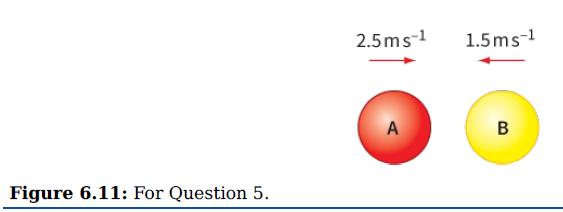
Figure 6.11 shows two identical balls A and B about to make a head-on collision. After the collision, ball A rebounds at a speed of 1.5 m s−1 and ball B rebounds at a speed of 2.5 m s−1. The mass of each ball is 4.0 kg.a. Calculate the momentum of each ball before the collision.b. Calculate the
An object is dropped and its momentum increases as it falls toward the ground. Explain how the law of conservation of momentum and Newton’s third law of motion can be applied to this situation.
Copy this table, choosing the correct words from each pair. Type of collision Momentum perfectly elastic conserved / not conserved inelastic conserved / not conserved Kinetic energy conserved / not conserved conserved / not conserved Total energy conserved / not conserved conserved / not conserved
An object has mass 2.0 ± 0.2 kg and a velocity of 10 ± 1 m s−1. What is the percentage uncertainty in the momentum of the object?A. 1%B. 6%C. 10%D. 20%
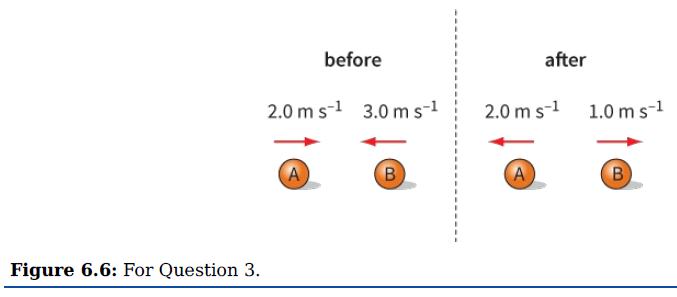
Two balls, each of mass 0.50 kg, collide as shown in Figure 6.6. Show that their total momentum before the collision is equal to their total momentum after the collision. before after 2.0 m s-1 3.0 ms-1 2.0 m s-1 1.0 ms-1 A A B) Figure 6.6: For Question 3.
A railway truck of mass 8,000 kg travels along a level track at a velocity of 2.5 m s–1 and collides with a stationary truck of mass 12,000 kg. The collision takes 4.0 s and the two trucks move together at the same velocity after the collision.What is the average force that acts on the 8,000 kg
Calculate the momentum of each of the following objects:a. A 0.50 kg stone travelling at a velocity of 20 m s−1b. A 25,000 kg bus travelling at 20 m s−1 on a roadc. An electron travelling at 2.0 × 10⁷ m s−1.(The mass of the electron is 9.1 × 10⁻³¹ kg.)
Which quantity has the same unit as the rate of change of momentum?A. AccelerationB. EnergyC. WeightD. Work
a. Ball A, moving towards the right, collides with stationary ball B. Ball A bounces back; ball B moves off slowly to the right. Which has the greater mass, ball A or ball B?b. Trolley A, moving towards the right, collides with stationary trolley B. They stick together, and move off at less than
In an experiment to measure a student’s power, she times herself running up a flight of steps. Use the data to work out her useful power.Number of steps = 28Height of each step = 20 cmAcceleration of free fall = 9.81 m s−2Mass of student = 55 kgTime taken = 5.4 s
A particular car engine provides a force of 700 N when the car is moving at its top speed of 40 m s−1.a. Calculate how much work is done by the car’s engine in one second.b. State the output power of the engine.
A car engine does 4200 kJ of work in one minute. Calculate its output power, in kilowatts.
Calculate how much work is done by a 50 kW car engine in a time of 1.0 minute.
A stone falls from the top of a cliff, 80 m high. When it reaches the foot of the cliff, its speed is 38 m s−1.a. Calculate the proportion of the stone’s initial g.p.e. that is converted to k.e.b. What happens to the rest of the stone’s initial energy?
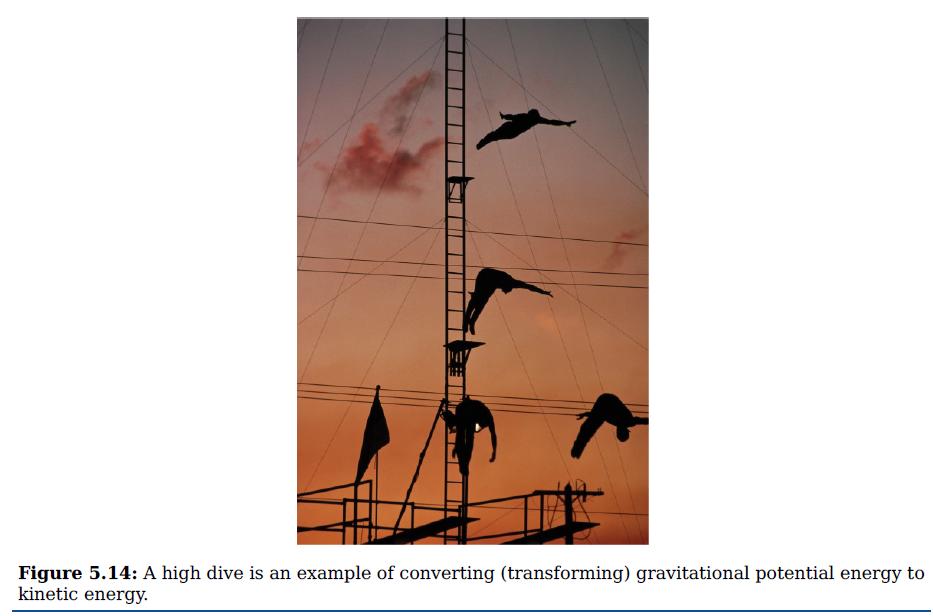
A high diver (see Figure 5.14) reaches the highest point in her jump with her centre of gravity 10 m above the water.Assuming that all her gravitational potential energy becomes kinetic energy during the dive, calculate her speed just before she enters the water. Figure 5.14: A high dive is an
Calculate how much gravitational potential energy is lost by an aircraft of mass 80,000 kg if it descends from an altitude of 10,000 m to an altitude of 1,000 m. What happens to this energy if the pilot keeps the aircraft’s speed constant?
a i. Define potential energy.ii. Identify differences between gravitational potential energy and elastic potential energy.b. Seawater is trapped behind a dam at high tide and then released through turbines. The level of the water trapped by the dam falls 10.0 m until it is all at the same height as
Re-work Worked example 4 for a brass sphere of mass 10 kg, and show that you get the same result. Repeat with any other value of mass.
a. Use the equations of motion to show that the kinetic energy of an object of mass m moving with velocity v is 1/2 mv2 . b. A car of mass 800 kg accelerates from rest to a speed of 20 m s−1 in a time of 6.0 s.i. Calculate the average power used to accelerate the car in the first 6.0
Calculate the change in kinetic energy of a ball of mass 200 g when it bounces. Assume that it hits the ground with a speed of 15.8 m s−1 and leaves it at 12.2 m s−1.
a. Explain what is meant by work.b i. Explain how the principle of conservation of energy applies to a man sliding from rest down a vertical pole, if there is a constant force of friction acting on him.ii. The man slides down the pole and reaches the ground after falling a distance h = 15 m. His
Which has more k.e., a car of mass 500 kg travelling at 15 m s−1 or a motorcycle of mass 250 kg travelling at 30 m s−1?
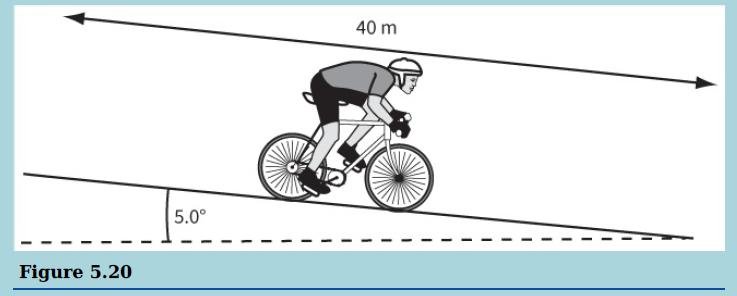
A cyclist pedals a long slope which is at 5.0° to the horizontal, as shown.The cyclist starts from rest at the top of the slope and reaches a speed of 12 m s−1 after a time of 67 s, having travelled 40 m down the slope. The total mass of the cyclist and bicycle is 90 kg.a. Calculate:i. The loss
a. A toy car works by means of a stretched rubber band. What form of potential energy does the car store when the band is stretched?b. A bar magnet is lying with its north pole next to the south pole of another bar magnet. A student pulls them apart. Why do we say that the magnets’ potential
a. Define power and state its unit.b. Write a word equation for the kinetic energy of a moving object.c. A car of mass 1100 kg starting from rest reaches a speed of 18 m s−1 in 25 s. Calculate the average power developed by the engine of the car.
A climber of mass 100 kg (including the equipment she is carrying) ascends from sea level to the top of a mountain 5500 m high. Calculate the change in her gravitational potential energy.
A 950 kg sack of cement is lifted to the top of a building 50 m high by an electric motor.a. Calculate the increase in the gravitational potential energy of the sack of cement.b. The output power of the motor is 4.0 kW. Calculate how long it took to raise the sack to the top of the building.c. The
Calculate how much gravitational potential energy is gained if you climb a flight of stairs. Assume that you have a mass of 52 kg and that the height you lift yourself is 2.5 m.
Explain which of the following has greater kinetic energy?A 20-tonne truck travelling at a speed of 30 m s−1A 1.2 g dust particle travelling at 150 km s−1 through space.
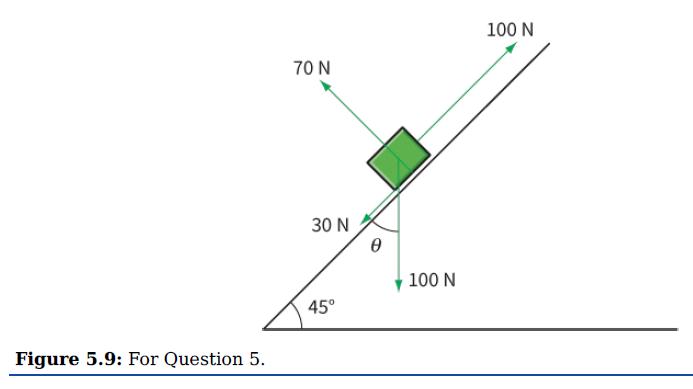
Figure 5.9 shows the forces acting on a box that is being pushed up a slope. Calculate the work done by each force if the box moves 0.50 m up the slope. 100 N 70 N 30 N 100 N 45° Figure 5.9: For Question 5.
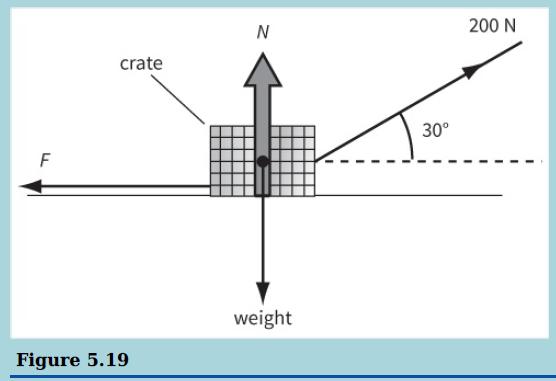
A 120 kg crate is dragged along the horizontal ground by a 200 N force acting at an angle of 30° to the horizontal, as shown.The crate moves along the surface with a constant velocity of 0.5 m s−1. The 200 N force is applied for a time of 16 s.a. Calculate the work done on the crate by:i. The
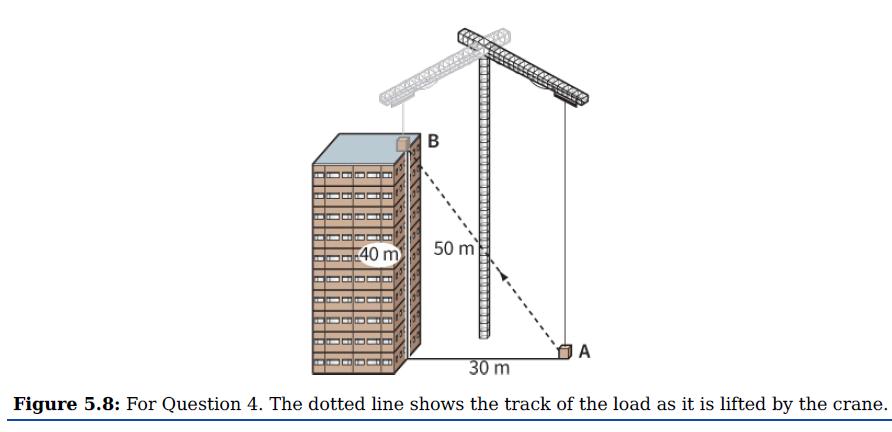
The crane shown in Figure 5.8 lifts its 500 N load to the top of the building from A to B. Distances are as shown on the diagram. Calculate how much work is done by the crane. B 40 m 50 m A 30 m Figure 5.8: For Question 4. The dotted line shows the track of the load as it is lifted by the crane.
In each case a–c, describe the energy changes taking place:a. An apple falling towards the groundb. A car decelerating when the brakes are appliedc. A space probe falling towards the surface of a planet.
A stone of weight 10 N falls from the top of a 250 m high cliff.a. Calculate how much work is done by the force of gravity in pulling the stone to the foot of the cliff.b. How much energy is transferred to the stone if air resistance is ignored?
A man of mass 70 kg climbs stairs of vertical height 2.5 m. Calculate the work done against the force of gravity. (Take g = 9.81 m s−2.)
An object falls at terminal velocity in air. What overall conversion of energy is occurring?A. Gravitational potential energy to kinetic energyB. Gravitational potential energy to thermal energyC. Kinetic energy to gravitational potential energyD. Kinetic energy to thermal energy
In each of the following examples, explain whether or not any work is done by the force mentioned.a. You pull a heavy sack along rough ground.b. The force of gravity pulls you downwards when you fall off a wall.c. The tension in a string pulls on a stone when you whirl it around in a circle at a
How is the joule related to the base units of m, kg and s?A. Kg m−1 s2B. Kg m2 s−2C. Kg m2 s−1D. Kg s−2
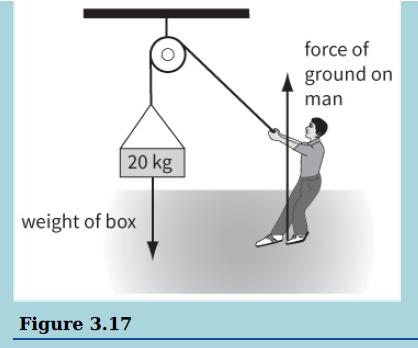
This diagram shows a man who is just supporting the weight of a box. Two of the forces acting are shown in the diagram. According to Newton’s third law, each of these forces is paired with another force.For a the weight of the box, and b the force of the ground on the man, state:i. The body that
In a race, downhill skiers want to travel as quickly as possible. They are always looking for ways to increase their top speed. Explain how they might do this. Think about:a. Their skisb. Their clothingc. Their musclesd. The slope.
Name these forces:a. The upward push of water on a submerged objectb. The force that wears away two surfaces as they move over one anotherc. The force that pulled the apple off Isaac Newton’s treed. The force that stops you falling through the floore. The force in a string that is holding up an
Which of the following pairs contains one vector and one scalar quantity?A. Displacement : massB. Displacement : velocityC. Distance : speedD. Speed : time
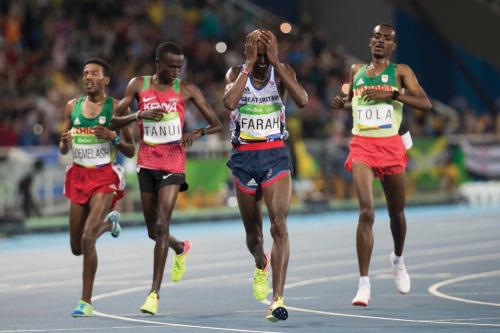
Look at Figure 1.2. The runner has just run 10,000 m in a time of 27 minutes 5.17 s. Calculate his average speed during the race. EAT RITA KEVA TANU TOLA FARAH CEMELASH
A vector P of magnitude 3.0 N acts towards the right and a vector Q of magnitude 4.0 N acts upwards.What is the magnitude and direction of the vector (P − Q)?A. 1.0 N at an angle of 53° downwards to the direction of PB. 1.0 N at an angle of 53° upwards to the direction of PC. 5.0 N at an angle
Here are some units of speed:m s−1 mm s−1 km s−1 km h−1Which of these units would be appropriate when stating the speed of each of the following?a. A tortoiseb. A car on a long journeyc. Lightd. A sprinter.
A car travels one complete lap around a circular track at a constant speed of 120 km h−1.a. If one lap takes 2.0 minutes, show that the length of the track is 4.0 km.b. Explain why values for the average speed and average velocity are different.c. Determine the magnitude of the displacement of
A snail crawls 12 cm in one minute. What is its average speed in mm s−1?
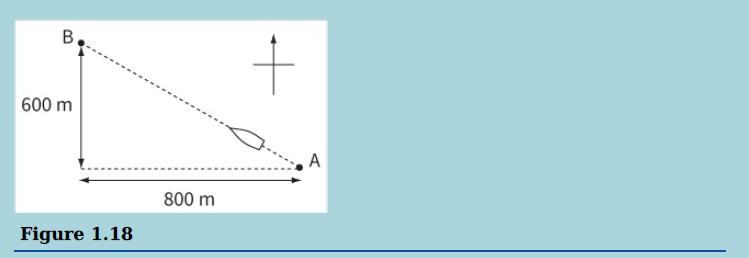
A boat leaves point A and travels in a straight line to point B. The journey takes 60 s.Calculate:a. The distance travelled by the boatb. The total displacement of the boatc. The average velocity of the boat.Remember that each vector quantity must be given a direction as well as a magnitude. B. 600
A trolley with a 5.0 cm long card passed through a single light gate. The time recorded by a digital timer was 0.40 s. What was the average speed of the trolley in m s−1?
A boat travels at 2.0 m s−1 east towards a port, 2.2 km away. When the boat reaches the port, the passengers travel in a car due north for 15 minutes at 60 km h−1. Calculate:a. The total distance travelledb. The total displacementc. The total time takend. The average speed in m s−1 e.
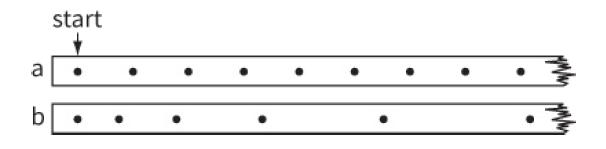
Figure 1.7 shows two ticker-tapes. Describe the motion of the trolleys that produced them. start a
A river flows from west to east with a constant velocity of 1.0 m s−1. A boat leaves the south bank heading due north at 2.4 m s−1. Find the resultant velocity of the boat.
Four methods for determining the speed of a moving trolley have been described. Each could be adapted to investigate the motion of a falling mass. Choose two methods that you think would be suitable, and write a paragraph for each to say how you would adapt it for this purpose.
a. Define displacement.b. Use the definition of displacement to explain how it is possible for an athlete to run round a track yet have no displacement.
Do these statements describe speed, velocity, distance or displacement? (Look back at the definitions of these quantities.)a. The ship sailed south-west for 200 miles.b. I averaged 7 mph during the marathon.c. The snail crawled at 2 mm s−1 along the straight edge of a bench.d. The sales
A girl is riding a bicycle at a constant velocity of 3.0 m s−1 along a straight road. At time t = 0, she passes her brother sitting on a stationary bicycle. At time t = 0, the boy sets off to catch up with his sister. His velocity increases from time t = 0 until t = 5.0 s, when he has covered a
A submarine uses sonar to measure the depth of water below it. Reflected sound waves are detected 0.40 s after they are transmitted. How deep is the water? (Speed of sound in water = 1500 m s−1.)
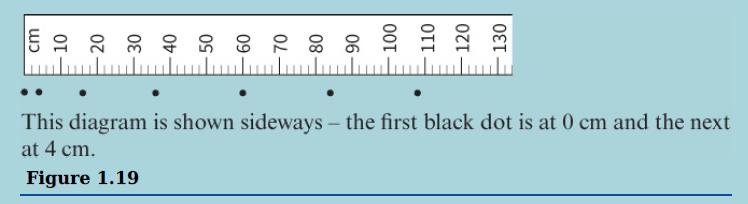
A student drops a small black sphere alongside a vertical scale marked in centimetres. A number of flash photographs of the sphere are taken at 0.10 s intervals:The first photograph is taken with the sphere at the top at time t = 0 s.a. Explain how Figure 1.19 shows that the sphere reaches a
The Earth takes one year to orbit the Sun at a distance of 1.5 × 10¹¹ m. Calculate its speed. Explain why this is its average speed and not its velocity.
a. State one difference between a scalar quantity and a vector quantity and give an example of each.b. A plane has an air speed of 500 km h−1 due north. A wind blows at 100 km h−1 from east to west. Draw a vector diagram to calculate the resultant velocity of the plane. Give the direction of
The displacement–time sketch graph in Figure 1.11 represents the journey of a bus. What does the graph tell you about the journey? SA t
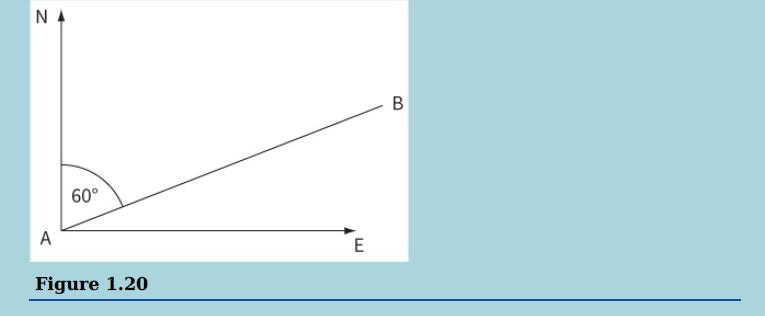
A small aircraft for one person is used on a short horizontal flight. On its journey from A to B, the resultant velocity of the aircraft is 15 m s−1 in a direction 60° east of north and the wind velocity is 7.5 m s−1 due north.a. Show that for the aircraft to travel from A to B it should be
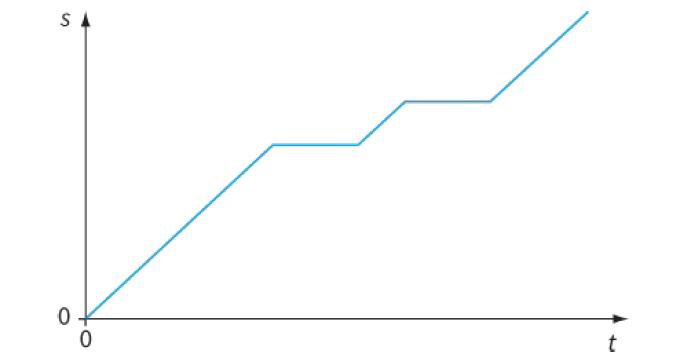
Sketch a displacement–time graph to show your motion for the following event. You are walking at a constant speed across a field after jumping off a gate. Suddenly you see a horse and stop. Your friend says there’s no danger, so you walk on at a reduced constant speed. The horse neighs, and you
Table 1.4 shows the displacement of a racing car at different times as it travels along a straight track during a speed trial.a. Determine the car’s velocity.b. Draw a displacement–time graph and use it to find the car’s velocity. Displacement / m 85 170 255 340 Time / s 1.0 2.0 3.0 4.0
An old car travels due south. The distance it travels at hourly intervals is shown in Table 1.5.a. Draw a distance–time graph to represent the car’s journey.b. From the graph, deduce the car’s speed in km h−1 during the first three hours of the journey.c. What is the car’s average speed
You walk 3.0 km due north, and then 4.0 km due east.a. Calculate the total distance in km you have travelled.b. Make a scale drawing of your walk, and use it to find your final displacement. Remember to give both the magnitude and the direction.c. Check your answer to part b by calculating your
A student walks 8.0 km south-east and then 12 km due west.a. Draw a vector diagram showing the route. Use your diagram to find the total displacement. Remember to give the scale on your diagram and to give the direction as well as the magnitude of your answer.b. Calculate the resultant
A swimmer can swim at 2.0 m s−1 in still water. She aims to swim directly across a river that is flowing at 0.80 m s−1. Calculate her resultant velocity. (You must give both the magnitude and the direction.)
A stone is thrown from a cliff and strikes the surface of the sea with a vertical velocity of 18 m s−1 and a horizontal velocity v. The resultant of these two velocities is 25 m s−1.a. Draw a vector diagram showing the two velocities and the resultant.b. Use your diagram to find the value
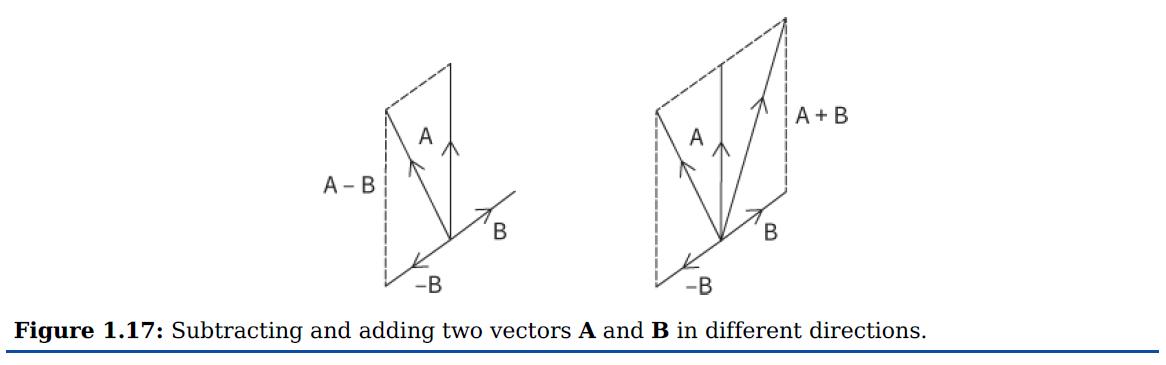
A velocity of 5.0 m s−1 is due north. Subtract from this velocity another velocity that is:a. 5.0 m s−1 due southb. 5.0 m s−1 due northc. 5.0 m s−1 due westd. 5.0 m s−1 due east A+ B А - В В -B -B Figure 1.17: Subtracting and adding two vectors A and B in different directions.
A car accelerates from a standing start and reaches a velocity of 18 m s−1 after 6.0 s. Calculate its acceleration.
An aircraft, starting from rest accelerates uniformly along a straight runway. It reaches a speed of 200 km h–1 and travels a distance of 1.4 km.What is the acceleration of the aircraft along the runway?A. 1.1 m s–2B. 2.2 m s–2C. 3.0 m s–2D. 6.0 m s–2
A car driver brakes gently. Her car slows down from 23 m s−1 to 11 m s−1 in 20 s. Calculate the magnitude (size) of her deceleration. (Note that, because she is slowing down, her acceleration is negative.)
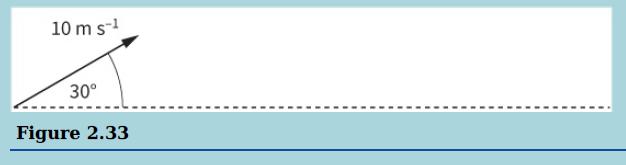
A ball is thrown with a velocity of 10 m s−1 at an angle of 30° to the horizontal. Air resistance has a negligible effect on the motion of the ball.What is the velocity of the ball at the highest point in its path?A. 0B. 5.0 m s−1C. 8.7 m s−1D. 10 m s−1 10 m s- 30° Figure 2.33
A stone is dropped from the top of a cliff. Its acceleration is 9.81 m s−2. How fast is it moving:a. After 1.0 s?b. After 3.0 s?
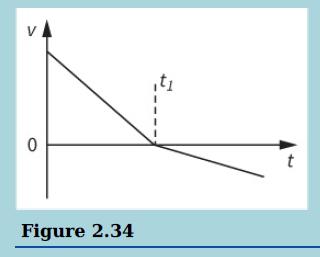
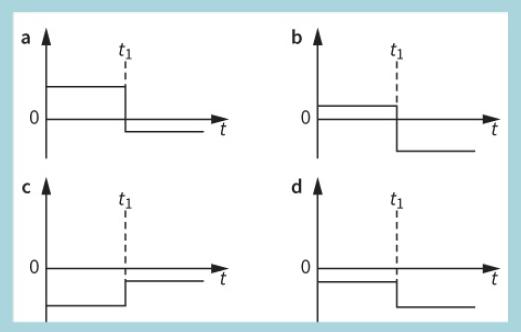
A trolley travels along a straight track. The variation with time t of the velocity v of the trolley is shown.Which graph shows the variation with time of the acceleration a of the trolley? t Figure 2.34
A lorry driver is travelling at the speed limit on a motorway. Ahead, he sees hazard lights and gradually slows down. He sees that an accident has occurred, and brakes suddenly to a halt. Sketch a velocity–time graph to represent the motion of this lorry.
A motorway designer can assume that cars approaching a motorway enter a slip road with a velocity of 10 m s−1 and reach a velocity of 30 m s−1 before joining the motorway. Calculate the minimum length for the slip road, assuming that vehicles have an acceleration of 4.0 m s−2.
Table 2.1 shows how the velocity of a motorcyclist changed during a speed trial along a straight road.a. Draw a velocity–time graph for this motion.b. From the table, deduce the motorcyclist’s acceleration during the first 10 s.c. Check your answer by finding the gradient of the graph during
A train is travelling at 50 m s−1 when the driver applies the brakes and gives the train a constant deceleration of magnitude 0.50 m s−2 for 100 s. Describe what happens to the train. Calculate the distance travelled by the train in 100 s.
Sketch a section of ticker-tape for a trolley that travels at a steady velocity and then decelerates.
A boy stands on a cliff edge and throws a stone vertically upwards at time t = 0. The stone leaves his hand at 20 m s−1. Take the acceleration of the ball as 9.81 m s−2.a. Show that the equation for the displacement of the ball is:s = 20t − 4.9t2 b. Calculate the height of the stone 2.0
Figure 2.11 shows the dimensions of an interrupt card, together with the times recorded as it passed through a light gate. Use these measurements to calculate the acceleration of the card. Os 0.20 s 0.30 s 0.35 s 5.0 cm 5.0 cm Figure 2.11: For Question 7.
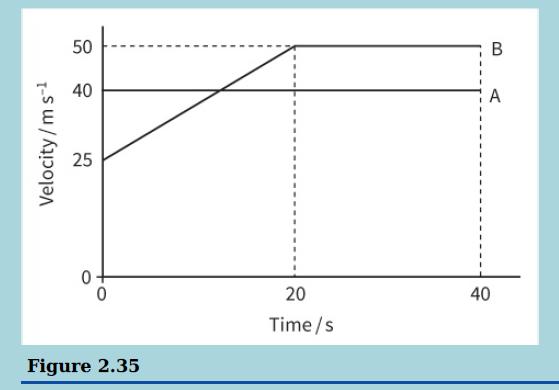
This graph shows the variation of velocity with time of two cars, A and B, Which are travelling in the same direction over a period of time of 40 s.Car A, travelling at a constant velocity of 40 m s−1, overtakes car B at time t = 0. In order to catch up with car A, car B immediately accelerates
Two adjacent five-dot sections of a ticker-tape measure 10 cm and 16 cm, respectively. The interval between dots is 0.02 s. Deduce the acceleration of the trolley that produced the tape.
An athlete competing in the long jump leaves the ground with a velocity of 5.6 m s−1 at an angle of 30° to the horizontal.a. Determine the vertical component of the velocity and use this value to find the time between leaving the ground and landing.b. Determine the horizontal component of the
A car is initially stationary. It has a constant acceleration of 2.0 m s−2.a. Calculate the velocity of the car after 10 s.b. Calculate the distance travelled by the car at the end of 10 s.c. Calculate the time taken by the car to reach a velocity of 24 m s−1.
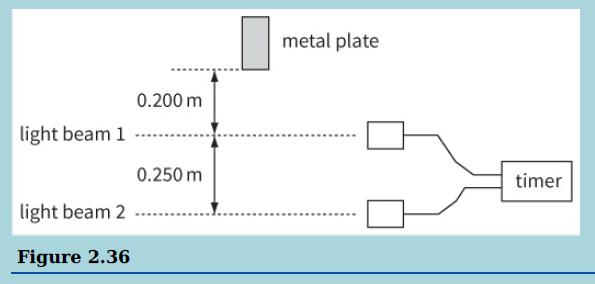
This diagram shows an arrangement used to measure the acceleration of a metal plate as it falls vertically.The metal plate is released from rest and falls a distance of 0.200 m before breaking light beam 1. It then falls a further 0.250 m before breaking light beam 2.a. Calculate the time taken for
A train accelerates steadily from 4.0 m s−1 to 20 m s−1 in 100 s.a. Calculate the acceleration of the train.b. From its initial and final velocities, calculate the average velocity of the train.c. Calculate the distance travelled by the train in this time of 100 s.
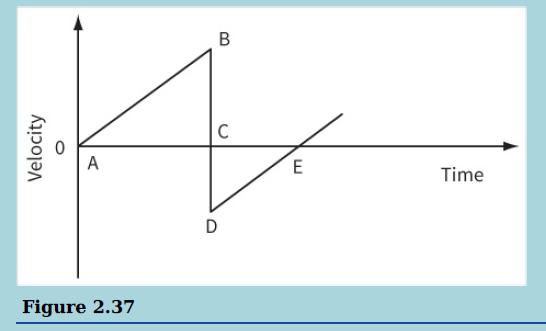
This is a velocity–time graph for a vertically bouncing ball.The ball is released at A and strikes the ground at B. The ball leaves the ground at D and reaches its maximum height at E. The effects of air resistance can be neglected.a. State:i. Why the velocity at D is negativeii. Why the gradient
A car is moving at 8.0 m s−1. The driver makes it accelerate at 1.0 m s−2 for a distance of 18 m. What is the final velocity of the car?
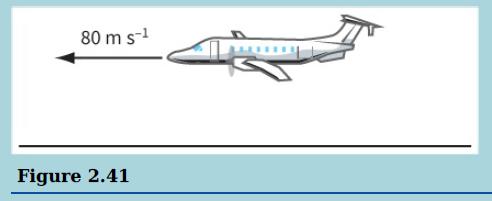
An aeroplane is travelling horizontally at a speed of 80 m s−1 and drops a crate of emergency supplies.To avoid damage, the maximum vertical speed of the crate on landing is 20 m s−1. You may assume air resistance is negligible.a. Calculate the maximum height of the aeroplane when the crate is
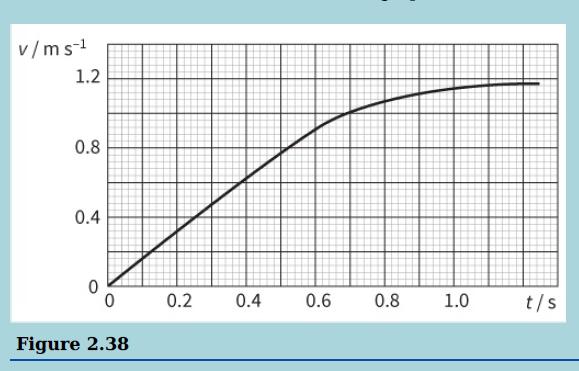
A student measures the speed v of a trolley as it moves down a slope. The variation of v with time t is shown in this graph.a. Use the graph to find the acceleration of the trolley when t = 0.70 s.b. State how the acceleration of the trolley varies between t = 0 and t = 1.0 s.Explain your answer by
Trials on the surface of a new road show that, when a car skids to a halt, its acceleration is −7.0 m s−2. Estimate the skid-to-stop distance of a car travelling at a speed limit of 30 m s−1 (approximately 110 km h−1 or 70 mph).
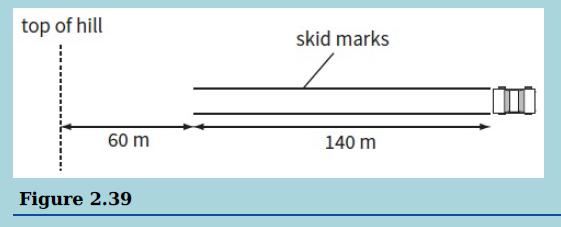
A car driver is travelling at speed v on a straight road. He comes over the top of a hill to find a fallen tree on the road ahead. He immediately brakes hard but travels a distance of 60 m at speed v before the brakes are applied. The skid marks left on the road by the wheels of the car are of
At the scene of an accident on a country road, police find skid marks stretching for 50 m. Tests on the road surface show that a skidding car decelerates at 6.5 m s−2. Was the car that skidded exceeding the speed limit of 25 m s−1 (90 km h−1) on this road?
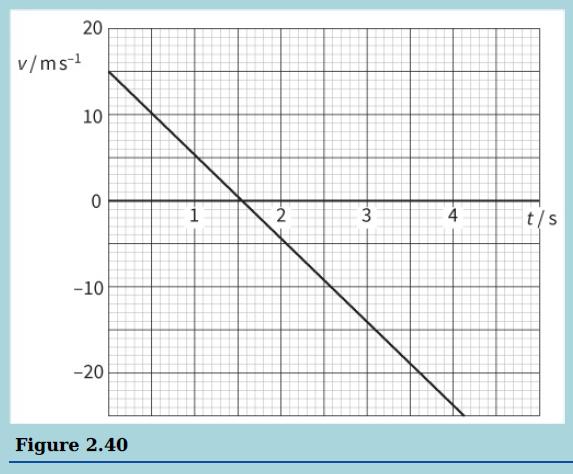
A hot-air balloon rises vertically. At time t = 0, a ball is released from the balloon. This graph shows the variation of the ball’s velocity v with t. The ball hits the ground at t = 4.1 s.a. Explain how the graph shows that the acceleration of the ball is constant.b. Use the graph to:i.
Showing 800 - 900
of 962
1
2
3
4
5
6
7
8
9
10
Step by Step Answers

 Get 50% OFF
Claim Now
Get 50% OFF
Claim Now