New Semester
Started
Get
50% OFF
Study Help!
--h --m --s
Claim Now
Question Answers
Textbooks
Find textbooks, questions and answers
Oops, something went wrong!
Change your search query and then try again
S
Books
FREE
Study Help
Expert Questions
Accounting
General Management
Mathematics
Finance
Organizational Behaviour
Law
Physics
Operating System
Management Leadership
Sociology
Programming
Marketing
Database
Computer Network
Economics
Textbooks Solutions
Accounting
Managerial Accounting
Management Leadership
Cost Accounting
Statistics
Business Law
Corporate Finance
Finance
Economics
Auditing
Tutors
Online Tutors
Find a Tutor
Hire a Tutor
Become a Tutor
AI Tutor
AI Study Planner
NEW
Sell Books
Search
Search
Sign In
Register
study help
sciences
cambridge international as & a level physics coursebook
Cambridge International AS And A Level Physics Coursebook 3rd Edition David Sang, Graham Jones, Gurinder Chadha, Richard Woodside - Solutions
A 20 cm length of wire is placed at right angles to a magnetic field. When a current of 1.5 A flows in the wire, a force of 0.015 N acts on it. Determine the flux density of the field.
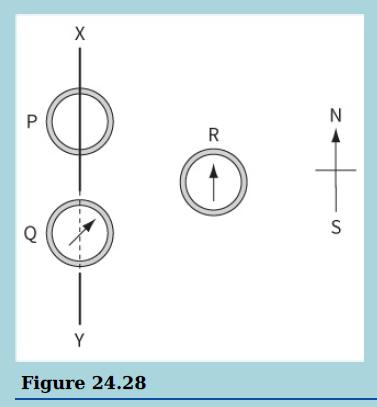
This diagram shows a wire XY that carries a constant direct current. Plotting compass R, placed alongside the wire, points due north. Compass P is placed below the wire and compass Q is placed above the wire.a. State the direction of the current in the wire.b. State in which direction compass P
A wire of length 50 cm carrying a current lies at right angles to a magnetic field of flux density 5.0 mT.a. If 1018 electrons pass a point in the wire each second, what current is flowing? (electron charge e = 1.60 × 10⁻¹⁹ C.)b. What force acts on the wire?
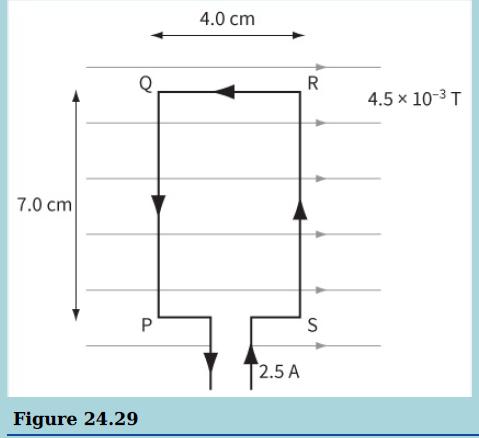
This diagram shows a rectangular metal frame PQRS placed in a uniform magnetic field.The magnetic flux density is 4.5 × 10⁻³ T and the current in the metal frame is 2.5 A.a. Calculate the force experienced by side PQ of the frame.b. Suggest why side QR does not experience a force.c. Describe the
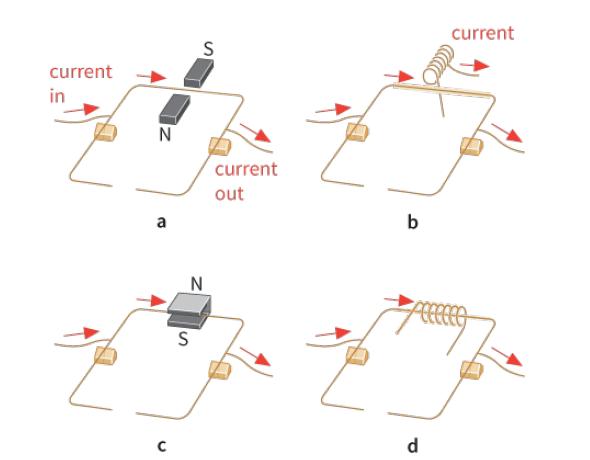
In the examples shown in the diagrams in Figure 24.16, which current balances will tilt? Will the side carrying the current tilt upwards or downwards? current current in N current out a b N d
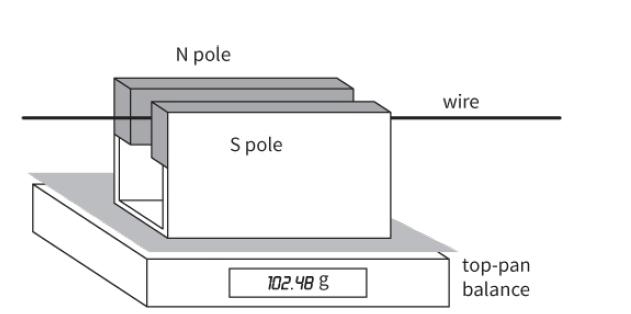
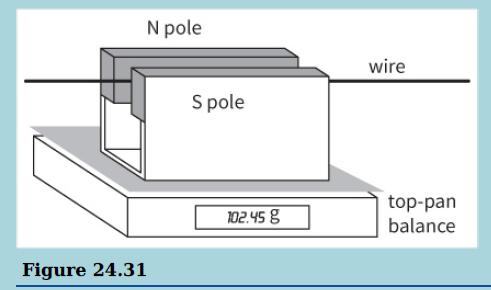
In the arrangement shown in Figure 24.17, the balance reading changes from 102.48 g to 104.48 g when the current is switched on. Explain why this happens and give the direction and the size of the force on the wire when the current is on. What is the direction of the current in the wire? N pole
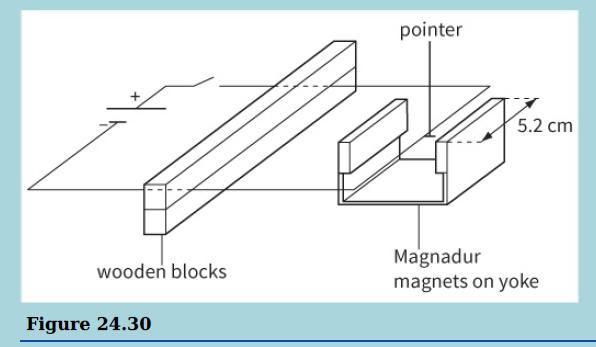
This diagram shows a current-carrying wire frame placed between a pair of Magnadur magnets on a yoke. A pointer is attached to the wire.A current of 8.5 A in the wire causes the pointer to move vertically upwards. A small paper tape is attached to the pointer and the current is adjusted until the
A wire of length 50 cm carrying a current of 2.4 A lies at right angles to a magnetic field of flux density 5.0 mT. Calculate the force on the wire.
a. The size of the force acting on a wire carrying a current in a magnetic field is proportional to the size of the current in the wire. With the aid of a diagram, describe how this can be demonstrated in a school laboratory.b. At a certain point on the Earth’s surface, the horizontal component
The coil of an electric motor is made up of 200 turns of wire carrying a current of 1.0 A. The coil is square, with sides of length 20 cm, and it is placed in a magnetic field of flux density 0.05 T.a. Determine the maximum force exerted on the side of the coil.b. In what position must the coil be
This diagram shows a fixed horizontal wire passing centrally between the poles of a permanent magnet that is placed on a top-pan balance.With no current flowing, the balance records a mass of 102.45 g. When a current of 4.0 A flows in the wire, the balance records a mass of 101.06 g.a. Explain why
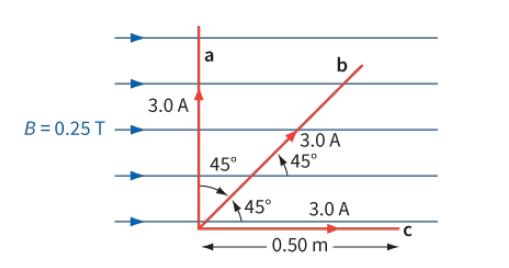
What force is exerted on each of the currents shown in Figure 24.21, and in what direction does each force act? a b 3.0 A B = 0.25 T 3.0 A 45° 45° 45° 3.0 A C 0.50 m
a. Define magnetic flux density and explain the similarity with the definition of electric field strength.b. Two thin horizontal wires are placed in a north–south direction. One wire is placed on a bench and the other wire is held 3.0 cm directly above the first wire.i. When equal currents flow
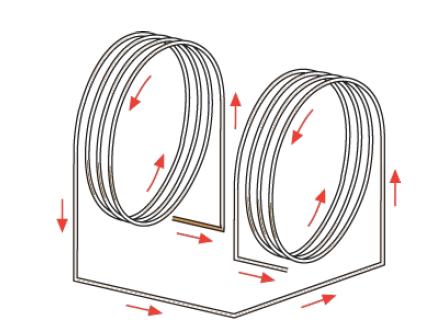
Two flat circular coils of wire are set up side by side, as shown in Figure 24.25. They are connected in series so that the same current flows around each, and in the same direction. Will the coils attract or repel one another? Explain your answer, first by describing the coils as electromagnets,
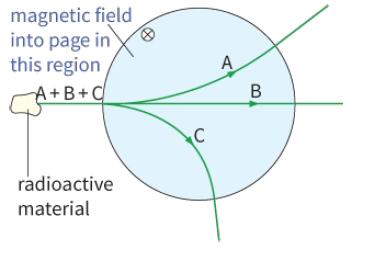
Figure 25.5 shows how radiation from a radioactive material passes through a region of uniform magnetic field.State and explain whether each type of radiation has positive or negative charge, or is uncharged. magnetic field into page in this region A A+B+C C radioactive material B.
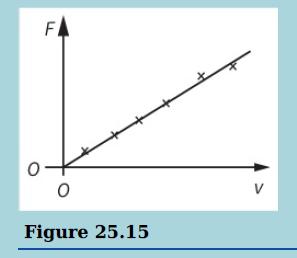
A scientist is doing an experiment on a beam of electrons travelling at right angles to a uniform magnetic field of flux density B. The graph shows the variation of the magnetic force F acting on an electron with the speed v of the electron.The gradient of the graph is G. The magnitude of the
An electron is moving at 1.0 × 10⁶ m s−1 in a uniform magnetic field of flux density 0.50 T. Calculate the force on the electron when it is moving:a. At right angles to the fieldb. At an angle of 45° to the field.
The magnetic force BQv causes an electron to travel in a circle in a uniform magnetic field.Explain why this force does not cause an increase in the speed of the electron.
An electron beam is produced from an electron gun in which each electron is accelerated through a potential difference (p.d.) of 1.6 kV. When these electrons pass at right angles through a magnetic field of flux density 8.0 mT, the radius of curvature of the electron beam is 0.017 m.Calculate the
Positrons are particles identical to electrons, except that their charge is positive (+e). Use a diagram to explain how a magnetic field could be used to separate a mixed beam consisting of both positrons and electrons.
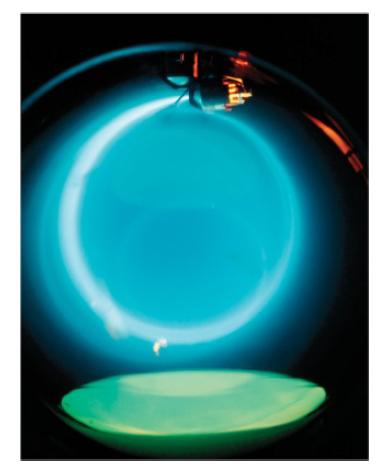
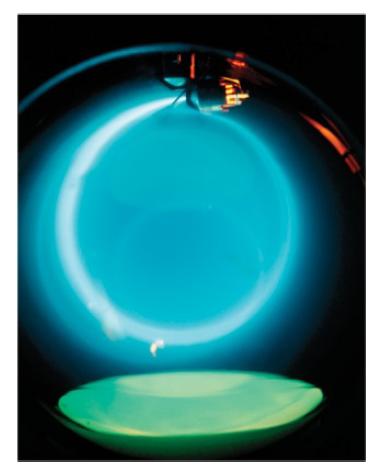
Look at the photograph of the electron beam in the fine-beam tube (Figure 25.8).State the direction is the magnetic field (into or out of the plane of the photograph).
Two particles, an α-particle and a β−-particle, are travelling through a uniform magnetic field. They have the same speed and their velocities are at rightangles to the field. Determine the ratio of:a. The mass of the α-particle to the mass of the β−-particleb. The charge of the α-particle
The particles in the circular beam shown in Figure 25.8 all travel round in the same orbit. State what can you deduce about their mass, charge and speed.
A moving charged particle experiences a force in an electric field and also in a magnetic field. State two differences between the forces experienced in the two types of field.
An electron beam in a vacuum tube is directed at right angles to a magnetic field, so that it travels along a circular path.Predict the effect on the size and shape of the path that would be produced (separately) by each of the following changes:a. Increasing the magnetic flux densityb. Reversing
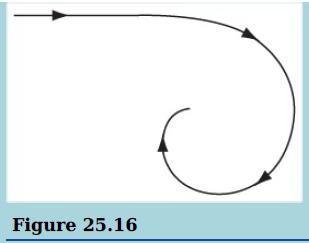
This diagram shows the path of an electron as it travels in air. The electron rotates clockwise around a uniform magnetic field into the plane of the paper, but the radius of the orbit decreases in size.a i. Explain the origin of the force that causes the electron to spiral in this manner.ii.
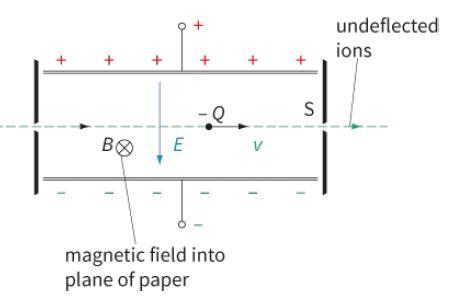
This question is about the velocity selector shown in Figure 25.11.a. State the directions of the magnetic and electric forces on a positively charged ion travelling towards the slit S.b. Calculate the speed of an ion emerging from the slit S when the magnetic flux density is 0.30 T and the
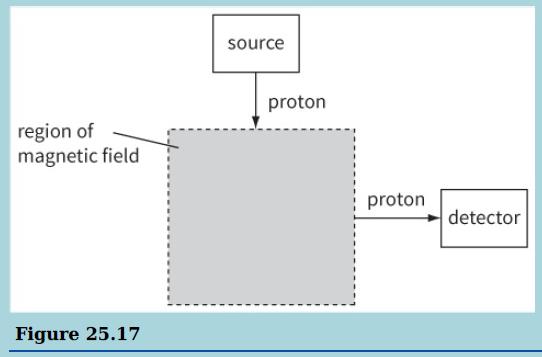
This diagram shows an arrangement to deflect protons from a source to a detector using a magnetic field. The charge on each proton is +e. A uniform magnetic field exists only within the area shown. Protons move from the source to the detector in the plane of the paper.a i. Copy the diagram and
A Hall probe is designed to operate with a steady current of 0.020 A in a semiconductor slice of thickness 0.05 mm. The number density of charge carriers (electrons) in the semiconductor is 1.5 × 10²³ m−3.a. Calculate the Hall voltage that will result when the probe is placed at right angles to
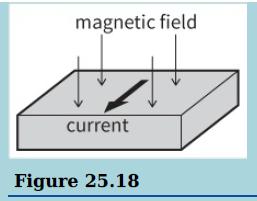
This diagram shows a thin slice of semiconductor material carrying a current in a magnetic field at right angles to the current.a. The current in the slice is due to the movement of free electrons.i. Add + and − signs to the diagram to show the charge separation caused by the Hall effect. Explain
Suggest how the Hall effect could be used to determine the number density of charge carriers n in a semiconducting material.
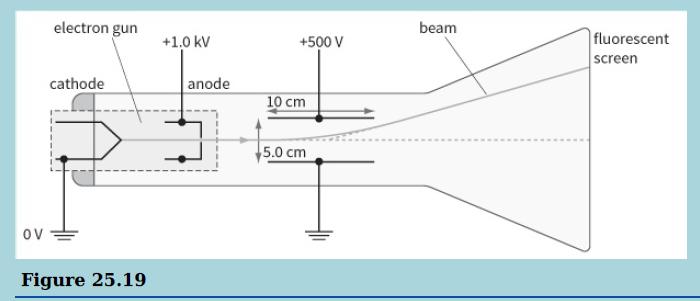
This diagram shows an electron tube. Electrons emitted from the cathode accelerate towards the anode and then pass into a uniform electric field created by two oppositely charged horizontal metal plates.a i. Explain why the beam curves upwards between the plates.ii. Explain how the pattern formed
The charge-to-mass ratio e/me for the electron is 1.76 × 10¹¹ C kg−1.Calculate the mass of the electron using e = 1.60 × 10⁻¹⁹ C.
Protons and helium nuclei from the Sun pass into the Earth’s atmosphere above the poles, where the magnetic flux density is 6.0 × 10⁻⁵ T. The particles are moving at a speed of 1.0 × 10⁶ m s−1 at right angles to the magnetic field in this region. The magnetic field can be assumed to be
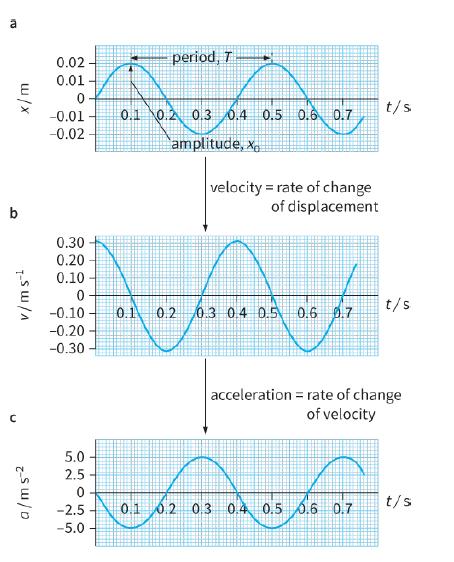
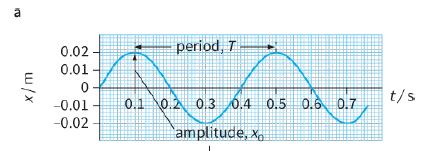
Use the graphs shown in Figure 18.15 to determine the values of the following quantities:a. Amplitudeb. Time periodc. Maximum velocityd. Maximum acceleration. 0.02 - period, T 0.01 - t/s -0.01 - 0.1 0.2 0.3 6.4 0.5 0.6 0.7 -0.02 amplitude, x. velocity = rate of change of displacement b 0.30 0.20
The Boltzmann constant k is equal to R/NA. From values of R and NA, show that k has the value 1.38 × 10⁻²³ J K−1.
a. Perfectly elastic collisions with the walls of their container.i. Explain what is meant by a perfectly elastic collision.ii. State three other assumptions of the kinetic theory.b. A single molecule is contained within a cubical box of side length 0.30 m.The molecule, of mass 2.4 × 10⁻²⁶ kg,
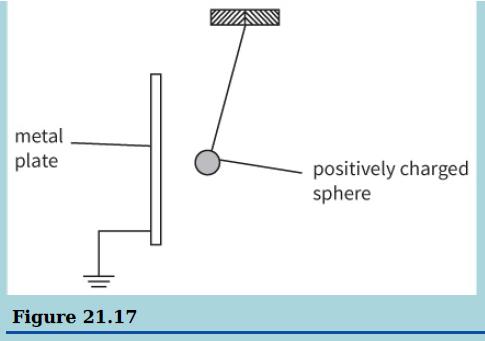
This diagram shows a positively charged sphere hanging by an insulating thread close to an earthed metal plate.a. Copy the diagram and draw five lines to show the electric field near the plate and the sphere.b. Explain why the sphere is attracted towards the metal plate.c. The sphere is now
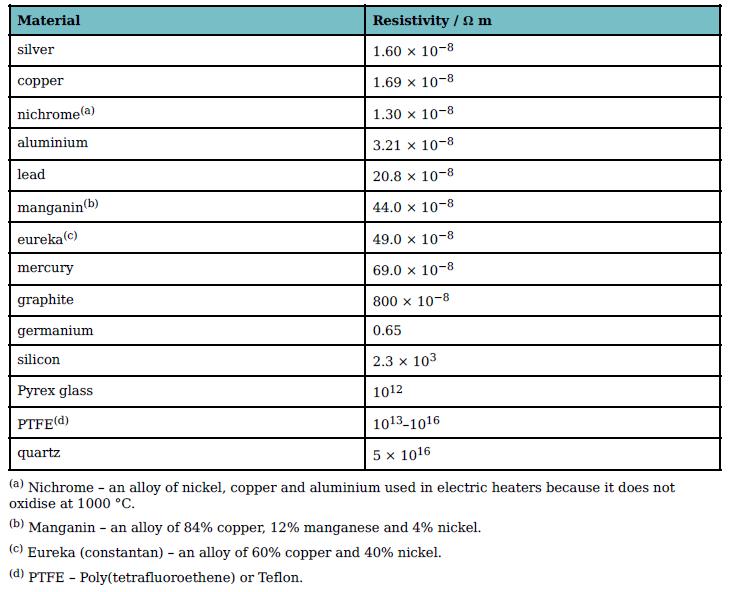
1.0 cm3 of copper is drawn out into the form of a long wire of cross-sectional area 4.0 × 10⁻⁷ m2.Calculate its resistance. (Use the resistivity value for copper from Table 10.2.) Material Resistivity / m silver 1.60 x 10⁻⁸ copper 1.69 x 10⁻⁸ nichrome(a) 1.30 x 10⁻⁸ aluminium 3.21 x 10⁻⁸
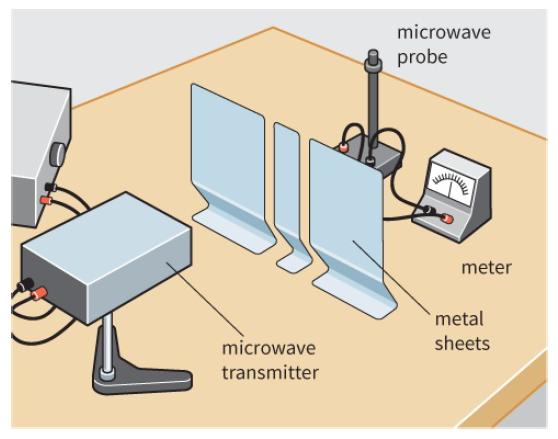
a. Explain what is meant by destructive interference.b. A student sets up an experiment to investigate the interference pattern formed by microwaves of wavelength 1.5 cm. The apparatus is set up as in Figure 13.17.The distance between the centres of the two slits is 12.5 cm. The detector is
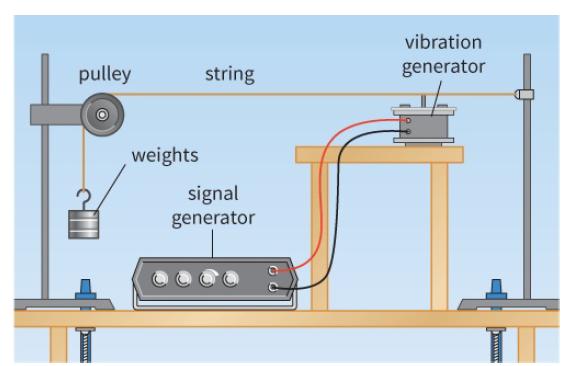
A stationary (standing) wave is set up on a vibrating spring. Adjacent nodes are separated by 25 cm.Calculate:a. The wavelength of the progressive waveb. The distance from a node to an adjacent antinode.
a. Sketch a stationary wave pattern for the microwave experiment in Practical Activity 14.1. Clearly show whether there is a node or an antinode at the reflecting sheet.b. The separation of two adjacent points of high intensity is found to be 14 mm. Calculate the wavelength and frequency of the
Explain how two sets of identical but oppositely travelling waves are established in the microwave and air column experiments described in Practical Activity 14.1.PRACTICAL ACTIVITY 14.1Observing stationary wavesHere we look at experimental arrangements for observing stationary waves, for
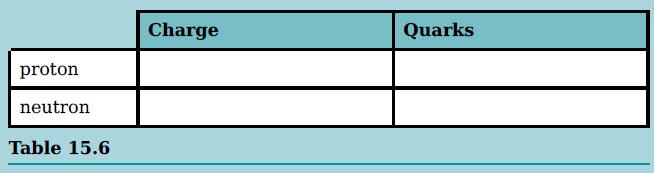
a. A quark is a fundamental particle but a neutron is not. Explain what this statement means.b. A proton and a neutron each contain three quarks, either up or down quarks.i. Copy and complete the table to show the charge on a proton and a neutron and the quarks that they contain.ii. Using
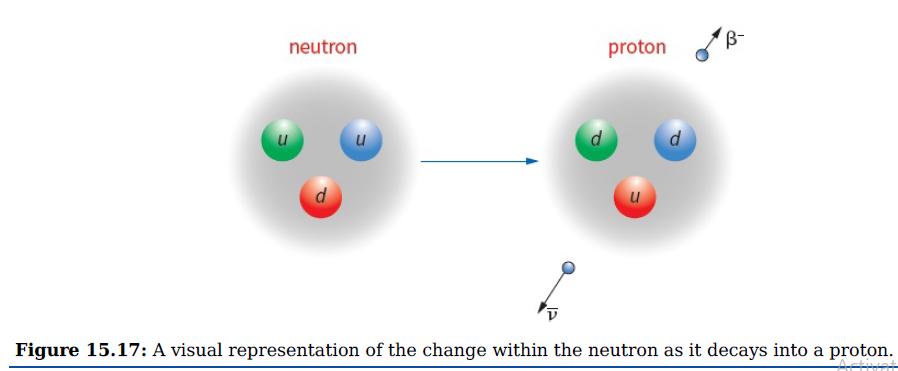
a. Draw a diagram similar to Figure 15.17 to show β+ decay.b. Write an equation to describe the changes in β+ decay. B- neutron proton d u Figure 15.17: A visual representation of the change within the neutron as it decays into a proton.
a. Explain what is meant by a centripetal acceleration.b. A teacher swings a bucket of water, of total mass 5.4 kg, round in a vertical circle of diameter 1.8 m.i. Calculate the minimum speed that the bucket must be swung at so that the water remains in the bucket at the top of the circle.ii.
A mass, hung from a spring, oscillates with simple harmonic motion.Which statement is correct?A. The force on the mass is directly proportional to the angular frequency of the oscillation.B. The force on the mass is greatest when the displacement of the bob is greatest.C. The force on the mass is
State which of the following are free oscillations, and which are forced:a. The wing beat of a mosquitob. The movement of the pendulum in a upright clockc. The vibrations of a cymbal after it has been struckd. The shaking of a building during an earthquake.
The bob of a simple pendulum has a mass of 0.40 kg. The pendulum oscillates with a period of 2.0 s and an amplitude of 0.15 m.At one point in its cycle it has a potential energy of 0.020 J.What is the kinetic energy of the pendulum bob at this point?A. 0.024 JB. 0.044 JC. 0.14 JD. 0.18 J
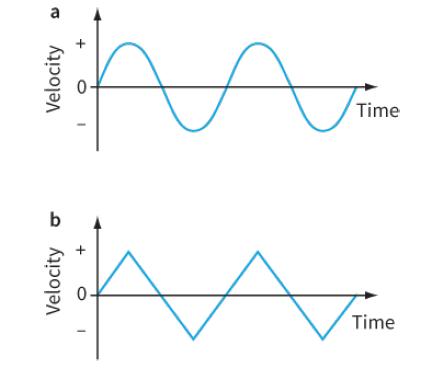
If you could draw a velocity–time graph for any of the oscillators described in Practical Activity 18.1, what would it look like? Would it be a curve like the one shown in Figure 18.6a, or triangular (saw-toothed) like the one shown in Figure 18.6b? Time Time Velocity o Velocity
State and justify whether the following oscillators show simple harmonic motion:a. A basketball being bounced repeatedly on the ground.b. A guitar string vibratingc. A conducting sphere vibrating between two parallel, oppositely charged metal platesd. The pendulum of a grandfather clock.
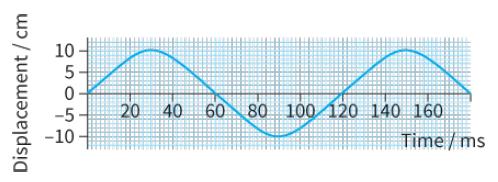
From the displacement–time graph shown in Figure 18.8, determine the amplitude, period and frequency of the oscillations represented. 20 40 60 80 100 120 140 160 Time/ms Displacement/ cm
The pendulum of a clock is displaced by a distance of 4.0 cm and it oscillates in s.h.m. with a period of 1.0 s.a. Write down an equation to describe the displacement x of the pendulum bob with time t.b. Calculate:i. The maximum velocity of the pendulum bobii. Its velocity when its displacement is
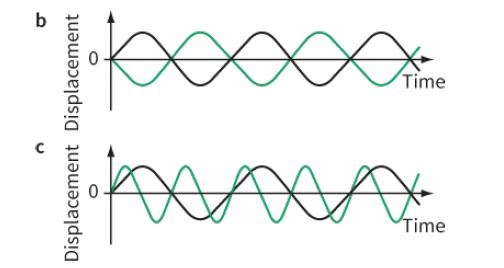
Figure 18.9b shows two oscillations that are out of phase. By what fraction of an oscillation are they out of phase?Why would it not make sense to ask the same question about Figure 18.9c? Time Time Displacement Displacement
A 50 g mass is attached to a securely clamped spring. The mass is pulled downwards by 16 mm and released, which causes it to oscillate with s.h.m. of time period of 0.84 s.a. Calculate the frequency of the oscillation.b. Calculate the maximum velocity of the mass.c. Calculate the maximum kinetic
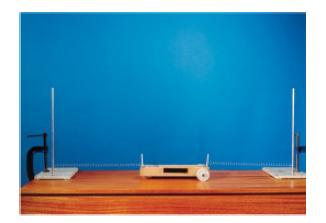
Identify the features of the motion of the trolley in Figure 18.3 that satisfy the three requirements for s.h.m.
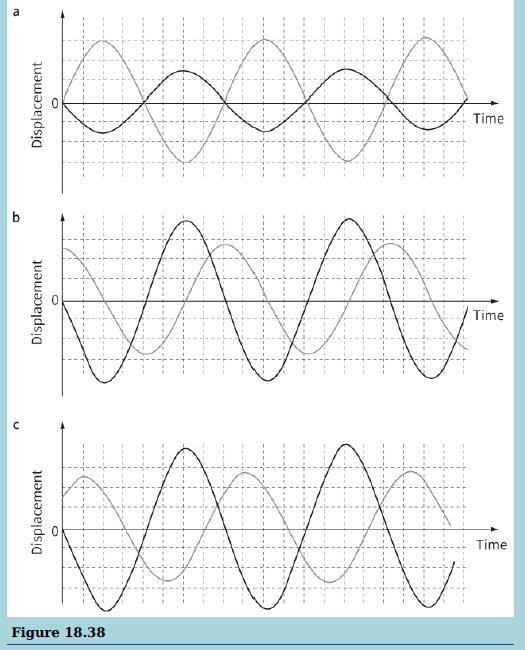
In each of the three graphs, a, b and c in Figure 18.38, give the phase difference between the two curves:i. As a fraction of an oscillationii. In degreesiii. In radians. Time b Time Time Figure 18.38 Displacement
Explain why the motion of someone jumping up and down on a trampoline is not simple harmonic motion. (Their feet lose contact with the trampoline during each bounce.)
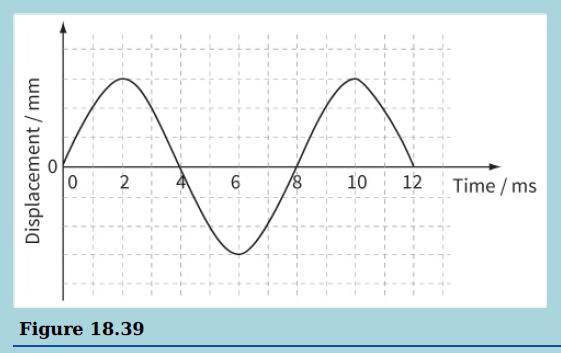
a. Determine the frequency and the period of the oscillation described by this graph.b. Use a copy of the graph and on the same axes sketch:i. The velocity of the particleii. The acceleration of the particle. 2 6. 8/ 10 12 Time / ms Figure 18.39 Displacement /mm
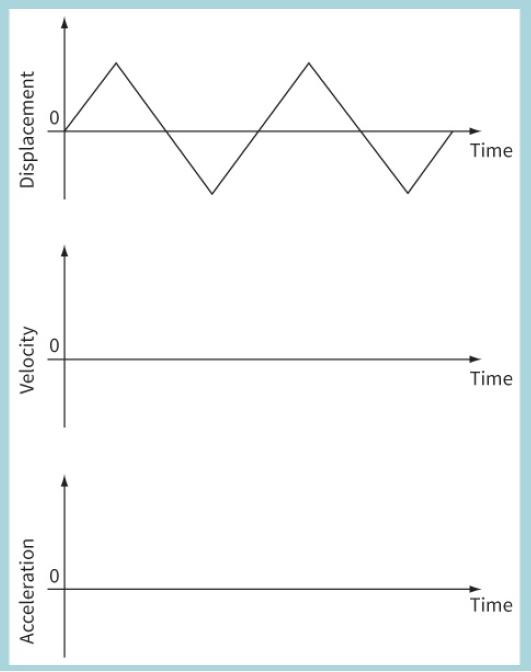
These graphs show the displacement of a body as it vibrates between two points.Figure 18.40a. State and explain whether the body is moving with simple harmonic motion. b. Make a copy of the three graphs.i. On the second set of axes on your copy show the velocity of the body as it vibrates.
State at what point in an oscillation the oscillator has zero velocity but acceleration towards the right.
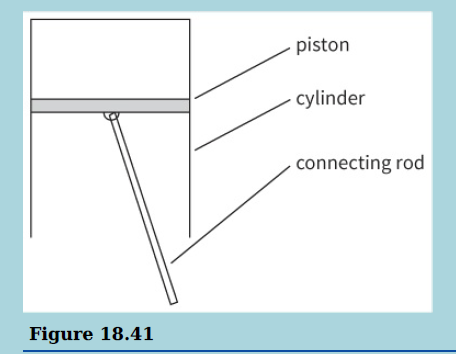
This diagram shows the piston of a small car engine that oscillates in the cylinder with a motion that approximates simple harmonic motion at 4200 revs per minute (1rev = 1 cycle). The mass of the piston is 0.24 kg. a. Explain what is meant by simple harmonic motion.b. Calculate the frequency of
Look at the x–t graph of Figure 18.15a. When t = 0.1 s, what is the gradient of the graph? State the velocity at this instant. a period, T 0.02 - 0.01 - 0.1 0.2 0.3 0.4 0.5 0.6 0.7 t/s -0.01 -0.02 amplitude, x w/x
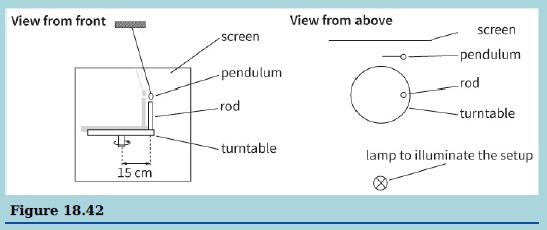
This diagram shows a turntable with a rod attached to it a distance 15 cm from the centre. The turntable is illuminated from the side so that a shadow is cast on a screen.A simple pendulum is placed behind the turntable and is set oscillating so that it has an amplitude equal to the distance of the
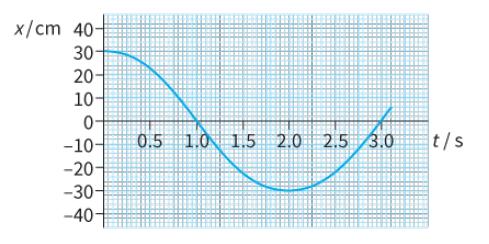
Figure 18.16 shows the displacement–time (x–t) graph for an oscillating mass. Use the graph to determine the following quantities:a. The velocity in cm s−1 when t = 0 sb. The maximum velocity in cm s−1c. The acceleration in cm s−2 when t = 1.0 s. x/cm 40- 30- 20 10- -10- 0,5 1.0 1.5 2.0
When a cricket ball hits a cricket bat at high speed it can cause a standing wave to form on the bat. In one such example, the handle of the bat moved with a frequency of 60 Hz with an amplitude of 2.8 mm.The vibrational movement of the bat handle can be modelled on simple harmonic motion.a. State
An object moving with s.h.m. goes through two complete cycles in 1.0 s. Calculate:a. The period Tb. The frequency fc. The angular frequency ω.
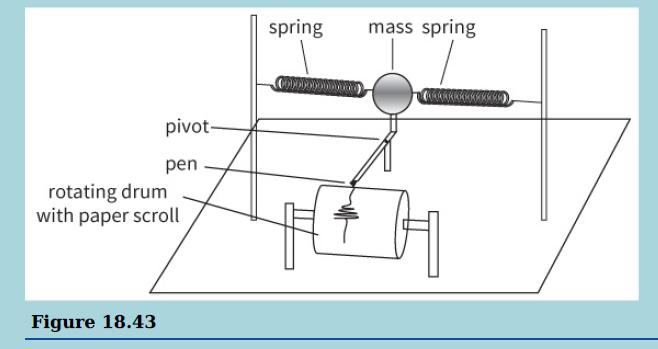
Seismometers are used to detect and measure the shock waves that travel through the Earth due to earthquakes.This diagram shows the structure of a simple seismometer. The shock wave will cause the mass to vibrate, causing a trace to be drawn on the paper scroll.a. The frequency of a typical shock
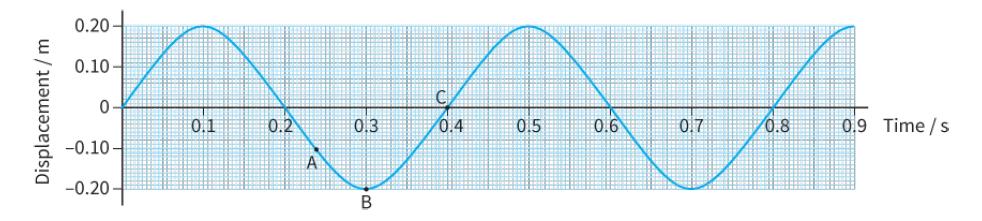
Figure 18.18 shows the displacement–time graph for an oscillating mass. Use the graph to determine the following:a. Amplitudeb. Periodc. Frequencyd. Angular frequencye. Displacement at Af. Velocity at Bg. Velocity at C. 0.20 0.10 - C 0- 0.1 0.2 0.3 0.4 0,5 0.6 0,7 0.8 0,9 Time/s -0.10 - A -0.20 -
An atom in a crystal vibrates with s.h.m. with a frequency of 1014 Hz. The amplitude of its motion is 2.0 × 10⁻¹² m.a. Sketch a graph to show how the displacement of the atom varies during one cycle.b. Use your graph to estimate the maximum velocity of the atom.
The vibration of a component in a machine is represented by the equation:x = 3.0 × 10⁻⁴ sin (240πt)where the displacement x is in metres.Determine the:a. Amplitudeb. Frequencyc. Period of the vibration.
A trolley is at rest, tethered between two springs. It is pulled 0.15 m to one side and, when time t = 0, it is released so that it oscillates back and forth with s.h.m. The period of its motion is 2.0 s.a. Write an equation for its displacement x at any time t (assume that the motion is not damped
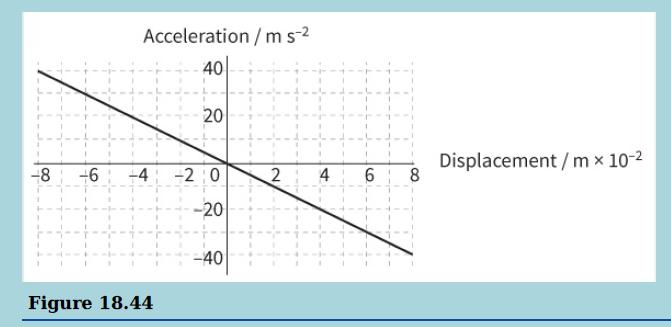
A mass secured at the end of a spring moves with s.h.m. The frequency of its motion is 1.4 Hz.a. Write an equation of the form a = −ω2x to show how the acceleration of the mass depends on its displacement.b. Calculate the acceleration of the mass when it is displaced 0.050 m from its equilibrium
A short pendulum oscillates with s.h.m. such that its acceleration a (in m s−2) is related to its displacement x (in m) by the equation a = −300x. Determine the frequency of the oscillations.
A trolley of mass m is fixed to the end of a spring. The spring can be compressed and extended. The spring has a force constant k. The other end of the spring is attached to a vertical wall. The trolley lies on a smooth horizontal table. The trolley oscillates when it is displaced from its
To start a pendulum swinging, you pull it slightly to one side.a. What kind of energy does this transfer to the mass?b. Describe the energy changes that occur when the mass is released.
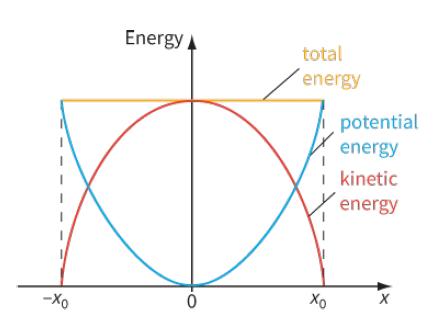
Figure 18.23 shows how the different forms of energy change with displacement during s.h.m. Copy the graph, and show how the graph would differ if the oscillating mass were given only half the initial input of energy. Energy total energy potential energy kinetic energy -Xo
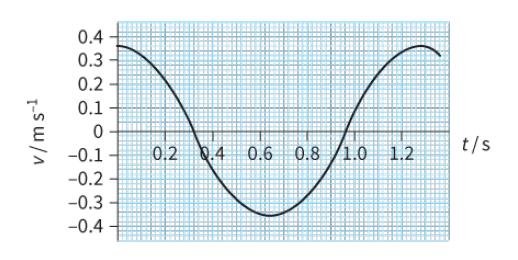
Figure 18.24 shows how the velocity ν of a 2.0 kg mass was found to vary with time t during an investigation of the s.h.m. of a pendulum. Use the graph to estimate the following for the mass:a. Its maximum velocityb. Its maximum kinetic energyc. Its maximum potential energyd. Its maximum
a. Sketch graphs to show how each of the following quantities changes during the course of a single complete oscillation of an undamped pendulum: kinetic energy, potential energy, total energy.b. State how your graphs would be different for a lightly damped pendulum.
Give an example of a situation where resonance is a problem, and a second example where resonance is useful. In each example, state what the oscillating system is and what forces it to resonate.
Describe a liquid in terms of the arrangement of its particles, the bonding between them and their motion.
What is the internal energy of an object?A. The amount of heat supplied to the objectB. The energy associated with the random movement of the atoms in the objectC. The energy due to the attraction between the atoms in the objectD. The potential and kinetic energy of the object.
Use the kinetic model of matter to explain the following:a. If you leave a pan of water on the hob for a long time, it does not all boil away as soon as the temperature reaches 100 °C.b. It takes less energy to melt a 1.0 kg block of ice at 0 °C than to boil away 1.0 kg of water at 100 °C.
Use the first law of thermodynamics to answer the following.a. A gas is heated by supplying it with 250 kJ of thermal energy; at the same time, it is compressed so that 500 kJ of work is done on the gas. Calculate the change in the internal energy of the gas.b. The same gas is heated as before with
Describe the changes to the kinetic energy, the potential energy and the total internal energy of the molecules of a block of ice as:a. It melts at 0 °Cb. The temperature of the water rises from 0 °C to room temperature.
When you blow up a balloon, the expanding balloon pushes aside the atmosphere. How much work is done against the atmosphere in blowing up a balloon from a very small volume to a volume of 2 litres (0.002 m3)? (Atmospheric pressure = 1.0 × 10⁵ N m−2.)
a. Convert each of the following temperatures from the Celsius scale to the thermodynamic scale: 0 °C, 20 °C, 120 °C, 500 °C, −23 °C, −200 °C.b. Convert each of the following temperatures from the thermodynamic scale to the Celsius scale: 0 K, 20 K, 100 K, 300 K, 373 K, 500 K.
Explain why the barrel of a bicycle pump gets very hot as it is used to pump up a bicycle tyre.
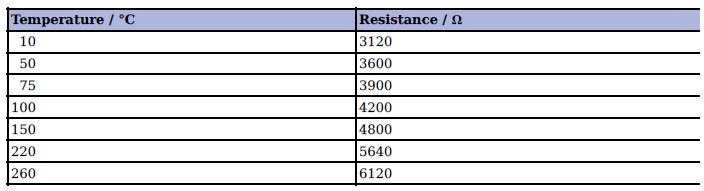
The electrical resistance of a pure copper wire is mostly due to the vibrations of the copper atoms.Table 19.1 shows how the resistance of a length of copper wire is found to change as it is heated. Copy the table and add a column showing the temperatures in K. Draw a graph to show these data.
The so-called ‘zeroth law of thermodynamics’ states that if the temperature of body A is equal to the temperature of body B and the temperature of body B is the same as body C, then the temperature of body C equals the temperature of body A.Explain, in terms of energy flow, why the concept of
Give one word for each of the following:a. Adding a scale to a thermometerb. All the temperatures, from lowest to highest, which a thermometer can measurec. The extent to which equal rises in temperature give equal changes in the thermometer’s outputd. How big a change in output is produced by a
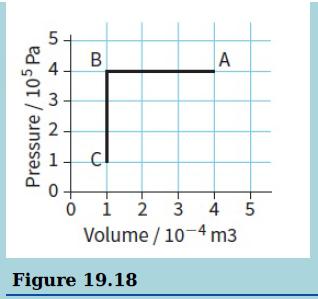
a. The first law of thermodynamics can be represented by the expression: ΔU = q + W. State what is meant by all the symbols in this expression.b. Figure 19.18 shows a fixed mass of gas that undergoes a change from A to B and then to C.i. During the change from A to B, 220 J of thermal energy
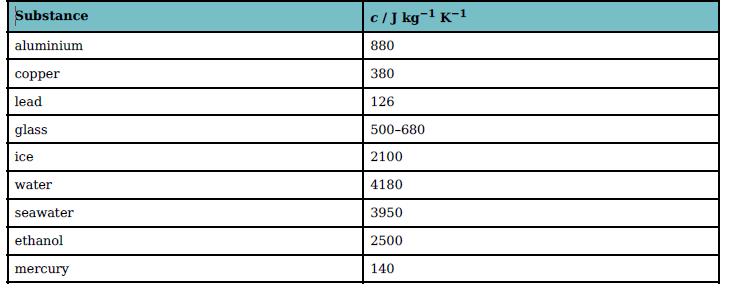
Calculate the energy that must be supplied to raise the temperature of 5.0 kg of water from 20 °C to 100 °C.You will need to use data from Table 19.3 to answer these questions. Substance cIJ kg-1 K-1 aluminium 880 copper 380 lead 126 glass 500-680 ice 2100 water 4180 seawater 3950 ethanol 2500
When a thermocouple has one junction in melting ice and the other junction in boiling water it produces an e.m.f. of 63 μV.a. What e.m.f. would be produced if the second junction was also placed in melting ice?b. When the second junction is placed in a cup of coffee, the e.m.f. produced is 49 μV.
Which requires more energy – heating a 2.0 kg block of lead by 30 K or heating a 4.0 kg block of copper by 5.0 K?You will need to use data from Table 19.3 to answer these questions. Substance cIJ kg-1 K-1 aluminium 880 copper 380 lead 126 glass 500-680 ice 2100 water 4180 seawater 3950 ethanol
The resistance of a thermistor at °C is 2000 Ω. At 100 °C the resistance falls to 200 Ω. When the thermistor is placed in water of constant temperature, its resistance is 620 Ω.a. Assuming that the resistance of the thermistor varies linearly with temperature, calculate the temperature of the
A well-insulated 1.2 kg block of iron is heated using a 50 W heater for 4.0 min. The temperature of the block rises from 22 °C to 45 °C. Find the experimental value for the specific heat capacity of iron.You will need to use data from Table 19.3 to answer these questions. Substance cIJ kg-1 K-1
a. A 500 W kettle contains 300 g of water at 20 °C. Calculate the minimum time it would take to raise the temperature of the water to boiling point.b. The kettle is allowed to boil for 2 minutes. Calculate the mass of water that remains in the kettle. State any assumptions that you make.(Specific
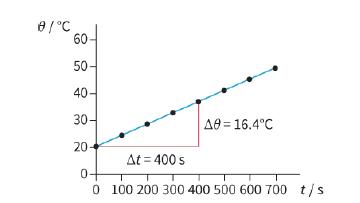
At higher temperatures than shown, the graph in Figure 19.15 deviates increasingly from a straight line. Suggest an explanation for this. e/°C 60- 50- 40- 30- Ae = 16.4°C 20 At = 400 s 0+ O 100 200 300 400 500 600 700 t/s
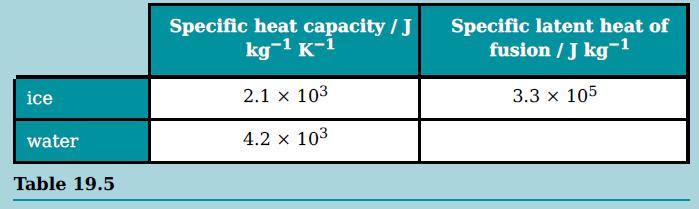
a. Define specific heat capacity of a substance.b. A mass of 20 g of ice at −15 °C is taken from a freezer and placed in a beaker containing 200 g of water at 26 °C. Data for ice and water are given in Table 19.5.i. Calculate the amount of thermal energy (heat) needed to convert all the ice at
Showing 300 - 400
of 962
1
2
3
4
5
6
7
8
9
10
Step by Step Answers

 Get 50% OFF
Claim Now
Get 50% OFF
Claim Now