New Semester
Started
Get
50% OFF
Study Help!
--h --m --s
Claim Now
Question Answers
Textbooks
Find textbooks, questions and answers
Oops, something went wrong!
Change your search query and then try again
S
Books
FREE
Study Help
Expert Questions
Accounting
General Management
Mathematics
Finance
Organizational Behaviour
Law
Physics
Operating System
Management Leadership
Sociology
Programming
Marketing
Database
Computer Network
Economics
Textbooks Solutions
Accounting
Managerial Accounting
Management Leadership
Cost Accounting
Statistics
Business Law
Corporate Finance
Finance
Economics
Auditing
Tutors
Online Tutors
Find a Tutor
Hire a Tutor
Become a Tutor
AI Tutor
AI Study Planner
NEW
Sell Books
Search
Search
Sign In
Register
study help
engineering
mechanical engineering
Vector Mechanics For Engineers Statics And Dynamics 8th Edition Ferdinand Beer, E. Russell Johnston, Jr., Elliot Eisenberg, William Clausen, David Mazurek, Phillip Cornwell - Solutions
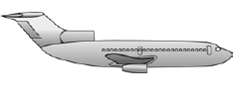
A jet airliner is cruising at a speed of 560 mi/h with its engines scooping in air at the rate of 720 lb/s and discharging it with a velocity of 1860 ft/s relative to the plane when a control surface malfunction suddenly causes a 20 percent increase in drag, knowing that the pilot maintains level
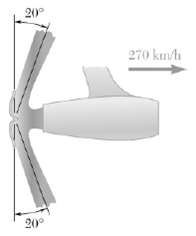
In order to shorten the distance required for landing, a jet airplane is equipped with moveable vanes which partially reverse the direction of the air discharged by each of its engines. Each engine scoops in the air at a rate of 120 kg/s and discharges it with a velocity of 600 m/s relative to the
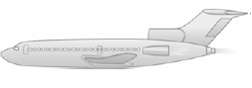
A jetliner is cruising at a speed of 900 km/h with each of its three engines discharging air with a velocity of 800 m/s relative to the plane. Determine the speed of the airliner after it has lost the use of (a) One of its engines, (b) Two of its engines. Assume that the drag due to air friction is
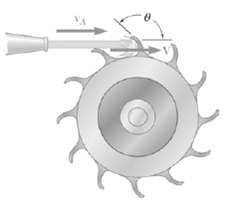
In a Pelton-wheel turbine, a stream of water is deflected by a series of blades so that the rate at which water is deflected by the blades is equal to the rate at which water issues from the nozzle (Δm/Δt = AρvA). Using the same notation as in Sample Prob. 14.7, (a) Determine the velocity V of
While cruising in level flight at a speed of 570 mi/h, a jet airplane scoops in air at a rate of 240 lb/s and discharges it with a velocity of 2200 ft/s relative to the airplane. Determine(a) The power actually used to propel the airplane,(b) The total power developed by the engine,(c) The
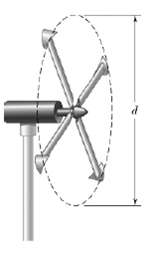
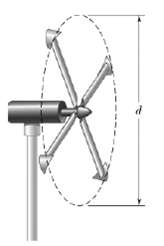
The wind-turbine-generator shown operates at a wind speed of 30 km/h with an efficiency of 0.4. Knowing that the area swept out by the blades is a circle of diameter d = 6.5 m and that ρ = 1.2 kg/m3, determine (a) The kinetic energy of the air particles entering the 6.5-m-diameter circle per
The wind-turbine-generator shown has an output-power rating of 3.5 Kw for a wind speed of 36 km/h and operates at an efficiency of 0.35. Knowing that ρ = 1.2 kg/m3, determine (a) The diameter d of the circular area swept out by the blades, (b) The kinetic energy of the air particles entering the
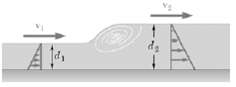
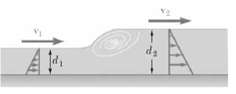
The depth of water flowing in a rectangular channel of width b at a speed v1 and a depth d1 increases to a depth d2 at a hydraulic jump. Express the rate of flow Q in terms of b, d1, andd2.
Determine the rate of flow in the channel of Prob. 14.83, knowing that b = 3 m, d1 = 1.25 m, and d2 = 1.5 m. Problem 14.83: The depth of water flowing in a rectangular channel of width b at a speed v1 and a depth d1 increases to a depth d2 at a hydraulic jump. Express the rate of flow Q in terms of
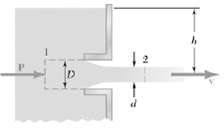
A circular reentrant orifice (also called Borda??s mouthpiece) of diameter D is placed at a depth h below the surface of a tank. Knowing that the speed of the issuing stream is v = ??2gh and assuming that the speed of approach v1 is zero, show that the diameter of the stream is d=D/2.
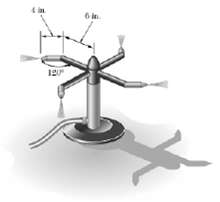
A garden sprinkler has four rotating arms, each of which consists of two horizontal straight sections of pipe forming an angle of 120 ?. Each arm discharges water at a rate of 5gal/min with a velocity of 60 ft/s relative to the arm. Knowing that the friction between the moving and stationary parts
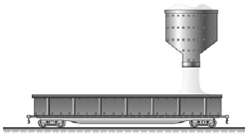
A railroad car of length L and mass m0 when empty is moving freely on a horizontal track while being loaded with sand from a stationary chute at a rate dm/dt = q. Knowing that the car was approaching the chute at a speed v0, determine (a) The mass of the car and its load after the car has cleared
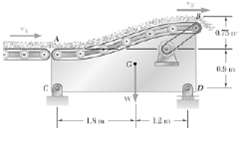
The final component of a conveyor system receives sand at a rate of 100 kg/s at A and discharges it at B. The sand is moving horizontally at A and B with a velocity of magnitude vA = vB = 4.5 m/s, knowing that the combined weight of the component and of the sand it supports is W = 4 kN, determine
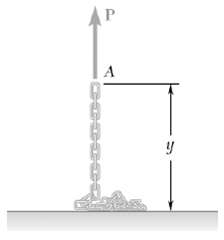
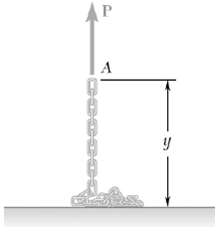
A chain of length l and mass m lies in a pile on the floor. If its end A is raised vertically at a constant speed v, express in terms of the length y of chain which is off the floor at any given instant (a) The magnitude of the force P applied at A, (b) The reaction of thefloor.
Solve Prob. 14.89, assuming that the chain is being lowered to the floor at a constant speedv.
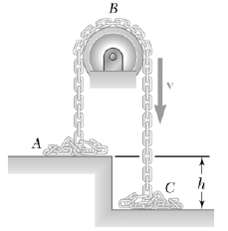
The ends of a chain lie in plies at A and C. When given an initial speed v, the chain keeps moving freely at that speed over the pulley at B. Neglecting friction, determine the required value of h.
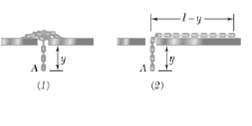
A chain of length l and mass m falls through a small hole in a plate. Initially, when y is very small, the chain is at rest. In each case shown, determine (a) The acceleration of the first link A as a function of y, (b) The velocity of the chain as the last link passes through the hole. In case 1
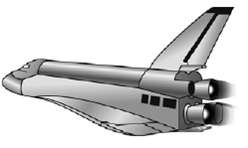
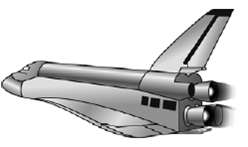
The main propulsion system of a space shuttle consists of three identical rocket engines, each of which burns the hydrogen-oxygen propellant at the rate of 750 lb/s and ejects it with a relative velocity of 12,500 ft/s. Determine the total thrust provided by the threeengines.
The main propulsion system of a space shuttle consists of three identical rocket engines which provide a total thrust of 1200 kips. Determine the rate at which the hydrogen-oxygen propellant is burned by each of the three engines, knowing that it is ejected with a relative velocity of 12,500ft/s.
A rocket has a mass of 1500kg, including 1200 kg of fuel, which is consumed at the rate of 15kg/s. Knowing that the rocket is fired vertically from the ground and that its acceleration increases by 220m/s2 from the time it is fired to the time the last particle of fuel has been consumed, determine
A rocket of mass 1500 kg (not including the fuel) is fired vertically at time t = 0. The fuel is consumed at a constant rate q = dm/dt and is expelled at a constant speed of 450 m/s relative to the rocket. Knowing that the rocket is designed to achieve a maximum acceleration of 25 m/s2 in 15.6 s,
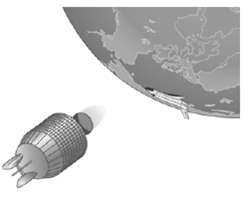
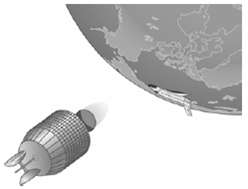
A weather satellite of mass 5000 kg, including fuel, has been ejected from a space shuttle describing a low circular orbit around the earth. After the satellite has slowly drifted to a safe distance from the shuttle, its engine is fired to increase its velocity by 2430 m/s as a first step to its
Determine the increase in velocity of the weather satellite of Prob. 14.97 after 1500 kg of fuel has beenconsumed.
The weight of a spacecraft, including fuel, is 11,600 lb when the rocket engines are fired to increase its velocity by 360ft/s, knowing that 1000lb of fuel is consumed, determine the relative velocity of the fuelejected.
The rocket engines of a spacecraft are fired to increase its velocity by 450 ft/s, knowing that 1200 lb of fuel is ejected at a relative velocity of 5400 ft/s, determine the weight of the spacecraft after the firing.
A rocket of initial weight 7300 lb, including 4000 lb of fuel, is fired vertically at time t = 0. The fuel is consumed at a constant rate of 260 lb/s and is expelled at a constant speed of 1500 ft/s relative to the rocket. Determine the altitude of the rocket when all the fuel has been consumed.
Determine the distance traveled by the spacecraft of Prob. 14.99 during the rocket engine firing, knowing that its initial speed was 7500 ft/s and the duration of the firing was 60s.
A rocket has a mass of 960 kg, including 800 kg of fuel, which is consumed at the rate of 10 kg/s and ejected with a relative velocity of 3600 m/s. Knowing that the rocket is fired vertically from the ground, determine(a) The altitude at which all fuel has been consumed,(b) The velocity of the
In Prob. 14.97, determine the distance separating the weather satellite from the space shuttle 80 s after its engine has been fired, knowing that the fuel is consumed at a rate of 18.75kg/s.
In a jet airplane, the kinetic energy imparted to exhaust gases is wasted as far as propelling the airplane is concerned. The useful power is equal to the product of the force available to propel the airplane and the speed of the airplane. If v is the speed of the airplane and u is the relative
In a rocket, the kinetic energy imparted to the consumed and ejected fuel is wasted as far as propelling the rocket is concerned. The useful power is equal to the product of the force available to propel the rocket and the speed of the rocket. If v is the speed of the rocket and u is the relative
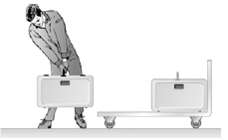
An airline employee tosses two suitcases, of weight 30 lb and 40 lb, respectively, onto a 50-lb baggage carrier in rapid succession. Knowing that the carrier is initially at rest and that the employee imparts a 9-ft/s horizontal velocity to the 30-lb suitcase and a 6-ft/s horizontal velocity to the
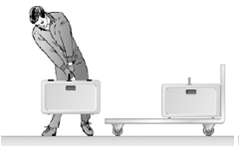
An airline employee tosses two suitcases in rapid succession, with a horizontal velocity of 7.2 ft/s, onto a 50-lb baggage carrier which is initially at rest. (a) Knowing that the final velocity of the baggage carrier is 3.6 ft/s and that the first suitcase the employee tosses onto the carrier has
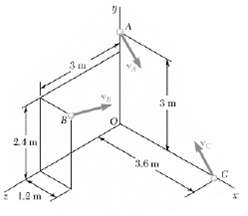
A system consists of three particles A, B, and C. We know that mA = 3 kg, mB = 2 kg, and mC = 4 kg and that the velocities of the particles expressed in m/s are, respectively, vA = 4i + 2j + 2k, vB = 4i + 3j, and vC = ??2i + 4j + 2k. Determine the angular momentum HO of the system about O.
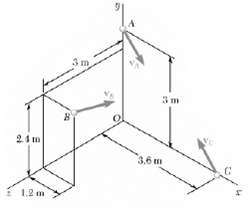
For the system of particles of Prob. 14.109, determine (a) The position vector r of the mass center G of the system, (b) The linear momentum mv of the system, (c) The angular momentum HG of the system about G. Also verify that he answers to this problem and to Prob. 14.109 satisfy the equation
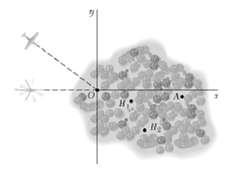
A small 3000-lb airplane and a 6000-lb helicopter flying at an altitude of 3600 ft are observed to collide directly above a tower located at O in a wooded area, four minutes earlier the helicopter had been sighted 5.5 mi due west of the tower and the airplane 10 mi west and 7.5 mi north of the
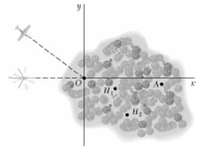
In Problem 14.111, knowing that the wreckage of the small airplane was found at A(3600 ft, 240 ft) and the 2000-lb fragment of the helicopter at point H1 (1200 ft, ??600 ft) , and assuming that all pieces hit the ground at the same time, determine the coordinates of the point H2 where the other
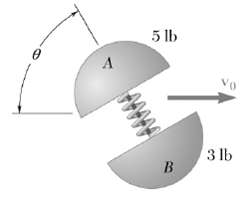
Two hemispheres are held together by a cord which maintains a spring under compression (the spring is not attached to the hemispheres). The potential energy of the compressed spring is 90 ft ? lb and the assembly has an initial velocity v0 of magnitude v0 = 24 ft/s. Knowing that the cord is severed
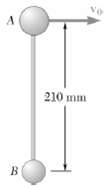
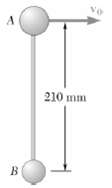
Two small spheres A and B, with masses of 2.5 kg and 1 kg, respectively, are connected by a rigid rod of negligible mass. The two spheres are resting on a horizontal, frictionless surface when A is suddenly given the velocity V0 = 3.5 m/si. Determine (a) The linear momentum of the system and its
Two small spheres A and B, with masses of 2.5 kg and 1 kg, respectively, are connected by a rigid rod of negligible mass. The two spheres are resting on a horizontal, frictionless surface when A is suddenly given the velocity V0 = 3.5 m/si. Determine (a) The linear momentum of the system and its
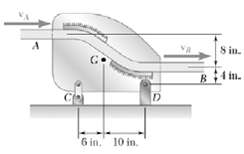
A stream of water having a cross-sectional area of 1.5 in2 and moving with a velocity of magnitude 60 ft/s at both A and B is deflected by two vanes which are welded as shown to a vertical plate. Knowing that the combined weight of the plate and vanes is 10 lb, determine the reactions at C and D.
The propeller of a small airplane has a 2-m-diameter slipstream and produces a thrust of 3.6kN when the airplane is at rest on the ground. Assuming ng ρ = 1.21 kg/m3 for air, determine(a) The speed of the air in the slipstream,(b) The volume of air passing through the propeller per second,(c) The
A rocket has a mass of 960 kg, including 800 kg of fuel, which is consumed at the rate of 10 kg/s and ejected with a relative velocity of 3600 m/s, knowing that the rocket is fired vertically from the ground, determine its acceleration(a) As it is fired,(b) As the last particle of fuel is being
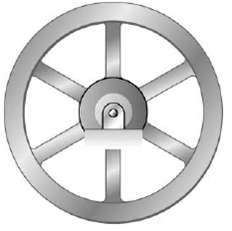
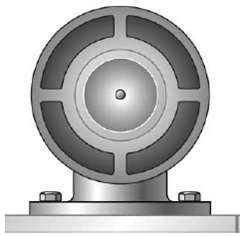
The flywheel of a small punching machine rotates at 360 rpm. Each punching operation requires 2034 J of work and it is desired that the speed of the flywheel after each punching be not less that 95 percent of the original speed.(a) Determine the required moment of inertia of the flywheel.(b) If a
The motion of an oscillating flywheel is defined by the relation θ = θ0e??7πt/6 sin4πt, where θ is expressed in radians and t in seconds. Knowing that θ0 = 0.4 rad, determine the angular coordinate, the angular velocity, and the angular acceleration of the flywheel when (a) t = 0.125 s, (b) t
A flywheel executes 1800 revolutions while it coasts to rest from speed of 6000 rpm. Assuming uniformly accelerated motion, determine(a) The time required for the flywheel to coast to rest,(b) The time required for the flywheel to execute the first 900 revolutions.
When the power to an electric motor is turned on the motor reaches its rated speed of 2400 rpm in 4s, and when the power is turned off the motor coasts to rest in 40s. Assuming uniformly accelerated motion, determine the number of revolutions that the motor executes (a) In reaching its rated
The angular acceleration of a flywheel is defined by the relation α = 30e−0.2t, where α and t are expressed in rad/s2 and seconds, respectively. Knowing that θ = 0 and ω = 0 at t = 0, determine the angular velocity and angular coordinate of the particle when t = 0.5 s
The angular acceleration of a shaft is defined by the relation α = − 0.5ω, where α is expressed in rad/s2 and ω in rad/s. Knowing that at t = 0 the angular velocity of the shaft is 30 rad/s, determine(a) The number of revolutions the shaft will execute before coming to rest,(b) The time
The angular acceleration of an oscillating disk is defined by the relation α = − kθ. Determine(a) The value of k for which ω = 12 rad/s when θ = 0 and θ = 6 rad when ω = 0,(b) The angular velocity of the disk when θ = 3 rad.
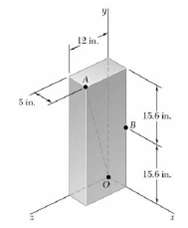
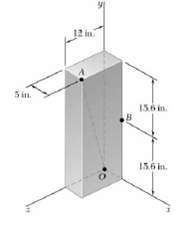
The rectangular block shown rotates about the diagonal OA with a constant angular velocity of 6.76 rad/s. Knowing that the rotation is counterclockwise as viewed from A, determine the velocity and acceleration of point B at the instantshown.
In Prob. 15.9, determine the velocity and acceleration of point B at the instant shown, assuming that the angular velocity is 3.38 rad/s and decreases at the rate of 5.07rad/s2.
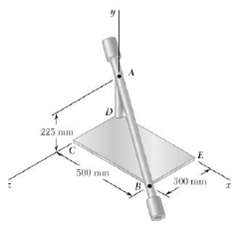
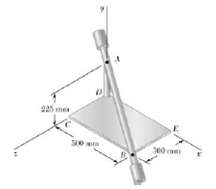
The assembly shown consists of two rods and a rectangular plate BCDE which are welded together. The assembly rotates about the axis AB with a constant angular velocity of 10 rad/s, knowing that the rotation is counterclockwise as viewed from B determines the velocity and acceleration of corner E.
In Prob. 15.11, determine the velocity and acceleration of corner C, assuming that the angular velocity is 10 rad/s and decreases at the rate of 20rad/s2.
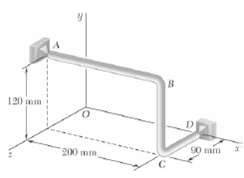
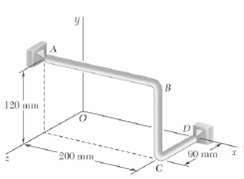
The bent rod ABCD rotates about a line joining points A and D with a constant angular velocity of 75 rad/s. Knowing that at the instant considered the velocity of corner C is upward, determine the velocity and acceleration of corner B.
In Prob. 15.13, determine the velocity and acceleration of corner B, assuming that the angular velocity is 75 rad/s and decreases at the rate of 600rad/s2.
The earth makes one complete revolution around the sun in 365.24 days. Assuming that the orbit of the earth is circular and has a radius of 93,000,000 mi, determine the velocity and acceleration of the earth
The earth makes one complete revolution on its axis in 23 h 56 min, knowing that the mean radius of the earth is 6370km determine the linear velocity and acceleration of a point on the surface of the earth(a) At the equator,(b) At Philadelphia, latitude 40° north,(c) At the North Pole.
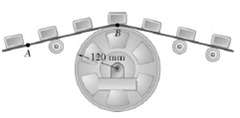
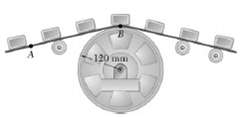
A series of small machine components being moved by a conveyor belt passes over a 120-mm-radius idler pulley. At the instant shown, the velocity of point A is 300 mm/s to the left and its acceleration is 180 mm/s2 to the right. Determine (a) The angular velocity and angular acceleration of the
A series of small machine components being moved by a conveyor belt passes over a 120-mm-radius idler pulley. At the instant shown, the angular velocity of the idler pulley is 4 rad/s clockwise. Determine the angular acceleration of the pulley for which the magnitude of the total acceleration of
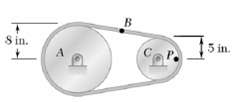
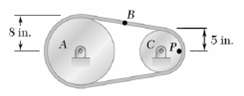
The belt shown moves over two pulleys without slipping. At the instant shown the pulleys are rotating clockwise and the speed of point B on the belt is 12 ft/s, increasing at the rate of 96 ft/s. Determine, at this instant, (a) The angular velocity and angular acceleration of each pulley, (b) The
The belt shown moves over two pulleys without slipping. Pulley A starts from rest with a clockwise angular acceleration defined by the relation α = 120 ?? 0.002ω2, where α is expressed in rad/s2 and ω is expressed in rad/s. Determine, after one-half revolution of pulley A, (a) The magnitude of
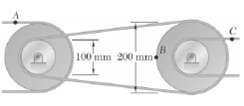
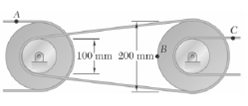
Three belts move over two pulleys without slipping in the speed reduction system shown. Point A on the input belt moves to the right with a constant speed of 0.6 m/s. Determine (a) The velocity of point C on the output belt, (b) The acceleration of point B on the out putpulley.
Three belts move over two pulleys without slipping in the speed reduction system shown. At the instant shown the velocity of point A on the input belt is 0.6 m/s to the right, decreasing at the rate of 1.8 2 m/s . Determine, at this instant, (a) The velocity and acceleration of point C on the
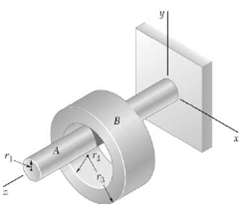
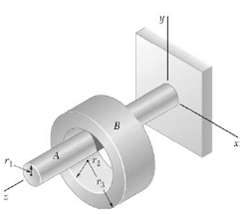
Ring B has an inner radius us r2 and hangs from the horizontal shaft A as shown. Knowing that shaft A rotates with a constant angular velocity ωA and that no slipping occurs, derive a relation in terms of r1, r2, r3, and ωA for (a) The angular velocity of ring B, (b) The acceleration of the
Ring B has an inner radius us r2 and hangs from the horizontal shaft A as shown. Shaft A rotates with a constant angular velocity of 25 rad/s and no slipping occurs. Knowing that r1 = 0.5 in., r2 = 2.5 in., and r3 = .5 in., determine (a) The angular velocity of ring B, (b) The acceleration of the
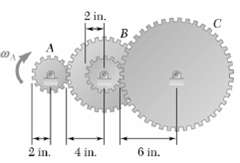
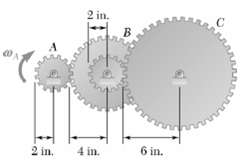
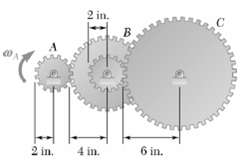
A gear reduction system consists of three gears A, B, and C. Knowing that gear A rotates clockwise with a constant angular velocity ωA = 600 rpm, determine (a) The angular velocities of gears B and C, (b) The accelerations of the points on gears B and C which are in contact.
A gear reduction system consists of three gears A, B, and C. Gear A starts from rest at time t = 0 and rotates clockwise with constant angular acceleration. Knowing that the angular velocity of gear A is 600 rpm at time t = 2 s, determine (a) The angular accelerations of gears B and C, (b) The
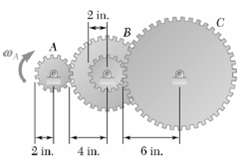
A gear reduction system consists of three gears A, B, and C. Gear A starts from rest at time t = 0 and rotates clockwise with constant angular acceleration. Knowing that the angular velocity of gear A is 600 rpm at time t = 2 s, determine (a) The angular accelerations of gears B and C, (b) The
A gear reduction system consists of three gears A, B, and C. Gear A starts from rest at time t = 0 and rotates clockwise with constant angular acceleration. Knowing that the angular velocity of gear A is 600 rpm at time t = 2 s, determine (a) The angular accelerations of gears B and C, (b) The
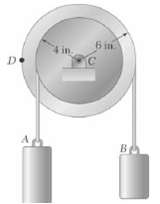
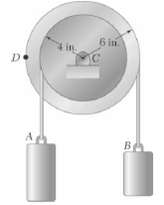
A pulley and two loads are connected by inextensible cords as shown. Load A has a constant acceleration of 10 in/s2 and an initial velocity of 8 in/s, both directed upward. Determine (a) The number of revolutions executed by the pulley in 3 s, (b) The velocity and position of load B after 3 s, (c)
A pulley and two loads are connected by inextensible cords as shown. The pulley starts from rest at t = 0 and is accelerated at the uniform rate of 2.4 rad/s2 clockwise. At t = 4 s, determine the velocity and position (a) Of load A, (b) Of load B.
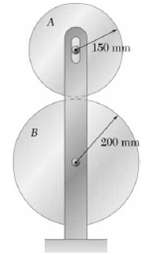
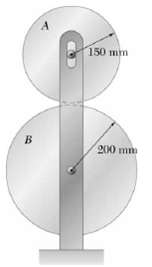
Two friction disks A and B are to be brought into contact without slipping when the angular velocity of disk A is 240 rpm counterclockwise. Disk A starts from rest at time t = 0 and is given a constant angular acceleration of magnitude α. Disk B starts from rest at time t = 2 s and is given a
Two friction disks A and B are brought into contact when the angular velocity of disk A is 240 rpm counterclockwise and disk B is at rest. A period of slipping follows and disk B makes 2 revolutions before reaching its final angular velocity. Assuming that the angular acceleration of each disk is
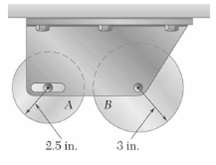
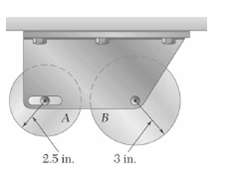
A simple friction drive consists of two disks A and B. Initially, disk B has a clockwise angular velocity of 500 rpm, and disk A is at rest. It is known that disk B will coast to rest in 60s. However, rather than waiting until both disks are at rest to bring them together, disk A is given a
Two friction wheels A and B are both rotating freely at 300 rpm counterclockwise when they are brought into contact. After 12 s of slippage, during which each wheel has a constant angular acceleration, wheel B reaches a final angular velocity of 75 rpm counterclockwise. Determine (a) The angular
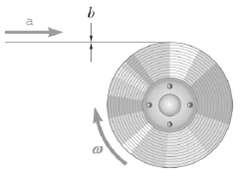
Television recording tape is being rewound on a VCR reel which rotates with a constant angular velocity ω0. Denoting by r the radius of the reel at any given time and by b the thickness of the tape, derive an expression for the acceleration of the tape as it approaches the reel.
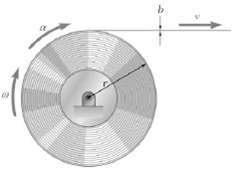
In a continuous printing process paper is drawn into the presses at a constant speed v Denoting by r the radius of the paper roll at any given time and by b the thickness of the paper, derive an expression for the angular acceleration of the paper roll.
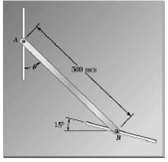
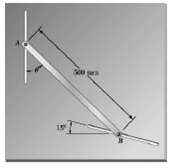
The motion of rod AB is guided by pins attached at A and B which slide in the slots shown. At the instant shown, n, θ = 0? and the pin at B moves upward to the left with a constant velocity of 150 mm/s. Determine (a) The angular velocity of the rod, (b) The velocity of the pin at end A.
The motion of rod AB is guided by pins attached at A and B which slide in the slots shown. At the instant shown, θ = 30? and the pin at A moves downward with a constant velocity of 225 mm/s. Determine (a) The angular velocity of the rod, (b) The velocity of the pin at end B.
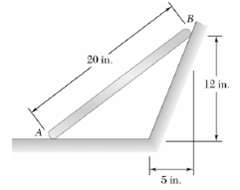
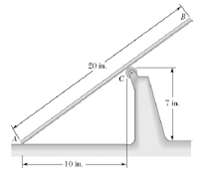
Rod AB can slide freely along the floor and the inclined plane. At the instant shown, the velocity of end A is 4.2 ft/s to the left. Determine (a) The angular velocity of the rod, (b) The velocity of end B of the rod.
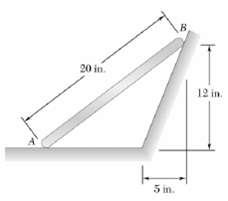
Rod AB can slide freely along the floor and the inclined plane. At the instant shown the angular velocity of the rod is 4.2 rad/s counterclockwise. Determine (a) The velocity of end A of the rod, (b) The velocity of end B of the rod.
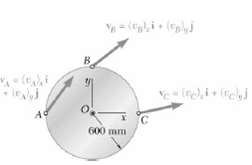
The disk shown moves in the xy plane. Knowing that (vA)y = ?? 7 m/s, (vB)x = ??7.4m/s, and (vC)x = ??1.4 m/s, determine (a) The angular velocity of the disk, (b) The velocity of point B.
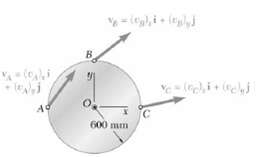
In Prob. 15.41, determine (a) The velocity of point O, (b) The point of the disk with zero velocity.
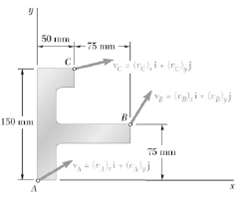
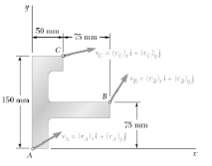
The sheet metal form shown moves in the xy plane. Knowing that (vA)x = 100mm/s, (vB)y = ??75mm/s, and (vC)x = 400mm/s, determine (a) The angular velocity of the plate, (b) The velocity of point A.
In Prob. 15.43, determine the locus of points of the sheet metal form for which the magnitude of the velocity is 200mm/s.
Rod AB moves over a small wheel at C while end A moves to the right with a constant velocity of 25 in./s. At the instant shown, determine (a) The angular velocity of the rod, (b) The velocity of end B of the rod.
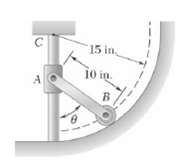
Rod AB is attached to a collar at A and is fitted with a small wheel at B which rolls on a circular surface. Knowing that when θ = 60? the velocity of the collar is 1.2 ft/s downward, determine, at that instant, (a) The angular velocity of rod AB, (b) The velocity of point B.
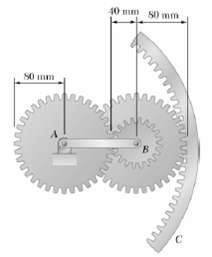
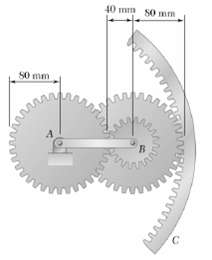
The outer gear C rotates with an angular velocity of 5 rad/s clockwise. Knowing that the inner gear A is stationary, determine (a) The angular velocity of the intermediate gear B, (b) The angular velocity of the arm AB.
The intermediate gear B rotates with an angular velocity of 20 rad/s clockwise. Knowing that the outer gear C is stationary, determine (a) The angular velocity of the inner gear A, (b) The angular velocity of the arm AB.
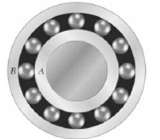
In the simplified sketch of a ball bearing shown, the diameter of the inner race A is 2.5 in. and the diameter of each ball is 0.5 in. The outer race B is stationary while the inner race has an angular velocity of 3600 rpm. Determine (a) The speed of the center of each ball, (b) The angular
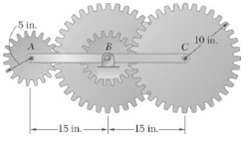
The outer gear A rotates with an angular velocity of 3 rad/s counterclockwise. Knowing that the angular velocity of the intermediate gear B is 6 rad/s clockwise, determine the angular velocity of (a) The arm ABC, (b) The outer gear C.
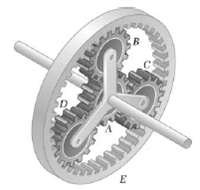
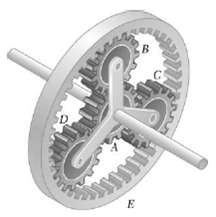
In the planetary gear system shown, the radius of gears A, B, C, and D is 60 mm and the radius of the outer gear E is 180 mm, knowing that gear E has an angular velocity of 120 rpm clockwise and that the central gear has an angular velocity of 150 rpm clockwise, determine (a) The angular velocity
In the planetary gear system shown, the radius of the central gear A is a, the radius of the planetary gears is b, and the radius of the outer gear E is a + 2b. The angular velocity of gear A is ωA clockwise, and the outer gear is stationary. If the angular velocity of the spider BCD is to be
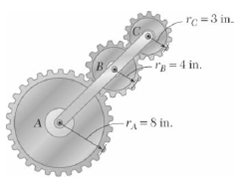
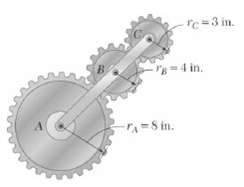
Three gears A, B, and C are pinned at their centers to rod ABC. Knowing that end A of rod ABC is fixed and that gear A does not rotate, determine the angular velocity of gears B and C when rod ABC rotates clockwise with a constant angular velocity of 75rpm.
Three gears A, B, and C are pinned at their centers to rod ABC. Knowing that end C of rod ABC is fixed and that gear C does not rotate, determine the angular velocity of gears A and B when rod ABC rotates clockwise with a constant angular velocity of 80rpm.
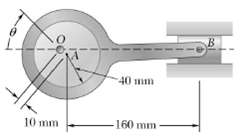
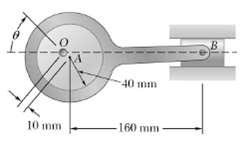
In the eccentric shown, a disk of 40-mm-radius revolves about shaft O that is located 10 mm from the center A of the disk. The distance between the center A of the disk and the pin at B is 160 mm. Knowing that the angular velocity of the disk is 900 rpm clockwise, determine the velocity of the
Determine the velocity of the block of Prob. 15.55 when θ = 120?. Problem 15.55: In the eccentric shown, a disk of 40-mm-radius revolves about shaft O that is located 10 mm from the center A of the disk. The distance between the center A of the disk and the pin at B is 160 mm, Knowing that the
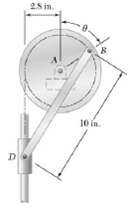
Knowing that the disk has a constant angular velocity of 15 rad/s clockwise, determine the angular velocity of bar BD and the velocity of collar D when (a) θ = 0, (b) θ = 90?, (c) θ = 180?.
Showing 11100 - 11200
of 18200
First
105
106
107
108
109
110
111
112
113
114
115
116
117
118
119
Last
Step by Step Answers

 Get 50% OFF
Claim Now
Get 50% OFF
Claim Now