New Semester
Started
Get
50% OFF
Study Help!
--h --m --s
Claim Now
Question Answers
Textbooks
Find textbooks, questions and answers
Oops, something went wrong!
Change your search query and then try again
S
Books
FREE
Study Help
Expert Questions
Accounting
General Management
Mathematics
Finance
Organizational Behaviour
Law
Physics
Operating System
Management Leadership
Sociology
Programming
Marketing
Database
Computer Network
Economics
Textbooks Solutions
Accounting
Managerial Accounting
Management Leadership
Cost Accounting
Statistics
Business Law
Corporate Finance
Finance
Economics
Auditing
Tutors
Online Tutors
Find a Tutor
Hire a Tutor
Become a Tutor
AI Tutor
AI Study Planner
NEW
Sell Books
Search
Search
Sign In
Register
study help
engineering
mechanical engineering
Vector Mechanics For Engineers Statics And Dynamics 8th Edition Ferdinand Beer, E. Russell Johnston, Jr., Elliot Eisenberg, William Clausen, David Mazurek, Phillip Cornwell - Solutions
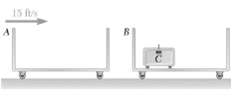
After having been pushed by an airline employee, an empty 80-lb luggage carrier A hits with a velocity of 15 ft/s an identical carrier B containing a 30-lb suitcase equipped with rollers. The impact causes the suitcase to roll into the left wall of carrier B. Knowing that the coefficient of
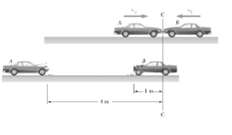
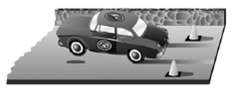
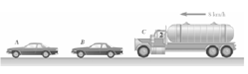
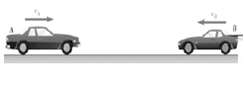
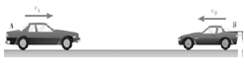
Two cars of the same mass run head-on into each other at C. After the collision, the cars skid with their brakes locked and come to a stop in the position shown in the lower part of the figure. Knowing that the speed of car A just before impact was 5 km/h and that the coefficient of kinetic
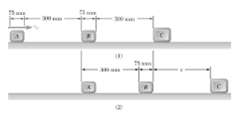
Blocks A and B each have a mass of 0.4 kg and block C has a mass of 1.2 kg. The coefficient of friction between the blocks and the plane is μk = 0.30. Initially block A is moving at a speed v0 = 3 m/s and blocks B and C are at rest (Fig. 1). After A strikes B and B strikes C, all three blocks come
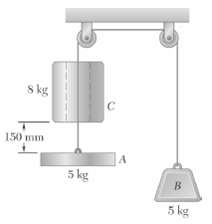
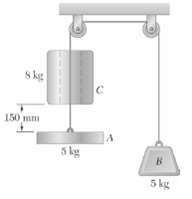
An 8-kg cylinder C is released from rest in the position shown and drops onto a 5-kg platform A which is at rest and is supported by an inextensible cord attached to a 5-kg counterweight B. Knowing that the coefficient of restitution between cylinder C and platform A is 0.8, determine(a) The
An 8-kg cylinder C is released from rest in the position shown and drops onto a 5-kg platform A which is at rest and is supported by an inextensible cord attached to a 5-kg counterweight B. Knowing that the coefficient of restitution between cylinder C and platform A is 0.8 and that the velocity of
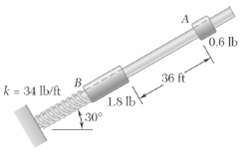
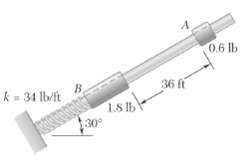
A 0.6-lb collar A is released from rest, slides down a frictionless rod, and strikes a 1.8-lb collar B which is at rest and supported by a spring of constant 34 lb/ft. Knowing that the coefficient of restitution between the two collars is 0.9, determine (a) The maximum distance collar A moves up
A 0.6-lb collar A is released from rest, slides down a frictionless rod, and strikes a 1.8-lb collar B which is at rest and supported by a spring of constant 34 lb/ft. Knowing that the velocity of collar A is zero immediately after impact, determine (a) The coefficient of restitution between the
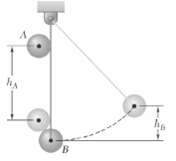
Ball B is hanging from an inextensible cord. An identical ball A is released from rest when it is just touching the cord and drops through the vertical distance hA = 200 mm before striking ball B. Assuming perfectly elastic impact (e = 1) and no friction, determine the resulting maximum vertical
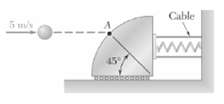
A 2-kg sphere moving to the right with a velocity of 5 m/s strikes at A the surface of a 9-kg quarter cylinder which is initially at rest and in contact with a spring of constant 20 kN/m. The spring is held by cables so that it is initially compressed 50 mm. Neglecting frictions and knowing that
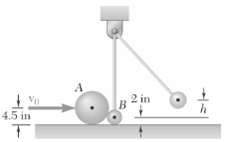
A 50-lb sphere A of radius 4.5 in. moving with a velocity of magnitude v0 = 6 ft/s strikes a 4.6-lb sphere B of radius 2 in. which is hanging from an in extensible cord and is initially at rest. Knowing that sphere B swings to a maximum height h = 0.75 ft, determine the coefficient of restitution
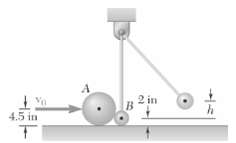
A 20-lb sphere A of radius 4.5 in. moving with a velocity of magnitude v0 = 6 ft/s strikes a 2-lb sphere B of radius 2 in. which is hanging from an inextensible cord and is initially at rest. Sphere B swings to a maximum height h after the impact. Determine the range of values of h for values of
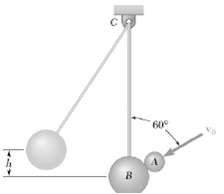
A 340-g ball B is hanging from an inextensible cord attached to a support C. A 170-g ball A strikes B with a velocity v0 of magnitude 1.5 m/s at an angle of 60? with the vertical. Assuming perfectly elastic impact (e = 1) and no friction, determine the height h reached by ball B.
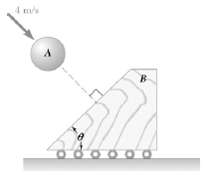
A 2-kg sphere A strikes the frictionless inclined surface of a 6-kg wedge B at a 90? angle with a velocity of magnitude 4 m/s. The wedge can roll freely on the ground and is initially at rest. Knowing that the coefficient of restitution between the wedge and the sphere is 0.50 and that the inclined
Skid marks on a drag race track indicate that the rear (drive) wheels of a car skid for the first 18 m and roll with slipping impending during the remaining 382 m. The front wheels of the car are just off the ground for the first 18 m, and for the remainder of the race 75 percent of the weight of
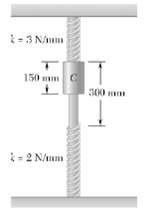
A 3-kg collar C slides on a frictionless vertical rod. It is pushed up into the position shown, compressing the upper spring by 50 mm and released. Determine (a) The maximum deflection of the lower spring, (b) The maximum velocity of the collar.
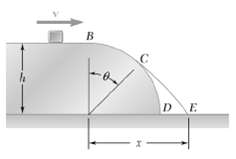
A small block slides at a speed d v = 3 m/s on a horizontal surface at a height h = 1 m above the ground. Determine (a) The angle θ at which it will leave the cylindrical surface BCD, (b) The distance x at which it will hit the ground. Neglect friction and air resistance.
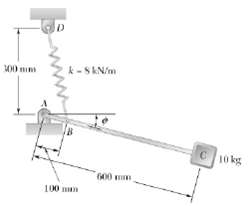
The system shown is in equilibrium when en φ = 0. Knowing that initially φ =90? and that block C is given a slight nudge when the system is in that position, determine the velocity of the block as it passes through the equilibrium position φ = 0. Neglect the mass of the rod.
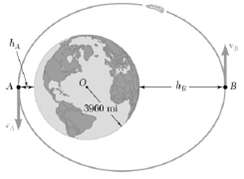
A spacecraft is describing an elliptic orbit of minimum altitude hA = 1500 mi and maximum altitude hB = 6000 mi above the surface of the earth. Determine the speed of the spacecraft at A.
A truck is traveling on a level road at a speed of 60 mi/h when its brakes are applied to slow it down to 20 mi/h. An antiskid braking system limits the braking force to a value at which the wheels of the truck are just about to slide. Knowing that the coefficient of static friction between the
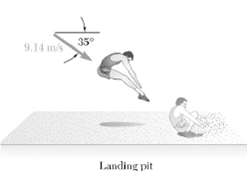
The last segment of the triple jump track-and-field event is the jump, in which the athlete makes a final leap, landing in a sand-filled pit. Assuming that the velocity of an 84-kg athlete just before landing is 9.14 m/s at an angle of 35? with the horizontal and that the athlete comes to a
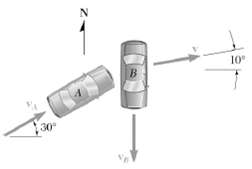
At an intersection car B was traveling south and car A was traveling 30? north of east when they slammed into each other. Upon investigation it was found that after the crash the two cars got stuck and skidded off at an angle of 10? north of east. Each driver claimed that he was going at the speed
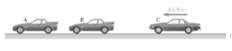
Two identical cars A and B are at rest on a loading dock with brakes released. Car C, of a slightly different style but of the same weight, has been pushed by dockworkers and hits car B with a velocity of 4.5 ft/s. Knowing that the coefficient of restitution is 0.8 between B and C and 0.5 between A
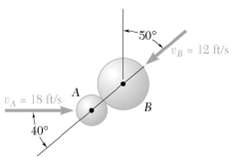
A 1.5-lb ball A is moving with a velocity of magnitude 18 ft/s when it is hit by a 2.5-lb ball B which has a velocity of magnitude 12 ft/s. Knowing that the coefficient of restitution is 0.8 and assuming no friction, determine the velocity of each ball afterimpact.
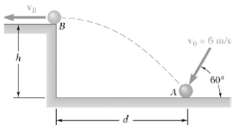
A ball hits the ground at A with a velocity v0 of 6 m/s at an angle of 60? with the horizontal. Knowing that e = 0.6 between the ball and the ground and that after rebounding the ball reaches point B with a horizontal velocity, determine (a) The distances h and d, (b) The velocity of the ball as it
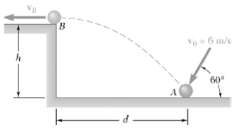
A ball hits the ground at A with a velocity v0 of 6 m/s at an angle of 60? with the horizontal. Knowing that e = 0.6 between the ball and the ground and that after rebounding the ball reaches point B with a horizontal velocity, determine (a) The distances h and d, (b) The velocity of the ball as it
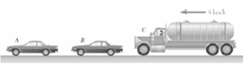
Two identical 1350-kg automobiles A and B are at rest with their brakes released when B is struck by a 5400-kg truck C which is moving to the left at 8 km/h. A second collision then occurs when B strikes A. Assuming the first collision is perfectly plastic and the second collision is perfectly
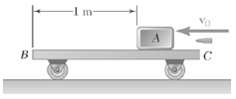
A 28-g bullet is fired with a velocity of 550 m/s into a block A, which has a mass of 5 kg. The coefficient of kinetic friction between block A and the cart BC is 0.50. Knowing that the cart has a mass of 4 kg and can roll freely, determine (a) The final velocity of the cart and block, (b) The
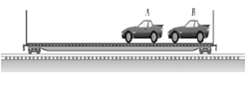
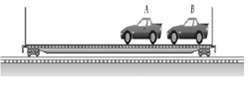
Car A weighing 4000 lb and car B weighing 3700 lb are at rest on a 22-ton flatcar which is also at rest. Cars A and B then accelerate and quickly reach constant speeds relative to the flatcar of 7 ft/s and 3.5 ft/s, respectively, before decelerating to a stop at the opposite end of the flatcar.
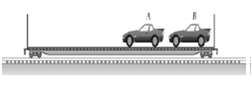
Car A weighing 4000 lb and car B weighing 3700 lb are at rest on a flatcar which is also at rest. Cars A and B then accelerate and quickly reach constant speeds relative to the flatcar of 7.65 ft/s and 7.50 ft/s, respectively, before decelerating to a stop at the opposite end of the flatcar.
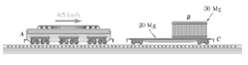
An 80-Mg railroad engine A coasting at 6.5 km/h strikes a 20-Mg flatcar C carrying a 30-Mg load B which can slide along the floor of the flatcar (μk = 0.25). Knowing that the flatcar was at rest with its brakes released and that it automatically coupled with the engine upon impact, determine the
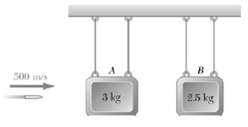
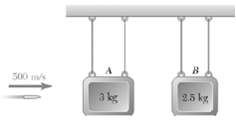
A bullet is fired with a horizontal velocity of 500 m/s through a 3-kg block A and becomes embedded in a 2.5-kg block B. Knowing that blocks A and B start moving with velocities of 3 m/s and 5 m/s, respectively, determine (a) The mass of the bullet, (b) Its velocity as it travels from block A to
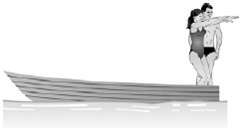
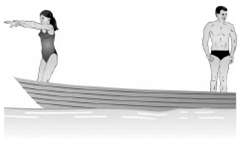
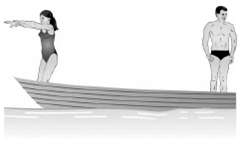
A 180-lb man and a 120-lb woman stand side by side at the same end of a 300-lb boat, ready to dive, each with a 16-ft/s velocity relative to the boat. Determine the velocity of the boat after they have both dived, if (a) The woman dives first, (b) The man dives first.
A 180-lb man and a 120-lb woman stand at opposite ends of a 300-lb boat, ready to dive, each with a 16-ft/s velocity relative to the boat. Determine the velocity of the boat after they have both dived, if (a) The woman dives first, (b) The man dives first.
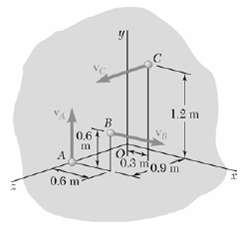
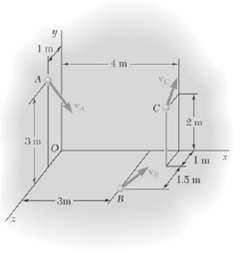
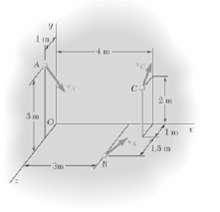
A system consists of three identical 9-kg particles A, B, and C. The velocities of the particles are, respectively, vA = vAj, vB = vBi, and vC = vCk. Knowing that the angular momentum of the system about O, expressed in kg ?? m2/s is HO = ??1.8k, determine (a) The velocities of the particles, (b)
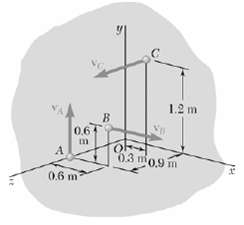
A system consists of three identical 9-kg particles A, B, and C. The velocities of the particles are, respectively, vA = vAj, vB = vBi, and vC = vCk, and the magnitude of the linear momentum L of the system is 45 kg ?? m/s. Knowing that HG = HO, where HG is the angular momentum of the system about
A 180-lb man and a 120-lb woman stand at opposite ends of a 300-lb boat, ready to dive, each with a 16-ft/s velocity relative to the boat. Determine the velocity of the boat after they have both dived, if (a) The woman dives first, (b) The man dives first.
For the system of particles of Prob. 14.11, determine (a) The position vector r of the mass center G of the system, (b) The linear momentum mv of the system, (c) The angular momentum HG of the system about G. Also verify that the answers to this problem and to Prob. 14.11 satisfy the equation given
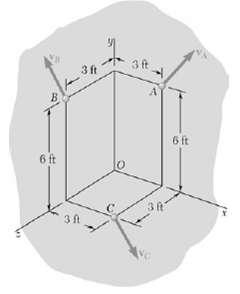
A system consists of three particles A, B, and C. We know that mA = 1 kg, mB = 2 kg, and mC = 3 kg and that the velocities of the particles expressed in m/s are, respectively, vA = 3i ?? 2j + 4k, vB =4i + 3j, and vC = ??2i + 5j ?? 3k. Determine the angular momentum HO of the system about O.
For the system of particles of Prob. 14.13, determine (a) The position vector r of the mass center G of the system, (b) The linear momentum mv of the system, (c) The angular momentum HG of the system about G. Also verify that the answers to this problem and to Prob. 14.13 satisfy the equations
A 20-kg projectile is passing through the origin O with a velocity v0 = (60 m/s)i when it explodes into two fragments A and B, of 8-kg and 12-kg, respectively. Knowing that 2 s later the position of fragment A is (120 m,−10 m,−20m), determine the position of fragment B at the same instant.
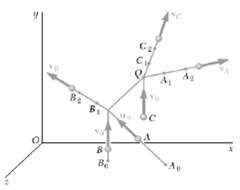
A 500-kg space vehicle traveling with a velocity v0 = (450 m/s)i passes through the origin O at t = 0. Explosive charges then separate the vehicle into three parts A, B, and C of masses 300-kg, 150-kg, and 50-kg, respectively. Knowing that at t = 4 s, the positions of parts A and B are observed to
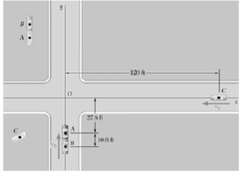
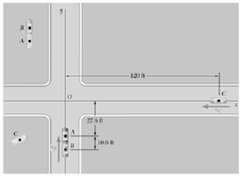
Car A was at rest 27.8 ft south of the point O when it was struck in the rear by car B, which was traveling north at a speed vB. Car C, which was traveling west at a speed vC, was 120 ft east of point O at the time of the collision. Cars A and B stuck together and, because the pavement was covered
Car A was at rest 27.8 ft south of the point O when it was struck in the rear by car B, which was traveling north at a speed vB. Car C, which was traveling west at a speed vC, was 120 ft east of point O at the time of the collision. Cars A and B stuck together and, because the pavement was covered
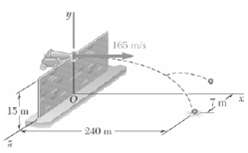
Two 15-kg cannon balls are chained together and fired horizontally with a velocity of 165 m/s from the top of a 15-m wall. The chain breaks during the flight of the cannon balls and one of them strikes the ground at t = 1.5 s, at a distance of 240 m from the foot of the wall, and 7 m to the right
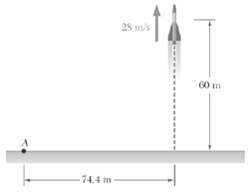
A 3-kg model rocket is launched vertically and reaches an altitude of 60 m with a speed of 28 m/s at the end of powered flight, time t = 0. As the rocket approaches its maximum altitude it explodes into two parts of masses mA = 1 kg and mB = 2 kg. Part A is observed to strike the ground 74.4 m west
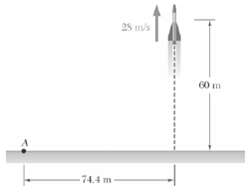
A 3-kg model rocket is launched vertically and reaches an altitude of 60 m with a speed of 28 m/s at the end of powered flight, time t = 0. As the rocket approaches its maximum altitude it explodes into two parts of masses mA = 1 kg and mB = 2 kg. Part A is observed to strike the ground 74.4 m west
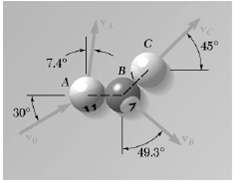
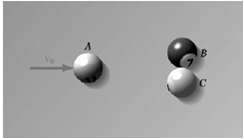
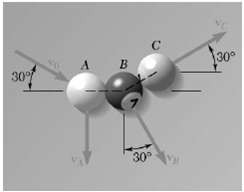
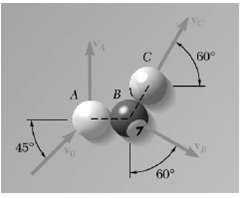
In a game of pool, ball A is traveling with a velocity v0 when it strikes balls B and C which are at rest and aligned as shown. Knowing that after the collision the three balls move in the directions indicated and that v0 = 4 m/s and vC = 2.1 m/s, determine the magnitude of the velocity of (a) Ball
A 10,000-lb helicopter A was traveling due east at a speed of 190 mi/h and an altitude of 2400 ft when it was hit by a 13,000-lb helicopter B. As a result of the collision, both helicopters lost their lift, and their entangled wreckage fell to the ground in 12 s at a point located 1600 ft east and
A 6-lb game bird flying due east 45 ft above the ground with a velocity vB = (30 ft/s)i is hit by a 2-oz arrow with a velocity vA = (180 ft/s)j + (240 ft/s)k, where j is directed upward. Determine the position of the point P where the bird will hit the ground, relative to the point O located
In a scattering experiment, an alpha particle A is projected with the velocity u0 = ?(600 m/s)i + (750 m/s)j ? (800m/s)k into a stream of oxygen nuclei with a common velocity v0 = (600 m/s)j . After colliding successively with nuclei B and C, particle A is observed to move along the path defined by
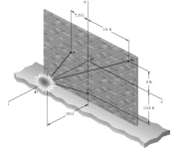
An 18-lb shell moving with a velocity v0 = (60 ft/s)i??(45 ft/s) j ?? (1800 ft/s)k explodes at point D into three fragments A, B, and C weighing, respectively, 8 lb, 6 lb, and 4 lb. Knowing that the fragments hit the vertical wall at the points indicated, determine the speed of each fragment
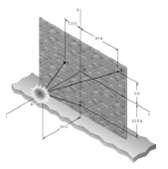
A 6-lb shell moving with a velocity ?? v0k explodes at point D into three fragments which hit the vertical wall at the points indicated. Fragments A, B, and C hit the wall 0.010 s, 0.018 s, and 0.012 s, respectively, after the explosion. Determine (a) The weights of the three fragments, (b) The
Derive the relation HO = r × mv + HG between the angular moment a HO and HG defined in Eqs (14.7) and (14.24), respectively. The vectors r and v define, respectively, the position and velocity of the mass center G of the system of particles relative to the Newtonian frame of reference Oxyz, and m
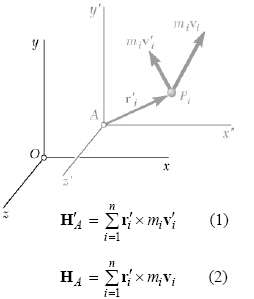
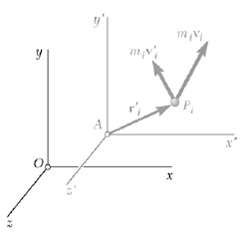
Consider the frame of reference Ax?? y?? z?? in translation with respect to the Newtonian frame of reference Oxyz. We define the angular momentum H??A of a system of n particles about A as the sum of the moments about A of the moment a miv?? i of the particles in their motion relative to the frame
Show that the relation ΣMA = HA, where H??A is defined by Eq. (1) of Prob. 14.29 and where ΣMA represents the sum of the moments about A of the external forces acting on the system of particles, is valid if, and only if, one of the following conditions is satisfied: (a) The frame Ax?? y?? z?? is
In Prob. 14.6, determine the energy lost as the bullet (a) Passes through block A, (b) Becomes embedded in block B.
In Prob. 14.1, determine the energy lost as a result of the first collision and verify that the total kinetic energy is unchanged as a result of the second collision.
In Prob. 14.3, determine the total work done by the engines of cars A and B while the cars are accelerating to reach constant speeds.
In Prob. 14.27, determine the increase in kinetic energy as a result of the explosion.
Two automobiles A and B, of mass ss mA and mB, respectively, are traveling in opposite directions when they collide head on. The impact is assumed perfectly plastic, and it is further assumed that the energy absorbed by each automobile is equal to its loss of kinetic energy with respect to a moving
It is assumed that each of the two automobiles involved in the collision described in Prob. 14.35 had been designed to safely withstand a test in which it crashed into a solid, immovable wall at the speed v0. The severity of the collision of Prob. 14.35 may then be measured for each vehicle by the
In a game of pool, ball A is moving with a velocity v0= v0i when it strikes balls B and C, which are at rest side by side. Assuming frictionless surfaces and perfectly elastic impact (that is, conservation of energy), determine the final velocity of each ball, assuming that the path of A is (a)
Solve Sample Prob. 14.4, assuming that cart A is given an initial horizontal velocity v0 while ball B is at rest.
In a game of pool, ball A is moving with a velocity v0 of magnitude v0 = 15 ft/s when it strikes balls B and C, which are at rest and aligned as shown. Knowing that after the collision the three balls move in the directions indicated and assuming frictionless surfaces and perfectly elastic impact
In a game of pool, ball A is moving with a velocity v0 of magnitude v0 = 15 ft/s when it strikes balls B and C, which are at rest and aligned as shown. Knowing that after the collision the three balls move in the directions indicated and assuming frictionless surfaces and perfectly elastic impact
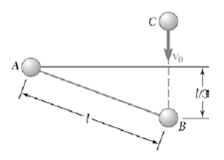
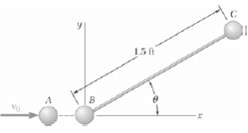
Three spheres, each of mass m, can slide freely on a frictionless, horizontal surface. Spheres A and B are attached to an inextensible, inelastic cord of length l and are at rest in the position shown when sphere B is struck squarely by sphere C which is moving with a velocity v0, knowing that the
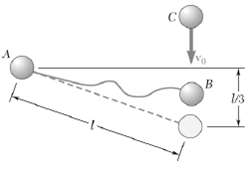
Three spheres, each of mass m, can slide freely on a frictionless, horizontal surface. Spheres A and B are attached to an inextensible, inelastic cord of length l and are at rest in the position shown when sphere B is struck squarely by sphere C which is moving with a velocity v0. Knowing that the
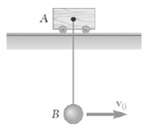
Ball B is suspended from a cord of length l attached to cart A, which can roll freely on a frictionless, horizontal track. The ball and the cart have the same mass m. If the ball is given an initial horizontal velocity v0 while the cart is at rest, describe the subsequent motion of the system,
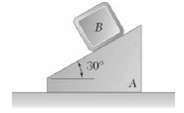
A 6-kg block B starts from rest and slides on the 10-kg wedge A, which is supported by a horizontal surface. Neglecting friction, determine (a) The velocity of B relative to A after it has slid 1 m down the inclined surface of the wedge, (b) The corresponding velocity ofA.
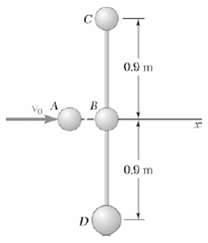
Four small disks A, B, C, and D can slide freely on a frictionless horizontal surface. Disks B, C, and D are connected by light rods and are at rest in the position shown when disk B is struck squarely by disk A which is moving to the right with a velocity v0 = (12 m/s)i. The masses of the disks
Four small disks A, B, C, and D can slide freely on a frictionless horizontal surface. Disks B, C, and D are connected by light rods and are at rest in the position shown when disk B is struck squarely by disk A which is moving to the right with a velocity v0 = (12 m/s)i. The masses of the disks
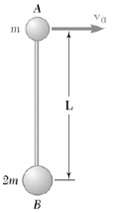
Two small spheres A and B, respectively of mass m and 2m, are connected by a rigid rod of length l and negligible mass. The two spheres are resting on a horizontal, frictionless surface when A is suddenly given the velocity v0 = v0i. Determine (a) The linear momentum of the system and its angular
A 750-lb space vehicle traveling with a velocity v0 = (1500 ft/s)k passes through the origin O. Explosive charges then separate the vehicle into three parts A, B and C, weighing, respectively, 125lb, 250lb, and 375lb. Knowing that shortly thereafter the positions of the three parts are,
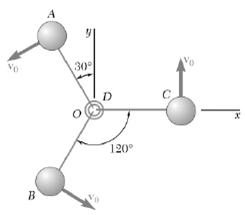
Three small spheres A, B, and C, each of mass m, are connected to a small ring D of negligible mass by means of three inextensible, inelastic cords of length l. The spheres can slide freely on a frictionless horizontal surface and are rotating initially at a speed v0 about ring D which is at rest.
Three small spheres A, B, and C, each of mass m, are connected to a small ring D of mass 2m by means of three inextensible, inelastic cords of length l which are equally spaced. The spheres can slide freely on a frictionless horizontal surface and are rotating initially at a speed v0 about ring D
Three identical small spheres, each of weight 2 lb, can slide freely on a horizontal frictionless surface. Spheres B and C are connected by a light rod and are at rest in the position shown when sphere B is struck squarely by sphere A which is moving to the right with a velocity 0 v = (6.5 ft/s)i.
Three identical small spheres, each of weight 2 lb, can slide freely on a horizontal frictionless surface. Spheres B and C are connected by a light rod and are at rest in the position shown when sphere B is struck squarely by sphere A which is moving to the right with a velocity v0 = (8 ft/s)i.
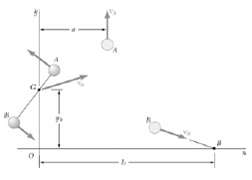
Two small disks, A and B, weighing 4.8 lb and 2.4 lb, respectively, can slide on a horizontal, frictionless surface. They are connected by a cord, 3 ft long, and spin counterclockwise about their mass center G at a rate of 8 rad/s. At t = 0, the coordinates of G are x0 = 0, y0 = 7.44 ft, and its
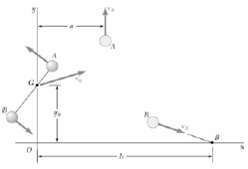
Two small disks, A and B, of weighing 6 lb and 3 lb, respectively, can slide on a horizontal and frictionless surface. They are connected by a cord of negligible mass and spin about their mass center G. At t = 0, G is moving with the velocity v0 and its coordinates are x0 = 0, y0 = 7.5 ft. Shortly
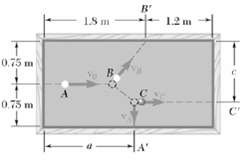
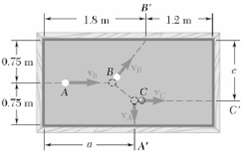
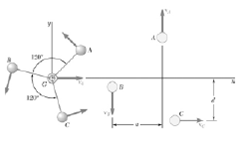
In a game of billiards, ball A is given an initial velocity v0 along the longitudinal axis of the table. It hits ball B and then ball C, which are both at rest. Balls A and C are observed to hit the sides of the table squarely at A?? and C??, respectively, and ball B is observed to hit the side
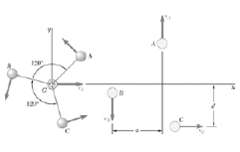
For the game of billiards of Prob. 14.55, it is now assumed that v0 =5 m/s,vC = 3.2 m/s, and c = 1.22 m. Determine (a) the velocities vA and vB of balls A and B, (b) the point A?? where ball A hits the side of the table. Problem 14.55: In a game of billiards, ball A is given an initial velocity v0
Three small identical spheres A, B, and C, which can slide on a horizontal, frictionless surface, are attached to three strings of length l which are tied to a ring G. Initially the spheres rotate about the ring which moves along the x axis with a velocity v0. Suddenly the ring breaks and the three
Three small identical spheres A, B, and C, which can slide on a horizontal, frictionless surface, are attached to three strings, 75 mm long, which are tied to a ring G. Initially the spheres rotate counterclockwise about the ring with a relative velocity of 0.75 m/s and the ring moves along the x
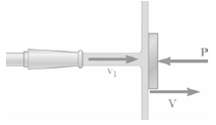
A stream of water of cross-sectional area A and velocity v1 strikes a plate which is held motionless by a force P. Determine the magnitude of P, knowing that A = 500 mm2, v1 = 25 m/s and V =0.
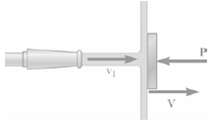
A stream of water of cross-sectional area A and velocity v1 strikes a plate which moves to the right with a velocity V. Determine the magnitude of V, knowing that A = 600 mm2, v1 = 30 m/s and P = 400N.
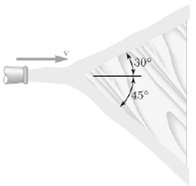
The nozzle shown discharges a stream of water at a flow rate Q = 475 gal/min with a velocity v of magnitude 60 ft/s. The stream is split into two streams with equal flow rates by a wedge which is kept in a fixed position. Determine the components (drag and lift) of the force exerted by the stream
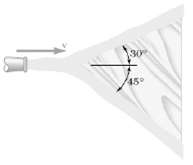
The nozzle shown discharges a stream of water at a flow rate Q = 500 gal/min with a velocity v of magnitude 48 ft/s. The stream is split into two streams of equal flow rates by a wedge which is moving to the left at a constant speed of 12 ft/s. Determine the components (drag and lift) of the force
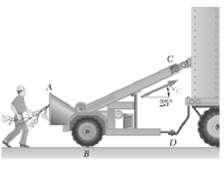
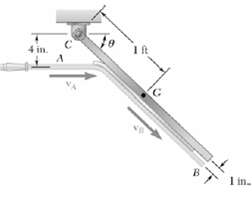
Tree limbs and branches are being fed at A at the rate of 10 lb/s into a shredder which spews the resulting wood chips at C with a velocity of 60 ft/s. Determine the horizontal component of the force exerted by the shredder on the truck hitch atD.
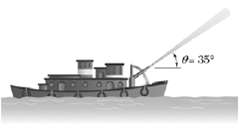
A hose discharges water at a rate of 8 m3/min with a velocity of 50 m/s from the bow of a fireboat. Determine the thrust developed by the engine to keep the fireboat in a stationaryposition.
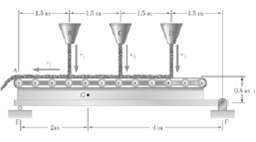
Sand falls from three hoppers onto a conveyor belt at a rate of 40 kg/s for each hopper. The sand hits the belt with a vertical velocity 1 v = 3 m/s and is discharged at A with a horizontal velocity 2 v = 4 m/s. Knowing that the combined mass of the beam, belt system, and the sand it supports is
Knowing that the blade AB of Sample Prob. 14.7 is in the shape of an arc of a circle, show that the resultant force F exerted by the blade on the stream is applied at the midpoint C of the arc AB.
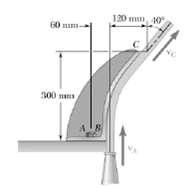
The nozzle shown discharges water at the rate of 800 L/min. Knowing that at both B and C the stream of water moves with a velocity of magnitude 30 m/s, and neglecting the weight of the vane, determine the force-couple system which must be applied at A to hold the vane inplace.
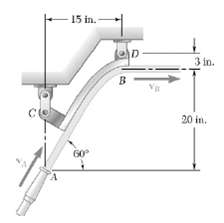
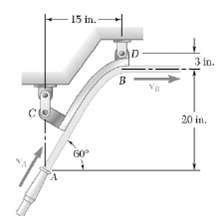
The nozzle shown discharges water at the rate of 40 ft3/min. Knowing that at both A and B the stream of water moves with a velocity of magnitude 75 ft/s and neglecting the weight of the vane, determine the components of the reactions at C andD.
The nozzle shown discharges water at the rate of 40 ft3/min. Knowing that at both A and B the stream of water moves with a velocity of magnitude 75 ft/s and neglecting the weight of the vane, determine the components of the reactions at C andD.
A stream of water flowing at a rate of 300 gal/min and moving with a velocity of magnitude v at both A and B is deflected by a vane welded to a hinged plate. The combined weight of the vane and plate is 40 lb with the mass center at point G. Knowing that ? = 45?, determine (a) The speed v of the
The total drag due to air friction on a jet airplane traveling at 900 km/h is 35 kN. Knowing that the exhaust velocity is 600 m/s relative to the airplane, determine the mass of air which must pass through the engine per second to maintain the speed of 900 km/h in level flight.
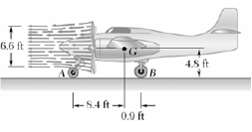
Prior to take-off the pilot of a 6000-lb twin-engine airplane tests the reversible-pitch propellers by increasing the reverse thrust with the brakes at point B locked. Knowing that point G is the center of gravity of the airplane, determine the velocity of the air in the two 6.6-ft-diameter
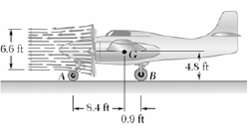
Prior to take-off the pilot of a 6000-lb twin-engine airplane tests the reversible-pitch propellers with the brakes at point B locked. Knowing that the velocity of the air in the two 6.6-ft-diameter slipstreams is 60 ft/s and that point G is the center of gravity of the airplane, determine the
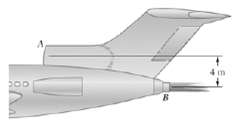
The jet engine shown scoops in air at A at a rate of 90 kg/s and discharges it at B with a velocity of 600 m/s relative to the airplane. Determine the magnitude and line of action of the propulsive thrust developed by the engine when the speed of the airplane is (a) 480 km/h, (b) 960km/h.
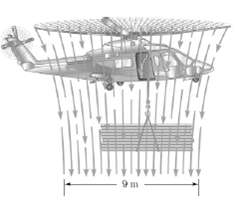
The helicopter shown can produce a maximum downward air speed of 24 m/s in a 9-m-diameter slipstream. Knowing that the weight of the helicopter and crew is 15 kN and assuming ρ = 1.21 kg/m3 for air, determine the maximum load that the helicopter can lift while hovering in midair.
Showing 11000 - 11100
of 18200
First
104
105
106
107
108
109
110
111
112
113
114
115
116
117
118
Last
Step by Step Answers

 Get 50% OFF
Claim Now
Get 50% OFF
Claim Now