New Semester
Started
Get
50% OFF
Study Help!
--h --m --s
Claim Now
Question Answers
Textbooks
Find textbooks, questions and answers
Oops, something went wrong!
Change your search query and then try again
S
Books
FREE
Study Help
Expert Questions
Accounting
General Management
Mathematics
Finance
Organizational Behaviour
Law
Physics
Operating System
Management Leadership
Sociology
Programming
Marketing
Database
Computer Network
Economics
Textbooks Solutions
Accounting
Managerial Accounting
Management Leadership
Cost Accounting
Statistics
Business Law
Corporate Finance
Finance
Economics
Auditing
Tutors
Online Tutors
Find a Tutor
Hire a Tutor
Become a Tutor
AI Tutor
AI Study Planner
NEW
Sell Books
Search
Search
Sign In
Register
study help
engineering
mechanical engineering
Vector Mechanics For Engineers Statics And Dynamics 8th Edition Ferdinand Beer, E. Russell Johnston, Jr., Elliot Eisenberg, William Clausen, David Mazurek, Phillip Cornwell - Solutions
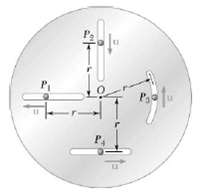
Four pins slide in four separate slots cut in a circular plate as shown. When the plate is at rest, each pin has a velocity directed as shown and of the same constant magnitude u. If each pin maintains the same velocity relative to the plate when the plate rotates about O with a constant
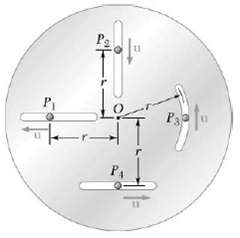
Solve Prob. 15.158, assuming that the plate rotates about O with a constant clockwise angular velocity ω. Problem 15.158: Four pins slide in four separate slots cut in a circular plate as shown. When the plate is at rest, each pin has a velocity directed as shown and of the same constant magnitude
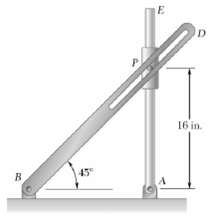
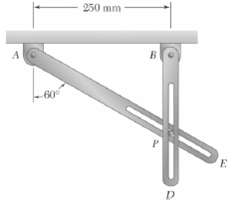
Pin P is attached to the collar shown; the motion of the pin is guided by a slot cut in bar BD and by the collar that slides on rod AE. Rod AE rotates with a constant angular velocity of 6 rad/s clockwise and the distance from A to P increases at a constant rate of 8 ft/s. Determine at the instant
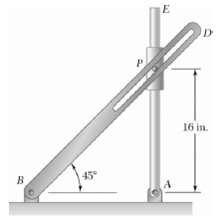
Pin P is attached to the collar shown; the motion of the pin is guided by a slot cut in bar BD and by the collar that slides on rod AE. Bar BD rotates with a constant angular velocity of 6 rad/s counterclockwise and the distance from B to P decreases at a constant rate of 10.5 ft/s. Determine at
A rocket sled is tested on a straight track that is built along a meridian. Knowing that the track is located at latitude 40° north, determine the Coriolis acceleration of the sled when it is moving north at a speed of 600 mi/h.
The cage of a mine elevator moves downward at a constant speed of 12.2 m/s. Determine the magnitude and direction of the Coriolis acceleration of the cage if the elevator is located(a) At the equator,(b) At latitude 40° north,(c) At latitude 40° south.
Collar P slides toward point A at a constant relative speed of 6ft/s along rod AB which rotates counterclockwise with a constant angular velocity of 5rad/s At the instant shown determine (a) The velocity and acceleration of point P, (b) The velocity and acceleration of point D.
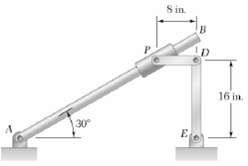
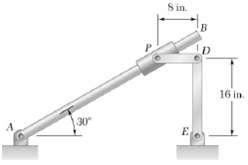
Collar P slides toward point A at a constant relative speed of 9.6 ft/s along rod AB which rotates clockwise with a constant angular velocity of 4rad/s, at the instant shown determine(a) The angular velocities of bars PD and DE,(b) The angular accelerations of bars PD andDE.
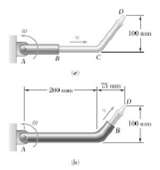
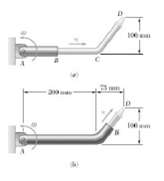
The motion of nozzle D is controlled by arm AB. At the instant shown the arm is rotating counterclockwise at the constant rate ω = 2.4 rad/s and portion BC is being extended at the constant rate u = 250 mm/s with respect to the arm. For each of the arrangements shown, determine the acceleration of
Solve Prob. 15.166, assuming that the direction of the relative velocity u is reversed so that portion BD is being retracted. Problem 15.166: The motion of nozzle D is controlled by arm AB. At the instant shown the arm is rotating counterclockwise at the constant rate ω = 2.4 rad/s and portion BC
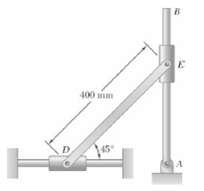
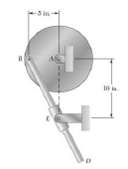
Collar E slides toward point A with a constant relative speed of 3 m/s along rod AB which rotates counterclockwise with a constant angular velocity of 15 rad/s. At the instant shown determine the angular velocity and angular acceleration of rod DE.
Collar E slides away from point A with a constant relative speed of 2 m/s along rod AB which rotates clockwise with a constant angular velocity of 10 rad/s. At the instant shown determine the velocity and acceleration of collar D.
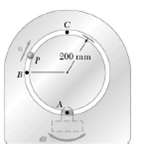
Pin P slides in a circular slot cut in the plate shown at a constant relative speed u = 180 mm/s. Knowing that at the instant shown the plate rotates clockwise about A at the constant rate ω = 6 rad/s, determine the acceleration of the pin if it is located at (a) Point A, (b) Point B, (c) Point C.
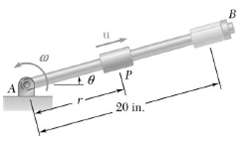
The collar P slides outward at a constant relative speed u along rod AB, which rotates counterclockwise with a constant angular velocity of 20 rpm. Knowing that r = 10 in. when θ = 0 and that the collar reaches B when θ =90?, determine the magnitude of the acceleration of the collar P just as it
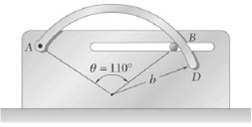
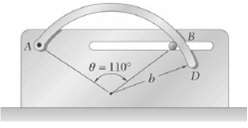
Rod AD is bent in the shape of an arc of a circle of radius b = 150 mm. The position of the rod is controlled by pin B which slides in a horizontal slot and also slides along the rod. Knowing that at the instant shown pin B moves to the right at a constant speed of 75 mm/s, determine (a) The
Solve Prob. 15.172 when ? = 90?. Problem 15.172: Rod AD is bent in the shape of an arc of a circle of radius b = 150 mm. The position of the rod is controlled by pin B which slides in a horizontal slot and also slides along the rod. Knowing that at the instant shown pin B moves to the right at a
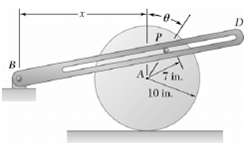
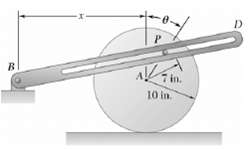
Pin P is attached to the wheel shown and slides in a slot cut in bar BD. The wheel rolls to the right without slipping with a constant angular velocity of 20 rad/s. Knowing that x = 24 in. when θ = 0, determine (a) The angular acceleration of the bar, (b) The relative acceleration of pin P with
Pin P is attached to the wheel shown and slides in a slot cut in bar BD. The wheel rolls to the right without slipping with a constant angular velocity of 20 rad/s. Knowing that x = 24 in. when θ = 0, determine (a) The angular acceleration of the bar, (b) The relative acceleration of pin P with
The disk shown rotates with a constant clockwise angular velocity of 12 rad/s. At the instant shown, determine (a) The angular velocity and angular acceleration of rod BD, (b) The velocity and acceleration of the point of the rod coinciding with E.
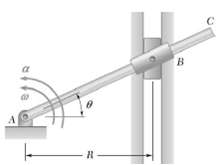
Collar B slides along rod AC and is attached to a block that moves in a vertical slot. Knowing that R = 18 in., θ = 30?, ω = 6 rad/s, and α = 4 rad/s2, determine the velocity and acceleration of collar B.
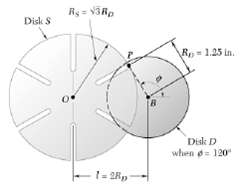
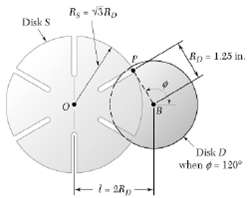
The Geneva mechanism shown is used to provide an intermittent rotary motion of disk S. Disk D rotates with a constant counterclockwise angular velocity ?D of 8 rad/s. A pin P is attached to disk D and can slide in one of six equally spaced slots cut in disk S. It is desirable that the angular
In Prob. 15,178, determine the angular velocity and angular acceleration of disk S at the instant when φ = 135?. Problem 15.178: The Geneva mechanism shown is used to provide an intermittent rotary motion of disk S. Disk D rotates with a constant counterclockwise angular velocity ωD of 8 rad/s. A
In Prob. 15.149, determine the acceleration of pin P. Problem 15.149: The motion of pin P is guided by slots cut in rods AE and BD. Knowing that the rods rotate with the constant angular velocities ωA = 4 rad/s clockwise and ωB = 5 rad/s clockwise, determine the velocity of pin P for the position
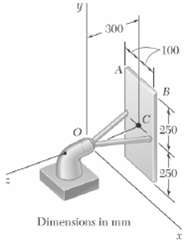
The plate and rods shown are welded together to form an assembly which rotates about the ball-and-socket joint O with an angular velocity ω. Denoting the velocity of point A by vA = (vA)xi + (vA)yj + (vA)zk, and knowing that (vA)x = 10 mm/s and (vA)z = 80 mm/s, determine the velocity component
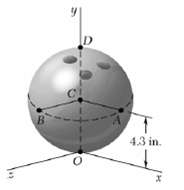
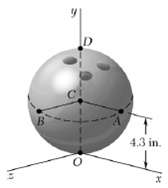
The bowling ball shown rolls without slipping on the horizontal xz plane with an angular velocity ω = ωxi + ωyj + ωzk. Knowing that vA = (14.4 ft/s)i (14.4 ft/s)j + (10.8 ft/s)k and D (28.8 ft/s) v = i+ (21.6 ft/s)k, determine (a) The angular velocity of the bowling ball, (b) The velocity of
The bowling ball shown rolls without slipping on the horizontal xz plane with an angular velocity ω = ωxi + ωyj + ωzk. Knowing that vB = (10.8 ft/s)i ?? (14.4 ft/s)j + (14.4 ft/s)k and vD (21.6 ft/s)i + (28.8 ft/s)k, determine (a) The angular velocity of the bowling ball, (b) The velocity of
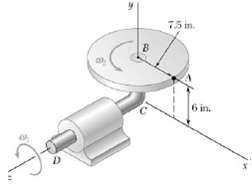
The L-shaped arm BCD rotates about the z axis with a constant angular velocity ω1 of 5rad/s, knowing that the 7.5-in.-radius disk rotates about BC with a constant angular velocity ω2 of 4 rad/s, determine the angular acceleration of the disk.
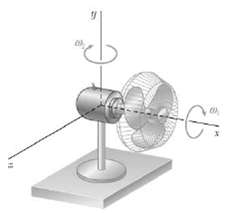
The blade assembly of an oscillating fan rotates with a constant angular velocity ω1 = ?? (450 rpm)i with respect to the motor housing. Determine the angular acceleration of the blade assembly, knowing that at the instant shown the angular velocity and the angular acceleration of the motor housing
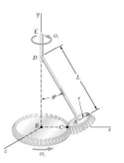
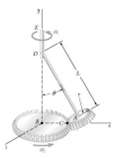
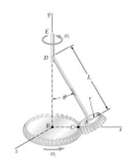
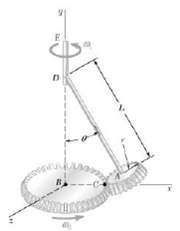
Gear A is constrained to roll on the fixed gear B but is free to rotate about axle AD. Axle AD is connected by a clevis to the vertical shaft DE which rotates as shown with a constant angular velocity ω1. Determine (a) The angular velocity of gear A, (b) The angular acceleration of gear A.
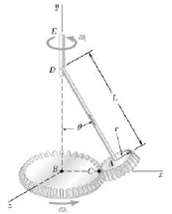
Gear A is constrained to roll on gear B but is free to rotate about axle AD. Axle AD is connected by a clevis to the vertical shaft DE which rotates as shown with a constant angular velocity ω1. Knowing that gear B rotates with a constant angular velocity ω 2, determine (a) The angular velocity
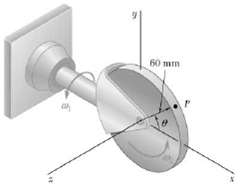
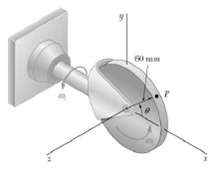
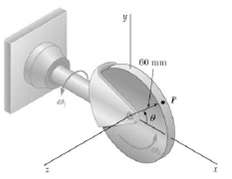
A 60-mm-radius disk spins at the constant rate ?2 = 4 rad/s about an axis held by a housing attached to a horizontal rod that rotates at the constant rate ?1 = 5 rad/s. For the position shown, determine(a) The angular acceleration of the disk,(b) The acceleration of point P on the rim of the disk
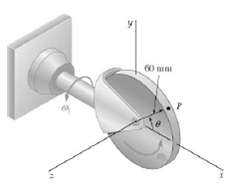
A 60-mm-radius disk spins at the constant rate ω2 = 4 rad/s about an axis held by a housing attached to a horizontal rod that rotates at the constant rate ω1 = 5 rad/s. Knowing that θ = 30?, determine the acceleration of point P on the rim of the disk.
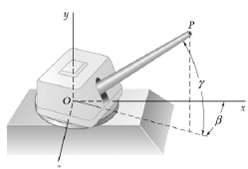
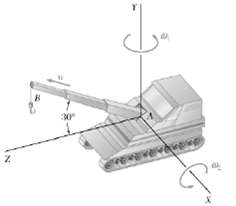
A gun barrel of length h OP = 12 ft is mounted on a turret as shown. To keep the gun aimed at a moving target the azimuth angle β is being increased at the rate dβ /dt = 30?/s and the elevation angle γ is being increased at the rate dγ /dt = 10?/s. For the position β = 90? and γ = 30?,
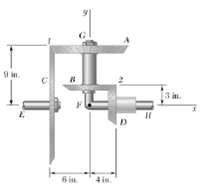
In the planetary gear system shown, gears A and B are rigidly connected to each other and rotate as a unit about shaft FG. Gears C and D rotate with constant angular velocities of 15 rad/s and 30 rad/s, respectively, both counterclockwise when viewed from the right, choosing the z axis pointing out
In Prob. 15.186, determine the acceleration of the point on gear A which is in contact with gear B. Problem 15.186: Gear A is constrained to roll on the fixed gear B but is free to rotate about axle AD. Axle AD is connected by a clevis to the vertical shaft DE which rotates as shown with a constant
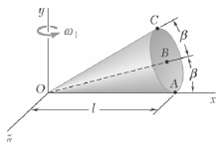
The cone shown rolls on the zx plane with its apex at the origin of coordinates. Denoting by ω1 the constant angular velocity of the axis OB of the cone about the y axis, determine (a) The rate of spin of the cone about the axis OB, (b) The total angular velocity of the cone, (c) The angular
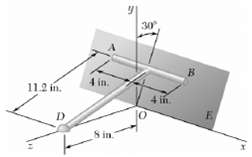
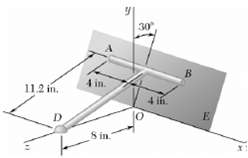
Two rods are welded together to form the assembly shown that is attached to a fixed ball-and-socket joint at D. Rod AB moves on the inclined plane E that is perpendicular to the yz plane. Knowing that at the instant shown the speed of point B is 4 in/s and ?y (a) The angular velocity of the
In Prob. 15.194 the speed of point B is known to be increasing at the rate of 8 in/s2. For the position shown, determine (a) The angular acceleration of the assembly, (b) The radius of curvature of the path of point B.
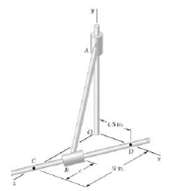
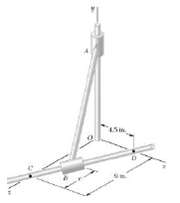
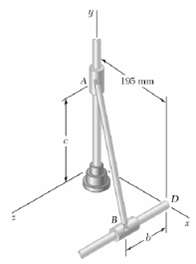
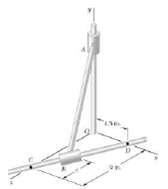
Rod AB of length 325 mm is connected by ball-and-socket joints to collars A and B, which slide along the two rods shown. Knowing that collar B moves toward point D at a constant speed of 1 m/s, determine the velocity of collar A when b = 100mm.
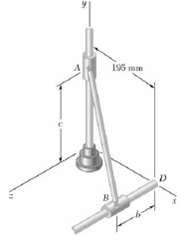
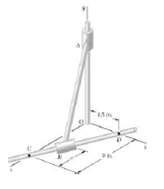
Rod AB of length 325 mm is connected by ball-and-socket joints to collars A and B, which slide along the two rods shown. Knowing that collar B moves away from point D at a constant speed of 1.6 m/s, determine the velocity of collar A when b = 156mm.
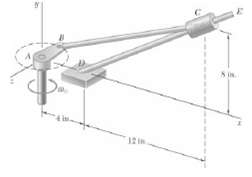
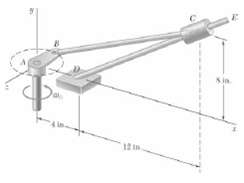
Rod BC, of length 18 in., is connected by ball-and-socket joints to the rotating arm AB and to collar C which can slide on the fixed rod DE. Arm AB is of length 2 in. and rotates at the constant rate ω0 = 24 rad/s. For the position shown determine the velocity of collar C.
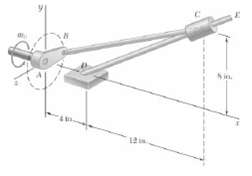
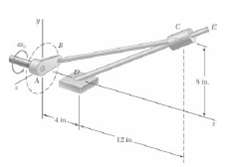
Rod BC, of length 18 in., is connected by ball-and-socket joints to the rotating arm AB and to collar C which can slide on the fixed rod DE. Arm AB is of length 2 in. and rotates at the constant rate ω0 = 24 rad/s. For the position shown determine the velocity of collar C.
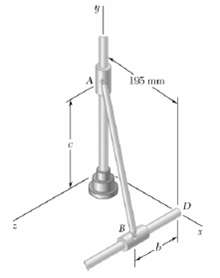
Rod AB of length 15 in. is connected by ball-and-socket joints to collars A and B, which slide along the two rods shown. Knowing that collar B moves toward point D at a constant speed of 2.5 in./s, determine the velocity of collar A when c = 4in.
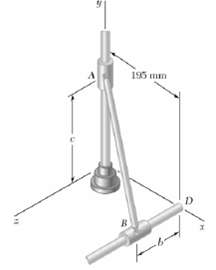
Rod AB of length 15 in. is connected by ball-and-socket joints to collars A and B, which slide along the two rods shown. Knowing that collar B moves toward point D at a constant speed of 2.5 in./s, determine the velocity of collar A when c = 6in.
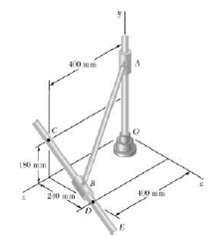
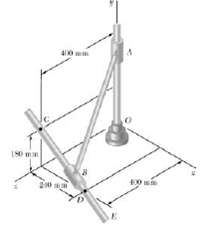
Rod AB of length 500 mm is connected by ball-and-socket joints to collars A and B, which slide along the two rods shown. Knowing that collar B moves toward point E at a constant speed of 200 mm/s, determine the velocity of collar A as collar B passes through point D.
Rod AB of length 500 mm is connected by ball-and-socket joints to collars A and B, which slide along the two rods shown. Knowing that collar B moves toward point E at a constant speed of 200 mm/s, determine the velocity of collar A as collar B passes through point C.
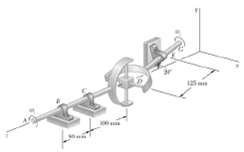
Two shafts AC and EG, which lie in the vertical yz plane, are connected by a universal joint at D. Shaft AC rotates with a constant angular velocity ω1 as shown. At a time when the arm of the crosspiece attached to shaft AC is vertical, determine the angular velocity of shaft EG.
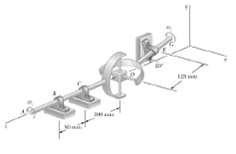
Solve Prob. 15.204 assuming that the arm of the crosspiece attached to shaft AC is horizontal. Problem 15.204: Two shafts AC and EG, which lie in the vertical yz plane, are connected by a universal joint at D. Shaft AC rotates with a constant angular velocity ω1 as shown. At a time when the arm of
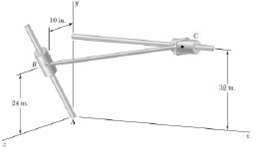
Rod BC of length 42 in. is connected by a ball-and-socket joint to collar B and by a clevis connection to collar C. Knowing that collar B moves toward A at a constant speed of 19.5 in./s, determine at the instant shown (a) The angular velocity of the rod, (b) The velocity of collar C.
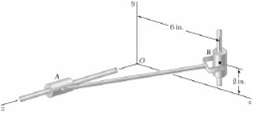
Rod AB of length 11 in. is connected by a ball-and-socket joint to collar A and by a clevis connection to collar B. Knowing that collar B moves down at a constant speed of 4.5 ft/s, determine at the instant shown (a) The angular velocity of the rod, (b) The velocity of collar A.
In Prob. 15.196, determine the acceleration of collar A. Problem 15.196: Rod AB of length 325 mm is connected by ball-and-socket joints to collars A and B, which slide along the two rods shown. Knowing that collar B moves toward point D at a constant speed of 1 m/s, determine the velocity of collar
In Prob. 15.197, determine the acceleration of collar A. Problem 15.197: Rod AB of length 325 mm is connected by ball-and-socket joints to collars A and B, which slide along the two rods shown. Knowing that collar B moves away from point D at a constant speed of 1.6 m/s, determine the velocity of
In Prob. 15.198, determine the acceleration of collar C. Problem 15.198: Rod BC, of length 18 in., is connected by ball and-socket joints to the rotating arm AB and to collar C which can slide on the fixed rod DE. Arm AB is of length 2 in. and rotates at the constant rate ω0 = 24 rad/s. For the
In Prob. 15.199, determine the acceleration of collar C. Problem 15.199: Rod BC, of length 18 in., is connected by ball and- socket joints to the rotating arm AB and to collar C which can slide on the fixed rod DE. Arm AB is of length 2 in. and rotates at the constant rate ω0 = 24 rad/s. For the
For the mechanism of Prob. 15.200, determine the acceleration of collar A. Problem 15.200: Rod AB of length 15 in. is connected by ball and socket joints to collars A and B, which slide along the two rods shown. Knowing that collar B moves toward point D at a constant speed of 2.5 in./s, determine
For the mechanism of Prob. 15.201, determine the acceleration of collar A. Problem 15.201: Rod AB of length 15 in. is connected by ball and socket joints to collars A and B, which slide along the two rods shown. Knowing that collar B moves toward point D at a constant speed of 2.5 in./s, determine
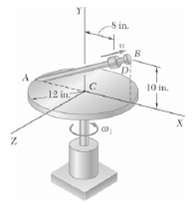
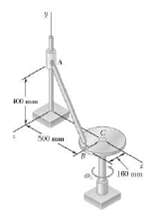
Rod AB is welded to the 12-in.-radius plate which rotates at the constant rate ω1 = 6 rad/s. Knowing that collar D moves toward end B of the rod at a constant speed u = 78 in./s, determine, for the position shown, (a) The velocity of D, (b) The acceleration of D.
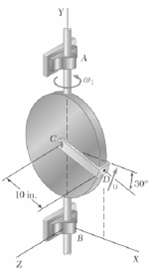
The circular plate shown rotates about its vertical diameter at the constant rate ω1 = 10 rad/s. Knowing that in the position shown the disk lies in the XY plane and point D of strap CD moves upward at a constant relative speed u = 4.5 ft/s, determine (a) The velocity of D, (b) The acceleration of
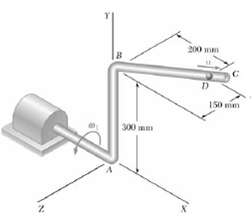
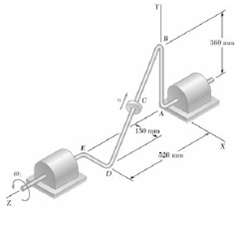
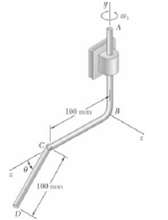
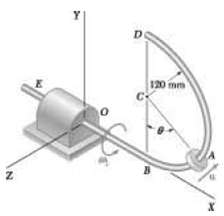
The bent pipe shown rotates at the constant rate ω1 = 10 rad/s. Knowing that a ball bearing D moves in portion BC of the pipe toward end C at a constant relative speed u = 0.6 m/s, determine at the instant shown (a) The velocity of D, (b) The acceleration of D.
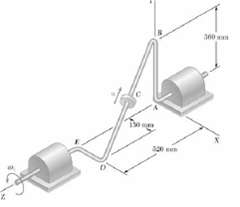
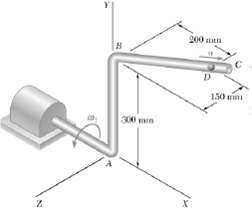
The bent rod shown rotates at the constant rate ω1 = 5 rad/s and collar C moves toward point B at a constant relative speed u = 975 mm/s. Knowing that collar C is halfway between points B and D at the instant shown, determine its velocity and acceleration.
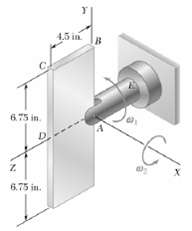
The rectangular plate shown rotates at the constant rate ω2 = 12 rad/s with respect to arm AE, which itself rotates at the constant rate ω1 = 9 rad/s about the Z axis. For the position shown, determine (a) The velocity of corner B, (b) The acceleration of corner B.
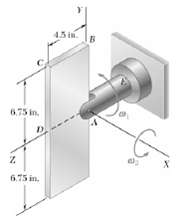
The rectangular plate shown rotates at the constant rate ω2 = 12 rad/s with respect to arm AE, which itself rotates at the constant rate ω1 = 9 rad/s about the Z axis. For the position shown, determine (a) The velocity of corner C, (b) The acceleration of corner C.
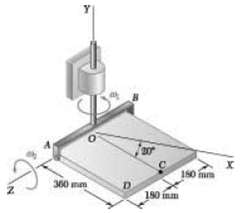
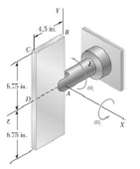
A square plate of side 360 mm is hinged at A and B to a clevis. The plate rotates at the constant rate ω2 = 4 rad/s with respect to the clevis, which itself rotates at the constant rate ω1 = 3 rad/s about the Y axis. For the position shown, determine (a) The velocity of point C, (b) The
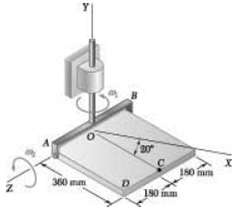
A square plate of side 360 mm is hinged at A and B to a clevis. The plate rotates at the constant rate ω2 = 4 rad/s with respect to the clevis, which itself rotates at the constant rate ω1 = 3 rad/s about the Y axis. For the position shown, determine (a) The velocity of corner D, (b) The
Solve Prob. 15.216 assuming that at the instant shown the angular velocity ω1 of the pipe is 10 rad/s and is decreasing at the rate of 15 rad/s2, while the relative speed u of the ball bearing is 0.6 m/s and is increasing at the rate of 3 m/s2.
Solve Prob. 15.217 assuming that at the instant shown the angular velocity ω1 of the rod is 5 rad/s and is increasing at the rate of 10 rad/s2, while the relative speed u of the collar C is 975 mm/s and is decreasing at the rate of 6.5m/s2. Problem 15.217: The bent rod shown rotates at the
Solve Prob. 15.219 assuming that at the instant shown the angular velocity ω2 of the plate with respect to arm AE is 12 rad/s and is decreasing at the rate of 60 rad/s2, while the angular velocity ω1 of the arm about the Z axis is 9 rad/s and is decreasing at the rate of 45 rad/s2.
Using the method of Sec. 15.14, solve Prob. 15.186. Problem 15.186: Gear A is constrained to roll on the fixed gear B but is free to rotate about axle AD. Axle AD is connected by a clevis to the vertical shaft DE which rotates as shown with a constant angular velocity ?1. Determine(a) The angular
Using the method of Sec. 15.14, solve Prob. 15.187. Problem 15.187: Gear A is constrained to roll on gear B but is free to rotate about axle AD. Axle AD is connected by a clevis to the vertical shaft DE which rotates as shown with a constant angular velocity ω1. Knowing that gear B rotates with a
Using the method of Sec. 15.14, solve Prob. 15.188. Problem 15.188: A 60-mm-radius disk spins at the constant rate ω2 = 4 rad/s about an axis held by a housing attached to a horizontal rod that rotates at the constant rate ω1 = 5 rad/s. For the position shown, determine (a) The angular
Using the method of Sec. 15.14, solve Prob. 15.189. Problem 15.189: A 60-mm-radius disk spins at the constant rate ω2 = 4 rad/s about an axis held by a housing attached to a horizontal rod that rotates at the constant rate ω1 = 5 rad/s. Knowing that θ =30?, determine the acceleration of point P
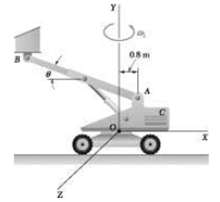
The crane shown rotates at the constant rate ω1 = 0.25 rad/s; simultaneously, the telescoping boom is being lowered at the constant rate ω2 = 0.40 rad/s. Knowing that at the instant shown the length of the boom is 6 m and is increasing at the constant rate u = 0.45 m/s, determine the velocity and
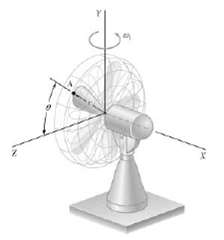
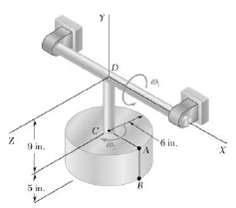
The rotor of a fan rotates about the Y axis at a constant rate ω1 = 0.8 rad/s. At the same time, the blades rotate at a constant rate ω2 = dθ /dt = 300 rpm. Knowing that the distance between the rotor and point A on the tip of the blade is r = 160 mm and that θ = 45? at the instant shown,
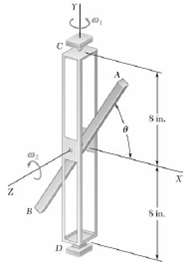
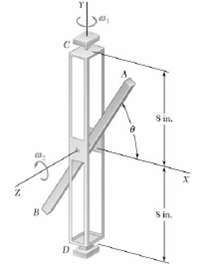
The 16-in. bar AB is made to rotate at the constant rate ω2 = dθ/dt = 8 rad/s with respect to the frame CD which itself rotates at the constant rate ω1 = 12 rad/s about the Y axis. Knowing that θ = 60? at the instant shown, determine the velocity and acceleration of point A.
The 16-in. bar AB is made to rotate at the rate ?2 = d? /dt with respect to the frame CD which itself rotates at the rate ?1 about the Y axis. At the instant shown ?1 = 12 rad/s, d?1/dt= ?16 rad/s2, ?2 = 8 rad/s, d?2/dt = 10 rad/s2, and ? = 60?. Determine the velocity and acceleration of point A at
The arm AB of length 5 m is used to provide an elevated platform for construction workers. In the position shown, arm AB is being raised at the constant rate dθ/dt = 0.25 rad/s; simultaneously, the unit is being rotated counterclockwise about the Y axis at the constant rate ω1 = 0.15 rad/s.
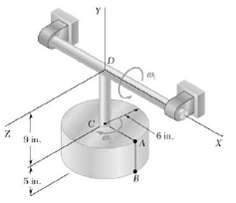
The rod CD is attached to arm ABC by means of a clevis at C and is made to rotate at the e rate ω2 = dθ/dt with respect to arm ABC. The entire assembly rotates about the fixed Y axis at the constant rate ω1 = 8 rad/s. Knowing that θ = 45?, ω2 = 4 rad/s, and dω2/dt = 5 rad/s2 at the instant
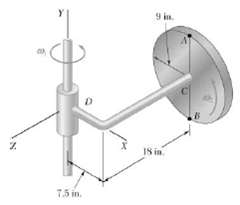
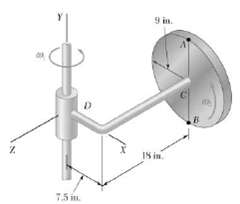
A disk of 9-in. radius rotates at the constant rate ω2 = 12 rad/s with respect to arm CD, which itself rotates at the constant rate ω1 = 8 rad/s about the Y axis. Determine at the instant shown the velocity and acceleration of point A on the rim of the disk.
A disk of 9-in. radius rotates at the constant rate ω2 = 12 rad/s with respect to arm CD, which itself rotates at the constant rate ω1 = 8 rad/s about the Y axis. Determine at the instant s.
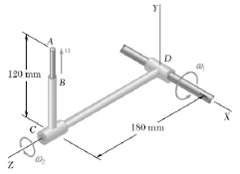
In the position shown the thin rod moves at a constant speed u = 60 mm/s out of the tube BC. At the same time tube BC rotates at the constant rate ω2 = 1.5 rad/s with respect to arm CD. Knowing that the entire assembly rotates about the X axis at the constant rate ω1 = 1.2 rad/s, determine the
In the position shown the thin rod moves at a constant speed u = 60 mm/s out of the tube BC. At the same time tube BC rotates at the constant rate ω2 = 1.5 rad/s with respect to arm CD. Knowing that the entire assembly rotates about the X axis at the constant rate ω1 = 1.2 rad/s, determine the
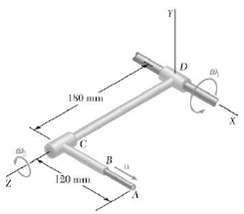
The cylinder shown rotates at the constant rate ω2 = 8 rad/s with respect to rod CD, which itself rotates at the constant rate ω1 = 6 rad/s about the X axis. For the position shown, determine the velocity and acceleration of point A on the edge of the cylinder.
The cylinder shown rotates at the constant rate ω2 = 8 rad/s with respect to rod CD, which itself rotates at the constant rate ω1 = 6 rad/s about the X axis. For the position shown, determine the velocity and acceleration of point B on the edge of the cylinder.
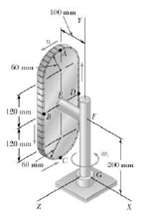
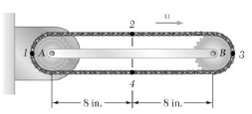
The vertical plate shown is welded to arm EFG, and the entire unit rotates at the constant rate ω1 = 1.6 rad/s about the Y axis. At the same time, a continuous link belt moves around the perimeter of the plate at a constant speed u = 90 mm/s. For the position shown, determine the acceleration of
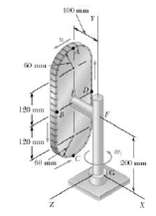
The vertical plate shown is welded to arm EFG, and the entire unit rotates at the constant rate 1 ω = 1.6 rad/s about the Y axis. At the same time, a continuous link belt moves around the perimeter of the plate at a constant speed u = 90 mm/s. For the position shown, determine the acceleration of
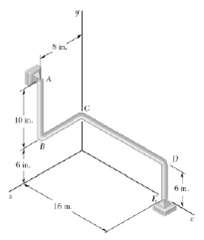
The bent rod ABCDE rotates about a line joining points A and E with a constant angular velocity of 12 rad/s, knowing that the rotation is clockwise as viewed from E, determine the velocity of corner C.
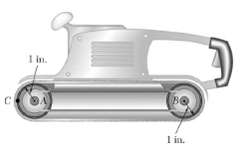
The rated speed of drum B of the belt sander shown is 2400 rpm. When the power is turned off, it is observed that the sander coasts from its rated speed to rest in 10 s. Assuming uniformly decelerated motion, determine the velocity and acceleration of point C of the belt, (a) Immediately before the
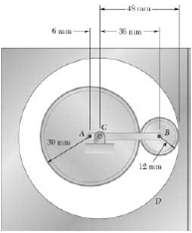
Arm ACB rotates about point C with an angular velocity of 40 rad/s counterclockwise. Two friction disks A and B are pinned at their centers to arm ACB as shown. Knowing that the disks roll without slipping at surfaces of contact, determine the angular velocity of (a) Disk A, (b) Disk B.
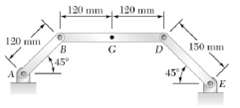
Bar AB is rotating clockwise and, at the instant shown, the magnitude of the velocity of point G is 3.6 m/s. Determine the angular velocity of each of the three bars at that instant.
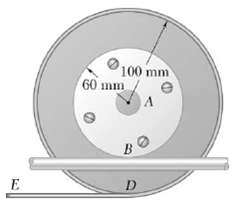
A 60-mm-radius drum is rigidly attached to a 100-mm-radius drum as shown. One of the drums rolls without sliding on the surface shown, and a cord is wound around the other drum. Knowing that end E of the cord is pulled to the left with a velocity of 120 mm/s, determine (a) The angular velocity of
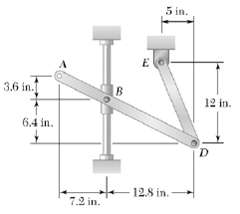
Arm ABD is connected by pins to a collar at B and to crank DE. Knowing that the velocity of collar B is 16 in./s upward, determine (a) The angular velocity of arm ABD, (b) The velocity of point A.
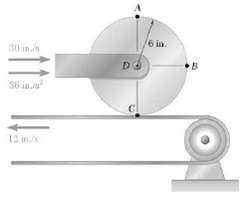
The 6-in.-radius drum rolls without slipping on a belt that moves to the left with a constant velocity of 12 in/s. At an instant when the velocity and acceleration of the center D of the drum are as shown, determine the accelerations of points A, B, and C of the drum.
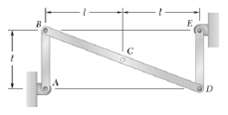
At the instant shown rod AB has a constant angular velocity of 8 rad/s clockwise. Knowing that l = 12 in., determine the acceleration of the midpoint C of member BD.
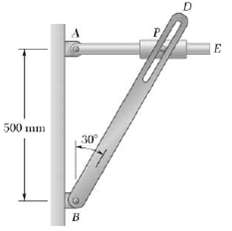
Pin P is attached to the collar shown; the motion of the pin is guided by a slot cut in rod BD and by the collar that slides on rod AE. Knowing that at the instant considered the rods rotate clockwise with ωAE = 8 rad/s and ωBD = 3 rad/s, determine the velocity of pin P.
A chain is looped around two gears of radius 2 in. that can rotate freely with respect to the 16-in. arm AB. The chain moves about arm AB in a clockwise direction at the constant rate of 4 in./s relative to the arm. Knowing that in the position shown arm AB rotates clockwise about A at the constant
Rod AB is connected by ball-and-socket joints to collar A and to the 320-mm-diameter disk C, knowing that disk C rotates counterclockwise at the constant rate ω0 = 3 rad/s in the zx plane, determine the velocity of collar A for the position shown.
The bent rod EBD rotates at the constant rate ω1 = 8 rad/s. Knowing that collar A moves upward along the rod at a constant relative speed u = 600 mm/s and that θ = 60?, determine (a) The velocity of A, (b) The acceleration of A.
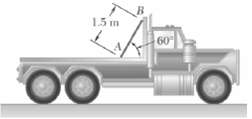
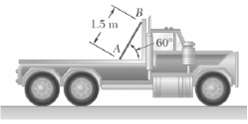
A 30-kg uniform thin panel is placed in a truck with end A resting on a rough horizontal surface and end B supported by a smooth vertical surface. Knowing that the deceleration of the truck is 4 m/s2, determine (a) The reactions at ends A and B, (b) The minimum required coefficient of static
A 30-kg uniform thin panel is placed in a truck with end A resting on a rough horizontal surface and end B supported by a smooth vertical surface. Knowing that the panel remains in the position shown, determine (a) The maximum allowable acceleration of the truck, (b) The corresponding minimum
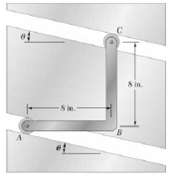
Two identical 0.9-lb slender rods AB and BC are welded together to form an L-shaped assembly. The assembly is guided by two small wheels that roll freely in inclined parallel slots cut in a vertical plate. Knowing that θ = 30?, determine (a) The acceleration of the assembly, (b) The reactions at A
Showing 11300 - 11400
of 18200
First
107
108
109
110
111
112
113
114
115
116
117
118
119
120
121
Last
Step by Step Answers

 Get 50% OFF
Claim Now
Get 50% OFF
Claim Now