New Semester
Started
Get
50% OFF
Study Help!
--h --m --s
Claim Now
Question Answers
Textbooks
Find textbooks, questions and answers
Oops, something went wrong!
Change your search query and then try again
S
Books
FREE
Study Help
Expert Questions
Accounting
General Management
Mathematics
Finance
Organizational Behaviour
Law
Physics
Operating System
Management Leadership
Sociology
Programming
Marketing
Database
Computer Network
Economics
Textbooks Solutions
Accounting
Managerial Accounting
Management Leadership
Cost Accounting
Statistics
Business Law
Corporate Finance
Finance
Economics
Auditing
Tutors
Online Tutors
Find a Tutor
Hire a Tutor
Become a Tutor
AI Tutor
AI Study Planner
NEW
Sell Books
Search
Search
Sign In
Register
study help
engineering
mechanical engineering
Fundamentals of Heat and Mass Transfer 6th Edition Incropera, Dewitt, Bergman, Lavine - Solutions
A truncated solid cone is of circular cross section, and its diameter is related to the axial coordinate by an expression of the form D = ax 3/2, where a = 1.0 m-1/2.The sides are well insulated, while the top surface of the cone at x1 is maintained at T1 and the bottom surface at x2 is maintained
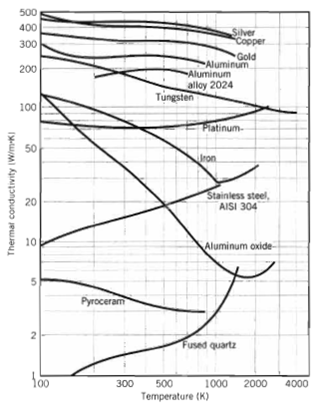
From Figure it is evident that, over a wide temperature range, the temperature dependence of the thermal conductivity of many solids may be approximated by a linear expression of the form k = ko + aT, where ko is a positive constant and a is a coefficient that may be positive or negative. Obtain an
Consider a tube wall of inner and outer radii r; and ro, whose temperatures are maintained at Ti and To, respectively. The thermal conductivity of the cylinder is temperature dependent and may be represented by an expression of the form k = ko< 1 + aT), where ko and a are constants. Obtain an
Measurements show that steady-state conduction through a plane wall without heat generation produced a convex temperature distribution such that the mid- point temperature was 6.To higher than expected for a linear temperature distribution.Assuming that the thermal conductivity has a linear
A device used to measure the surface temperature of an object to within a spatial resolution of approximately 50 nm is shown in the schematic. It consists of an extremely sharp-tipped stylus and an extremely small cantilever that is scanned across the surface. The probe tip is of circular cross
A steam pipe of 0.12-m outside diameter is insulated with a layer of calcium silicate.(a) If the insulation is 20 mm thick and its inner and outer surfaces are maintained at Ts,1 = 800 K and Ts.2 = 490 K, respectively, what is the heat loss per unit length (q') of the pipe?(b) We wish to explore
Consider the water heater described in Problem 1.37. We now wish to determine the energy needed to compensate for heat losses incurred while the water is prescribed temperature of 55°C. The cylindrical storage tank (with flat ends) has a capacity of 100 gallons, and foamed urethane is used to
A thin electrical heater is wrapped around the outer surface of a long cylindrical tube whose inner surface is maintained at a temperature of 5°C. The tube wall has inner and outer radii of 25 and 75 mm, respectively, and a thermal conductivity of 10 W/m. K. The thermal contact resistance between
In the previous problem, the electrical power required to maintain the heater at To = 25°C depends on the thermal conductivity of the wall material k, the thermal contact resistance Rt,c, and the convection coefficient h. Compute and plot the separate effect of changes in k (1 < k < 200 W/m
A stainless steel (AISI 304) tube used to transport a chilled pharmaceutical has an inner diameter of 36 mm and a wall thickness of 2 mm. The pharmaceutical and ambient air are at temperatures of 6°C and 23°C, respectively, while the corresponding inner and outer convection coefficients are 400
Superheated steam at 575°C is routed from a boiler to the turbine of an electric power plant through steel tubes (k = 35 W/m ∙ K) of 300 mm inner diameter and 30 mm wall thickness. To reduce heat loss to the surroundings and to maintain a safe-to-touch outer surface temperature, a layer of
A thin electrical heater is inserted between a long circular rod and a concentric tube with inner and outer radii of 20 and 40 mm. The rod (A) has a thermal conductivity of k A = 0.15 W/m. K, while the tube (B) has a thermal conductivity of k B = 1.5 W/m. K and its outer surface is subjected to
A wire of diameter D = 2 mm and uniform temperature T has an electrical resistance of 0.01 n/m and a current flow of 20 A.(a) What is the rate at which heat is dissipated per unit length of wire? What is the heat dissipation per unit volume within the wire?(b) If the wire is not insulated and is in
A 2-mm-diameter electrical wire is insulated by a 2-mm-thick rubberized sheath (k = 0.13 W/m ∙ K), and the wire/sheath interface is characterized by a thermal contact resistance of R c = 3 X 10⁻⁴ m2 ∙ K/W. The convection heat transfer coefficient at the outer surface of the sheath is 10 W/m2
Electric current flows through a long rod generating thermal energy at a uniform volumetric rate of q = 2 X 10⁶ W/m3. The rod is concentric with a hollow ceramic cylinder, creating an enclosure that is filled with air.The thermal resistance per unit length due to radiation between the enclosure
The evaporator section of a refrigeration unit consists of thin-walled, 10-mm-diarneter tubes through which refrigerant passes at a temperature of - 18°C. Air is cooled as it flows over the tubes, maintaining a surface convection coefficient of 100 W/m2 ∙ K, and is subsequently routed to the
A composite cylindrical wall is composed of two materials of thermal conductivity k A and k B, which are separated by a very thin, electric resistance heater for which interfacial contact resistances are negligible.Liquid pumped through the tube is at a temperature T∞,i and provides a convection
An electrical current of 700 A flows through a stainless steel cable having a diameter of 5 mm and an electrical resistance of 6 X 10⁻⁴ Ω/m (i.e., per meter of cable length). The cable is in an environment having a temperature of 30°C, and the total coefficient associated with convection and
A 0.20-m-diameter, thin-walled steel pipe is used to transport saturated steam at a pressure of 20 bars in a room for which the air temperature is 25°C and the convection heat transfer coefficient at the outer surface of the pipe is 20 W/m2 ∙ K.(a) What is the heat loss per unit length from the
Steam at a temperature of 250°C flows through a steel pipe (AISI 1010) of 60-mm inside diameter and 75-mm outside diameter. The convection coefficient between the steam and the inner surface of the pipe is 500 W/m2 ∙ K, while that between the outer surface of the pipe and the surroundings is 25
We wish to determine the effect of adding a layer of magnesia insulation to the steam pipe of the foregoing problem. The convection coefficient at the outer surface of the insulation may be assumed to remain at 25 W/m2 ∙ K, and the emissivity is ε = 0.8. Determine and plot the heat loss per unit
An uninsulated, thin-walled pipe of 100-mm diameter is used to transport water to equipment that operates outdoors and uses the water as a coolant. During particularly harsh winter conditions, the pipe wall achieves a temperature of -15°C and a cylindrical layer of ice forms on the inner surface
Steam flowing through a long, thin-walled pipe maintains the pipe wall at a uniform temperature of 500 K. The pipe is covered with an insulation blanket comprised of two different materials, A and B.The interface between the two materials may be assumed to have an infinite contact resistance, and
A Bakelite coating is to be used with a 10-mm-diameter conducting rod, whose surface is maintained at 200°C by passage of an electrical current. The rod is in a fluid at 25°C, and the convection coefficient is 140 W/m2 ∙ K. What is the critical radius associated with the coating? What is the
A storage tank consists of a cylindrical section that has a length and inner diameter of L = 2 m and Di = 1 m, respectively, and two hemispherical end sections. The tank is constructed from 20-mm-thick glass (Pyrex) and is exposed to ambient air for which the temperature is 300 K and the convection
Consider the liquid oxygen storage system and the laboratory environmental conditions of Problem 1.49. To reduce oxygen loss due to vaporization, an insulating layer should be applied to the outer surface of the container. Consider using a laminated aluminum foil/glass mat insulation, for which the
In Example 3.5, an expression was derived for the critical insulation radius of an insulated, cylindrical tube. Derive the expression that would be appropriate for an insulated sphere.
A hollow aluminum sphere, with an electrical heater in the center, is used in tests to determine the thermal conductivity of insulating materials. The inner and outer radii of the sphere are 0.15 and 0.18 m, respectively, and testing is done under steady-state conditions with the inner surface of
A spherical tank for storing liquid oxygen on the space shuttle is to be made from stainless steel of 0.80-m outer diameter and 5-mm wall thickness. The boiling point and latent heat of vaporization of liquid oxygen are 90 K and 213 kJ/kg respectively. The tank is to be installed in a large
A spherical cryosurgical probe may be imbedded in diseased tissue for the purpose of freezing, and thereby destroying, the tissue. Consider a probe of 3-mm diameter whose surface is maintained at - 30°C when imbedded in tissue that is at 37°C. A spherical layer of frozen tissue forms around the
A spherical vessel used as a reactor for producing pharmaceuticals has a 10-mm-thick stainless steel wall (k = 17 W/m ∙ K) and an inner diameter of I m. The exterior surface of the vessel is exposed to ambient air (T∞ = 25°C) for which a convection coefficient of 6 W/m2 ∙ K may be
The wall of a spherical tank of 1-m diameter contains an exothermic chemical reaction and is at 200°C when the ambient air temperature is 25°C. What thickness of urethane foam is required to reduce the exterior temperature to 40°C, assuming the convection coefficient is 20 W/m2 ∙ K for both
A composite spherical shell of inner radius r1 = 0.25 m is constructed from lead of outer radius r2 = 0.30 m and AISI 302 stainless steel of outer radius r3 = 0.31 m. The cavity is filled with radioactive wastes that generate heat at a rate of q = 5 X 10⁵ W/m3. It is proposed to submerge the
As an alternative to storing radioactive materials in oceanic waters, it is proposed that the system of Problem 3.62 be placed in a large tank for which the flow of water, and hence the convection coefficient h, can be controlled. Compute and plot the maximum temperature of the lead, T(r1), as a
The energy transferred from the anterior chamber of the eye through the cornea varies considerably depending on whether a contact lens is worn. Treat the eye as a spherical system and assume the system to be at steady state. The convection coefficient ho is unchanged with and without the contact
The outer surface of a hollow sphere of radius r2 is subjected to a uniform heat flux q2. The inner surface at r1 is held at a constant temperature T∞.1.(a) Develop an expression for the temperature distribution T(r) in the sphere wall in terms of q2, Ts.1, r1, r2, and the thermal conductivity of
A spherical shell of inner and outer radii ri and r0, respectively, is filled with a heat-generating material that provides for a uniform volumetric generation rate (W/m3) of q. The outer surface of the shell is exposed to a fluid having a temperature T∞ and a convection coefficient h. Obtain an
A spherical tank of 3-m diameter contains a liquefied petroleum gas at -60°C. Insulation with a thermal conductivity of 0.06 W/m. K and thickness 250 mm is applied to the tank to reduce the heat gain.(a) Determine the radial position in the insulation layer at which the temperature is O°C when
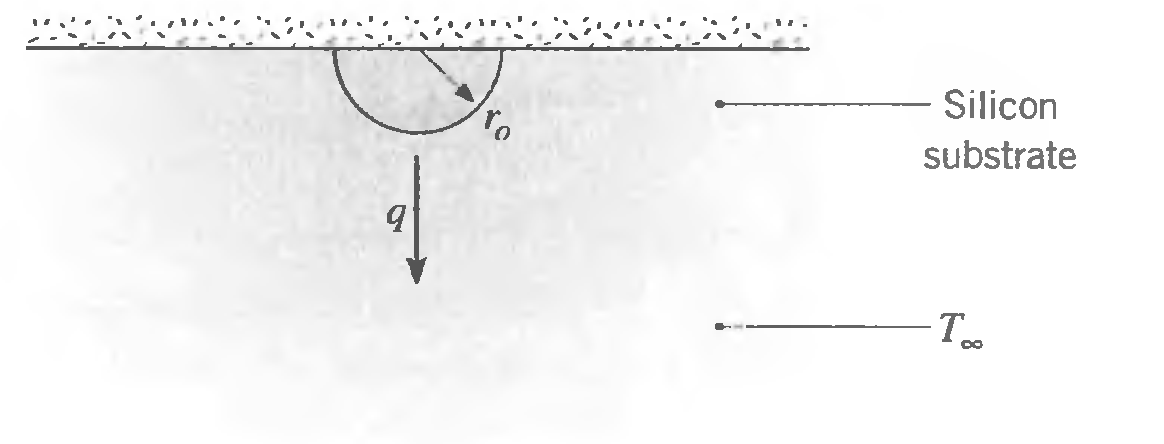
A transistor, which may be approximated as a hemispherical heat source of radius r0 = 0.1 mm. is embedded in a large silicon substrate (k = 125 W/m ∙ K) and dissipates heat at a rate q. All boundaries of the silicon are maintained at an ambient temperature of T∞ = 27°C, except for the top
One modality for destroying malignant tissue involves imbedding a small spherical heat source of radius ro within the tissue and maintaining local temperatures above a critical value Tc for an extended period. Tissue that is well removed from the source may be assumed to remain at normal body
Consider cylindrical and spherical shells with inner and outer surfaces at r1 and r2 maintained at uniform temperatures Ts.1 and Ts.2 respectively. If there is uniform heat generation within the shells, obtain expressions for the steady-state, one-dimensional radial distributions of the
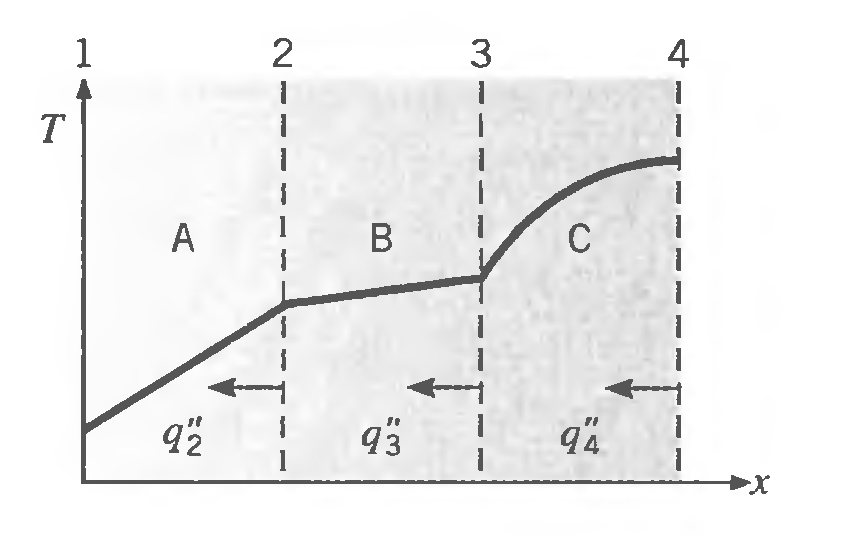
The steady-state temperature distribution in a composite plane wall of three different materials, each of constant thermal conductivity, is shown as follows.(a) Comment on the relative magnitudes of q”2; and q”3 and of q”3 and q”4.(b) Comment on the relative magnitudes of kA and k B
A plane wall of thickness 0.1 m and thermal conductivity 25 W/m ∙ K having uniform volumetric heat generation of 0.3 MW/m3 is insulated on one side, while the other side is exposed to a fluid at 92°C. The convection heat transfer coefficient between the wall and the fluid is 500 W/m2 ∙ K.
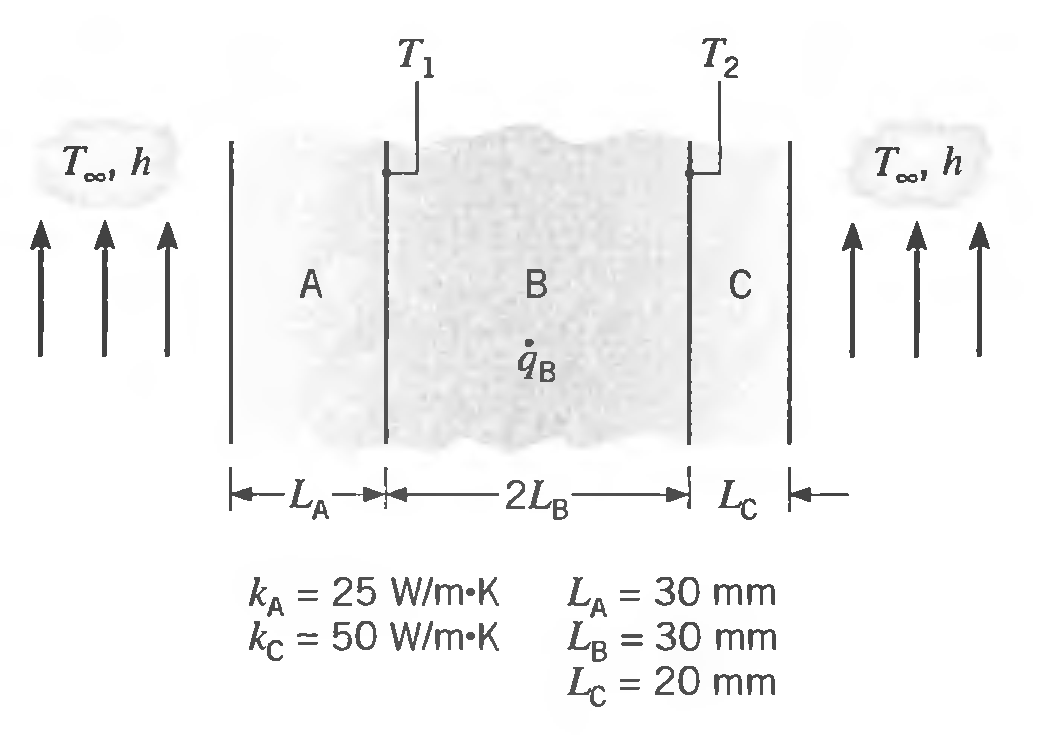
Consider one-dimensional conduction in a plane composite wall. The outer surfaces are exposed to a fluid at 25°C and a convection heat transfer coefficient of 1000 W/m2 ∙ K. The middle wall B experiences uniform heat generation qB, while there is no generation in walls A and C. The temperatures
Consider a plane composite wall that is composed of three materials (materials A, B, and C are arranged left to right) of thermal conductivities kA = 0.24 W/m ∙ K, kB = 0.13 W/m ∙ K, and kC = 0.50 W/m ∙ K. The thicknesses of the three sections of the wall are LA = 20 mm, LB = 13 mm, and LC =
Consider the composite wall of Example 3.7. In the Comments section, temperature distributions in the wall were determined assuming negligible contact resistance between materials A and B. Compute and plot the temperature distributions if the thermal contact resistance is Rt,c = 10-4 m2 ∙ K/W.
A plane wall of thickness 2L and thermal conductivity k experiences a uniform volumetric generation rate q. As shown in the sketch for Case I, the surface at x = - L is perfectly insulated, while the other surface is maintained at a uniform, constant temperature To. For Case 2, a very thin
A nuclear fuel element of thickness 2L is covered with a steel cladding of thickness b. Heat generated within the nuclear fuel at a rate q is removed by a fluid at T∞, which adjoins one surface and is characterized by a convection coefficient h. The other surface is well insulated, and the fuel
Consider the clad fuel element of Problem 3.77.(a) Using appropriate relations from Tables C.1 and C.2, obtain an expression for the temperature distribution T(x) in the fuel element. For kf = 60 W/m ∙ K, L = 15 mm, b = 3 mm, ks = 15 W/m ∙ K, h = 10,000 W/m2 ∙ K, and Tx = 200°C, what are the
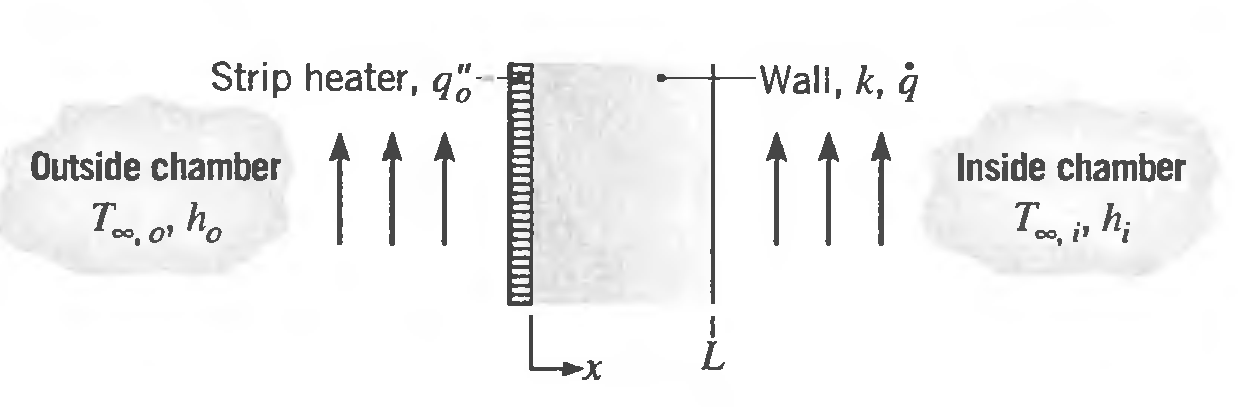
The air inside a chamber at T∞,i = 50°C is heated convectively with h; = 20 W/m2 ∙ K by a 200-mm-thick wall having a thermal conductivity of 4 W/m ∙ K and a uniform heat generation of 1000 W/m3. To prevent any heat generated within the wall from being lost to the outside of the chamber at
In the previous problem, the strip heater acts to guard against heat losses from the wall to the outside, and the required heat flux q”o depends on chamber operating conditions such as q and T∞,i. As a first step in designing a controller for the guard heater, compute and plot q”0 and T(0) as
The exposed surface (x = 0) of a plane wall of thermal conductivity k is subjected to microwave radiation that causes volumetric heating to vary as where q"0(W/m3) is a constant. The boundary at x = L is perfectly insulated, while the exposed surface is maintained at a constant temperature To.
A quartz window of thickness L serves as a viewing port in a furnace used for annealing steel. The inner surface (x = 0) of the window is irradiated with a uniform heat flux q;: due to emission from hot gases in the furnace. A fraction, β, of this radiation may be assumed to be absorbed at the
For the conditions described in Problem 1.44, determine the temperature distribution, T(r), in the container, expressing your result in terms of qo, ro, T∞, h, and the thermal conductivity k of the radioactive wastes.
A cylindrical shell of inner and outer radii, ri and r0, respectively, is filled with a heat-generating material that provides a uniform volumetric generation rate (W/m3) of q. The inner surface is insulated, while the outer surface of the shell is exposed to a fluid at T∞ and a convection
Consider the solid tube of Example 3.8. Using Equation (7) with Equation (10) in the IHT workspace, calculate and plot the temperature distributions for a tube of inner and outer radii, 50 mm and 100 mm, and a thermal conductivity of 5 W/m. K for volumetric generation rates of 1 X 10⁵ ,5 X 105 ,
An air heater may be fabricated by coiling Nichrome wire and passing air in cross flow over the wire. Consider a heater fabricated from wire of diameter D = 1 mm, electrical resistivity Pe = 10-6 Ω ∙ m, thermal conductivity k = 25 W/m ∙ K, and emissivity ε = 0.20. The heater is designed to
The cross section of a long cylindrical fuel element in a nuclear reactor is shown. Energy generation occurs uniformly in the thorium fuel rod, which is of diameter D = 25 mm and is wrapped in a thin aluminum cladding.(a) It is proposed that, under steady-state conditions, the system operates with
A nuclear reactor fuel element consists of a solid cylindrical pin of radius r1 and thermal conductivity kf. The fuel pin is in good contact with a cladding material of outer radius r2 and thermal conductivity kc. Consider steady-state conditions for which uniform heat generation occurs within the
Consider the configuration of Example 3.8, where uniform volumetric heating within a stainless steel tube is induced by an electric current and heat is transferred by convection to air flowing through the tube. The tube wall has inner and outer radii of r1 = 25 mm and r2 = 35 mm, a thermal
A homeowner, whose water pipes have frozen during a period of cold weather, decides to melt the ice by passing an electric current I through the pipe wall. The inner and outer radii of the wall are designated as r1 and r2, and its electrical resistance per unit length is designated as R’e
A high-temperature, gas-cooled nuclear reactor consists of a composite cylindrical wall for which a thorium fuel element (k = 57 W/m ∙ K) is encased in graphite (k ≈ 3 W/m ∙ K) and gaseous helium flows through an annular coolant channel. Consider conditions for which the helium temperature is
A long cylindrical rod of diameter 200 mm with thermal conductivity of 0.5 W/m. K experiences uniform volumetric heat generation of 24,000 W/m3. The rod is encapsulated by a circular sleeve having an outer diameter of 400 mm and a thermal conductivity of 4 W/m ∙ K. The outer surface of the sleeve
A radioactive material of thermal conductivity k is cast as a solid sphere of radius ro and placed in a liquid bath for which the temperature T∞ and convection coefficient h are known. Heat is uniformly generated within the solid at a volumetric rate of q. Obtain the steady-state radial
Radioactive wastes are packed in a thin-walled spherical container. The wastes generate thermal energy non-uniformly according to the relation q = qo[1 – (r/r0)2], where q is the local rate of energy generation per unit volume, qo is a constant, and ro is the radius of the container.
Radioactive wastes (krw = 20 W/m ∙ K) are stored in a spherical, stainless steel (kss, = 15 W/m ∙ K) container of inner and outer radii equal to ri = 0.5 m and ro = 0.6 m. Heat is generated volumetrically within the wastes at a uniform rate of q = 10-5 W/m3 , and the outer surface of the
Unique characteristics of biologically active materials such as fruits, vegetables, and other products require special care in handling. Following harvest and separation from producing plants, glucose is catabolized to produce carbon dioxide, water vapor, and heat, with attendant internal energy
Consider the plane wall, long cylinder, and sphere shown schematically, each with the same characteristic length a. thermal conductivity k, and uniform volumetric energy generation rate q.(a) On the same graph, plot the steady-state dimensionless temperature, [T(x or r) – T(a)]/[(qa2)/2k],
The radiation heat gage shown in the diagram is made from constantan metal foil, which is coated black and is in the form of a circular disk of radius R and thickness t. The gage is located in an evacuated enclosure. The incident radiation flux absorbed by the foil, qi diffuses toward the outer
Copper tubing is joined to the absorber of a flat-plate solar collector as shown.The aluminum alloy (2024- T6) absorber plate is 6 mm thick and well insulated on its bottom. The top surface of the plate is separated from a transparent cover plate by an evacuated space. The tubes are spaced a
Copper tubing is joined to the absorber of a flat-plate solar collector as shown.The aluminum alloy (2024- T6) absorber plate is 6 mm thick and well insulated on its bottom. The top surface of the plate is separated from a transparent cover plate by an evacuated space. The tubes are spaced a
A thin flat plate of length L, thickness t, and width W > L is thermally joined to two large heat sinks that are maintained at a temperature To. The bottom of the plate is well insulated, while the net heat flux to the top surface of the plate is known to have a uniform value of q0.(a) Derive the
Consider the flat plate of Problem 3.101, but with the heat sinks at different temperatures, T(0) = To and T(L) = T L , and with the bottom surface no longer insulated. Convection heat transfer is now allowed to occur between this surface and a fluid at Toc, with a convection coefficient h.(a)
A bonding operation utilizes a laser to provide a constant heat flux, q"0, across the top surface of a thin adhesive-backed, plastic film to be affixed to a metal strip as shown in the sketch. The metal strip has a thickness d = 1.25 mm and its width is large relative to that of the film. The
A thin metallic wire of thermal conductivity k, diameter D, and length 2L is annealed by passing an electrical current through the wire to induce a uniform volumetric heat generation q. The ambient air around the wire is at a temperature T∞, while the ends of the wire at x = ±L are also
A motor draws electric power Pelec from a supply line and delivers mechanical power Pmech to a pump through a rotating copper shaft of thermal conductivity ks, length L, and diameter D. The motor is mounted on a square pad of width W, thickness t, and thermal conductivity kp. The surface of the
Consider the fuel cell stack of Problem 1.58. The t = 0.42 rum thick membranes have a nominal thermal conductivity of k = 0.79 W/m ∙ K that can be increased to keff,x = 15.1 W/m ∙ K by loading 10%, by volume, carbon nanotubes into the catalyst layers (see Problem 3.12). The membrane experiences
The thermocouple (TC) installation on a snowmobile engine cylinder head is shown in the schematic. The TC wire leads are attached to the upper and lower surfaces of the cylindrically shaped solder bead. The base of the bead is attached to the cylinder head operating at 385°C, and there is a
Consider a rod of diameter D, thermal conductivity k, and length 2L that is perfectly insulated over one portion of its length, - L
A probe of overall length L = 200 mm and diameter D = 12.5 mm is inserted through a duct wall such that a portion of its length, referred to as the immersion length L i , is in contact with the water stream whose temperature, T∞,i , is to be determined. The convection coefficients over the
A rod of diameter D = 25 mm and thermal conductivity k = 60 W/m. K protrudes normally from a furnace wall that is at Tw = 200°C and is covered by insulation of thickness L ins = 200 mm. The rod is welded to the furnace wall and is used as a hanger for supporting instrumentation cables. To avoid
A metal rod of length 2L, diameter D, and thermal conductivity k is inserted into a perfectly insulating wall, exposing one-half of its length to an air stream that is of temperature T∞ and provides a convection coefficient h at the surface of the rod. An electromagnetic field induces volumetric
A very long rod of 5-mm diameter and uniform thermal conductivity k = 25 W/m. K is subjected to a heat treatment process. The center, 30-mm-Iong portion of the rod within the induction heating coil experiences uniform volumetric heat generation of7.5 X 106 W/m3.The unheated portions 0f e rod, which
From Problem 1.71 consider the wire leads connecting the transistor to the circuit board. The leads are of thermal conductivity k, thickness t. width w, and length L. One end of a lead is maintained at a temperature Tc corresponding to the transistor case, while the other end assumes the
A disk-shaped electronic device of thickness Ld, diameter D, and thermal conductivity kd dissipates electrical power at a steady rate Pe along one of its surfaces. The device is bonded to a cooled base at Tv using a thermal pad of thickness Lp and thermal conductivity kp. A long fin of diameter D
Turbine blades mounted to a rotating disc in a gas turbine engine are exposed to a gas stream that is at T∞ = 1200°C and maintains a convection coefficient of h = 250 W/m2 ∙ K over the blade.The blades, which are fabricated from Inconel, k = 20 W/m ∙ K, have a length of L = 50 mm. The
In a test to determine the friction coefficient, μ, associated with a disk brake, one disk and its shaft are rotated at a constant angular velocity w, while an equivalent disk/shaft assembly is stationary. Each disk has an outer radius of r2 = 180 mm, a shaft radius of r1 = 20 mm, a thickness of t
Consider an extended surface of rectangular cross section with heat flow in the longitudinal direction.In this problem we seek to determine conditions for which the transverse (y-direction) temperature difference within the extended surface is negligible compared to the temperature difference
A long, circular aluminum rod is attached at one end to a heated wall and transfers heat by convection to a cold fluid.(a) If the diameter of the rod is tripled, by how much would the rate of heat removal change?(b) If a copper rod of the same diameter is used in place of the aluminum, by how much
A brass rod 100 mm long and 5 mm in diameter extends horizontally from a casting at 200°e. The rod is in an air environment with T∞ = 20°C and h = 30 W/m2 ∙ K. What is the temperature of the rod 25, 50, and 100 mm from the casting?
The extent 10 which the tip condition affects the thermal performance of a fin depends on the fin geometry and thermal conductivity, as well as the convection coefficient. Consider an alloyed aluminum (k = 180 W/m ∙ K) rectangular fin of length L = 10 mm, thickness t = 1 mm, and width w t. The
The extent to which the tip condition affects the thermal performance of a fin depends on the fin geometry and thermal conductivity, as well as the convection coefficient. Consider an alloyed aluminum (k = 180 W/m ∙ K) rectangular fin whose base temperature is Tb = 100°C. The fin is exposed to a
A straight fin fabricated from 2024 aluminum alloy (k = 185 W/m ∙ K) has a base thickness of t = 3 mm and a length of L = 15 mm. Its base temperature is Tb = 100°C, and it is exposed to a fluid for which T∞ = 20°C and h = 50 W/m2 ∙ K. For the foregoing conditions and a fin of unit width,
Two long copper rods of diameter D = 10 mm are soldered together end to end, with solder having a melting point of 650°e. The rods are in air at 25°C with a convection coefficient of l0W/m2 ∙ K. What is the minimum power input needed to effect the soldering?
Circular copper rod of diameter D = 1 mm and length L = 25 mm are used to enhance heat transfer from a surface that is maintained at Ts.1 = 100°C. One end of the rod is attached to this surface (at x = 0), while the other end (x = 25 mm) is joined to a second surface, which is maintained at Ts.2 =
During the initial stages of the growth of the nanowire of Problem 3.109, a slight perturbation of the liquid catalyst droplet can cause it to be suspended on the top of the nanowire in an off-center position. The resulting non-uniform deposition of solid at the solid-liquid interface can be
Consider two long slender rods of the same diameter but different materials. One end of each rod is attached to a base surface maintained at 100°C, while the surfaces of the rods are exposed to ambient air at 20°C. By traversing the length of each rod with a thermocouple, it was observed that the
A 40-mm-Iong, 2-mm-diameter pin fin is fabricated of an aluminum alloy (k = 140 W/m2 ∙ K).(a) Determine the fin heat transfer rate for Th = 50°C, T∞. = 25°C, h = 1000 W/m2 ∙ K. and an adiabatic tip condition.(b) An engineer suggests that by holding the fin tip at a low temperature, the fin
An experimental arrangement for measuring the thermal conductivity of solid materials involves the use of two long rods that are equivalent in every respect, except that one is fabricated from a standard material of known thermal conductivity k A while the other is fabricated from the material
Finned passages are frequently formed between parallel plates to enhance convection heat transfer in compact heat exchanger cores. An important application is in electronic equipment cooling, where one or more air-cooled stacks are placed between heat-dissipating electrical components. Consider a
Showing 8300 - 8400
of 18200
First
77
78
79
80
81
82
83
84
85
86
87
88
89
90
91
Last
Step by Step Answers

 Get 50% OFF
Claim Now
Get 50% OFF
Claim Now


.PNG)
.PNG)
.PNG)
.PNG)
.PNG)
.PNG)
.PNG)
.PNG)
.PNG)
.PNG)
.PNG)
.PNG)
.PNG)
.PNG)
.PNG)
.PNG)
.PNG)
.PNG)
.PNG)
.PNG)
.PNG)
.PNG)
.PNG)
.PNG)
.PNG)
.PNG)
.PNG)
.PNG)
.PNG)
.PNG)
.PNG)
.PNG)


