New Semester
Started
Get
50% OFF
Study Help!
--h --m --s
Claim Now
Question Answers
Textbooks
Find textbooks, questions and answers
Oops, something went wrong!
Change your search query and then try again
S
Books
FREE
Study Help
Expert Questions
Accounting
General Management
Mathematics
Finance
Organizational Behaviour
Law
Physics
Operating System
Management Leadership
Sociology
Programming
Marketing
Database
Computer Network
Economics
Textbooks Solutions
Accounting
Managerial Accounting
Management Leadership
Cost Accounting
Statistics
Business Law
Corporate Finance
Finance
Economics
Auditing
Tutors
Online Tutors
Find a Tutor
Hire a Tutor
Become a Tutor
AI Tutor
AI Study Planner
NEW
Sell Books
Search
Search
Sign In
Register
study help
engineering
mechanical engineering
Fundamentals of Heat and Mass Transfer 6th Edition Incropera, Dewitt, Bergman, Lavine - Solutions
Most of the energy we consume as food is converted to thermal energy in the process of performing all our bodily functions and is ultimately lost as heat from our bodies. Consider a person who consumes 2100 kcal per day (note that what are commonly referred to as food calories are actually
Single fuel cells such as the one of Example 1.4 can be scaled up by arranging them into a fuel cell stack. A stack consists of multiple electrolytic membranes that are sandwiched between electrically conducting bipolar plates. Air and hydrogen are fed to each membrane through flow channels within
Consider Problem 1.1.(a) If the exposed cold surface of the insulation is at T2 = 20°C, what is the value of the convection heat transfer coefficient on the cold side of the insulation if the surroundings temperature is Tsur = 320 K, the ambient temperature is T∞ = 5°C, and the emissivity is B
The wall of an oven used to cure plastic parts is of thickness L = 0.05 m and is exposed to large surroundings and air at its outer surface. The air and the surroundings are at 300 K.(a) If the temperature of the outer surface is 400 K and its convection coefficient and emissivity are h = 20 W/m2
An experiment to determine the convection coefficient associated with airflow over the surface of a thick stainless steel casting involves insertion of thermocouples in the casting at distances of 10 and 20 mm from the surface along a hypothetical line normal to the surface. The steel has a thermal
A thin electrical heating element provides a uniform heat flux q;' to the outer surface of a duct through which air flows. The duct wall has a thickness of 10 mm and a thermal conductivity of 20 W/m . K.(a) At a particular location, the air temperature is 30°C and the convection heat transfer
A rectangular forced air heating duct is suspended from the ceiling of a basement whose air and walls are at a temperature of Too = Tsur = 5°C. The duct is 15 m long, and its cross-section is 350 mm x 200 mm.(a) For an uninsulated duct whose average surface temperature is 50°C, estimate the rate
Consider the steam pipe of Example 1.2. The facilities manager wants you to recommend methods for reducing the heat loss to the room, and two options are proposed. The first option would restrict air movement around the outer surface of the pipe and thereby reduce the convection coefficient by a
During its manufacture, plate glass at 600°C is cooled by passing air over its surface such that the convection heat transfer coefficient is h = 5 W/m2 ∙ K. To prevent cracking, it is known that the temperature gradient must not exceed 15°C/mm at any point in the glass during the cooling
The curing process of Example 1.7 involves exposure of the plate to irradiation from an infrared lamp and attendant cooling by convection and radiation exchange with the surroundings. Alternatively, in lieu of the lamp, heating may be achieved by inserting the plate in an oven whose walls (the
The electrical-substitution radiometer shown schematically determines the optical (radiant) power of a beam by measuring the electrical power required to heat the receiver to the same temperature. With a beam, such as a laser of optical power P opt, incident on the receiver, its temperature, Ts,
The diameter and surface emissivity of an electrically heated plate are D = 300 mm and B = 0.80, respectively.(a) Estimate the power needed to maintain a surface temperature of 200°C in a room for which the air and the walls are at 25°C. The coefficient characterizing heat transfer by natural
Bus bars proposed for use in a power transmission station have a rectangular cross section of height H = 600 mm and width W = 200 mm. The electrical resistivity, ρc<μΩ ∙ m), of the bar material is a function of temperature, ρc = ρc,o [1 + α(T - To)], where ρc,o = 0.0828 μΩ ∙ m, To
A solar flux of 700 W/m2 is incident on a flat-plate solar collector used to heat water. The area of the collector is 3 m2, and 90% of the solar radiation passes through the cover glass and is absorbed by the absorber plate. The remaining 10% is reflected away from the collector. Water flows
Consider a surface-mount type transistor on a circuit board whose temperature is maintained at 35°C. Air at 20°C flows over the upper surface of dimensions 4 mm by 8 mm with a convection coefficient of 50 W/m2 ∙ K, Three wire leads, each of cross section 1 mm by 0.25 mm and length 4 mm, conduct
In analyzing the performance of a thermal system, the engineer must be able to identify the relevant heat transfer processes. Only then can the system behavior be properly quantified. For the following systems identify the pertinent processes, designating them by appropriately labeled arrows on a
In considering the following problems involving heat transfer in the natural environment (outdoors), recognize that solar radiation is comprised of long and short wavelength components. If this radiation is incident on a semitransparent medium, such as water or glass, two things will happen to the
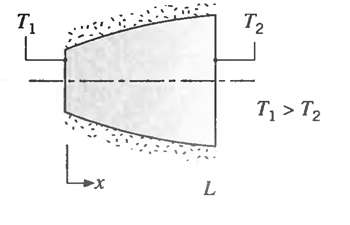
Assume steady-state, one-dimensional heat conduction through the ax-symmetric shape shown below. Assuming constant properties and no internal heat generation, sketch the temperature distribution on T-x coordinates. Briefly explain the shape of your curve.
A hot water pipe with outside radius r1 has a temperature T1. A thick insulation applied to reduce the heat loss has an outer radius r2 and temperature T2. On T-r coordinates, sketch the temperature distribution in the insulation for one-dimensional, steady-state heat transfer with constant
A spherical shell with inner radius r1 and outer radius r2 has surface temperatures T1 and T2, respectively, where T1 > T2. Sketch the temperature distribution on T-r coordinates assuming steady-state, one-dimensional conduction with constant properties. Briefly justify the shape of your curve.
Assume steady-state, one-dimensional heat conduction through the symmetric shape shown.Assuming that there is no internal heat generation, derive an expression for the thermal conductivity k(x) for these conditions: A(x) = (1 - x), T(x) = 300(1 - 2x – x3), and q = 6000 W, where A is in
A solid, truncated cone serves as a support for a system that maintains the top (truncated) face of the cone at a temperature T" while the base of the cone is at a temperature T2 < T1.The thermal conductivity of the solid depends on temperature according to the relation k = ko - aT, where a is a
To determine the effect of the temperature dependence of the thermal conductivity on the temperature distribution in a solid, consider a material for which this dependence may be represented as k = ko + aT where ko is a positive constant and a is a coefficient that may be positive or negative.
A young engineer is asked to design a thermal protection barrier for a sensitive electronic device that might be exposed to irradiation from a high-powered infrared laser. Having learned as a student that a low thermal conductivity material provides good insulating characteristics, the engineer
Consider steady-state conditions for one-dimensional conduction in a plane wall having a thermal conductivity k = 50 W/m ∙ K and a thickness L = 0.25 m, with no internal heat generation. Determine the heat flux and the unknown quantity for each case and sketch the temperature distribution.
Consider a plane wall 100 mm thick and of thermal conductivity 100 W/m ∙ K. Steady-state conditions are known to exist with T1 = 400 K and T2 = 600 K. Determine the heat flux q; and the temperature gradient dT/dx for the coordinate systems shown.
A cylinder of radius ro, length L, and thermal conductivity k is immersed in a fluid of convection coefficient hand unknown temperature T∞. At a certain instant the temperature distribution in the cylinder is T(r) = a + br2, where a and b are constants. Obtain expressions for the heat transfer
In the two-dimensional body illustrated, the gradient at surface A is found to be ∂T/∂y = 30 K/m. What are ∂T/∂y and ∂T/∂x at surface B?
Sections of the trans-Alaska pipeline run above the ground and are supported by vertical steel shafts (k = 25 W/m ∙ K) that are 1 m long and have a cross-sectional area of 0.005 m2. Under normal operating conditions, the temperature variation along the length of a shaft is known to be governed by
Steady-state, one-dimensional conduction occurs in a rod of constant thermal conductivity k and variable cross-sectional area As(x) = Aoe ax, where Ao and a are constants. The lateral surface of the rod is well insulated.(a) Write an expression for the conduction heat rate, qx(x). Use this
Consider a 300 mm x 300 mm window in an aircraft. For a temperature difference of 80°C from the inner to the outer surface of the window, calculate the heat loss through L = 10-mm-thick polycarbonate, soda lime glass, and aero-gel windows, respectively. The thermal conductivities of the aero-gel
Gold is commonly used in semiconductor packaging to form interconnections (also known as interconnects) that carry electrical signals between different devices in the package. In addition to being a good electrical conductor, gold interconnects are also effective at protecting the heat-generating
A TV advertisement by a well-known insulation manufacturer states: it isn't the thickness of the insulating material that counts, it's the R-value. The ad shows that to obtain an R-value of 19, you need 18 ft of rock, 15 in. of wood, or just 6 in. of the manufacturer's insulation. Is this
An apparatus for measuring thermal conductivity employs an electrical heater sandwiched between two identical samples of diameter 30 mm and length 60 mm, which are pressed between plates maintained at a uniform temperature To = 77°C by a circulating fluid. A conducting grease is placed between all
An engineer desires to measure the thermal conductivity of an aero-gel material. It is expected that the aero-gel will have an extremely small thermal conductivity.(a) Explain why the apparatus of Problem 2.17 cannot be used to obtain an accurate measurement of the aero-gel's thermal
A method for determining the thermal conductivity k and the specific heat c p of a material is illustrated in the sketch. Initially the two identical samples of diameter D = 60 mm and thickness L = 10 mm and the thin heater are at a uniform temperature of Ti = 23.00°C, while surrounded by an
At a given instant of time the temperature distribution within an infinite homogeneous body is given by the function T(x, y, z) = x2 – 2y2 + z2 – xy + 2yz Assuming constant properties and no internal heat generation, determine the regions where the temperature changes with time.
A pan is used to boil water by placing it on a stove, from which heat is transferred at a fixed rate qo. There are two stages to the process. In Stage I, the water is taken from its initial (room) temperature T; to the boiling point, as heat is transferred from the pan by natural convection. During
Uniform internal heat generation at q = 5 X 10⁷ W/m3 is occurring in a cylindrical nuclear reactor fuel rod of 50-mm diameter, and under steady-state conditions the temperature distribution is of the form T(r) = a + br2, where T is in degrees Celsius and r is in meters, while a = 800°C and b =
The steady-state temperature distribution in a one-dimensional wall of thermal conductivity 50 W/m ∙ K and thickness 50 mm is observed to be T(oC) = a + bx2, where a = 200°C, b = - 2000°C/m2 , and x is in meters.(a) What is the heat generation rate q in the wall?(b) Determine the heat fluxes at
The temperature distribution across a wall 0.3 m thick at a certain instant of time is T(x) = a + bx + cx2, where T is in degrees Celsius and x is in meters, a = 200°C, b = -200°C/m, and c = 30°C/m 2. The wall has a thermal conductivity of 1 W/m ∙ K.(a) On a unit surface area basis, determine
A plane wall of thickness 2L = 40 mm and thermal conductivity k = 5 W/m ∙ K experiences uniform volumetric heat generation at a rate q, while convection heat transfer occurs at both of its surfaces (x = - L, + L), each of which is exposed to a fluid of temperature T∞ = 20°C. Under steady-state
One-dimensional, steady-state conduction with uniform internal energy generation occurs in a plane wall with a thickness of 50 mm and a constant thermal conductivity of 5 W/m ∙ K. For these conditions, the temperature distribution has the form, T(x) = a + bx + cx2. The surface at x = 0 has a
A salt-gradient solar pond is a shallow body of water that consists of three distinct fluid layers and is used to collect solar energy. The upper- and lower-most layers are well mixed and serve to maintain the upper and lower surfaces of the central layer at uniform temperatures TI and T2 , where
The steady-state temperature distribution in a semitransparent material of thermal conductivity k and thickness L exposed to laser irradiation is of the formWhere A, a, B, and C are known constants. For this situation, radiation absorption in the material is manifested by a distributed heat
The steady-state temperature distribution in a one-dimensional wall of thermal conductivity k and thickness L is of the form T = ax3 + bx2 + ex + d. Derive expressions for the heat generation rate per unit volume in the wall and the heat fluxes at the two wall faces (x = 0, L).
One-dimensional steady-state conduction with no internal energy generation is occurring in a plane wall of constant thermal conductivity.(a) Is the prescribed temperature distribution possible? Briefly explain your reasoning.(b) With the temperature at x = 0 and the fluid temperature fixed at T (0)
A plane layer of coal of thickness L = 1 m experiences uniform volumetric generation at a rate of q = 20 W/m3 due to slow oxidation of the coal particles. Averaged over a daily period, the top surface of the layer transfers heat by convection to ambient air for which h = 5 W/m2 ∙ K and T∞ =
The cylindrical system illustrated has negligible variation of temperature in the rand z directions. Assume that ∆r = ro - ri is small compared to r; and denote the length in the z direction, normal to the page, as L.(a) Beginning with a properly defined control volume and considering energy
Beginning with a differential control volume in the form of a cylindrical shell, derive the heat diffusion equation for a one-dimensional, cylindrical, radial coordinate system with internal heat generation. Compare your result with Equation 2.24,
Beginning with a differential control volume in the form of a spherical shell, derive the heat diffusion equation for a one-dimensional, spherical, radial coordinate system with internal heat generation. Compare your result with Equation 2.27.
Derive the heat diffusion equation, Equation 2.24, for cylindrical coordinates beginning with the differential control volume shown in Figure 2.12.
Derive the heat diffusion equation, Equation 2.27, for spherical coordinates beginning with the differential control volume shown in Figure 2.13.
A steam pipe is wrapped with insulation of inner and outer radii, ri and ro, respectively. At a particular instant the temperature distribution in the insulation is known to be of the formAre conditions steady-state or transient? How do the heat flux and heat rate vary with radius?
For a long circular tube of inner and outer radii r1 and r2, respectively, uniform temperatures T1 and T2 are maintained at the inner and outer surfaces, while thermal energy generation is occurring within the tube wall (r1 < r < r2). Consider steady-state conditions for which T1. > T2. Is
Passage of an electric current through a long conducting rod of radius r j and thermal conductivity k results ri uniform volumetric heating at a rate of q. The conducting rod is wrapped in an electrically non-conducting cladding material of outer radius ro and thermal conductivity kc, and
Two-dimensional, steady-state conduction occurs in a hollow cylindrical solid of thermal conductivity k = 16 W/m ∙ K, outer radius ro = 1 m, and overall length 2zo = 5 m, where the origin of the coordinate system is located at the midpoint of the centerline. The inner surface of the cylinder is
An electric cable of radius rl and thermal conductivity ke is enclosed by an insulating sleeve whose outer surface is of radius r2 and experiences convection heat transfer and radiation exchange with the adjoining air and large surroundings, respectively. When electric current passes through the
A spherical shell of inner and outer radii ri and ro, respectively, contains heat-dissipating components, and at a particular instant the temperature distribution in the shell is known to be of the form T(r) = C1/r + C2. Are conditions steady-state or transient? How do the heat flux and heat rate
A chemically reacting mixture is stored in a thin-walled spherical container of radius r l = 200 mm, and the exothermic reaction generates heat at a uniform, but temperature-dependent volumetric rate of q = qo exp (– A/To), where qo = 5000 W/m3, A = 75 K, and To is the mixture temperature in
The one-dimensional system of mass M with constant properties and no internal heat generation shown in the figure is initially at a uniform temperature Ti. The electrical heater is suddenly energized providing a uniform heat flux q0 at the surface x = O. The boundaries at x = L and elsewhere are
A large plate of thickness 2L is at a uniform temperature of T; = 200°C, when it is suddenly quenched by dipping it in a liquid bath of temperature T∞ = 20°C. Heat transfer to the liquid is characterized by the convection coefficient h.(a) If x = 0 corresponds to the mid plane of the wall, on T
The plane wall with constant properties and no internal heat generation shown in the figure is initially at a uniform temperature Ti Suddenly the surface at x = L is heated by a fluid at T∞ having a convection heat transfer coefficient h. The boundary at x = 0 is perfectly insulated.(a) Write the
A plane wall has constant properties, no internal heat generation, and is initially at a uniform temperature Ti. Suddenly, the surface at x = L is heated by a fluid at T∞ having a convection coefficient h. At the same instant, the electrical heater is energized, providing a constant heat flux qx
A plane wall with constant properties is initially at a uniform temperature To. Suddenly, the surface at x = L is exposed to a convection process with a fluid at T∞ (> To) having a convection coefficient h. Also, suddenly the wall experiences a uniform internal volumetric heating q that is
Consider the conditions associated with Problem 2.48, but now with a convection process for which Too < To.(a) On T - x coordinates, sketch the temperature distributions for the following conditions: initial condition (t < 5 0), steady-state condition (t → ∞), and for two intermediate
A spherical particle of radius r1 experiences uniform thermal generation at a rate of q. The particle is encapsulated by a spherical shell of outside radius r2 that is cooled by ambient air. The thermal conductivities of the particle and shell are k1 and k2, respectively, where k1 = 2k2.(a) By
A plane wall of thickness L = 0.1 m experiences uniform volumetric heating at a rate q. One surface of the wall (x = 0) is insulated, while the other surface is exposed to a fluid at Too = 20°C, with convection heat transfer characterized by h = 1000 W/m2 ∙ K. Initially, the temperature
A plane wall that is insulated on one side (x = 0) is initially at a uniform temperature Ti, when its exposed surface at x = L is suddenly raised to a temperature Ts'(a) Verify that the following equation satisfies the heat equation and boundary conditions: where C) is a constant and a is the
A thin electrical heater dissipating 4000 W/m2 is sandwiched between two 25-mm-thick plates whose exposed surfaces experience convection with a fluid for which Too = 20°C and h = 400 W/m 2 . K. The thermo-physical properties of the plate material are p = 2500 kg/m3, C = 700J/kg ∙ K, and k = 5
Typically, air is heated in a hair dryer by blowing it across a coiled wire through which an electric current is passed. Thermal energy is generated by electric resistance heating within the wire and is transferred by convection from the surface of the wire to the air. Consider conditions for which
Consider the plane wall of Figure 3.1, separating hot and cold fluids at temperatures T∞,1 and T∞,2 ' respectively. Using surface energy balances as boundary conditions at x = 0 and x = L (see Equation 2.32), obtain the temperature distribution within the wall and the heat flux in terms of
The rear window of an automobile is defogged by passing warm air over its inner surface.(a) If the warm air is at T∞,i = 40°C and the corresponding convection coefficient is hi = 30 W/m2 ∙ K, what are the inner and outer surface temperatures of 4-mm-thick window glass, if the outside ambient
The rear window of an automobile is defogged by attaching a thin, transparent, film-type heating element to its inner surface. By electrically heating this element, a uniform heat flux may be established at the inner surface.(a) For 4-mm-thick window glass, determine the electrical power required
In a manufacturing process, a transparent film is being bonded to a substrate as shown in the sketch. To cure the bond at a temperature To, a radiant source is used to provide a heat flux qo (W/m2), all of which is absorbed at the bonded surface. The back of the substrate is maintained at T1 while
The walls of a refrigerator are typically constructed by sandwiching a layer of insulation between sheet metal panels. Consider a wall made from fiberglass insulation of thermal conductivity k; = 0.046 W/m ∙ K and thickness Lp = 50 mm and steel panels, each of thermal conductivity kp = 60 W/m ∙
A technique for measuring convection heat transfer coefficients involves bonding one surface of a thin metallic foil to an insulating material and exposing the other surface to the fluid flow conditions of interest.By passing an electric current through the foil, heat is dissipated uniformly within
The wind chill, which is experienced on a cold, windy day, is related to increased heat transfer from exposed human skin to the surrounding atmosphere. Consider a layer of fatty tissue that is 3 mm thick and whose interior surface is maintained at a temperature of 36°C. On a calm day the
A thermo pane window consists of two pieces of glass 7 mm thick that enclose an air space 7 mm thick. The window separates room air at 20°C from outside ambient air at - 10°C. The convection coefficient associated with the inner (room-side) surface is 10 W/m2 ∙ K.(a) If the convection
The composite wall of an oven consists of three materials, two of which are of known thermal conductivity, k A = 20 W/m ∙ K and kc = 50 W/m ∙ K, and known thickness, LA = 0.30 m and Lc = 0.15 m. The third material, B, which is sandwiched between materials A and C, is of known thickness. LB =
A testing lab is contracted to measure the thermal conductivity of various liquids as a function of the liquid temperature. Typically, the lab would measure the thermal conductivity and its temperature dependence by performing many time-consuming experiments at various operating temperatures. A new
The wall of a drying oven is constructed by sandwiching an insulation material of thermal conductivity k = 0.05 W/m ∙ K between thin metal sheets. The oven air is at T∞,i = 300°C, and the corresponding convection coefficient is hi = 30 W/m2 ∙ K. The inner wall surface absorbs a radiant flux
The electrolytic membrane of the fuel cell in Example 1.4 is a thin composite structure consisting of sandwiched layers of delicate materials, as shown in the sketch. The thickness of the polymer core is tpc = 0.20 mm, while the thickness of each of the catalyst layers is tel = 0.01 mm. The gas
A house has a composite wall of wood, fiberglass insulation, and plaster board, as indicated in the sketch. On a cold winter day the convection heat transfer coefficients are ho = 60 W/m'2. K and hi = 30 W/m2 ∙ K. The total wall surface area is 350 m2.(a) Determine a symbolic expression for the
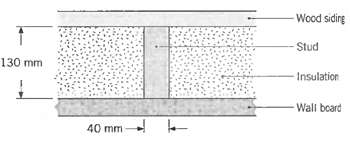
Consider a composite wall that includes an 8-mm-thick hardwood siding. 40-mm by 130-mm hardwood studs on 0.65-m centers with glass fiber insulation (paper faced, 28 kg/m3) and a 12-mm layer of gypsum (vermiculite) wall board. What is the thermal resistance associated with a wall that is 2.5 m high
The thermal characteristics of a small, dormitory refrigerator are determined by performing two separate experiments, each with the door closed and the refrigerator placed in ambient air at T∞ = 25°C. In one case, an electric heater is suspended in the refrigerator cavity, while the refrigerator
In the design of buildings, energy conservation requirements dictate that the exterior surface area, A" be minimized. This requirement implies that, for a desired floor space, there may be optimum values associated with the number of floors and horizontal dimensions of the building. Consider a
When raised to very high temperatures, many conventional liquid fuels dissociate into hydrogen and other components. Thus the advantage of a solid oxide fuel cell is that such a device can internally reform readily available liquid fuels into hydrogen that can then be used to produce electrical
A firefighter's protective clothing, referred to as a turnout coat, is typically constructed as an ensemble of three layers separated by air gaps, as shown schematically.Representative dimensions and thermal conductivities for the layers are as follows.Layer
A composite wall separates combustion gases at 2600°C from a liquid coolant at 100°C, with gas- and liquid-side convection coefficients of 50 and 1000 W/m2 ∙ K. The wall is composed of a 10-mm-thick layer of beryllium oxide on the gas side and a 20-mm-thick slab of stainless steel (AISI 304) on
Two stainless steel plates 10 mm thick are subjected to a contact pressure of I bar under vacuum conditions for which there is an overall temperature drop of 100°C across the plates. What is the heat flux through the plates? What is the temperature drop across the contact plane?
Consider a plane composite wall that is composed of two materials of thermal conductivities kA = 0.1 W/m ∙ K and kB = 0.04 W/m ∙ K and thicknesses LA = 10 mm and LB = 20 mm. The contact resistance at the interface between the two materials is known to be 0.30 m2 ∙ K/W. Material A adjoins a
Consider the composite wall of Problem 3.13 under conditions for which the inside air is still characterized by T ∞.i = 20°C and hi = 30 W/m2 ∙ K. However, use the more realistic conditions for which the outside air is characterized by a diurnal (time) varying temperature of the formwith ho =
The performance of gas turbine engines may be improved by increasing the tolerance of the turbine blades to hot gases emerging from the combustor. One approach to achieving high operating temperatures involves application of a thermal barrier coating (TBC) to the exterior surface of a blade, while
A commercial grade cubical freezer, 3 m on a side, has a composite wall consisting of an exterior sheet of 6.35-mm-thick plain carbon steel, an intermediate layer of 100-mm-thick cork insulation, and an inner sheet of 6.35-mm-thick aluminum alloy (2024). Adhesive inter- faces between the insulation
Physicists have determined the theoretical value of the thermal conductivity of a carbon nanotubes to be k∞.r = 5000W/m ∙ K.(a) Assuming the actual thermal conductivity of the carbon nanotubes is the same as its theoretical value, find the thermal contact resistance, R,.", that exists between
In a particular application it is desirable to minimize the effects of the thermal contact resistance between two plane mating surfaces as shown in part(a) Of the schematic. An engineer suggests that the overall resistance to heat transfer can be reduced by cutting relatively deep linear grooves in
Approximately 10 6 discrete electrical components can be placed on a single integrated circuit (chip), with electrical heat dissipation as high as 30,000 W/m2 ∙ the chip, which is very thin. is exposed to a dielectric liquid at its outer surface with ho = 1000 W/m2 ∙ K and T∞.o = 20°C,
Consider a power transistor encapsulated in an aluminum case that is attached at its base to a square aluminum plate of thermal conductivity k = 240 W/m ∙ K. thickness L = 6 mm, and width W = 20 mm. The case is joined to the plate by screws that maintain a contact pressure of 1 bar, and the back
The diagram shows a conical section fabricated from pure aluminum. It is of circular cross section having diameter D = ax½, where a = 0.5 m½. The small end is located at X1 = 25 mm and the large end at X2 = 125 mm. The end temperatures are T1 = 600 K and T2 = 400 K, while the lateral surface is
Showing 8200 - 8300
of 18200
First
76
77
78
79
80
81
82
83
84
85
86
87
88
89
90
Last
Step by Step Answers

 Get 50% OFF
Claim Now
Get 50% OFF
Claim Now


.PNG)
.PNG)
.PNG)
.PNG)
.PNG)
.PNG)
.PNG)
.PNG)
.PNG)
.PNG)
.PNG)
.PNG)
.PNG)
.PNG)
.PNG)
.PNG)
.PNG)
.PNG)
.PNG)
.PNG)
.PNG)
.PNG)
.PNG)
.PNG)
.PNG)
.PNG)


.PNG)


.PNG)
.PNG)
.PNG)
.PNG)
.PNG)
.PNG)
.PNG)
.PNG)
.PNG)
.PNG)
.PNG)
.PNG)
.PNG)
.PNG)
.PNG)
.PNG)
.PNG)
.PNG)
.PNG)
.PNG)
.PNG)
.PNG)


