New Semester
Started
Get
50% OFF
Study Help!
--h --m --s
Claim Now
Question Answers
Textbooks
Find textbooks, questions and answers
Oops, something went wrong!
Change your search query and then try again
S
Books
FREE
Study Help
Expert Questions
Accounting
General Management
Mathematics
Finance
Organizational Behaviour
Law
Physics
Operating System
Management Leadership
Sociology
Programming
Marketing
Database
Computer Network
Economics
Textbooks Solutions
Accounting
Managerial Accounting
Management Leadership
Cost Accounting
Statistics
Business Law
Corporate Finance
Finance
Economics
Auditing
Tutors
Online Tutors
Find a Tutor
Hire a Tutor
Become a Tutor
AI Tutor
AI Study Planner
NEW
Sell Books
Search
Search
Sign In
Register
study help
engineering
mechanical engineering
Fundamentals of Heat and Mass Transfer 6th Edition Incropera, Dewitt, Bergman, Lavine - Solutions
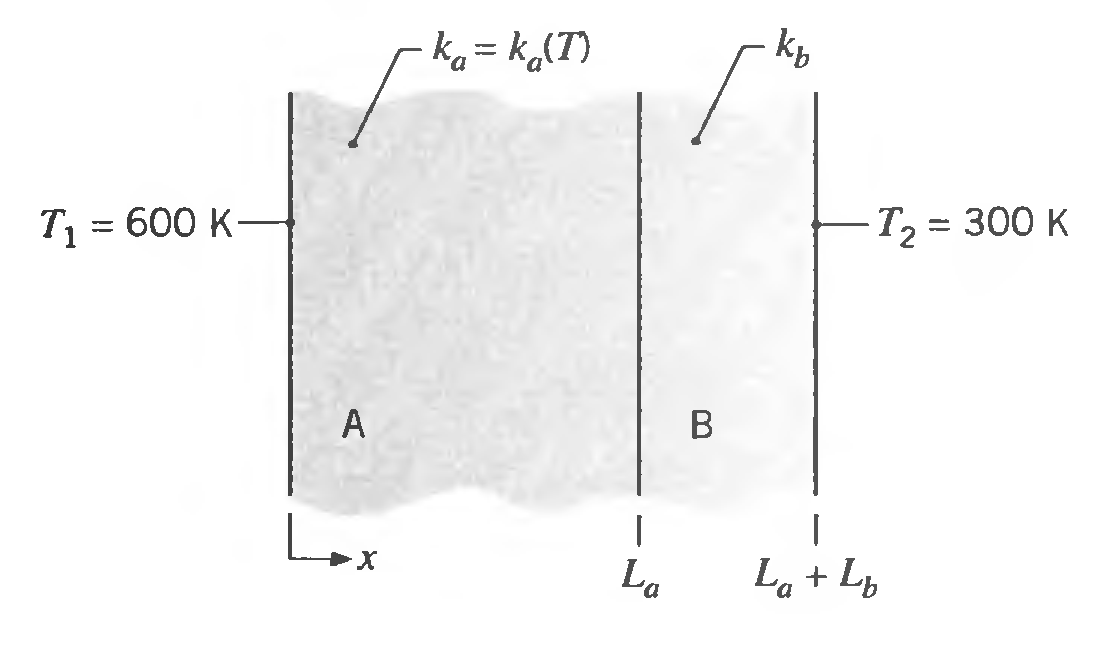
Consider one-dimensional conduction in a plane composite wall. The exposed surfaces of materials A and B are maintained at T1 = 600 K and T2 = 300 K respectively. Material A, of thickness La = 20 mm, has a temperature-dependent thermal conductivity of ka = ko [1 + a(T – To)], where ko = 4.4 W/m
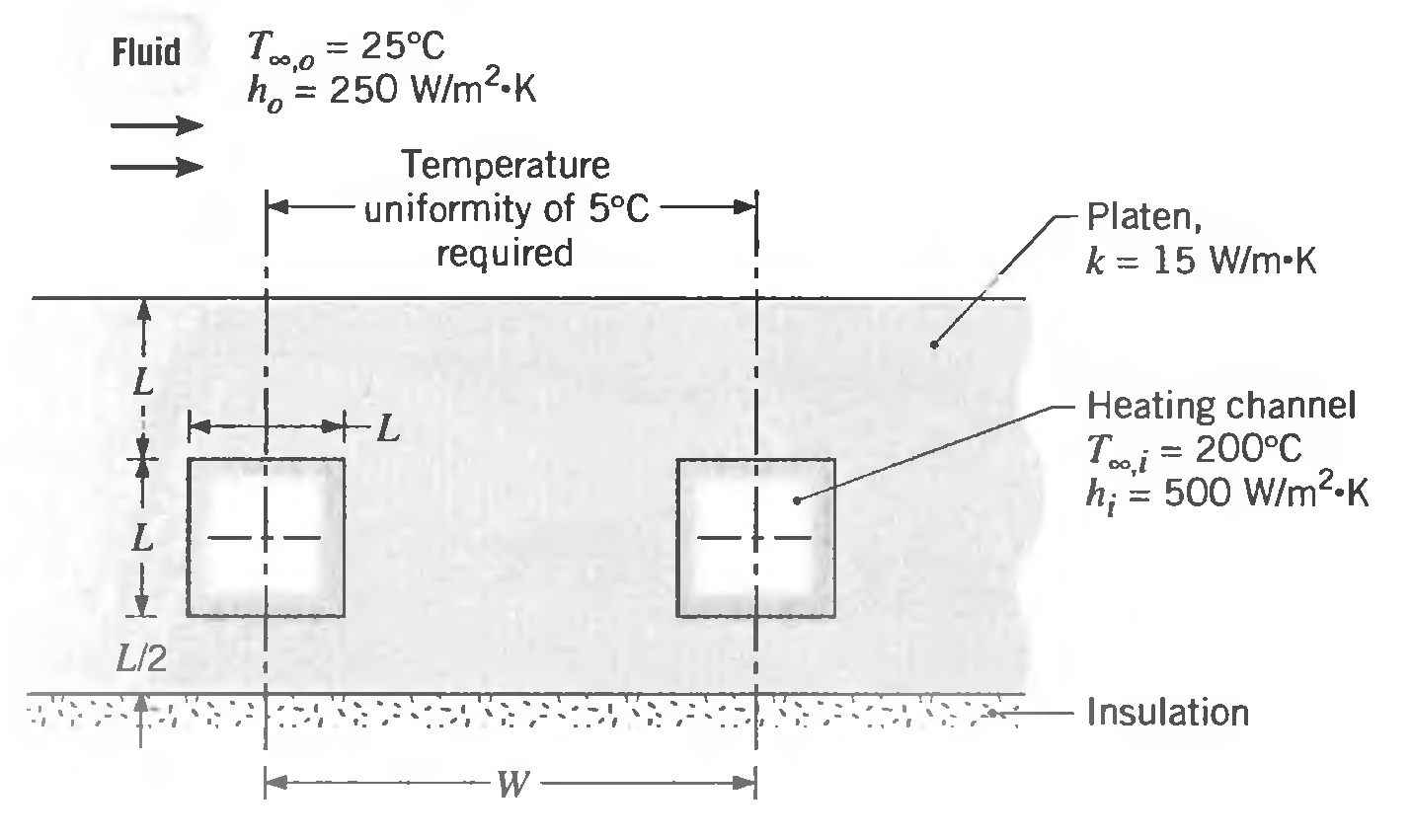
A platen of thermal conductivity k = 15 W/m ∙ K is heated by flow of a hot fluid through channels of width L = 20mm, with T∞,i = 200°C and hi = 500W/m2 ∙ K. The upper surface of the platen is used to heat a process fluid at T∞.o = 25°C with a convection coefficient of h n = 250 W/m2 ∙
Consider the cooling arrangement for the very large-scale integration (VLSI) chip of Problem 4.75. Use the finite-element method of FEHT to obtain the following results.(a) Determine the temperature distribution in the chip-substrate system. Will the maximum temperature exceed 85°C?(b) Using the
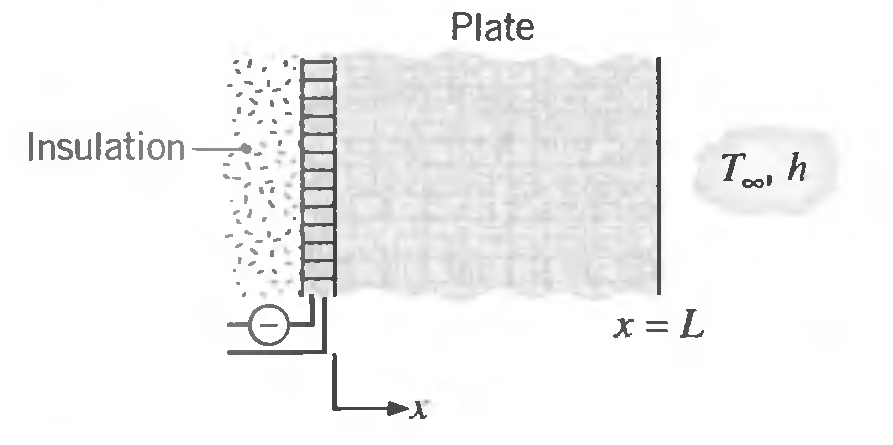
Consider a thin electrical heater attached to a plate and backed by insulation. Initially, the heater and plate are at the temperature of the ambient air, T∞. Suddenly, the power to the heater is activated, yielding a constant heat flux q: (W/m2) at the inner surface of the plate.(a) Sketch and
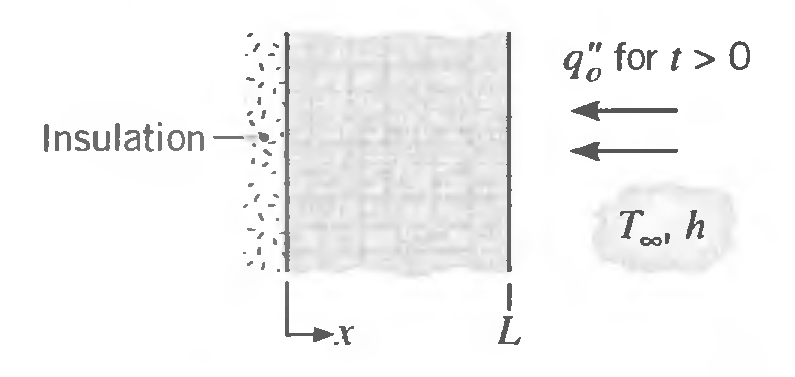
The inner surface of a plane wall is insulated while the outer surface is exposed to an airstream at T∞. The wall is at a uniform temperature corresponding to that of the airstream. Suddenly, a radiation heat source is switched on applying a uniform flux q"o to the outer surface. 0 Insulation -
A microwave oven operates on the principle that application of high-frequency field causes electrically polarized molecules in food to oscillate. The net effect is a nearly uniform generation of thermal energy within the food. Consider the process of cooking a slab of beef of thickness 2L in a
A plate of thickness 2L, surface area As, mass M, and specific heat c p ' initially at a uniform temperature T∞, is suddenly heated on both surfaces by a convection process (T∞, h) for a period of time to following which the plate is insulated. Assume that the mid plane temperature does not
Steel balls 12 mm in diameter are annealed by heating to 1150 K and then slowly cooling to 400 K in an air environment for which T∞, = 325 K and h = 20 W/m2 ∙ K. Assuming the properties of the steel to be k = 40 W/m ∙ K, p = 7800 kg/m3, and c = 600J/kg ∙ K, estimate the time required
Consider the steel balls of Problem 5.5, except now the air temperature increases with time as T∞,(t) = 325 K + at where a = 0.1875 K/s.(a) Sketch the ban temperature versus time for 0 < t < 1 h. Also show the ambient temperature, T∞ in your graph. Explain special features of the ball
The heat transfer coefficient for air flowing over a sphere is to be determined by observing the temperature-time history of a sphere fabricated from pure copper. The sphere, which is 12.7 mm in diameter, is at 66°C before it is inserted into an airstream having a temperature of 27°C. A
A solid steel sphere (AISI 1010), 300 mm in diameter, is coated with a dielectric material layer of thickness 2 mm and thermal conductivity 0.04 W/m' K. The coated sphere is initially at a uniform temperature of 500°C and is suddenly quenched in a large oil bath for which T∝ = 100°C and h =
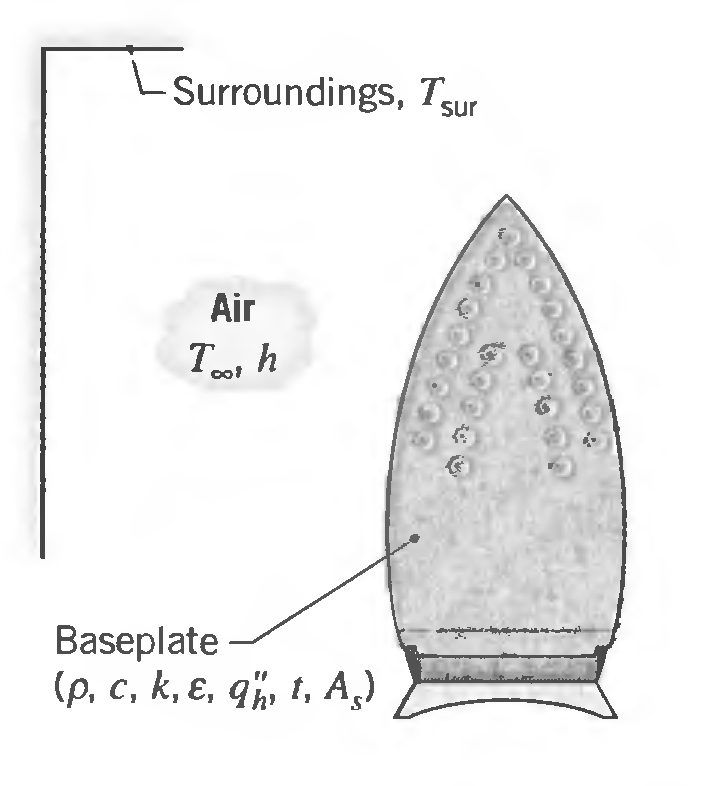
The base plate of an iron has a thickness of L = 7 mm and is made from an aluminum alloy (p = 2800 kg/m3 ∙c = 900 J/kg ∙ K, k = 180 W/m ∙ K, ε = 0.80). An electric resistance heater is attached to the inner surface of the plate, while the outer surface is exposed to ambient air and large
Carbon steel (AISI 1010) shafts of 0.1-m diameter are heat treated in a gas-fired furnace whose gases are at 1200 K and provide a convection coefficient of 100 W/m2 ∙ K. If the shafts enter the furnace at 300 K, how long must they remain in the furnace to achieve a centerline temperature of 800 K?
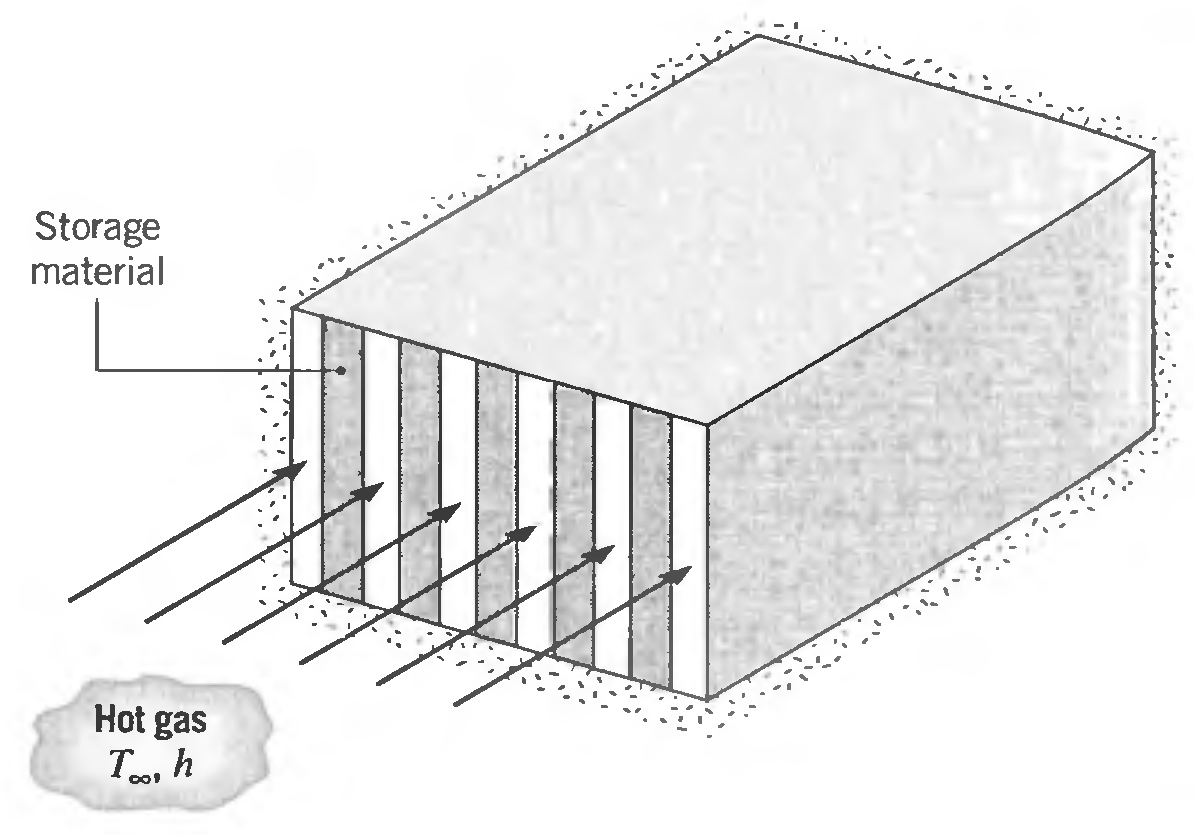
A thermal energy storage unit consists of a large rectangular channel, which is well insulated on its outer surface and encloses alternating layers of the storage material and the flow passage.Each layer of the storage material is an aluminum slab of width W = 0.05 m, which is at an initial
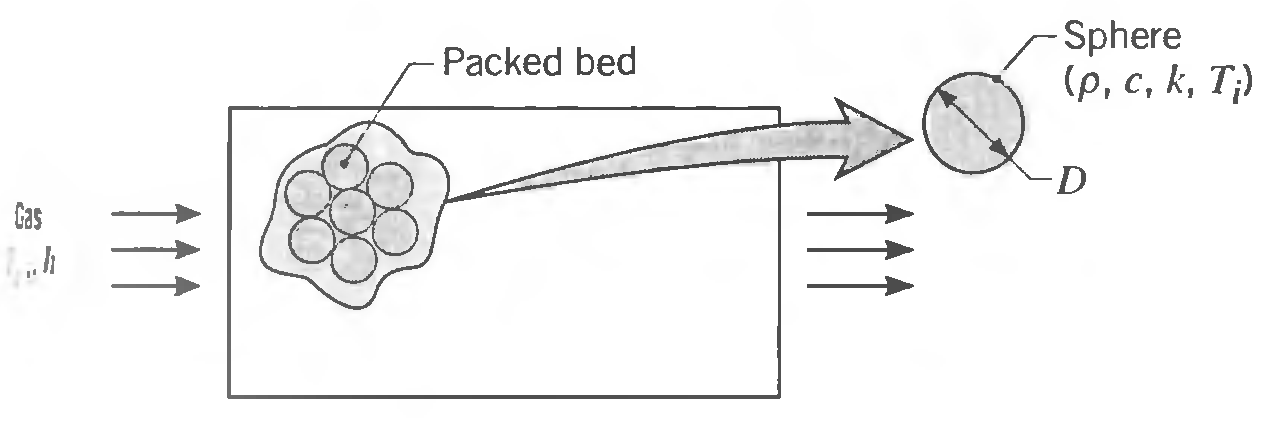
Thermal energy storage systems commonly involve a packed bed of solid spheres, through which a hot gas flows if the system is being charged, or a cold gas if it is being discharged. In a charging process, heat transfer from the hot gas increases thermal energy stored within the colder spheres:
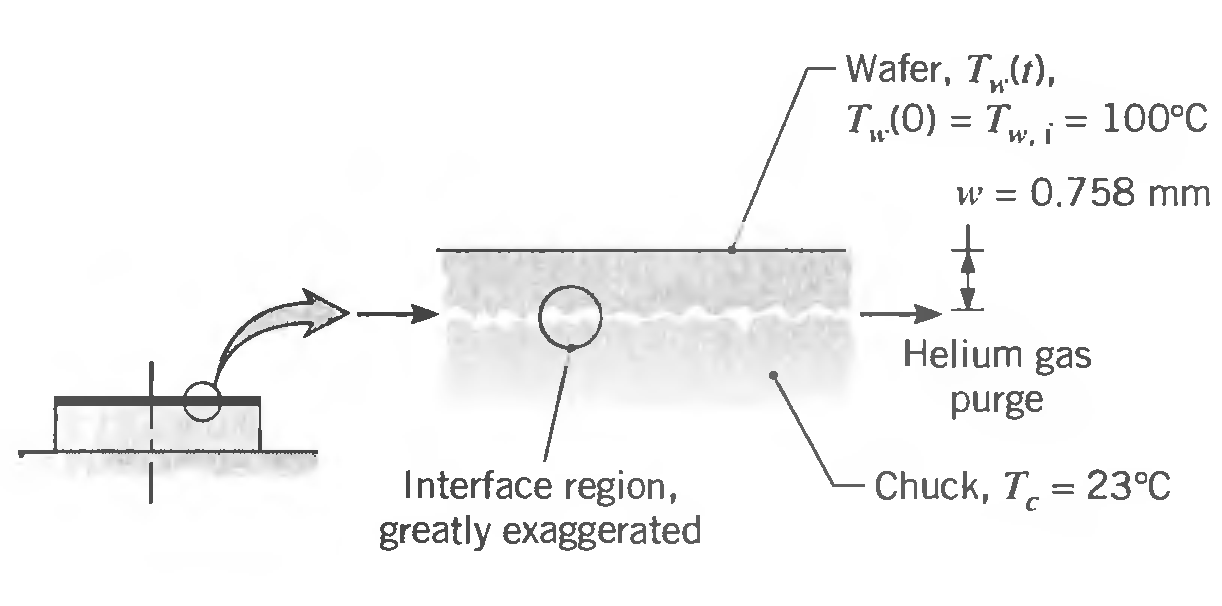
A tool used for fabricating semiconductor devices consists of a chuck (thick metallic, cylindrical disk) onto which a very thin silicon wafer (p = 2700 kg/m3 ∙ c = 875 J/kg ∙ K, k = 177 W/m ∙ K) is placed by a robotic arm. Once in position, an electric field in the chuck is energized,
A spherical vessel used as a reactor for producing pharmaceuticals has a 5-mm-thick stainless steel wall (k = 17 W/m ∙ K) and an inner diameter of D j = 1.0 m. During production, the vessel is filled with reactants for which p = 1100 kg/m3 and c = 2400 J/kg ∙ K. while exothermic reactions
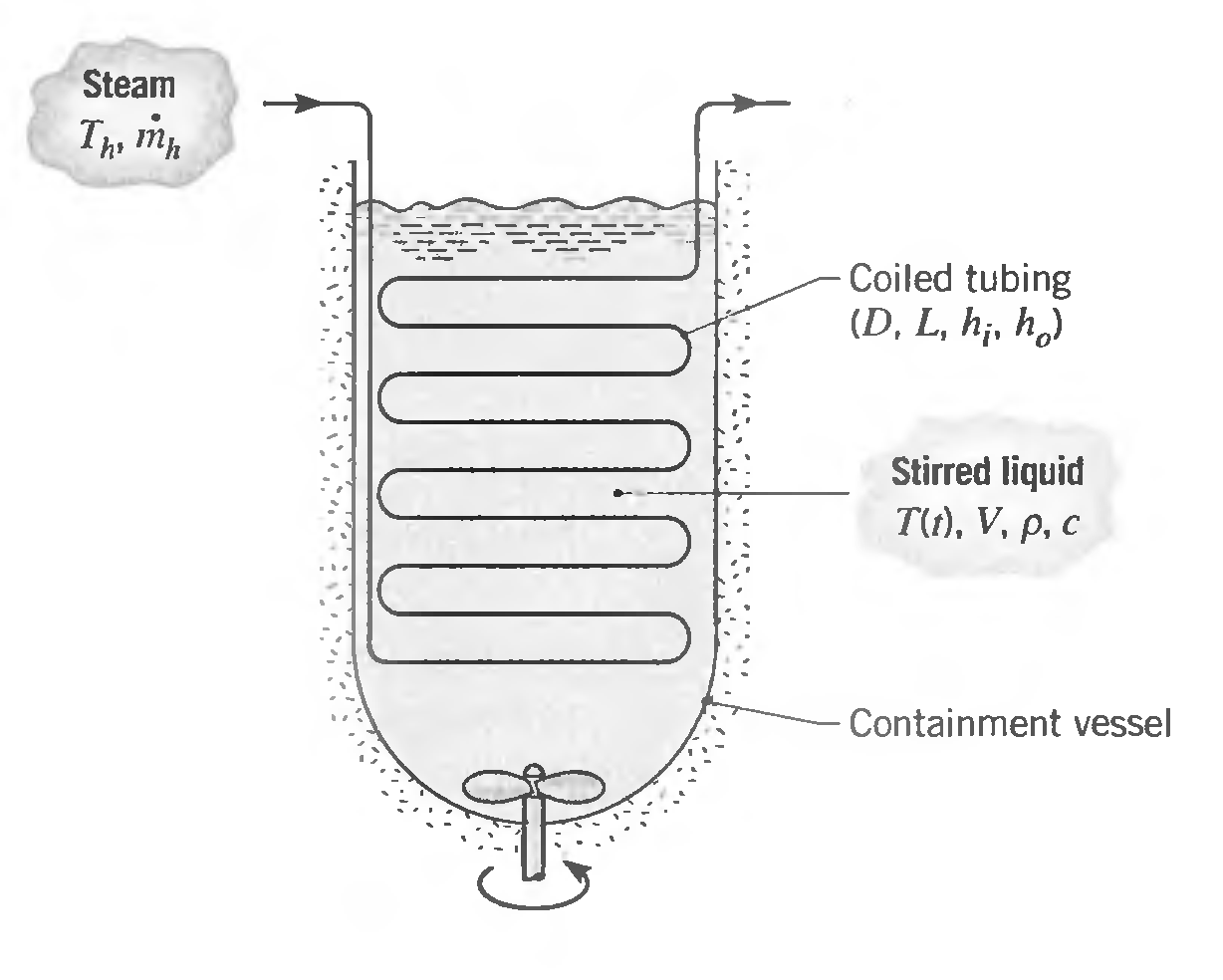
Batch processes are often used in chemical and pharmaceutical operations to achieve a desired chemical composition for the final product and typically involve a transient heating operation to take the product from room temperature to the desired process temperature.Consider a situation for which a
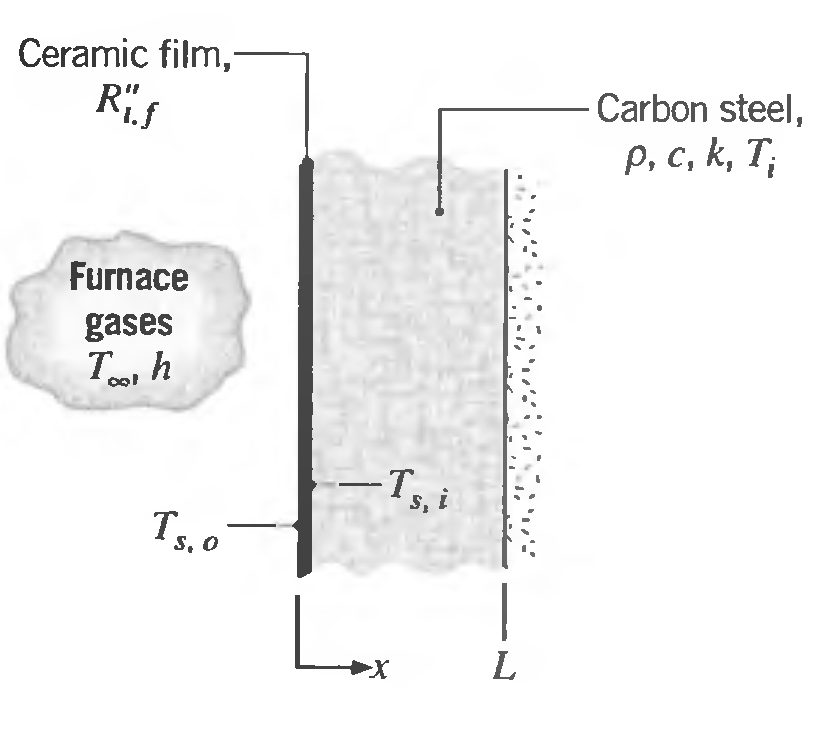
A plane wall of a furnace is fabricated from plain carbon steel (k = 60 W/m ∙ K, p = 7850 kg/m3, c = 430 J/kg ∙ K) and is of thickness L = 10 mm. To protect it from the corrosive effects of the furnace combustion gases, one surface of the wall is coated with a thin ceramic film that, for a unit
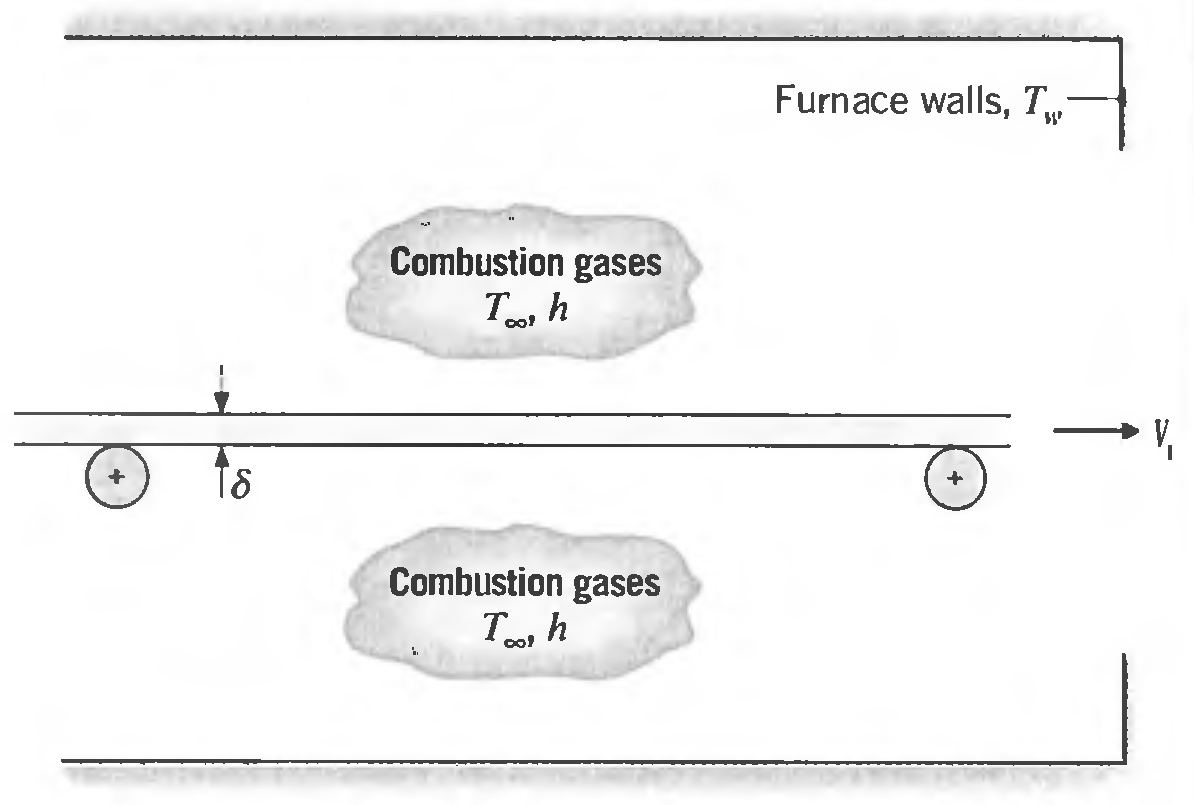
A steel strip of thickness 8 = 12 mm is annealed by passing it through a large furnace whose walls are maintained at a temperature Tw corresponding to that of combustion gases flowing through the furnace (Tw = T∞). The strip, whose density, specific heat, thermal conductivity, and emissivity are
A long wire of diameter D = 1 mm is submerged in an oil bath of temperature T∞ = 25°C. The wire has an electrical resistance per unit length of R = 0.01Ω/m. If a current of I = 100 A flows through the wire and the convection coefficient is h = 500 W/m2 ∙ K, what is the steady-state
Consider the system of Problem 5.1 where the temperature of the plate is space wise isothermal during the transient process.(a) Obtain an expression for the temperature of the plate as a function of time T(t) in terms of q"0, T∞, h. L, and the plate properties p and c.(b) Determine the thermal
An electronic device, such as a power transistor mounted on a finned heat sink, can be modeled as a spatially isothermal object with internal heat generation and an external convection resistance.(a) Consider such a system of mass M, specific heat c, and surface area AS' which is initially in
Before being injected into a furnace, pulverized coal is preheated by passing it through a cylindrical tube whose surface is maintained at Tsur = 1000°C. The coal pellets are suspended in an airflow and are known to move with a speed of 3 m/s. If the pellets may be approximated as spheres of I-mm
A metal sphere of diameter D, which is at a uniform temperature Tj, is suddenly removed from a furnace and suspended from a fine wire in a large room with air at a uniform temperature T∞ and the surrounding walls at a temperature Tsur(a) Neglecting heat transfer by radiation obtains an expression
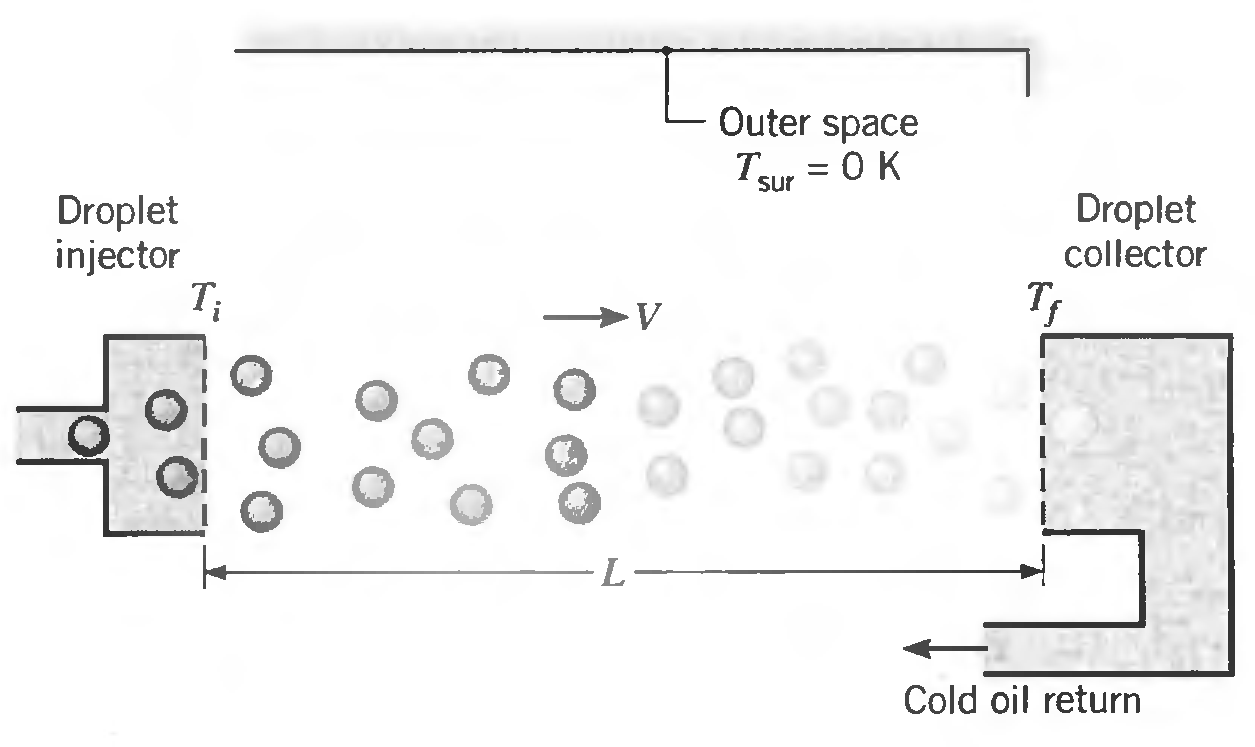
As permanent space stations increase in size, there is an attendant increase in the amount of electrical power they dissipate. To keep station compartment temperatures from exceeding prescribed limits, it is necessary to transfer the dissipated heat to space. A novel heat rejection scheme that has
In a material processing experiment conducted aboard the space shuttle, a coated niobium sphere of l0-mm diameter is removed from a furnace at 900°C and cooled to a temperature of 300°C. Although properties of the niobium vary over this temperature range, constant values may be assumed to a
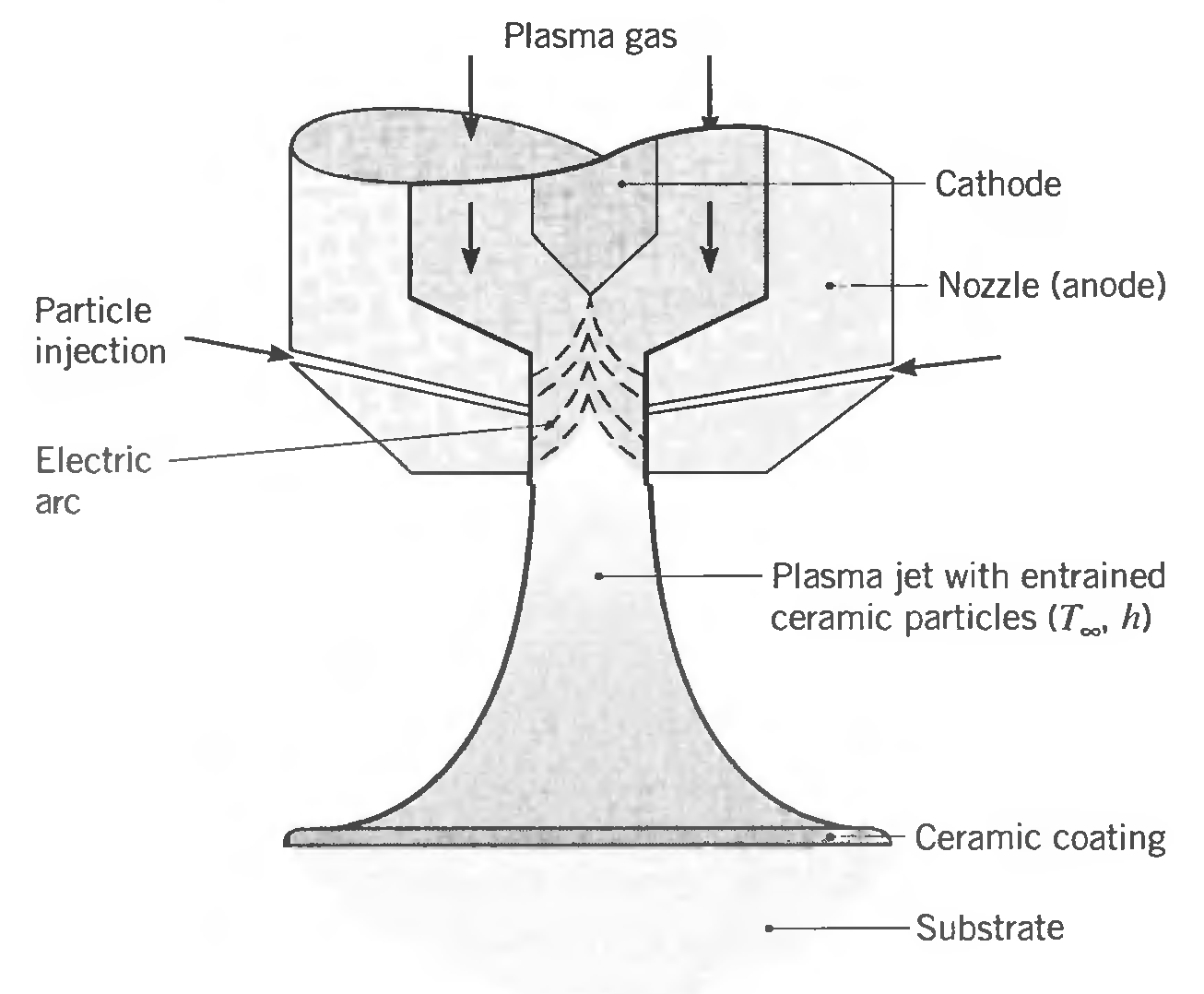
Plasma spray-coating processes are often used to provide surface protection for materials exposed to hostile environments, which induce degradation through factors such as wear, corrosion, or outright thermal failure. Ceramic coatings are commonly used for this purpose. By injecting ceramic powder
Thin film coatings characterized by high resistance to abrasion and fracture may be formed by using micro-scale composite particles in a plasma spraying process. A spherical particle typically consists of a ceramic core, such as tungsten carbide (WC), and a metallic shell, such as cobalt (Co). The
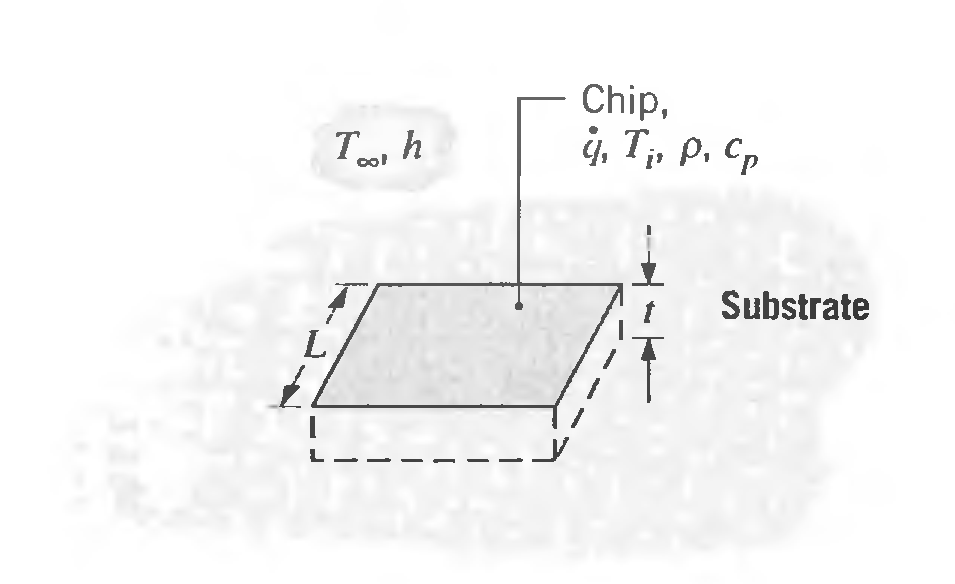
A chip that is of length L = 5 mm on a side and thickness t = 1 mm is encased in a ceramic substrate, and its exposed surface is convectively cooled by a dielectric liquid for which h = 150 W/m2 ∙ K and T∞ = 20°C.In the off-mode the chip is in thermal equilibrium with the coolant (Ti = T∞).
Consider the conditions of Problem 5.27. In addition to treating heat transfer by convection directly from the chip to the coolant, a more realistic analysis would account for indirect transfer from the chip to the substrate and then from the substrate to the coolant. The total thermal resistance
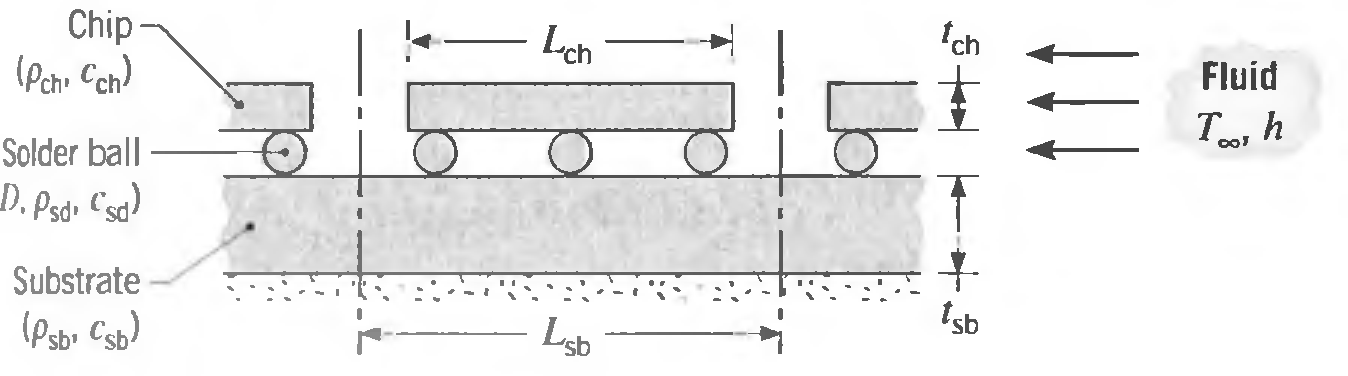
Thermal stress testing is a common procedure used to assess the reliability of an electronic package. Typically, thermal stresses are induced in soldered or wired connections to reveal mechanisms that could cause failure and must therefore be corrected before the product is released. As an example
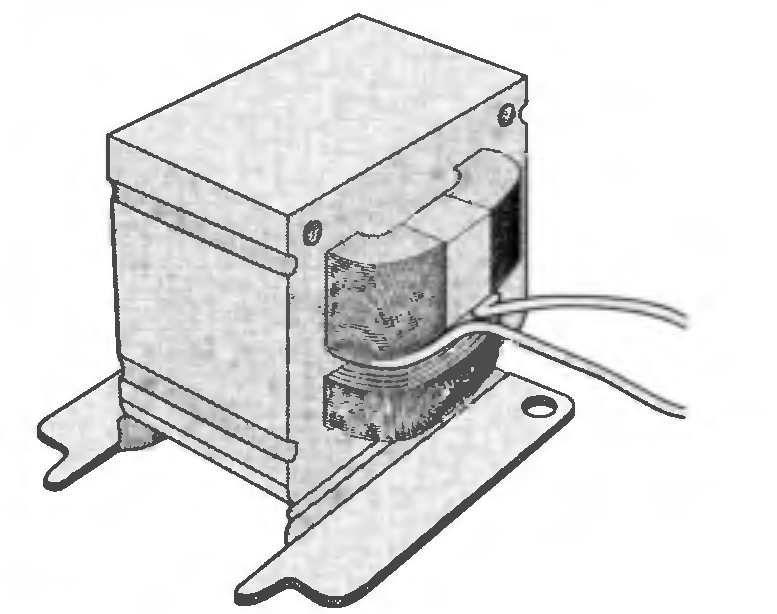
The objective of this problem is to develop thermal models for estimating the steady-state temperature and the transient temperature history of the electrical transformer shown below.The external transformer geometry is approximately cubical, with a length of 32 mm to a side. The combined mass of
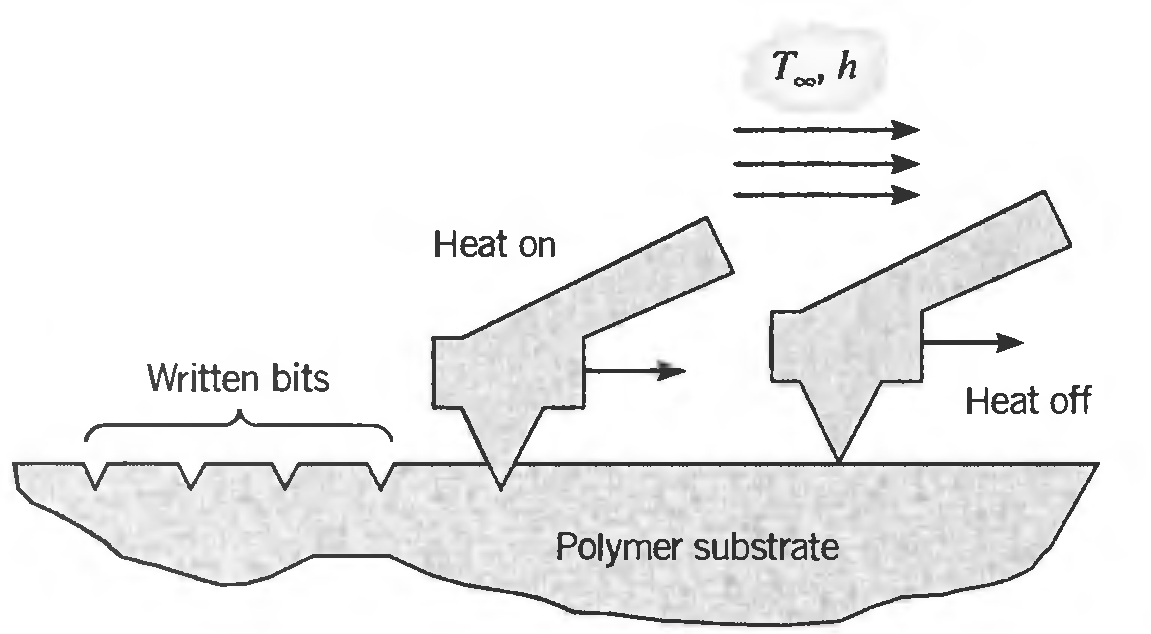
In thermo mechanical data storage, a processing head, consisting of M heated cantilevers, is used to write data onto an underlying polymer storage medium. Electrical resistance heaters are micro fabricated onto each cantilever, which continually travel over the surface of the medium. The resistance
The melting of water initially at the fusion temperature, Tf = 0°C, was considered in Example 1.5. Freezing of water often occurs at 0°C. However, pure liquids that undergo a cooling process can remain in a super cooled liquid state well below their equilibrium freezing temperature, Tf'
As noted in Problem 5.3, microwave ovens operate by rapidly aligning and reversing water molecules within the food, resulting in volumetric energy generation and, in turn, cooking of the food. When the food is initially frozen, however, the water molecules do not readily oscillate in response to
Consider the series solution, Equation 5.39, for the plane wall with convection. Calculate mid plane (x* = 0) and surface (x* = 1) temperatures θ* for Fo = 0.1 and I, using Bi = 0.1, 1, and 10. Consider only the first four eigenvalues. Based on these results discuss the validity of the approximate
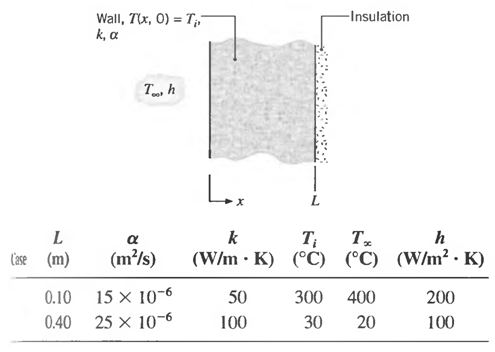
Consider the one-dimensional wall shown in the sketch, which is initially at a uniform temperature T j and is suddenly subjected to the convection boundary condition with a fluid at T∝.For a particular wall, case 1, the temperature at x = L1 after t1 = 100s is T1 (L1, t1) = 315°C. Another
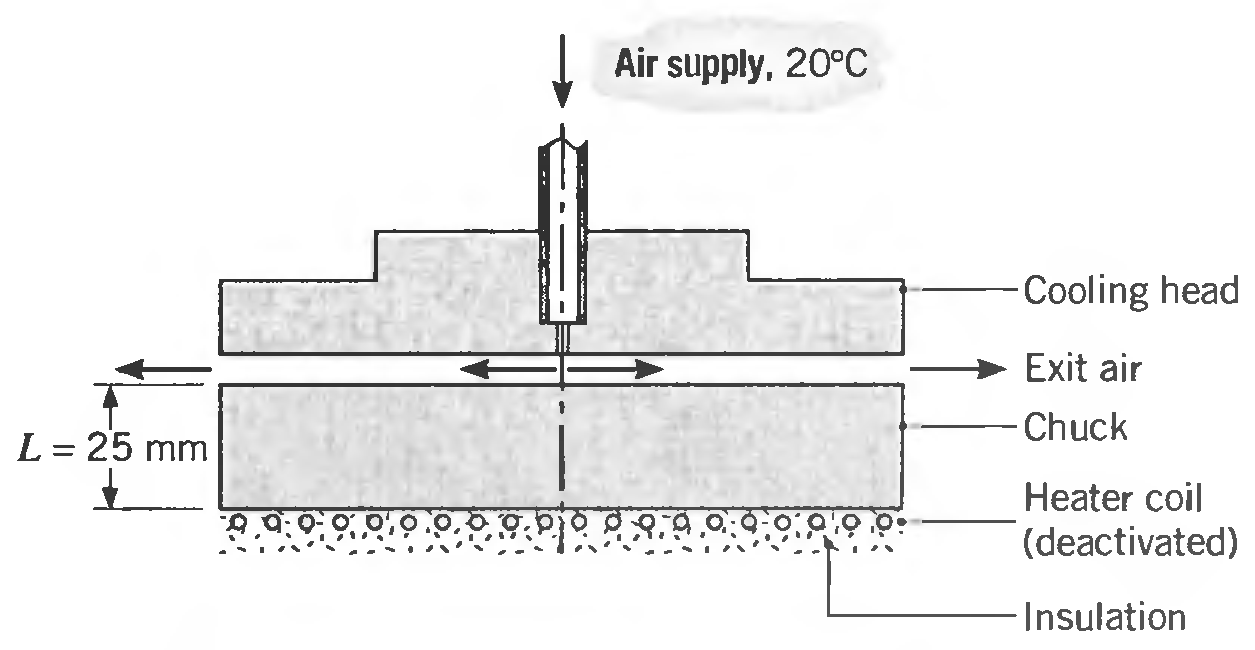
Referring to the semiconductor processing tool of Problem 5.13, it is desired at some point in the manufacturing cycle to cool the chuck, which is made of aluminum alloy 2024. The proposed cooling scheme passes air at 20°C between the air-supply head and the chuck surface.(a) If the chuck is
Annealing is a process by which steel is reheated and then cooled to make it less brittle. Consider the reheat stage for a 100-mm-thick steel plate (p = 7830 kg/m3, c = 550 J/kg ∙ K, k = 48 W/m ∙ K), which is initially at a uniform temperature of Tj = 200°C and is to be heated to a minimum
Consider the heavily insulated pipe of Example 5.4, which is suddenly subjected to the flow of hot oil. Use the Transient Conduction, Plane Wall model of IHT to obtain the following solutions.(a) Calculate the temperature of the inner and outer surfaces of the pipe, the heat flux at the inner
The 150-mm-thick wall of a gas-fired furnace is constructed of fire-day brick (k = 1.5 W/m ∙ K. p = 2600 kg/m ∙ c p = 1000 J/kg ∙ K) and is well insulated at its outer surface. The wall is at a uniform initial temperature of 20°C, when the burners are fired and the inner surface is exposed
Steel is sequentially heated and cooled (annealed) to relieve stresses and to make it less brittle. Consider a 100-mm-thick plate (k = 45 W/m ∙ K. p = 7800 kg/m3 ∙ cp = 500J/kg ∙ K) that is initially at a uniform temperature of 300°C and is heated (on both sides) in a gas-fired furnace
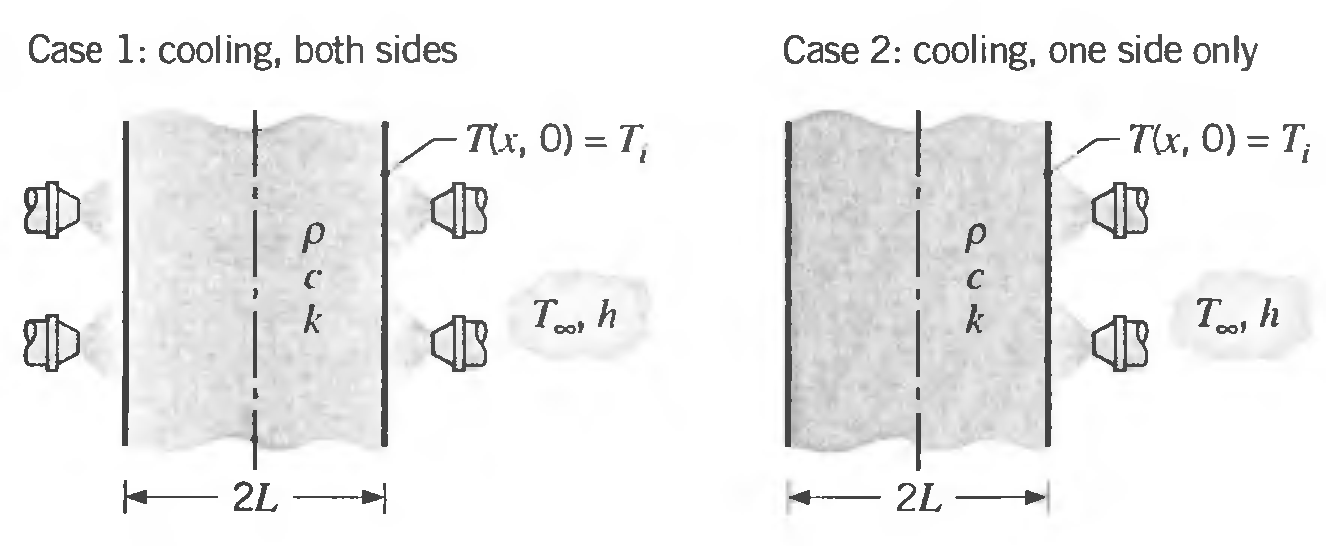
A plate of thickness 2L = 25 mm at a temperature of 600°C is removed from a hot pressing operation and must be cooled rapidly in order to achieve the required physical properties. The process engineer plans to use air jets to control the rate of cooling. But she is uncertain whether it is
During transient operation the steel nozzle of a rocket engine must not exceed a maximum allowable operating temperature of 1500 K when exposed to combustion gases characterized by a temperature of 2300 K and a convection coefficient of 5000 W/m2 ∙ K. To extend the duration of engine operation,
In a tempering process, glass plate, which is initially at a uniform temperature Ti, is cooled by suddenly reducing the temperature of both surfaces to Ts. The plate is 20 mm thick, and the glass has a thermal diffusivity of 6 x 10⁻⁷ m2/s.(a) How long wi1l it take for the mid plane temperature to
The strength and stability of tires may be enhanced by heating both sides of the rubber (k = 0.14 W/m ∙ K. a = 6.35 x 10⁻⁸ m2/s) in a steam chamber for which T∝ = 200°C. In the heating process, a 20-mm-thick rubber wall (assumed to be un-treaded) is taken from an initial temperature of 25°C
Copper-coated, epoxy-fi1led fiberglass circuit boards are treated by heating a stack of them under high pressure as shown in the sketch. The purpose of the pressing-heating operation is to cure the epoxy that bonds the fiberglass sheets, imparting stiffness to the boards. The stack, referred to as
Circuit boards are treated by heating a stack of them under high pressure as illustrated in Problem 5.45. The platens at the top and bottom of the stack are maintained at a uniform temperature by a circulating fluid. The purpose of the pressing-heating operation is to cure the epoxy, which bonds
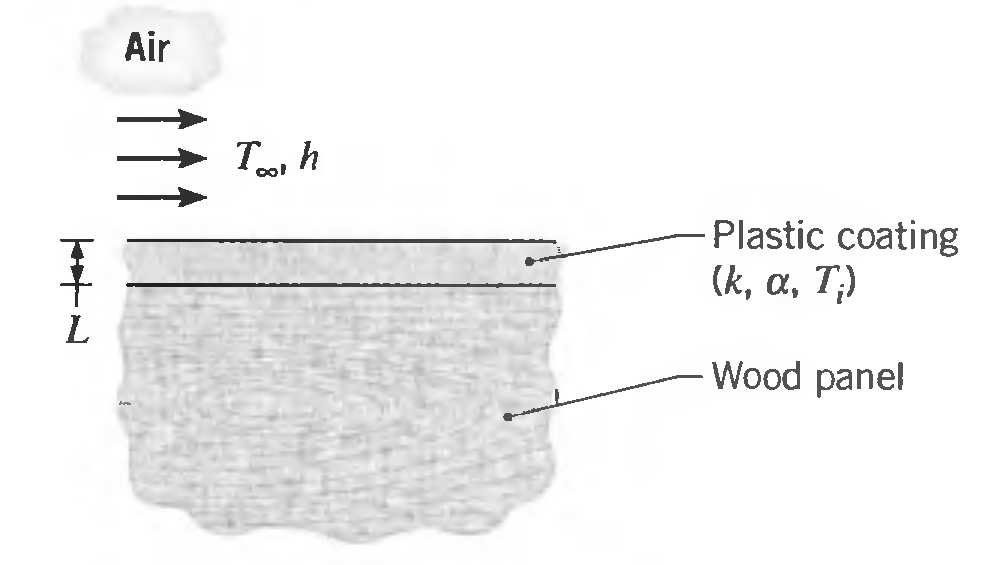
A plastic coating is applied to wood panels by first depositing molten polymer on a panel and then cooling the surface of the polymer by subjecting it to air flow at 25°C. As first approximations, the heat of reaction associated with solidification of the polymer may be neglected and the
A long rod of 60-mm diameter and thermo physical properties P = 8000 kg/m3, c = 500 J/kg ∙ K, and k = 50 W/m ∙ K is initially at a uniform temperature and is heated in a forced convection furnace maintained at 750 K. The convection coefficient is estimated to be 1000 W/m2 ∙ K.(a) What is the
A long cylinder of 30-mm diameter, initia1ly at a uniform temperature of 1000 K. is suddenly quenched in a large, constant-temperature oil bath at 350 K. The cylinder properties are k = 1.7 W/m ∙ K, c = 1600 J/kg ∙ K, and p = 400 kg/m3, while the convection coefficient is 50 W/m2 ∙ K.(a)
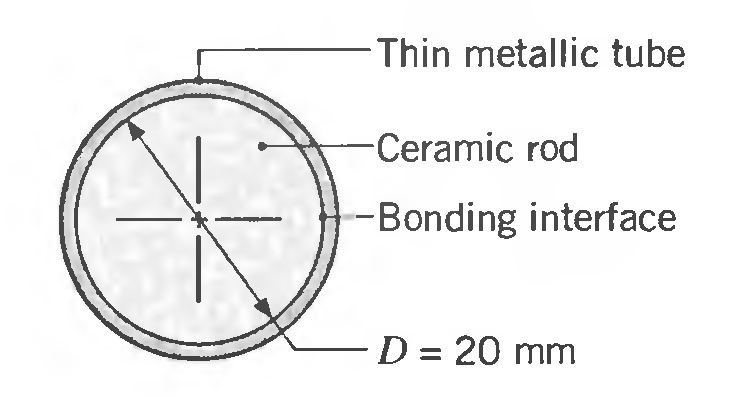
A long pyroceram rod of diameter 20 mm is clad with a very thin metallic tube for mechanical protection. The bonding between the rod and the tube has a thermal contact resistance of Rt.c = 0.12 m ∙ K/W.(a) If the rod is initially at a uniform temperature of 900 K and is suddenly cooled by
A long rod 40 mm in diameter, fabricated from sapphire (aluminum oxide) and initially at a uniform temperature of 800 K, is suddenly cooled by a fluid at 300 K having a heat transfer coefficient of 1600 W/m2 ∙ K. After 35 s, the rod is wrapped in insulation and experiences no heat losses. What
A long plastic rod of 30-mm diameter (k = 0.3 W/m ∙ K and pcp = 1040kJ/m3 ∙ K) is uniformly heated in an oven as preparation for a pressing operation. For best results, the temperature in the rod should not be less than 200°C. To what uniform temperature should the rod be heated in the oven
In a manufacturing process, long rods of different diameters are at a uniform temperature of 400°C in a curing oven, from which they are removed and cooled by forced convection in air at 25°C. One of the line operators has observed that it takes 280 seconds for a 40-mm. diameter rod to cool to an
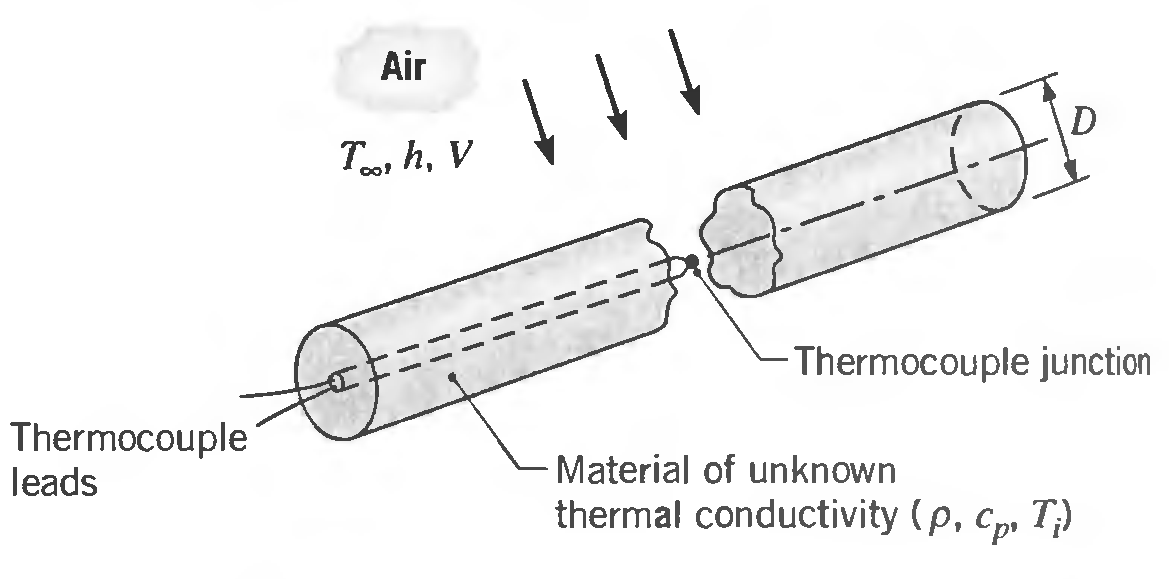
The density and specific heat of a particular material are known (p = 1200 kg/m3 ∙ c p = 1250 J/kg ∙ K), but its thermal conductivity is unknown. To determine the thermal conductivity, a long cylindrical specimen of diameter D = 40 mm is machined, and a thermo couple is inserted through a small
In Section 5.2 we noted that the value of the Biot number significantly influences the nature of the temperature distribution in a solid during a transient conduction process. Reinforce your understanding of this important concept by using the IHT model for one-dimensional transient conduction to
In heat treating to harden steel ban bearings (c = 500 J/kg ∙ K p = 7800 kg/m3, k = 50 W/m ∙ K), it is desirable to increase the surface temperature for a short time without significantly warming the interior of the ball. This type of heating can be accomplished by sudden immersion of the ban
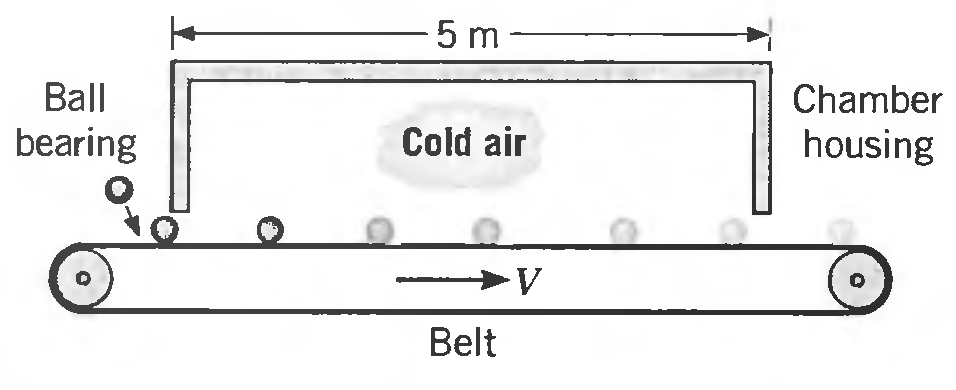
A cold air chamber is proposed for quenching steel ball bearings of diameter D = 0.2 m and initial temperature Ti = 400°C. Air in the chamber is maintained at – 15°C by a refrigeration system, and the steel bans pass through the chamber on a conveyor belt. Optimum bearing production requires
Stainless steel (AISI 304) ball bearings, which have uniformly been heated to 850°C, are hardened by quenching them in an oil bath that is maintained at 40°C. The ball diameter is 20 mm, and the convection coefficient associated with the oil bath is 1000 W/m2 ∙ K.(a) If quenching is to occur
As part of a heat treatment process cylindrical, 304 stainless steel rods of 100-mm diameter are cooled from an initial temperature of 500°C by suspending them in an oil bath at 30°e. If a convection coefficient of 500 W/m2 ∙ K is maintained by circulation of the oil, how long does it take for
A sphere 30 mm in diameter initially at 800 K is quenched in a large bath having a constant temperature of 320 K with a convection heat transfer coefficient of 75 W/m2 ∙ K. The thermo physical properties of the sphere material are: p = 400 kg/m3, c = 1600 J/kg ∙ K, and k = 1.7 W/m ∙ K.(a)
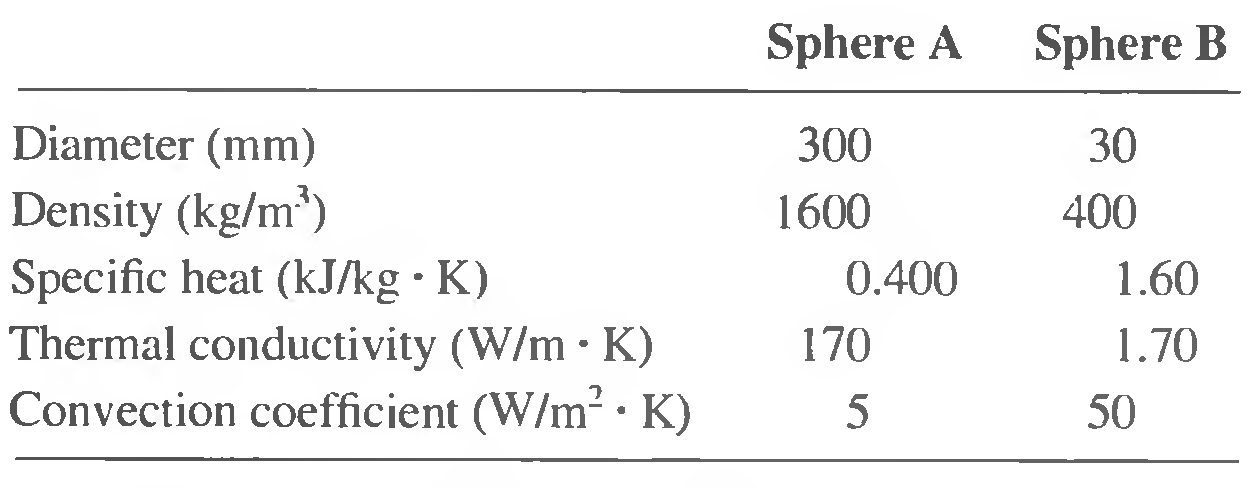
Spheres A and B are initially at 800 K, and they are simultaneously quenched in large constant temperature baths, each having a temperature of 320 K. The following parameters are associated with each of the spheres and their cooling processes.(a) Show in a qualitative manner on T versus t
Spheres of 40-mm diameter heated to a uniform temperature of 400°C are suddenly removed from the oven and placed in a forced-air bath operating at 25°C with a convection coefficient of 300 W 1m:!. . K on the sphere surfaces, the thermo physical properties of the sphere material are p = 3000
Consider the packed bed operating conditions of Problem 5.12, but with Pyrex (p = 2225 kg/m3 ∙ c = 835 J/kg ∙ K. k = 1.4 W/m ∙ K) used instead of aluminum. How long does it take a sphere near the inlet of the system to accumulate 90% of the maximum possible thermal energy? What is the
The convection coefficient for flow over a solid sphere may be determined by submerging the sphere which is initial1y at 25°C, into the flow, which is at 75°C, and measuring its surface temperature at some time during the transient heating process.(a) If the sphere has a diameter of 0.1 m, a
Consider the sphere of Example 5.5, which is initially at a uniform temperature when it is suddenly removed from the furnace and subjected to a two-step cooling process. Use the Transie1l1 Conduction, Sphere model of IHT to obtain the following solutions.(a) For step 1, calculate the time required
Two large blocks of different materials, such as copper and concrete have been sitting in a room (23°C) for a very long time. Which of the two blocks if either will feel colder to the touch? Assume the blocks to be semi infinite solids and your hand to be at a temperature of 37°C.
A plane wal1 of thickness 0.6 m (L = 0.3 m) is made of steel (k = 30 W/m ∙ K. p = 7900 kg/m3, c = 640 J/kg ∙ K). It is initially at a uniform temperature and is then exposed to air on both surfaces. Consider two different convection conditions: natural convection, characterized by h = 10 W/m2
Asphalt pavement may achieve temperatures as high as 50°C on a hot summer day. Assume that such a temperature exists throughout the pavement, when suddenly a rainstorm reduces the surface temperature to 20°C. Calculate the total amount of energy (J/m2) that will be transferred from the asphalt
A thick steel slab (p = 7800 kg/m3, c = 480 J/kg ∙ K, k = 50 W/m ∙ K) is initially at 300°C and is cooled by water jets impinging on one of its surfaces. The temperature of the water is 25°C, and the jets maintain an extremely large, approximately uniform convection coefficient at the
Consider the water main of Example 5.6, which is buried in soil initially at 20°C and is suddenly subjected to a constant surface temperature of -15°C for 60 days. Use the Transient Conduction/Semi-Infinite Solid model of IHT to obtain the following solutions. Compare your results with those in
A tile-iron consists of a massive plate maintained at 150°C by an imbedded electrical heater. The iron is placed in contact with a tile to soften the adhesive, allowing the tile to be easily lifted from the subflooring. The adhesive will soften sufficiently if heated above 50°C for at least 2
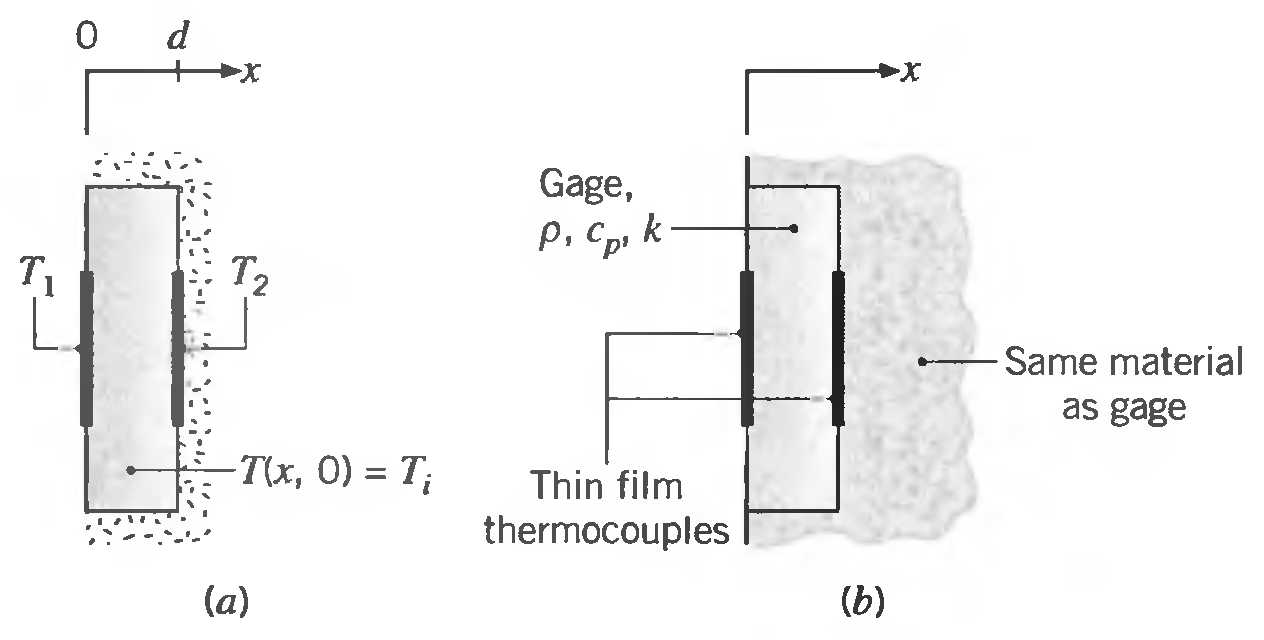
The manufacturer of a heat flux gage like that illustrated in Problem 1 12 claims the time constant for a 63.2% response to be τ = (4d2 pc p) π2k where p, c p, and k are the thermo physical properties of the gage material and d is its thickness. Not knowing the origin of this relation, your task
A simple procedure for measuring surface convection heat transfer coefficients involves coating the surface with a thin layer of material having a precise melting point temperature. The surface is then heated and, by determining the time required for melting to occur.The convection coefficient is
An insurance company has hired you as a consultant to improve their understanding of burn injuries. They are especially interested in injuries induced when a portion of a worker's body comes into contact with machinery that is at elevated temperatures in the range of 50 to 100°C. Their medical
A procedure for determining the thermal conductivity of a solid material involves embedding a thermocouple in a thick slab of the solid and measuring the response to a prescribed change in temperature at one surface. Consider an arrangement for which the thermocouple is embedded 10 mm from a
The density and specific heat of a plastic material are known (p = 950 kg/m3, cp = 1100 J/kg ∙ K), but its thermal conductivity is unknown. To determine the thermal conductivity, an experiment is performed in which a thick sample of the material is heated to a uniform temperature of 100°C and
A very thick slab with thermal diffusivity 5.6 x 10⁻⁶ m2/s and thermal conductivity 20 W/m ∙ K is initially at a uniform temperature of 325°C. Suddenly, the surface is exposed to a coolant at 15°C for which the convection heat transfer coefficient is 100 W/m2 ∙ K.(a) Determine temperatures at
A thick oak wall, initially at 25°C, is suddenly exposed to combustion products for which T∞ = 800°C and h=20W/m2 ∙ K.(a) Determine the time of exposure required for the surface to reach the ignition temperature of 400°C.(b) Plot the temperature distribution T(x) in the medium at t =
Standards for firewalls may be based on their thermal response to a prescribed radiant heat flux. Consider a 0.25-m-thick concrete wall (p = 2300 kg/m3 ∙ c = 880 J/kg. K, k = 1.4 W/m ∙ K), which is at an initial temperature of Ti = 25°C and irradiated at one surface by lamps that provide a
It is well known that, although two materials are at the same temperature, one may feel cooler to the touch than the other. Consider thick plates of copper and glass, each at an initial temperature of 300 K.Assuming your finger to be at an initial temperature of 310 K and to have thermo physical
Two stainless steel plates (p = 8000 kg/m3, c = 500 J/kg ∙ K, k = 15 W/m ∙ K), each 20 mm thick and insulated on one surface, are initially at 400 and 300 K when they are pressed together at their uninsulated surfaces. What is the temperature of the insulated surface of the hot plate after 1
Special coatings are often formed by depositing thin layers of a molten material on a solid substrate. Solidification begins at the substrate surface and proceeds until the thickness S of the solid layer becomes equal to the thickness 8 of the deposit.(a) Consider conditions for which molten
When a molten metal is cast in a mold that is a poor conductor, the dominant resistance to heat flow is within the mold wall. Consider conditions for which a liquid metal is solidifying in a thick-waned mold of thermal conductivity k... and thermal diffusivity an. The density and latent heat of
Joints of high quality can be formed by friction welding. Consider the friction welding of two 4O-mm-diameter Inconel rods. The bottom rod is stationary, while the top rod is forced into a back-and-forth linear motion characterized by an instantaneous horizontal displacement, d(t) = a cos(wt) where
An above-ground circular swimming pool is heated so that it can be used in cool weather. The ground has a temperature of 10°C far from the pool. The heater is turned on and quickly brings the pool water to a comfortable 20°C; assume this is the temperature of the circular region of the ground
A rewritable optical disc (DVD) is formed by sandwiching a 15-nm-thick binary compound storage material between two I-mm-thick polycarbonate sheets. Data are written to the opaque storage medium by irradiating it from below with a relatively high-powered laser beam of diameter 0.4μm and power 1mW
To enable cooking a wider range of foods in microwave ovens, thin, metallic packaging materials have been developed that will readily absorb microwave energy. As the packaging material is heated by the microwaves, conduction simultaneously occurs from the hot packaging material to the cold food.
The structural components of modern aircraft are commonly fabricated of high-performance composite materials. These materials are fabricated by impregnating mats of extremely strong fibers that are held within a form with an epoxy or thermoplastic liquid. After the liquid cures or cools, the
Problem 4.9 addressed radioactive wastes stored underground in a spherical container. Because of uncertainty in the thermal properties of the soil, it is desired to measure the steady-state temperature using a test container (identical to the real container) that is equipped with internal
A thermal storage medium consists of a large mass of limestone. Ambient air is pumped through a 30-mm-high, 5-m-long 5-m-wide fissure within the limestone at a velocity of 2m/s. providing a heat transfer coefficient between the air and the limestone of h = 10 W/m2 ∙ K. Over a 24-hour time period,
Consider the experimental measurement of Example 5.8. It is desired to measure the thermal conductivity of an extremely thin sample of the same nanostructured material having the same length and width. To minimize experimental uncertainty the experimenter wishes to keep the amplitude of the
The stability criterion for the explicit method requires that the coefficient of the term of the one-dimensional, finite-difference equation be zero or positive. Consider the situation for which the temperatures at the two neighboring nodes are 100°C while the center node is at 50°C.
A thin rod of diameter D is initially in equilibrium with its surroundings, a large vacuum enclosure at temperature Tsur. Suddenly an electrical current I (A) is passed through the rod having an electrical resistivity Pe and emissivity ε. Other pertinent thermo physical properties are identified
A one-dimensional slab of thickness 2L is initially at a uniform temperature Ti. Suddenly, electric current is passed through the slab causing a uniform volumetric heating q (W/m3). At the same time, both outer surfaces (x = ± L) are subjected to a convection process at T∝ with a heat transfer
A plane wall (p = 4000 kg/m3, c p = 500 J/kg ∙ K, k = 10 W/m ∙ K) of thickness L = 20 mm initially has a linear, steady-state temperature distribution with boundaries maintained at T1 = 0°C and T2 = 100°C. Suddenly, an electric current is passed through the wall, causing uniform energy
A round solid cylinder made of a plastic material (a = 6 x 10⁻⁷ m2/s) is initially at a uniform temperature of 20oC and is well insulated along its lateral surface and at one end. At time t = 0, heat is applied to the left boundary causing To to increase linearly with time at a rate of 1oC/s.(a)
Derive the explicit finite-difference equation for an interior node for three-dimensional transient conduction. Also determine the stability criterion. Assume constant properties and equal grid spacing in all three directions.
Showing 8500 - 8600
of 18200
First
79
80
81
82
83
84
85
86
87
88
89
90
91
92
93
Last
Step by Step Answers

 Get 50% OFF
Claim Now
Get 50% OFF
Claim Now


.PNG)

.PNG)
.PNG)
.PNG)
.PNG)
.PNG)
.PNG)
.PNG)


.PNG)
.PNG)
.PNG)
.PNG)


