New Semester
Started
Get
50% OFF
Study Help!
--h --m --s
Claim Now
Question Answers
Textbooks
Find textbooks, questions and answers
Oops, something went wrong!
Change your search query and then try again
S
Books
FREE
Study Help
Expert Questions
Accounting
General Management
Mathematics
Finance
Organizational Behaviour
Law
Physics
Operating System
Management Leadership
Sociology
Programming
Marketing
Database
Computer Network
Economics
Textbooks Solutions
Accounting
Managerial Accounting
Management Leadership
Cost Accounting
Statistics
Business Law
Corporate Finance
Finance
Economics
Auditing
Tutors
Online Tutors
Find a Tutor
Hire a Tutor
Become a Tutor
AI Tutor
AI Study Planner
NEW
Sell Books
Search
Search
Sign In
Register
study help
engineering
mechanical engineering
Fundamentals of Heat and Mass Transfer 6th Edition Incropera, Dewitt, Bergman, Lavine - Solutions
Determine the mass products of inertia Ixy, Iyz, and Izx of the cast aluminum machine component shown. (The density of aluminum is 2700 kg/m3.)
A section of sheet steel 3 mm thick is cut and bent into the machine component shown. Knowing that the density of the steel is 7860 kg/m3, determine the mass products of inertia Ixy, Iyz, and Izx of the component.
A section of sheet steel 3 mm thick is cut and bent into the machine component shown. Knowing that the density of the steel l is 7860 kg/m3, determine the mass products of inertia Ixy, I yz, and Izx of the component.
A section of sheet steel 3 mm thick is cut and bent into the machine component shown. Knowing that the density of the steel l is 7860 kg/m3, determine the mass products of inertia Ixy, Iyz, and Izx of the component.
A section of sheet steel 0.08 in. thick is cut and bent into the machine component shown. Knowing that the specific weight of steel is 490 lb/ft3, determine the mass products of inertia a Ixy, Iyz, and Izx of the component.
Brass wire with a weight per unit length w is used to form the wire figure.
Brass wire with a weight per unit length w is used to form the figure shown. Determine the mass products of inertia a Ixy, Iyz, and Izx of the wire figure.
The figure shown is formed of 0.075-in.-diameter aluminum wire. Knowing that the specific weight of aluminum is 0.10 lb/in3, determine the mass products of inertia Ixy, Iyz , and Izx of the wire figure.
A homogeneous wire with a mass per unit length of 1.8 kg/m is used to form the figure shown. Determine the mass products of inertia Ixy, Iyz, and Izx of the wire figure.
Complete the derivation of Eqs (9.47), which express the parallel-axis theorem for mass products of inertia.
For the homogeneous tetrahedron of mass m shown,(a) Determine by direct integration the mass product of inertia a Izx,(b) Deduce Iyz and Ixy from the results obtained in part a.
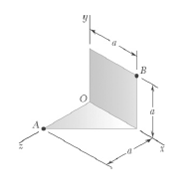
The homogeneous circular cylinder shown has a mass m. Determine the mass moment of inertia of the cylinder with respect to the line joining the origin O and point A which is located on the perimeter of the top surface of the cylinder.
The homogeneous circular cone shown has a mass m. Determine the mass moment of inertia of the cone with respect to the line joining the origin O and point A.
Shown is the machine element of Prob. 9.143. Determine its mass moment of inertia with respect to the line joining the origin O and point A.
Determine the mass moment of inertia of the steel machine element of Probs. 9.147 and 9.151 with respect to the axis through the origin which forms equal angles with the x, y, and z axes.
The thin bent plate shown is of uniform density and weight W. Determine its mass moment of inertia with respect to the line joining the origin O and point A.
A piece of sheet metal of thickness t and density ρ is cut and bent into the shape shown. Determine its mass moment of inertia with respect to a line joining points A and B.
Determine the mass moment of inertia of the machine component of Probs. 9.138 and 9.157 with respect to the axis through the origin defined by the unit vector λ = (−4i + 8j + k)/9.
For the wire figure of the problem indicated, determine the mass moment of inertia of the figure with respect to the axis through the origin defined by the unit vector λ = (ˆ’3i ˆ’ 6j + 2k)/7. Prob. 9.150
For the wire figure of the problem indicated, determine the mass moment of inertia of the figure with respect to the axis through the origin defined by the unit vector λ = (−3i−6j+2k)/7. Prob. 9.149.
For the wire figure of the problem indicated, determine the mass moment of inertia of the figure with respect to the axis through the origin defined by the unit vector λ = (−3i − 6j + 2k)/7. Prob. 9.148.
For the rectangular prism shown, determine the values of the ratios b/a and c/a so that the ellipsoid of inertia of the prism is a sphere when computed(a) At point A,(b) At point B.
For the right circular cone of Sample Prob. 9.11, determine the value of the ratio a/h for which the ellipsoid of inertia of the cone is a sphere when calculated(a). At the apex of the cone,(b). At the center of the base of the cone.
For the homogeneous circular cylinder of radius a and length L shown, determine the value of the ratio a/L for which the ellipsoid of inertia of the cylinder is a sphere when computed(a) At the centroid of the cylinder,(b) At point A.
Given an arbitrary body and three rectangular axes x, y, and z, prove that the mass moment of inertia of the body with respect to any one of the three axes cannot be larger than the sum of the mass moments of inertia of the body with respect to the other two axes. That is, prove that the inequality
Consider a cube of mass m and side a. (a) Show that the ellipsoid of inertia at the center of the cube is a sphere, and use this property to determine the mass moment of inertia of the cube with respect to one of its diagonals. (b) Show that the ellipsoid of inertia at one of the corners of the
Given a homogeneous body of mass m and arbitrary shape and three rectangular axes x, y, and z with origin at O, prove that the sum Ix +Iy + Iz of the mass moments of inertia of the body cannot be smaller than the similar sum computed for a sphere of the same mass and the same material centered at
The homogeneous circular cylinder shown has a mass m, and the diameter OB of its top surface forms 45° angles with the x and z axes.(a) Determine the principal mass moments of inertia of the cylinder at the origin O.(b) Compute the angles that the principal axes of inertia at O form with the
For the component described in the problem indicated, determine(a) The principal mass moments of inertia at the origin,(b) The principal axes of inertia at the origin. Sketch the body and show the orientation of the principal axes of inertia relative to the x, y, and z axes. Probs. 9.143 and
For the component described in the problem indicated, determine(a) The principal mass moments of inertia at the origin,(b) The principal axes of inertia at the origin. Sketch the body and show the orientation of the principal axes of inertia relative to the x, y, and z axes. Probs. 9.147 and 9.151:
For the component described in the problem indicated, determine(a) The principal mass moments of inertia at the origin,(b) The principal axes of inertia at the origin. Sketch the body and show the orientation of the principal axes of inertia relative to the x, y, and z axes. Prob. 9.169: The thin
For the component described in the problem indicated, determine (a) The principal mass moments of inertia at the origin, (b) The principal axes of inertia at the origin. Sketch the body and show the orientation of the principal axes of inertia relative to the x, y, and z axes. Prob. 9.170: A piece
For the component described in the problem indicated, determine(a) The principal mass moments of inertia at the origin,(b) The principal axes of inertia at the origin. Sketch the body and show the orientation of the principal axes of inertia relative to the x, y, and z axes. Probs. 9.150 and 9.172:
Determine by direct integration the moment of inertia of the shaded area with respect to the y axis.
Determine by direct integration the moment of inertia of the shaded area with respect to the x axis.
Determine the moment of inertia and the radius of gyration of the shaded area with respect to the x axis.
Determine the moment of inertia and the radius of gyration of the shaded area with respect to the y axis.
Determine the polar moment of inertia of the area shown with respect to(a) Point O,(b) The centroid of the area.
To form a reinforced box section, two rolled W sections and two plates are welded together. Determine the moments of inertia and the radii of gyration of the combined section with respect to the centroidal axes shown.
Two L3 × 3 × ¼-in. angles are welded to a C10 × 20 channel. Determine the moments of inertia of the combined section with respect to centroidal axes respectively parallel and perpendicular to the web of the channel.
For the 2-kg connecting rod shown, it has been experimentally determined that the mass moments of inertia of the rod with respect to the centerline axes of the bearings AA€² and BB€² are IAA€² = 78 g‹…m2 and IBB€² = 41 g‹…m2 ,
Using the parallel-axis theorem, determine the product of inertia of the area shown with respect to the centroidal x and y axes.
Using Mohr€™s circle, determine the orientation of the principal centroidal axes and the corresponding values of the moments of inertia.
Determine by direct integration the mass moment of inertia with respect to the z axis of the right circular cylinder shown assuming that it has a uniform density and a mass m.
Determine the mass products of inertia Ixy, Iyz, and Izx of the steel machine element shown. (The specific weight of steel is 0.284 lb / in3)
The thermal conductivity of a sheet of rigid, extruded insulation is reported to be k = 0.029 W/m. K. The measured temperature difference across a 20-mm-thick sheet of the material is T1 - T2 = 10°e.(a) What is the heat flux through a 2 m X 2 m sheet of the insulation?(b) What is the rate of heat
A concrete wall, which has a surface area of 20 m2 and is 0.30 m thick, separates conditioned room air from ambient air. The temperature of the inner surface of the wall is maintained at 25°C, and the thennal conductivity of the concrete is 1 W/m. K.(a) Determine the heat loss through the wall for
The concrete slab of a basement is 11 m long, 8 m wide and 0.20 m thick. During the winter, temperatures are nominally 17°C and 10oC at the top and bottom surfaces, respectively. If the concrete has a thermal conductivity of 1.4 W/m. K, what is the rate of heat loss through the slab? If the
The heat flux through a wood slab 50 mm thick, whose inner and outer surface temperatures are 40 and 20°C, respectively, has been determined to be 40W/m z. What is the thermal conductivity of the wood?
The inner and outer surface temperatures of a glass window 5 mm thick are 15 and 5°e. What is the heat loss through a window that is 1 m by 3 m on a side? The thermal conductivity of glass is 1.4 W/m. K.
A glass window of width W = 1 m and height H = 2 m is 5 mm thick and has a thermal conductivity of kg = 1.4 W/m. K if the inner and outer surface temperatures of the glass are 15°C and -20°e, respectively, on a cold winter day, what is the rate of heat loss through the glass? To reduce heat loss
A freezer compartment consists of a cubical cavity that is 2 m on a side. Assume the bottom to be perfectly insulated. What is the minimum thickness of Styrofoam insulation (k = 0.030 W/m. K) that must be applied to the top and side walls to ensure a heat load of less than 500 W, when the inner and
An inexpensive food and beverage container is fabricated from 25-mm-thick polystyrene (k = 0.023 W/m. K) and has interior dimensions of 0.8 m x 0.6 m x 0.6 m. Under conditions for which an inner surface temperature of approximately 2°C is maintained by an ice-water mixture and an outer surface
What is the thickness required of a masonry wall having thermal conductivity 0.75 W/m. K if the heat rate is to be 80% of the heat rate through a composite structural wall having a thermal conductivity of 0.25 W/m. K and a thickness of 100 mm? Both walls are subjected to the same surface
The 5-mm-thick bottom of a 200-mm-diameter pan may be made from aluminum (k = 240 W/m. K) or copper (k = 390 W/m. K). When used to boil water, the surface of the bottom exposed to the water is nominally at 110°C. If heat is transferred from the stove to the pan at a rate of 600 W, what is the
A square silicon chip (k = 150 W/m. K) is of width w = 5 mm on a side and of thickness t = 1 mm. The chip is mounted in a substrate such that its side and back surfaces are insulated, while the front surface is exposed to a coolant.If 4 Ware being dissipated in circuits mounted to the back surface
A gage for measuring heat flux to a surface or through a laminated material employs five thin-films, chromel/ alumel (type K) thermocouples deposited on the upper and lower surfaces of a wafer with a thermal conductivity of 1.4 W/m. K and a thickness of 0.25 mm.(a) Determine the heat flux q"
You've experienced convection cooling if you've ever extended your hand out the window of a moving vehicle or into a flowing water stream. With the surface of your hand at a temperature of 30°C, determine the convection heat flux for(a) A vehicle speed of 35 km/h in air at –5°C with a
Air at 40°C flows over a long, 25-mm-diameter cylinder with an embedded electrical heater In a series of tests, measurements were made of the power per unit length, P', required to maintain the cylinder surface temperature at 300°C for different free stream velocities V of the air. The results
An electric resistance heater is embedded in a long cylinder of diameter 30 mm. When water with a temperature of 25°C and velocity of 1 m/s flows crosswise over the cylinder, the power per unit length required to maintain the surface at a uniform temperature of 90°C is 28 kW/m. When air, also at
A cartridge electrical heater is shaped as a cylinder of length L = 200 mm and outer diameter D = 20 mm. Under normal operating conditions the heater dissipates 2 kW while submerged in a water flow that is at 20°C and provides a convection heat transfer coefficient of h = 5000 W/m2 . K. Neglecting
A common procedure for measuring the velocity of an air stream involves insertion of an electrically heated wire (called a hot-wire anemometer) into the air flow, with the axis of the wire oriented perpendicular to the flow direction. The electrical energy dissipated in the wire is assumed to be
A square isothermal chip is of width w = 5 mm on a side and is mounted in a substrate such that its side and back surfaces are well insulated, while the front surface is exposed to the flow of a coolant at T∞ = 15°C. From reliability considerations the chip temperature must not exceed T =
The case of a power transistor, which is of length L = 10 mm and diameter D = 12 mm, is cooled by an air stream of temperature T∞, = 25°C.Under conditions for which the air maintains an average convection coefficient of h = 100 W/m2. K on the surface of the case what is the maximum allowable
The use of impinging air jets is proposed as a means of effectively cooling high-power logic chips in a computer. However, before the technique can be implemented, the convection coefficient associated with jet impingement on a chip surface must be known. Design an experiment that could be used to
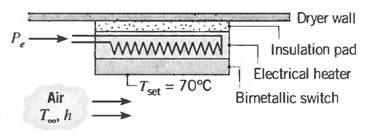
The temperature controller for a clothes dryer consists of a bimetallic switch mounted on an electrical heater attached to a wall-mounted insulation pad.The switch is set to open at 70°C, the maximum dryer air temperature. In order to operate the dryer at a lower air temperature, sufficient power
The free convection heat transfer coefficient on a thin hot vertical plate .suspended in still air can be determined from observations of the change in plate temperature with time as it cools. Assuming the plate is isothermal and radiation exchange with its surroundings is negligible, evaluate the
A transmission case measures W = 0.30 m on a side and receives a power input of Pi = 150 hp from the engine.If the transmission efficiency is η = 0.93 and air flow over the case corresponds to T∞ = 30°C and h = 200 W/m2. K, what is the surface temperature of the transmission?
Under conditions for which the same room temperature is maintained by a heating or cooling system, it is not uncommon for a person to feel chilled in the winter but comfortable in the summer. Provide a plausible explanation for this situation (with supporting calculations) by considering a room
A spherical interplanetary probe of 0.5-m diameter contains electronics that dissipate 150 W. If the probe surface has an emissivity of 0.8 and the probe does not receive radiation from other surfaces, as, for example, from the sun, what is its surface temperature?
An instrumentation package has a spherical outer surface of diameter D = 100 mm and emissivity B = 0.25. The package is placed in a large space simulation chamber whose walls are maintained at 77 K. If operation of the electronic components is restricted to the temperature range 40 < T <
Consider the conditions of Problem 1.22. However, now the plate is in a vacuum with a surrounding temperature of 25°C. What is the emissivity of the plate? What is the rate at which radiation is emitted by the surface?
An overhead 25-m-Iong, un-insulated industrial steam pipe of 100 mm diameter is routed through a building whose walls and air are at 25°C. Pressurized steam maintains a pipe surface temperature of 150°C, and the coefficient associated with natural convection is h = 10 W/m2. K. The surface
If Ts ≈ Tsur in Equation 1.9, the radiation heat transfer coefficient may be approximated as hr,a = 4εσT3 where T ≡ (Ts + Tsur)/2. We wish to assess the validity of this approximation by comparing values of hr and hr,a for the following conditions. In each case represent your results
Consider the conditions of Problem 1.18. With heat transfer by convection to air, the maximum allowable chip power is found to be 0.35 W. If consideration is also given to net heat transfer by radiation from the chip surface to large surroundings at 15°C, what is the percentage increase in the
Chips of width L = 15 mm on a side are mounted to a substrate that is installed in an enclosure whose walls and air are maintained at a temperature of Tsur = Tx = 25°C. The chips have an emissivity of B = 0.60 and a maximum allowable temperature of Ts = 85°C.
A vacuum system, as used in sputtering electrically conducting thin films on microcircuits, is comprised of a base plate maintained by an electrical heater at 300 K and a shroud within the enclosure maintained at 77 K by a liquid-nitrogen coolant loop. The circular base plate, insulated on the
Consider the transmission case of Problem 1.23, but now allow for radiation exchange with the ground chassis, which may be approximated as large surroundings at Tsur = 30°C. If the emissivity of the case is B = 0.80, what is the surface temperature?
An electrical resistor is connected to a battery, as shown schematically. After a brief transient, the resistor assumes a nearly uniform, steady-state temperature of 95°C, while the battery and lead wires remain at the ambient temperature of 25°C. Neglect the electrical resistance of the lead
An aluminum plate 4 mm thick is mounted in a horizontal position and its bottom surface is well insulated. A special, thin coating is applied to the top surface such that it absorbs 80% of any incident solar radiation, while having an emissivity of 0.25. The density p and specific heat c of
The energy consumption associated with a home water heater has two components: (i) the energy that must be supplied to bring the temperature of groundwater to the heater storage temperature, as it is introduced to replace hot water that has been used, and (ii) the energy needed to compensate for
Three electric resistance heaters of length L = 250 mm and diameter D = 25 mm are submerged in a 10 gallon tank of water, which is initially at 295 K. The water may be assumed to have a density and specific heat of p = 990 kg/m3 and c = 4180J/kg ∙ K.(a) If the heaters are activated, each
A hair dryer may be idealized as a circular duct through which a small fan draws ambient air and within which the air is heated as it flows over a coiled electric resistance wire.
In one stage of an annealing process, 304 stainless steel sheet is taken from 300 K to 1250 K as it passes through an electrically heated oven at a speed of V, = 10 mm/s. The sheet thickness and width are ts = 8 mm and W, = 2 m, respectively, while the height, width and length of the oven are Ho =
Annealing, an important step in semiconductor materials processing, can be accomplished by rapidly heating the silicon wafer to a high temperature for a short period of time. The schematic shows a method involving use of a hot plate operating at an elevated temperature Tit' The wafer, initially at
In the thermal processing of semiconductor materials, annealing is accomplished by heating a silicon wafer according to a temperature-time recipe and then maintaining a fixed elevated temperature for a prescribed period of time. For the process tool arrangement shown as follows, the wafer is in an
A furnace for processing semiconductor materials is formed by a silicon carbide chamber that is zone heated on the top section and cooled on the lower section. With the elevator in the lowest position, a robot arm inserts the silicon wafer on the mounting pins. In a production operation, the wafer
Radioactive wastes are packed in a long, thin-walled cylindrical container. The wastes generate thermal energy non-uniformly according to the relation q = qv [1 – (r/ro) 2], where q is the local rate of energy generation per unit volume, qo is a constant, and r0 is the radius of the
Consider the conducting rod of Example 1.3 under steady-state conditions. As suggested in Comment 3, the temperature of the rod may be controlled by varying the speed of air flow over the rod, which, in turn, alters the convection heat transfer coefficient. To consider the effect of the convection
A long bus bar (cylindrical rod used for making electrical connections) of diameter D is installed in a large conduit having a surface temperature of 30°C and in which the ambient air temperature is T", = 30°C. The electrical resistivity, ρ<μΩ ∙ m), of the bar material is a function of
A small sphere of reference-grade iron with a specific heat of 447 J/kg 0 K and a mass of 0.515 kg is suddenly immersed in a water-ice mixture. Fine thermocouple wires suspend the sphere, and the temperature is observed to change from 15 to 14°C in 6.35 s. The experiment is repeated with a
A spherical, stainless steel (AISI 302) canister is used to store reacting chemicals that provide for a uniform heat flux q”i to its inner surface. The canister is suddenly submerged in a liquid bath of temperature T∞i, where Ti is the initial temperature of the canister wall.(a) Assuming
Liquid oxygen, which has a boiling point of 90 K and a latent heat of vaporization of 214kJ/kg, is stored in a spherical container whose outer surface is of 500-mm diameter and at a temperature of - 10°C. The container is housed in a laboratory whose air and walls are at 25°C.(a) If the surface
A freezer compartment is covered with a 2-mm-thick layer of frost at the time it malfunctions. If the compartment is in ambient air at 20°C and a coefficient of h = 2 W/m2 ∙ K characterizes heat transfer by natural convection from the exposed surface of the layer, estimate the time required to
A vertical slab of Woods metal is joined to a substrate on one surface and is melted as it is uniformly irradiated by a laser source on the opposite surface. The metal is initially at its fusion temperature of Tf = 72°C and the melt runs off by gravity as soon as it is formed. The absorptivity of
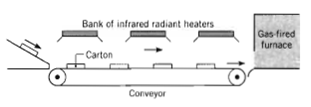
Following the hot vacuum forming of a paper-pulp mixture, the product, an egg carton, is transported on a conveyor for 18 s toward the entrance of a gas-fired oven where it is dried to a desired final water content. It is observed that very little water evaporates during the travel time. So to
Electronic power devices are mounted to a heat sink having an exposed surface area of 0.045 m2 and an emissivity of 0.80. When the devices dissipate a total power of 20 Wand the air and surroundings are at 27°C, the average sink temperature is 42°C. What average temperature will the heat sink
A computer consists of an array of five printed circuit boards (PCBs), each dissipating Pb = 20 W of power. Cooling of the electronic components on a board is provided by the forced flow of air, equally distributed in passages formed by adjoining boards, and the convection coefficient associated
The roof of a car in a parking lot absorbs a solar radiant flux of 800 W/m2, while the underside is perfectly insulated. The convection coefficient between the roof and the ambient air is 12 W/m2 ∙ K.(a) Neglecting radiation exchange with the surroundings, calculate the temperature of the roof
Consider the conditions of Problem 1.22, but the surroundings temperature is 25°C and radiation exchange with the surroundings is not negligible. If the convection coefficient is 6.4 W/m2 ∙ K and the emissivity of the plate is ε = 0.42, determine the time rate of change of the plate
Showing 8100 - 8200
of 18200
First
75
76
77
78
79
80
81
82
83
84
85
86
87
88
89
Last
Step by Step Answers

 Get 50% OFF
Claim Now
Get 50% OFF
Claim Now


.PNG)
.PNG)
.PNG)
.PNG)
.PNG)
.PNG)
.PNG)
.PNG)
.PNG)
.PNG)
.PNG)
.PNG)
.PNG)
.PNG)
.PNG)
.PNG)
.PNG)
.PNG)
.PNG)
.PNG)
.PNG)
.PNG)
.PNG)
.PNG)
.PNG)
.PNG)
.PNG)
.PNG)
.PNG)
.PNG)
.PNG)
.PNG)
.PNG)
.PNG)
.PNG)
.PNG)
.PNG)
.PNG)
.PNG)
.PNG)
.PNG)
.PNG)
.PNG)
.PNG)
.PNG)
.PNG)
.PNG)
.PNG)
.PNG)
.PNG)
.PNG)
.PNG)
.PNG)
.PNG)
.PNG)
.PNG)
.PNG)


