New Semester
Started
Get
50% OFF
Study Help!
--h --m --s
Claim Now
Question Answers
Textbooks
Find textbooks, questions and answers
Oops, something went wrong!
Change your search query and then try again
S
Books
FREE
Study Help
Expert Questions
Accounting
General Management
Mathematics
Finance
Organizational Behaviour
Law
Physics
Operating System
Management Leadership
Sociology
Programming
Marketing
Database
Computer Network
Economics
Textbooks Solutions
Accounting
Managerial Accounting
Management Leadership
Cost Accounting
Statistics
Business Law
Corporate Finance
Finance
Economics
Auditing
Tutors
Online Tutors
Find a Tutor
Hire a Tutor
Become a Tutor
AI Tutor
AI Study Planner
NEW
Sell Books
Search
Search
Sign In
Register
study help
physics
light and optics
Physics 2nd edition Alan Giambattista, Betty Richardson, Robert Richardson - Solutions
A light bulb is 4.00 m from a wall. You are to use a concave mirror to project an image of the bulb on the wall, with the image 2.25 times the size of the object. How far should the mirror be from the wall? What should its radius of curvature be?
A concave mirror is to form an image of the filament of a headlight lamp on a screen 8.00 m from the mirror. The filament is 6.00 mm tall, and the image is to be 36.0 cm tall. (a) How far in front of the vertex of the mirror should the filament be placed?(b) What should be the radius of curvature
Rear-View Mirror A mirror on the passenger side of your car is convex and has a radius of curvature with magnitude 18.0 cm. (a) Another car is seen in this side mirror and is 13.0 m behind the mirror. If this car is 1.5 m tall, what is the height of the image? (b) The mirror has a warning attached
Suppose the lamp filament shown in Example 34.1 (Section 34.2) is moved to a position 8.0 cm in front of the mirror.(a) Where is the image located now? Is it real or virtual? (b) What is the height of the image? Is it erect or inverted? (c) In Example 34.1, the filament is 10.0cm in front of the
Where must you place an object in front of a concave mirror with radius R so that the image is erect and 2 ½ times the size of the object? Where is the image?
Virtual Object If the light incident from the left one a convex mirror does not diverge from an object point but instead converges toward a point at a (negative) distance. to the right of the mirror, this point is called a virtual object. (a) For a convex mirror having a radius of curvature of 24.0
A layer of benzene (n = 1.50) 2.60 cm deep floats on water (n = 1.33) that is 6.50 cm deep. What is the apparent distance from the upper benzene surface to the bottom of the water layer when it is viewed at normal incidence?
Sketch the various possible thin lenses that can be obtained by combining two surfaces whose radii of curvature are 4.00 cm and 8.00 cm in absolute magnitude. Which are converging and which are diverging? Find the focal length of each if the surfaces are made of glass with index of refraction 1.60.
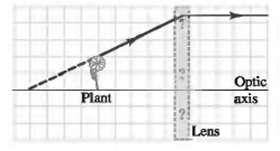
Figure 34.56 shows a small plant near a thin lens. The ray shown is one of the principal rays for the lens. Each square is 2.0 cm along the horizontal direction, but the vertical direction is not to the same scale. Use information from the diagram to answer the following questions:(a) Using only
You are in your car driving on a highway at 25m/s when you glance in the passenger side mirror (a convex mirror with radius of curvature 150 cm) and notice a truck approaching. If the image of the truck is approaching the vertex of the mirror at a speed of 1.5mn/s when the truck is 2.0 m away, what
A microscope is focused on the upper surface of a glass plate. A second plate is then placed over the first. To focus on the bottom surface of the second plate, the microscope must be raised 0.780 mm. To focus on the upper surface, it must be raised another 2.50 mm. Find the index of refraction of
Three Dimensional Image The longitudinal magnification is defined as m' = ds'/ds. It relates the longitudinal dimension of a small object to the longitudinal dimension of its image. (a) Show that for a spherical mirror, m' = – m2. What is the significance of the fact that m' is always negative?
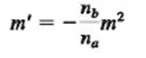
Refer to Problem 34.75. Show that the longitudinal magnification m' for refraction at a spherical surface is givenby
Pinhole Camera A pinhole camera is just a rectangular box with a tiny hole in one face. The film is on the face opposite this hole, and that is where the image is formed. The camera forms an image without a lens. (a) Make a clear ray diagram to show how a pinhole camera can form an image on the
A Glass Rod Both ends of a glass rod with index of refraction 1.60 are ground and polished to convex hemispherical surfaces. The radius of curvature at the left end is 6.00 cm, and the radius of curvature at the right end is 12.0 cm. The length of the rod between vertices is 40.0 cm. The object for
The rod in Problem 34.78 is shortened to a distance of 25.0 cm between its vertices; the curvatures of its ends remain the same. As in Problem 34.78, the object for the surface at the left end is an arrow that lies 23.0 cm to the left of the vertex of this surface. The arrow is 1.50 mm tall and at
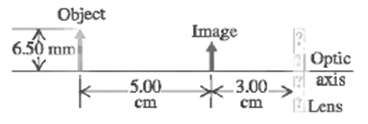
Figure 34.57 shows an object and its image formed by a thin lens.(a) What is the focal length of the lens, and what type of lens (converging or diverging) is it?(b) What is the height of the image? Is it real orvirtual?
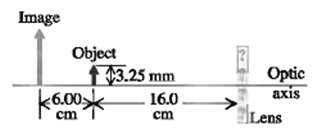
Figure 34.58 shows an object and its image formed by a thin lens.(a) What is the focal length of the lens, and what type of lens (converging or diverging) is it?(b) What is the height of the image? Is it real orvirtual?
A transparent rod 30.0 cm long is cut flat at one end and rounded to a hemispherical surface of radius 10.0 cm at the other end. A small object is embedded within the rod along its axis and halfway between its ends, 15.0 cm from the flat end and 15.0 cm from the vertex of the curved end when viewed
A solid glass hemisphere of radius 12.0 cm and index of refraction n = 1.50 is placed with its flat face downward on a table. A parallel beam of light with a circular cross section 3.80 mm in diameter travels straight down and enters the hemisphere at the center of its curved surface. (a) What is
A thick-walled wine goblet sitting on a table can be considered to be a hollow glass sphere with an outer radius of 4.00 cm and an inner radius of 3.40 cm. The index of refraction of the goblet glass is 1.50. (a) A beam of parallel light rays enters the side of the empty goblet along a horizontal
Focus of the Eye. The cornea of the eye has a radius of curvature of approximately 0.50 cm, and the aqueous humor behind it has an index of refraction of 1.35. The thickness of the cornea itself is small enough that we shall neglect it. The depth of a typical human eye is around 25 mm. (a) What
A transparent rod 50.0 cm long and with a refractive index of 1.60 is cut flat at the right end and rounded to a hemispherical surface with a 15.0-cm radius at the left end. An object is placed on the axis of the rod 12.0 cm to the left of the vertex of the hemispherical end. (a) What is the
What should be the index of refraction of a transparent sphere in order for paraxial rays from an infinitely distant object to be brought to a focus at the vertex of the surface opposite the point of incidence?
A glass rod with a refractive index of 1.55 is ground and polished at both ends to hemispherical surfaces with radii of 6.00 cm. When an object is placed on the axis of the rod, 25.0 cm to the left of the left-hand end, the final image is formed 65.0 cm to the right of the right-hand end. What is
Two thin lenses with focal lengths of magnitude 15.0 cm, the first diverging and the second converging, are placed 12.00 cm apart. An object 4.00 mm tall is placed 5.00 cm to the left of the first (diverging) lens. (a) Where is the image formed by the first lens located? (b) How far from the object
The radii of curvature of the surfaces of a thin converging meniscus lens are R1 = + 12.0 cm and R2 = + 28.0 cm. The index of refraction is 1.60.(a) Compute the position and size of the image of an object in the form of an arrow 5.00 mm tall, perpendicular to the lens axis, 45.0 cm to the left of
An object to the left of a lens is imaged by the lens on a screen 30.0 cm to the right of the lens. When the lens is moved 4.00 cm to the right the screen must be moved 4.00 cm to the left to refocus the image. Determine the focal length of the lens.
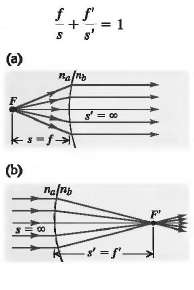
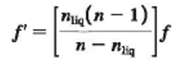
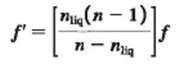
For refraction at a spherical surface, the first focal length f is defined as the value of s corresponding to s' = ?, as shown in Fig. 34.59a. The second focal length f' is defined as the value of s' when s = ?, as shown in Fig. 34.59b.(a) Prove that na/nb = f/f'??.(b) Prove that the general
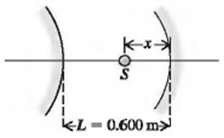
A convex mirror and a concave mirror are placed on the same optic axis, separated by a distance L = 0.600 m. The radius of curvature of each mirror has a magnitude of 0.360 m. A light source is located a distance x from the concave mirror, as shown in Fig. 34.60.(a) What distance x will result in
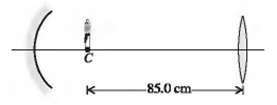
As shown in Fig. 34.61 the candle is at the center of curvature of the concave mirror, whose focal length is 10.0cm. The converging lens has a focal length of 32.0 cm and is 85.0 cm to the right of the candle. The candle is viewed looking through the lens from the right. The lens forms two images
One end of a long glass rod is ground to a convex hemispherical shape. This glass has an index of refraction of 1.55. When a small leaf is placed 20.0 cm in front of the center of the hemisphere along the optic axis, an image is formed inside the glass 9.12 cm from the spherical surface. Where the
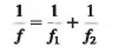
Two Lenses in Contact(a) Prove that when two thin lenses with focal lengths f1 and f2 are placed in contact, the focal length I of the combination is given by the relationship(b) A converging meniscus lens (see Fig. 34.32a) has an index of refraction of 1.55 and radii of curvature for its surfaces
Rays from a lens are converging toward a point image P located to the right of the lens. What thickness t of glass with index of refraction 1.60 must be interposed between the lens and P for the image to be formed at P', located 0.30 cm to the right of P? The locations of the piece of glass and of
A Lens in a Liquid A lens obeys Snell's law, bending light rays at each surface an amount determined by the index of refraction of the lens and the index of the medium in which the lens is located.(a) Equation (34.19) assumes that the lens is surrounded by air. Consider instead a thin lens immersed
When an object is placed at the proper distance to the left of a converging lens, the image is focused on a screen 30.0cm to the right of the lens. A diverging lens is now placed 15.0cm to the right of the converging lens, and it is found that the screen must be moved 19.2cm farther to the right to
A convex spherical mirror with a focal length of magnitude 24.0cm is placed 20.0fm to the left of a plane mirror. An object 0.250cm tall is placed midway between the surface of the plane mirror and the vertex of the spherical mirror. The spherical mirror forms multiple images of the object. Where
A glass plate 3.50cm thick, with an index of refraction of 1.55 and plane parallel faces, is held with its faces horizontal and its lower face 6.00cm above a printed page. Find the position of the image of the page formed by rays making a small angle with the normal to the plate.
A symmetric, double-convex, thin lens made of glass with index of refraction 1.52 has a focal length in air of 40.0cm. The lens is sealed into an opening in the left-hand end of a tank filled with water. At the right-hand end of the tank, opposite the lens, is a plane mirror 90.0cm from the lens.
You have a camera with a 35.0-mm focal length lens and 36.0-mm-wide film. You wish to take a picture of a 12.0-m-long sailboat but find that the image of the boat fills only ¼ of the width of the film. (a) How far are you from the boat? (b) How much closer must the boat be to you for its image to
An object is placed 18.0cm from a screen. (a) At what two points between object and screen may a converging lens with a 3.00-cm focal length be placed to obtain an image on the screen?(b) What is the magnification of the image for each position of the lens?
Three thin lenses, each with a focal length of 40.0 cm, are aligned on a common axis; adjacent lenses are separated by 52.0cm. Find the position of the image of a small object on the axis, 80.0cm to the left of the first lens.
A camera with a 90-mm-focal-Iength lens is focused on an object 130 m from the lens. To refocus on an object 6.50 m from the lens, by how much must the distance between the lens and the film be changed? To refocus on the more distant object, is the lens moved toward or away from the film?
The derivation of the expression for angular magnification, Eq. (34.22), assumed a near point of 25 cm. In fact, the near point changes with age as shown in Table 34.1. In order to achieve an angular magnification of 2.0 x, what focal length should be used by a person of (a) Age 10; (b) Age 30; (c)
Angular Magnification In deriving Eq. (34.22) for the angular magnification of a magnifier, we assumed that the object is placed at the focal point of the magnifier so that the virtual image is formed at infinity. Suppose instead that the object is placed so that the virtual image appears at an
In one form of cataract surgery the person's natural lens, which has become cloudy, is replaced by an artificial lens. The refracting properties of the replacement lens can be chosen so that the person's eye focuses on distant objects. But there is no accommodation, and glasses or contact lenses
A Nearsighted Eye A certain very nearsighted person cannot focus on anything farther than 36.0 cm from the eye. Consider the simplified model of the eye described in Exercise 34.46. If the radius of curvature of the cornea is 0.75cm when the eye is focusing on an object 36.0cm from the cornea
Focal Length of a Zoom Lens Figure 34.63 shows a simple version of a zoom lens. The converging lens has focal length f1, and the diverging lens has focal length f2 = ?? | f2|. The two lenses are separated by a variable distance d that is always less than f1. Also, the magnitude of the focal length
A certain reflecting telescope, constructed as shown in Fig. 34.55a, has a spherical mirror with a radius of curvature of 96.0 cm and an eyepiece with a focal length of 1.20cm. If the angular magnification has a magnitude of 36 and the object is at infinity, find the position of the eyepiece and
A microscope with an objective of focal length 8.00 mm and an eyepiece of focal length 7.50 cm is used to project an image on a screen 2.00 m from the eyepiece. Let the image distance of the objective be 18.0 cm. (a) What is the lateral magnification of the image? (b) What is the distance between
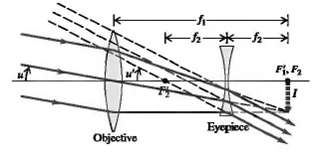
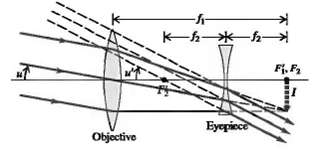
The Galilean Telescope. Figure 34.64 is a diagram of a Galilean telescope, or opera glass, with both the object and its final image at infinity. The image I serve as a virtual object for the eyepiece. The final image is virtual and erect.(a) Prove that the angular magnification is M = - f1/ f2.(b)
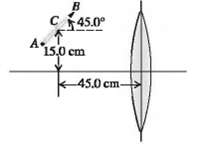
An Object at an Angle A 16.0-cm-long pencil is placed at a 45.0? angle, with its center 15.0 cm above the optic axis and 45.0 cm from a lens with a 20.0-cm focal length as shown in Fig. 34.65. (Note that the figure is not drawn to scale.) Assume that the diameter of the lens is large enough for the
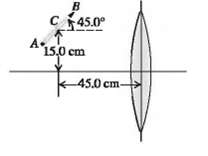
An Object at an Angle A 16.0-cm-long pencil is placed at a 45.0? angle, with its center 15.0 cm above the optic axis and 45.0 cm from a lens with a 20.0-cm focal length as shown in Fig. 34.65. (Note that the figure is not drawn to scale.) Assume that the diameter of the lens is large enough for the
(a) For a lens with focal length f, find the smallest distance possible between the object and its real image. (b) Graph the distance between the object and the real image as a function of the distance of the object from the lens. Does your graph agree with the result you found in part (a)?
Two mirrors are placed together as shown in Fig. 34.66.(a) Show that a point source in front of these mirrors and its two images lie on a circle.(b) Find the center of the circle.(c) In a diagram, show where an observer should stand so as to be able to see bothimages.
People with normal vision cannot focus their eyes underwater if they aren't wearing a face mask or goggles and there is water in contact with their eyes (see Discussion Question Q34.23).(a) Why not? (b) With the simplified model of the eye described in Exercise 34.46, what corrective lens
Two coherent sources A and B of radio waves are 5.00 m apart. Each source emits waves with wavelength 6.00 m. Consider points along the line between the two sources. At what distances, if any, from A is the interference (a) Constructive and (b) Destructive?
Radio Interference. Two radio antennas A and B radiate in phase. Antenna B is 120 m to the right of antenna A. Consider point Q along the extension of the line connecting the antennas, a horizontal distance of 40 m to the right of antenna B. The frequency, and hence the wavelength, of the emitted
A radio transmitting station operating at a frequency of 120 MHz has two identical antennas that radiate in phase. Antenna B is 9.00nm to the right of antenna A. Consider point P between the antennas and along the line connecting them, a horizontal distance x to the right of antenna A. For what
Two light sources can be adjusted to emit monochromatic light of any visible wavelength. The two sources are coherent, 2.04µm apart, and in line with an observer, so that one source is 2.04µm farther from the observer than the other. (a) For what visible wavelengths (400 to 100nm) will the
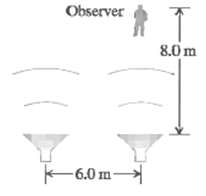
Two speakers, emitting identical sound waves of wavelength 2.0 m in phase with each other, and an observer are located as shown in Fig. 35.21.(a) At the observer's location, what is the path difference for waves from the two speakers?(b) Will the sound waves interfere constructively or
Figure 35.3 shows the wave pattern produced by two identical, coherent sources emitting waves with wavelength λ and separated by a distance d = 4λ. (a) Explain why the positive y-axis above S1, constitutes an anti nodal curve with m = +4 and why the negative y-axis below S2 constitutes
Consider Fig. 35.3, which could represent interference between water waves in a ripple tank. Pick at least three points on the anti nodal curve labeled "m = 3," and make measurements from the figure to show that Eq. (35.1) is indeed satisfied. Explain what measurements you made and bow you measured
Young's experiment is perfonned with light from excited helium atoms (λ = 502 om). Fringes are measured carefully on a screen 1.20 m away from the double slit, and the center of the 20th fringe (not counting the central bright fringe) is found to be 10.6 mm from the center of the central
Two slits spaced 0.450 mm apart are placed 75.0 cm from a screen. What is the distance between the second and third dark lines of the interference pattern on the screen when the slits are illuminated with coherent light with a wavelength of 500nm?
Coherent light with wavelength 450nm falls on a double slit. On a screen 1.80 m away, the distance between dark fringes is 4.20 mm. What is the separation of the slits?
Coherent light from a sodium-vapor lamp is passed through a filter that blocks everything except light of a single wavelength. It then falls on two slits separated by 0.460 mm. In the resulting interference pattern on a screen 2.20 m away, adjacent bright fringes are separated by 2.82 mm. What is
Coherent light with wavelength 400nm passes through two very narrow slits that are separated by 0.200 mm and the interference pattern is observed on a screen 4.00 m from the slits. (a) What is the width (in mm) of the central interference maximum? (b) What is the width of the first-order bright
Two very narrow slits are spaced 1.80µm apart and are placed 35.0 cm from a screen. What is the distance between the first and second dark lines of the interference pattern when the slits are illuminated with coherent light with λ = 550nm?
Coherent light that contains two wavelengths, 660nm (red) and 470 urn (blue), passes through two narrow slits separated by 0.300 mm, and the interference pattern is observed on a screen 5.00 m from the slits. What is the distance on the screen between the first-order bright fringes for the two
Coherent light with wavelength 600 urn passes through two very narrow slits and the interference pattern is observed on a screen 3.00 m from the slits. The first-order bright fringe is at 4.84 mm from the center of the central bright fringe. For what wavelength of light will the first-order dark
Coherent light of frequency 6.32 x 10¹⁴ Hz passes through two thin slits and falls on a screen 85.0 cm away. You observe that the third bright fringe occurs at ± 3.11 cm on either side of the central bright fringe. (a) How far apart are the two slits? (b) At what distance from the central bright
An FM radio station has a frequency of 107.9 MHz and uses two identical antennas mounted at the same elevation, 12.0 m apart. The antennas radiate in phase. The resulting radiation pattern has a maximum intensity along a horizontal line perpendicular to the line joining the antennas and midway
In a two-slit interference pattern, the intensity at the peak ofthe central maximum is I0. (a) At a point in the pattern where the phase difference between the waves from the two slits is 60.0°, what is the intensity? (b) What is the path difference for 480-urn light from the two slits at a point
Coherent sources A and B emit electromagnetic waves with wavelength 2.00 cm. Point P is 4.86 m from A and 5.24 m from B. What is the phase difference at P between these two waves?
Coherent light with wavelength 500nm passes through narrow slits separated by 0.340 mm. At a distance from the slits large compared to their separation, what is the phase difference (in radians) in the light from the two slits at an angle of 23.0° from the centerline?
Coherent light with wavelength 500nm passes through narrow slits separated by 0.340 mm. At a distance from the slits large compared to their separation, what is the phase difference (in radians) in the light from the two slits at an angle of 23.0° from the centerline? Discuss.
Two slits spaced 0.260 mm apart are placed 0.700 m from a screen and illuminated by coherent light with a wavelength of 660mm. The intensity at the center of the central maximum (θ = 0o) is I0. (a) What is the distance on the screen from the center of the central maximum to the first
Show that Eq. (35.14) gives zero-intensity directions that agree with Eq. (35.5).
Points A and B are 56.0 m apart along an east-west line. At each of these points, a radio transmitter is emitting a 12.5-MHz signal horizontally. These transmitters are in phase with other and emit their beams uniformly in a horizontal plane. A receiver is taken 0.500 km north of the AB line and
Points A and B are 56.0 m apart along an east-west line. At each of these points, a radio transmitter is emitting a 12.5-MHz signal horizontally. These transmitters are in phase with other and emit their beams uniformly in a horizontal plane. A receiver is taken 0.500 km north of the AB line and
What is the thinnest film of a coating with n = 1.42 on glass (n = 1.52) for which destructive interference of the red component (650nm) of an incident white light beam in air can take place by reflection?
Non-glare Glass. When viewing a piece of art that is behind glass, one often is affected by the light that is reflected off the front of the glass (called glare), which can make it difficult to see the art clearly. One solution is to coat the outer surface of the glass with a film to cancel part of
Two rectangular pieces of plane glass are laid one upon the other on a table. A thin strip of paper is placed between them at one edge so that a very thin wedge of air is formed. The plates are illuminated at normal incidence by 546-nm light from a mercury vapor lamp. Interference fringes are
A plate of glass 9.00cm long is placed in contact with a second plate and is held at a small angle with it by a metal strip 0.0800 mm thick placed under one end. The space between the plates is filled with air. The glass is illuminated from above with light having a wavelength in air of 656nm. How
A uniform film of TiO2, 1036nm thick and having index of refraction 2.62, is spread uniformly over the surface of crown glass of refractive index 1.52. Light of wavelength 520.0nm falls at normal incidence onto the film from all You want to increase the thickness of this film so that the reflected
A plastic film with index of refraction 1.85 is put on the surface of a car window to increase the reflectivity and thus to keep the interior of the car cooler. The window glass has index of refraction 1.52. (a) What minimum thickness is required if light with wavelength 550nm in air reflected
The walls of a soap bubble have about the same index of refraction as that of plain water, n = 133. There is air both inside and outside the bubble. (a) What wavelength (in air) of visible light is most strongly reflected from a point on a soap bubble where its wall is 290nm thick? To what color
Light with wavelength 648nm in air is incident perpendicularly from air on a film 8.76µm thick and with refractive index 1.35. Part of the light is reflected from the first surface of the film, and part enters the film and is reflected back at the second surface, where the film is again in contact
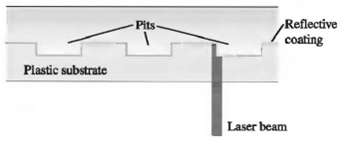
Compact Disc Player a compact disc (CD) is read from the bottom by a semiconductor laser with wavelength 790nm passing through a plastic substrate of refractive index 1.8. When the beam encounters a pit, part of the beam is reflected from the pit and part from the flat region between the pits, so
What is the thinnest soap film (excluding the case of zero thickness) that appears black when illwninated with light with wavelength 480nm? The index of refraction of the film is 1.33, and there is air on both sides of the film.
How far must the mirror M2 (see Fig. 35.20) of the Michel-son interferometer be moved so that 1800 fringes of He-Ne laser light (λ = 633nm) move across a line in the field of view?
Jan first uses a Michelson interferaneter with the 606-nm light from a krypton-86 lamp. He displaces the movable mirror away from him, counting 818 fringes moving across a line in his field of view. Then Linda replaces the krypton lamp with filtered 502-nm light from a helium lamp and displaces the
The radius of curvature of the convex surface of a planoconvex lens is 95.2 cm. The lens is placed convex side down on a perfectly flat glass plate lhat is illuminated from above with red light having a wavelength of 580nm. Find the diameter of the second bright ring in the interference pattern.
Newton's rings can be seen when a planoconvex lens is placed on a flat glass surface (see Problem 3539). For a particular lens with an index of refraction of n = 1.50 and a glass plate with an index of n = 1.80, the diameter of the third bright ring is 0.850 mm. If water (n = 1.33) now fills the
Suppose you illuminate two thin slits by monochromatic coherent light in air and find lhat they produce their first interference minima at ± 35.20° on either side of the central bright spot. You then immerse these slits in a transparent liquid and illuminate them with the same light. Now you find
A very thin sheet of brass contains two thin parallel slits. When a laser beam shines on these slits at normal incidence and room temperature (20.0oC), the first interference dark fringes occur at ±325° from the original direction of the laser beam when viewed from some distance. If this sheet is
Two speakers, 2.50 m apart, are driven by the same audio oscillator so that each one produces a sound consisting of two distinct frequencies, 0.900 kHz and 1.20 kHz. The speed of sound in the room is 344 m}s. Find all the angles relative to the usual center line in front of (and far from) the
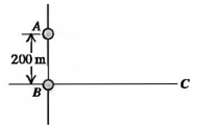
Two radio antennas radi ating in phase are located at points A and B, 200 m apart (Fig. 35.23). The radio waves have a frequency of 5.80 MHz. A radio receiver is moved out from point B along a line perpendicular to the line connecting A and B (line Be shown in Fig. 35.23). At what distances from B
Showing 1100 - 1200
of 2678
First
5
6
7
8
9
10
11
12
13
14
15
16
17
18
19
Last
Step by Step Answers

 Get 50% OFF
Claim Now
Get 50% OFF
Claim Now