New Semester
Started
Get
50% OFF
Study Help!
--h --m --s
Claim Now
Question Answers
Textbooks
Find textbooks, questions and answers
Oops, something went wrong!
Change your search query and then try again
S
Books
FREE
Study Help
Expert Questions
Accounting
General Management
Mathematics
Finance
Organizational Behaviour
Law
Physics
Operating System
Management Leadership
Sociology
Programming
Marketing
Database
Computer Network
Economics
Textbooks Solutions
Accounting
Managerial Accounting
Management Leadership
Cost Accounting
Statistics
Business Law
Corporate Finance
Finance
Economics
Auditing
Tutors
Online Tutors
Find a Tutor
Hire a Tutor
Become a Tutor
AI Tutor
AI Study Planner
NEW
Sell Books
Search
Search
Sign In
Register
study help
physics
light and optics
Fundamentals of Physics 8th Extended edition Jearl Walker, Halliday Resnick - Solutions
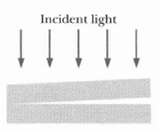
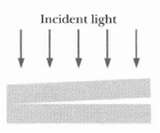
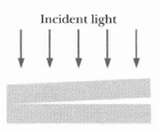
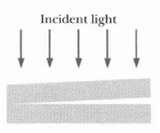
In Figure a broad beam of light of wavelength 683 nm is sent directly downward through the top plate of a pair of glass plates. The plates are 120 mm long, touch at the left end, and are separated by 48.0μm at the right end. The air between the plates acts as a thin film. How many bright fringes
In Figure a broad beam of light of wavelength 620 nm is sent directly downward through the top plate of a pair of glass plates touching at the left end. The air between the plate??s acts as a thin film and an interference pattern can be seen from above the plates. Initially, a dark fringe lies at
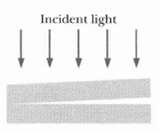
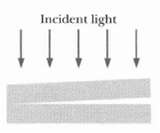
In Figure two microscope slides touch at one end and are separated at the other end. When light of wavelength 500 nm shines vertically down on the slides, an overhead observer sees interference pattern on the slides with the dark fringes separated by L2 mm. What is the angle between the slides?
In Figure a broad beam of monochromatic light is directed perpendicularly through two glass plates that are held together at one end to create a wedge of air between them. An observer intercepting light reflected from the wedge of air, which acts as a thin film, sees 4001 dark fringes along the
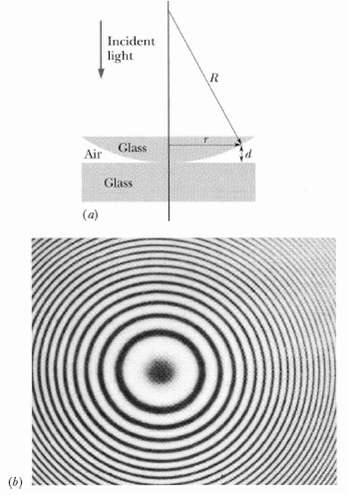
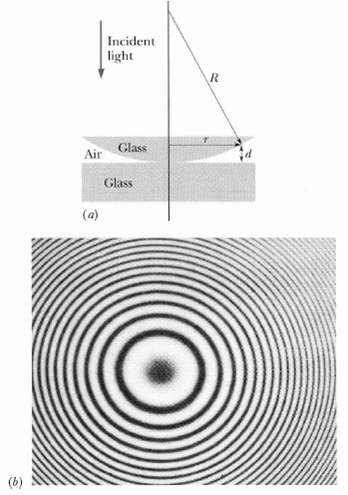
Figure a shows a lens with radius of curvature R lying on a flat glass plate and illuminated from above by light with wavelength ? Figure b, (a photograph taken from above the lens) shows that circular interference fringes (called Newton's rings) appear, associated with the variable thickness d of
In a Newton's rings experiment (see Problem 75), the radius of curvature R of the lens is 5.0 m and the lens diameter is 20 mm.(a) How many bright rings are produced? Assume that λ = 589 nm.(b) How many bright rings would be produced if the arrangement were immersed in water (n = 1.33)?
A Newton's rings apparatus is to be used to determine the radius of curvature of a lens. The radii of the nth and (n + 20)th bright rings are measured and found to be 0.1,62 and 0.368 cm, respectively, in light of wavelength 546 nm. Calculate the radius of curvature of the lower surface of thelens.
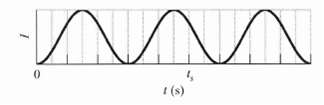
A thin film of liquid is held in a horizontal circular ring, with air on both sides of the film. A beam of light at wavelength 550 nm is directed perpendicularly onto the film, and the intensity 1 of its reflection is monitored. Figure gives intensity I as a function of time t; the horizontal scale
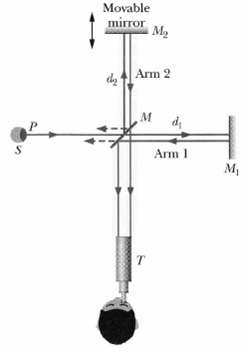
If mirror Mz in a Michelson interferometer (Figure) is moved through 0.233mm, a shift of 792 bright fringes occurs. What is the wavelength of the light producing the fringepattern?
A thin film with index of refraction n = 1.40 is placed in one arm of a Michelson interferometer, perpendicular to the optical path. If this causes a shift of 7.0 bright fringes of the pattern produced by light of wavelength 589nm, what is the film thickness?
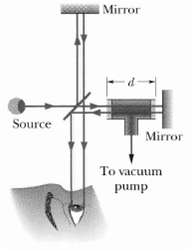
In Figure an airtight chamber of length d = 5.0 cm is placed in one of the arms of a Michelson interferometer. (The glass window on each end of the chamber has negligible thickness.) Light of wavelength ? = 500 nm is used. Evacuating the air from the chamber causes a shift of 60 bright fringes.
The element sodium can emit light at two wavelengths, λ1 = 589.10 nm and λ2 = 589.59 nm. Light from sodium is being used in a Michelson interferometer (Figure). Through what distance must mirror M2 be moved if the shift in the fringe pattern for one wavelength is to be 1.00fringe more than the
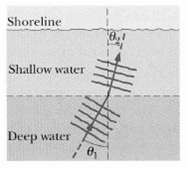
Ocean waves moving at a speed of 4.0 m/s are approaching a beach at angle ?1 = 30o to the normal, as shown from above in Figure. Suppose the water depth changes abruptly at a certain distance from the beach and the wave speed there drops to 3.0 m/s.(a) Close to the beach, what is the angle ?2
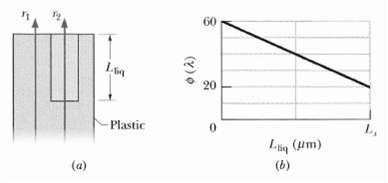
Figure a, shows two light rays that are initially in phase as they travel upward through a block of plastic, with wavelength 400 nm as measured in air. Light ray r1 exits directly into air. However, before light ray r2 exits into air, it travels through a liquid in a hollow cylinder within the
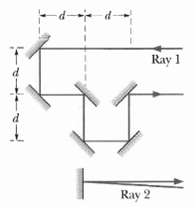
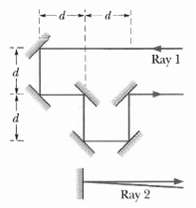
Two light rays, initially in phase and with a wavelength of 500 nm, go through different paths by reflecting from the various mirrors shown in Figure. (Such a reflection does not itself produce a phase shift.) (a) What least value of distance d will put the rays exactly out of phase when they
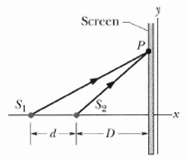
In Figure two isotropic point sources S1 and S2 emit light in phase at wavelength 1 and at the same amplitude. The sources are separated by distance d = 6.00? on an x axis. A viewing screen is at distance D = 20.0? from S2 and parallel to the y axis. The figure shows two rays reaching point P on
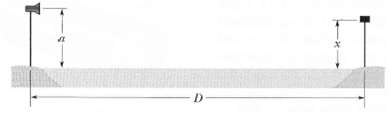
In Figure a microwave transmitter at height a above the water level of a wide lake transmits microwaves of wavelength ? toward a receiver on the opposite shore, a distance x above the water level. The microwaves reflecting from the water interfere with the microwaves arriving directly from the
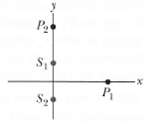
In Figure two isotropic point sources S1 and S2 emit light at wavelength ? = 400 nm. Source S1 is located at y = 640 nm; source S2 is located at y = ?? 640 nm. At point P1 (at x = 120 nm), the wave from S2 arrives ahead of the wave from S1 by a phase difference of 0.600? rad.(a) What multiple of ?
A double-slit arrangement produces bright interference fringes for sodium light (λ = 589 nm) that are angularly separated by 0.30o near the center of the pattern. What is the angular fringe separation if the entire arrangement is immersed in water, which has an index of refraction of 1.33?
Two light rays, initially in phase and with a wavelength of 500 nm, go through different paths by reflecting from the various mirrors shown in Figure. (Such a reflection does not itself produce a phase shift.)(a) What least value of distance d will put the rays exactly out of phase when they emerge
In a phasor diagram for the waves at any point on the viewing screen for the two-slit experiment in Figure the phasor of the resultant wave rotates 60.0o in 2.50 x 10⁻¹⁶ s. What is the wavelength of the light?
Light of wavelength 700.0 nm is sent along a route of length 2000 nm. The route is then filled with a medium having an index of refraction of 1.400. In degrees, by how much does the medium phase-shift the light? Give(a) The full shift and(b) The equivalent shift that has a value less than 360o.
Two parallel slits are illuminated with monochromatic light of wavelength 500 nm. An interference pattern is formed on a screen some distance from the slits, and the fourth dark band is located 1.68 cm from the central bright band on the screen. (a) What is the path length difference corresponding
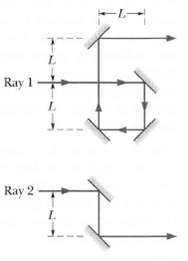
In two experiments, light is to be sent along the two paths shown in Figure by reflecting it from the various flat surfaces shown. In the first experiment, rays 1 and 2 are initially in phase and have a wavelength of 620.0 nm. In the second experiment, rays 1 and 2 are initially in phase and have a
Find the slit separation of a double-slit arrangement that will produce interference fringes 0.018 rad apart on a distant screen when the light has wavelength λ = 589 nm.
A thin film suspended in air is 0.410μm thick and is illuminated with white light incident perpendicularly on its surface. The index of refraction of the film is 1.50. At what wavelength wills visible light that is reflected from the two surfaces of the film undergo fully constructive interference?
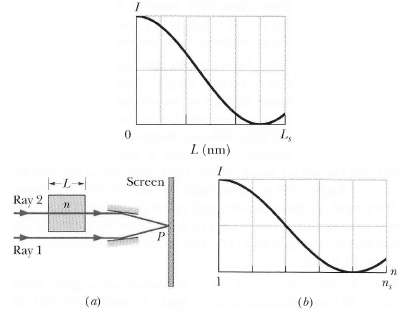
In Figure a, the waves along rays 1 and 2 are initially in phase, with the same wavelength ? in air. ?Ray 2 goes through a material with length L and index of refraction n. The rays are then reflected by mirrors to a common point P on a screen. Suppose that we can vary L from 0 to 2400 nm. Suppose
A camera lens with index of refraction greater than 1.30 is coated with a thin transparent film of index of refraction 1.25 to eliminate by interference the reflection of light at wavelength i that is incident perpendicularly on the lens. What multiple of ,1, gives the minimum film thickness needed?
If the distance between the first and tenth minima of a double-slit pattern is 18.0 mm and the slits are separated by 0.150 mm with the screen 50.0 cm from the slits, what is the wavelength of the light used?
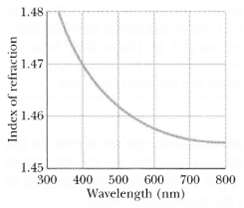
What is the speed in fused quartz of light of wavelength 550 nm? (SeeFigure)
In Sample Problem assume that the coating eliminates the reflection of light of wavelength 550 nm at normal incidence. By what percentages is reflection diminished by the coating at (a) 450 nm and (b) 650 nm?
Laser light of wavelength 632.8 nm passes through a double-slit arrangement at the front of a lecture room, reflects off a mirror 20.0 m away at the back of the room, and then produces an interference pattern on a screen at the front of the room. The distance between adjacent bright fringes is 10.0
Light of wavelength λ is used in a Michelson interferometer. Let x be the position of the movable mirror, with x = 0 when the arms have equal lengths d2 = d1. Write an expression for the intensity of the observed light as a function of x, letting Im be the maximum intensity.
A sheet of glass having an index of refraction of 1.40 is to be coated with a film of material having an index of refraction of 1.55 in order that green light with a wavelength of 525nm (in air) will be preferentially transmitted via constructive interference. (a) What is the minimum thickness of
One slit of a double-slit arrangement is covered by a thin glass plate with index of refraction 1.4 and the other by u thin glass plate with index of refraction 1.7. The point on the screen at which the central maximum fell before the glass plates were inserted is now occupied by what had been the
In Figure two glass plates are held together at one end to form a wedge of air that acts as a thin film. A broad beam of light of wavelength 480 nm is directed through the plates, perpendicular to the first plate. An observer intercepting light reflected from the plates sees on the plates an
A broad beam of light of wavelength 600 nm is sent directly downward through the glass plate (n = 1.50) in Figure. That plate and a plastic plate (n = 1.20) form a thin wedge of air that acts as a thin film. An observer looking down through the top plate sees the fringe pattern shown in Fig. 35-58,
Sodium light (λ = 589 nm) illuminates two slits separated by d = 2.0 mm. The slit-screen distance D is 40 mm. What percentage error is made by using Eq. 35-14 to locate the m : 10 bright fringe on the screen rather than using the exact path length difference?
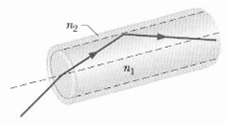
Figure shows an optical fiber in which a central plastic core of index of refraction n1 = 1.58 is surrounded by a plastic sheath of index of refraction n2 = 1.53. Light can travel along different paths within the central core, leading to different travel times through the fiber. This causes an
When an electron moves through a medium at a speed exceeding the speed of light in that medium, the electron radiates electromagnetic energy (the Cerenkov effect). What minimum speed must an electron have in a liquid with index of refraction 1.54 in order to radiate?
Point sources S1 and S2 radiate in phase at wavelength 400 nm and at the same amplitude. The sources are located on an x axis at x = 6.5μm and x = – 6.0μm, respectively. (a) Determine the phase difference (in radians) at the origin between the radiation from 51 and the radiation from
The second dark band in a double-slit interference pattern is I.2 cm from the central maximum of the pattern. The separation between the two slits is equal to 800 wavelengths of the monochromatic light incident (perpendicularly) on the slits. What is the distance between the plane of the slits and
In Figure two glass plates (n = 1.60) form a wedge, and a fluid (n = 1.50) fills the wedge-shaped space. At the left end the plates touch; at the right, they are separated by 580 nm. Light with a wavelength (in air) of 580 nm shines downward on the assembly, and an observer intercepts light sent
A thin film (n = 1.25) is deposited on a glass plate (n = 1.40) and illuminated with light of wavelength 550nm (measured in air). The light beam is perpendicular to the plate.What is the minimum (nonzero) thickness for the film that will(a) Maximally transmit and (b) Maximally reflect the light?
A light beam with a wavelength of 600 nm in air passes through film 1 (n1 = 1.2) of thickness 1.0μm, then through film 2 (air) of thickness 1.5 pm, and finally through film 3 (n3 = 1.8) of thickness 1.0μm. The beam is perpendicular to the film surfaces, which are parallel to one another.
Two light rays, initially in phase and having wavelength λ = 6.00 x 10⁻⁷ rn, pass through different plastic layers of the same thickness, 7.00 x 10⁻⁶ m. The indexes of refraction are 1.65 for one layer and 1.49 for the other. (a) What least multiple of λ gives the phase difference
In a double-slit interference experiment, the slit separation is 2.00μm, the light wavelength is 500 nm, and the separation between the slits and the screen is 4.00 m. (a) What is the angle between the center and the third side bright fringe? If we decrease the light frequency to 90.0% of
A plane monochromatic light wave in air is perpendicularly incident on a thin film of oil that covers a glass plate. The wavelength of the source may be varied continuously. Fully destructive interference of the reflected light occurs for wavelengths 500 and 700 nm and for no wavelength in between.
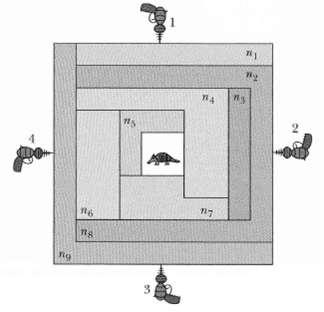
Figure shows the design of a Texas arcade game. Four laser pistols are pointed toward the center of an array of plastic layers where a clay armadillo is the target. The indexes of refraction of the layers are n1 = 1.55, n2 = 1.70, n3 = 1.45, n4 = 1.60, n5 = 1.45, n6 = 1.61, n7 = 1.59, n8 = 1.70,
In Figure let the angle θ of the two rays be 20.0o, slit separation d be 58.00μm, and wavelength λ be 500.9 nm. (a) What multiple of λ gives the phase difference of the two rays when they reach a common point on a distant screen? (b) Does their interference result in complete
Slits of unequal widths are used in a double-slit arrangement to produce an interference pattern on a distant screen. If only the narrower slit I is illuminated (the wider slit 2 is covered), the light reaching the center of the pattern has amplitude E0 and intensity I0. If only slit 2 is
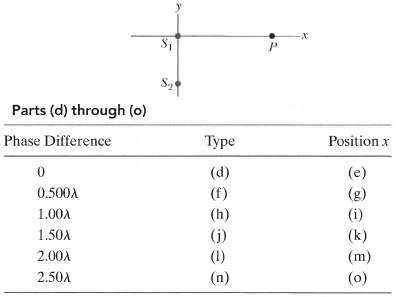
Figure shows two point sources, S1 and S2 that emit light at wavelength λ = 500 nm and with the same amplitude. The emissions are isotropic and in phase, and the separation between the sources ts d = 2.00μm. At any point P on the x axis, the wave from S1 and the wave from S2 interfere. When P is
(a) Use the result of Problem to show that, in a Newton's rings experiment, the difference in radius between adjacent bright rings (maxima) is given by Δr = r m+1 – rm ≈ ½ √λR/m, assuming m >> 1. (b) Now show that the area between adjacent bright rings is given by A =
A single slit is illuminated by light of wavelengths λa and λb chosen so that the first diffraction minimum of the λab component coincides with the second minimum of the λb component.(a) If λb = 350nm, what is λa? For what order number mb (if any) does a minimum of the λb component coincide
Monochromatic light of wavelength 441 nm is incident on a narrow slit. On a screen 2.00 m away, the distance between the second diffraction minimum and the central maximum is 1.50 cm.(a) Calculate the angle of diffraction 0 of the second minimum.(b) Find the width θ of the slit.
Light of wavelength 633 nm is incident on a narrow slit. The angle between the first diffraction minimum on one side of the central maximum and the first minimum on the other side is 1.20o. What is the width of the slit?
What must be the ratio of the slit width to the wavelength for a single slit to have the first diffraction minimum at θ = 45.0o?
A plane wave of wavelength 590 nm is incident on a slit with a width of a = 0.40 mm. A thin converging lens of focal length +70 cm is placed between the slit and a viewing screen and focuses the light on the screen.(a) How far is the screen from the lens?(b) What is the distance on the screen from
In conventional television, signals are broadcast from towers to home receivers. Even when a receiver is not in direct view of a tower because of a hill or building, it can still intercept a signal if the signal diffracts enough around the obstacle, into the obstacle's "shadow region." Previously,
The distance between the first and fifth minima of a single-slit diffraction pattern is 0.35 mm with the screen 40 cm away from the slit, when light of wavelength 550 nm is used.(a) Find the slit width.(b) Calculate the angle 0 of the first diffraction minimum.
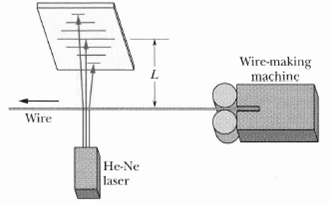
Manufacturers of wire (and other objects of small dimension) sometimes use a laser to continually monitor the thickness of the product. The wire intercepts the laser beam, producing a diffraction pattern like that of a single slit of the same width as the wire diameter (Figure). Suppose a
A slit 1.00 mm wide is illuminated by light of wavelength 589 nm. We see a diffraction pattern on a screen 3.00 m away. What is the distance between the first two diffraction minima on the same side of the central diffraction maximum?
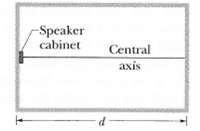
Sound waves with frequency 3000 Hz and speed 343 m/s diffract through the rectangular opening of a speaker cabinet and into a large auditorium of length d = 100 m. The opening, which has a horizontal width of 30.0 cm, faces a wall 100m away (figure). Along that wall, how far from the central axis
Monochromatic light with wavelength 538 nm is incident on a slit with width 0.025 mm. The distance from the slit to a screen is 3.5m. Consider a point on the screen 1.1 cm from the central maximum. Calculate(a) θ for that point,(b) α, and(c) The ratio of the intensity at that point to the
(a) What is the ratio of Ip to the intensity Im at the center of the pattern?(b) Determine where point P is in the diffraction pattern by giving the maximum and minimum between which it lies, or the two minima between which it lies.
A 0.10-mm-wide slit is illuminated by light of wavelength 589 nm. Consider a point P on a viewing screen on which the diffraction pattern of the slit is viewed; the point is at 30o from the central axis of the slit. What is the phase difference between the Huygens wavelets arriving at point P from
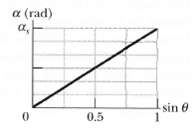
Figure gives a versus the sine of the angle θ in a single-slit diffraction experiment using light of wavelength 610 nm. The vertical axis scale is set by as = 12 rad. What are? (a) The slit width, (b) The total number of diffraction minima in the pattern (count them on both sides of the center of
(a) Show that the values of a at which intensity maxima for single-slit diffraction occur can be found exactly by differentiating Eq. 36-5 with respect to a and equating the result to zero, obtaining the condition tan a = a. To find values of a satisfying this relation, plot the curve y = tan a and
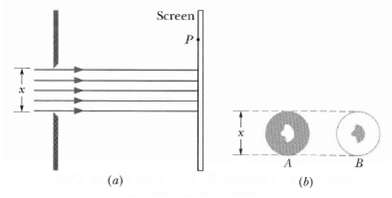
Babinet's principle, a monochromatic beam of parallel light is incident on a "collimating" hole of diameter x >> A. Point P lies in the geometrical shadow region on a distant screen (Figure a) Two diffracting objects, shown in Figure b, are placed in turn over the collimating hole. Object A
The full width at half-maximum (FWHM) of a central diffraction maximum is defined as the angle between the two points in the pattern where the intensity is one-half that at the center of the pattern.(a) Show that the intensity drops to one-half the maximum value when sin2 a = a2/2.(b) Verify that a
The telescopes on some commercial surveillance satellites can resolve objects on the ground as small as 85 cm across (see Google Earth), and the telescopes on military surveillance satellites reportedly can resolve objects as small as 10 cm across. Assume first that object resolution is determined
If Superman really had x-ray vision at 0.10 nm wavelength and a 4.0 mm pupil diameter, at what maximum altitude could he distinguish villains from heroes, assuming that he needs to resolve points separated by 5.0 cm to do this?
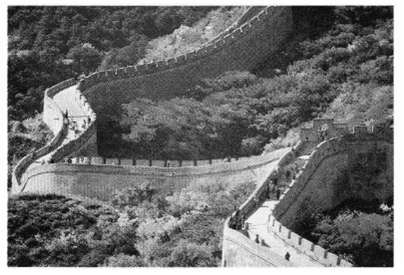
Assume that Rayleigh's criterion gives the limit of resolution of an astronaut's eye looking down on Earth's surface from a typical space shuttle altitude of 400 km. (a) Under that that idealized assumption, estimate the smallest linear width on Earth's surface that the astronaut can resolve. Take
The two headlights of an approaching automobile are 1.4 m apart. At what(a) Angular separation and(b) Maximum distance wills the eye resolve them? Assume that the pupil diameter is 5.0 mm, and use a wavelength of 550 nm for the light. Also assume that diffraction effects alone limit the resolution
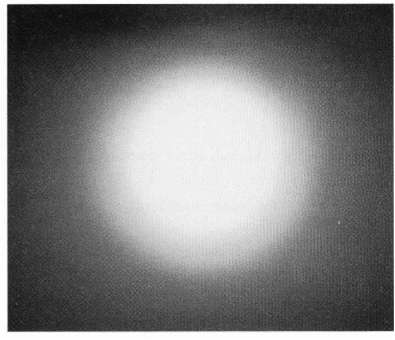
Entopic halos if someone looks at a bright outdoor lamp in otherwise dark surroundings, the lamp appears to be surrounded by bright and dark rings (hence halos) that are actually a circular diffraction pattern as in Figure with the central maximum overlapping the direct light from the lamp. The
Find the separation of two points on the Moon's surface that can just be resolved by the 200 in. (= 5.1 m) telescope at Mount Palomar, assuming that this separation is determined by diffraction effects. The distance from Earth to the Moon is 3.8 x 10⁵ km. Assume a wavelength of 550 nm for the light.
The radar system of a navy cruiser transmits at a wavelength of 1.6 cm, from a circular antenna with a diameter of 2.3 m. At a range of 6.2 km, what is the smallest distance that two speedboats can be from each other and still be resolved as two separate objects by the radar system?
Estimate the linear separation of two objects on Mars that can just be resolved under ideal conditions by an observer on Earth(a) Using the naked eye and(b) Using the 200 in. (= 5.1m) Mount Palomar telescope. Use the following data: distance to Mars = 8.0 x 10⁷ km, diameter of pupil = 5.0 mm,
The wall of a large room is covered with acoustic tile in which small holes are drilled 5.0 mm from center to center. How far can a person be from such a tile and still distinguish the individual holes, assuming ideal conditions, the pupil diameter of the observer's eye to be 4.0 mm, and the
(a) How far from grains of red sand must you be to position yourself just at the limit of resolving the grains if your pupil diameter is 1.5 mm, the grains are spherical with radius 50 pm, and the light from the grains has wavelength 650 nm?(b) If the grains were blue and the light from them had
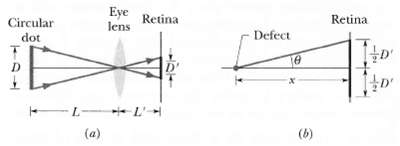
Floaters the floaters you see when viewing a bright, featureless background are diffraction patterns of defects in the vitreous humor that fills most of your eye. Sighting through a pinhole sharpens the diffraction pattern. If you also view a small circular dot, you can approximate the defect's
Millimeter-wave radar generates a narrower beam than conventional microwave radar, making it less vulnerable to antiradar missiles than conventional radar.(a) Calculate the angular width 20 of the central maximum, from first minimum to first minimum, produced by a 220 GHz radar beam emitted by a
(a) A circular diaphragm 60 cm in diameter oscillates at a frequency of 25 kHz as an underwater source of sound used for submarine detection. Far from the source, the sound intensity is distributed as the diffraction pattern of a circular hole whose diameter equals that of the diaphragm. Take the
Nuclear-pumped x-ray lasers ate seen as a possible weapon to destroy ICBM booster rockets at ranges up to 2000 km. One limitation on such a device is the spreading of the beam due to diffraction, with resulting dilution of beam intensity. Consider such a laser operating at a wavelength of 1.40 nm.
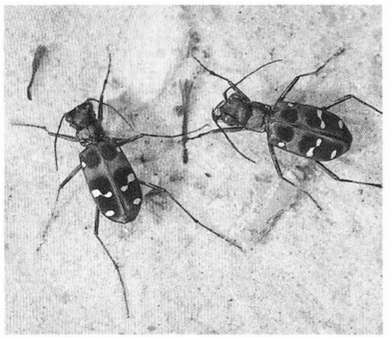
The wings of tiger beetles (Figure) are colored by interference due to thin cuticle-like layers. In addition, these layers are arranged in patches that are 60μm across and produce different colors. The color you see is a pointillistic mixture of thin-film interference colors that varies with
(a) What is the angular separation of two stars if their images are barely resolved by the Thaw refracting telescope at the Allegheny Observatory in Pittsburgh? The lens diameter is 76 cm and its focal length is 14 m. Assume λ = 550 nm.(b) Find the distance between these barely resolved stars if
A circular obstacle produces the same diffraction pattern as a circular hole of the same diameter (except very near 6 = 0). Airborne water drops are examples of such obstacles. When you see the Moon through suspended water drops, such as in a fog, you intercept the diffraction pattern from many
In a double-slit experiment, the slit separation d is 2.00 times the slit width w. How many bright interference fringes are in the central diffraction envelope?
A beam of light of a single wavelength is incident perpendicularly on a double-slit arrangement, as in Figure. The slit widths are each 46μm and the slit separation is 0.30 mm. How many complete bright fringes appear between the two first-order minima of the diffraction pattern?
Suppose that the central diffraction envelope of a double-slit diffraction pattern contains 11 bright fringes and the first diffraction minima eliminate (are coincident with) bright fringes. How many bright fringes lie between the first and second minima of the diffraction envelope?
Two slits of width a and separation d are illuminated by a coherent beam of light of wavelength λ. What is the linear separation of the bright interference fringes observed on a screen that is at a distance D away?
(a) How many bright fringes appear between the first diffraction-envelope minima to either side of the central maximum in a double-slit pattern if λ = 550 nm, d = 0.150nm, and a = 30.0μm?(b) What is the ratio of the intensity of the third bright fringe to the intensity of the central fringe?
(a) In a double-slit experiment, what ratio of d to a causes diffraction to eliminate the fourth bright side fringe?(b) What other bright fringes are also eliminated?
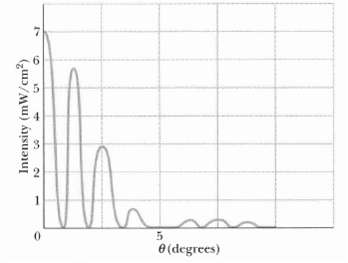
Light of wavelength 440 nm passes through a double slit, yielding a diffraction pattern whose graph of intensity l versus angular position θ is shown in Figure calculate (a) The slit width and (b) The slit separation. (c) Verify the displayed intensities of the m = 1 and m = 2 interference fringes.
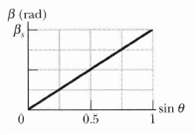
Figure gives the parameter B of Eq. 36-20 versus the sine of the angle θ in a two-slit interference experiment using light of wavelength 435nm. The vertical axis scale is set by βs = 80.0 rad what are? (a) The slit separation, (b) The total number of interference maxima (count them on both sides
(a) What is the ratio of Ip to the intensity Im at the center of the pattern?(b) Determine where P is in the two-slit interference pattern by giving the maximum or minimum on which it lies or the maximum and minimum between which it lies.(c) Next, for the diffraction that occurs, determine where
Visible light is incident perpendicularly on a grating with 315rulings/mm. What is the longest wavelength that can be seen in the fifth-order diffraction?
A grating has 400lines/mm. How many orders of the entire visible spectrum (400-700 nm) can it produce in a diffraction experiment, in addition to the m = 0 order?
Perhaps to confuse a predator, some tropical gyrinid beetles (whirligig beetles) are colored by optical interference that is due to scales whose alignment forms a diffraction grating (which scatters light instead of transmitting it). When the incident light rays are perpendicular to the grating,
A diffraction grating 20.0 mm wide has 6000 rulings. Light of wavelength 589 nm is incident perpendicularly on the grating. What are the(a) Largest,(b) Second largest, and(c) Third largest values of θ at which maxima appear on a distant viewing screen?
Showing 1500 - 1600
of 2678
First
9
10
11
12
13
14
15
16
17
18
19
20
21
22
23
Last
Step by Step Answers

 Get 50% OFF
Claim Now
Get 50% OFF
Claim Now