New Semester
Started
Get
50% OFF
Study Help!
--h --m --s
Claim Now
Question Answers
Textbooks
Find textbooks, questions and answers
Oops, something went wrong!
Change your search query and then try again
S
Books
FREE
Study Help
Expert Questions
Accounting
General Management
Mathematics
Finance
Organizational Behaviour
Law
Physics
Operating System
Management Leadership
Sociology
Programming
Marketing
Database
Computer Network
Economics
Textbooks Solutions
Accounting
Managerial Accounting
Management Leadership
Cost Accounting
Statistics
Business Law
Corporate Finance
Finance
Economics
Auditing
Tutors
Online Tutors
Find a Tutor
Hire a Tutor
Become a Tutor
AI Tutor
AI Study Planner
NEW
Sell Books
Search
Search
Sign In
Register
study help
physics
light and optics
College Physics 7th Edition Raymond A. Serway, Jerry S. Faughn, Chris Vuille, Charles A. Bennett - Solutions
A contact lens is made of plastic with an index of refraction of 1.50. The lens has an outer radius of curvature of + 2.00 cm and an inner radius of curvature of + 2.50 cm. What is the focal length of the lens?
The left face of a biconvex lens has a radius of curvature of 12.0 cm, and the right face has a radius of curvature of 18.0 cm. The index of refraction of the glass is 1.44.(a) Calculate the focal length of the lens. (b) Calculate the focal length if the radii of curvature of the two faces are
A converging lens has a focal length of 20.0 cm. Locate the images for object distances of(a) 40.0 cm, (b) 20.0 cm, and (c) 10.0 cm. For each case, state whether the image is real or virtual and upright or inverted, and find the magnification.
Where must an object be placed to have unit magnification (|M| =1.00) (a) For a converging lens of focal length 12.0 cm? (b) For a diverging lens of focal length 12.0 cm?
A diverging lens has a focal length of 20.0 cm. Locate the images for object distances of(a) 40.0 cm,(b) 20.0 cm, and(c) 10.0 cm. For each case, state whether the image is real or virtual and upright or inverted, and find the magnification.
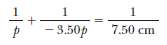
The use of a lens in a certain situation is described by the Equation Determine(a) The object distance and (b) The image distance. (c) Use a ray diagram to obtain a description of the image. (d) Identify a practical device described by the given equation, and write the statement of a problem
A transparent photographic slide is placed in front of a converging lens with a focal length of 2.44 cm. The lens forms an image of the slide 12.9 cm from it. How far is the lens from the slide if the image is (a) Real? (b) Virtual?
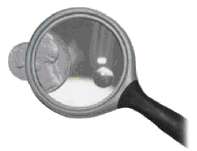
The nickel??s image in figure has twice the diameter of the nickel when the lens is 2.84 cm from the nickel. Determine the focal length of thelens.
A certain LCD projector contains a single thin lens. An object 24.0 mm high is to be projected so that its image fills a screen 1.80 m high. The object-to-screen distance is 3.00 m. (a) Determine the focal length of the projection lens. (b) How far from the object should the lens of the projector
A person uses a converging lens that has a focal length of 12.5 cm to inspect a gem. The lens forms a virtual image 30.0 cm away. Determine the magnification. Is the image upright or inverted?
A diverging lens is to be used to produce a virtual image one-third as tall as the object. Where should the object be placed?
An object is 5.00 m to the left of a flat screen. A converging lens for which the focal length is f = 0.800 m is placed between object and screen. (a) Show that there are two lens positions that form an image on the screen, and determine how far these positions are from the object. (b) How do the
A converging lens is placed 30.0 cm to the right of a diverging lens of focal length 10.0 cm. A beam of parallel light enters the diverging lens from the left, and the beam is again parallel when it emerges from the converging lens. Calculate the focal length of the converging lens.
An object is placed 20.0 cm to the left of a converging lens of focal length 25.0 cm. A diverging lens of focal length 10.0 cm is 25.0 cm to the right of the converging lens. Find the position and magnification of the final image.
Two converging lenses, each of focal length 15.0 cm, are placed 40.0 cm apart, and an object is placed 30.0 cm in front of the first lens. Where is the final image formed, and what is the magnification of the system?
Object O1 is 15.0 cm to the left of a converging lens with a 10.0-cm focal length. A second lens is positioned 10.0 cm to the right of the first lens and is observed to form a final image at the position of the original object O1. (a) What is the focal length of the second lens? (b) What is the
A 1.00-cm-high object is placed 4.00 cm to the left of a converging lens of focal length 8.00 cm. A diverging lens of focal length – 16.00 cm is 6.00 cm to the right of the converging lens. Find the position and height of the final image. Is the image inverted or upright? Real or virtual?
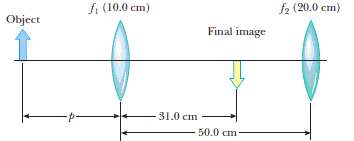
Two converging lenses having focal lengths of 10.0 cm and 20.0 cm are placed 50.0 cm apart, as shown in figure. The final image is to be located between the lenses, at the position indicated.(a) How far to the left of the first lens should the object be positioned?(b) What is the overall
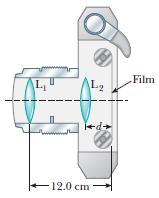
Lens L1 in Figure has a focal length of 15.0 cm and is located a fixed distance in front of the film plane of a camera. Lens L2 has a focal length of 13.0 cm, and its distance d from the film plane can be varied from 5.00 cm to 10.0 cm. Determine the range of distances for which objects can be
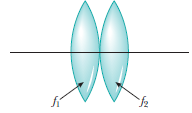
Consider two thin lenses, one of focal length f1 and the other of focal length f2, placed in contact with each other as shown in figure. Apply the thin-lens equation to each of these lenses and combine the results to show that this combination of lenses behaves like a thin lens having a focal
An object placed 10.0 cm from a concave spherical mirror produces a real image 8.00 cm from the mirror. If the object is moved to a new position 20.0 cm from the mirror, what is the position of the image? Is the final image real or virtual?
An object is placed 12 cm to the left of a diverging lens of focal length – 6.0 cm. A converging lens of focal length 12 cm is placed a distance d to the right of the diverging lens. Find the distance d that places the final image at infinity.
A convergent lens with a 50.0-mm focal length is used to focus an image of a very distant scene onto a flat screen 35.0 mm wide. What is the angular width α of the scene included in the image on the screen?
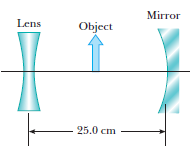
The object in figure is midway between the lens and the mirror. The mirror??s radius of curvature is 20.0 cm, and the lens has a focal length of _16.7 cm. Considering only the light that leaves the object and travels first towards the mirror, locate the final image formed by this system. Is the
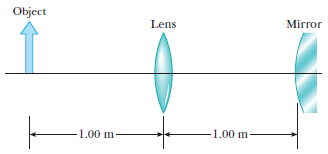
The lens and mirror in figure are separated by 1.00 m and have focal lengths of + 80.0 cm and ?? 50.0 cm, respectively. If an object is placed 1.00 m to the left of the lens, locate the final image. State whether the image is upright or inverted, and determine the overallmagnification.
A diverging lens (n = 1.50) is shaped like that in Active figure c. The radius of the first surface is 15.0 cm, and that of the second surface is 10.0 cm.(a) Find the focal length of the lens. Determine the positions of the images for object distances of (b) Infinity, (c) 3 | f |,(d) | f |, and (e)
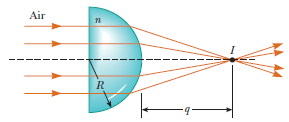
A parallel beam of light enters a glass hemisphere perpendicular to the flat face, as shown in figure. The radius of the hemisphere is R = 6.00 cm, and the index of refraction is n = 1.560. Determine the point at which the beam is focused. (Assume paraxial rays??that is, assume that all rays are
A converging lens of focal length 20.0 cm is separated by 50.0 cm from a converging lens of focal length 5.00 cm.(a) Find the position of the final image of an object placed 40.0 cm in front of the first lens. (b) If the height of the object is 2.00 cm, what is the height of the final image? Is the
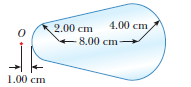
To work this problem, use the fact that the image formed by the first surface becomes the object for the second surface. Figure shows a piece of glass with index of refraction 1.50. The ends are hemispheres with radii 2.00 cm and 4.00 cm, and the centers of the hemispherical ends are separated by a
In a darkened room, a burning candle is placed 1.50 m from a white wall. A lens is placed between candle and wall at a location that causes a larger, inverted image to form on the wall. When the lens is moved 90.0 cm toward the wall, another image of the candle is formed. Find (a) The two object
An object 2.00 cm high is placed 40.0 cm to the left of a converging lens having a focal length of 30.0 cm. A diverging lens having a focal length of – 20.0 cm is placed 110 cm to the right of the converging lens. (a) Determine the final position and magnification of the final image.(b) Is the
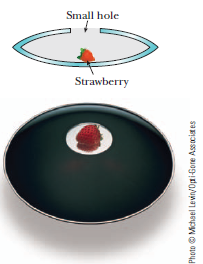
A floating strawberry illusion can be produced by two parabolic mirrors, each with a focal length of 7.5 cm, facing each other so that their centers are 7.5 cm apart (Figure). If a strawberry is placed on the bottom mirror, an image of the strawberry forms at the small opening at the center of the
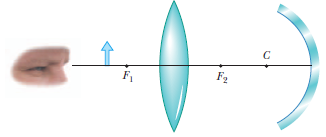
Figure shows a converging lens with radii R1 = 9.00 cm and R2 = ?? 11.00 cm, in front of a concave spherical mirror of radius R = 8.00 cm. The focal points (F1 and F2) for the thin lens and the center of curvature (C) of the mirror are also shown.(a) If the focal points F1 and F2 are 5.00 cm from
Find the object distances (in terms of f) for a thin converging lens of focal length f if (a) The image is real and the image distance is four times the focal length; (b) The image is virtual and the image distance is three times the focal length. (c) Calculate the magnification of the lens for
The lens maker??s equation for a lens with index n1 immersed in a medium with index n2 takes the form A thin diverging glass (index = 1.50) lens with R1 = ?? 3.00 m and R2 = ?? 6.00 m is surrounded by air. An arrow is placed 10.0 m to the left of the lens. (a) Determine the position of the image.
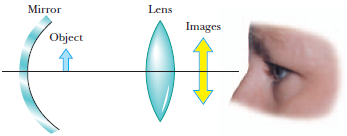
An observer to the right of the mirror??lens combination shown in figure sees two real images that are the same size and in the same location. One image is upright and the other is inverted. Both images are 1.50 times larger than the object. The lens has a focal length of 10.0 cm. The lens and
The lens maker’s equation applies to a lens immersed in a liquid if n in the equation is replaced by n1/n2. Here n1 refers to the refractive index of the lens material and n2 is that of the medium surrounding the lens. (a) A certain lens has focal length of 79.0 cm in air and a refractive index
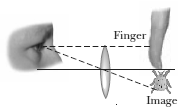
One method for determining the position of an image, either real or virtual, is by means of parallax. If a finger or another object is placed at the position of the image, as shown in Figure, and the finger and the image are viewed simultaneously (the image is viewed through the lens if it is
Explain why a mirror cannot give rise to chromatic aberration.
A solar furnace can be constructed by using a concave mirror to reflect and focus sunlight into the enclosure of a furnace. What factors in the design of the reflecting mirror will guarantee that very high temperatures can be reached?
1. A common mirage is formed when the air gets gradually cooler as the height above the ground increases. What might happen if the air grows gradually warmer as the height increases? This often happens over bodies of water or snow-covered ground; the effect is called looming. 2. What is wrong with
Lenses used in eyeglasses, whether converging or diverging, are always designed such that the middle of the lens curves away from the eye. Why?
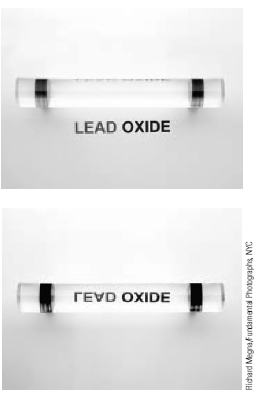
1. If a cylinder of solid glass or clear plastic is placed above the words LEAD OXIDE and viewed from the side, as shown in figure, the word LEAD appears inverted, but the word OXIDE does not. Explain.2. Why does a clear stream always appear to be shallower than it actuallyis?
Light from an object passes through a lens and forms a visible image on a screen. If the screen is removed, would you be able to see the image if (a) You remained in your present position? (b) You could look at the lens along the its axis, beyond the original position of the screen?
An inverted image of an object is viewed on a screen from the side facing a converging lens. An opaque card is then introduced covering only the upper half of the lens. What happens to the image on the screen?(a) Half the image would disappear. (b) The entire image would appear and remain
A camera used by a professional photographer to shoot portraits has a focal length of 25.0 cm. The photographer takes a portrait of a person 1.50 m in front of the camera. Where is the image formed, and what is the lateral magnification?
The lens of a certain 35 mm camera (35 mm is the width of the film strip) has a focal length of 55 mm and a speed (an f-number) of f/1.8. Determine the diameter of the lens.
A photographic image of a building is 0.092 0 m high. The image was made with a lens with a focal length of 52.0 mm. If the lens was 100 m from the building when the photograph was made, determine the height of the building.
The full Moon is photographed using a camera with a 120-mm-focal-length lens. Determine the diameter of the Moon’s image on the film. [Note: The radius of the Moon is 1.74 x 10⁶ m, and the distance from the Earth to the Moon is 3.84 x 10⁸ m.]
A camera is being used with the correct exposure at f/4 and a shutter speed of 1/32 s. In order to “stop” a fast-moving subject, the shutter speed is changed to 1/256 s. Find the new f -stop that should be used to maintain satisfactory exposure, assuming no change in lighting conditions.
(a) Use conceptual arguments to show that the intensity of light (energy per unit area per unit time) reaching the film in a camera is proportional to the square of the reciprocal of the f -number, as I ∞ 1/(f/D)2(b) The correct exposure time for a camera set to f/1.8 is (1/500) s. Calculate the
A certain type of film requires an exposure time of 0.010 s with an f/11 lens setting. Another type of film requires twice the light energy to produce the same level of exposure. What f -stop does the second type of film need with the 0.010-s exposure time?
Assume that the camera in figure has a fixed focal length of 65.0 mm and is adjusted to properly focus the image of a distant object. How far and in what direction must the lens be moved to focus the image of an object that is 2.00 m away?
A retired bank president can easily read the fine print of the financial page when the newspaper is held no closer than arm’s length, 60.0 cm from the eye. What should be the focal length of an eyeglass lens that will allow her to read at the more comfortable distance of 24.0 cm?
A person has far points 84.4 cm from the right eye and 122 cm from the left eye. Write a prescription for the powers of the corrective lenses.
The accommodation limits for Nearsighted Nick’s eyes are 18.0 cm and 80.0 cm. When he wears his glasses, he is able to see faraway objects clearly. At what minimum distance is he able to see objects clearly?
The near point of an eye is 100 cm. A corrective lens is to be used to allow this eye to clearly focus on objects 25.0 in front of it. (a) What should be the focal length of the lens? (b) What is the power of the needed corrective lens?
An individual is nearsighted; his near point is 13.0 cm and his far point is 50.0 cm. (a) What lens power is needed to correct his nearsightedness? (b) When the lenses are in use, what is this person’s near point?
A certain child’s near point is 10.0 cm; her far point (with eyes relaxed) is 125 cm. Each eye lens is 2.00 cm from the retina. (a) Between what limits, measured in diopters, does the power of this lens–cornea combination vary?(b) Calculate the power of the eyeglass lens the child should use
An artificial lens is implanted in a person’s eye to replace a diseased lens. The distance between the artificial lens and the retina is 2.80 cm. In the absence of the lens, an image of a distant object (formed by refraction at the cornea) falls 2.53 cm behind the retina. The lens is designed to
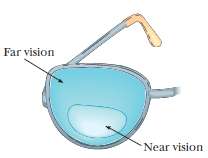
A person is to be fitted with bifocals. She can see clearly when the object is between 30 cm and 1.5 m from the eye.(a) The upper portions of the bifocals (Figure.) should be designed to enable her to see distant objects clearly. What power should they have?(b) The lower portions of the bifocals
A stamp collector uses a lens with 7.5-cm focal length as a simple magnifier. The virtual image is produced at the normal near point (25 cm). (a) How far from the lens should the stamp be placed? (b) What is the expected angular magnification?
A lens having a focal length of 25 cm is used as a simple magnifier. (a) What is the angular magnification obtained when the image is formed at the normal near point (q = – 25 cm)? (b) What is the angular magnification produced by this lens when the eye is relaxed?
A biology student uses a simple magnifier to examine the structural features of the wing of an insect. The wing is held 3.50 cm in front of the lens, and the image is formed 25.0 cm from the eye. (a) What is the focal length of the lens? (b) What angular magnification is achieved?
A lens that has a focal length of 5.00 cm is used as a magnifying glass. (a) To obtain maximum magnification, where should the object be placed? (b) What is the magnification?
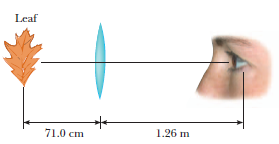
A leaf of length h is positioned 71.0 cm in front of a converging lens with a focal length of 39.0 cm. An observer views the image of the leaf from a position 1.26 m behind the lens, as shown in figure.(a) What is the magnitude of the lateral magnification (the ratio of the image size to the object
The objective lens in a microscope with a 20.0-cm-long tube has a magnification of 50.0, and the eyepiece has a magnification of 20.0. What are the focal lengths of?(a) The objective and (b) The eyepiece? (c) What is the overall magnification of the microscope?
The desired overall magnification of a compound microscope is 140 x. The objective alone produces a lateral magnification of 12 x. Determine the required focal length of the eyepiece.
A microscope has an objective lens with a focal length of 16.22 mm and an eyepiece with a focal length of 9.50 mm. With the length of the barrel set at 29.0 cm, the diameter of a red blood cell’s image subtends an angle of 1.43mrad with the eye. If the final image distance is 29.0 cm from the
The length of a microscope tube is 15.0 cm. The focal length of the objective is 1.00 cm, and the focal length of the eyepiece is 2.50 cm. What is the magnification of the microscope, assuming it is adjusted so that the eye is relaxed?
A certain telescope has an objective of focal length 1 500 cm. If the Moon is used as an object, a 1.0-cm-long image formed by the objective corresponds to what distance, in miles, on the Moon? Assume 3.8 x 10⁸ m for the Earth–Moon distance.
The lenses of an astronomical telescope are 92 cm apart when adjusted for viewing a distant object with minimum eyestrain. The angular magnification produced by the telescope is 45. Compute the focal length of each lens.
An elderly sailor is shipwrecked on a desert island, but manages to save his eyeglasses. The lens for one eye has a power of + 1.20 diopters, and the other lens has a power of + 9.00 diopters. (a) What is the magnifying power of the telescope he can construct with these lenses?(b) How far apart are
Astronomers often take photographs with the objective lens or mirror of a telescope alone, without an eyepiece. (a) Show that the image size h’ for a telescope used in this manner is given by h’ = fh/(f – p), where h is the object size, f is the objective focal length, and p is the object
Galileo devised a simple terrestrial telescope that produces an upright image. It consists of a converging objective lens and a diverging eyepiece at opposite ends of the telescope tube. For distant objects, the tube length is the objective focal length less the absolute value of the eyepiece focal
A person decides to use an old pair of eyeglasses to make some optical instruments. He knows that the near point in his left eye is 50.0 cm and the near point in his right eye is 100 cm. (a) What is the maximum angular magnification he can produce in a telescope? (b) If he places the lenses 10.0 cm
If the distance from the Earth to the Moon is 3.8 x 10⁸ m, what diameter would be required for a telescope objective to resolve a Moon crater 300 m in diameter? Assume a wavelength of 500 nm.
A converging lens with a diameter of 30.0 cm forms an image of a satellite passing overhead. The satellite has two green lights (wavelength 500 nm) spaced 1.00 m apart. If the lights can just be resolved according to the Rayleigh criterion, what is the altitude of the satellite?
The pupil of a cat’s eye narrows to a vertical slit of width 0.500 mm in daylight. What is the angular resolution for a pair of horizontally separated mice? (Use 500-nm light in your calculation.)
To increase the resolving power of a microscope, the object and the objective are immersed in oil (n = 1.5). If the limiting angle of resolution without the oil is 0.60 µrad, what is the limiting angle of resolution with the oil?
(a) Calculate the limiting angle of resolution for the eye, assuming a pupil diameter of 2.00 mm, a wavelength of 500 nm in air, and an index of refraction for the eye of 1.33. (b) What is the maximum distance from the eye at which two points separated by 1.00 cm could be resolved?
Two stars in a binary system are 8.0 light-years away from the observer and can just be resolved by a 20-in. telescope equipped with a filter that allows only light of wavelength 500 nm to pass. What is the distance between the two stars?
A spy satellite circles the Earth at an altitude of 200 km and carries out surveillance with a special high-resolution telescopic camera having a lens diameter of 35 cm. If the angular resolution of this camera is limited by diffraction, estimate the separation of two small objects on the Earth’s
Suppose a 5.00-m-diameter telescope were constructed on the Moon, where the absence of atmospheric distortion would permit excellent viewing. If observations were made using 500-nm light, what minimum separation between two objects could just be resolved on Mars at closest approach (when Mars is
The Hα line in hydrogen has a wavelength of 656.20 nm. This line differs in wavelength from the corresponding spectral line in deuterium (the heavy stable isotope of hydrogen) by 0.18 nm. (a) Determine the minimum number of lines a grating must have to resolve these two wavelengths in the first
A 15.0-cm-long grating has 6 000 slits per centimeter. Can two lines of wavelengths 600.000 nm and 600.003 nm be separated with this grating? Explain.
Light of wavelength 550 nm is used to calibrate a Michelson interferometer. With the use of a micrometer screw, the platform on which one mirror is mounted is moved 0.180 mm. How many fringe shifts are counted?
An interferometer is used to measure the length of a bacterium. The wavelength of the light used is 650 nm. As one arm of the interferometer is moved from one end of the cell to the other, 310 fringe shifts are counted. How long is the bacterium?
Mirror M1 in figure is displaced a distance ∆L. During this displacement, 250 fringe shifts are counted. The light being used has a wavelength of 632.8 nm. Calculate the displacement ∆L.
A thin sheet of transparent material has an index of refraction of 1.40 and is 15.0 µm thick. When it is inserted in the light path along one arm of an interferometer, how many fringe shifts occur in the pattern? Assume that the wavelength (in a vacuum) of the light used is 600 nm.
The Michelson interferometer can be used to measure the index of refraction of a gas by placing an evacuated transparent tube in the light path along one arm of the device. Fringe shifts occur as the gas is slowly added to the tube. Assume that 600-nm light is used, that the tube is 5.00 cm long,
The light path in one arm of a Michelson interferometer includes a transparent cell that is 5.00 cm long. How many fringe shifts would be observed if all the air were evacuated from the cell? The wavelength of the light source is 590 nm and the refractive index of air is 1.000 29. (See the hint in
A person with a nearsighted eye has near and far points of 16 cm and 25 cm, respectively. (a) Assuming a lens is placed 2.0 cm from the eye, what power must the lens have to correct this condition? (b) Suppose that contact lenses placed directly on the cornea are used to correct the person’s eye.
The near point of an eye is 75.0 cm. (a) What should be the power of a corrective lens prescribed to enable the eye to see an object clearly at 25.0 cm? (b) If, using the corrective lens, the person can see an object clearly at 26.0 cm, but not at 25.0 cm, by how many diopters did the lens grinder
If a typical eyeball is 2.00 cm long and has a pupil opening that can range from about 2.00 mm to 6.00 mm, what are (a) The focal length of the eye when it is focused on objects 1.00 m away, (b) The smallest f -number of the eye when it is focused on objects 1.00 m away, and (c) The largest f
A cataract-impaired lens in an eye may be surgically removed and replaced by a manufactured lens. The focal length required for the new lens is determined by the lens-to-retina distance, which is measured by a sonarlike device, and by the requirement that the implant provide for correct distance
Estimate the minimum angle subtended at the eye of a hawk flying at an altitude of 50 m necessary to recognize a mouse on the ground.
The wavelengths of the sodium spectrum are λ1 = 589.00 nm and λ2 = 589.59 nm. Determine the minimum number of lines in a grating that will allow resolution of the sodium spectrum in (a) The first order and (b) The third order.
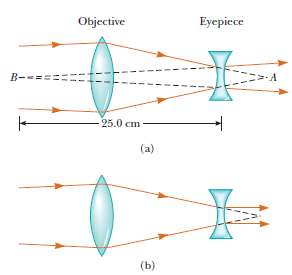
The text discusses the astronomical telescope. Another type is the Galilean telescope, in which an objective lens gathers light (Figure) and tends to form an image at point A. An eyepiece consisting of a diverging lens intercepts the light before it comes to a focus and forms a virtual image at
A laboratory (astronomical) telescope is used to view a scale that is 300 cm from the objective, which has a focal length of 20.0 cm; the eyepiece has a focal length of 2.00 cm. Calculate the angular magnification when the telescope is adjusted for minimum eyestrain.
Showing 1700 - 1800
of 2678
First
11
12
13
14
15
16
17
18
19
20
21
22
23
24
25
Last
Step by Step Answers

 Get 50% OFF
Claim Now
Get 50% OFF
Claim Now