New Semester
Started
Get
50% OFF
Study Help!
--h --m --s
Claim Now
Question Answers
Textbooks
Find textbooks, questions and answers
Oops, something went wrong!
Change your search query and then try again
S
Books
FREE
Study Help
Expert Questions
Accounting
General Management
Mathematics
Finance
Organizational Behaviour
Law
Physics
Operating System
Management Leadership
Sociology
Programming
Marketing
Database
Computer Network
Economics
Textbooks Solutions
Accounting
Managerial Accounting
Management Leadership
Cost Accounting
Statistics
Business Law
Corporate Finance
Finance
Economics
Auditing
Tutors
Online Tutors
Find a Tutor
Hire a Tutor
Become a Tutor
AI Tutor
AI Study Planner
NEW
Sell Books
Search
Search
Sign In
Register
study help
physics
light and optics
Fundamentals of Physics 8th Extended edition Jearl Walker, Halliday Resnick - Solutions
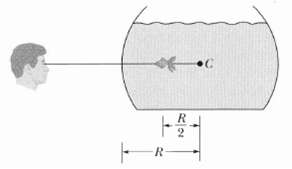
A goldfish in a spherical fish bowl of radius R is at the level of the center C of the bowl and at distance R=L from the glass (Figure). What magnification of the fish is produced by the water in the bowl for a viewer looking along a line that includes the fish and the center, with the fish on the
An eraser of height 1.0 cm is placed 10.0 cm in front of a two-lens system. Lens 1 (nearer the eraser) has focal length f1 = – 15 cm, lens 2 has f2 = 12cm, and the lens separation is d = 12cm. For the image produced by lens 2, what are?(a) The image distance i2 (including sign),(b) The image
A peanut is placed 40 cm in front of a two-lens system: lens 1 (nearer the peanut) has focal length f1 = + 20 cm, lens 2 has f2 = – 15cm and the lens separation ts d = 10 cm. For the image produced by lens 2, what are?(a) The image distance i2 (including sign),(b) The image orientation (inverted
A coin is place d 20 cm in front of a two-lens system. Lens 1 (nearer the coin) has focal length f1, = + 10 cm, lens 2 has f2 = + 12.5 cm, and the lens separation is d = 30 cm. For the image produced by lens 2, what are?(a) The image distance i2 (including sign),(b) The overall lateral
An object is 20 cm to the left of a thin diverging lens that has a 30 cm focal length.(a) What is the image distance i?(b) Draw a ray diagram showing the image position.
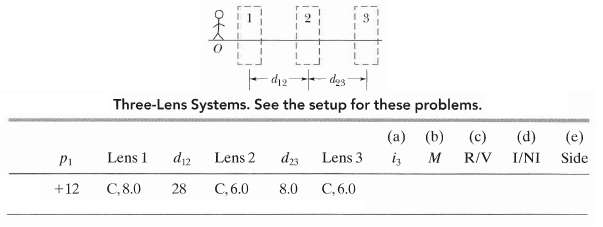
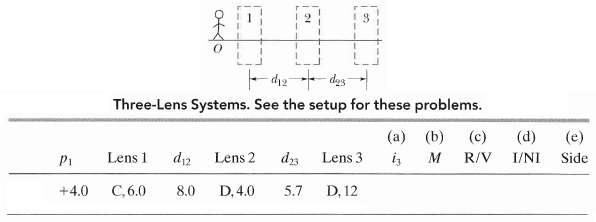
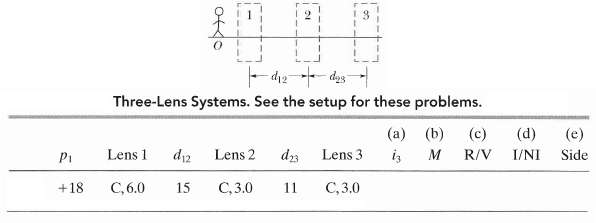
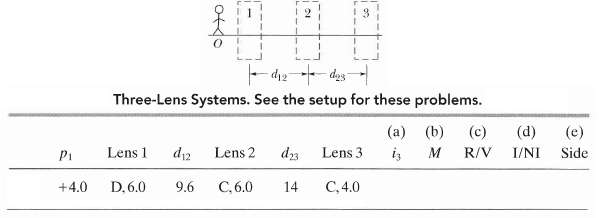
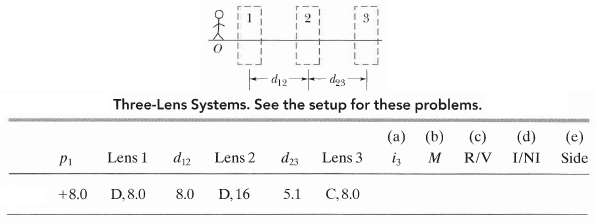
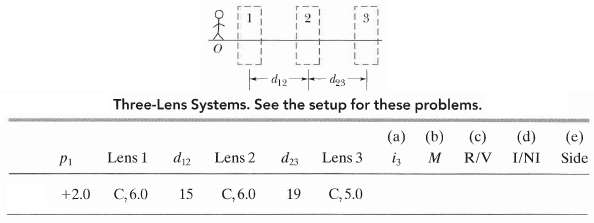
Three-lens systems In figure stick figure O (the Object) stands on the common central axis of three thin, symmetric lenses, which are mounted in the boxed regions. Lens 1 is mounted within the boxed region closest to O, which is at object distance pr Lens 2 is mounted within the middle boxed
Three-lens systems In figure stick figure O (the Object) stands on the common central axis of three thin, symmetric lenses, which are mounted in the boxed regions. Lens 1 is mounted within the boxed region closest to O, which is at object distance pr Lens 2 is mounted within the middle boxed
Three-lens systems In figure stick figure O (the Object) stands on the common central axis of three thin, symmetric lenses, which are mounted in the boxed regions. Lens 1 is mounted within the boxed region closest to O, which is at object distance pr Lens 2 is mounted within the middle boxed
Three-lens systems In figure stick figure O (the Object) stands on the common central axis of three thin, symmetric lenses, which are mounted in the boxed regions. Lens 1 is mounted within the boxed region closest to O, which is at object distance pr Lens 2 is mounted within the middle boxed
Three-lens systems In figure stick figure O (the Object) stands on the common central axis of three thin, symmetric lenses, which are mounted in the boxed regions. Lens 1 is mounted within the boxed region closest to O, which is at object distance pr Lens 2 is mounted within the middle boxed
Three-lens systems In figure stick figure O (the Object) stands on the common central axis of three thin, symmetric lenses, which are mounted in the boxed regions. Lens 1 is mounted within the boxed region closest to O, which is at object distance pr Lens 2 is mounted within the middle boxed
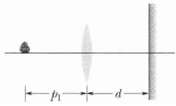
In Figure a pinecone is at distance p1 = 1.0 m in front of a lens of focal length f1 = 0.50 m; a flat mirror is at distance d = 2.0 m behind the lens. Light from the pinecone passes rightward through the lens, reflects from the mirror, passes leftward through the lens, and forms a final image of
One end of a long glass rod (n = 15) is a convex surface of radius 6.0 cm. An object is located in air along the axis of the rod, at a distance of 10 cm from the convex end.(a) How far apart are the object and the image formed by the glass rod?(b) Within what range of distances from the end of the
A short straight object of length L lies along the central axis of a spherical mirror, a distance p from the mirror. (a) Show that its image in the mirror has a length L', where L' = L (f/p – f) 2.(b) Show that the longitudinal magnification m' (= L'/L) is equal to m2, where m rs the lateral
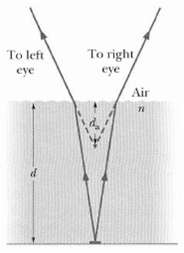
You look down at a coin that lies at the bottom of a pool of liquid of depth d and index of refraction n (Figure). Because you view with two eyes, which intercept different rays of light from the coin, you perceive the coin to be where extensions of the intercepted rays cross, at depth du instead
AS Prove that if a plane mirror is rotated through an angle a, the reflected beam is rotated through an angle 2a. Show that this result is reasonable for a = 45o.
An object is 30.0 cm from a spherical mirror, along the mirror's central axis. The mirror produces an inverted image with a lateral magnification of absolute value 0.500. What is the focal length of the mirror?
A concave mirror has a radius of curvature of 24 cm. How far is an object from the mirror if the image formed is (a) Virtual and 3.0 times the size of the object, (b) Real and 3.0 times the size of the object, and(c) Real and 1/3 the size of the object?
A pepper seed is placed in front of a lens. The lateral magnification of the seed is + 0.300. The absolute value of the lens's focal length is 40.0 cm. How far from the lens is the image?
The equation l/p + 1/i = 2/r for spherical mirrors is an approximation that is valid if the image is formed by rays that make only small angles with the central axis. In reality, many of the angles are large, which smears the image a little. You can determine how much. Refer to Figure and consider
A small cup of green tea is positioned on the central axis of a spherical mirror. The lateral magnification of the cup is + 0.250, and the distance between the mirror and its focal point is 2.00 cm.(a) What is the distance between the mirror and the image it produces?(b) Is the focal length
A 20-mm-thick layer of water (n = 1.33) floats on a 40-mm-thick layer of carbon tetrachloride (n = 1.46) in a tank. A coin lies at the bottom of the tank. At what depth below the top water surface do you perceive the coin?
A millipede sits 1.0 m in front of the nearest part of the surface of a shiny sphere of diameter 0.70 m.(a) How far from the surface does the millipede's image appear?(b) If the millipede's height is 2.0mm, what is the image height?(c) Is the image inverted?
(a) Show that if the object O rn Figure c is moved from focal point n toward the observer's eye, the image moves in from infinity and the angle θ (and thus the angular magnification mθ) increases.(b) If you continue this process, where is the image when mθ as its maximum usable value? (You can
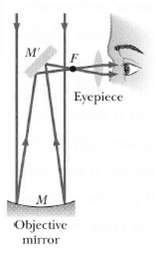
Isaac Newton, having convinced himself (erroneously as it turned out) that chromatic aberration is an inherent property of refracting telescopes, invented the reflecting telescope, shown schematically in Figure. He presented his second model of this telescope, with a magnifying power of 38, to the
A narrow beam of parallel light rays is incident on a glass sphere from the left, directed toward the center of the sphere. (The sphere is a lens but certainly not a thin lens.) Approximate the angle of incidence of the rays as 0o, and assume that the index of refraction of the glass is n 12.0.(a)
A corner reflector, much used in optical, microwave, and other applications, consists of three plane mirrors fastened together to form the corner of a cube. Show that after three reflections, an incident ray is returned with its direction exactly reversed.
A cheese enchilada is 4.00 cm in front of a converging lens. The magnification of the enchilada is -2.00. What is the focal length of the lens?
A grasshopper hops to a point on the central axis of a spherical mirror. The absolute magnitude of the mirror's focal length is 40.0cm, and the lateral magnification of the image produced by the mirror is + 0.200.(a) Is the mirror convex or concave?(b) How far from the mirror is the grasshopper?
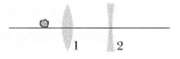
In Figure a sand grain is 3.00 cm from thin lens 1, on the central axis through the two symmetric lenses. The distance between focal point and lens is 4.00 cm for both lenses; the lenses are separated by 8.00 cm.(a) What is the distance between lens 2 and the image it produces of the sand grain? Is
The speed of yellow light (from a sodium lamp) in a certain liquid is measured to be 1.92 x 10⁸ m/s. What is the index of refraction of this liquid for the light?
In Figure a, a beam of light in material 1 is incident on a boundary at an angle of 30
How much faster, in meters per second, does light travel in sapphire than in diamond?
The wavelength of yellow sodium light in air is 589 nm.(a) What is its frequency?(b) What is its wavelength in glass whose index of refraction is 1.52?(c) From the results of (a) and (b), find its speed in this glass.
In Figure assume that two waves of light in air, of wavelength 400 nm, are initially in phase. One travels through a glass layer of index of refraction n1 = 1.60 and thickness L. The other travels through an equally thick plastic layer of index of refraction n2 = 1.50.(a) What is the smallest value
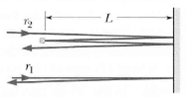
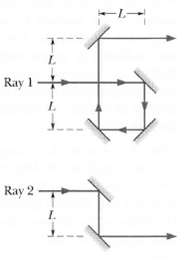
In Figure a light wave along ray h reflects once from a mirror and a light wave along ray 12 reflects twice from that same mirror and once from a tiny mirror at distance L from the bigger mirror. (Neglect the slight tilt of the rays.) The waves have wavelength, 1, and are initially exactly out of
In Figure a light wave along ray r1 reflects once from a mirror and a light wave along ray r2 reflects twice from that same mirror and once from a tiny mirror at distance L from the bigger mirror. (Neglect the slight tilt of the rays.) The waves have wavelength 620 nm and are initially in phase.(a)
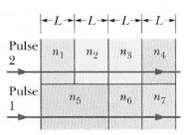
In Figure two light pulses are sent through layers of plastic with thicknesses of either L or 2L as shown and indexes of refraction n1 = 1.55, n2 = 1.70, n3 = 1.60, n4 = 1.45, ns = 7.59, /t6 : I.65, and n7 = 1.50. (a) Which pulse travels through the plastic in less time? (b) What multiple of L/C
Suppose that the two waves in Figure have wavelength λ = 500 nm in air. What multiple of λ gives their phase difference when they emerge if(a) n1 = 1.50, n2 = 1.60, and L = 8.50μm;(b) n1 = 1.62, n2 = 1.72, and L = 8.50μm; and(c) n1 = 1.59, n2 = 1.79, and L = 3.25μm?(d) Suppose that in each of
In Figure two light rays go through different paths by reflecting from the various flat surfaces shown. The light waves have a wavelength of 420.0 nm and are initially in phase. What are the (a) Smallest and (b) Second smallest value of distance L that will put the waves exactly out of phase as
In Figure assume that the two light waves, of wavelength 620 nm in air, are initially out of phase by π rad. The indexes of refraction of the media are n1 = 1.45 and n2 = 1.65. What are the(a) Smallest and(b) Second smallest value of L that will put the waves exactly in phase once they pass
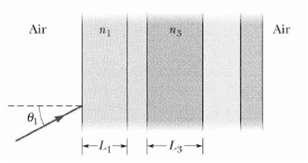
In figure a light ray is incident at angle θ1 = 50o on a series of five transparent layers with parallel boundaries. For layers 1 and 3, L1 = 20μm, L3 = 25μm, n1 = 1.6, and n3 = 1.45. (a) At what angle does the light emerge back into air at the right? (b) How much time does the light take to
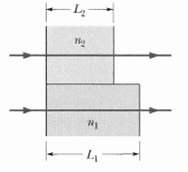
Two waves of light in air, of wavelength λ = 600.0 nm, are initially in phase. They then travel through plastic layers as shown in Figure, with L1 = 4.00μm, L2 = 3.50μm, n1 = 1.4l, and n2 = 1.60. (a) What multiple of λ gives their phase difference after they both have emerged from the
Monochromatic green light, of wavelength 550 nm, illuminates two parallel narrow slits 7 .70 pm apart. Calculate the angular deviation (θ in Figure) of the third-order (for m = 3) bright fringe (a) In radians and(b) In degrees.
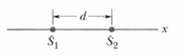
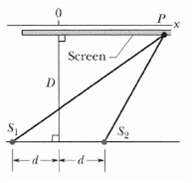
In Figure two radio-frequency point sources S1 and S2, separated by distance d = 2.0m, are radiating in phase with λ = 0.50 m. A detector moves in a large circular path around the two sources in a plane containing them. How many maxima does it detect?
In a double-slit arrangement the slits are separated by a distance equal to 100 times the wavelength of the light passing through the slits.(a) What is the angular separation in radians between the central maximum and an adjacent maximum?(b) What is the distance between these maxima on a screen
A double-slit arrangement produces interference fringes for sodium light (λ = 589 nm) that have an angular separation of 3.50 x 10⁻³ rad. For what wavelength would the angular separation be 10.0% greater?
A double-slit arrangement produces interference fringes for sodium light (λ = 589 nm) that are 0.20o apart. What is the angular fringe separation if the entire arrangement is immersed in water (n = 1.33)?
Suppose that Young's experiment is performed with blue-green light of wavelength 500 nm. The slits are 1.20 mm apart, and the viewing screen is 5.40 m from the slits. How far apart are the bright fringes near the center of the interference pattern?
In the two-slit experiment of Figure let angle θ be 20.0o, the slit separation is 4.24μm, and the wavelength be λ = 500 nm.(a) What multiple of λ gives the phase difference between the waves of rays 11 and 12 when they arrive at point P on the distant screen?(b) What is the phase difference in
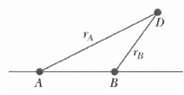
In Figure sources A and B emit long-range radio waves of wavelength 400 m, with the phase of the emission from A ahead of that from source B by 90o. The distance 14 from A to detector D is greater than the corresponding distance (n by 100 m. What is the phase difference of the waves at D?
Sunlight is used in a double-slit interference experiment. The fourth-order maximum for a wavelength of 450 nm occurs at an angle of θ = 90o. Thus, it is on the verge of being eliminated from the pattern because 0 cannot exceed 90o in Eq. 35-14.(a) What range of wavelengths in the visible range
In Figure two isotropic point sources of light (S1 and S2) are separated by distance 2.70 μm along a y axis and emit in phase at wavelength 900 nm and at the same amplitude. A light detector is located at point P at coordinate xp on the x axis. What is the greatest value of xp at which the
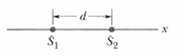
In Fig two isotropic point sources S1 and S2 emit identical light waves in phase at wavelength λ. The sources lie at separation d on an x axis, and a light detector is moved in a circle of large radius around the midpoint between them. It detects 30 points of zero intensity, including two on the x
In a double-slit experiment, the distance between slits is 5.0 mm and the slits are 1.0 m from the screen. Two interference patterns can be seen on the screen: one due to light of wavelength 480 mm, and the other due to light of wavelength 600 nm. What is the separation on the screen between the
In Figure two isotropic point sources S1 and S2 emit light in phase at wavelength A and at the same amplitude. The sources are separated by distance 2d = 6.00λ. They lie on an axis that is parallel to an x axis, which runs along a viewing screen at distance D = 20.0λ. The origin lies on the
A thin flake of mica (n = 1.58) is used to cover one slit of a double-slit interference arrangement. The central point on the viewing screen is now occupied by what had been the seventh bright side fringe (m = 7). If λ = 550 nm, what is the thickness of the mica?
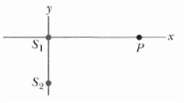
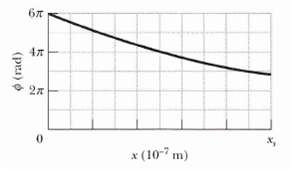
Figure shows two isotropic point sources of light (S1 and S2) that emit in phase at wavelength 400 nm and at the same amplitude. A detection point P is shown on an x axis that extends through source S1. The phase difference Φ between the light arriving at point P from the two sources is to be
Two waves of the same frequency have amplitudes 1.00 and 2.00. They interfere at a point where their phase difference is 60.0o. What is the resultant amplitude?
Find the sum y of the following quantities: y1 = 10 sin wt and y2 = 8.0sin (wt + 30o).
Three electromagnetic waves travel through a certain point P along an x axis. They are polarized parallel to a y axis, with the following variations in their amplitudes. Find their resultant at P. E1 = (10.0μV/m) sin [(2.0 x 10¹⁴ rad/s)t] E2 = (5.00μV/m) sin [(2.0 x 10¹⁴ rad/s)t + 45.0
In the double-slit experiment of Figure the electric fields of the waves arriving at point P are given by E1 = (2.00μV/m) sin [(l .26 x 1015)t] E2 = (2.00μV/m) sin [(l .26 x 1015)t + 39.6 rad], where time / is in seconds. (a) What is the amplitude of the resultant electric field at
Add the quantities y1 = 10 sin wt, y2 = 15 sin (wt + 30o), and y3 = 5.0 sin (wt – 45o) using the phasor method.
In the double-slit experiment of Figure the viewing screen is at distance D = 4.00 m, point P lies at distance y = 20.5 cm from the center of the pattern, the slit separation d is 4.50μm, and the wavelength λ is 580 nm. (a) Determine where point P is in the interference pattern by
The rhinestones in costume jewelry are glass with index of refraction 1.50. To make them more reflective, they are often coated with a layer of silicon monoxide of index of refraction 2.00. What is the minimum coating thickness needed to ensure that light of wavelength 560 nm and of perpendicular
White light is sent downward onto a horizontal thin film that is sandwiched between two materials. The indexes of refraction are 1.80 for the top material, 1.70 for the thin film, and 1.50 for the bottom material. The film thickness is 5.00 x 10⁻⁷ m. Of the visible wavelengths (400 to 700 nm) that
Light of wavelength 624 nm is incident perpendicularly on a soap film (n = 1.33) suspended in air. What ate the(a) Least and (b) Second least thicknesses of the film for which the reflections from the film undergo fully constructive interference?
A 600-nm-thick soap film (n = 1.40) in air is illuminated with white light in a direction perpendicular to the film. For how many different wavelengths in the 300 to 700 nm range is there (a) Fully constructive interference and (b) Fully destructive interference in the reflected light?
We wish to coat flat glass (n = 1.50) with a transparent material (n = 1.25) so that reflection of light at wavelength 600 nm is eliminated by interference. What minimum thickness can the coating have to do this?
A thin film of acetone (n = 1.25) coats a thick glass plate (n = 1.50). White light is incident normal to the film. In the reflections, fully destructive interference occurs at 600 nm and fully constructive interference at 700 nm. Calculate the thickness of the acetone film.
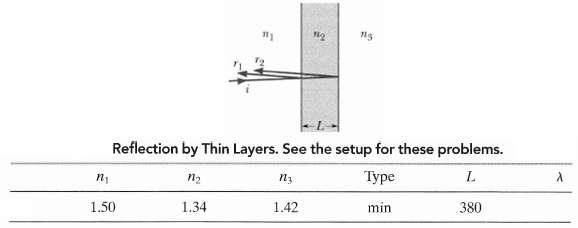
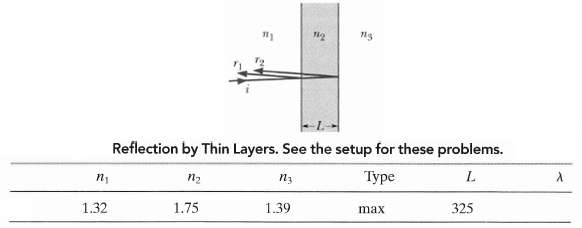
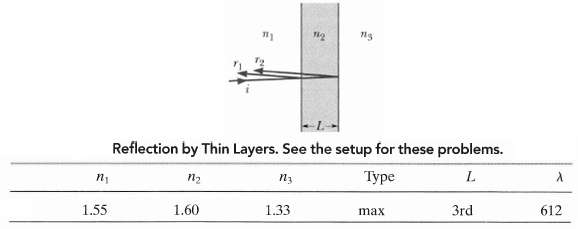
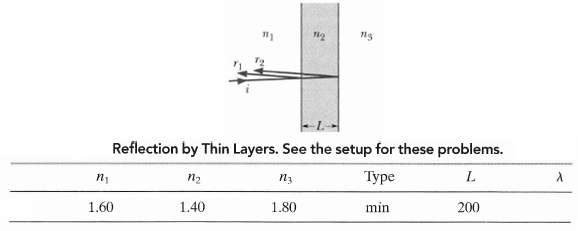
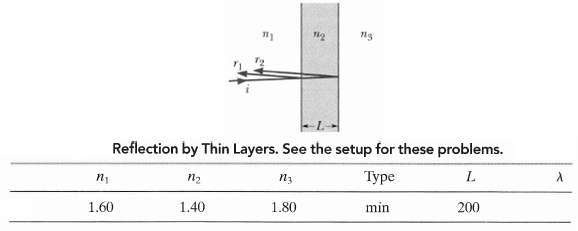
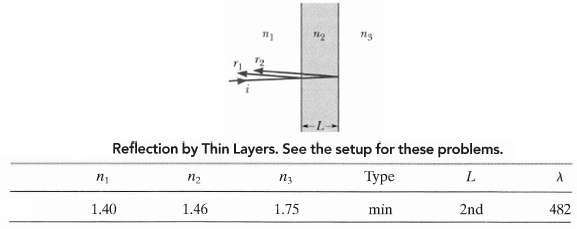
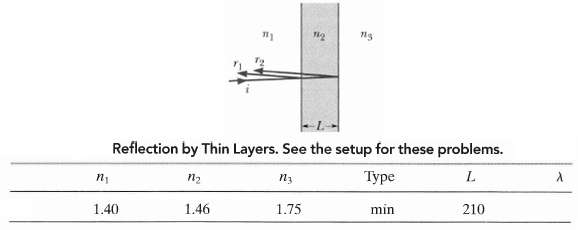
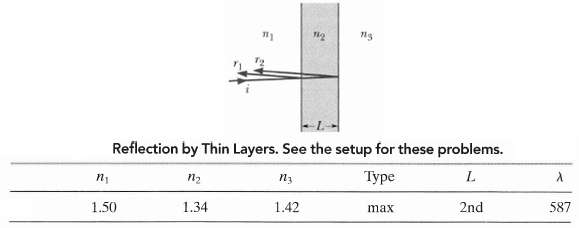
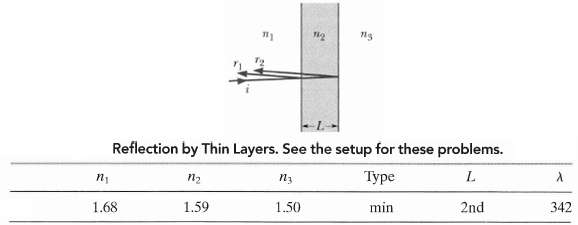
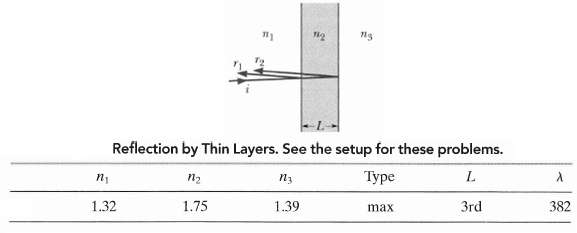
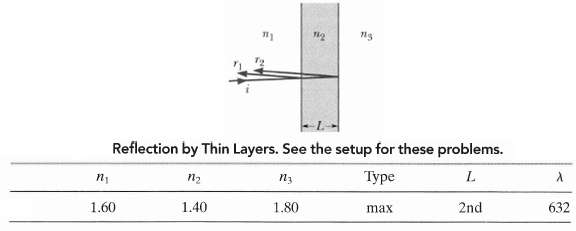
Reflection by thin layers in Figure light is incident perpendicularly on a thin layer of material 2 that lies between (thicker) materials 1 and 3. (The rays are tilted only for clarity.) The waves of rays r1 and r2 interfere, and here we consider the type of interference to be either maximum (max)
Reflection by thin layers in Figure light is incident perpendicularly on a thin layer of material 2 that lies between (thicker) materials 1 and 3. (The rays are tilted only for clarity.) The waves of rays r1 and r2 interfere, and here we consider the type of interference to be either maximum (max)
Reflection by thin layers in Figure light is incident perpendicularly on a thin layer of material 2 that lies between (thicker) materials 1 and 3. (The rays are tilted only for clarity.) The waves of rays r1 and r2 interfere, and here we consider the type of interference to be either maximum (max)
Reflection by thin layers in Figure light is incident perpendicularly on a thin layer of material 2 that lies between (thicker) materials 1 and 3. (The rays are tilted only for clarity.) The waves of rays r1 and r2 interfere, and here we consider the type of interference to be either maximum (max)
Reflection by thin layers in Figure light is incident perpendicularly on a thin layer of material 2 that lies between (thicker) materials 1 and 3. (The rays are tilted only for clarity.) The waves of rays r1 and r2 interfere, and here we consider the type of interference to be either maximum (max)
Reflection by thin layers in Figure light is incident perpendicularly on a thin layer of material 2 that lies between (thicker) materials 1 and 3. (The rays are tilted only for clarity.) The waves of rays r1 and r2 interfere, and here we consider the type of interference to be either maximum (max)
Reflection by thin layers in Figure light is incident perpendicularly on a thin layer of material 2 that lies between (thicker) materials 1 and 3. (The rays are tilted only for clarity.) The waves of rays r1 and r2 interfere, and here we consider the type of interference to be either maximum (max)
Reflection by thin layers in Figure light is incident perpendicularly on a thin layer of material 2 that lies between (thicker) materials 1 and 3. (The rays are tilted only for clarity.) The waves of rays r1 and r2 interfere, and here we consider the type of interference to be either maximum (max)
Reflection by thin layers in Figure light is incident perpendicularly on a thin layer of material 2 that lies between (thicker) materials 1 and 3. (The rays are tilted only for clarity.) The waves of rays r1 and r2 interfere, and here we consider the type of interference to be either maximum (max)
A thin film of acetone (n = 1.25) coats a thick glass plate (n = 1.50). White light is incident normal to the film. In the reflections, fully destructive interference occurs at 600 nm and fully constructive interference at 700 nm. Calculate the thickness of the acetone film.
Reflection by thin layers in Figure light is incident perpendicularly on a thin layer of material 2 that lies between (thicker) materials 1 and 3. (The rays are tilted only for clarity.) The waves of rays r1 and r2 interfere, and here we consider the type of interference to be either maximum (max)
Reflection by thin layers in Figure light is incident perpendicularly on a thin layer of material 2 that lies between (thicker) materials 1 and 3. (The rays are tilted only for clarity.) The waves of rays r1 and r2 interfere, and here we consider the type of interference to be either maximum (max)
A disabled tanker leaks kerosene (n = 1.20) into the Persian Gulf, creating a large slick on top of the water (n = 1.30).(a) If you are looking straight down from an airplane, while the Sun is overhead, at a region of the slick where its thickness is 460 nm, for which wavelength(s) of visible light
A thin film, with a thickness of 272.7 nm and with air on both sides, is illuminated with a beam of white light. The beam is perpendicular to the film and consists of the full range of wavelengths for the visible spectrum. In the light reflected by the film, light with a wavelength of 600.0 nm
The reflection of perpendicularly incident white light by a soap film in air has an interference maximum at 600 nm and a minimum at 450 nm, with no minimum in between. If n = 1.33 for the film, what is the film thickness, assumed uniform?
A plane wave of monochromatic light is incident normally on a uniform thin film of oil that covers a glass plate. The wavelength of the source can be varied continuously. Fully destructive interference of the reflected light is observed for wavelengths of 500 and 700 nm and for no wavelengths in
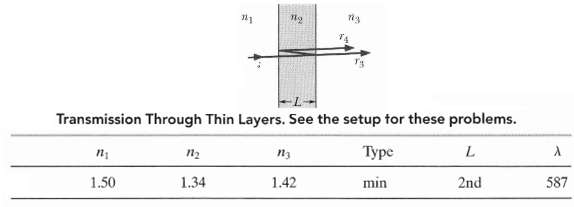
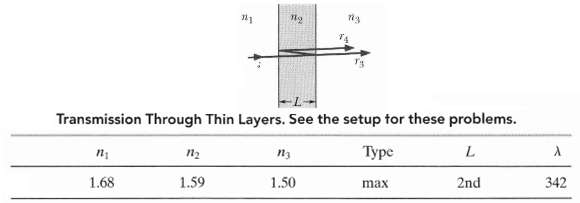
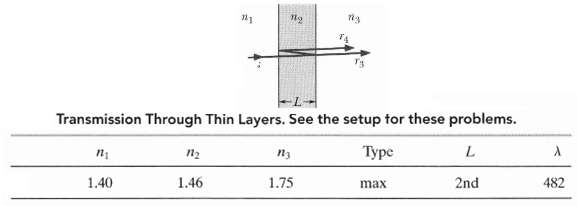
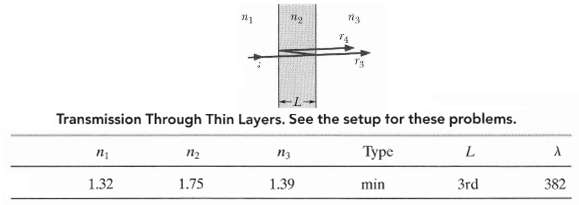
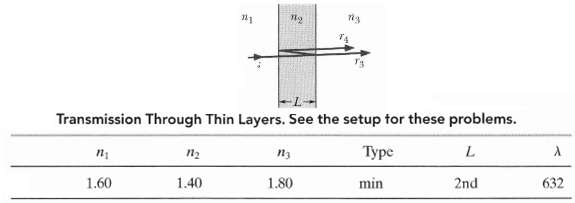
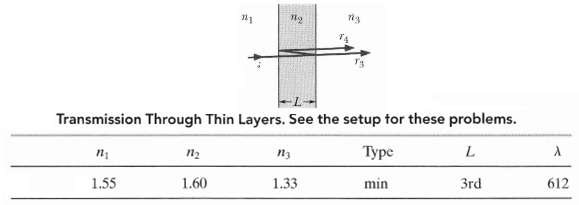
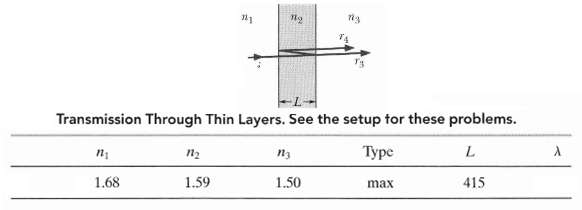
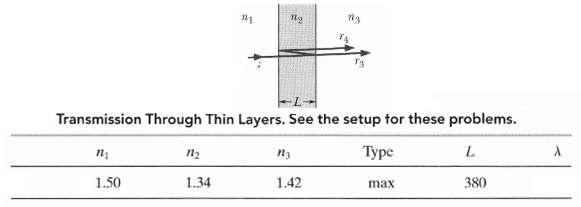
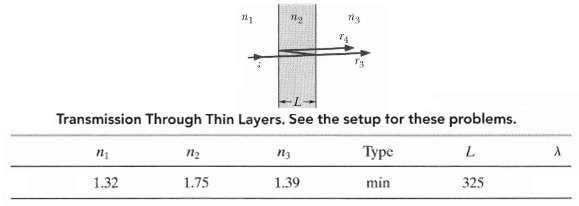
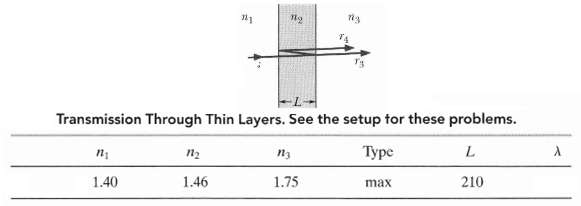
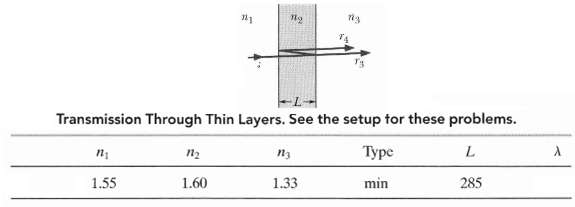
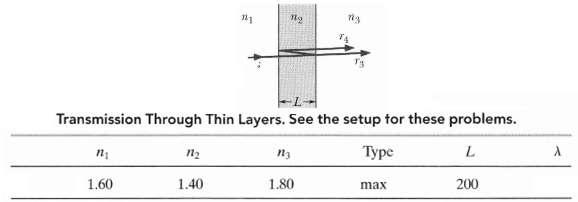
Transmission through thin layers in Figure light is incident perpendicularly on a thin layer of material 2 that lies between (thicker) materials 1 and 3. (The rays are tilted only for clarity.) Part of the light ends up in material 3 as ray r3 (the light does not reflect inside material2) and r4
Transmission through thin layers in Figure light is incident perpendicularly on a thin layer of material 2 that lies between (thicker) materials 1 and 3. (The rays are tilted only for clarity.) Part of the light ends up in material 3 as ray r3 (the light does not reflect inside material 2) and r4
Transmission through thin layers in Figure light is incident perpendicularly on a thin layer of material 2 that lies between (thicker) materials 1 and 3. (The rays are tilted only for clarity.) Part of the light ends up in material 3 as ray r3 (the light does not reflect inside material 2) and r4
Transmission through thin layers in Figure light is incident perpendicularly on a thin layer of material 2 that lies between (thicker) materials 1 and 3. (The rays are tilted only for clarity.) Part of the light ends up in material 3 as ray r3 (the light does not reflect inside material 2) and r4
Transmission through thin layers in Figure light is incident perpendicularly on a thin layer of material 2 that lies between (thicker) materials 1 and 3. (The rays are tilted only for clarity.) Part of the light ends up in material 3 as ray r3 (the light does not reflect inside material 2) and r4
Transmission through thin layers in Figure light is incident perpendicularly on a thin layer of material 2 that lies between (thicker) materials 1 and 3. (The rays are tilted only for clarity.) Part of the light ends up in material 3 as ray r3 (the light does not reflect inside material 2) and r4
Transmission through thin layers in Figure light is incident perpendicularly on a thin layer of material 2 that lies between (thicker) materials 1 and 3. (The rays are tilted only for clarity.) Part of the light ends up in material 3 as ray r3 (the light does not reflect inside material 2) and r4
Transmission through thin layers in Figure light is incident perpendicularly on a thin layer of material 2 that lies between (thicker) materials 1 and 3. (The rays are tilted only for clarity.) Part of the light ends up in material 3 as ray r3 (the light does not reflect inside material 2) and r4
Transmission through thin layers in Figure light is incident perpendicularly on a thin layer of material 2 that lies between (thicker) materials 1 and 3. (The rays are tilted only for clarity.) Part of the light ends up in material 3 as ray r3 (the light does not reflect inside material 2) and r4
Transmission through thin layers in Figure light is incident perpendicularly on a thin layer of material 2 that lies between (thicker) materials 1 and 3. (The rays are tilted only for clarity.) Part of the light ends up in material 3 as ray r3 (the light does not reflect inside material2) and r4
Transmission through thin layers in Figure light is incident perpendicularly on a thin layer of material 2 that lies between (thicker) materials 1 and 3. (The rays are tilted only for clarity.) Part of the light ends up in material 3 as ray r3 (the light does not reflect inside material2) and r4
Transmission through thin layers in Figure light is incident perpendicularly on a thin layer of material 2 that lies between (thicker) materials 1 and 3. (The rays are tilted only for clarity.) Part of the light ends up in material 3 as ray r3 (the light does not reflect inside material2) and r4
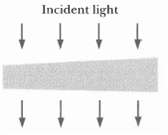
In Figure a broad beam of light of wavelength 630 nm is incident at 90o on a thin, wedge-shaped film with index of refraction 1.50. An observer intercepting the light transmitted by the film sees 10 bright and 9 dark fringes along the length of the film. By how much does the film thickness change
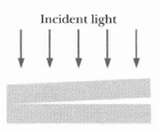
Two rectangular glass plates (n = 1.60) are in contact along one edge and are separated along the opposite edge (Figure).Light with a wavelength of 600 nm is incident perpendicularly onto the top plate. The air between the plates acts as a thin film. Nine dark fringes and eight bright fringes are
Showing 1400 - 1500
of 2678
First
8
9
10
11
12
13
14
15
16
17
18
19
20
21
22
Last
Step by Step Answers

 Get 50% OFF
Claim Now
Get 50% OFF
Claim Now