New Semester
Started
Get
50% OFF
Study Help!
--h --m --s
Claim Now
Question Answers
Textbooks
Find textbooks, questions and answers
Oops, something went wrong!
Change your search query and then try again
S
Books
FREE
Study Help
Expert Questions
Accounting
General Management
Mathematics
Finance
Organizational Behaviour
Law
Physics
Operating System
Management Leadership
Sociology
Programming
Marketing
Database
Computer Network
Economics
Textbooks Solutions
Accounting
Managerial Accounting
Management Leadership
Cost Accounting
Statistics
Business Law
Corporate Finance
Finance
Economics
Auditing
Tutors
Online Tutors
Find a Tutor
Hire a Tutor
Become a Tutor
AI Tutor
AI Study Planner
NEW
Sell Books
Search
Search
Sign In
Register
study help
physics
light and optics
College Physics 7th Edition Raymond A. Serway, Jerry S. Faughn, Chris Vuille, Charles A. Bennett - Solutions
In a certain two-slit interference pattern, 10 bright fringes lie within the second side peak of the diffraction envelope and diffraction minima coincide with two-slit interference maxima. What is the ratio of the slit separation to the slit width?
A diffraction grating having 180 lines/mm is illuminated with a light signal containing only two wavelengths, λ1 = 400 nm and λ2 = 500 nm. The signal is incident perpendicularly on the grating.(a) What is the angular separation between the second-order maxima of these two wavelengths?(b) What is
A diffraction grating is made up of slits of width 300 nm with separation 900 nm. The grating is illuminated by monochromatic plane waves of wavelength λ = 600 nm at normal incidence.(a) How many maxima are there in the full diffraction pattern?(b) What is the angular width of a spectral line
Light of wavelength 600 nm is incident normally on a diffraction grating. Two adjacent maxima occur at angles given by sin θ = 0.2 and sin θ = 0.3. The fourth-order maxima are missing. (a) What is the separation between adjacent slits?(b) What is the smallest slit width this grating can have? For
With light from a gaseous discharge tube incident normally on a grating with slit separation 1.73μm, sharp maxima of green light are experimentally found at angles 0 – + 17.6, 37.3o, – 37.1o, 65.2o, and – 65.0o. Compute the wavelength of the green light that best fits these data.
Assume that the limits of the visible spectrum are arbitrarily chosen as 430 and 680 nm. Calculate the number of rulings per millimeter of a grating that will spread the first order spectrum through an angle of 20.0o.
A beam of light consisting of wavelengths from 460.0 nm to 640.0 nm is directed perpendicularly onto a diffraction grating with 160lines/mm.(a) What is the lowest order that is overlapped by another order?(b) What is the highest order for which the complete wavelength range of the beam is present?
A grating has 350rulings/mm and is illuminated at normal incidence by white light. A spectrum is formed on a screen 30.0 cm from the grating. If a hole 10.0 mm square is cut in the screen, its inner edge being 50.0 mm from the central maximum and parallel to it, what are the(a) Shortest and(b)
Derive this expression for the intensity pattern for a three-slit "grating": I = 1/9 Im (1 + 4 cos Φ + 4 cos2 Φ), where Φ = (2πd sin θ) / λ and a << λ.
A diffraction grating with a width of 2.0 cm contains 1000 lines/cm across that width. For an incident wavelength of 600nm, what is the smallest wavelength difference this grating can resolve in the second order?
The D line in the spectrum of sodium is a doublet with wavelengths 589.0 and 589.6 nm. Calculate the minimum number of lines needed in a grating that will resolve this doublet in the second-order spectrum.
Light at wavelength 589 nm from a sodium lamp is incident perpendicularly on a grating with 40 000 rulings over width 76 nm, what are the first-order?(a) Dispersion D and(b) Resolving power R, the second-order(c) D and(d) R and the third-order(e) D and(f) R?
(a) How many rulings must a 4.00-cm-wide diffraction grating have to resolve the wavelengths 415.496 and 415.487 nm in the second order?(b) At what angle are the second order maxima found?
A source containing a mixture of hydrogen and deuterium atoms emits red light at two wavelengths whose mean is 656.3 nm and whose separation is 0.180 nm. Find the minimum number of lines needed in a diffraction grating that can resolve these lines in the first order.
A grating has 600rulings/mm and is 5.0 mm wide.(a) What is the smallest wavelength interval it can resolve in the third order at λ = 500 nm?(b) How many higher orders of maxima can be seen?
With a particular grating the sodium doublet is viewed in the third order at 10o to the normal and is barely resolved. Find(a) The grating spacing and(b) The total width of the rulings.
A diffraction grating illuminated by monochromatic light normal to the grating produces a certain line at angle θ.(a) What is the product of that line's half-width and the grating's resolving power?(b) Evaluate that product for the first order of a grating of slit separation 900 nm in light of
Figure is a graph of intensity versus angular position θ for the diffraction of an x-ray beam by a crystal. The horizontal scale is set by θs = 2.00o. The beam consists of two wavelengths and the spacing between the reflecting planes is 0.94nm. What are the(a) Shorter and(b) Longer wavelength in
If first-order reflection occurs in a crystal at Bragg angle 3.4o, at what Bragg angle does second-order reflection occur from the same family of reflecting planes?
X rays of wavelength 0.12 nm are found to undergo second-order reflection at a Bragg angle of 28o from a lithium fluoride crystal, what is the inter planar spacing of the reflecting planes in the crystal?
What is the smallest Bragg angle for x rays of wavelength 30 pm to reflect from reflecting planes spaced 0.30 nm apart in a calcite crystal?
An x-ray beam of wavelength A undergoes first-order reflection from a crystal when its angle of incidence to a crystal face ts 23o, and an x-ray beam of wavelength 97 pm undergoes third-order reflection when its angle of incidence to that face is 60o. Assuming that the two beams reflect from the
An x-ray beam of a certain wavelength is incident on a NaCl crystal, at 30.0o to a certain family of reflecting planes of spacing 39.8 pm. If the reflection from those planes is of the first order, what is the wavelength of the x rays?
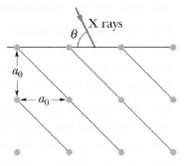
Consider a two-dimensional square crystal structure, such as one side of the structure shown in Figure a. The largest inter planar spacing of reflecting planes are the unit cell size as. Calculate and sketch the(a) Second largest,(b) Third largest,(c) Fourth largest,(d) Fifth largest, and(e) Sixth
In Figure first-order reflection from the reflection planes shown occurs when an x-ray beam of wavelength 0.260 nm makes an angle θ = 63.8o with the top face of the crystal. What is the unit cell size a0?
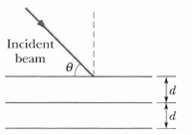
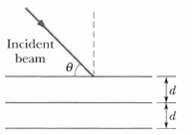
In Figure let a beam of x rays of wavelength 0.125 nm be incident on an NaCl crystal at angle θ = 45.0o to the top face of the crystal and a family of reflecting planes. Let the reflecting planes have separation d = 0.252 nm. The crystal is turned through angle Φ around an axis perpendicular to
In Figure an x-ray beam of wavelengths from 95.0 to 140 pm is incident at 0 = 45.0o to a family of reflecting planes with spacing d - 275 pm. What are the (a) Longest wavelength I and (b) Associated order number m and the (c) Shortest λ and (d) Associated m of the intensity maxima in the
In June 1985, a laser beam was sent out from the Air Force Optical Station on Maui, Hawaii, and reflected back from the shuttle Discovery as it sped by 354 km overhead. The diameter of the central maximum of the beam at the shuttle position was said to be 9.1 m, and the beam wavelength was 500 nm.
An astronaut in a space shuttle claims she can just barely resolve two point sources on Earth's surface, 160 km below. Calculate their(a) Angular and(b) Linear separation, assuming ideal conditions. Take A = 540 nm and the pupil diameter of the astronaut's eye to be 5.0 mm.
Visible light is incident perpendicularly on a diffraction grating of 200rulings/mm. What are the(a) Longest,(b) Second longest, and(c) Third longest wavelengths that can be associated with an intensity maximum at θ = 30.0o?
When monochromatic light is incident on a slit 22.0 μm wide, the first diffraction minimum lies at 1.80o from the direction of the incident light what is the wavelength?
In a single-slit diffraction experiment, there is a minimum of intensity for orange light (λ = 600 nm) and a minimum of intensity for blue-green light (λ = 500 nm) at the same angle of 1.00mrad. For what minimum slit width is this possible?
In a two-slit interference pattern, what is the ratio of slit separation to slit width if there arc 17 bright fringes within the central diffraction envelope and the diffraction minima coincide with two-slit interference maxima?
In two-slit interference, if the slit separation is 14μm and the slit widths are each 2.0μm,(a) How many two-slit maxima are in the central peak of the diffraction envelope and(b) How many are in either of the first side peak of the diffraction envelope?
A single-slit diffraction experiment is set up with light of wavelength 420nm, incident perpendicularly on a slit of width 5.10μm. The viewing screen is 3.20 m distant. On the screen, what is the distance between the center of the diffraction pattern and the second diffraction minimum?
A beam of light with a narrow wavelength range centered on 450 nm is incident perpendicularly on a diffraction grating with a width of 1.80 cm and a line density of 1400 lines/cm across that width. For this light, what is the smallest wavelength difference this grating can resolve in the third
If you look at something 40 m from you, what is the smallest length (perpendicular to your line of sight) that you can resolve, according to Rayleigh's criterion? Assume the pupil of your eye has a diameter of 4.00mm and use 500 nm as the wavelength of the light reaching you.
Two yellow flowers are separated by 60 cm along a line perpendicular to your line of sight to the flowers. How far are you from the flowers when they are at the limit of resolution according to the Rayleigh criterion? Assume the light from the flowers has a single wavelength of 550 nm and that your
In a single-slit diffraction experiment, what must be the ratio of the slit width to the wavelength if the second diffraction minima are to occur at an angle of 37.0o from the center of the diffraction pattern on a viewing screen?
A diffraction grating 3.00 cm wide produces the second order at 33.0" with light of wavelength 600 nm. What is the total number of lines on the grating?
A beam of light consists of two wavelengths, 590.159 nm and 590.220nm, that are to be resolved with a diffraction grating. If the grating has lines across a width of 3.80cm, what is the minimum number of lines required for the two wavelengths to be resolved in the second order?
A spy satellite orbiting at 160 km above Earth's surface has a lens with a focal length of 3.6 m and can resolve objects on the ground as small as 30 cm. For example, it can easily measure the size of an aircraft's air intake port. What is the effective diameter of the lens as determined by
The pupil of a person's eye has a diameter of 5.00 mm. According to Rayleigh's criterion, what distance apart must two small objects be if their images are just barely resolved when they are 250 mm from the eye? Assume they are illuminated with light of wavelength 500nm.
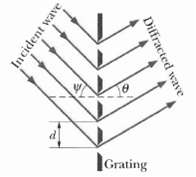
Light is incident on a grating at an angle ? as shown in Figure show that bright fringes occur at angles ? that satisfy the equation d(sin ? + sin ?) = m?, for m = 0, 1, 2, . . . (compare this equation with Eq. 36-25.) Only the special case ? = has been treated in this chapter.
A grating with d = 1.50 μm is illuminated at various angles of incidence by light of wavelength 600 nm. Plot, as a function of the angle of incidence (0 to 90o), the angular deviation of the first-order maximum from the incident direction
If you double the width of a single slit, the intensity of the central maximum of the diffraction pattern increases by a factor of 4, even though the energy passing through the slit only doubles. Explain this quantitatively.
In an experiment to monitor the Moon's surface with a light beam, pulsed radiation from a ruby laser (λ = 0.69 pm) was directed to the Moon through a reflecting telescope with a mirror radius of 1.3 m. A reflector on the Moon behaved like a circular flat mirror with radius 10 cm, reflecting
A diffraction grating has resolving power R = λavg/Δλ = Nm.(a) Show that the corresponding frequency range Δf that can just be resolved is given by Δf = c/Nmλ.(b) From Figure show that the times required for light to travel along the ray at the bottom of the figure and the ray at the top
A double-slit system with individual slit widths of 0.030 mm and a slit separation of 0.18 mm is illuminated with 500 nm light directed perpendicular to the plane of the slits. What is the total number of complete bright fringes appearing between the two first order minima of the diffraction
A diffraction grating has 8900 slits across 1.20 cm. If light with a wavelength of 500 nm is sent through it, how many orders (maxima) lie to one side of the central maximum?
A diffraction grating 1.00 cm wide has 10 000 parallel slits. Monochromatic light that is incident normally is diffracted through 30o in the first order. What is the wavelength of the light?
A diffraction grating has 200lines/mm light consisting of a continuous range of wavelengths between 550nm and 700 nm is incident perpendicularly on the grating. (a) What is the lowest order that is overlapped by another order? (b) What is the highest order for which the complete spectrum is present?
Suppose that two points are separated by 2.0 cm. If they are viewed by an eye with a pupil opening of 5.0 mm, what distance from the viewer puts them at the Rayleigh limit of resolution? Assume a light wavelength of 500 nm.
Show that the dispersion of a grating is D = (tan θ)λ.
Light containing a mixture of two wavelengths, 500 and 600 nm, is incident normally on a diffraction grating. It is desired (1) that the first and second maxima for each wavelength appear at θ < 30o, (2) that the dispersion be as high as possible, and (3) that the third order for the 600 nm
A beam of x rays with wavelengths ranging from 0.120 nm to 0.0700 nm scatters from a family of reflecting planes in a crystal. The plane separation is 0.250 nm. It is observed that scattered beams are produced for 0.100 nm and 0.0750 nm. What is the angle between the incident and scattered beams?
Show that a grating made up of alternately transparent and opaque strips of equal width eliminates all the even orders of maxima (except m = 0).
Light of wavelength 500 nm diffracts through a slit of width 2.00 pm and onto a screen that is 2.00 m away. On the screen, what is the distance between the center of the diffraction pattern and the third diffraction minimum?
If in a two-slit interference pattern, there are 8 bright fringes within the first side peak of the diffraction envelope and diffraction minima coincide with two-slit interference maxima, then what is the ratio of slit separation to slit width?
White light (consisting of wavelengths from 400nm to 700nm) is normally incident on a grating. Show that, no matter what the value of the grating spacing d, the second order and third order overlap.
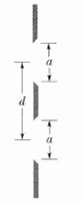
If we make d = a in Figure the two slits coalesce into a single slit of width 2a. Show that Eq. 36-19 reduces to give the diffraction pattern for such aslit.
Derive Eq. 36-28, the expression for the half-width of lines in a grating's diffraction pattern.
Prove that it is not possible to determine both wavelength of incident radiation and spacing of reflecting planes in a crystal by measuring the Bragg angles for several orders.
How many orders of the entire visible spectrum (400–700 nm) can be produced by a grating of 500lines/mm?
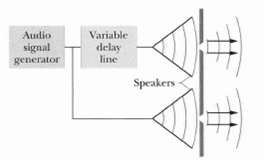
An acoustic double-slit system (of slit separation d and slit width a) is driven by two loudspeakers as shown in Figure. By use of a variable delay line, the phase of one of the speakers may be varied relative to the other speaker. Describe in detail what changes occur in the double-slit
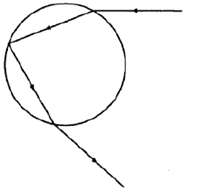
According to Descartes? theory of the formation of the rainbow, a ray of sunlight is refracted as it enters a spherical raindrop, undergoes a single internal reflexion, and is then refracted as it leaves the drop, as shown in figure. The rainbow is formed from the rays whose deviation from the
The distance between an object and its real image, formed by a converging lens, is held fixed. Show that there are two possible positions for the lens, and that the size of the object is given by (h1h2)1/2 where h1 and h2 are the sizes of the two images.
Draw a scale diagram of the optical component in a refracting telescope in normal adjustment, giving the components the following values in your diagram: Objective lens focal length 12cm, diameter 6cm; Single eyepiece lens focal length 2 cm, diameter 2cm.Consider an
A beam of light of wavelength 600 nm passes through a slit of width 0.01 mm and strikes a screen, normal to the beam, placed a distance 2m from the slit. Derive an expression for the shape of the intensity distribution seen on the screen and thereby deduce the width between the first minima of the
A Young’s slits experiment is set up in which two narrow slits, of separation d, are illuminated by light of wavelength λ. The diffraction pattern is viewed on a screen at a distance D. Derive expressions for the intensity distribution on the screen and the separation of the fringes. If D = 1m,
A diffraction grating has N slits. Show that the resolving power R = λ/∆λ of the grating is given by R = mN, where m is the order of interference which is under observation.
A telescope is used to observe at a distance of 10 km two objects which are 0.12 m apart and illuminated by light of wavelength 600 nm. Estimate the diameter of the objective lens of the telescope if it can just resolve the two objects.
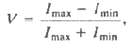
The visibility V of the fringes observed in a Michelson interferometer is defined asWhere Imax and Imin are the intensities at the maxima and minima of the fringe pattern. In observations of the sodium D-lines, V varies from a maximum of 1.00 to a minimum of 0.33 over a range of approximately 500
Does your bathroom mirror show you older or younger than your actual age? Compute an order-of-magnitude estimate for the age difference, based on data that you specify.
Use Active figure to give a geometric proof that the virtual image formed by a plane mirror is the same distance behind the mirror as the object is in front of it.
A person walks into a room that has, on opposite walls, two plane mirrors producing multiple images. Find the distances from the person to the first three images seen in the left-hand mirror when the person is 5.00 ft from the mirror on the left wall and 10.0 ft from the mirror on the right wall.
In a church choir loft, two parallel walls are 5.30 m apart. The singers stand against the north wall. The organist faces the south wall, sitting 0.800 m away from it. So that she can see the choir, a flat mirror 0.600 m wide is mounted on the south wall, straight in front of the organist. What
At an intersection of hospital hallways, a convex mirror is mounted high on a wall to help people avoid collisions. The mirror has a radius of curvature of 0.550m. Locate and describe the image of a patient 10.0 m from the mirror. Determine the magnification of the image.
To fit a contact lens to a patient’s eye, a keratometer can be used to measure the curvature of the cornea—the front surface of the eye. This instrument places an illuminated object of known size at a known distance p from the cornea, which then reflects some light from the object, forming an
A concave spherical mirror has a radius of curvature of 20.0 cm. Locate the images for object distances of(a) 40.0 cm, (b) 20.0 cm, and (c) 10.0 cm. In each case, state whether the image is real or virtual and upright or inverted, and find the magnification.
A dentist uses a mirror to examine a tooth that is 1.00 cm in front of the mirror. The image of the tooth is formed 10.0 cm behind the mirror. Determine (a) The mirror’s radius of curvature and (b) The magnification of the image.
A large church has a niche in one wall. On the floor plan it appears as a semicircular indentation of radius 2.50 m. A worshiper stands on the centerline of the niche, 2.00 m out from its deepest point, and whispers a prayer. Where is the sound concentrated after it reflects from the back wall of
While looking at her image in a cosmetic mirror, Dina notes that her face is highly magnified when she is close to the mirror, but as she backs away from the mirror, her image first becomes blurry, then disappears when she is about 30 cm from the mirror, and then inverts when she is beyond 30 cm.
A 2.00-cm-high object is placed 3.00 cm in front of a concave mirror. If the image is 5.00 cm high and virtual, what is the focal length of the mirror?
A dedicated sports car enthusiast polishes the inside and outside surfaces of a hubcap that is a section of a sphere. When he looks into one side of the hubcap, he sees an image of his face 30.0 cm in back of it. He then turns the hubcap over, keeping it the same distance from his face. He now sees
A concave makeup mirror is designed so that a person 25 cm in front of it sees an upright image magnified by a factor of two. What is the radius of curvature of the mirror?
A certain Christmas tree ornament is a silver sphere having a diameter of 8.50 cm. Determine an object location for which the size of the reflected image is three-fourths the size of the object. Use a principal-ray diagram to arrive at a description of the image.
A man standing 1.52 m in front of a shaving mirror produces an inverted image 18.0 cm in front of it. How close to the mirror should he stand if he wants to form an upright image of his chin that is twice the chin’s actual size?
A convex spherical mirror with a radius of curvature of 10.0 cm produces a virtual image one-third the size of the real object. Where is the object?
A child holds a candy bar 10.0 cm in front of a convex mirror and notices that the image is only one-half the size of the candy bar. What is the radius of curvature of the mirror?
It is observed that the size of a real image formed by a concave mirror is four times the size of the object when the object is 30.0 cm in front of the mirror. What is the radius of curvature of this mirror?
A spherical mirror is to be used to form an image, five times as tall as an object, on a screen positioned 5.0 m from the mirror. (a) Describe the type of mirror required.(b) Where should the mirror be positioned relative to the object?
A ball is dropped from rest 3.00 m directly above the vertex of a concave mirror having a radius of 1.00 m and lying in a horizontal plane. (a) Describe the motion of the ball’s image in the mirror. (b) At what time do the ball and its image coincide?
A cubical block of ice 50.0 cm on an edge is placed on a level floor over a speck of dust. Locate the image of the speck, when viewed from directly above, if the index of refraction of ice is 1.309.
The top of a swimming pool is at ground level. If the pool is 2 m deep, how far below ground level does the bottom of the pool appear to be located when? (a) The pool is completely filled with water? (b) The pool is filled halfway with water?
A paperweight is made of a solid glass hemisphere with index of refraction 1.50. The radius of the circular cross section is 4.0 cm. The hemisphere is placed on its flat surface, with the center directly over a 2.5-mm-long line drawn on a sheet of paper. What length of line is seen by someone
A flint glass plate (n = 1.66) rests on the bottom of an aquarium tank. The plate is 8.00 cm thick (vertical dimension) and covered with water (n = 1.33) to a depth of 12.0 cm. Calculate the apparent thickness of the plate as viewed from above the water. (Assume nearly normal incidence of light
A transparent sphere of unknown composition is observed to form an image of the Sun on its surface opposite the Sun. What is the refractive index of the sphere material?
A goldfish is swimming at 2.00 cm/s toward the front wall of a rectangular aquarium. What is the apparent speed of the fish as measured by an observer looking in from outside the front wall of the tank? The index of refraction of water is 1.333.
Showing 1600 - 1700
of 2678
First
10
11
12
13
14
15
16
17
18
19
20
21
22
23
24
Last
Step by Step Answers

 Get 50% OFF
Claim Now
Get 50% OFF
Claim Now