New Semester
Started
Get
50% OFF
Study Help!
--h --m --s
Claim Now
Question Answers
Textbooks
Find textbooks, questions and answers
Oops, something went wrong!
Change your search query and then try again
S
Books
FREE
Study Help
Expert Questions
Accounting
General Management
Mathematics
Finance
Organizational Behaviour
Law
Physics
Operating System
Management Leadership
Sociology
Programming
Marketing
Database
Computer Network
Economics
Textbooks Solutions
Accounting
Managerial Accounting
Management Leadership
Cost Accounting
Statistics
Business Law
Corporate Finance
Finance
Economics
Auditing
Tutors
Online Tutors
Find a Tutor
Hire a Tutor
Become a Tutor
AI Tutor
AI Study Planner
NEW
Sell Books
Search
Search
Sign In
Register
study help
physics
light and optics
Fundamentals of Physics 8th Extended edition Jearl Walker, Halliday Resnick - Solutions
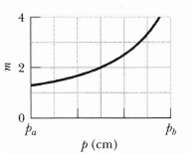
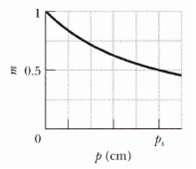
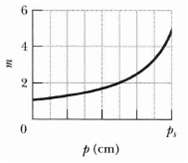
An object is moved along the central axis of a spherical mirror while the lateral magnification m of it is measured. Figure gives m versus object distance p for the range pa = 2.0 cm to pb = 8.0 cm. What is the magnification of the object when the object is 14.0 cm from the mirror?
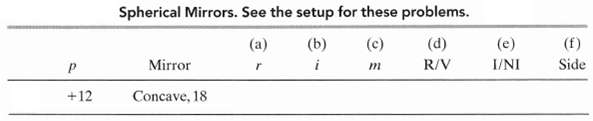
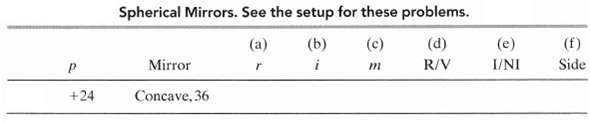
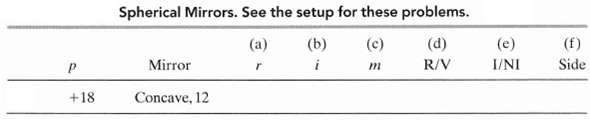
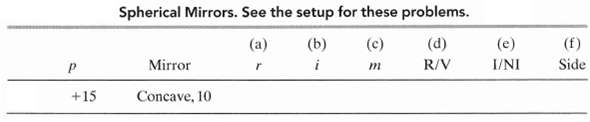
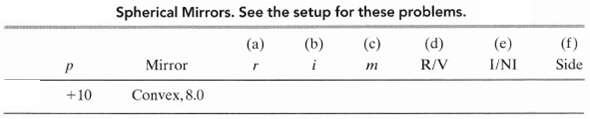
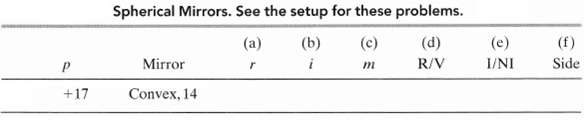
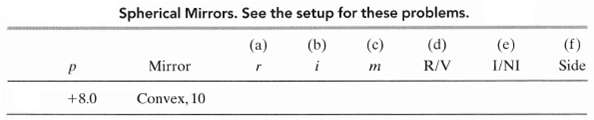
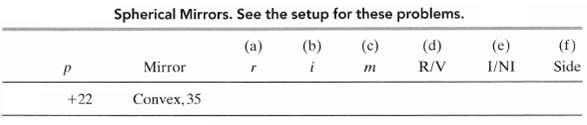
Spherical mirrors Object O stands on the central axis of a spherical mirror. For this situation, each problem in Table 34-3 gives object distance p, (centimeters), the type of mirror, and then the distance (centimeters, without proper sign) between the focal point and the mirror. Find (a) The
Spherical mirrors Object O stands on the central axis of a spherical mirror. For this situation, each problem in Table 34-3 gives object distance p, (centimeters), the type of mirror, and then the distance (centimeters, without proper sign) between the focal point and the mirror. Find (a) The
Spherical mirrors Object O stands on the central axis of a spherical mirror. For this situation, each problem in Table 34-3 gives object distance p, (centimeters), the type of mirror, and then the distance (centimeters, without proper sign) between the focal point and the mirror. Find (a) The
Spherical mirrors Object O stands on the central axis of a spherical mirror. For this situation, each problem in Table 34-3 gives object distance p, (centimeters), the type of mirror, and then the distance (centimeters, without proper sign) between the focal point and the mirror. Find (a) The
Spherical mirrors Object O stands on the central axis of a spherical mirror. For this situation, each problem in Table 34-3 gives object distance p, (centimeters), the type of mirror, and then the distance (centimeters, without proper sign) between the focal point and the mirror. Find (a) The
Spherical mirrors Object O stands on the central axis of a spherical mirror. For this situation, each problem in Table 34-3 gives object distance p, (centimeters), the type of mirror, and then the distance (centimeters, without proper sign) between the focal point and the mirror. Find (a) The
Spherical mirrors Object O stands on the central axis of a spherical mirror. For this situation, each problem in Table 34-3 gives object distance p, (centimeters), the type of mirror, and then the distance (centimeters, without proper sign) between the focal point and the mirror. Find (a) The
Spherical mirrors Object O stands on the central axis of a spherical mirror. For this situation, each problem in Table 34-3 gives object distance p, (centimeters), the type of mirror, and then the distance (centimeters, without proper sign) between the focal point and the mirror. Find (a) The
(a) A luminous point is moving at speed v0 toward a spherical mirror with radius of curvature r, along the central axis of the mirror. Show that the image of this point is moving at speed v1 = – (r/2p – r)2 v0, where p is the distance of the luminous point from the mirror at any given time. Now
Figure gives the lateral magnification m of an object versus the object distance p from a spherical mirror as the object is moved along the mirror's central axis through a range of values for p. The horizontal scale is set by p = 10.0 cm. What is the magnification of the object when the object is
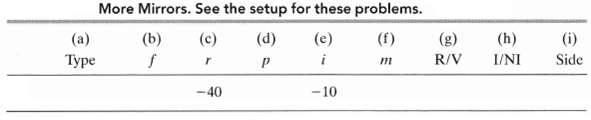
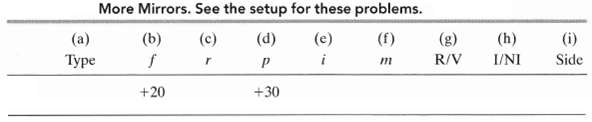
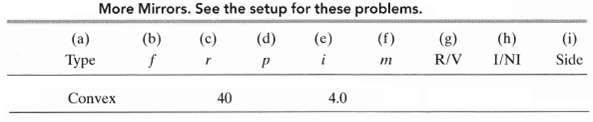
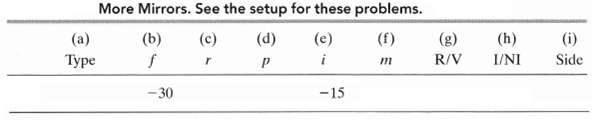
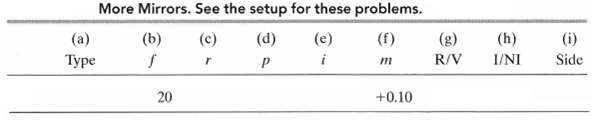
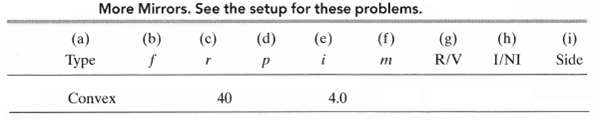
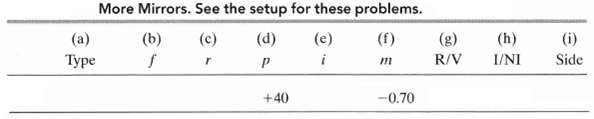
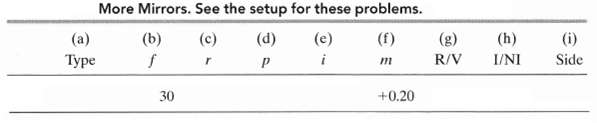
More mirrors. Object O stands on the central axis of a spherical or plane mirror. For this situation, each problem in Table 34-4 refers to (a) The type of mirror, (b) The focal distance f, (c) The radius of curvature r, (d) The object distance p, (e) The image distance i, and (f) The lateral
More mirrors. Object O stands on the central axis of a spherical or plane mirror. For this situation, each problem in Table 34-4 refers to (a) The type of mirror, (b) The focal distance f, (c) The radius of curvature r, (d) The object distance p, (e) The image distance i, and (f) The lateral
More mirrors. Object O stands on the central axis of a spherical or plane mirror. For this situation, each problem in Table 34-4 refers to (a) The type of mirror, (b) The focal distance f, (c) The radius of curvature r, (d) The object distance p, (e) The image distance i, and (f) The lateral
More mirrors. Object O stands on the central axis of a spherical or plane mirror. For this situation, each problem in Table 34-4 refers to (a) The type of mirror, (b) The focal distance f, (c) The radius of curvature r, (d) The object distance p, (e) The image distance i, and (f) The lateral
More mirrors. Object O stands on the central axis of a spherical or plane mirror. For this situation, each problem in Table 34-4 refers to (a) The type of mirror, (b) The focal distance f, (c) The radius of curvature r, (d) The object distance p, (e) The image distance i, and (f) The lateral
More mirrors. Object O stands on the central axis of a spherical or plane mirror. For this situation, each problem in Table 34-4 refers to (a) The type of mirror, (b) The focal distance f, (c) The radius of curvature r, (d) The object distance p, (e) The image distance i, and (f) The lateral
More mirrors. Object O stands on the central axis of a spherical or plane mirror. For this situation, each problem in Table 34-4 refers to (a) The type of mirror, (b) The focal distance f, (c) The radius of curvature r, (d) The object distance p, (e) The image distance i, and (f) The lateral
More mirrors. Object O stands on the central axis of a spherical or plane mirror. For this situation, each problem in Table 34-4 refers to (a) The type of mirror, (b) The focal distance f, (c) The radius of curvature r, (d) The object distance p, (e) The image distance i, and (f) The lateral
More mirrors. Object O stands on the central axis of a spherical or plane mirror. For this situation, each problem in Table 34-4 refers to (a) The type of mirror, (b) The focal distance f, (c) The radius of curvature r, (d) The object distance p, (e) The image distance i, and (f) The lateral
More mirrors. Object O stands on the central axis of a spherical or plane mirror. For this situation, each problem in Table 34-4 refers to (a) The type of mirror, (b) The focal distance f, (c) The radius of curvature r, (d) The object distance p, (e) The image distance i, and (f) The lateral
More mirrors. Object O stands on the central axis of a spherical or plane mirror. For this situation, each problem in Table 34-4 refers to (a) The type of mirror, (b) The focal distance f, (c) The radius of curvature r, (d) The object distance p, (e) The image distance i, and (f) The lateral
More mirrors. Object O stands on the central axis of a spherical or plane mirror. For this situation, each problem in Table 34-4 refers to (a) The type of mirror, (b) The focal distance f, (c) The radius of curvature r, (d) The object distance p, (e) The image distance i, and (f) The lateral
More mirrors. Object O stands on the central axis of a spherical or plane mirror. For this situation, each problem in Table 34-4 refers to (a) The type of mirror, (b) The focal distance f, (c) The radius of curvature r, (d) The object distance p, (e) The image distance i, and (f) The lateral
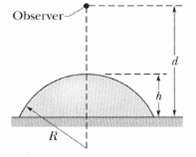
A glass sphere has radius R = 5.0cm and index of refraction 1.6. A paperweight is constructed by slicing through the sphere along a plane that is 2.0cm from the center of the sphere, leaving height h = 3.0cm. The paperweight is placed on a table and viewed from directly above by an observer who is
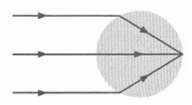
In Figure a beam of parallel light rays from a laser is incident on a solid transparent sphere of index of refraction n. (a) If a point image is produced at the back of the sphere, what is the index of refraction of the sphere? (b) What index of refraction, if any, will produce a point image at the
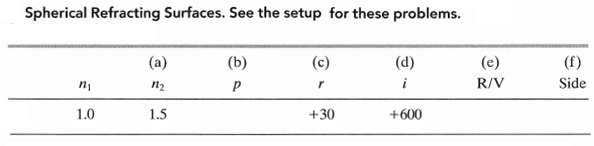
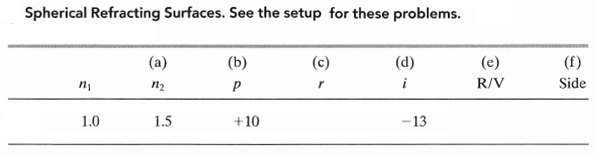
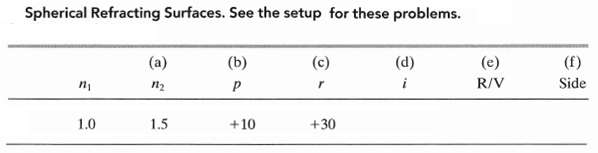
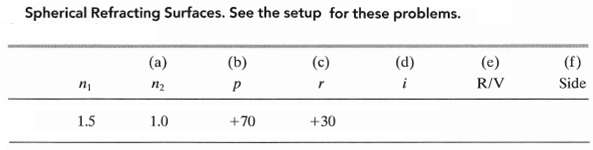
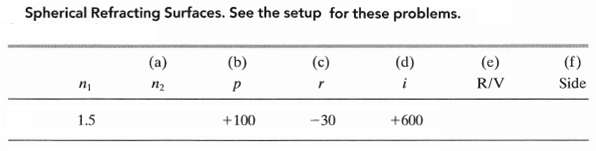
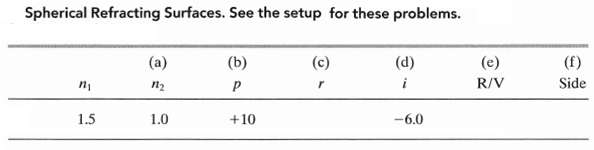
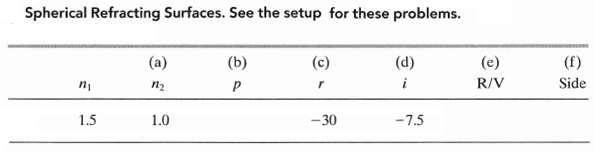
Spherical refracting surfaces an object O stands on the central axis of a spherical refracting surface. For this situation, each problem in Table 34-5 refers to the index of refraction n1 where the object is located, (a) The index of refraction n2 on the other side of the refracting surface, (b)
Spherical refracting surfaces an object O stands on the central axis of a spherical refracting surface. For this situation, each problem in Table 34-5 refers to the index of refraction n1 where the object is located, (a) The index of refraction n2 on the other side of the refracting surface, (b)
Spherical refracting surfaces an object O stands on the central axis of a spherical refracting surface. For this situation, each problem in Table 34-5 refers to the index of refraction n1 where the object is located, (a) The index of refraction n2 on the other side of the refracting surface, (b)
Spherical refracting surfaces an object O stands on the central axis of a spherical refracting surface. For this situation, each problem in Table 34-5 refers to the index of refraction n1 where the object is located, (a) The index of refraction n2 on the other side of the refracting surface, (b)
Spherical refracting surfaces an object O stands on the central axis of a spherical refracting surface. For this situation, each problem in Table 34-5 refers to the index of refraction n1 where the object is located, (a) The index of refraction n2 on the other side of the refracting surface, (b)
Spherical refracting surfaces an object O stands on the central axis of a spherical refracting surface. For this situation, each problem in Table 34-5 refers to the index of refraction n1 where the object is located, (a) The index of refraction n2 on the other side of the refracting surface, (b)
Spherical refracting surfaces an object O stands on the central axis of a spherical refracting surface. For this situation, each problem in Table 34-5 refers to the index of refraction n1 where the object is located, (a) The index of refraction n2 on the other side of the refracting surface, (b)
A double-convex lens is to be made of glass with an index of refraction of 1.5. One surface is to have twice the radius of curvature of the other and the focal length is to be 60 mm. What is the(a) Smaller and(b) Larger radius?
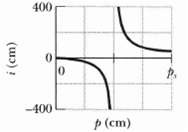
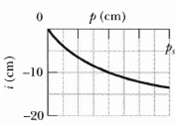
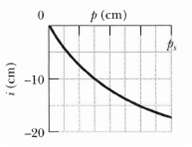
An Object is placed against the center of a thin lens and then moved away from it along the central axis as the image distance i is measured Figure gives i versus object distance p out to ps = 60cm, what is the image distance when p =100cm?
You produce an image of the Sun on a screen, using a thin lens whose focal length is 20.0 cm. What is the diameter of the image? (See Appendix C for needed data on the Sun.)
An object is placed against the center of a thin lens and then moved 70 cm from it along the central axis as the image distance i is measured. Figure gives i versus object distance p out to ps = 40 cm. What is the image distance when p = 70cm?
A movie camera with a (single) lens of focal length 75 mm takes a picture of a person standing 27 m away. If the person is 180 cm tall, what is the height of the image on the film?
An object is moved along the central axis of a thin lens while the lateral magnification m is measured. Figure gives rn versus object distance p out to ps = 8.0 cm. What is the magnification of the object when the object is 14.0 cm from the lens?
An illuminated slide is held 44 cm from a screen. How far from the slide must a lens of focal length 11 cm be placed (between the slide and the screen) to form an image of the slide's picture on the screen?
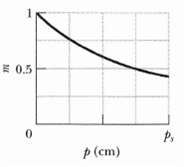
Figure gives the lateral magnification m of an object versus the object distance p from a lens as the object is moved along the central axis of the lens through a range of values f or p out to ps = 20.0 cm. What is the magnification of the object when the object is 35 cm from the lens?
A lens is made of glass having an index of refraction of 1.5. One side of the lens is flat, and the other is convex with a radius of curvature of 20 cm.(a) Find the focal length of the lens.(b) If an object is placed 40 cm in front of the lens, where will the image be located?
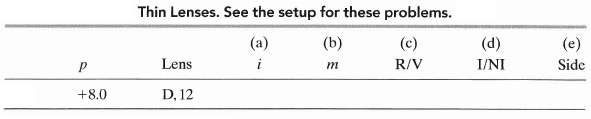
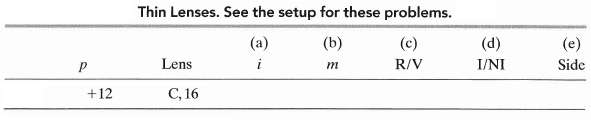
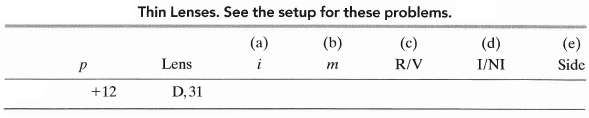
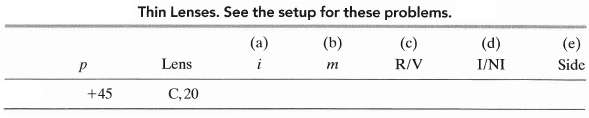
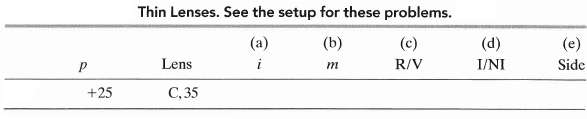
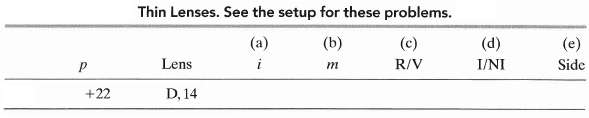
Thin lenses Object O stands on the central axis of a thin symmetric lens. For this situation, each problem in Table 34-6 gives object distance p (centimeters), the type of lens (C stands for converging and D for diverging), and then the distance (centimeters, without proper sign) between a focal
Thin lenses Object O stands on the central axis of a thin symmetric lens. For this situation, each problem in Table 34-6 gives object distance p (centimeters), the type of lens (C stands for converging and D for diverging), and then the distance (centimeters, without proper sign) between a focal
Thin lenses Object O stands on the central axis of a thin symmetric lens. For this situation, each problem in Table 34-6 gives object distance p (centimeters), the type of lens (C stands for converging and D for diverging), and then the distance (centimeters, without proper sign) between a focal
Thin lenses Object O stands on the central axis of a thin symmetric lens. For this situation, each problem in Table 34-6 gives object distance p (centimeters), the type of lens (C stands for converging and D for diverging), and then the distance (centimeters, without proper sign) between a focal
Thin lenses Object O stands on the central axis of a thin symmetric lens. For this situation, each problem in Table 34-6 gives object distance p (centimeters), the type of lens (C stands for converging and D for diverging), and then the distance (centimeters, without proper sign) between a focal
Thin lenses Object O stands on the central axis of a thin symmetric lens. For this situation, each problem in Table 34-6 gives object distance p (centimeters), the type of lens (C stands for converging and D for diverging), and then the distance (centimeters, without proper sign) between a focal
Thin lenses Object O stands on the central axis of a thin symmetric lens. For this situation, each problem in Table 34-6 gives object distance p (centimeters), the type of lens (C stands for converging and D for diverging), and then the distance (centimeters, without proper sign) between a focal
Thin lenses Object O stands on the central axis of a thin symmetric lens. For this situation, each problem in Table 34-6 gives object distance p (centimeters), the type of lens (C stands for converging and D for diverging), and then the distance (centimeters, without proper sign) between a focal
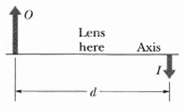
In Figure, a real inverted image l of an object O is formed by a certain lens (not shown); the object-image separation is d = 40.0cm, measured along the central axis of the lens. The image is just half the size of the object, (a) What kind of lens must be used to produce this image? (b) How far
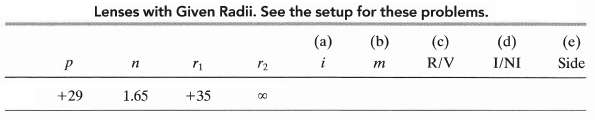
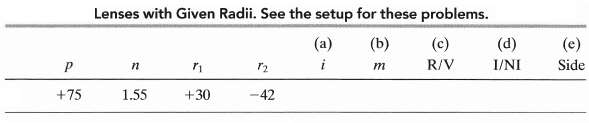
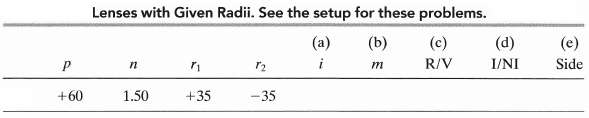
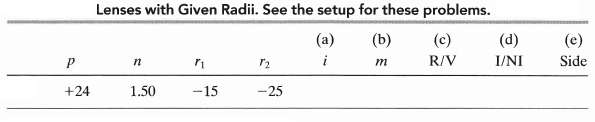
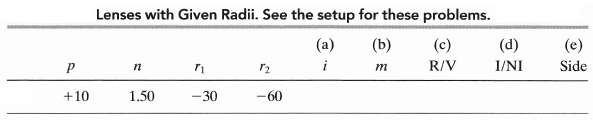
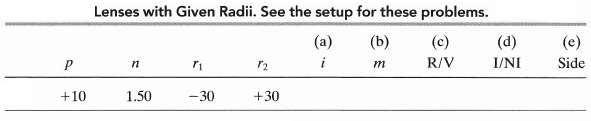
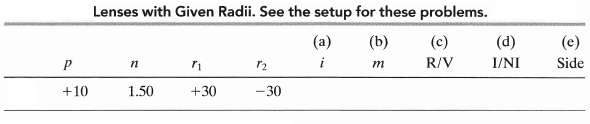
Lenses with given radii object O stands in front of a thin lens, on the central axis. For this situation, each problem in Table 34-7 gives object distance p, index of refraction n of. the lens, radius 11 of the nearer lens surface, and radius 12 of the farther lens surface. (All distances are in
Lenses with given radii object O stands in front of a thin lens, on the central axis. For this situation, each problem in Table 34-7 gives object distance p, index of refraction n of. the lens, radius 11 of the nearer lens surface, and radius 12 of the farther lens surface. (All distances are in
Lenses with given radii object O stands in front of a thin lens, on the central axis. For this situation, each problem in Table 34-7 gives object distance p, index of refraction n of. the lens, radius 11 of the nearer lens surface, and radius 12 of the farther lens surface. (All distances are in
Lenses with given radii object O stands in front of a thin lens, on the central axis. For this situation, each problem in Table 34-7 gives object distance p, index of refraction n of. the lens, radius 11 of the nearer lens surface, and radius 12 of the farther lens surface. (All distances are in
Lenses with given radii object O stands in front of a thin lens, on the central axis. For this situation, each problem in Table 34-7 gives object distance p, index of refraction n of. the lens, radius 11 of the nearer lens surface, and radius 12 of the farther lens surface. (All distances are in
Lenses with given radii object O stands in front of a thin lens, on the central axis. For this situation, each problem in Table 34-7 gives object distance p, index of refraction n of. the lens, radius 11 of the nearer lens surface, and radius 12 of the farther lens surface. (All distances are in
Lenses with given radii object O stands in front of a thin lens, on the central axis. For this situation, each problem in Table 34-7 gives object distance p, index of refraction n of. the lens, radius 11 of the nearer lens surface, and radius 12 of the farther lens surface. (All distances are in
Lenses with given radii object O stands in front of a thin lens, on the central axis. For this situation, each problem in Table 34-7 gives object distance p, index of refraction n of. the lens, radius 11 of the nearer lens surface, and radius 12 of the farther lens surface. (All distances are in
Lenses with given radii object O stands in front of a thin lens, on the central axis. For this situation, each problem in Table 34-7 gives object distance p, index of refraction n of. the lens, radius 11 of the nearer lens surface, and radius 12 of the farther lens surface. (All distances are in
Lenses with given radii object O stands in front of a thin lens, on the central axis. For this situation, each problem in Table 34-7 gives object distance p, index of refraction n of. the lens, radius 11 of the nearer lens surface, and radius 12 of the farther lens surface. (All distances are in
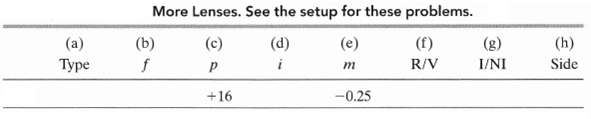
More lenses Object O stands on the central axis of a thin symmetric lens. For this situation, each problem in Table 34-8 refers to (a) The lens type, converging (C) or diverging (D), (b) The focal distance f, (c) The object distance p, (d) The image distance i, and (e) The lateral
More lenses Object O stands on the central axis of a thin symmetric lens. For this situation, each problem in Table 34-8 refers to (a) The lens type, converging (C) or diverging (D), (b) The focal distance f, (c) The object distance p, (d) The image distance i, and (e) The lateral
More lenses Object O stands on the central axis of a thin symmetric lens. For this situation, each problem in Table 34-8 refers to (a) The lens type, converging (C) or diverging (D), (b) The focal distance f, (c) The object distance p, (d) The image distance i, and (e) The lateral
More lenses Object O stands on the central axis of a thin symmetric lens. For this situation, each problem in Table 34-8 refers to (a) The lens type, converging (C) or diverging (D), (b) The focal distance f, (c) The object distance p, (d) The image distance i, and (e) The lateral
More lenses Object O stands on the central axis of a thin symmetric lens. For this situation, each problem in Table 34-8 refers to (a) The lens type, converging (C) or diverging (D), (b) The focal distance f, (c) The object distance p, (d) The image distance i, and (e) The lateral
More lenses Object O stands on the central axis of a thin symmetric lens. For this situation, each problem in Table 34-8 refers to (a) The lens type, converging (C) or diverging (D), (b) The focal distance f, (c) The object distance p, (d) The image distance i, and (e) The lateral
More lenses Object O stands on the central axis of a thin symmetric lens. For this situation, each problem in Table 34-8 refers to (a) The lens type, converging (C) or diverging (D), (b) The focal distance f, (c) The object distance p, (d) The image distance i, and (e) The lateral
More lenses Object O stands on the central axis of a thin symmetric lens. For this situation, each problem in Table 34-8 refers to (a) The lens type, converging (C) or diverging (D), (b) The focal distance f, (c) The object distance p, (d) The image distance i, and (e) The lateral
More lenses Object O stands on the central axis of a thin symmetric lens. For this situation, each problem in Table 34-8 refers to (a) The lens type, converging (C) or diverging (D), (b) The focal distance f, (c) The object distance p, (d) The image distance i, and (e) The lateral
More lenses Object O stands on the central axis of a thin symmetric lens. For this situation, each problem in Table 34-8 refers to (a) The lens type, converging (C) or diverging (D), (b) The focal distance f, (c) The object distance p, (d) The image distance i, and (e) The lateral
More lenses Object O stands on the central axis of a thin symmetric lens. For this situation, each problem in Table 34-8 refers to (a) The lens type, converging (C) or diverging (D), (b) The focal distance f, (c) The object distance p, (d) The image distance i, and (e) The lateral
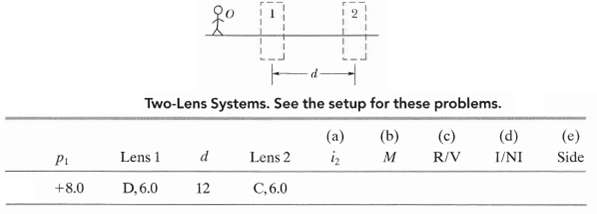
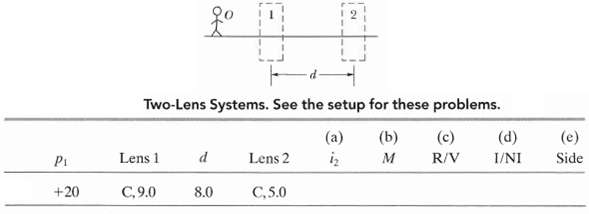
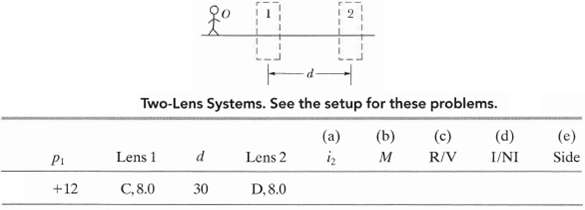
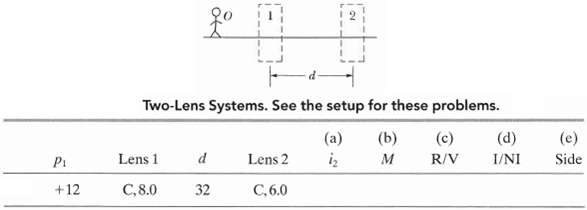
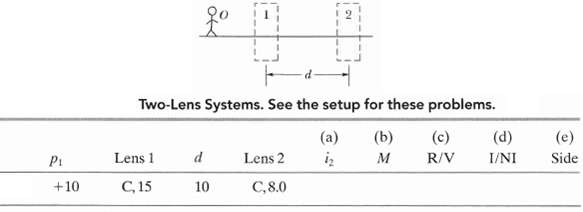
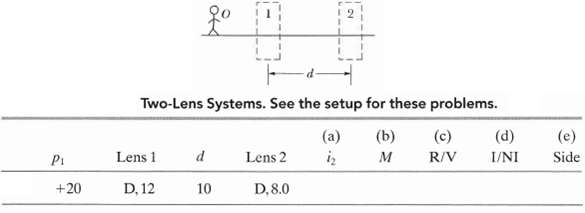
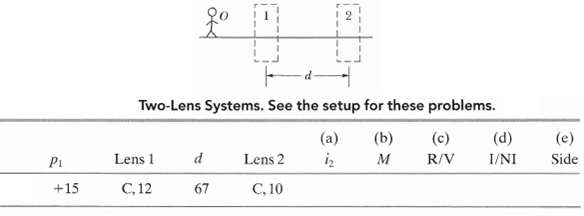
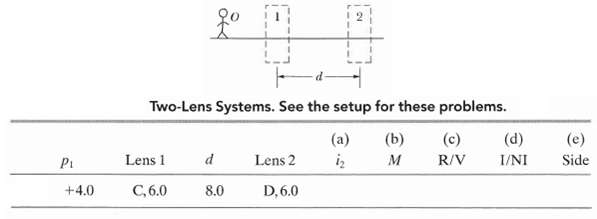
Two-lens systems In Figure stick figure O (the object) stands on the common central axis of two thin, symmetric lenses, which are mounted in the boxed regions. Lens 1 is mounted within the boxed region closer to O, which of lens is indicated by C for converging and D for diverging; the number after
Two-lens systems In Figure stick figure O (the object) stands on the common central axis of two thin, symmetric lenses, which are mounted in the boxed regions. Lens 1 is mounted within the boxed region closer to O, which of lens is indicated by C for converging and D for diverging; the number after
Two-lens systems In Figure stick figure O (the object) stands on the common central axis of two thin, symmetric lenses, which are mounted in the boxed regions. Lens 1 is mounted within the boxed region closer to O, which of lens is indicated by C for converging and D for diverging; the number after
Two-lens systems In Figure stick figure O (the object) stands on the common central axis of two thin, symmetric lenses, which are mounted in the boxed regions. Lens 1 is mounted within the boxed region closer to O, which of lens is indicated by C for converging and D for diverging; the number after
Two-lens systems In Figure stick figure O (the object) stands on the common central axis of two thin, symmetric lenses, which are mounted in the boxed regions. Lens 1 is mounted within the boxed region closer to O, which of lens is indicated by C for converging and D for diverging; the number after
Two-lens systems In Figure stick figure O (the object) stands on the common central axis of two thin, symmetric lenses, which are mounted in the boxed regions. Lens 1 is mounted within the boxed region closer to O, which of lens is indicated by C for converging and D for diverging; the number after
Two-lens systems In Figure stick figure O (the object) stands on the common central axis of two thin, symmetric lenses, which are mounted in the boxed regions. Lens 1 is mounted within the boxed region closer to O, which of lens is indicated by C for converging and D for diverging; the number after
Two-lens systems In Figure stick figure O (the object) stands on the common central axis of two thin, symmetric lenses, which are mounted in the boxed regions. Lens 1 is mounted within the boxed region closer to O, which of lens is indicated by C for converging and D for diverging; the number after
If the angular magnification of an astronomical telescope is 36 and the diameter of the objective is 75 mm, what is the minimum diameter of the eyepiece required to collect all the light entering the objective from a distant point source on the telescope axis?
In a microscope of the type shown in Figure the focal length of the objective is 4.00cm and that of the eyepiece is 8.00 cm. The distance between the lenses is 25.0 cm.(a) What is the tube length s?(b) If image 1 in Fig. 34-20 is to be just inside focal point Fi, how far from the objective should
An object is 10.0 mm from the objective of a certain compound microscope. The lenses are 300 mm apart, and the intermediate image is 50.0 mm from the eyepiece. What overall magnification is produced by the instrument?
Someone with a near point Pn of 25cm views a thimble through a simple magnifying lens of focal length 10 cm by placing the lens near his eye. What is the angular magnification of the thimble if it is positioned so that its image appears at(a) Pn and(b) Infinity?
Figure a, shows the basic structure of a camera. A lens can be moved forward or back to produce an image on film at the back of the camera. For a certain camera, with the distance i between the lens and the film set at f = 5.0cm, parallel light rays from a very distant object O converge to a point
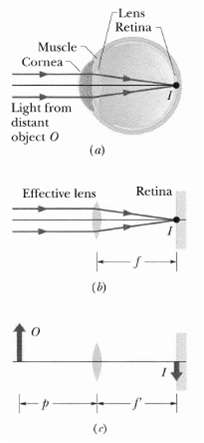
Figure a shows the basic structure of a human eye. Light refracts into the eye through the cornea and is then further redirected by a lens whose shape (and thus ability to focus the light) is controlled by muscles. We can treat the cornea and eye lens as a single effective thin lens (Figure b). A
An object is placed against the center of a spherical mirror and then moved 70 cm from it along the central axis as the image distance i is measured. Figure gives i versus object distance p out to ps, = 40 cm. What is the image distance when the object is 70 cm from the mirror?
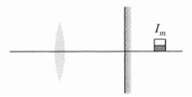
In Figure a box is somewhere at the left, on the central axis of the thin converging lens. The image Im of the box produced by the plane mirror is 4.00 cm "inside" the mirror. The lens-mirror separation is 10.0 cm, and the focal length of the lens is 2.00 cm. (a) What is the distance between the
Two plane mirrors are placed parallel to each other and 40 cm apart. An object is placed 10 cm from one mirror. Determine the(a) Smallest,(b) Second smallest(c) Third smallest (occurs twice), and(d) Fourth smallest distance of the object?
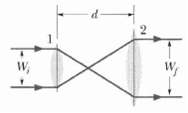
Figure shows a beam expander made with two coaxial converging lenses of focal lengths f1 and f2 and separation d = f1 + f2. The device can expand a laser beam while keeping the light rays in the beam parallel to the central axis through the lenses. Suppose a uniform laser beam of width Wi =2.5 mm
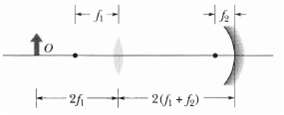
In Figure an object is placed in front of a converging lens at a distance equal to twice the focal length f1 of the lens. On the other side of the lens is a concave mirror of focal length f2 separated from the lens by a distance 2(f1 + f2). Light from the object passes rightward through the lens,
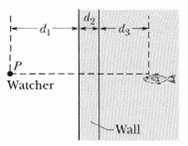
In Figure a fish watcher at point P watches a fish through a glass wall of a fish tank. The watcher is level with the fish; the index of refraction of the glass is 8/5, and that of the water rs 4/3. The distances are d1 = 8.0 cm, d2 = 3.0 cm, and d3 = 6.8 cm. (a) To the fish, how far away does the
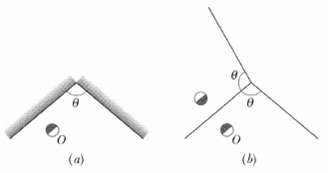
Figure a, is an overhead view of two vertical plane mirrors with an object O placed between them. If you look into the mirrors, you see multiple images of O. You can find them by drawing the reflection in each mirror of the angular region between the mirrors, as is done in Figure b, for the
A point object is 10 cm away from a plane mirror, and the eye of an observer (with pupil diameter 5.0 mm) is 20 cm away. Assuming the eye and the object to be on the same line perpendicular to the mirror surface, find the area of the mirror used in observing the reflection of the point.
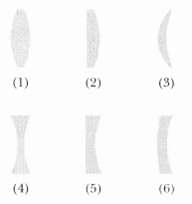
You grind the lenses shown in Fig. 34-53 from flat glass disks (n = 1.5) using a machine that can grind a radius of curvature of either 40 cm or 60 cm. In a lens where either radius is appropriate, you select the 40 cm radius. Then you hold each lens in sunshine to form an image of the Sun. What
The formula 1/p + 1/i = 1/f is called the Gaussian form of the thin-lens formula. Another form of this formula, the Newtonian form, is obtained by considering the distance x from the object to the first focal point and the distance x' from the second focal point to the image. Show that xx' = f2 ts
Show that the distance between an object and its real image formed by a thin converging lens is always greater than or equal to four times the focal length of the lens
Two thin lenses of focal lengths f1 and f2 are in cont act. Show that they are equivalent to a single thin lens for which the focal length is f = f1 f2 (f1 + f2)
A luminous object and a screen are a fixed distance D apart.(a) Show that a converging lens of focal length f, placed between object and screen, will form a real image on the screen for two lens positions that are separated by a distance d = √D(D - 4f).(b) Show that (D – d/D + d)2 gives the
A fruit fly of height H sits in front of lens 1 on the central axis through the lens. The lens forms an image of the fly at a distance d = 20 cm from the fly; the image has the fly's orientation and height H1 = 2.0H.What are(a) The focal length f1 of the lens and(b) The object distance pt of the
Showing 1300 - 1400
of 2678
First
7
8
9
10
11
12
13
14
15
16
17
18
19
20
21
Last
Step by Step Answers

 Get 50% OFF
Claim Now
Get 50% OFF
Claim Now