New Semester
Started
Get
50% OFF
Study Help!
--h --m --s
Claim Now
Question Answers
Textbooks
Find textbooks, questions and answers
Oops, something went wrong!
Change your search query and then try again
S
Books
FREE
Study Help
Expert Questions
Accounting
General Management
Mathematics
Finance
Organizational Behaviour
Law
Physics
Operating System
Management Leadership
Sociology
Programming
Marketing
Database
Computer Network
Economics
Textbooks Solutions
Accounting
Managerial Accounting
Management Leadership
Cost Accounting
Statistics
Business Law
Corporate Finance
Finance
Economics
Auditing
Tutors
Online Tutors
Find a Tutor
Hire a Tutor
Become a Tutor
AI Tutor
AI Study Planner
NEW
Sell Books
Search
Search
Sign In
Register
study help
physics
light and optics
Fundamentals of Ethics for Scientists and Engineers 1st Edition Edmund G. Seebauer, Robert L. Barry - Solutions
If the aqueous humor of the eye has an index of refraction of 1.34 and the distance from the vertex of the cornea to the retina is 2.00 cm, what is the radius of curvature of the cornea for which distant objects will be focused on the retina? (For simplicity, assume that all refraction occurs in
A boy scout starts a fire by using a lens from his eyeglasses to focus sunlight on kindling 5.0 cm from the lens. The boy scout has a near point of 15 cm. When the lens is used as a simple magnifier, (a) What is the maximum magnification that can be achieved, and (b) What is the magnification when
Why is it difficult or impossible to focus a microscope on an object across a room?
If you want to examine the fine detail of an object with a magnifying glass with a power of + 20.0 diopters, where should the object be placed in order to observe a magnified image of the object?
1. Compare and contrast the eye and a camera. What parts of the camera correspond to the iris, the retina, and the cornea of the eye?2. If you want to use a converging lens to set fire to a piece of paper, why should the light source be farther from the lens than its focal point?
Which is most important in the use of a camera photoflash unit, the intensity of the light (the energy per unit area per unit time) or the product of the intensity and the time of the flash, assuming the time is less than the shutter speed?
A lens with a certain power is used as a simple magnifier. If the power of the lens is doubled, does the angular magnification increase or decrease?
A laser beam (λ = 632.8 nm) is incident on two slits 0.200 mm apart. How far apart are the bright interference fringes on a screen 5.00 m away from the double slits?
In a Young’s double-slit experiment, a set of parallel slits with a separation of 0.100 mm is illuminated by light having a wavelength of 589 nm, and the interference pattern is observed on a screen 4.00 m from the slits. (a) What is the difference in path lengths from each of the slits to the
A pair of narrow, parallel slits separated by 0.250 mm is illuminated by the green component from a mercury vapor lamp (λ = 546.1 nm). The interference pattern is observed on a screen 1.20 m from the plane of the parallel slits. Calculate the distance (a) From the central maximum to the first
Light of wavelength 460 nm falls on two slits spaced 0.300 mm apart. What is the required distance from the slit to a screen if the spacing between the first and second dark fringes is to be 4.00 mm?
In a location where the speed of sound is 354 m/s, a 2 000-Hz sound wave impinges on two slits 30.0 cm apart. (a) At what angle is the first maximum located? (b) If the sound wave is replaced by 3.00-cm microwaves, what slit separation gives the same angle for the first maximum? (c) If the slit
White light spans the wavelength range between about 400 nm and 700 nm. If white light passes through two slits 0.30 mm apart and falls on a screen 1.5 m from the slits, find the distance between the first-order violet and the first-order red fringes.
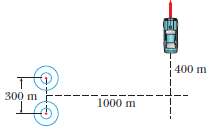
Two radio antennas separated by 300 m, as shown in figure, simultaneously transmit identical signals of the same wavelength. A radio in a car traveling due north receives the signals.(a) If the car is at the position of the second maximum, what is the wavelength of the signals?(b) How much farther
If the distance between two slits is 0.050 mm and the distance to a screen is 2.50 m, find the spacing between the first- and second-order bright fringes for yellow light of 600-nm wavelength.
Waves from a radio station have a wavelength of 300 m. They travel by two paths to a home receiver 20.0 km from the transmitter. One path is a direct path, and the second is by reflection from a mountain directly behind the home receiver. What is the minimum distance from the mountain to the
A pair of slits, separated by 0.150 mm, is illuminated by light having a wavelength of λ = 643 nm. An interference pattern is observed on a screen 140 cm from the slits. Consider a point on the screen located at y = 1.80 cm from the central maximum of this pattern. (a) What is the path difference
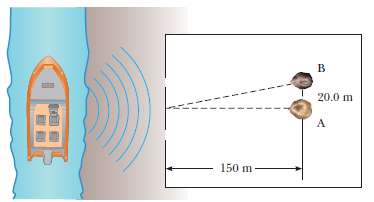
A riverside warehouse has two open doors, as in figure. Its interior is lined with a sound-absorbing material. A boat on the river sounds its horn. To person A, the sound is loud and clear. To person B, the sound is barely audible. The principal wavelength of the sound waves is 3.00 m. Assuming
The waves from a radio station can reach a home receiver by two different paths. One is a straight-line path from the transmitter to the home, a distance of 30.0 km. The second path is by reflection from a storm cloud. Assume that this reflection takes place at a point midway between receiver and
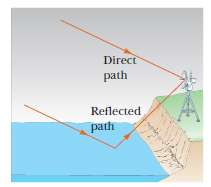
Radio waves from a star, of wavelength 250 m, reach a radio telescope by two separate paths, as shown in Figure. One is a direct path to the receiver, which is situated on the edge of a cliff by the ocean. The second is by reflection off the water. The first minimum of destructive interference
Determine the minimum thickness of a soap film (n = 1.330) that will result in constructive interference of(a) The red Hα line (λ = 656.3 nm); (b) The blue Hγ line (λ = 434.0 nm).
Suppose the film shown in figure has an index of refraction of 1.36 and is surrounded by air on both sides. Find the minimum thickness that will produce constructive interference in the reflected light when the film is illuminated by light of wavelength 500 nm.
A thin film of glass (n = 1.50) floats on a liquid of n = 1.35 and is illuminated by light of λ = 580 nm incident from air above it. Find the minimum thickness of the glass, other than zero, that will produce destructive interference in the reflected light.
A coating is applied to a lens to minimize reflections. The index of refraction of the coating is 1.55, and that of the lens is 1.48. If the coating is 177.4 nm thick, what wavelength is minimally reflected for normal incidence in the lowest order?
A possible means for making an airplane invisible to radar is to coat the plane with an antireflective polymer. If radar waves have a wavelength of 3.00 cm and the index of refraction of the polymer is n = 1.50, how thick would you make the coating?
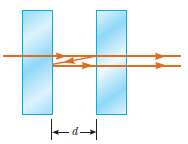
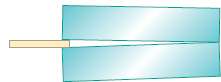
A beam of light of wavelength 580 nm passes through two closely spaced glass plates, as shown in figure. For what minimum non-zero value of the plate separation d will the transmitted light be bright? This arrangement is often used to measure the wavelength of light and is called a
Astronomers observe the chromosphere of the sun with a filter that passes the red hydrogen spectral line of wavelength 656.3 nm, called the Hα line. The filter consists of a transparent dielectric of thickness d held between two partially aluminized glass plates. The filter is kept at a constant
Two rectangular optically flat plates (n = 1.52) are in contact along one end and are separated along the other end by a 2.00-m-thick spacer (Figure). The top plate is illuminated by monochromatic light of wavelength 546.1 nm. Calculate the number of dark parallel bands crossing the top plate
An air wedge is formed between two glass plates separated at one edge by a very fine wire, as in figure. When the wedge is illuminated from above by 600-nm light, 30 dark fringes are observed. Calculate the radius of the wire.
A planoconvex lens with radius of curvature R = 3.0 m is in contact with a flat plate of glass. A light source and the observer’s eye are both close to the normal, as shown in Figure a. The radius the 50th bright Newton’s ring is found to be 9.8 mm. What is the wavelength of the light produced
A planoconvex lens rests with its curved side on a flat glass surface and is illuminated from above by light of wavelength 500 nm. (See Figure) A dark spot is observed at the center, surrounded by 19 concentric dark rings (with bright rings in between). How much thicker is the air wedge at the
Nonreflective coatings on camera lenses reduce the loss of light at the surfaces of multilens systems and prevent internal reflections that might mar the image. Find the minimum thickness of a layer of magnesium fluoride (n = 1.38) on flint glass (n = 1.66) that will cause destructive interference
A thin film of MgF2 (n = 1.38) with thickness 1.00 x 10⁻⁵ cm is used to coat a camera lens. Are any wavelengths in the visible spectrum intensified in the reflected light?
A flat piece of glass is supported horizontally above the flat end of a 10.0-cm-long metal rod that has its lower end rigidly fixed. The thin film of air between the rod and the glass is observed to be bright when illuminated by light of wavelength 500 nm. As the temperature is slowly increased by
Helium–neon laser light (λ = 632.8 nm) is sent through a 0.300-mm-wide single slit. What is the width of the central maximum on a screen 1.00 m from the slit?
Light of wavelength 600 nm falls on a 0.40-mm-wide slit and forms a diffraction pattern on a screen 1.5 m away.(a) Find the position of the first dark band on each side of the central maximum. (b) Find the width of the central maximum.
Light of wavelength 587.5 nm illuminates a slit of width 0.75 mm. (a) At what distance from the slit should a screen be placed if the first minimum in the diffraction pattern is to be 0.85 mm from the central maximum?(b) Calculate the width of the central maximum.
Microwaves of wavelength 5.00 cm enter a long, narrow window in a building that is otherwise essentially opaque to the incoming waves. If the window is 36.0 cm wide, what is the distance from the central maximum to the first order minimum along a wall 6.50 m from the window?
A slit of width 0.50 mm is illuminated with light of wavelength 500 nm, and a screen is placed 120 cm in front of the slit. Find the widths of the first and second maxima on each side of the central maximum.
A screen is placed 50.0 cm from a single slit, which is illuminated with light of wavelength 680 nm. If the distance between the first and third minima in the diffraction pattern is 3.00 mm, what is the width of the slit?
Three discrete spectral lines occur at angles of 10.1°, 13.7°, and 14.8°, respectively, in the first-order spectrum of a diffraction-grating spectrometer. (a) If the grating has 3 660 slits/cm, what are the wavelengths of the light?(b) At what angles are these lines found in the second order
Intense white light is incident on a diffraction grating that has 600lines/mm. (a) What is the highest order in which the complete visible spectrum can be seen with this grating?(b) What is the angular separation between the violet edge (400 nm) and the red edge (700 nm) of the first-order spectrum
The hydrogen spectrum has a red line at 656 nm and a violet line at 434 nm. What angular separation between these two spectral lines obtained with a diffraction grating that has 4 500 lines/cm?
A grating with 1 500 slits per centimeter is illuminated with light of wavelength 500 nm. (a) What is the highest-order number that can be observed with this grating?(b) Repeat for a grating of 15 000 slits per centimeter.
A light source emits two major spectral lines: an orange line of wavelength 610 nm and a blue-green line of wavelength 480 nm. If the spectrum is resolved by a diffraction grating having 5 000 lines/cm and viewed on a screen 2.00 m from the grating, what is the distance (in centimeters) between the
White light is spread out into its spectral components by a diffraction grating. If the grating has 2 000 lines per centimeter, at what angle does red light of wavelength 640 nm appear in the first-order spectrum?
Sunlight is incident on a diffraction grating that has 2 750 lines/cm. The second-order spectrum over the visible range (400–700 nm) is to be limited to 1.75 cm along a screen that is a distance L from the grating. What is the required value of L?
Light containing two different wavelengths passes through a diffraction grating with 1 200 slits/cm. On a screen 15.0 cm from the grating, the third-order maximum of the shorter wavelength falls midway between the central maximum and the first side maximum for the longer wavelength. If the
A beam of 541-nm light is incident on a diffraction grating that has 400 lines/mm. (a) Determine the angle of the second-order ray. (b) If the entire apparatus is immersed in water, determine the new second-order angle of diffraction. (c) Show that the two diffracted rays of parts (a) and (b) are
Light from a helium–neon laser (λ = 632.8 nm) is incident on a single slit. What is the maximum width for which no diffraction minima are observed?
The angle of incidence of a light beam in air onto a reflecting surface is continuously variable. The reflected ray is found to be completely polarized when the angle of incidence is 48.0°. (a) What is the index of refraction of the reflecting material? (b) If some of the incident light (at an
Unpolarized light passes through two polaroid sheets. The axis of the first is vertical, and that of the second is at 30.0° to the vertical. What fraction of the initial light is transmitted?
The index of refraction of a glass plate is 1.52. What is the Brewster’s angle when the plate is? (a) In air? (b) In water?
At what angle above the horizon is the Sun if light from it is completely polarized upon reflection from water?
A light beam is incident on heavy flint glass (n = 1.65) at the polarizing angle. Calculate the angle of refraction for the transmitted ray.
The critical angle for total internal reflection for sapphire surrounded by air is 34.4°. Calculate the Brewster angle for sapphire if the light is incident from the air.
Equation 24.14 assumes that the incident light is in air. If the light is incident from a medium of index n1 onto a medium of index n2, follow the procedure used to derive Equation 24.14 to show that tan θp = n2/n1.
Plane-polarized light is incident on a single polarizing disk, with the direction of E0 parallel to the direction of the transmission axis. Through what angle should the disk be rotated so that the intensity in the transmitted beam is reduced by a factor of (a) 3.00, (b) 5.00, (c) 10.0?
Three polarizing plates whose planes are parallel are centered on a common axis. The directions of the transmission axes relative to the common vertical direction are shown in Figure. A linearly polarized beam of light with plane of polarization parallel to the vertical reference direction is
Light of intensity I0 and polarized parallel to the transmission axis of a polarizer, is incident on an analyzer. (a) If the transmission axis of the analyzer makes an angle of 45° with the axis of the polarizer, what is the intensity of the transmitted light? (b) What should the angle between the
Light with a wavelength in vacuum of 546.1 nm falls perpendicularly on a biological specimen that is 1.000 µm thick. The light splits into two beams polarized at right angles, for which the indices of refraction are 1.320 and 1.333, respectively. (a) Calculate the wavelength of each component of
A beam containing light of wavelengths λ1 and λ2 is incident on a set of parallel slits. In the interference pattern, the fourth bright line of the λ1 light occurs at the same position as the fifth bright line of the λ2 light. If λ1 is known to be 540 nm, what is the value of λ2?
Light of wavelength 546 nm (the intense green line from a mercury source) produces a Young’s interference pattern in which the second minimum from the central maximum is along a direction that makes an angle of 18.0 min of arc with the axis through the central maximum. What is the distance
The two speakers are placed 35.0 cm apart. A single oscillator makes the speakers vibrate in phase at a frequency of 2.00 kHz. At what angles, measured from the perpendicular bisector of the line joining the speakers, would a distant observer hear maximum sound intensity? Minimum sound intensity?
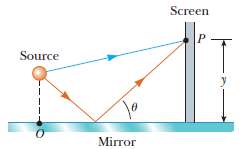
Interference effects are produced at point P on a screen as a result of direct rays from a 500-nm source and reflected rays off a mirror, as in figure. If the source is 100 m to the left of the screen and 1.00 cm above the mirror, find the distance y (in millimeters) to the first dark band above
Many cells are transparent and colorless. Structures of great interest in biology and medicine can be practically invisible to ordinary microscopy. An interference microscope reveals a difference in refractive index as a shift in interference fringes, to indicate the size and shape of cell
A thin layer of oil (n = 1.25) is floating on water. How thick is the oil in the region that strongly reflects green light (λ = 525 nm)?
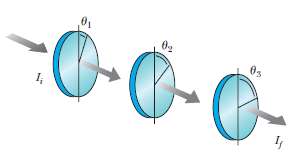
Three polarizers, centered on a common axis and with their planes parallel to each other, have transmission axes oriented at angles of θ1, θ2, and θ3 from the vertical, as shown in Figure. Light of intensity Ii, polarized with its plane of polarization oriented vertically, is incident from the
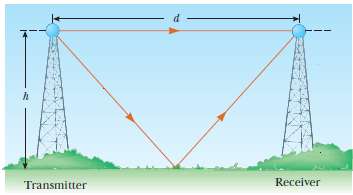
Figure shows a radio-wave transmitter and a receiver, both h = 50.0 m above the ground and d = 600 m apart. The receiver can receive signals directly from the transmitter, and indirectly, from signals that bounce off the ground. If the ground is level between the transmitter and receiver and a λ/2
A planoconvex lens (flat on one side, convex on the other) with index of refraction n rests with its curved side (radius of curvature R) on a flat glass surface of the same index of refraction with a film of index nfilm between them. The lens is illuminated from above by light of wavelength λ.
The transmitting antenna on a submarine is 5.00 m above the water when the ship surfaces. The captain wishes to transmit a message to a receiver on a 90.0-m-tall cliff at the ocean shore. If the signal is to be completely polarized by reflection off the ocean surface, how far must the ship be from
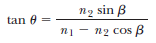
(a) If light is incident at an angle θ from a medium of index n1 on a medium of index n2 so that the angle between the reflected ray and refracted ray is β, show thatsin(A + B) = sin A cos B + cos A sin B(b) Show that the foregoing equation for tan θ reduces to Brewster??s law when β = 90?, n1
A diffraction pattern is produced on a screen 140 cm from a single slit, using monochromatic light of wavelength 500 nm, The distance from the center of the central maximum to the first-order maximum is 3.00 mm. Calculate the slit width.
A glass plate (n = 1.61) is covered with a thin, uniform layer of oil (n = 1.20). A light beam of variable wavelength is normally incident from air onto the oil surface. Observation of the reflected beam shows destructive interference at 500 nm and constructive interference at 750 nm. From this
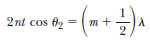
The condition for constructive interference by reflection from a thin film in air, as developed in Section 24.4, assumes nearly normal incidence.(a) Show that for large angles of incidence, the condition for constructive interference of light reflecting from a thin film of thickness t, with index
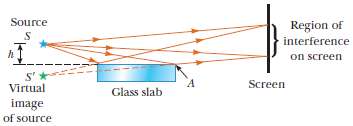
Figure illustrates the formation of an interference pattern by the Lloyd??s mirror method. Light from source S reaches the screen via two different pathways. One is a direct path, and the second is by reflection from a horizontal mirror. The effect is as if light from two different sources S and
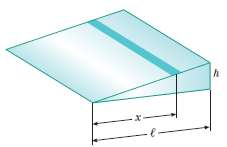
A piece of transparent material having an index of refraction n is cut into the shape of a wedge as shown in figure. The angle of the wedge is small. Monochromatic light of wavelength λ is normally incident from above, and viewed from above. Let h represent the height of the wedge and ?? its
Holding your hand at arm’s length, you can readily block sunlight from your eyes. Why can you not block sound from your ears this way?
If Young’s double-slit experiment were performed under water, how would the observed interference pattern be affected?
If white light is used in Young’s double-slit experiment, rather than monochromatic light, how does the interference pattern change?
What is the necessary condition on the difference in path length between two waves that interfere? (a) Constructively and (b) Destructively? Assume that the wave sources are coherent.
Often, fingerprints left on a piece of glass such as a windowpane show colored spectra like that from a diffraction grating. Why?
Suppose reflected white light is used to observe a thin, transparent coating on glass as the coating material is gradually deposited by evaporation in a vacuum. Describe some color changes that might occur during the process of building up the thickness of the coating.
Certain sunglasses use a polarizing material to reduce the intensity of light reflected from shiny surfaces, such as water or the hood of a car. What orientation of the transmission axis should the material have to be most effective?
1. A simple way of observing an interference pattern is to look at a distant light source through a stretched handkerchief or an open umbrella. Explain how this works.2. Can a sound wave be polarized? Explain.
1. In one experiment, blue light passes through a diffraction grating and forms an interference pattern on a screen. In a second experiment, red light passes through the same diffraction grating and forms another interference pattern. How do the separations between bright lines in the two
The image of the point object P in Figure is viewed by an eye as shown. Draw a bundle of rays from the object that reflect from the mirror and enter the eye. For this object position and mirror, indicate the region of space in which the eye can see theimage.
A person 1.62 m tall wants to be able to see her full image in a plane mirror.(a) What must be the minimum height of the mirror?(b) How far above the floor should it be placed, assuming that the top of the person’s head is 15 cm above her eye level? Draw a ray diagram.
Two plane mirrors make an angle of 90°. Show by considering various object positions that there are three images for any position of an object. Draw appropriate bundles of rays from the object to the eye for viewing each image.
(a) Two plane mirrors make an angle of 60° with each other. Show on a sketch the location of all the images formed of a point object on the bisector of the angle between the mirrors.(b) Repeat for an angle of 120°.
When two plane mirrors are parallel, such as on opposite walls in a barber shop, multiple images arise because each image in one mirror serves as an object for the other mirror. A point object is placed between parallel mirrors separated by 30 cm. The object is 10 cm in front of the left mirror and
Under what condition will a concave mirror produce an erect image? A virtual image? An image smaller than the object? An image larger than the object?
A concave spherical mirror has a radius of curvature of 40 cm. Draw ray diagrams to locate the image (if one is formed) for an object at a distance of(a) 100 cm,(b) 40 cm,(c) 20 cm, and(d) 10 cm from the mirror.For each case, state whether the image is real or virtual; erect or inverted; and
Use the mirror equation to locate and describe the images for the object distances and mirror of Problem 13.
Repeat Problem 13 for a convex mirror with the same radius of curvature.
Use the mirror equation to locate and describe the images for the object distances and convex mirror of Problem 15.
Show that a convex mirror cannot form a real image of a real object, no matter where the object is placed, by showing that s’ is always negative for a positive s.
A dentist wants a small mirror that will produce an upright image with a magnification of 5.5 when the mirror is located 2.1 cm from a tooth.(a) What should the radius of curvature of the mirror be?(b) Should it be concave or convex?
Convex mirrors are used in stores to provide a wide angle of surveillance for a reasonable mirror size. The mirror shown in Figure allows a clerk 5 m away from the mirror to survey the entire store. It has a radius of curvature of 1.2 m.(a) If a customer is 10 m from the mirror, how far from the
Showing 1800 - 1900
of 2678
First
12
13
14
15
16
17
18
19
20
21
22
23
24
25
26
Last
Step by Step Answers

 Get 50% OFF
Claim Now
Get 50% OFF
Claim Now


.png)
.png)


