New Semester
Started
Get
50% OFF
Study Help!
--h --m --s
Claim Now
Question Answers
Textbooks
Find textbooks, questions and answers
Oops, something went wrong!
Change your search query and then try again
S
Books
FREE
Study Help
Expert Questions
Accounting
General Management
Mathematics
Finance
Organizational Behaviour
Law
Physics
Operating System
Management Leadership
Sociology
Programming
Marketing
Database
Computer Network
Economics
Textbooks Solutions
Accounting
Managerial Accounting
Management Leadership
Cost Accounting
Statistics
Business Law
Corporate Finance
Finance
Economics
Auditing
Tutors
Online Tutors
Find a Tutor
Hire a Tutor
Become a Tutor
AI Tutor
AI Study Planner
NEW
Sell Books
Search
Search
Sign In
Register
study help
physics
mechanics
Physics Principles with Applications 7th edition Douglas C. Giancoli - Solutions
A person driving her car at 35km / h approaches an intersection just as the traffic light turns yellow. She knows that the yellow light lasts only 2.0 s before turning to red, and she is 28 m away from the near side of the intersection (Fig. 2-49). Should she try to stop, or should she speed up to
A car is behind a truck going 18 m / s on the highway. The car's driver looks for an opportunity to pass, guessing that his car can accelerate 0.60 m/s2 at and that he has to cover the 20-m length of the truck, plus 10-m extra space at the rear of the truck and 10 m more at the front of it. In the
Agent Bond is standing on a bridge, 15m above the road below, and his pursuers are getting too close for comfort. He spots a flatbed truck approaching at 25m/s, which he measures by knowing that the telephone poles the truck is passing are 25 m apart in this region. The roof of the truck is 3.5 m
A conveyor belt is used to send burgers through a grilling machine. If the grilling machine is 1.2 m long and the burgers require 2.8 min to cook, how fast must the conveyor belt travel? If the burgers are spaced 25 cm apart, what is the rate of burger production (in burgers/min)?
A horse trots away from its trainer in a straight line, moving 38 m away in 9.0 s. It then turns abruptly and gallops halfway back in 1.8 s. Calculate(a) Its average speed(b) Its average velocity for the entire trip, using "away from the trainer" as the positive direction.
Two children are playing on two trampolines. The first child bounces up one-and-a-half times higher than the second child. The initial speed up of the second child is 4.0 m/s.(a) Find the maximum height the second child reaches.(b) What is the initial speed of the first child?(c) How long was the
If there were no air resistance, how long would it take a free-falling skydiver to fall from a plane at 3200 m to an altitude of 450 m, where she will open her parachute? What would her speed be at 450 m? (In reality, the air resistance will restrict her speed to perhaps 150 km /h.)
You stand at the top of a cliff while your friend stands on the ground below you. You drop a ball from rest and see that she catches it 1.4 s later. Your friend then throws the ball up to you, such that it just comes to rest in your hand. What is the speed with which your friend threw the ball?
On an audio compact disc (CD), digital bits of information are encoded sequentially along a spiral path. Each bit occupies about 0.28 μm. A CD player's readout laser scans along the spiral's sequence of bits at a constant speed of about 1.2m/s as the CD spins.(a) Determine the number N of
A person jogs eight complete laps around a 400-m track in a total time of 14.5 min. Calculate(a) The average speed(b) The average velocity, in m/s.
You are on the street trying to hit a friend in his dorm window with a water balloon. He has a similar idea and is aiming at you with his water balloon. You aim straight at each other and throw at the same instant. Do the water balloons hit each other? Explain why or why not.
A projectile has the least speed at what point in its path?
A car is driven 225 km west and then 98 km southwest (45°). What is the displacement of the car from the point of origin (magnitude and direction)? Draw a diagram.
For the vectors given in Fig. 3-35, determine(a) A - B + C,(b) A + B - C,(c) C - A - B,
A tiger leaps horizontally from a 7.5-m-high rock with a speed of 3.0 m / s. How far from the base of the rock will she land?
Estimate by what factor a person can jump farther on the Moon as compared to the Earth if the takeoff speed and angle are the same. The acceleration due to gravity on the Moon is one-sixth what it is on Earth.
A delivery truck travels 21 blocks north, 16 blocks east, and 26 blocks south. What is its final displacement from the origin? Assume the blocks are equal length.
A ball is thrown horizontally from the roof of a building 7.5 m tall and lands 9.5 m from the base. What was the ball's initial speed?
A ball thrown horizontally at 12.2 m/s from the roof of a building lands 21.0 m from the base of the building. How high is the building?
A diver running 2.5 m / s dives out horizontally from the edge of a vertical cliff and 3.0 s later reaches the water below. How high was the cliff and how far from its base did the diver hit the water?
A fire hose held near the ground shoots water at a speed of 6.5 m / s. At what angle(s) should the nozzle point in order that the water land 2.5 m away (Fig. 3-36)? Why are there two different angles? Sketch the two trajectories.
A grasshopper hops along a level road. On each hop, the grasshopper launches itself at angle θ0 = 45ο and achieves a range R = 0.80 m. What is the average horizontal speed of the grasshopper as it hops along the road? Assume that the time spent on the ground between hops in negligible and
Extreme-sports enthusiasts have been known to jump off the top of El Capitan, a sheer granite cliff of height 910 m in Yosemite National Park. Assume a jumper runs horizontally off the top of El Capitan with speed 4.0 m / s and enjoys a free fall until she is 150 m above the valley floor, at which
A projectile is fired with an initial speed of 36.6 m / s at an angle of 42.2° above the horizontal on a long flat firing range. Determine(a) The maximum height reached by the projectile,(b) The total time in the air,(c) The total horizontal distance covered (that is, the range),(d) The speed of
An athlete performing a long jump leaves the ground at a 27.0° angle and lands 7.80 m away.(a) What was the takeoff speed?(b) If this speed were increased by just 5.0%, how much longer would the jump be?
If Vx = 9.80 units and Vy = -6.40 units, determine the magnitude and direction of V.
Suppose the rescue plane of Problem 31 releases the supplies a horizontal distance of 425 m in advance of the mountain climbers. What vertical velocity (up or down) should the supplies be given so that they arrive precisely at the climbers' position (Fig. 3-39)? With what speed do the supplies land?
Suppose the kick in Example 3-6 is attempted 36.0m from the goalposts, whose crossbar is 3.05 m above the ground. If the football is directed perfectly between the goalposts, will it pass over the bar and be a field goal? Show why or why not. If not, from what horizontal distance must this kick be
A stunt driver wants to make his car jump over 8 cars parked side by side below a horizontal ramp (Fig. 3-41).(a) With what minimum speed must he drive off the horizontal ramp? The vertical height of the ramp is 1.5 m above the cars and the horizontal distance he must clear is 22 m.(b) If the ramp
Huck Finn walks at a speed of 0.70 m / s across his raft (that is, he walks perpendicular to the raft's motion relative to the shore). The heavy raft is traveling down the Mississippi River at a speed of 1.50 m / s relative to the river bank (Fig. 3-42). What is Huck's velocity (speed and
Graphically determine the resultant of the following three vector displacements:(1) 24 m, 36° north of east;(2) 18 m, 37° east of north; and(3) 26 m, 33° west of south.
Two planes approach each other head-on. Each has a speed of 780 km / h, and they spot each other when they are initially 10.0 km apart. How much time do the pilots have to take evasive action?
A passenger on a boat moving at 1.70 m / s on a still lake walks up a flight of stairs at a speed of 0.60 m / s Fig. 3-43. The stairs are angled at 45° pointing in the direction of motion as shown. What is the velocity of the passenger relative to the water?
A person in the passenger basket of a hot-air balloon throws a ball horizontally outward from the basket with speed 10.0 m / s (Fig. 3-44). What initial velocity (magnitude and direction) does the ball have relative to a person standing on the ground(a) If the hot-air balloon is rising at 3.0 m / s
An airplane is heading due south at a speed of 688 km / h. If a wind begins blowing from the southwest at a speed of90.0 km / h (average), calculate (a) The velocity (magnitude and direction) of the plane, relative to the ground, (b) How far from its intended position it will be after 11.0 min if
In what direction should the pilot aim the plane in Problem 44 so that it will fly due south? Problem 44 An airplane is heading due south at a speed of 688 km / h. If a wind begins blowing from the southwest at a speed of90.0 km / h (average), calculate
A swimmer is capable of swimming 0.60 m / s in still water. (a) If she aims her body directly across a 45-m-wide river whose current is 0.50 m / s, how far downstream (from a point opposite her starting point) will she land? (b) How long will it take her to reach the other side?
A boat, whose speed in still water is 2.50 m / s, must cross a 285-m-wide river and arrive at a point 118m upstream from where it starts (Fig. 3-45). To do so, the pilot must head the boat at a 45.0° upstream angle. What is the speed of the river's current?
A child, who is 45 m from the bank of a river, is being carried helplessly downstream by the river's swift current of 1.0 m / s. As the child passes a lifeguard on the river's bank, the lifeguard starts swimming in a straight line (Fig. 3-46) until she reaches the child at a point downstream.If the
V̅ is a vector 24.8 units in magnitude and points at an angle of 23.4° above the negative x axis.(a) Sketch this vector.(b) Calculate Vx and Vy.(c) Use Vx and to obtain (again) the magnitude and direction of Vx.
Two cars approach a street corner at right angles to each other (Fig. 3-47). Car 1 travels at a speed relative to Earth ν1E = 35 km / h, and car 2 at ν2E = 55 km / h. What is the relative velocity of car 1 as seen by car 2? What is the velocity of car 2 relative to car 1?
On mountainous downhill roads, escape routes are sometimes placed to the side of the road for trucks whose brakes might fail. Assuming a constant upward slope of 26°, calculate the horizontal and vertical components of the acceleration of a truck that slowed from 110 km / h to rest in 7.0 s. See
A light plane is headed due south with a speed relative to still air of 185 km / h. After 1.00 h, the pilot notices that they have covered only 135 km and their direction is not south but 15.0° east of south. What is the wind velocity?
Romeo is throwing pebbles gently up to Juliet's window, and he wants the pebbles to hit the window with only a horizontal component of velocity. He is standing at the edge of a rose garden 8.0 m below her window and 8.5m from the base of the wall (Fig. 3-49). How fast are the pebbles going when
Apollo astronauts took a "nine iron" to the Moon and hit a golf ball about 180 m. Assuming that the swing, launch angle, and so on, were the same as on Earth where the same astronaut could hit it only 32 m, estimate the acceleration due to gravity on the surface of the Moon. (We neglect air
(a) A long jumper leaves the ground at 45° above the horizontal and lands 8.0 m away. What is her "takeoff" speed v0?(b) Now she is out on a hike and comes to the left bank of a river. There is no bridge and the right bank is 10.0 m away horizontally and 2.5 m vertically below. If she long jumps
A projectile is shot from the edge of a cliff 115 m above ground level with an initial speed of 65.0 m / s at an angle of 35.0° with the horizontal, as shown in Fig. 3-51.(a) Determine the time taken by the projectile to hit point P at ground level.(b) Determine the distance X of point P from
Vector V1 is 6.6 units long and points along the negative x axis. Vector V2 is 8.5 units long and points at to the positive x axis.(a) What are the x and y components of each vector?(b) Determine the sum V1 + V2 (magnitude and angle).
A hunter aims directly at a target (on the same level) 38.0 m away.(a) If the arrow leaves the bow at a speed of 23.1 m / s, by how much will it miss the target?(b) At what angle should the bow be aimed so the target will be hit?
Figure 3-33 shows two vectors, A and B, whose magnitudes are A = 6.8 units and B = 5.5 units. Determine C if(a) C = A + B,(b) C = A - B,(c) C = B - A. Give the magnitude and direction for each.
An airplane is traveling 835 km / b in a direction 41.5° west of north (Fig. 3-34).(a) Find the components of the velocity vector in the northerly and westerly directions.(b) How far north and how far west has the plane traveled after 1.75 h?
Why is the stopping distance of a truck much shorter than for a train going the same speed?
If an object is moving, is it possible for the net force acting on it to be zero? Explain.
(a) Why do you push down harder on the pedals of a bicycle when first starting out than when moving at constant speed? (b) Why do you need to pedal at all when cycling at constant speed?
1. A truck is traveling horizontally to the right (Fig. 4-38).When the truck starts to slow down; the crate on the (frictionless) truck bed starts to slide. In what direction could the net force be on the crate?(a) No direction. The net force is zero. (b) Straight down (because of gravity). (c)
1. You are pushing a heavy box across a rough floor. When you are initially pushing the box and it is accelerating, (a) You exert a force on the box, but the box does not exert a force on you. (b) The box is so heavy it exerts a force on you, but you do not exert a force on the box. (c) The force
1. The normal force on an extreme skier descending a very steep slope (Fig. 4-42) can be zero if(a) His speed is great enough. (b) He leaves the slope (no longer touches the snow). (c) The slope is greater than 75°. (d) The slope is vertical (90°). 2. To pull an old stump out of the ground,
You are trying to push your stalled car. Although you apply a horizontal force of 400 N to the car, it doesn't budge, and neither do you. Which force(s) must also have a magnitude of 400 N? (a) The force exerted by the car on you. (b) The friction force exerted by the car on the road. (c) The
Matt, in the foreground of Fig. 4-39, is able to move the large truck because(a) He is stronger than the truck. (b) He is heavier in some respects than the truck. (c) He exerts a greater force on the truck than the truck exerts back on him. (d) The ground exerts a greater friction force on Matt
1. What causes the boat in Fig. 4-41 to move forward?(a) The force the man exerts on the paddle. (b) The force the paddle exerts on the water. (c) The force the water exerts on the paddle. (d) The motion of the water itself. 2. A person stands on a scale in an elevator. His apparent weight will be
1. When a skier skis down a hill, the normal force exerted on the skier by the hill is (a) Equal to the weight of the skier. (b) Greater than the weight of the skier. (c) Less than the weight of the skier. 2. A golf ball is hit with a golf club. While the ball flies through the air, which forces
How much tension must a cable withstand if it is used to accelerate a 1200-kg car vertically upward at 0.70 m/s2?
A 14.0-kg bucket is lowered vertically by a rope in which there is 163 N of tension at a given instant. What is the acceleration of the bucket? Is it up or down?
Can cars "stop on a dime"? Calculate the acceleration of a 1400-kg car if it can stop from 35 km/h on a dime (diameter = 1.7cm). How many g's is this? What is the force felt by the 68-kg occupant of the car?
A person jumps from the roof of a house 2.8 m high. When he strikes the ground below, he bends his knees so that his torso decelerates over an approximate distance of 0.70 m. If the mass of his torso (excluding legs) is 42 kg, find(a) His velocity just before his feet strike the ground,(b) The
What is the weight of a 68-kg astronaut?(a) On Earth,(b) On the Moon (g = 1.7 m/s2),(c) On Mars (g = 3.7 m/s2),(d) In outer space traveling with constant velocity?
A window washer pulls herself upward using the bucket-pulley apparatus shown in Fig. 4-48.(a) How hard must she pull downward to raise herself slowly at constant speed?(b) If she increases this force by 15%, what will her acceleration be? The mass of the person plus the bucket is 72 kg.
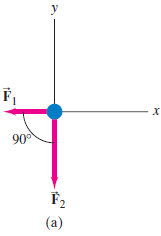
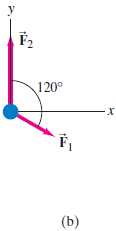
The two forces FÌ…1 and FÌ…2 shown in Fig. 4-52a and b (looking down) act on an 18.5-kg object on a frictionless tabletop. If FÌ…1 = 10.2 N FÌ…2 and FÌ…2 = 16.0N, find the net force on the object and its acceleration for (a) and (b).
(a) If mA = 13.0kg and mB = 5.0 kg in Fig. 4-53, determine the acceleration of each block.(b) If initially mA is at rest 1.250 m from the edge of the table, how long does it take to reach the edge of the table if the system is allowed to move freely?(c) If mB = 1.0kg, how large must mA be if the
Three blocks on a frictionless horizontal surface are in contact with each other as shown in Fig. 4-54. A force F is applied to block A (mass mA).(a) Draw a free-body diagram for each block. Determine(b) The acceleration of the system (in terms of mA, mB and mC),(c) The net force on each block,(d)
Suppose the pulley in Fig. 4-55 is suspended by a cord C. Determine the tension in this cord after the masses are released and before one hits the ground. Ignore the mass of the pulley and cords.
If the coefficient of kinetic friction between a 22-kg crate and the floor is 0.30, what horizontal force is required to move the crate at a steady speed across the floor? What horizontal force is required if µk is zero?
A force of 35.0 N is required to start a 6.0-kg box moving across a horizontal concrete floor.(a) What is the coefficient of static friction between the box and the floor?(b) If the 35.0-N force continues, the box accelerates at 0.60m/s2.What is the coefficient of kinetic friction?
The coefficient of static friction between hard rubber and normal street pavement is about 0.90. On how steep a hill (maximum angle) can you leave a car parked?
A 2.0-kg silverware drawer does not slide readily. The owner gradually pulls with more and more force, and when the applied force reaches 9.0 N, the drawer suddenly opens, throwing all the utensils to the floor. What is the coefficient of static friction between the drawer and the cabinet?
A box is given a push so that it slides across the floor. How far will it go, given that the coefficient of kinetic friction is 0.15 and the push imparts an initial speed of 3.5 m/s?
A 1280-kg car pulls a 350-kg trailer. The car exerts a horizontal force of 3.6 × 10³ N against the ground in order to accelerate. What force does the car exert on the trailer?Assume an effective friction coefficient of 0.15 for the trailer.
In Fig. 4-56 the coefficient of static friction between mass mA and the table is 0.40, whereas the coefficient of kinetic friction is 0.20.(a) What minimum value of mA will keep the system from starting to move?(b) What value(s) of mA will keep the system moving at constant speed?[Ignore masses of
A small box is held in place against a rough vertical wall by someone pushing on it with a force directed upward at 28° above the horizontal. The coefficients of static and kinetic friction between the box and wall are 0.40 and 0.30, respectively. The box slides down unless the applied force has
Two crates, of mass 65 kg and 125 kg, are in contact and at rest on a horizontal surface (Fig. 4-57). A 650-N force is exerted on the 65-kg crate. If the coefficient of kinetic friction is 0.18, calculate(a) The acceleration of the system.(b) The force that each crate exerts on the other.(c) Repeat
Superman must stop 120-km/h a train in 150 m to keep it from hitting a stalled car on the tracks. If the train's mass is 3.6 × 10⁵ kg, how much force must he exert? Compare to the weight of the train (give as %). How much force does the train exert on Superman?
A wet bar of soap slides down a ramp 9.0 m long inclined at 8.0°. How long does it take to reach the bottom? Assume µk = 0.060.
A skateboarder, with an initial speed of 2.0 m/s rolls virtually friction free down a straight incline of length 18 m in 3.3 s. At what angle is the incline oriented above the horizontal?
Uphill escape ramps are sometimes provided to the side of steep downhill highways for trucks with overheated brakes. For a simple 11° upward ramp, what minimum length would be needed for a runaway truck traveling140 km/h? Note the large size of your calculated length. (If sand is used for the bed
A block is given an initial speed 4.5 m/s of up the 22.0° plane shown in Fig. 4-59.(a) How far up the plane will it go?(b) How much time elapses before it returns to its starting point? Ignore friction.
The crate shown in Fig. 4-60 lies on a plane tilted at an angle θ = 25.0° to the horizontal, with µk = 0.19.(a) Determine the acceleration of the crate as it slides down the plane.(b) If the crate starts from rest 8.15 m up along the plane from its base, what will be the
A person has a reasonable chance of surviving an automobile crash if the deceleration is no more than 30 g's. Calculate the force on a 65-kg person accelerating at this rate. What distance is traveled if brought to rest at this rate from 95 km/h?
A crate is given an initial speed of 3.0m/s up the 25.0° plane shown in Fig. 4-60.(a) How far up the plane will it go?(b) How much time elapses before it returns to its starting point? Assume µk = 0.12.
A car can decelerate at -3.80 m/s2 without skidding when coming to rest on a level road. What would its deceleration be if the road is inclined at 9.3° and the car moves uphill? Assume the same static friction coefficient.
A skier moves down a 12° slope at constant speed. What can you say about the coefficient of friction, µk? Assume the speed is low enough that air resistance can be ignored.
A child slides down a slide with a 34° incline, and at the bottom her speed is precisely half what it would have been if the slide had been frictionless. Calculate the coefficient of kinetic friction between the slide and the child.
What average force is required to stop a 950-kg car in 8.0 s if the car is traveling at 95 km/h?
A 7180-kg helicopter accelerates upward at 0.80m/s2 while lifting a 1080-kg frame at a construction site, Fig. 4-68.(a)What is the lift force exerted by the air on the helicopter rotors?(b) What is the tension in the cable (ignore its mass) which connects the frame to the helicopter?(c) What force
Estimate the average force exerted by a shot-putter on a 7.0-kg shot if the shot is moved through a distance of 2.8 m and is released with a speed of 13 m/s.
Three mountain climbers who are roped together in a line are ascending an ice field inclined at 31.0° to the horizontal (Fig. 4-69). The last climber slips, pulling the second climber off his feet. The first climber is able to hold them both. If each climber has a mass of 75 kg, calculate the
A motorcyclist is coasting with the engine off at a steady speed of 20.0 m/s but enters a sandy stretch where the coefficient of kinetic friction is 0.70.Will the cyclist emerge from the sandy stretch without having to start the engine if the sand lasts for 15 m? If so, what will be the speed upon
The 70.0-kg climber in Fig. 4-72 is supported in the "chimney" by the friction forces exerted on his shoes and back. The static coefficients of friction between his shoes and the wall, and between his back and the wall, are 0.80 and 0.60, respectively. What is the minimum normal force he must
A 28.0-kg block is connected to an empty 2.00-kg bucket by a cord running over a frictionless pulley (Fig. 4-73). The coefficient of static friction between the table and the block is 0.45 and the coefficient of kinetic friction between the table and the block is 0.32. Sand is gradually added to
A 72-kg water skier is being accelerated by a ski boat on a flat ("glassy") lake. The coefficient of kinetic friction between the skier's skis and the water surface is µk = 0.25 (Fig. 4-74).(a) What is the skier's acceleration if the rope pulling the skier behind the boat applies a horizontal
Two blocks made of different materials, connected by a thin cord, slide down a plane ramp inclined at an angle to the horizontal, Fig. 4-76 (block B is above block A). The masses of the blocks are mA and mB, and the coefficients of friction are and µA and µB If mA and mB = 5.0kg, and
Showing 20800 - 20900
of 21795
First
202
203
204
205
206
207
208
209
210
211
212
213
214
215
216
Last
Step by Step Answers

 Get 50% OFF
Claim Now
Get 50% OFF
Claim Now


.png)
.png)
.png)
.png)
.png)
.png)
.png)
.png)
.png)
.png)
.png)
.png)
.png)
.png)
.png)
.png)
.png)
.png)
-1.png)
-2.png)
.png)
.png)
.png)
.png)
.png)
.png)
.png)
.png)
.png)
.png)
.png)
.png)
.png)
.png)
.png)
.png)
.png)


