New Semester
Started
Get
50% OFF
Study Help!
--h --m --s
Claim Now
Question Answers
Textbooks
Find textbooks, questions and answers
Oops, something went wrong!
Change your search query and then try again
S
Books
FREE
Study Help
Expert Questions
Accounting
General Management
Mathematics
Finance
Organizational Behaviour
Law
Physics
Operating System
Management Leadership
Sociology
Programming
Marketing
Database
Computer Network
Economics
Textbooks Solutions
Accounting
Managerial Accounting
Management Leadership
Cost Accounting
Statistics
Business Law
Corporate Finance
Finance
Economics
Auditing
Tutors
Online Tutors
Find a Tutor
Hire a Tutor
Become a Tutor
AI Tutor
AI Study Planner
NEW
Sell Books
Search
Search
Sign In
Register
study help
physics
mechanics
An Introduction to Geotechnical Engineering 2nd edition Robert D. Holtz, William D. Kovacs, Thomas C. Sheahan - Solutions
A sample of saturated silt is 10 cm in diameter and 2.5 cm thick. Its void ratio in this state is 1.35, and the specific gravity of solids is 2.70. The sample is compressed to a 2-cm thickness without a change in diameter.(a) Find the density of the silt sample, in prior to being compressed.(b)
A sample of sand has the following properties: total mass Mt = 160 g; total volume Vt =80 cm3; water content w = 20%; specific gravity of solids Gs =2.70. How much would the sample volume have to change to get 100% saturation, assuming the sample mass Mt stayed the same?
Draw a phase diagram and begin to fill in the blanks: A soil specimen has total volume of 80,000 mm3 and weighs 145 g. The dry weight of the specimen is 128 g, and the density of the soil solids is 2.68 Mg/m3. Find the:(a) Water content(b) Void ratio(c) Porosity(d) Degree of saturation(e) Wet
A sample of soil plus container weighs 397.6 g when the initial water content is 6.3%. The container weighs 258.7 g. How much water needs to be added to the original specimen if the water content is to be increased by 3.4%? After U.S. Dept. of Interior (1990)?
A water-content test was made on a sample of clayey silt. The weight of the wet soil plus container was 18.46 g, and the weight of the dry soil plus container was 15.03 g. Weight of the empty container was 7.63 g. Calculate the water content of the sample.
A soil sample is dried in a microwave oven to determine its water content. From the data below, evaluate the water content and draw conclusions. The oven-dried water content is 23.7%. The mass of the dish is 146.30 grams. After U.S. Dept. of Interior (1990)?
The mass of a sample of silty clay soil plus container is 18.43 g and the weight of the dry soil plus container is 13.67 g. The container weighs 8.84 g. Compute the water content of the sample.?
A specimen of fully saturated clay soil that weighs 1389 g in its natural state weighs 982 g after drying. What is the natural water content of the soil?
The volume of water in a sample of moist soil is 0.24 m3. The volume of solids Vs is 0.25 m3. Given that the density of soil solids ρs is 2600 kg/m3, find the water content.?
Assuming a value of ρs = 2.7 Mg/m3, take the range of saturated density in Table 2.1 for the six soil types and calculate/estimate the range in void ratios that one might expect for these soils.?
For the soil sample of Problem 2.29, compute (a) The void ratio (b) The porosity.?
For the soil sample of Problem 2.29, computea The total or wet densityb The dry density. Give your answers in Mg/m3, kg/m3, and lbf/ft3.?
A 592-cm3 volume of moist sand weighs 1090 g. Its dry weight is 920 g and the density of solids is 2680 kg/m3. Compute the void ratio, porosity, water content, degree of saturation, and total density in kg/m3.?
The saturated density γsat of a soil is 137 lbf/ft3. Find the buoyant density of this soil in both lbf/ft3 and kg/m3.?
A sand is composed of solid constituents having a density of 2.68 Mg/m3. The void ratio is 0.58. Compute the density of the sand when dry and when saturated and compare it with the density when submerged.?
A sample of natural glacial till was taken from below the groundwater table. The water content was found to be 52%. Estimate the wet density, dry density, buoyant density, porosity, and void ratio. Clearly state any necessary assumptions.?
A 1-m3 sample of moist soil weighs 2000 kg. The water content is 10%. Assume ρs = 2.70 Mg/m3. With this information, fill in all blanks in the phase diagram of Fig. P2.36.?
For the information given in Problem 2.36, calculate(a) The void ratio(b) The porosity(c) The dry density.?
The void ratio of clay soil is 0.6 and the degree of saturation is 75%. Assuming the density of the solids is 2710 kg/m3, compute(a) The water content(b) Dry and wet densities in both SI and British engineering units.?
A specimen of saturated glacial clay has a water content of 38%. On the assumption that ρs = 2.70 Mg/m3, compute the void ratio, porosity, and saturated density.?
Prepare a spreadsheet plot of dry density in Mg/m3 as the ordinate versus water content in percent as the abscissa. Assume ρs = 2.65 Mg/m3 and vary the degree of saturation, S, from 100% to 40% in 10% increments. A maximum of 50% water content should be adequate.
The values of minimum e and maximum e for pure silica sand were found to be 0.50 and 0.70, respectively. What is the corresponding range in the saturated density in kg/m3?
Calculate the maximum possible porosity and void ratio for a collection of (a) Tennis balls (assume they are 64.14 mm in diameter) (b) Tiny ball bearings 0.3 mm in diameter.
A plastic-limit test has the following results: Wet weight + container = 23.12 g Dry weight + container = 20.84 g Container weight = 1.46 g Compute the PL of the soil. Can the plastic limit be evaluated by a one-point method?
During a plastic-limit test, the following data was obtained for one of the samples: Wet weight + container = 23.13 g Dry weight + container = 19.12 g Container weight = 1.50 g What is the PL of the soil?
The degree of saturation of a cohesive soil is 100%. The clay when wet weighs 1489 g and after drying weighs only 876 g. Find the water content of the soil. Draw a phase diagram and properly label it.
For the soil in the previous problem, compute the void ratio and the porosity. Does your answer compare with what you would expect for a saturated cohesive soil?
For the soil in the previous two problems, compute(a) The total or wet density(b) The dry density. Provide your answers in units of Mg/m3, kN/m3, and lbf/ft3.?
A soil specimen had a buoyant density of 73 pounds per cubic foot. Calculate its wet density in kg/m3.?
The "chunk density" method is often used to determine the unit weight of a specimen of irregular shape. A specimen of cemented silty sand is treated in this way to obtain the "chunk density." From the information given below, determine the(a) Wet density(b) Dry density(c) Void ratio(d) Degree of
A sensitive volcanic clay soil was tested in the laboratory and found to have the following properties:(a) ρ = 1.28 Mg/m3(b) e = 0.90(c) S = 95%(d) ρs = 2.75 Mg/m3(e) w = 311%.In rechecking the above values, one was found to be inconsistent with the rest. Find the inconsistent value and report it
A cylinder contains 510 cm3 of loose dry sand which weighs 740 g. Under a static load of 200 kPa the volume is reduced 1%, and then by vibration it is reduced 10% of the original volume. Assume the solid density of the sand grains is 2.65 Mg/m3. Compute the void ratio, porosity, dry density, and
On five-cycle semi-logarithmic paper, plot the grain-size distribution curves from the following mechanical analysis data on six soils, A through F. For each soil determine the effective size as well as the uniformity coefficient and the coefficient of curvature. Determine also the percentages of
The soils in Problem 2.56 have the following Atterberg limits and natural water contents. Determine the PI and LI for each soil and comment on their general activity.?
Comment on the validity of the results of Atterberg limits on soils G and H.>
Prepare a graph like that in Problem 2.4, only use dry density units of kN/m3 and pounds per cubic feet.
Prepare a graph like that in Problem 2.4, only use dry density units of pounds per cubic feet.?
Prepare a graph like that in Problem 2.4, only for S = 100% and vary the density of solids from 2.60 to 2.80 Mg/m3. You decide the size of the increments you need to "satisfactorily" evaluate the relationship as ps varies. Prepare a concluding statement of your observations.
The following data were obtained from a liquid-limit test on a silty clay. Two plastic-limit determinations had water contents of 23.1% and 23.6%. Determine the LL, PI, the flow index, and the toughness index. The flow index is the slope of the water content versus log of number of blows in the
Classify the following soils according to the USCS: (a) A sample of well-graded gravel with sand has 73% fine to coarse sub-angular gravel, 25% fine to coarse sub-angular sand, and 2% fines. The maximum size of the particles is 75 mm. The coefficient of curvature is 2.7, while the uniformity
Classify the five soils in the preceding question according to the AASHTO method of soil classification.?
The results of a sieve test below give the percentage passing through the sieve.(a) Using a spreadsheet, plot the particle-size distribution.(b) Calculate the uniformity coefficient.(c) Calculate the coefficient of curvature.Sieve.................................... Percent Finer by
For the data given below, classify the soils according to the USCS. For each soil, give both the letter symbol and the narrative description. (a) 65% material retained on No. 4 sieve, 32% retained on No. 200 sieve. Cu = 3, Cc = 1. (b) 100% material passed No. 4 sieve, 90% passed No. 200 sieve. LL =
A sample of soil was tested in the laboratory and the following grain size analysis results were obtained. Classify this soil according to the USCS, providing the group symbol for it.?
A minus No. 40 material had a liquidity index of 0.73, a natural water content of 44.5%, and a plasticity index of 24.7. Classify this soil according to the USCS, provide the group symbol.?
A sample of soil was tested in the laboratory and the following grain size analysis results were obtained. Classify this soil according to the USCS, providing the group symbol for it.
A sample of soil was tested in the laboratory and the following grain size analysis results were obtained: Atterberg limits on minus No. 40 material were: LL = 36, PL = 14. Determine the USCS classification symbol for this soil. Extra credit - determine the full AASHTO classification for this soil
Laboratory testing was performed on two soil samples (A and B).(a) Determine the USCS classification symbol for Sample A.(b) Determine the AASHTO classification for Sample B.
The dry density of compacted sand is 1.87 Mg/m3 and the density of the solids is 2.67 Mg/m3. What is the water content of the material when saturated?
A sample of soil was tested in the laboratory and the following grain size analysis results were obtained: Atterberg limits on minus No. 40 material were: LL = 62, PL = 20. Determine the USCS letter symbol for this soil.?
A sample of a brown sandy clay was obtained to determine its Atterberg limits and then classify its soil type according to the Unified Soil Classification System. For one of the PL determinations, the wet + dish = 11.53 g and the dry weight + dish = 10.49 g. The dish only weighed 4.15 g. Compute
A soil that is completely saturated has a total density of 2045 kg/m3 and a water content of 24%. What is the density of the solids? What is the dry density of the soil?
What is the water content of a fully saturated soil with a dry density of 1.72 Mg/m3? Assume ρs = 2.72 Mg/m3.?
Calculate the specific surface of a cube (a) 10 mm (b) 1 mm (c) and (d) 1 nm on a side. Calculate the specific surface in terms of both areas and m2/kg. Assume for the latter case that ρs = 2.65 Mg/m3.?
Three sections of rock core are shown in Fig. 4.32. The rock comes from near Cumberland, RI, and is called Corbormite (Capt. James T. Kirk, personal communication, 2007). The length of the first (top) run is 56 in. and the computed RQD is 82%. For the second run (middle), a length of 60 in. was
In one core run of 1500 mm selected from cores obtained during drilling for a bridge foundation in hard limestone, the following core recovery information was obtained: Determine (a) The percent core recovery (b) The RQD. Based on this RQD, what is the rock quality? Core Recovery
Calculate the specific surface of (a) Tennis balls (b) Ping pong balls (c) Ball bearings 1.5 mm in diameter (d) Fly ash with approximately spherical particles 60 υm in diameter.
Verify that the maximum and minimum void ratios for perfect spheres given in Table 4.5 are reasonable.?
A specially processed clay has particles that are 500 nm thick and 10,000 nm x 10,000 nm wide. The specific gravity of solids is 2.80. The particles lie perfectly parallel with an edge-to-edge spacing of 400 nm (i.e., they look like thin bricks stacked perfectly parallel). (a) Initially, the cation
For the data in Fig. 5.1:(a) Estimate the maximum dry density and optimum water content for both the standard curve and the modified Proctor curve.(b) What is the placement water content range for 90% relative compaction for the modified Proctor curve and 95% relative compaction for the standard
The wet density of a sand in an embankment was found to be 1.85 Mg/m3 and the field water content was 12%. In the laboratory, the density of the solids was found to be 2.71 Mg/m3, and the maximum and minimum void ratios were 0.65 and 0.38, respectively. Calculate the relative density of the sand in
The laboratory test results on a sand are e max = 0.91, e min = 0.48, and Gs = 2.67.(a) What is the dry unit weight (in lb/ft3) of this sand when its relative density is 67% and its water content is 10%?(b) How would you classify the density of this soil?
Based on field data, you have determined that a sand's relative density is on the borderline between "medium" and "dense," and its void ratio is 0.93. For this soil, if the difference between e min and e max is 0.3, what is e min?
For a granular soil, given γt = 108 pcf, Dr = 82%, w = 8%, and Gs = 2.67. For this soil, if e min = 0.44, what would be the dry unit weight in the "loosest" state?
The laboratory test results on a sand are as follows: e max = 0.91, e min = 0.48, and Gs = 2.67. What would be the dry and moist unit weights of this sand, in lb/ft3, when densified at a moisture content of 10% to a relative density of 65%?
A sample of sand has a relative density of 40% with a specific gravity of solids of 2.65. The minimum void ratio is 0.45 and the maximum void ratio is 0.97.(a) What is the unit weight (in units of pcf) of this sand in the saturated condition?(b) If the sand is compacted to relative density of 65%,
A field compaction control test was conducted on a compacted lift. The mass of the material removed from the hole was 1820 g and the volume of the hole was found to be 955 cm3. A small sample of the soil lost 17 g in the drying test and the mass remaining after drying was 94 g. The laboratory
Calculate the compactive effort of the modified Proctor test in both a SI b British engineering units
Why does the relative compaction decrease if there is vibration during the sand-cone test?
In a field density test, using the oil method, the wet mass of soil removed from a small hole in the fill was 1.65 kg. The mass of oil (Gs-oil = 0.92) required to fill the hole was 0.75 kg, and the field water content was found to be 22%. If the ρs of the soil solids is 2650 kg/m3, what are the
The natural water content of a borrow material is known to be 8%. Assuming 5500 g of wet soil is used for laboratory compaction test points, compute how much water is to be added to other 5500 g samples to bring their water contents up to 11%, 15%, 18%, 22%, and 26%.?
You are an earthwork construction control inspector checking the field compaction of a layer of soil. The laboratory compaction curve is shown in Fig. P5.20. Specifications call for the compacted density to be at least 95% of the maximum laboratory value and within 2% of the optimum water content.
The specification for compaction states that the field-compacted soil must be at least 95% of the maximum control density and within 2% of the optimum moisture for the control curve. You dig a hole 1/30 ft3 in the compacted layer and extract a sample that weighs 3.8 lb wet and 3.1 lb dry. (a) What
A mixture contains 28% by dry weight fines and 72% coarse. When the coarse material has w = 3%, its affinity for water is completely satisfied. The fines have a PL = 22 and an LL = 34. This mixture is compacted by rolling to ρd = 128 pcf and w = 13%. What is the water content of the fines in the
A soil proposed for a compacted fill contains 38% fines and 62% coarse material by dry weight. When the coarse fraction has w = 2.0%, its affinity for water is completely satisfied (that is, it is saturated but surface dry). The Atterberg limits of the fines are LL=31 and PL = 13. The soil is
Given: the data shown in Fig. 5.4 Soil types 3 and 4 are mixed in the borrow area to some unknown extent. After a representative sample of the combined material is air dried to a uniform water content (hopefully on the dry side of optimum), a compaction test is performed and a value of 1.85 Mg/m3
A contractor is placing soil in 10-in. loose lifts, each at about 85 pcf. The moisture content is 8% at the time of placement. The optimum water content for this soil is 10%.The contractor has a water truck with a spray bar on the back. How fast should the truck move with the spray running at some
For the soil shown in Fig. 5.1, a field density test provided the following information:Water content = 13%Wet density = 1.84 Mg/m3 (115 lbf/ft3)Compute percent relative compaction based on modified Proctor and standard Proctor curves.?
For the data given below (ρs = 2.68 Mg/m3):(a) Plot the compaction curves.(b) Establish the maximum dry density and optimum water content for each test.(c) Compute the degree of saturation at the optimum point for data in column A.(d) Plot the 100% saturation (zero air voids) curve. Also plot the
The following moisture-density data are results from laboratory compaction tests on a given soil using the same compactive effort:(a) On a suitable graph or using a spreadsheet, plot the curve of dry unit weight versus water content and indicate the maximum dry unit weight and the optimum water
A Proctor test was performed on a soil which has a specific gravity of solids of 2.71. For the water content and total unit weight data below:(a) Plot the moisture-dry density curve.(b) Find the maximum dry density and optimum moisture content.(c) Determine the moisture range permitted if a
Two choices for borrow soil are available: It will be necessary to fill a 200,000 yd3 depression, and the fill material must be compacted to 95% of the standard Proctor (maximum) density. A final 10% moisture content is desired in either case.(a) What is the minimum volume of borrow from each site
Assume that 50,000 yd3 of the soil from the borrow pit is to be delivered to an embankment at a construction site. By the time it reaches the site, the water content is 9%. It will be compacted to a minimum of 90% of modified Proctor maximum dry density. Determine the total volume of water (in ft3)
The values of e min and e max for a pure silica sand ρs = 2.70 Mg/m3 were found to be 0.42 and 0.71, respectively.(a) What is the corresponding range in dry density?(b) If the in situ void ratio is 0.58, what is the relative density?
The end of a clean glass tube is inserted in pure water. What is the height of capillary rise if the tube is: (a) 0.15 mm (b) 0.015 mm (c) 0.0015 mm in diameter?
Assume that equations developed for height of capillary rise in constant-diameter tubes can be applied. Calculate the net compressive stress on a soil pat at the shrinkage limit where the average diameter of the surface pores is 0.0012 mm.?
Estimate the shrinkage limits of the soils A-F in Problem 2.58.?
During a shrinkage limit test on a silty clay, the volume of the dry soil pat was found to be 11.02 cm3 and its dry mass was 22.78 g. If the shrinkage limit was 10.9, what is the density of the soil solids?
Estimate the volume change of an organic silty clay with LL = 65 and PL = 38, when its water content is reduced from 48% to 18%.?
A saturated sample of clay with an SL of 20 has a natural water content of 32%. What would its dry volume be as a percentage of its original volume if ρs is 2.67?.?
A sample of clayey silt is mixed at about its LL of 43. It is placed carefully in a small porcelain dish with a volume of 18.9 cm3 and weighs 33.89 g. After oven drying, the soil pat displaces 212.4 g of mercury.(a) Determine the SL of the soil sample.(b) Estimate the ρs of the soil.?
The LL of a bentonitic clay is 442 and the PL is 69. The SL was determined to be about 9. Calculate the expected volumetric decrease when a sample of this bentonite is dried, if its natural water content was 91%.
The shrinkage limit of a 0.12 m3 sample of a clay is 13 and its natural water content is 29%. Assume the density of the soil solids is 2.70 Mg/m3, and estimate the volume of the sample when the water content is 11.8%.?
Calculate the maximum capillary pressure for the tubes in Problem 6.1.?(a) 0.15 mm, (b) 0.015 mm, (c) 0.0015 mm in diameter?
During the determination of the shrinkage limit of a sandy clay, the following laboratory data was obtained:Wet wt. of soil + dish = 91.04 gDry wt. of soil + dish = 78.22 gWt. of dish = 51.55 gVolumetric determination of soil pat:Wt. of dish + mercury = 430.80 gWt. of dish = 244.62 gCalculate the
The LL of a medium sensitive Swedish postglacial clay is 61 and the PI is 32. At its natural water content, the void ratio is 0.99, while after shrinkage the minimum void ratio is 0.69. Assuming the density of the soil solids is 2.69, calculate the shrinkage limit of the clay.?
Estimate the swelling potential of soils A-F, Problems 2.56 and 2.58. Use both Table 6.2 and Fig. 6.21.?
Estimate the frost susceptibility of soils A-F, Problems 2.56 and 2.58, according to Beskow (Fig. 6.29) and U. S. Army Corps of Engineers frost design classification system (Table 6.5).?
A soil has the following profile with depth: The water table is at a depth of 10 ft. Plot the total stress, effective stresses, and pore pressure versus depth. Show all of your calculations. Assume that there is no capillarity. 0 - 10 ft......................................... γt = 110 pcf 10 -
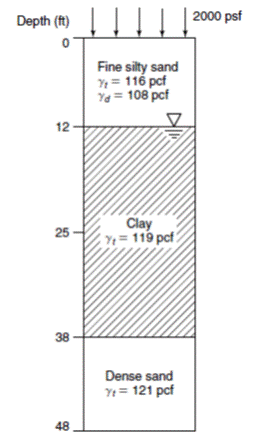
Figure P6.28 shows the soil profile at the site of an existing warehouse (i.e., covers a large area) that causes a surface loading of 2000 psf. Draw the ?v, ?v' and u profiles with depth. Show values at 0, 12, 25, 38 and 48 ft.?
Showing 21500 - 21600
of 21795
First
204
205
206
207
208
209
210
211
212
213
214
215
216
217
218
Step by Step Answers

 Get 50% OFF
Claim Now
Get 50% OFF
Claim Now


.png)
.png)
.png)
.png)
.png)
.png)
.png)