New Semester
Started
Get
50% OFF
Study Help!
--h --m --s
Claim Now
Question Answers
Textbooks
Find textbooks, questions and answers
Oops, something went wrong!
Change your search query and then try again
S
Books
FREE
Study Help
Expert Questions
Accounting
General Management
Mathematics
Finance
Organizational Behaviour
Law
Physics
Operating System
Management Leadership
Sociology
Programming
Marketing
Database
Computer Network
Economics
Textbooks Solutions
Accounting
Managerial Accounting
Management Leadership
Cost Accounting
Statistics
Business Law
Corporate Finance
Finance
Economics
Auditing
Tutors
Online Tutors
Find a Tutor
Hire a Tutor
Become a Tutor
AI Tutor
AI Study Planner
NEW
Sell Books
Search
Search
Sign In
Register
study help
business
cost accounting
Cost Accounting Foundations And Evolutions 6th Edition Michael R. Kinney, Jenice Prather-Kinsey, Cecily A. Raiborn - Solutions
HOW DO MANAGERS RANK INVESTMENT PROJECTS? LO.1
HOW IS RISK CONSIDERED IN CAPITAL BUDGETING ANALYSIS? LO.1
HOW AND WHY SHOULD MANAGEMENT CONDUCT A POSTINVESTMENT AUDIT OF A CAPITAL PROJECT? LO.1
(APPENDIX 1) HOW ARE PRESENT VALUES CALCULATED?Capital Budgeting LO.1
(APPENDIX 2) WHAT ARE THE ADVANTAGES AND DISADVANTAGES OF THE ACCOUNTING RATE OF RETURN METHOD? LO.1
Most capital budgeting techniques focus on cash flows because• evaluation of capital projects requires comparing the return on such projects with the cost of cap¬ ital, which is calculated using actual net cash flows rather than accounting accruals.• cash flows from a capital project can be
The payback period is computed by summing the annual net cash flows until they total the original investment. is the length of time required for cash inflows to recoup the initial cost of a capital project. LO.1
Net present value and profitability index use dis- counted cash flows to measure the expected returns on potential capital projects. Net present value (NPV) is the present value of cash inflows minus the present value of cash out- flows. To be acceptable, a project must generate an NPV of $0 or
The internal rate of return (IRR) of a project is the discount rate that causes the NPV to equal zero. IRR can be calculated by trial and error. Using the NPV framework, a discount rate can be ar- bitrarily selected and an NPV calculated. If the resulting NPV is positive, select a higher discount
Taxation and depreciation impact a project’s cash flows because• operating income is subject to income tax, which reduces the cash inflows from the capital project.• depreciation reduces the amount of taxes paid since depreciation is deducted in determining the taxable income from a project.
Each capital project evaluation method has certain underlying assumptions and limitations.• Payback method >- Assumptions❖ The speed of investment recovery is the most important investment criterion,❖ The timing and amounts of cash flows can be accurately predicted.❖ The risk is lower for
Managers can rank capital projects using the follow¬ ing guidelines:• Shorter payback period is preferred to longer payback period.• Higher net present value is preferred to lower net present value.• Higher profitability index is preferred to lower profitability index.• Higher internal
Capital budgeting analysis considers risk by• requiring a shorter payback period for riskier projects.• applying a higher discount rate for riskier proj¬ ects when the NPV or PI method is used.• applying a higher discount rate for riskier cash flows when the NPV or PI method is used.•
Postinvestment audits of projects should be conducted• after the project has stabilized rather than shortly after start-up.to compare actual project performance against expected performance to ❖ evaluate the accuracy of original projec¬ tions.❖ diagnose problems with implementation.❖
What is a capital asset? How is it distinguished from other assets? LO.1
Why do capital budgeting evaluation methods use cash flows rather than ac¬ counting income? LO.1
How are time lines helpful in evaluating capital projects? LO.1
What does the payback method measure? What are its major weaknesses? LO.1
What is the distinction between a return of capital and a return on capital? LO.1
What is measured by the net present value of a potential project? If the net present value of a project equals zero, is it an acceptable project? Explain. LO.1
Will the NPV amount determined in the capital budgeting process be the same amount as that which actually occurs after a project is undertaken?Why or why not? LO.1
How is the profitability index (PI) related to the NPV method? What does the PI measure? LO.1
What is measured by the internal rate of return? When is a project consid¬ ered acceptable using this method? LO.1
Because depreciation is not a cash flow, why is it important in capital bud¬ geting evaluation techniques that use discounted cash flows? LO.1
What four questions should managers ask when choosing the investment proposals to fund? LO.1
How is risk defined in capital budgeting analysis? List several aspects of a project in which risk is involved and how risk can affect a project’s net present value. LO.1
How is sensitivity analysis used in capital budgeting? LO.1
Why are postinvestment audits performed? When should they be performed? LO.1
(Appendix 1) What is meant by the term time value of money? Why is a present value always less than the future value to which it relates? LO.1
(Appendix 2) How is the accounting rate of return computed? How does this rate differ from the discount rate and the internal rate of return? LO.1
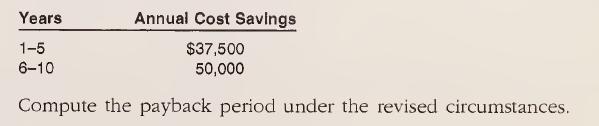
(Payback period) Apex Industries is considering the purchase of new pro¬ duction technology that would require an initial investment of $375,000 and have an expected life of 10 years. At the end of its life, the equipment would have no salvage value. By installing the new equipment, the firm’s
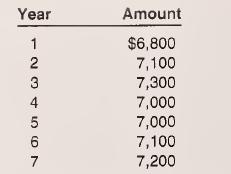
-(Payback; Cottonwood Department Store is considering a new product line that would require an investment of $80,000 in equipment and $90,000 in working capital. Store managers expect the following pattern of net cash in¬ flows from the new product line over the life of the investment.a. Compute
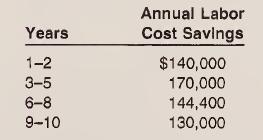
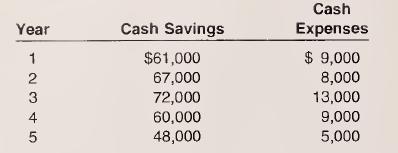
(NPV) Fullerton Iron Works is considering the installation of an $800,000 au¬ tomated product handling system that would generate the following labor cost savings over its 10-year life:The system will have no salvage at the end of its 10-year life, and the com¬ pany uses a discount rate of 12
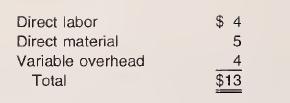
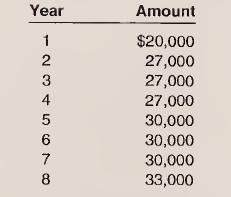
(NPV) Jason’s Designs has been approached by one of its customers about producing 200,000 special-purpose parts for a new home product. The parts would be produced at a rate of 25,000 per year for eight years. To provide these parts, Jason’s would need to acquire new production machines costing
(PI) Callie’s Carpet is interested in purchasing a computer and software that would allow its salespeople to demonstrate to customers how a finished car¬ pet installation would appear. Managers have estimated the cost of the com¬ puter, software, and peripheral equipment to be $60,000. Based on
(PI) Bellingham Bus Company (BBC) is considering adding a new bus route. To do so, BBC would be required to purchase a new bus, which would cost $500,000, have a 10-year life, and have no salvage value. If it purchases the new bus, BBC managers expect that net cash inflows from bus ridership would
(IRR; sensitivity analvsis) Padre Yacht Club is considering adding a new dock to its marina facilities to accommodate larger yachts. The dock would cost $340,000 and would generate $72,000 annually in new cash inflows. Its ex¬ pected life would be eight years, and it would have no salvage value.
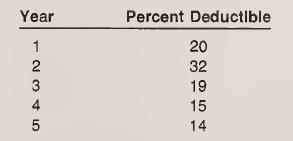
(Depreciation; FV) Caldwell Consulting operates three offices in the Midwest. The firm is considering an investment in a new mainframe computer and communications software. The computer and software would cost $2,000,000 and have an expected life of eight years. For tax purposes, the investment
(Alternative depreciation methods; NPV; sensitivity analysis) Allison West Coast Design Co. is considering an investment in computer-based production technology as part of a business reengineering process. The necessary equipment, installation, and training will cost $30,000,000, have a life of
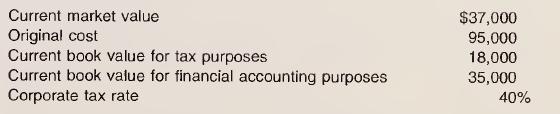
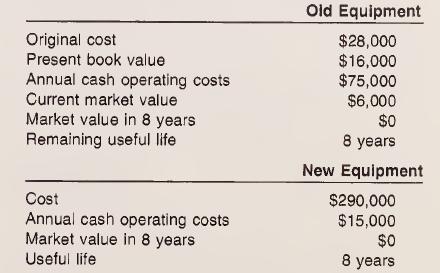
Fax effects of asset sale) Three years ago, Joe Dirt Co. purchased a material conveyor system. The company has decided to sell the system and acquire more advanced technology. Data relating to this system follow:a. How much depreciation has been taken on the conveyor system for (1) tax and (2)
ncertain annual cash flow) Central City Consulting is considering the instal¬ lation of a new system for electronically filing tax returns. The system has an initial cost of $60,000 and an expected life of five years.a. If the company’s cost of capital is 10 percent, how much annual in¬ crease
( Application of discounting methods) Several capital budgeting techniques depend on discounted cash flow concepts, which are applied in business in a variety of settings. Select a business that relies on discounted cash flow analysis, such as a bond investor, and prepare a brief report on how the
(Application of discounting methods) In recent years, stock price averages (e.g., the Dow Jones Industrial Average) have shown sensitivity to changes in interest rates. Based on your understanding of the factors that detennine stock prices and of how future cash flows are discounted, prepare a
(Financing decision Although they should be considered independently, of¬ ten the investing and financing decisions are considered together.It’s easy to understand the allure of auto leasing: Consumers make lower monthly payments; dealers gain volume, move expensive inventory—and keep
(Appendix 1) You have just invested $7,000 in a bank account that guaran¬ tees to pay you 10 percent interest, compounded annually. At the end of five years, how much money will have accumulated in your investment ac¬ count? (Ignore taxes.) LO.1
(Appendix 1) You have just purchased a new car, making a down payment of $6,000 and financing the balance of the purchase cost on an installment credit plan. According to the credit agreement, you will pay $900 per month for a period of 60 months. If the credit agreement is based on a monthly in¬
(Appendix 1) Use the tables in Appendix A to determine the answers to the following questions. Ignore taxes in all circumstances.a. Jim wishes to have $40,000 in six years. He can make an investment to¬ day that will earn 6 percent each year, compounded annually. What amount of investment should
Appendix 2) Ellis & Associates operates a rehabilitation center for individu¬ als with physical disabilities. The company is considering the purchase of a $1,200,000 piece of equipment that has a five-year life and no salvage value. The company depreciates assets on a straight-line basis. The
Appendix 2; comprehensive) Fashion Foto is evaluating the purchase of a state-of-the-art desktop publishing system that costs $40,000, has a six-year life, and has no salvage value at the end of its life. The company’s con¬ troller estimates that the system will annually generate $14,000 of cash
Time line; payback; NP\) Raleigh Retail is considering expanding its build¬ ing so it can stock additional merchandise for travelers and tourists. Store manager Ralph Lauren anticipates that building expansion costs would be $190,000. Lauren’s suppliers are willing to provide inventory on a
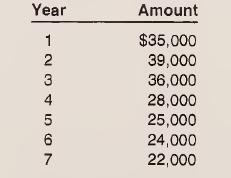
Time line; payback; NPV) East Side Delivery is considering the purchase of a new van to replace an existing truck. The van would cost $35,000 and would have a life of seven years with no salvage value. The truck could be sold currently for $4,000, but if it is kept, it will have a remaining life of
(NPV; PI; sensitivity analysis) Norton Industries is considering reengineering its manufacturing operations to replace certain manual operations with auto¬ mated equipment. The new equipment would have an initial cost of $5,000,000 including installation. The vendor has indicated that the equip¬
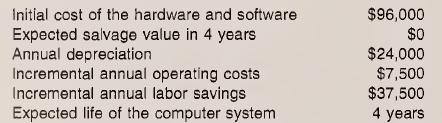
(Payback; IRR) Alley’s Accounting Service prepares tax returns for individuals and small businesses. The firm employs four tax professionals. Currently, all tax returns are prepared on a manual basis. The firm’s owner, Anne Alley, is considering purchasing a computer system that would allow the
NPV: PI; payback: IRR) Paul’s Paving provides custom paving of sidewalks and driveways. One of the most labor-intensive aspects of the paving opera¬ tion is preparing and mixing materials. Learned Hand, corporate engineer, has found new computerized equipment to mix (and monitor the mixing of)
(NPV; taxes; sensitivity analysis) The owner of Frank’s Fridge is considering a $390,000 installation of a new refrigerated storage room. The storage room has an expected life of 20 years with no salvage value. The storage room is expected to generate net annual cash revenues (before tax, labor,
(After-tax cash flows; payback; NPV; PI; IRR) Forrester Fashions is considering the purchase of computerized clothes-designing software. The software is expected to cost $160,000, have a useful life of five years, and have no sal¬ vage value at the end of its useful life. Assume that tax
(NPV; project ranking: risk) Ellsworth Engineering is expanding operations, and the firm’s president, Jimmy James, is trying to make a decision about new office space. The following are James’ options:If the company purchases Maple Commercial Plaza, it will occupy all of the space. If it
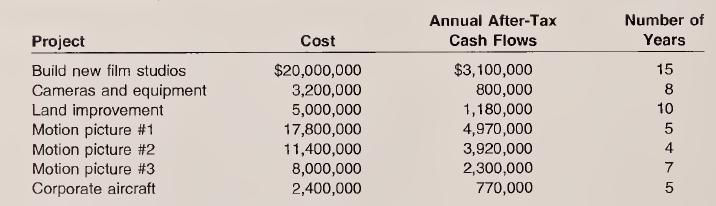
Capital rationing) Management of Wilson Studios is considering the follow¬ ing capital projects:Assume that all projects have no salvage value and that the firm uses a dis¬ count rate of 10 percent. Management has decided that only $25,000,000 can be spent in the current year for capital
(Sensitivity analysis) Baldwin Property Management is considering a 50-room motel for sale in Valdosta as an investment. The current owners state that the motel’s occupancy rate averages 80 percent each of the 300 days per year the motel is open. Each room rents for $60 per day, and variable cash
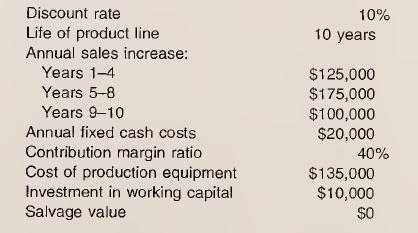
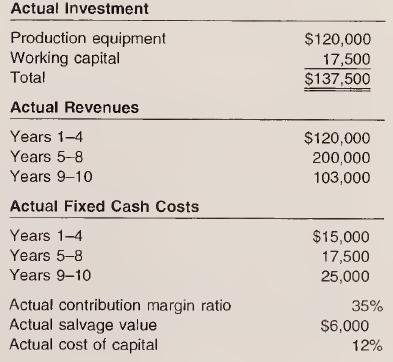
(Postinvestment audit) Ten years ago, based on a before-tax NPV analysis, Carson Leisure Ware decided to add a new product line. The data used in the analysis were as follows:Because the product line was discontinued this year, corporate managers de¬ cided to conduct a postinvestment audit to
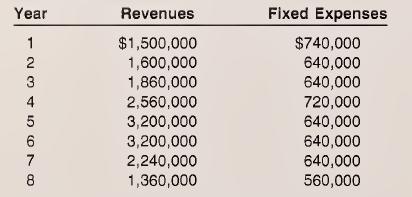
(Pavback; NPV; Appendix 2) Indiana Industrial Tools is considering adding a new product line that has an expected life of eight years. The product man¬ ufacturer would require the firm to incur setup costs of $3,200,000 to handle the new product line. All product line revenues will be collected as
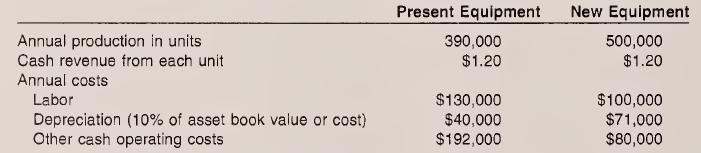
(Comprehensive; Appendix 2) The management of Syracuse Steel is evaluat¬ ing a proposal to buy a new turning lathe as a replacement for a less effi¬ cient piece of similar equipment that would then be sold. The new lathe’s cost, including delivery and installation, is $710,000. If the lathe is
(NPV) Minneapolis Machinery is considering the acquisition of new manufac¬ turing equipment that has the same capacity as the current equipment. The new equipment will provide $150,000 of annual operating efficiencies in di¬ rect and indirect labor, direct material usage, indirect supplies, and
(Postinvestment audit) Karnes Group has formal policies and procedures to screen and approve capital projects. Proposed capital projects are classified as one of the following types:1. expansion requiring new plant and equipment 2. expansion by replacement of present equipment with more productive
WHAT ARE THE FUNCTIONS OF AN EFFECTIVE COST CONTROL SYSTEM? LO.1
WHAT ARE THE GENERIC APPROACHES TO COST CONTROL? LO.1
WHAT FACTORS CAUSE COSTS TO CHANGE FROM PERIOD TO PERIOD OR TO DEVIATE FROM EXPECTATIONS? LO.1
WHAT ARE THE TWO PRIMARY TYPES OF FIXED COSTS, AND WHAT ARE THE CHARACTERISTICS OF EACH? LO.1
WHAT ARE THE TYPICAL APPROACHES TO CONTROLLING DISCRETIONARY FIXED COSTS? LO.1
WHAT ARE THE OBJECTIVES MANAGERS STRIVE TO ACHIEVE IN MANAGING CASH? LO.1
HOW IS TECHNOLOGY REDUCING COSTS OF SUPPLY CHAIN TRANSACTIONS? LO.1
WHY IS UNCERTAINTY GREATER IN DEALING WITH FUTURE EVENTS THAN PAST EVENTS? LO.1
WHAT ARE THE FOUR GENERIC APPROACHES TO MANAGING UNCERTAINTY? LO.1
An effective cost control system controls costs• prior to an event through>- establishment of budgets and standards.other stated expectations of performance out¬ comes.• during an event by>■ correcting deviations from plans or budgets.>■ monitoring other aspects of operations rela¬ tive
Three generic approaches to cost control include• cost containment, which is an approach to min¬ imize cost increases.• cost avoidance, which means finding ways to avoid high cost inputs by substituting lower cost inputs.• cost reduction, which involves finding alternative ways to execute
Costs can change from one period to the next, or de¬ viate from expectations, as a result of• variable costs moving with changes in volume.• inflation or deflation of prices.• supplier-changed prices>- in response to changes in demand, due to changes in cost of production.• purchase volume
Two primary types of fixed cost are• committed fixed costs, which are associated with an organization’s basic infrastructure and are de¬ termined by long-run strategy'; examples include depreciation, lease payments, and property taxes.• discretionary fixed costs, which are incurred for
Control of discretionary costs can be effected• before an event by the use of budgets or by treat¬ ing them as engineered costs if they are associ¬ ated with repetitive activities.• during an event by comparing budgets to actual expenditures.• after an event by calculating variances for
The objectives in managing cash are to• maintain an organization’s liquidity by making ceitain there is enough cash to cover cash ex¬ pense and to retire debt.• invest any idle cash so that a return is generated on cash balances exceeding liquidity needs. LO.1
Technology is reducing costs within supply chains by• reducing the need to generate paper documents for purchasing transactions.• automating payment transactions.• enhancing the exchange of information within the value chain.• enhancing competition among alternative suppliers. LO.1
Uncertainty is greater for future events than for past events because• cause and effect relationships are incompletely understood.• events that are unforeseen can alter outcomes. LO.1
Four generic strategies for dealing with uncertainty are to• explicitly consider uncertainty when estimates are generated by>- using best predictor variables in generating estimates.>- analyzing effects of estimation errors on es¬ timates using sensitivity analysis.structure costs to adjust to
How does the cost control system interact with the overall cost management system? LO.1
Why does the general control model begin with planning activities? LO.1
At what points in time is cost control for any specific organizational activity exercised? Why are these points of cost control important? LO.1
What factors can cause costs to change? Which of these factors are subject to cost containment and which are not? What creates the difference in con¬ trollability? LO.1
Why is it often difficult to measure the output of activities funded by discre¬ tionary costs? LO.1
Define efficiency and effectiveness and distinguish one from the other. Why is measuring the efficiency of discretionary costs often difficult? Explain how the effectiveness of discretionary cost activities can be measured. LO.1
What types of discretionary costs are subject to control as engineered costs? Provide several examples. LO.1
Why do firms hold cash balances? Why do some firms require larger cash balances than other firms? LO.1
How is technology affecting supply chain purchasing practices and transac¬ tion costs? LO.1
What are the four generic approaches to reducing uncertainty? LO.1
What factors create uncertainty when estimating future costs and revenues? LO.1
(Cost control activities) The firm of Xtreme Accountants hires full- and part- time professional employees. Full-time experienced staff can be hired for $57,000 per year; fringe benefit costs for each full-time employee amount to 20 percent of base salary. Xtreme Accountants pays part-time
(Cost control activities) Callie Swoosh has just been appointed the new di¬ rector of Youth Hot-Line, a not-for-profit organization that operates a phone bank for individuals experiencing emotional difficulties. The phones are staffed by qualified social workers and psychologists who are paid on
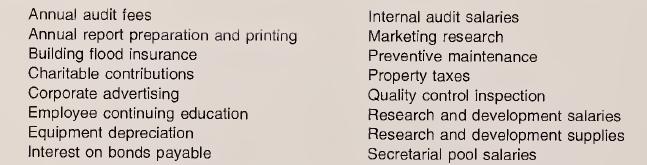
(Committed versus discretionary costs) A list of committed and discretionary costs follows:a. Classify each of the above costs as normally being either committed (C) or discretionary (D).b. Which of these costs can be either committed or discretionary based on management philosophy?C. For the
(Committed versus discretionary costs) Choose letter C (for committed cost) or D (for discretionary cost) to indicate to which type of cost each of the sentences below best relates. Explain the rationale for your choice.a. Control is first provided during the capital budgeting process.b. Typical
(Effectiveness measures) Williams Wellness Clinic has used funds during 2006 for the following purposes. Provide nonmonetary, surrogate measures that would help evaluate the effectiveness of the monies spent.a. Sent two cost accounting staff members to seminars on activity-based costing.b.
(Effectiveness and efficiency measures) The president at Northern State Uni¬ versity has formed a new department to recruit top out-of-state students. The department’s funding for 2006 is $400,000, and the department was given the goal of recruiting 300 new nonresident students. By year-end
Engineered cost variances) Fast Freight employs three drivers who are paid an average of $16 per hour for regular time and $24 for overtime. A pickup and delivery requires, on average, one hour of driver time. Drivers are paid for a 40-hour week because they must be on call all day. One driver
Showing 3500 - 3600
of 6579
First
29
30
31
32
33
34
35
36
37
38
39
40
41
42
43
Last
Step by Step Answers

 Get 50% OFF
Claim Now
Get 50% OFF
Claim Now