New Semester
Started
Get
50% OFF
Study Help!
--h --m --s
Claim Now
Question Answers
Textbooks
Find textbooks, questions and answers
Oops, something went wrong!
Change your search query and then try again
S
Books
FREE
Study Help
Expert Questions
Accounting
General Management
Mathematics
Finance
Organizational Behaviour
Law
Physics
Operating System
Management Leadership
Sociology
Programming
Marketing
Database
Computer Network
Economics
Textbooks Solutions
Accounting
Managerial Accounting
Management Leadership
Cost Accounting
Statistics
Business Law
Corporate Finance
Finance
Economics
Auditing
Tutors
Online Tutors
Find a Tutor
Hire a Tutor
Become a Tutor
AI Tutor
AI Study Planner
NEW
Sell Books
Search
Search
Sign In
Register
study help
business
fixed income analysis
Fixed Income Analysis 5th Edition Barbara S. Petitt - Solutions
Compare the segmented market and the preferred habitat term structure theories.
A. List the three factors that have empirically been observed to affect Treasury security returns and explain how each of these factors affects returns on Treasury securities.B. What has been observed to be the most important factor in affecting Treasury returns?C. Which measures of yield curve
Which forward rate cannot be computed from the one-, two-, three-, and four-year spot rates? The rate for a:A. one-year loan beginning in two yearsB. two-year loan beginning in two yearsC. three-year loan beginning in two years
Consider spot rates for three zero-coupon bonds: z(1) = 3%, z(2) = 4%, and z(3) = 5%. Which statement is correct? The forward rate for a one-year loan beginning in one year will be:A. Less than the forward rate for a one-year loan beginning in two years.B. Greater than the forward rate for a
If one-period forward rates are decreasing with maturity, the yield curve is most likely:A. Flat.B. Upward sloping.C. Downward sloping.
A one-year zero-coupon bond yields 4.0%. The two- and three-year zero-coupon bonds yield 5.0% and 6.0%, respectively.The rate for a one-year loan beginning in one year is closest to:A. 4.5%.B. 5.0%.C. 6.0%.
A one-year zero-coupon bond yields 4.0%. The two- and three-year zero-coupon bonds yield 5.0% and 6.0%, respectively.The forward rate for a two-year loan beginning in one year is closest to:A. 5.0%.B. 6.0%.C. 7.0%.
The forward rate for a one-year loan beginning in two years is closest to:A. 6.0%.B. 7.0%.C. 8.0%.
The five-year spot rate is not provided here; however, the forward price for a two-year zero-coupon bond beginning in three years is known to be 0.8479. The price today of a five-year zero-coupon bond is closest to:A. 0.7119.B. 0.7835.C. 0.9524.
The one-year spot rate z1 is 4%, the forward rate for a one-year loan beginning in one year is 6%, and the forward rate for a one-year loan beginning in two years is 8%. Which of the following rates is closest to the three-year spot rate?A. 4.0%B. 6.0%C. 8.0%
The one-year spot rate z1 is 5%, and the forward price for a one-year zero-coupon bond beginning in one year is 0.9346. The spot price of a two-year zero-coupon bond is closest to:A. 0.87.B. 0.89.C. 0.93.
In a typical interest rate swap contract, the swap rate is best described as the interest rate for the:A. Fixed-rate leg of the swap.B. Floating-rate leg of the swap.C. Difference between the fixed and floating legs of the swap.
A two-year fixed-for-floating MRR swap is 1.00%, and the two-year US Treasury bond is yielding 0.63%. The swap spread is closest to:A. 37 bps.B. 100 bps.C. 163 bps.
The swap spread is quoted as 50 bps. If the five-year US Treasury bond is yielding 2%, the rate paid by the fixed payer in a five-year interest rate swap is closest to:A. 0.50%.B. 1.50%.C. 2.50%.
If the three-month T-bill rate drops and Libor remains the same, the relevant TED spread:A. Increases.B. Decreases.C. Does not change.
Given the yield curve for US Treasury zero-coupon bonds, which spread is most helpful pricing a corporate bond? The:A. Z-spread.B. TED spread.C. Libor–OIS spread.
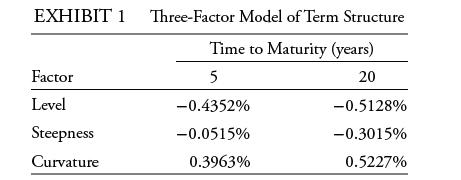
Based on Exhibit 1, the results of Analysis 2 should show the yield on the five-year bond:A. Decreasing by 0.8315%.B. Decreasing by 0.0389%.C. Increasing by 0.0389%.Rowan Madison is a junior analyst at Cardinal Capital. Sage Winter, a senior portfolio manager and Madison’s supervisor, meets with
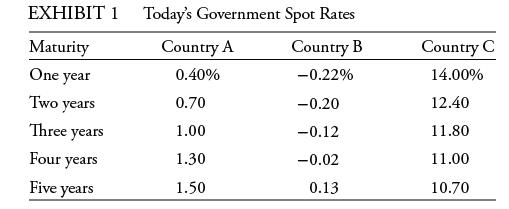
Did Tyo’s assistant accurately describe the process of bootstrapping?A. YesB. No, with respect to par yieldsC. No, with respect to backward substitutionLiz Tyo is a fund manager for an actively managed global fixed-income fund that buys bonds issued in Countries A, B, and C. She and her assistant
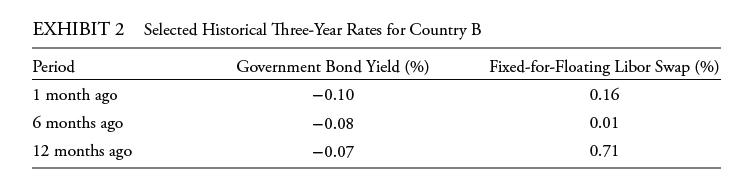
Based on Exhibit 2, the implied credit and liquidity risks as indicated by the historical three-year swap spreads for Country B were the lowest:A. 1 month ago.B. 6 months ago.C. 12 months ago.Liz Tyo is a fund manager for an actively managed global fixed-income fund that buys bonds issued in
The swap curve is a better benchmark than the government spot curve for:A. Country A.B. Country B.C. Country C.Liz Tyo is a fund manager for an actively managed global fixed-income fund that buys bonds issued in Countries A, B, and C. She and her assistant are preparing the quarterly markets
Based on Exhibit 1 and assuming Tyo’s market views on yield curve changes are realized, the forward curve of which country will lie below its spot curve?A. Country AB. Country BC. Country CLiz Tyo is a fund manager for an actively managed global fixed-income fund that buys bonds issued in
Based on Exhibit 1 and Tyo’s expectations, which country’s term structure is currently best for traders seeking to ride the yield curve?A. Country AB. Country BC. Country CLiz Tyo is a fund manager for an actively managed global fixed-income fund that buys bonds issued in Countries A, B, and C.
Liz Tyo is a fund manager for an actively managed global fixed-income fund that buys bonds issued in Countries A, B, and C. She and her assistant are preparing the quarterly markets update. Tyo begins the meeting by distributing the daily rates sheet, which includes the current government spot
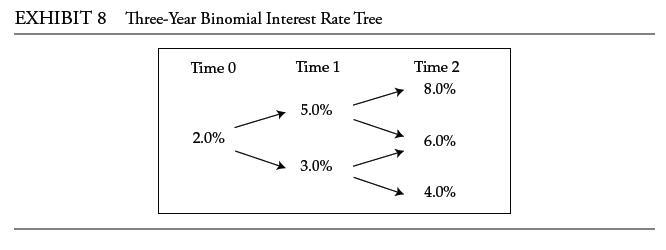
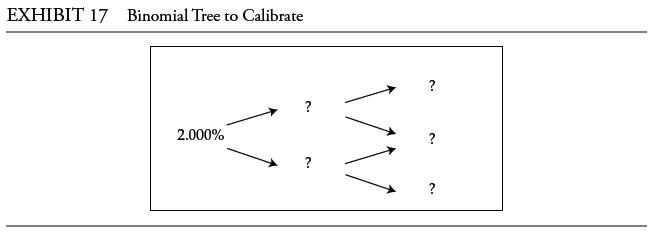
Using the interest rate tree in Exhibit 8, find the correct price for a three-year, annual pay bond with a coupon rate of 5%. EXHIBIT 8 Three-Year Binomial Interest Rate Tree Time 0 2.0% Time 1 5.0% 3.0% Time 2 8.0% 6.0% 4.0%
As in Example 2, the one-year par rate is 2.000%, the two-year par rate is 3.000%, and the three-year par rate is 4.000%. Consequently, the spot rates are S0 = 2.000%, S1 = 3.015%, and S2 = 4.055%. The forward rates are F0 = 2.000%, F1 = 4.040%, and F2 = 6.166%. Interest volatility is 15% for all
A flight to quality is most often associated with:A. A general rise in the level of interest rates.B. Bullish flattening.C. Bearish flattening.
When government budget deficits fall, fiscal supply-side effects are most likely to result in:A. Higher bond yields.B. A steeper yield curve.C. Lower bond yields.
During economic expansions, monetary authorities raise benchmark rates to help control inflation. This action is most often consistent with:A. Bearish flattening.B. Bullish steepening.C. Bearish steepening.
Based on Exhibit 1 and Tyo’s expectations for the yield curves, Tyo most likely perceives the bonds of which country to be fairly valued?A. Country AB. Country BC. Country CExhibit 1 Liz Tyo is a fund manager for an actively managed global fixed-income fund that buys bonds issued in Countries A,
Liz Tyo is a fund manager for an actively managed global fixed-income fund that buys bonds issued in Countries A, B, and C. She and her assistant are preparing the quarterly markets update. Tyo begins the meeting by distributing the daily rates sheet, which includes the current government spot
Which of the following is not an example of an embedded option?A. WarrantB. Call provisionC. Conversion provision
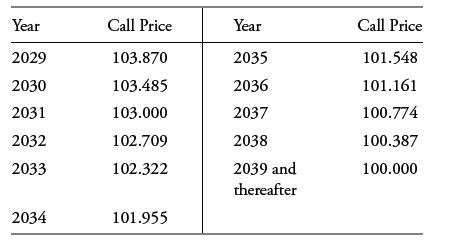
Assume a hypothetical 30-year bond is issued on 15 August 2019 at a price of 98.195 (as a percentage of par). Each bond has a par value of $1,000. The bond is callable in whole or in part every 15 August from 2029 at the option of the issuer. The call prices are shown below.The call protection
Floating-rate notes most likely pay:A. Annual coupons.B. Quarterly coupons.C. Semi-annual coupons.
Clauses that specify the rights of the bondholders and any actions that the issuer is obligated to perform or is prohibited from performing are:A. Covenants.B. Collaterals.C. Credit enhancements.
Which of the following type of debt obligation most likely protects bondholders when the assets serving as collateral are non-performing?A. Covered bondsB. Collateral trust bondsC. Mortgage-backed securities
Which of the following best describes a negative bond covenant? The requirement to:A. Insure and maintain assets.B. Comply with all laws and regulations.C. Maintain a minimum interest coverage ratio.
A bond issued by Sony in Japan, denominated in US dollars but not registered with the SEC, and sold to an institutional investor in the Middle East, is most likely an example of a:A. Eurobond.B. Global bond.C. Foreign bond.
Assume that a company issues bonds in the hypothetical country of Zinland, where the local currency is the zini (Z). There is an original issue discount tax provision in Zinland’s tax code. The company issues a 10-year zero-coupon bond with a par value of Z1,000 and sells it for Z800. An investor
A plain vanilla bond has a maturity of 10 years, a par value of £100, and a coupon rate of 9%. Interest payments are made annually. The market interest rate is assumed to be constant at 9%. The bond is issued and redeemed at par. The principal repayment the first year is closest to:A. £0.00.B.
Assume a hypothetical 30-year bond is issued on 15 August 2019 at a price of 98.195 (as a percentage of par). Each bond has a par value of $1,000. The bond is callable in whole or in part every 15 August from 2029 at the option of the issuer. The call prices are shown below.The call premium (per
A zero-coupon bond can best be considered a:A. Step-up bond.B. Credit-linked bond.C. Deferred coupon bond.
The type of bond with an embedded option that would most likely sell at a lower price than an otherwise similar bond without the embedded option is a:A. Putable bond.B. Callable bond.C. Convertible bond.
A sovereign bond has a maturity of 15 years. The bond is best described as a:A. Perpetual bond.B. Pure discount bond.C. Capital market security.
A money market security most likely matures in:A. One year or less.B. Between 1 and 10 years.C. Over 10 years.
The individual or entity most likely responsible for the timely payment of interest and repayment of principal to bondholders is the:A. Trustee.B. Primary or lead bank of the issuer.C. Treasurer or chief financial officer of the issuer.
Relative to a fully amortized bond, the coupon payments of an otherwise similar partially amortized bond are:A. Lower or equal.B. Equal.C. Higher or equal.
Assume a hypothetical 30-year bond is issued on 15 August 2019 at a price of 98.195 (as a percentage of par). Each bond has a par value of $1,000. The bond is callable in whole or in part every 15 August from 2029 at the option of the issuer. The call prices are shown below.The call provision is
The bonds that do not offer protection to the investor against increases in market interest rates are:A. Step-up bonds.B. Floating-rate notes.C. Inverse floating-rate notes.
The additional risk inherent to a callable bond is best described as:A. Credit risk.B. Interest rate risk.C. Reinvestment risk.
A company has issued a floating-rate note with a coupon rate equal to the three-month MRR + 65 bps. Interest payments are made quarterly on 31 March, 30 June, 30 September, and 31 December. On 31 March and 30 June, the three-month MRR is 1.55% and 1.35%, respectively. The coupon rate for the
If the bond’s price is higher than its par value, the bond is trading at:A. Par.B. A discount.C. A premium.
The major advantage of issuing bonds through a special legal entity is:A. Bankruptcy remoteness.B. Beneficial tax treatments.C. Greater liquidity and lower issuing costs.
The US Treasury offers Treasury Inflation-Protected Securities (TIPS). The principal of TIPS increases with inflation and decreases with deflation based on changes in the US Consumer Price Index. When TIPS mature, an investor is paid the original principal or inflation-adjusted principal, whichever
The put provision of a putable bond:A. Limits the risk to the issuer.B. Limits the risk to the bondholder.C. Does not materially affect the risk of either the issuer or the bondholder.
The legal contract that describes the form of the bond, the obligations of the issuer, and the rights of the bondholders can be best described as a bond’s:A. Covenant.B. Indenture.C. Debenture.
A bond has a par value of £100 and a coupon rate of 5%. Coupon payments are made semi-annually. The periodic interest payment is:A. £2.50, paid twice a year.B. £5.00, paid once a year.C. £5.00, paid twice a year.
The category of bond most likely repaid from the repayment of previous loans made by the issuer is:A. Sovereign bonds.B. Supranational bonds.C. Non-sovereign bonds.
Assume a hypothetical country, Lemuria, where the national government has issued 20-year capital-indexed bonds linked to the domestic Consumer Price Index (CPI). Lemuria’s economy has been free of inflation until the most recent six months, when the CPI increased. Following the increase in
Assume that a convertible bond issued in South Korea has a par value of 1,000,000 and is currently priced at 1,100,000. The underlying share price is 40,000, and the conversion ratio is 25:1. The conversion condition for this bond is:A. Parity.B. Above parity.C. Below parity.
Which of the following is a type of external credit enhancement?A. CovenantsB. A surety bondC. Overcollateralization
The coupon rate of a floating-rate note that makes payments in June and December is expressed as six-month MRR + 25 bps. Assuming that the six-month MRR is 3.00% at the end of June 20XX and 3.50% at the end of December 20XX, the interest rate that applies to the payment due in December 20XX is:A.
The type of collateral used to secure collateral trust bonds is most likely:A. Securities.B. Mortgages.C. Physical assets.
An affirmative covenant is most likely to stipulate:A. Limits on the issuer’s leverage ratio.B. How the proceeds of the bond issue will be used.C. The maximum percentage of the issuer’s gross assets that can be sold.
The type of bond that allows bondholders to choose the currency in which they receive each interest payment and principal repayment is a:A. Pure discount bond.B. Dual-currency bond.C. Currency option bond.
The external credit enhancement that has the least amount of third-party risk is a:A. Surety bond.B. Letter of credit.C. Cash collateral account.
Which of the following best describes a negative bond covenant? The issuer is:A. Required to pay taxes as they come due.B. Prohibited from investing in risky projects.C. Required to maintain its current lines of business.
An example of an affirmative covenant is the requirement:A. That dividends will not exceed 60% of earnings.B. To insure and perform periodic maintenance on financed assets.C. That the debt-to-equity ratio will not exceed 0.4 and times interest earned will not fall below 8.0.
A South African company issues bonds denominated in pound sterling that are sold to investors in the United Kingdom. These bonds can be best described as:A. Eurobonds.B. global bonds.C. foreign bonds.
An example of a covenant that protects bondholders against the dilution of their claims is a restriction on:A. Debt.B. Investments.C. Mergers and acquisitions.
Relative to domestic and foreign bonds, Eurobonds are most likely to be:A. Bearer bonds.B. Registered bonds.C. Subject to greater regulation.
An investor in a country with an original issue discount tax provision purchases a 20 year zero-coupon bond at a deep discount to par value. The investor plans to hold the bond until the maturity date. The investor will most likely report:A. A capital gain at maturity.B. A tax deduction in the year
A bond that is characterized by a fixed periodic payment schedule that reduces the bond’s outstanding principal amount to zero by the maturity date is best described as a:A. Bullet bond.B. Plain vanilla bond.C. Fully amortized bond.
If interest rates are expected to increase, the coupon payment structure most likely to benefit the issuer is a:A. Step-up coupon.B. Inflation-linked coupon.C. Cap in a floating-rate note.
Investors who believe that interest rates will rise most likely prefer to invest in:A. Inverse floaters.B. Fixed-rate bonds.C. Floating-rate notes.
A 10-year, capital-indexed bond linked to the Consumer Price Index (CPI) is issued with a coupon rate of 6% and a par value of 1,000. The bond pays interest semi annually. During the first six months after the bond’s issuance, the CPI increases by 2%. On the first coupon payment date, the
The provision that provides bondholders the right to sell the bond back to the issuer at a predetermined price prior to the bond’s maturity date is referred to as:A. A put provision.B. A make-whole call provision.C. An original issue discount provision.
Which of the following provisions is a benefit to the issuer?A. Put provisionB. Call provisionC. Conversion provision
Relative to an otherwise similar option-free bond, a:A. Putable bond will trade at a higher price.B. Callable bond will trade at a higher price.C. Convertible bond will trade at a lower price.
Which type of bond most likely earns interest on an implied basis?A. FloaterB. Conventional bondC. Pure discount bond
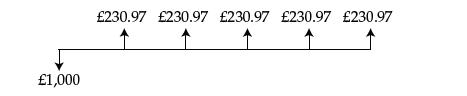
A five-year bond has the following cash flows:The bond can best be described as a:A. Bullet bond.B. Fully amortized bond.C. Partially amortized bond. £1,000 £230.97 £230.97 £230.97 £230.97 £230.97 个
Contrary to positive bond covenants, negative covenants are most likely:A. Costlier.B. Legally enforceable.C. Enacted at time of issue.
Investors seeking some general protection against a poor economy are most likely to select a:A. Deferred coupon bond.B. Credit-linked coupon bond.C. Payment-in-kind coupon bond.
The benefit to the issuer of a deferred coupon bond is most likely related to:A. Tax management.B. Cash flow management.C. Original issue discount price.
Which of the following bond types provides the most benefit to a bondholder when bond prices are declining?A. CallableB. Plain vanillaC. Multiple put
Which type of call bond option offers the greatest flexibility as to when the issuer can exercise the option?A. Bermuda callB. European callC. American call
Which of the following best describes a convertible bond’s conversion premium?A. Bond price minus conversion valueB. Par value divided by conversion priceC. Current share price multiplied by conversion ratio
Which of the following is most likely an issuer of bonds?A. Hedge fundB. Pension fundC. Local government
Open market operations describe the process used by central banks to buy and sell bonds to:A. Implement fiscal policy.B. Control the monetary base.C. Issue and repay government debt.
Which of the following best describes a primary market for bonds? A market:A. In which bonds are issued for the first time to raise capital.B. That has a specific location where the trading of bonds takes place.C. In which existing bonds are traded among individuals and institutions.
Sovereign debt with a maturity at issuance shorter than one year most likely consists of:A. Floating-rate instruments.B. Zero-coupon instruments.C. Coupon-bearing instruments.
Relative to sovereign bonds, non-sovereign bonds with similar characteristics most likely trade at a yield that is:A. Lower.B. The same.C. Higher.
A loan made by a group of banks to a private company is most likely:A. A bilateral loan.B. A syndicated loan.C. A securitized loan.
If an investor holds a credit-linked note and the credit event does not occur, the investor receives:A. All promised cash flows as scheduled.B. All coupon payments as scheduled but not the par value at maturity.C. All coupon payments as scheduled and the par value minus the nominal value of the
Which of the following are not considered wholesale funds?A. Interbank fundsB. Central bank fundsC. Repurchase agreements
The distinction between investment-grade debt and non-investment-grade debt is best described by differences in:A. Tax status.B. Credit quality.C. Maturity dates.
A bond issued by a city would most likely be classified as a:A. Supranational bond.B. Quasi-government bond.C. Non-sovereign government bond.
Retail investors most often:A. Do not invest in fixed-income securities.B. Invest directly in fixed-income securities.C. Invest indirectly in fixed-income securities through mutual funds or exchange-traded funds.
US Treasury bonds are typically sold to the public via a(n):A. Auction.B. Primary dealer.C. Secondary bond market.
Floating-rate bonds are issued by national governments as the best way to reduce:A. Credit risk.B. Inflation risk.C. Interest rate risk.
Bonds issued by a governmental agency are most likely:A. Repaid from the cash flows generated by the agency.B. Guaranteed by the national government that sponsored the agency.C. Backed by the taxing power of the national government that sponsored the agency.
Showing 1800 - 1900
of 2084
First
7
8
9
10
11
12
13
14
15
16
17
18
19
20
21
Step by Step Answers

 Get 50% OFF
Claim Now
Get 50% OFF
Claim Now